I was encouraged by a museum to visit this nearby archaeological site, so there will inevitably be a few posts about it. This is what happens when museums make helpful suggestions. They create content for me, and I become powerless to resist.
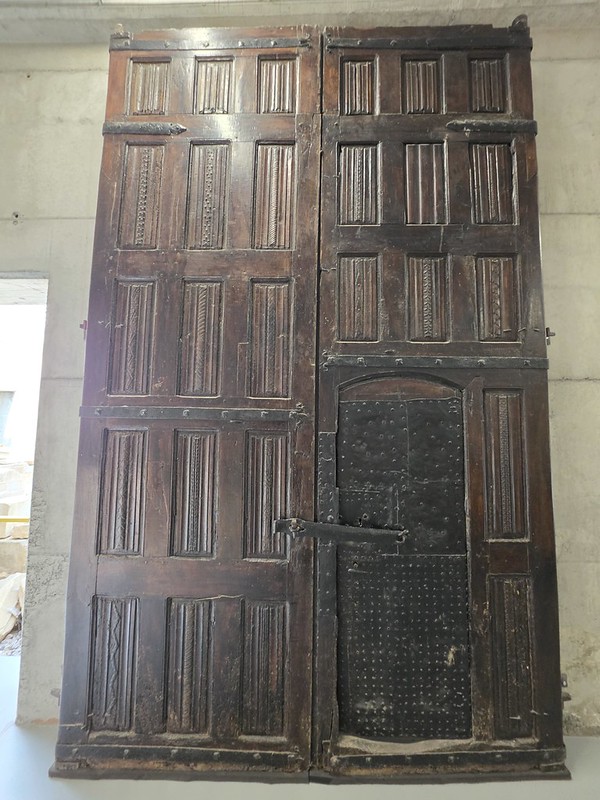
One of the items on display was this door, which was once the entrance to the parish church of Saint John the Baptist of Sondika. The building was demolished in 1939 when they decided they’d construct Bilbao Airport and the church was one of the casualties of that which is I suppose sub-optimal from a heritage perspective.
One of the architects of the new airport was Manuel Ignacio Galíndez Zabala (1892-1980) who was a local man who had an interest in history. He was the man who rescued the door and he donated it to the Euskal Museum and in recent years it has been moved to the Heart of Mary Square site. The entire church might have been lost, but at least someone had the foresight to save the front door and I think it looks like it was well worth saving.
I did try and find which bit of the airport the church would have been under, but I can’t find any old Spanish maps with enough detail to achieve that.
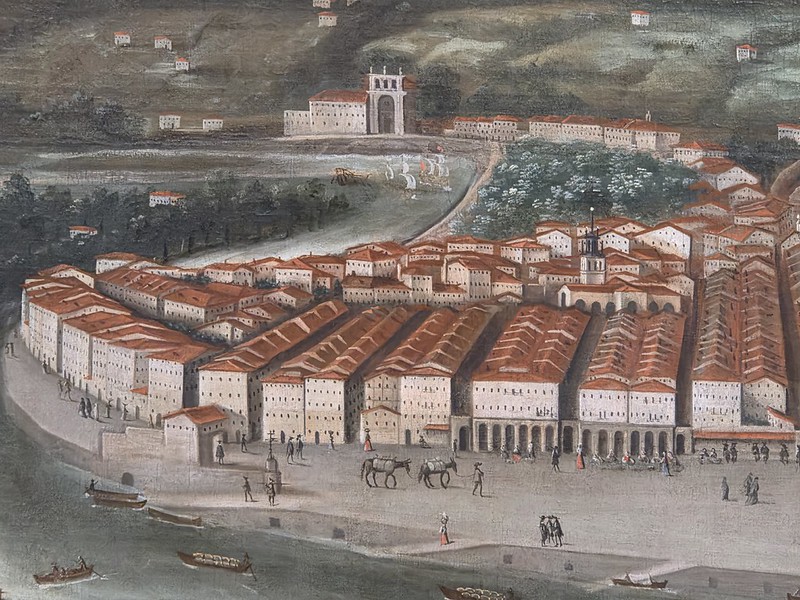
This is a ‘View of Bilbao’ by an anonymous 17th-century artist, and I do rather like old city views. They are part artwork, part map, part civic boast and part “we had better record this before someone builds something inconvenient” although the whole arrangement is relatively unrecognisable today. This one is especially interesting as it is described as the earliest known pictorial depiction of the city, which makes it rather more useful than my usual approach of photographing a railway station sign and hoping that counts as documentation.
The angel at the top of the painting adds a further note of drama, because clearly a normal cityscape was not enough and Bilbao required airborne supervision. I respect that. If I were producing the earliest known view of a city, it seems sensible to include a celestial endorsement, just in case future generations questioned whether the municipal layout had been properly authorised. Although the artist isn’t known, records do note that it was commissioned by the trader John Seale and it was painted in the Miribilla district.
There’s a load of detail packed into this as well. There are boats on the river, little figures on the quayside, buildings lined up with a pleasing sense of order and the surrounding landscape pressing in behind the city. It shows Bilbao as a compact river city, long before the modern version of galleries, tramlines, bridges and tourists attempting to identify pintxos without looking too foolish, but it clearly has the river at the heart of the whole arrangement.
As I’m not a student of Spanish history, I’m not entirely sure what all these buildings are by the river, they look more like warehouses than residential. It all feels like a working city and the museum is very pleased at this artwork and they’ve just had it restored.
Accommodation in Bilbao wasn’t the cheapest, but the Ibis Budget which was a short railway journey away was more affordable, so I stayed here for three nights. It takes around twenty minutes on the train and it’s only around £1 for a rail fare, so that was most agreeable.
The room was more functional than decadent. No-one walks into one of these hotels expecting chandeliers, velvet drapes and a butler asking whether sir would like his pillow angled towards the Guggenheim. Well, maybe my friend Richard actually, not that he’d set foot in anywhere with the word “Budget” in the hotel name.
The view from the window and this photo actually hides that it was quite pleasant with the large hill and forested area behind the factory.
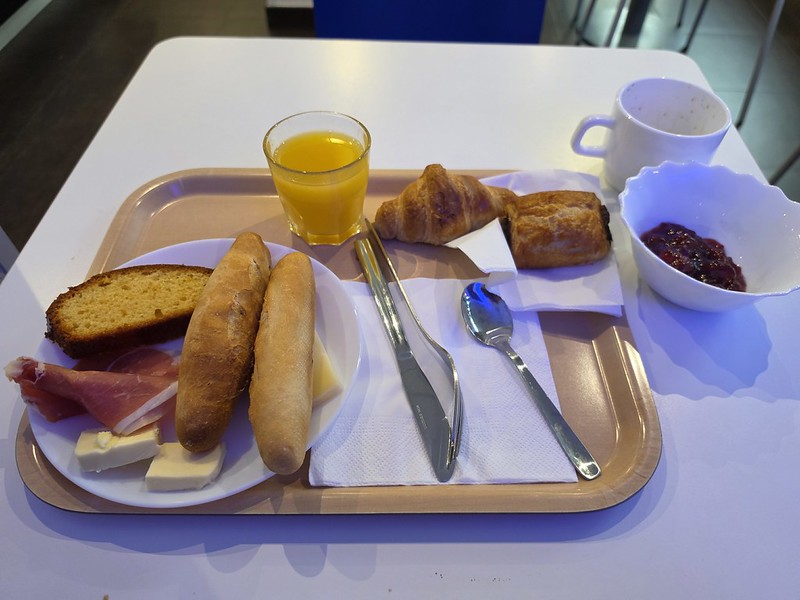
Breakfast was only around £5 per day, which seemed worth it for the coffee and orange juice alone. It was quite a basic breakfast to be fair, that ham looked bloody awful. I am not entirely sure what journey it had been on before reaching the buffet, but I decided not to become involved. Sometimes breakfast is about knowing which items to leave alone with dignity.
The breakfast area was basic, but this is in keeping with the international Ibis Budget branding. The team members were keeping things clean and organised, with everything feeling well managed. They are trying to feed people efficiently in a clean space before everyone goes off to museums, offices, airports or, in my case, railway stations and craft beer bars.
The bread with jam was rather lovely, as were the croissants, so it was a filling start to the day. It may not be luxury, but it does at least prevent the first meal of the day from becoming a formal complaint.
The online reviews are average, mostly people who had expected more luxury than the hotel ever claimed to offer. The air cooling system worked reasonably well so I was happy with that, but there was no air conditioning. Given the heat, this was an important detail, as I was not in the mood to spend three nights gently poaching in a compact room as that would have been entirely sub-optimal.
For the money charged, which was under £50 per night including breakfast, I thought that the whole arrangement was entirely satisfactory. The team members were friendly, there were no noise issues either internally or externally, with the room being cleaned every day which doesn’t happen everywhere now. I’d certainly consider staying here again whenever I next visit the city, assuming I can once again resist the emotional pull of paying much more money to sleep closer to the centre. And that’s quite likely as I like cheap….
In my quest for craft beer excitement, I went to Basquery which is Untappd verified and looked like it might have some interesting options. The online reviews were mostly favourable, but were a little mixed and I think there was a slight theme that the venue was slightly formulaic. This is not necessarily fatal. I am also quite formulaic, especially when overheated and in need of a beer.
They have a little bakery area just inside the entrance. It gives the whole place a comforting sense of purpose, even if I am mainly there to inspect the beer arrangements.
And a nice on-trend looking bar and it looked like it was arranged by someone who has strong opinions about exposed surfaces
The beer fridge with some interesting options.
The service was friendly and the team member found me a menu as I thought that some form of food might be a sensible idea. This was unusually mature of me, and I would like that noted.
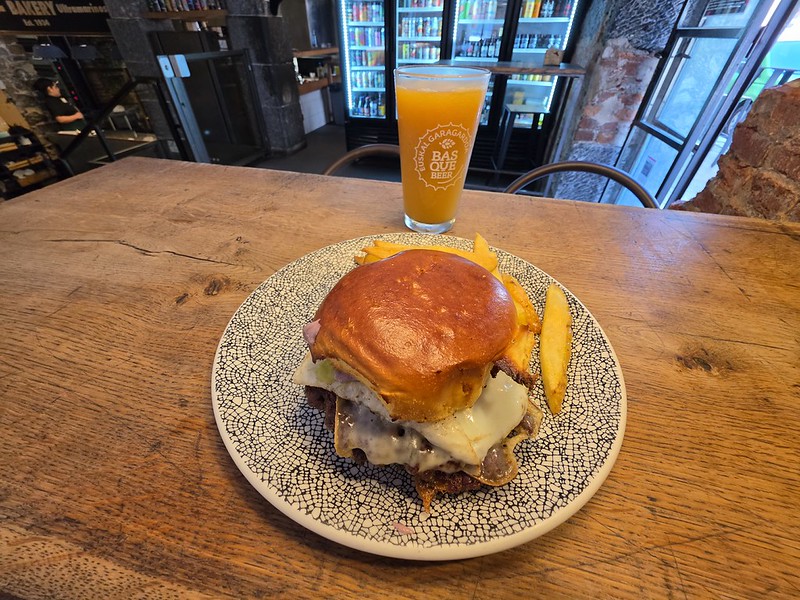
The beer is the Peach Jam from Drunken Bros who are a brewery located on the outskirts of Bilbao and I’ll visit their taproom when I’m next in the city. The beer was peachy, thick and lightly sour. The burger was OK, nothing overly exciting, the meat was a little tasteless and the chips lacked seasoning as well, but it was sensible to have something filling. Not every meal has to be a transformative culinary moment I guess.
Overall, Basquery is a rather lovely venue and there has clearly been some money spent on the decor. The beer selection was interesting, the service was friendly and the whole arrangement felt comfortable and well run. It may be a little polished and perhaps slightly formulaic, but there are much worse problems for a craft beer venue to have. Hopefully more places like this will open in Bilbao over the next few years, preferably with good beer, friendly staff and chips that have been introduced to salt.
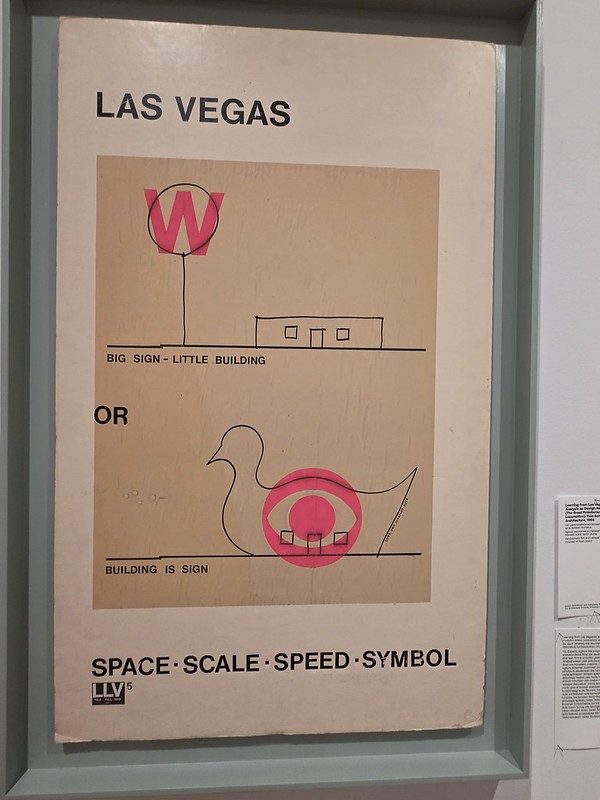
Back in the Denise Scott Brown temporary exhibition at the Museum of Fine Arts in Bilbao, and this was another part of Learning from Las Vegas that immediately made some sort of sense to me, which is always something of a relief. Being honest, a lot of temporary exhibitions are far too niche for me, so this arrangement felt much more agreeable.
The idea is that Las Vegas developed a very particular architectural language because people were moving past buildings quickly, usually in cars, and needed to understand them at speed. And Las Vegas is hardly understated, not point in whispering what you’re about when a fifty foot sign will do.
The second part of the image is even better, showing a building that is itself the sign. This is where architecture gives up on subtlety entirely and decides that if the business is a duck, the building might as well be a duck. I like this clarity. And so Denise Scott Brown, Robert Venturi and Steven Izenour realised that there was a great logic to the Strip, the road was wide, the cars moved quickly and the signs did the work. Space, scale, speed and symbol all mattered, because this was a landscape designed to be read in motion. So there was a system in the chaos which is all rather pleasing as Las Vegas isn’t really a place that often asks if it might be overdoing things.
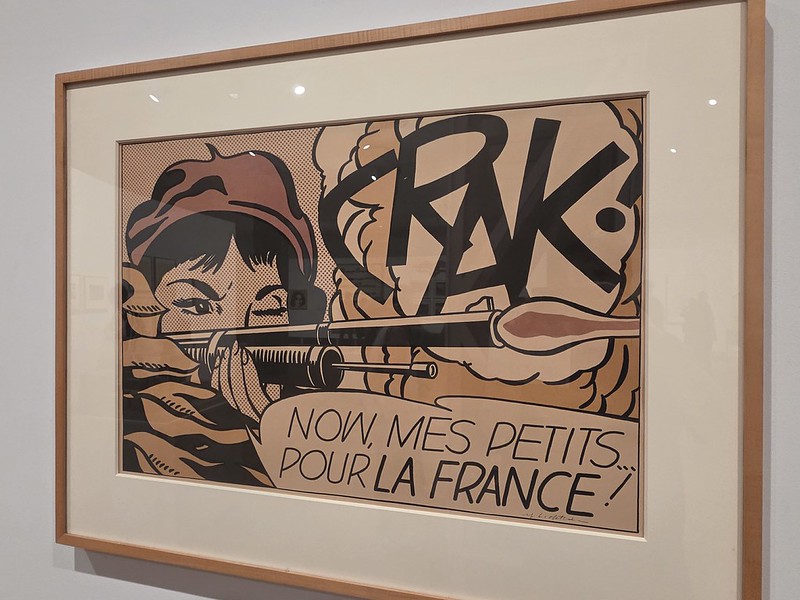
This artwork is Crak! by Roy Lichtenstein (1923-1997), created in 1963/64, and is in his familiar Pop Art style, which is about my limit of knowledge here but I won’t let that stop me. I like artworks that come across as simple and neat, it gives me some sort of chance of understanding them.
The image originally came from a war comic, with Lichtenstein cropping and reshaping it into something sharper and more theatrical. I don’t know what the meaning behind this is meant to be, I’m guessing that war is made to look heroic and exciting, something that is somehow thrilling to be a part of. The artwork might be fun and cartoony, but the reality of war is something a little different. Or at least that’s what I think is the plan, I can’t imagine that this is a picture about violence.
Image: IWM (Art.IWM PST 8696)
For reasons that aren’t entirely obvious even to me as this is a very different image, but this all reminded me of this war poster at the Imperial War Museum which is riddled with emotional guilt. The artist Savile Lumley (1876-1960) later disassociated himself from the image.
They are very different works, but both seem to deal with the way war is presented to people. Lichtenstein’s image makes it look dramatic and exciting, while Lumley’s poster makes refusal look shameful and cowardly. One sells war through action, the other through guilt. Neither is really about the messy, frightening reality of conflict, but about the images and emotions used to make people respond to it. So perhaps that is why the connection made sense to me, eventually.
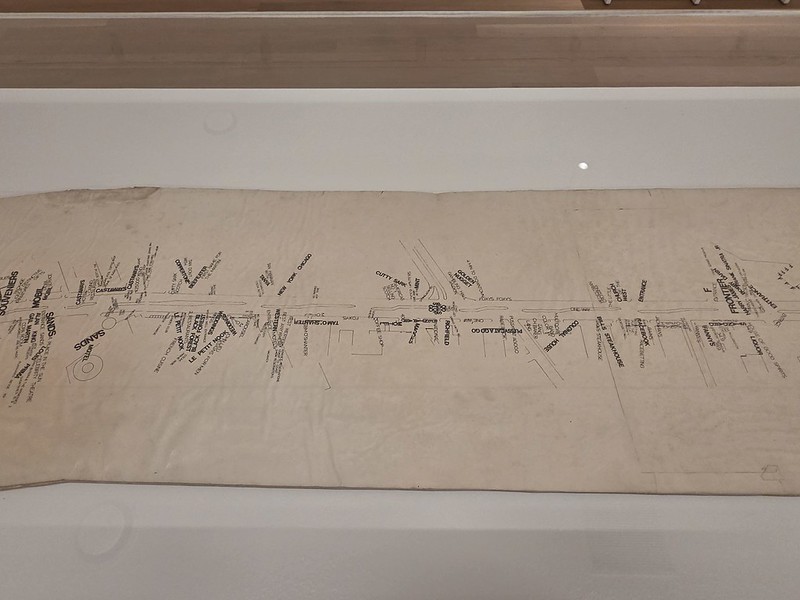
This is from the Denise Scott Brown temporary exhibition at the Museum of Fine Arts in Bilbao, and shows material connected with ‘Learning from Las Vegas, or Form Analysis as Design Research, the 1968 Yale School of Art and Architecture’ project that later helped lead to the famous 1972 book Learning from Las Vegas. I had thought that this exhibition all seemed a bit niche and hard work until I started to meander around it, especially as I’m fascinated with urban planning (ah, Sim City!) and the development of Las Vegas.
Rather than treating Las Vegas as an embarrassment to be ignored by serious architects, Denise Scott Brown, Robert Venturi and Steven Izenour asked what could actually be learned from it. They studied signs, buildings, roads, parking lots and commercial symbols, looking at the city as it really existed rather than as architects might have preferred it to behave. And the evolution of Las Vegas is, if I’m being honest, a bit ridiculous and from a city planning perspective, rather sub-optimal. But, they wanted to create sense from the chaos, recording the signs that people saw as they walked down the strip, getting meaning from the clutter.
What I liked about this arrangement was that it turned something as supposedly ordinary as a commercial road into a proper object of study. The wider argument of Learning from Las Vegas was that buildings and cities communicate through signs and symbols, not just through form and structure. The plan asks the viewer to slow down and notice the language of a place that many people might dismiss as tacky, chaotic or too commercial and there’s something very useful about the whole slow travel element there.
I like a bit of urban analysis to keep me engaged and this plan is a snapshot of a Las Vegas long gone. It shows the sign of when Stardust was the world’s largest resort hotel, that casino was demolished decades ago and only a few of the resorts survive today. At least Circus Circus is still there……
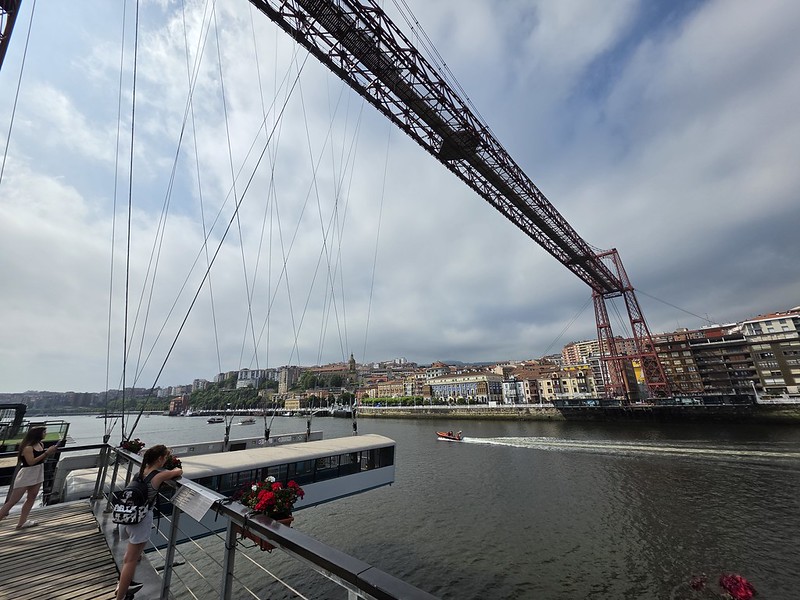
More about this in other posts, but I was excited to see that I could cross this for around 85p, which I did (and there’s another video coming about that).
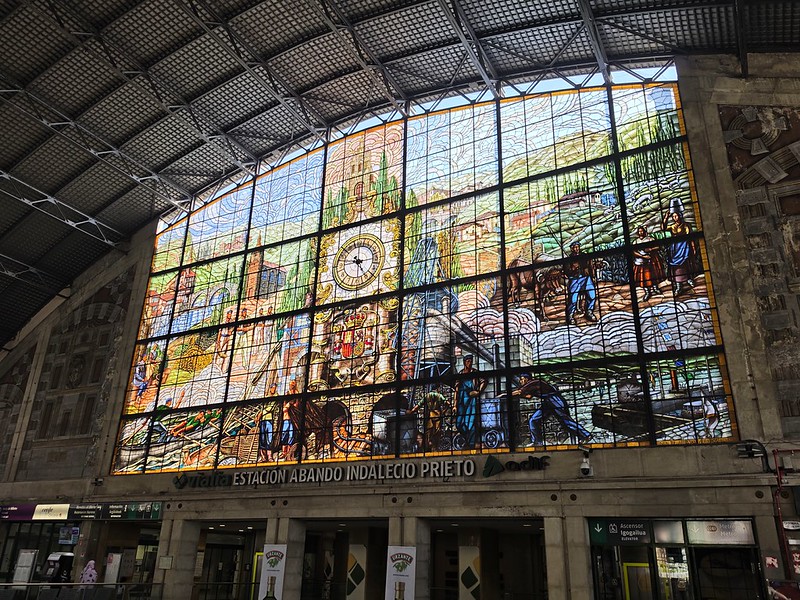
Bilbao-Abando railway station is the city’s main railway terminus and its history goes back to the arrival of the railway in the nineteenth century, with the station opening in 1863 as the terminus of the line from Tudela and becoming popularly known as the Estación del Norte because of the company that operated it. The present station is largely the result of a major 1948 rebuilding, which gave it a more monumental post-war appearance. The station, also known as Abando Indalecio Prieto and formerly as the Estación del Norte, sits near Plaza Circular and has the pleasing confidence of a station that knows it still matters.
There’s a bit of faded grandeur to the building, but it’s sizeable and things sort of function. It’s also connected to the metro network and it’s something of a transportation hub.
The most striking feature is the enormous stained-glass window inside the station, which depicts scenes connected with Bilbao and Biscayan life, including industry, fishing, sport, farmhouses, the Basilica of Begoña and the bridge of San Antón. It is a wonderful piece of civic storytelling, filling the station with colour and meaning in a way that makes most British railway concourses look as though they have given up emotionally. There is something rather lovely about arriving by train and being greeted not just by ticket barriers and someone eating crisps aggressively, but by a huge glowing summary of local history and identity. I very much like this, it’s got character.
It is not Bilbao’s most famous building, but it’s practical and it has a Carrefour which was very useful for stocking up on cold drinks to get me through the heat. Did I mention how hot it was?
I never did work out what this was. Art installation, memorial, or Renfe simply couldn’t be bothered moving some old sleepers.
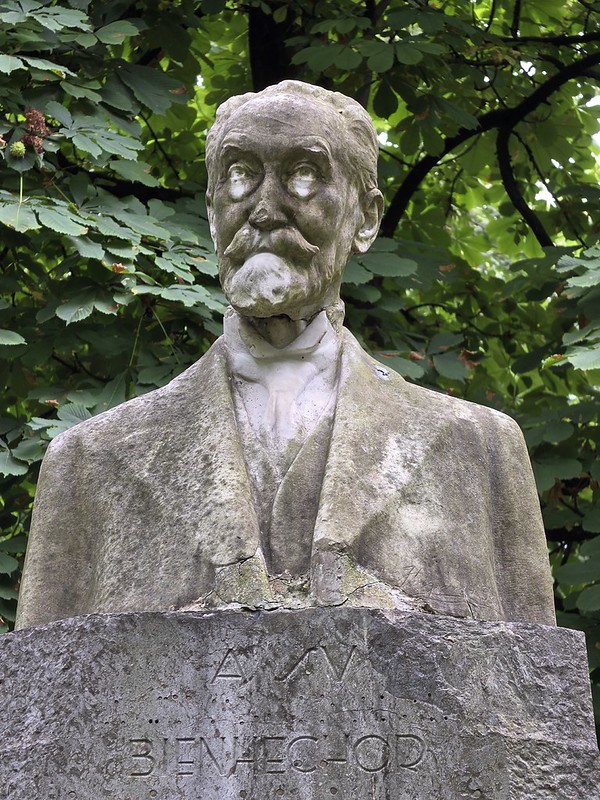
This is a sculpture of Luis Briñas (1849-1938) who was born in Bilbao and became one of the city’s notable benefactors. He was closely associated with the Santa Casa de Misericordia (a Catholic charity which helped provide healthcare, pensions and financial support to the poor) serving for many years on its charitable board, and he made major donations to welfare and civic causes in the city.
It’s a rather odd looking thing with his eyes, but I quite like the combination of quirky, moustache and his look of moral seriousness. It is not especially showy, but it does its job which is a public reminder of someone whose money and public spirit had a lasting impact on Bilbao. And, not only that, but the city has named a road and a school after him, which I’d be quite pleased at.