Category: Belgrade

  • Balkans Trip Day 5 – Belgrade – National Museum of Serbia (Saint Nicholas Protecting Travellers)

    Balkans Trip Day 5 – Belgrade – National Museum of Serbia (Saint Nicholas Protecting Travellers)

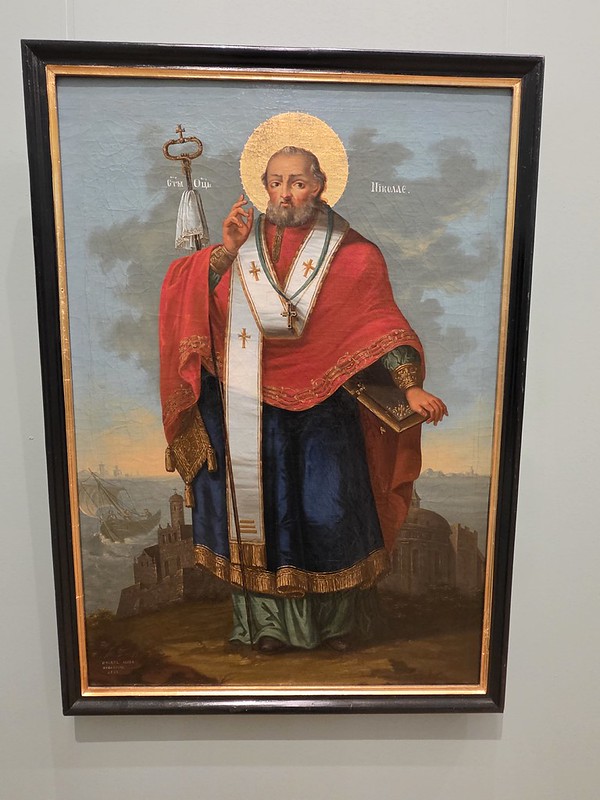
    This painting of Saint Nicholas was completed by Mihajlo Živković (1776-1825) in 1813 and is now displayed at the National Museum of Serbia. Nicholas was a fourth-century bishop whose reputation for protecting travellers and sailors made him one of the most widely revered saints in the Orthodox Christian world. Encountering him during my own journey across the Balkans therefore seemed reassuring, although I would have preferred to establish precisely when his protection had commenced and whether it applied retrospectively.

    Živković depicts Nicholas in episcopal robes, holding a book in one hand and raising the other in blessing. Behind him are ships, water and a coastal settlement beneath gathering clouds, directly connecting the saint with the maritime dangers from which people hoped he would protect them. The halo and formal pose belong to traditional religious imagery, but the landscape gives the painting a more immediate sense of events unfolding while Nicholas remains impressively calm in the foreground. Calmness is a virtue, but when you’re a saint I suppose this comes more naturally.

    Saint Nicholas was essentially providing an early form of travel insurance, although the full terms and conditions appear not to have survived. His protection traditionally covered shipwrecks, storms and other serious dangers, but there was no indication of whether delayed buses, airport security queues, extreme heat or a warm glass of coke was included. Nonetheless, with several countries still ahead of me and a long train journey approaching, I was pleased to discover that someone apparently had responsibility for the portfolio. It’s good to have a responsible adult.
  • Balkans Trip Day 5 – Belgrade – National Museum of Serbia (Nikola Nešković’s LinkedIn Profile)

    Balkans Trip Day 5 – Belgrade – National Museum of Serbia (Nikola Nešković’s LinkedIn Profile)

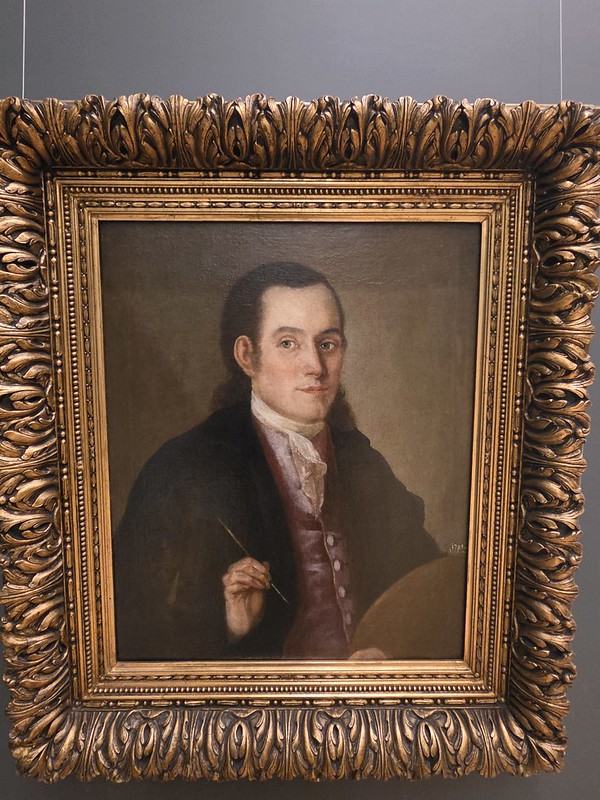
    This self-portrait by Nikola Nešković (1739-1785) was painted around 1775 and is now displayed at the National Museum of Serbia. I rather liked the idea of the portrait as an eighteenth century professional profile picture for LinkedIn or similar as what other options did they have? Nešković presents himself in fashionable clothing, while the paintbrush in his hand and palette beside him make his occupation immediately clear. Having trained as an artist and become known particularly for his religious paintings, icons and frescoes, he was showing viewers that being an artist was not merely something he did but a central part of his identity and social standing.

    Unlike a modern photograph, a self-portrait allowed Nešković to choose and control almost everything the viewer would see. The restrained pose, expensive looking clothes and quietly confident expression present him as a cultivated and successful professional, while the brush provides the eighteenth century equivalent of listing his skills. It is essentially a LinkedIn profile created in oils, although he resisted adding an inspirational account of how waking at five every morning transformed his approach to leadership.

    Ultimately, he had achieved the difficult task of looking creative, prosperous and available for commissions without once describing himself as passionate.

  • Balkans Trip Day 5 – Belgrade – National Museum of Serbia (The Travelling Painter)

    Balkans Trip Day 5 – Belgrade – National Museum of Serbia (The Travelling Painter)

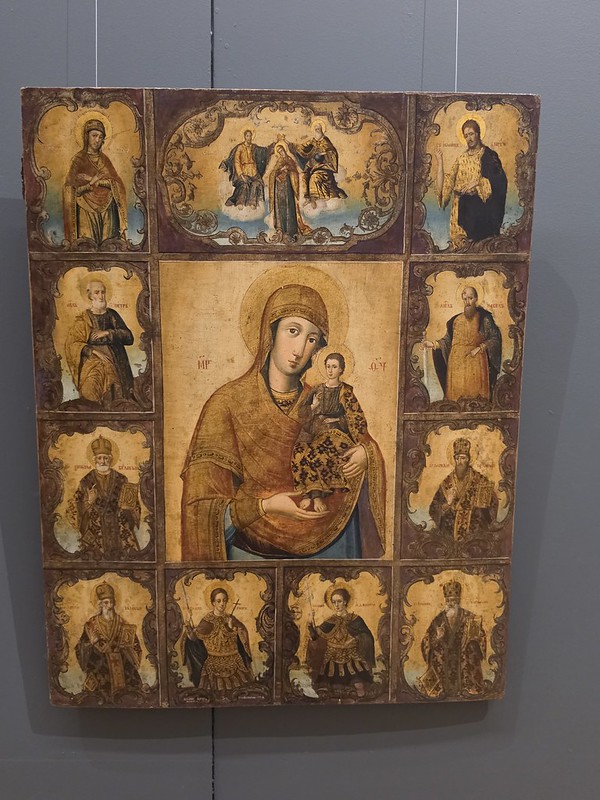
    This 1784 oil painting on wood, entitled The Mother of God with Christ and the Saints, is the work of Jovan Četirević Grabovan (1716-1790). Born in Grabova, in what is now Albania, Grabovan became an itinerant Orthodox painter whose career took him across a substantial part of eastern and southeastern Europe. He appears to have regarded national borders as an administrative inconvenience, although there were fortunately fewer passport queues in the eighteenth century and he didn’t have to traipse through airport security lines. Although, to be fair to him, this was a troublesome period with countries at war, so he had his own challenges.

    Grabovan received artistic training in the Russian Empire, probably including time in Kyiv, before working in places now belonging to Romania, Moldova, Hungary, Croatia and Serbia. He painted for Orthodox communities across different political and cultural territories, adapting the traditional religious imagery they expected while absorbing ideas from the places through which he travelled. His work consequently combined established Byzantine forms with Russian, Ukrainian and Western Baroque influences. This was the element I particularly liked. Grabovan travelled widely, absorbed different influences and brought them together in his own work. It was difficult not to admire a man who used his journeys to combine entire artistic traditions, especially when my principal international achievement that week had been complaining about a warm glass.

    The Virgin and Child dominate the central panel, surrounded by individual saints occupying their own smaller compartments. Jesus is not depicted as an ordinary, vulnerable infant, but as a remarkably composed little figure with a solemn expression, elaborate robes and his hand raised in blessing. Although it was created for Orthodox worship and devotion rather than simply as something attractive for future museum visitors to photograph, it also records the unusually mobile life of its creator. Grabovan crossed the region collecting artistic traditions, while I was collecting photographs and minor grievances about soft drinks. I liked it.

  • Balkans Trip Day 4 – Belgrade – Kafeterija Neimar

    Balkans Trip Day 4 – Belgrade – Kafeterija Neimar

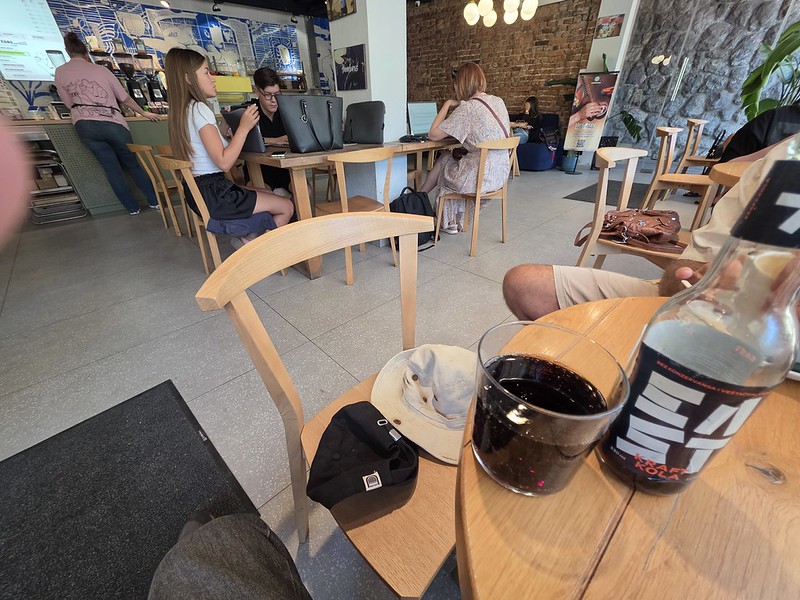
    Located near to my hotel was a little cafe called Kafeterija Neimar and here are some photos of the steps down as I didn’t want a photo from the front as there were lots of children playing and that didn’t feel entirely appropriate. This cafe was where I met Jonathan, who had safely checked into his accommodation in Belgrade and we now had to plan the next few days of the trip.

    The venue was mainly coffee based and the general prices were towards the higher end of the scale for Belgrade but it all felt modern and welcome. They also appeared to have seven staff which seemed high for a little coffee shop, but it was certainly efficiently run. No-one was going to be left unattended for long, although the business model may have depended upon selling quite a lot of coffee.

    I don’t know if I’ve mentioned the extreme heat in the city, but I thought I’d have a refreshing coke. After it was explained they only have craft coke rather than anything I’d heard of, I was then brought a warm glass so that entire plan didn’t really work out quite how I expected. However, the main part of the event was that the trip had now started that both of us were in the same place and that’s a marvellous place to start. Our next steps were to meet the following morning at a museum, so that means expect a heap of museum related posts now. Oh the excitement of it all.

  • Balkans Trip Day 4 – Belgrade – KFC with a View

    Balkans Trip Day 4 – Belgrade – KFC with a View

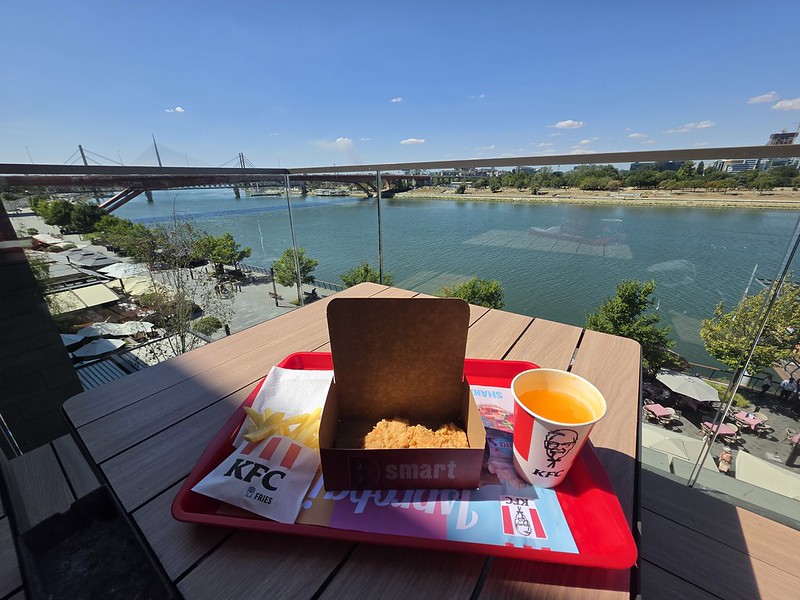
    As I had some time before Jonathan arrived in Belgrade, I decided to continue my immersive exploration of Serbian culture by going to KFC. This was nearly entirely because they offer unlimited refills on soft drinks and, having recently discovered that churches can be ranked by volume, I saw no real reason why the same principle should not be applied to Pepsi. Since the drink on its own cost nearly as much as a Smart Meal, I ordered some chicken strips and fries to accompany it. I had therefore successfully saved money by spending more, which is one of the central principles of modern consumer economics rather than just me trying to be decadent. The meal was also substantially easier on the self-service kiosk to order than anything requiring me to pronounce Serbian words, so the international cultural exchange was proceeding well as ever.

    The view the other way along the Sava River, which flows into the Danube just to the right of this photo. I sat outside to add a little continental sophistication to proceedings.

    I then realised that there were too many insects outside, so I returned to normality and went back inside. The main positive here was that I was now fully hydrated and ready to face the Belgrade sun.

  • Balkans Trip Day 4 – Belgrade – Church of Saint Sava

    Balkans Trip Day 4 – Belgrade – Church of Saint Sava

    Standing prominently on Belgrade’s Vračar plateau, the Church of Saint Sava rather glistened in the sunshine, much as I did, although the church was managing to look considerably more dignified. It is the largest Orthodox church in Serbia and one of the largest by volume (which is apparently a valid measurement of church size) in the world, with its white marble and granite exterior, great central dome and collection of smaller domes making it one of the city’s most recognisable landmarks. More immediately, it offered the possibility of shade, which was rapidly becoming my principal cultural interest.

    The church’s monumental Neo-Byzantine design was heavily influenced by Hagia Sophia in Istanbul and this building is dedicated to Saint Sava, the first archbishop of the independent Serbian Orthodox Church and one of the country’s most important religious figures. Its location is traditionally associated with the burning of his relics by the Ottoman authorities in 1594, although historians continue to debate precisely where this happened. Plans for a memorial church emerged during the nineteenth century, but construction did not begin until 1935. The main entrance is framed by three grand arches, decorated stonework and mosaics depicting Christ and Serbian saints, so there is little danger of mistaking it for the side door. Apologies, once again, for the slightly skewed photos, that’s me and isn’t a structural problem relating to the building.

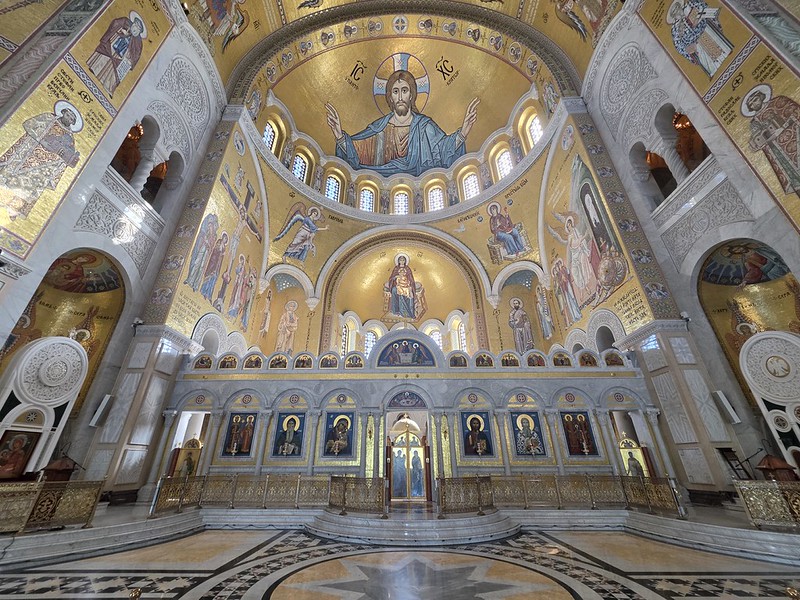
    Nothing about the relatively restrained exterior quite prepares visitors for what is waiting inside. The vast central space is covered with golden mosaics, marble, carved stone and elaborate geometric flooring, while an enormous circular chandelier hangs beneath the dome. Construction stopped following the Axis invasion of Yugoslavia in 1941 and the unfinished building was subsequently used for parking military vehicles and for storage. Work remained suspended through much of the communist period before finally resuming in 1985 when much of what had been constructed needed to be reworked.

    At the eastern end is the sanctuary, separated from the main body of the church by an iconostasis containing a series of richly coloured mosaic icons. Above it, Christ is shown giving a blessing from the golden half dome, with the Virgin Mary represented beneath him and saints, angels and biblical scenes covering almost every remaining surface.

    Looking upwards reveals the extraordinary scale of the central dome and surrounding vaults which is anything but understated. The dome’s principal mosaic depicts the Ascension of Christ, surrounded by angels, the Apostles and the Virgin Mary, and covers more than 1,200 square metres. The structural dome itself weighed around 4,000 tonnes and was assembled on the ground before being raised into position during 1989, an operation which took approximately forty days.

    Although the exterior was largely completed in 2004, the work on the mosaics and interior decoration continued for many more years, with a major phase finished in 2020. Whatever one’s religious views, the combination of scale, craftsmanship and shimmering gold is spectacular, with an extraordinary sense of space. The church has 49 bells and I was pleased to be able to hear them ringing when I left, that was rather lovely. Oh, and it was nice and cool, so I liked that as well.

  • Balkans Trip Day 4 – Belgrade – Curry Souls

    Balkans Trip Day 4 – Belgrade – Curry Souls

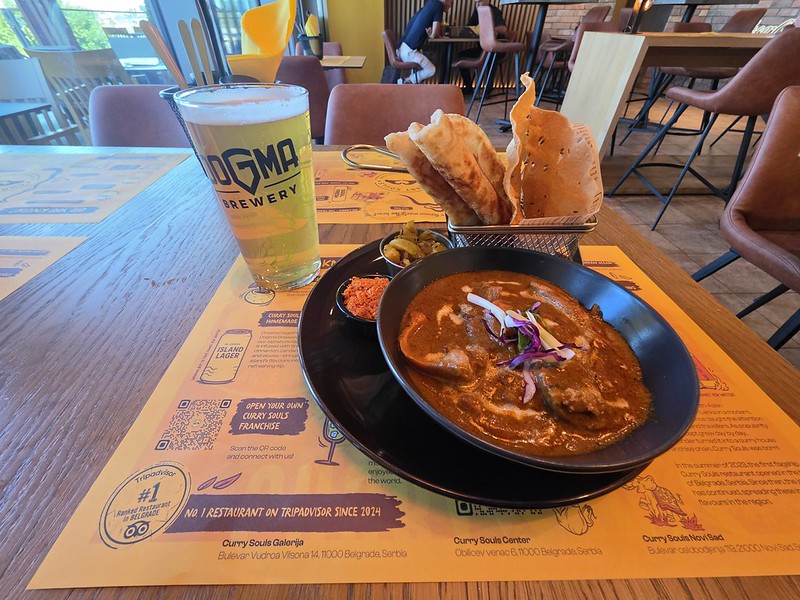
    Whilst waiting for Jonathan to arrive in Belgrade, I thought that I’d meander to Belgrade Waterfront and go to one of the highest-rated restaurants there. My choice at the Galerija shopping centre was Curry Souls which was open for lunch and it all felt on-trend and modern, specialising in Sri Lankan cuisine.

    It was bright, clean and welcoming inside, with plenty of space between the tables. I sat for a short while without anyone coming over and began to wonder whether I was supposed to order at the counter. I held firm, unwilling to expose my ignorance of the ordering system unless absolutely necessary, and a friendly and upbeat staff member eventually arrived with a menu.

    There was an outside area for those who like insects and excessive heat. I stayed inside, but near the window so that I could vaguely look at the river from time to time.

    Some of the menu which wasn’t extensive in size, something that I think is generally quite positive. I don’t usually like photos on menus, but it felt appropriate here to showcase the presentation and contents of the dishes.

    I ordered the chicken curry with grated coconut, roti and tempered potatoes, which arrived attractively presented. The grated coconut relish, known as pol sambol, brought texture, freshness and a little extra heat to the dish. The potatoes were soft and pleasantly spiced, but the curry was the highlight, which was fortunate. The curry was made with chicken thigh which was tender and served as a generous portion, with the sauce having a depth of flavour. This was really very good, it was towards the higher end of the scale of curries that I’ve had, with everything being at the appropriate hot temperature.

    As for the beer, that’s brewed by the very decent Dogma Brewery based in the city and it was the appropriately named Sri Lankan Spiced Lager which was a little floral with a fruit flavour to the arrangement.

    I lingered for a while so that I could write some blog posts otherwise this will be another trip where I finish writing about it about six weeks after actually being there. I’m determined to stay vaguely on top of it on this trip….. Anyway, I very much liked this venue, the service was friendly, the prices were reasonable and the food was firmly above average.

  • Balkans Trip Day 3 – Belgrade – Iva Old Town Hotel

    Balkans Trip Day 3 – Belgrade – Iva Old Town Hotel

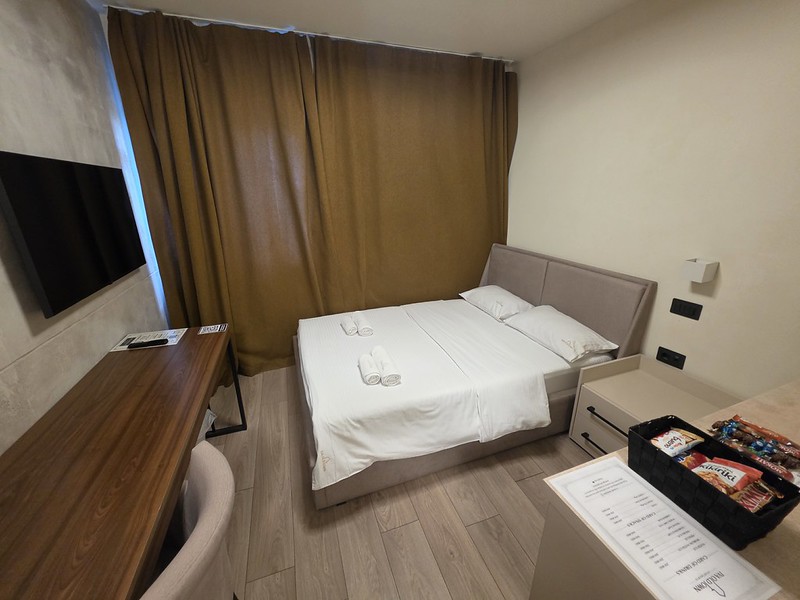
    I had spotted this Iva Old Town accommodation on booking.com and, although its position in a residential courtyard was not especially decadent, it had excellent reviews and looked clean and well organised. It was also conveniently located, and after the limited sleep permitted by an early flight I had no desire to spend the afternoon transporting myself across the entirety of Belgrade. And it was cheap.

    The lady at check-in was friendly and engaging, apologising for her English which was to be honest better than average for English people. When she showed me to my room she said that “I hope you like it cool” which delighted me as I like rooms to be something between freezing cold and very cold. The air conditioning arrangement met my expectations, hiding me away from the extreme heat outside.

    Incidentally, I like notes like this, I might usually stay at corporate Accor hotels (well, Ibis Budget) and so when it is a family operation, it’s rather nice for them to play on that.

    I like free chocolates as I can frequently be bribed to not notice that the window has fallen out or something similar.

    It was all clean and comfortable along with being sensibly organised. The television looked quite large and modern, not that I turned it down.

    There was also a compact private kitchenette with a sink, kettle and small fridge. It was considerably better equipped than necessary for someone whose principal catering activity involved opening the complimentary chocolates. The accommodation doesn’t offer evening meals or breakfast, so this is a handy additional offering.

    It was all keenly priced, quiet and easily accessible from the centre of the city, making it an ideal accommodation for my first night in Belgrade. I did look at booking the other two nights of my stay in the city at the hotel, but they were fully booked. I also doubted whether I would have got more chocolates, but who knows….

  • Balkans Trip Day 3 – Belgrade – Memorial to Deacon Avakum at Kalemegdan

    Balkans Trip Day 3 – Belgrade – Memorial to Deacon Avakum at Kalemegdan

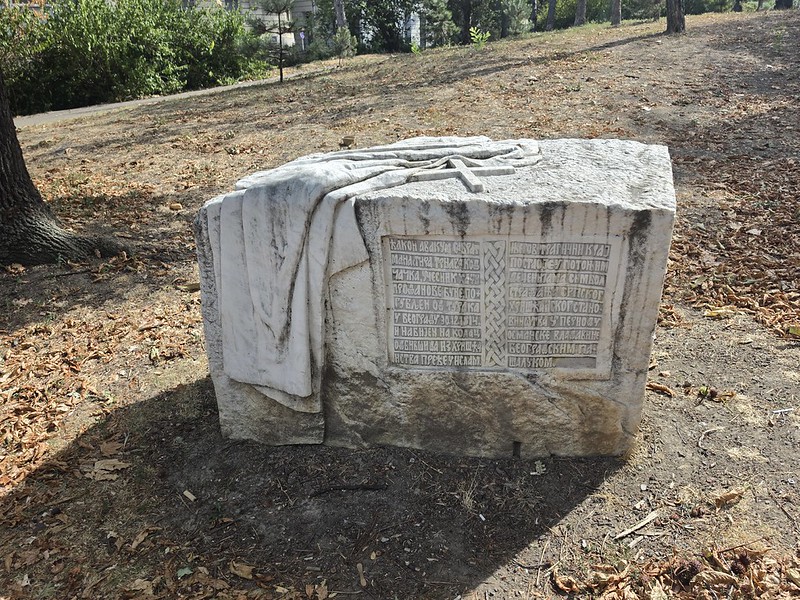
    I had to look up this stone monument after seeing it in Little Kalemegdan, a habit I have of continuing to photograph unidentified pieces of masonry and then ask questions afterwards. It commemorates Deacon Avakum, a young Serbian Orthodox monk associated with Trnava Monastery near Čačak. The monastery played a part in the unsuccessful Hadži Prodan uprising against Ottoman rule in 1814, after which Avakum and a number of other Serbian Christians were arrested and taken to Belgrade.

    According to Serbian Orthodox tradition, the Ottoman authorities offered to spare Avakum’s life if he converted to Islam. He refused and was executed by impalement on 30 December 1814. He was only about twenty years old and was later canonised by the Serbian Orthodox Church as a martyr. His refusal to renounce his faith, despite knowing the appalling death awaiting him, was an extraordinary act of courage. There’s also a story that not only did his snub the demand to convert to Islam, but he carried the stake intended for his execution whilst singing.

    Unveiled in 2009, the understated memorial consists of a roughly cut stone block topped by what appears to be a carved religious garment or shroud and an Orthodox cross. Its inscription describes Avakum’s death as a symbol of the suffering experienced by Serbian Christians under Ottoman rule. It does not stand on the precise site of his execution, which is believed to have been nearer the former Stambol Gate around today’s National Theatre. I was pleased that I stopped to investigate it, although photographing a stone without knowing what it is and then making myself undertake several hours of historical research is essentially my entire travel blog business model and I like hearing about bravery.

  • Balkans Trip Day 3 – Belgrade – The Big Staircase Descent to Belgrade Fortress

    Balkans Trip Day 3 – Belgrade – The Big Staircase Descent to Belgrade Fortress

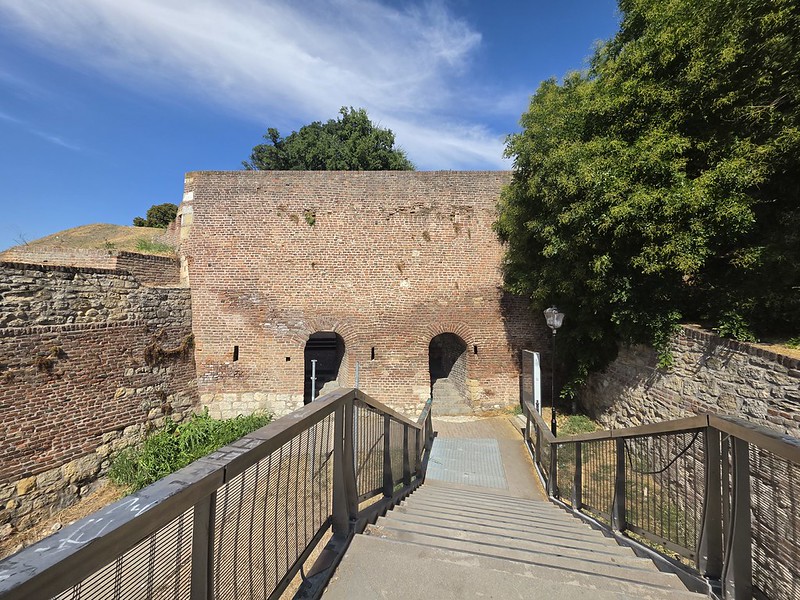
    Having walked beside the River Sava in the extreme heat, I began the climb from the river towards Belgrade Fortress using the modern pedestrian bridge near Beton Hala. This new bridge was completed in 2020, it crosses the busy road and former railway corridor which had rather effectively separated the historic fortress from its own waterfront. The bridge was conceived relatively recently as something of a cultural entry, but I was mostly using it to avoid being run over. As for the fortress, I wrote about that when I visited here in September 2024 and here’s a post full of photos in the rain from that day. I think I prefer it in the rain as opposed to extreme heat, but there we go.

    The modern walkway leads into the trench beneath the fortress’s south-western defences and towards the Big Staircase Descent. Despite its name, this is not the grand ornamental staircase in nearby Kalemegdan Park but an eighteenth-century military route constructed during the Ottoman rebuilding of the fortress. It provided the shortest connection between the port on the Sava and the upper fortifications, allowing soldiers, supplies and presumably numerous other people carrying something heavy to avoid taking the scenic and much longer route.

    The descent was restored in 2005 and its surviving brickwork reveals how many different periods of construction have been incorporated into the fortress. For centuries, the fortress and the settlement beside and within its defences effectively formed the heart of Belgrade, so there are multiple stages of construction here over the centuries by whichever empire had recently taken over control of the city.

    Today the passages instead accommodate tourists climbing up from the river, providing considerably less military excitement but a useful quantity of shade. Given the heat, this was the feature of Ottoman defensive architecture that I appreciated most immediately to be honest. The Ottoman Empire recovered Belgrade from Habsburg control in 1739 and retained a garrison in the fortress until 1867, when the keys were ceremonially handed to Prince Mihailo and the troops withdrew. The defences had therefore helped to secure another 128 years of Ottoman occupation, which by the exceptionally turbulent standards of Belgrade Fortress represented a relatively peaceful interval.