
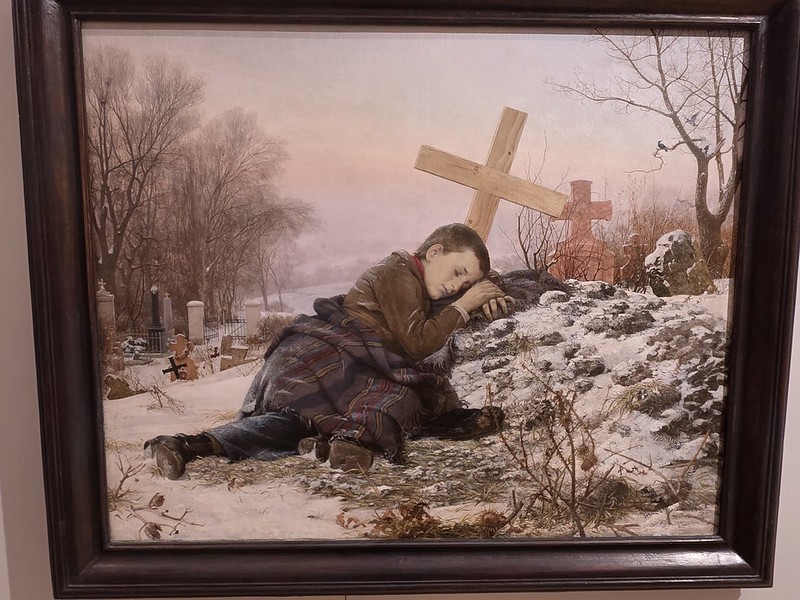
This 1888 painting by the Serbian realist artist Uroš Predić (1857-1953) is entitled An Orphan at His Mother’s Grave. It depicts a child lying alone in a cemetery, resting his head and arms against the earth beneath a simple wooden cross. The title tells us whose grave it is, but the mother’s name isn’t indicated. Despite her physical absence, everything within the painting is organised around her and the space she once occupied in the child’s life. This was the saddest painting that I saw in the gallery.
Predić makes the grief feel almost physically cold. Snow covers the cemetery, the trees are bare and the pale sky offers little suggestion of warmth. Dark earth remains visible around the grave and beneath the child, while his patterned covering provides one of the few strong areas of colour. He appears to have fallen asleep while holding himself as close to his mother as he now can, an ordinary physical gesture made devastating by the barrier between them.
The painting does not explain who the child is, how his mother died or what will happen when he wakes. The mother is missing from the canvas, but her absence fills it completely, making her the most important person in a painting in which she never appears. It’s emotive and it’s not clear to me who would have purchased this, it’s not a painting that I’d want on my wall. Incidentally, Predić was prolific, he painted over 1,600 artworks in his lifetime.