
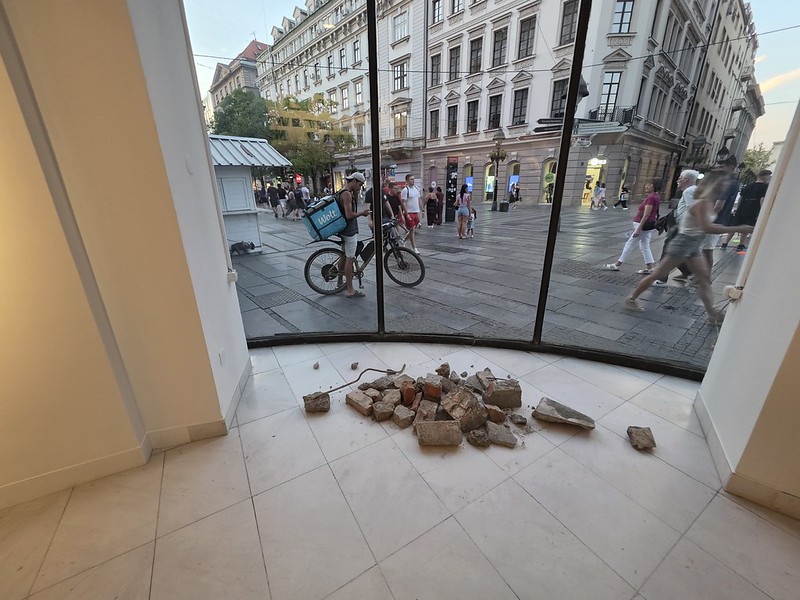
The SASA Gallery of Visual Arts and Music occupies part of the Serbian Academy of Sciences and Arts building on Knez Mihailova. Jonathan pointed it out, but otherwise I would probably have walked straight past it. It is not a conventional museum or gallery with a permanent chronological collection, but a gallery presenting substantial temporary exhibitions, which explains why it had felt slightly like a pop up museum to me. During my visit it was hosting Even in Captivity – Freedom! Serbian Art During the Second World War, an exhibition of nearly 300 works examining how artistic creation continued between the German invasion of Yugoslavia in April 1941 and the end of the war in May 1945. It was an extensive and often sombre exhibition, but it was well curated and interesting, especially as there is no admission charge to enter. The exhibition was relatively busy during our visit, although the spacious gallery never felt crowded.
There is a set of works by Miloš Bajić who began his formal artistic education in 1936, but the war interrupted his studies. He joined the Valjevo Partisan Detachment in 1941 and was reportedly sentenced to death on three occasions, escaping on the final occasion before reaching Belgrade. It was already clear that Bajić was not someone prepared to submit quietly to authority. He was arrested in October 1942, imprisoned at the Banjica concentration camp and transferred to Mauthausen in December 1944.
Drawing was strictly forbidden at the camp, but Bajić continued to record what he witnessed using whatever scraps of paper he could obtain. The act of drawing was therefore both artistic creation and dangerous testimony, completed in circumstances where possession of the work could itself have brought punishment or death. This was evidently a brave man.
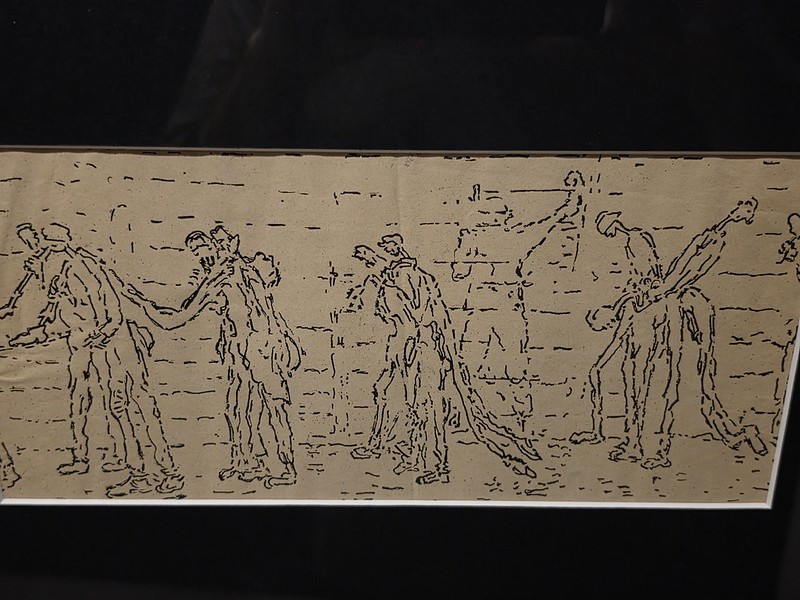
This pencil drawing, entitled Death on the March, was produced in 1945. Its thin and slightly hurried lines show exhausted prisoners supporting or carrying collapsing bodies, with almost no background detail to distract from their suffering. Knowing what we know now, this is a powerful piece of art because it shows with some strength the tragedy that was unfolding.
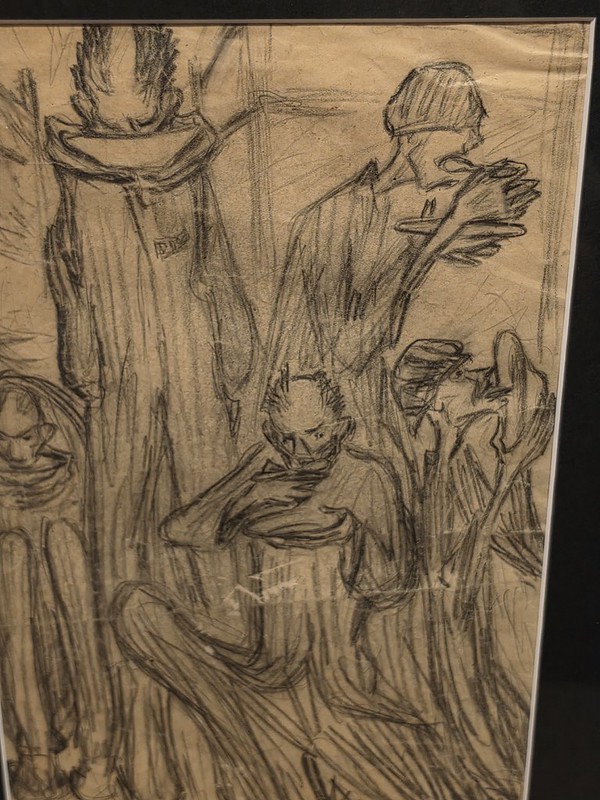
The second drawing, Mauthausen–Ebensee, Receiving Soup, dates from 1944 and records an apparently routine moment which was nevertheless essential to survival. Emaciated prisoners gather around their meagre food rations, with bowls and hands held close to their bodies. This must have been horrendous, the prisoners were ill, weak and in general fear for their lives, so survival must have been their central objective.
One figure appears to consume his portion immediately while others wait or stand nearby, their faces and bodies reduced to sharp lines and hollow shapes. Bajić did not need to exaggerate the scene, as the physical condition of the prisoners and the concentration with which they attend to the food communicate the deprivation.
Bajić concealed the drawings beneath his bunk, inside his clothing and buried in the ground. After Mauthausen was liberated in May 1945, he emptied a fire extinguisher, placed the surviving pictures inside it and returned to Belgrade. That extraordinary effort ensured that his private acts of resistance survived as a historical record. They later became evidence of what had occurred in the camp as well as the foundation for his subsequent Mauthausen series of paintings. These two works record different aspects of the same system, one showing death overtaking prisoners and the other the daily effort to postpone it. I hadn’t seen this sort of artwork before and it was one of the more striking series of images that I’ve seen from the Second World War, all sensitively displayed by the gallery.