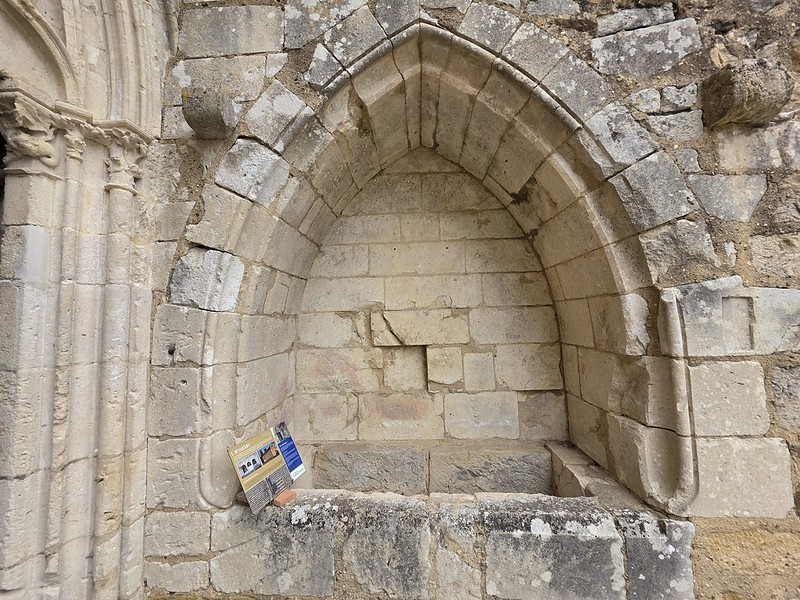
This rather modest arched recess in the cloisters at the Royal Abbey of l’Épau is effectively a cupboard, but far more exciting for me (I don’t get out much), it was a cupboard for storing books, better known as the abbey’s armarium. It was a handy location for the books to be stored whether for worship, study or some riveting evening reading. I like these little snapshots of abbey life, especially in a building where a lot of the details have been lost.
As for the word ‘armarium’, this is the Latin word for chest, cupboard or safe which is derived from the word ‘arma’ meaning tools, implements or weapons. And that’s where words such as armaments, army and the like come from.
Incidentally, I suspect that I would have needed a bigger book cupboard if I had been there at the time…..
There will now follow, much to the delight of likely nearby no-one, a series of posts about the Royal Abbey of l’Épau, which was the highlight of my travels last week.
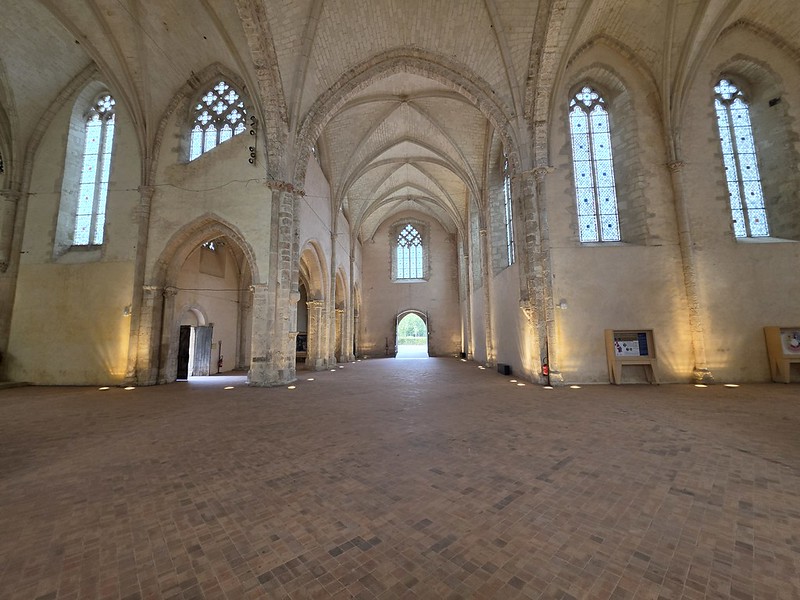
The Royal Abbey of l’Épau stands on the eastern edge of Le Mans and was founded in 1230 by Bérengère of Navarre, widow of Richard the Lionheart. Having settled in Le Mans after Richard’s death, she established the Cistercian monastery as both a religious foundation and her intended final resting place, although she died only months after the first stone was laid.
The first community consisted of twelve monks from Cîteaux, following the suitably austere Cistercian tradition in which unnecessary decoration, excessive comfort and cheerful clutter were all regarded with suspicion. I have some sympathy with their lack of interest in decadence and frivolity, it’s all rather over-rated. Bérengère was buried at the abbey, ensuring that she finally acquired a permanent connection with England’s royal history despite being the only English queen never actually to set foot in England. It felt most appropriate that I was visiting her tomb on the day that England were playing in the semi-finals of the World Cup because of the three lions link.
The abbey remained home to monks until the French Revolution, when it was sold as national property in 1791 and subsequently served as a laundry, farm and an agricultural store. It’s fair to say that it was not treated well during this period, these abbeys were not designed to be large sheds. But, at least the buildings weren’t demolished, although they were close to total destruction on numerous occasions. Indeed, it’s because the structure was rather handy as a large shed that they weren’t torn down.
British troops occupied the site during the First World War, while German forces used it as a vehicle garage during the Second World War, representing a particularly decisive departure from the original monastic rule. Things improved considerably after the Département de la Sarthe acquired the increasingly neglected complex in 1959 and began the extensive restoration that transformed it into one of the region’s principal historic and cultural sites.
Anyway, further examinations of the church, cloister, chapter house and Bérengère’s tomb will follow. At least it’ll keep me distracted for a while.
I meandered towards Gares de Nantes complaining to myself about the heat and preparing for my rail journey to Le Mans, the reasoning for all that is explained here. It’s a little odd as there are station buildings both sides of the tracks, although they’ve built a lovely new aerial walkway now to connect them together.
The station hall and I’m not entirely sure that I knew that there was a Pret a Manger in France, although I did know about the ones in Germany and the United States. It nevertheless provided a reassuringly familiar landmark, although I resisted buying a filter coffee as I already had enough thermal difficulties as it was.
This is the aerial walkway over the platforms. The design is modern and open, but it also gave the railway station something of a heat problem. They’d effectively created a municipal greenhouse and, to be honest, I did find that arrangement a little sub-optimal.
This heat problem was being resolved by having several of these dotted around the place and I enjoyed standing near to one of them to reduce my core body temperature to something that was compatible to continued life.
I took a photo of the railway tracks whilst I was standing in front of one of the fans.
I then went to the other part of the railway station as there was a Carrefour there, so I acquired a 1.5 litre bottle of Pulp, which is effectively their own brand cheap Orangina.
Down to the platforms and there were ticket barriers at the top of the escalators, but they were turned off and the staff were checking tickets before boarding.
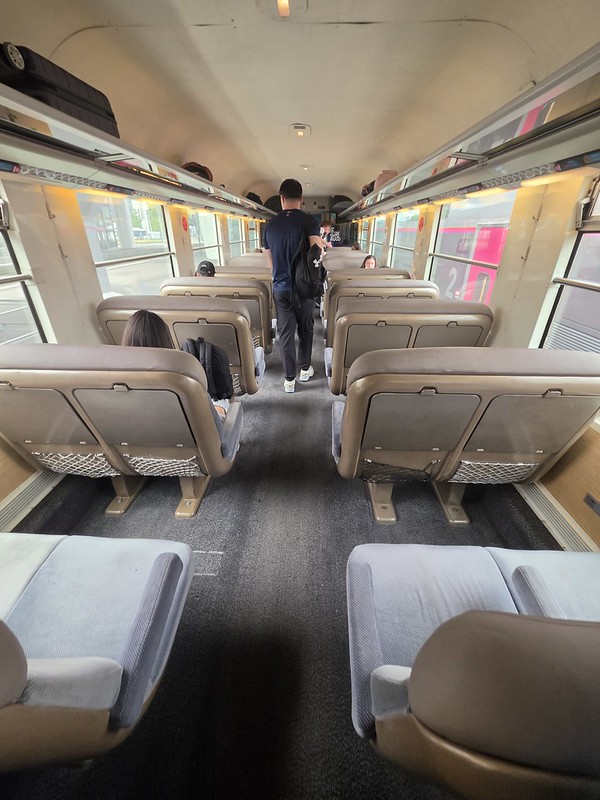
The train was relatively cheap, costing about £8 to get between Nantes and Le Mans. The service is operated by Ouigo classique trains and they’re using old SNCF Intercity trains to keep them in use and to have a lower price option. This train was going all the way to Paris and seat reservations, to my mild annoyance, were compulsory.
The trains were dated, but clean, although I prefer more upright seats in carriages. There were power points placed erratically down the carriage and one is visible on the other side, but I had to make do without any.
This carriage was literally the end of the train with nothing on the other side of that door at the rear. The temperature on board the train was moderate, not freezing cold as I would want, but also sufficiently cool that I wasn’t annoyed.
The bike storage facilities.
It seems almost archaic that in the UK until only a few years ago the trains from Norwich to London (and vice versa of course) could only be opened by lowering the window glass and then reaching out. The door handle here was on the inside, but passengers could roll down the window if they wanted. Incidentally, I was glad that another passenger opened the door and they struggled despite seemingly knowing what to do.
And safely into Le Mans. I felt that the service was keenly priced and sufficiently comfortable for the journey that I was making, but these trains are tired despite the modernisation that has been attempted on them. But, the journey went quickly, my phone coverage was strong throughout and I arrived on time.
I think it’s fair to say that Nantes doesn’t have a Reform led council, but let’s not digress….. I thought I’d better explain what I was trying to achieve in France last week beyond walking around in excessive heat and photographing municipal art.
The basic plan was, as ever, reassuringly simple. I had booked a cheap Ryanair flight to Nantes for Monday and needed to be back in Norwich by Friday for London Craft Beer Festival, which was an important professional and cultural commitment I was not intending on missing. Ideally, I wanted to return on Thursday, giving me enough time to be ready for the event in London that started on Friday morning.
My preferred option was a £9 Wizz Air flight using my Wizz Multipass, although availability is only revealed three days before departure. This adds a pleasing element of suspense to travel planning, rather like waiting for lottery results except that the prize is Luton Airport. When the flights appeared, the nearest suitable departure was not from Nantes or anywhere that could reasonably be described as nearby. It was from Lyon, on the other side of France, introducing the relatively minor logistical challenge of crossing a substantial portion of the country to take advantage of a £9 airfare.
I first checked the direct trains from Nantes to Lyon and discovered that French railways were apparently under the impression that I wished to purchase part of the train rather than merely sit on it. The fares were considerably higher than I had expected, threatening to undermine the entire financial achievement of the £9 flight. To show the challenge I faced, the train journeys were showing at around £300 and I wasn’t paying that.
Fortunately, continued research eventually revealed a cheaper train from Nantes to Le Mans. By “continued research”, I mean approximately three hours of opening tabs, rejecting fares and moving imaginary passengers around France like pieces on a railway-themed board game. Le Mans did not get me especially close to Lyon in any immediate geographical sense, but the ticket was affordable and the journey allowed me to spend a night in another city, which I naturally regarded as an advantage rather than an additional complication.
The resulting itinerary involved flying to Nantes, travelling to Le Mans, spending the night there, continuing across France to Lyon and then flying back to Britain for £9. To some people this might appear unnecessarily elaborate, but those people do not understand the quiet satisfaction of assembling a journey from a collection of individually cheap components. Other people have high powered jobs and families to manage, I have to work out how to get home without spending £300 on a train. Well, we all have our burdens I suppose.
So, what could possibly go wrong with this new competitive sport I’ve started playing of cheap and complex travel?
I was only staying in Nantes for one night as I had to get to Lyon, more on which in the next post actually, and I decided to have a walk around the city taking in the Mechanical Elephant. It meant around an hour of walking, but I had plenty of stops given the extreme heat in Nantes, although it was fortunately a little cooler than the previous day. This also meant that I could walk for several minutes at a time before needing to stand in the shade and reconsider every decision that had brought me to western France in July.
Anyway, the photo above is ‘Éloge du pas de côté’, or ‘In Praise of the Sidestep’, a bronze sculpture by Philippe Ramette in Place du Bouffay. Created for Le Voyage à Nantes in 2018, it shows a suited man stepping beyond the edge of his pedestal, celebrating the idea of looking at the world differently rather than obediently remaining where public monuments are usually expected to stand.
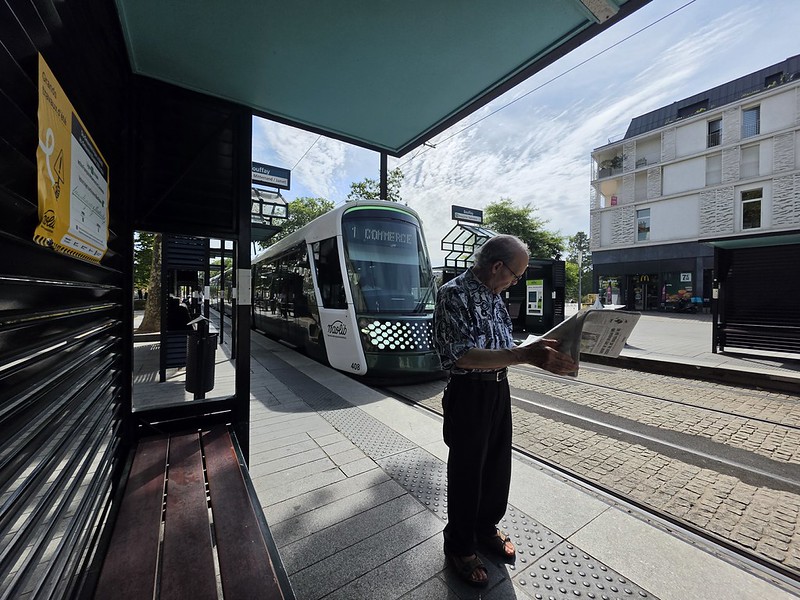
I thought I’d take a photo of a Nantes tram as, well, this is the sort of riveting content on which I thrive. There I stand, phone in hand, and a man decides to walk over, stop and read his newspaper. I decided this felt like a traditional French scene, so there we go.
This is Feydball, a permanent public artwork created for Le Voyage à Nantes in 2015, combining a deliberately uneven, crescent-shaped football pitch with a large warped mirror. The reflective surface makes the distorted pitch and goalposts appear reassuringly normal while bending the players and ball out of shape instead, which is perhaps contemporary art’s most accurate contribution to amateur football. The site retains its natural slope and irregularities, so anyone attempting a serious match must contend with geometry, gravity and the possibility that the mirror is making them look considerably more athletic than they really are. This might encourage me to play more five-a-side to be fair if it made me look athletic as there’s only so much that bar billiards can do for my sporting physique.
This monument in Place de la Bourse commemorates Colonel Georges de Villebois-Mareuil, a Nantes-born French officer who volunteered to fight alongside the Boer republics against the British during the Second Boer War and was killed in South Africa in 1900. The bronze sculpture, created by Raoul Verlet and unveiled in 1902, shows the dying officer supported by an allegorical figure of France, complete with flag and enough heroic drama to remove any possibility that he had merely sat down for a rest. I assumed that they no longer held any ill-feeling towards the British over the arrangement.
And safely at the railway station with just 53 minutes to spare before my train as I like plenty of time to find my platform. This transpired to involve 18 minutes of staying in front of a giant fan, 14 minutes finding Carrefour to get a drink and 1 minute finding the platform before boarding the train early.
I’ve already uploaded a video of the Grand Éléphant, or Mechanical Elephant, to surprise and delight my myriad of two blog readers.
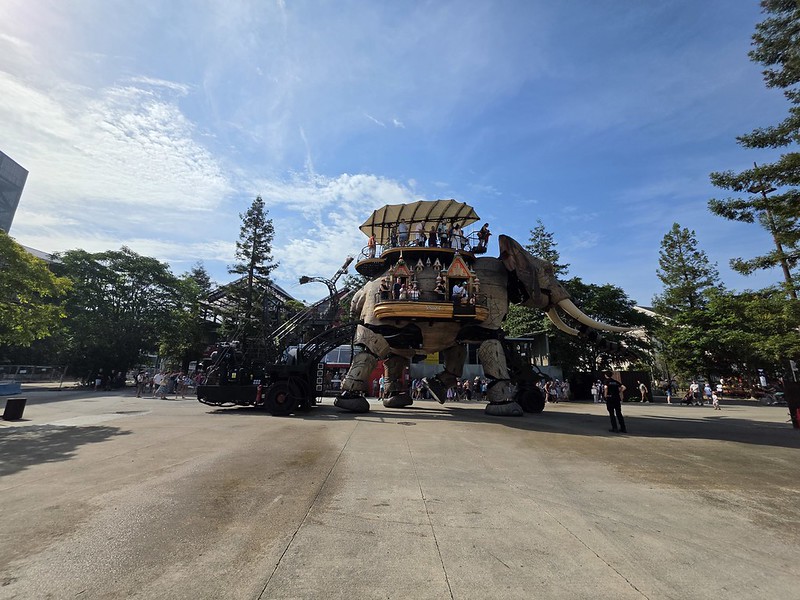
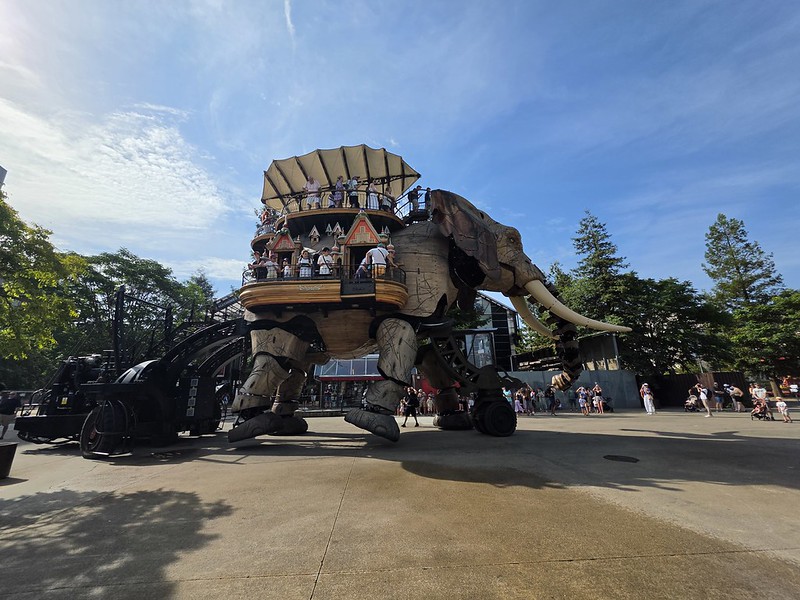
The Grand Éléphant is the most famous creation at Les Machines de l’Île, an artistic project developed on the former Nantes shipyards and inspired by the city’s industrial history, together with the imaginative worlds associated with Jules Verne. Inaugurated in 2007, the elephant is 12 metres high, 21 metres long and weighs 48.4 tonnes, so it’s not the most subtle of set-ups. Built from steel and wood, it moves through the old docklands at a stately one to three kilometres per hour, which is not especially rapid but is still quicker than some municipal regeneration schemes. There’s a staff member that walks with it to ensure that no pedestrians get flattened and there’s also a driver inside steering the arrangement.
Up to 50 passengers can climb aboard for a journey lasting around 30 minutes, with balconies and an upper terrace providing views across the former shipyards. Its legs, ears, eyes and trunk move through a combination of hydraulic, pneumatic and gas-powered cylinders, while the trunk can spray water over people standing nearby although I didn’t get too close to that. This is described as part of the entertainment, although it does perhaps introduce a useful element of jeopardy and uncertainty for anyone with expensive camera equipment. On this occasion though there was considerable restraint and no moment of collective panic. From the ground, the whole machine looks remarkably convincing to some degree, although obviously some imagination is required.
What makes the elephant particularly effective is that it is not confined inside a conventional attraction but walks through the public landscape of the Île de Nantes, turning the former industrial site into a piece of moving theatre. I hadn’t realised how close I would be able to get to it and there were plenty of people watching. It’s a bit expensive to actually take a ride on the elephant and exciting as that might have been, I thought it was just as satisfying watching for free nearby.
The only slight disappointment was that nobody was soaked by the elephant while I was watching, as this would have provided some additional material for the blog. The water spraying was really quite restrained, perhaps because of previous complaints or because the operators had correctly assessed the mood of the crowd. I had been hoping for at least one unsuspecting tourist to receive the full experience, entirely for documentary purposes, but the elephant behaved with impeccable moderation. It was still a spectacular and wonderfully eccentric creation, even if it declined to provide the minor public incident I had been waiting for.
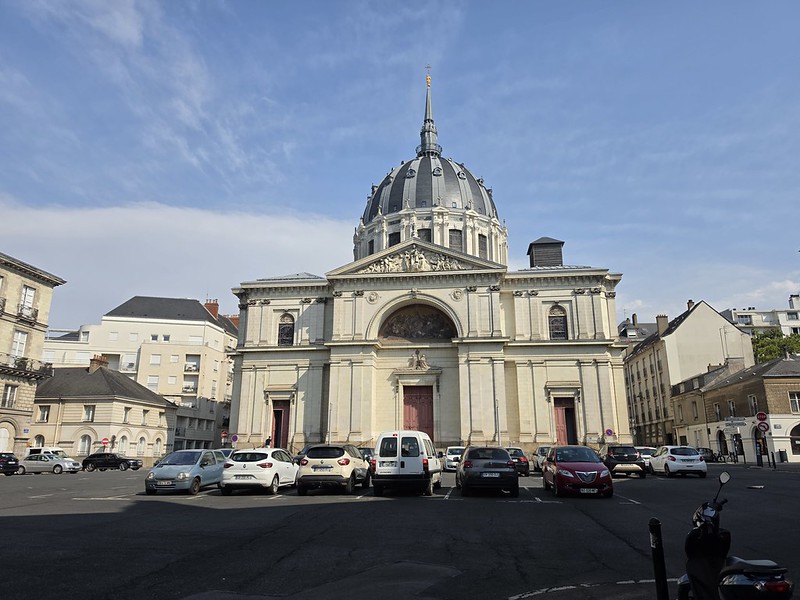
This is Notre-Dame-de-Bon-Port, a grand nineteenth-century church built close to the former harbour and dedicated to the Virgin Mary as protector of sailors. Its enormous dome and elaborate neoclassical façade give it a suitably commanding presence, suggesting that architectural modesty was considered and then rejected before the plans were approved. It’s a robust building though, I can imagine that the sailors liked it and I was also pleased that the authorities have put up an information board about it.
This is only a short post, which will likely come as a relief to my two loyal blog readers, as I did not go inside and therefore cannot offer my usual detailed assessment of the stonework, stained glass and available seating. It looked exceptionally grand from the exterior, although it was a shame that so many cars were parked directly in front of it, perhaps slightly compromising the intended effect of the monumental façade. Nineteenth-century architects rarely allowed for the possibility that their finest civic views would eventually become convenient places to leave a random assortment of Renaults.
There is no shortage of Accor hotel options in Nantes, which is fortunate as it means that the pricing is relatively favourable even during July. This particular hotel was centrally located and reasonably priced, although it appeared to attract rather more negative reviews than several nearby properties carrying the same corporate branding. This suggested either a hidden catastrophe or, more probably, rooms that were slightly smaller than some reviewers felt entitled to receive in the middle of a major French city.
I arrived an hour before the standard check-in time as I hadn’t had any sleep and needed a little nap before more city exploration. The helpful receptionist said that they couldn’t do an early check-in, but this was no obstacle to me, there were tables and free water and the receptionist said I was welcome to wait. I then discovered that there was no phone signal and I couldn’t access the wi-fi until I checked in, as I needed the room number.
Whilst debating whether I had the energy to get up and see if I could get that room number, the receptionist came over and asked for my name. Fortunately, I have stayed in enough Accor hotels to get free early check-in and she then said that she had checked with the cleaners and a room was available. To be fair, they probably didn’t want me cluttering up reception but, either way, my nap had moved considerably closer, making it a positive outcome for everyone involved.
The stairs to the room were entirely sub-optimal as they had all manner of stuff stored on the steps and it required some effort to get around it. I decided that I’d take the lift for the rest of my stay just to be on the safe side.
The room design was the oddest I’ve seen for some time and although it’s not evident from this photo, the shower is positioned just to the right of the photo facing straight towards the bed. That means that if the shower is turned on then there’s the risk of covering the bed, and the electrics, in a flood of water.
The security catch on the window was broken, which meant that I could open it fully and introduce some desperately needed air into the room. Given the temperature outside, this was welcome, although it did reinforce the impression that the hotel was not allowing excessive health and safety paperwork to inhibit its creative freedom. Between the obstructed staircase, unrestricted window and shower aimed towards the electrics, the building offered a pleasingly relaxed relationship with risk assessment.
The room itself was also small, which is something that seems to be behind many of the hotel’s poor reviews, and there was no desk of note, just a small circular table and chair. However, this was a keenly priced hotel in the middle of a city, so I can cope without having acres of space. I also liked the seating area near reception, so I could have moved there had I needed to.
I was surprised and delighted by the hotel’s beer offering for my welcome drink and the receptionist was enthused at showing me what they had. There was a range of mostly local beers and some national options, it was one of the best selections that I’ve had for some time in an Accor hotel and it was especially decent given that it was a relatively small hotel.
The breakfast was included in the room rate and there was plenty of space, although I did go down quite early on. When there’s a free breakfast, I don’t want to faff about.
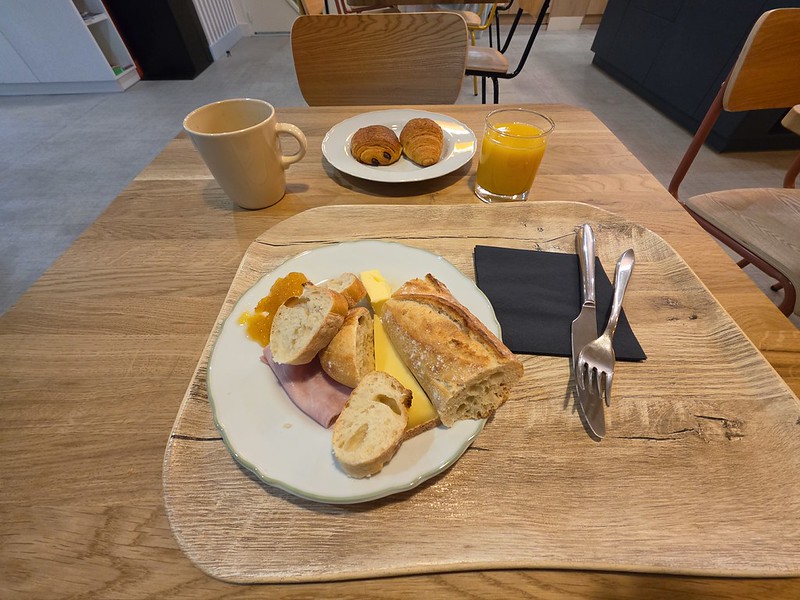
This was some of the selection and that cheese was delicious and it took quite a hit. The ham was awful, although Accor hotels, especially at the cheaper end, rarely get that right.
I had a lot of bread and cheese, croissants and pastries, alongside fresh orange juice and coffees. This is the sort of breakfast of champions that is a positive start to the day, although I had to have a little post-breakfast rest so I might have overdone it. This is what happens when there is no responsible adult present to impose sensible limits on my access to bread and cheese. Continental breakfast freedom carries responsibilities, and I had plainly failed to exercise them.
There was quite a lot technically wrong with the hotel in terms of presentation, room design and its somewhat free-spirited approach to safety, but none of it particularly bothered me. The room was clean, the staff were friendly and there were no significant noise problems, either inside or outside. I had been allocated a room at the end of a corridor, which helped, as some rooms appeared to be positioned close enough to the noisy lift for guests to participate emotionally in every journey it made.
Overall, I rather liked the hotel. It was inexpensive, central and comfortable enough, the breakfast was excellent and the beer selection was far better than it had any need to be. I’d happily stay here again, but I can see that the lack of space in some rooms might not be ideal for some guests.
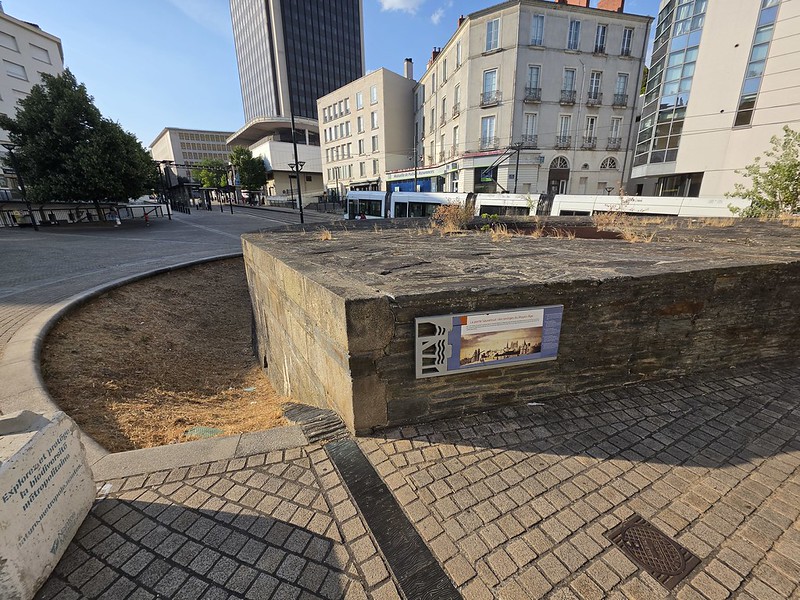
These rather modest remains belonged to Porte Sauvetout, once one of the principal entrances through the medieval walls of Nantes. Situated on the north-western side of the city, the gate controlled the routes towards Vannes and Rennes, so anyone arriving from that direction would have been required to pass through it rather than simply wandering into Nantes in search of craft beer. Thank goodness for freedom of movement is all I can note….
Porte Sauvetout was far more substantial than the remaining masonry arrangement might suggest. The main gateway stood between the Haut-le-Pied and Erdre towers, with a drawbridge and additional defensive works protecting the approach. The towers were rebuilt in 1482 and 1483 to accommodate gunpowder artillery, as medieval military technology had advanced beyond merely dropping unpleasant objects onto people from above.
Like most of Nantes’s medieval fortifications, the gate was largely dismantled from the mid-eighteenth century onwards as the city expanded and reshaped itself, with the last stretches disappearing in the early nineteenth century. Its base survived, and was properly investigated archaeologically around 1999, ahead of construction work for Nantes’s third tramway line. The dig, lasting a couple of months, confirmed that the tower was in remarkably good condition below ground. It has a horseshoe-shaped plan, still measuring around 14 metres by 12.6 metres, and is preserved to a height of about 3.5 metres on its northern side.
As the photograph shows, steps lead down into the heart of the tower, although access is closed. This is perhaps fitting for what was once a defensive structure, as the original policy of discouraging casual entry appears to remain in force. It was still pleasing to see such a substantial fragment of medieval Nantes preserved among the modern streets and I liked that it had a little information board so I knew what I was looking at.