
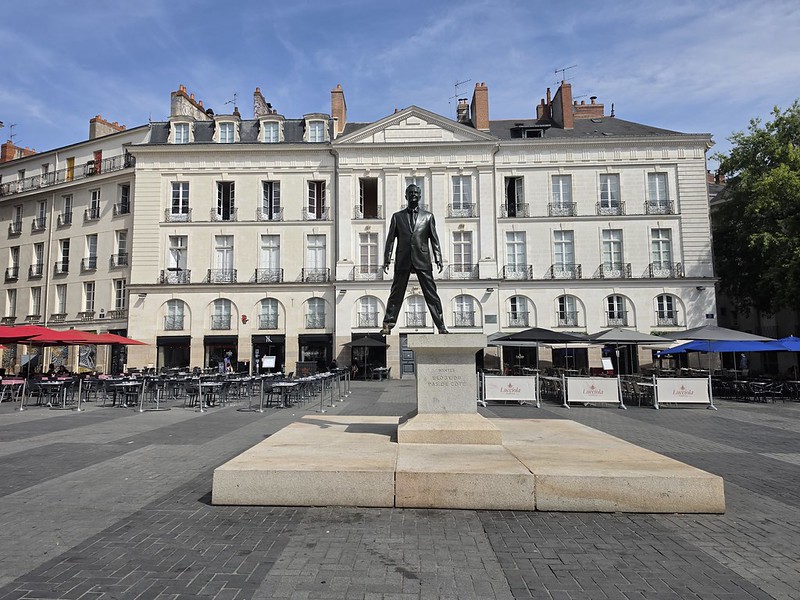
I was only staying in Nantes for one night as I had to get to Lyon, more on which in the next post actually, and I decided to have a walk around the city taking in the Mechanical Elephant. It meant around an hour of walking, but I had plenty of stops given the extreme heat in Nantes, although it was fortunately a little cooler than the previous day. This also meant that I could walk for several minutes at a time before needing to stand in the shade and reconsider every decision that had brought me to western France in July.
Anyway, the photo above is ‘Éloge du pas de côté’, or ‘In Praise of the Sidestep’, a bronze sculpture by Philippe Ramette in Place du Bouffay. Created for Le Voyage à Nantes in 2018, it shows a suited man stepping beyond the edge of his pedestal, celebrating the idea of looking at the world differently rather than obediently remaining where public monuments are usually expected to stand.
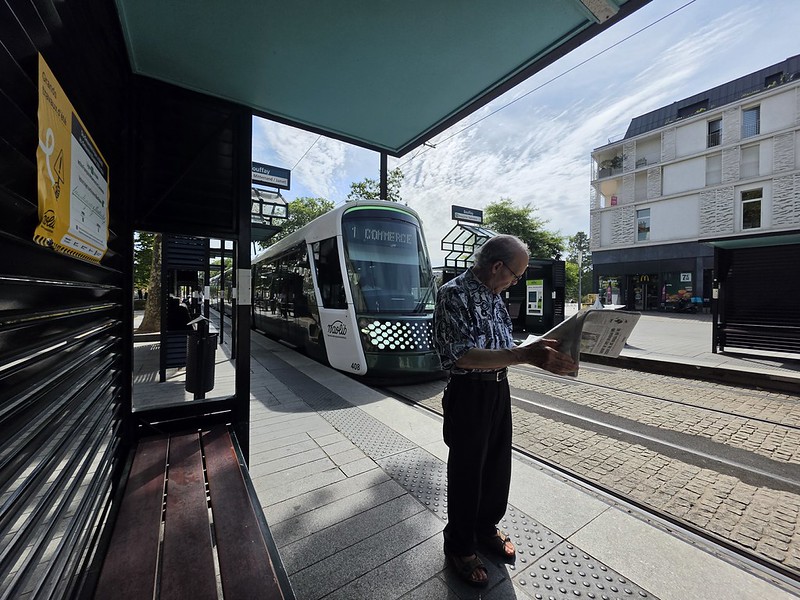
I thought I’d take a photo of a Nantes tram as, well, this is the sort of riveting content on which I thrive. There I stand, phone in hand, and a man decides to walk over, stop and read his newspaper. I decided this felt like a traditional French scene, so there we go.
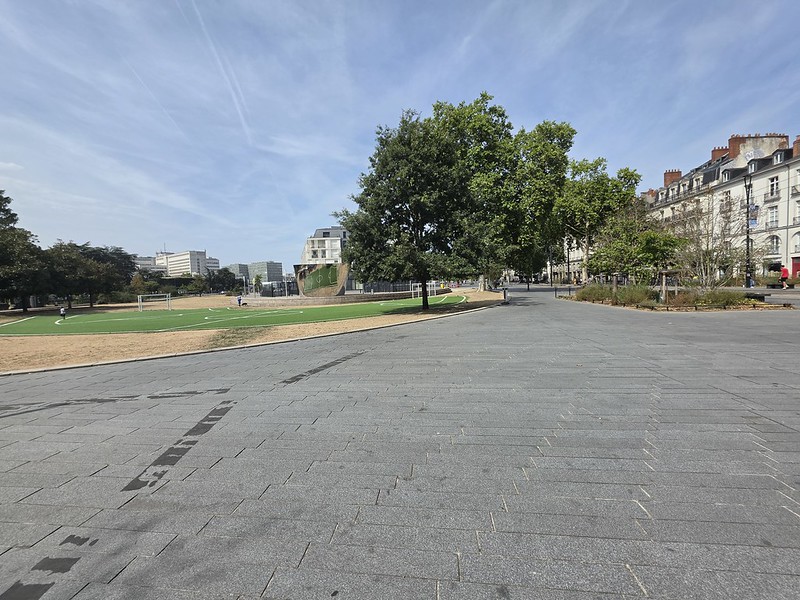
This is Feydball, a permanent public artwork created for Le Voyage à Nantes in 2015, combining a deliberately uneven, crescent-shaped football pitch with a large warped mirror. The reflective surface makes the distorted pitch and goalposts appear reassuringly normal while bending the players and ball out of shape instead, which is perhaps contemporary art’s most accurate contribution to amateur football. The site retains its natural slope and irregularities, so anyone attempting a serious match must contend with geometry, gravity and the possibility that the mirror is making them look considerably more athletic than they really are. This might encourage me to play more five-a-side to be fair if it made me look athletic as there’s only so much that bar billiards can do for my sporting physique.
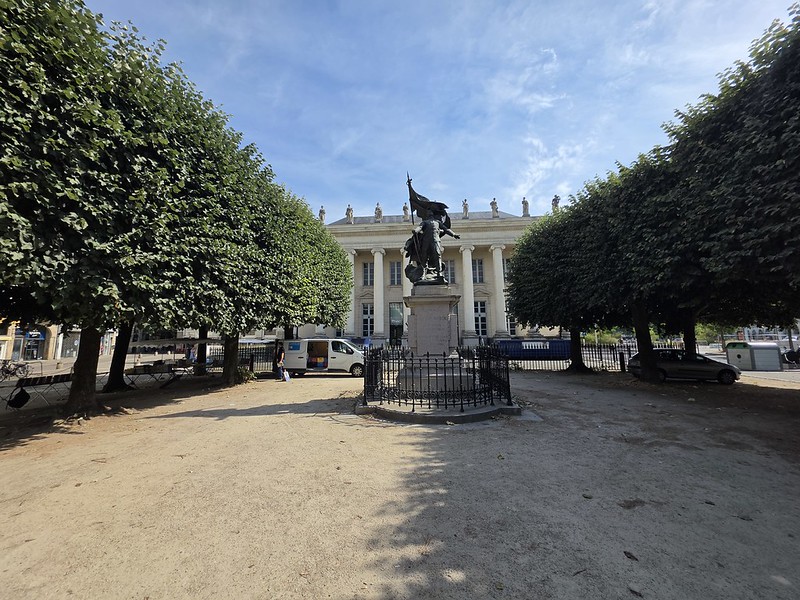
This monument in Place de la Bourse commemorates Colonel Georges de Villebois-Mareuil, a Nantes-born French officer who volunteered to fight alongside the Boer republics against the British during the Second Boer War and was killed in South Africa in 1900. The bronze sculpture, created by Raoul Verlet and unveiled in 1902, shows the dying officer supported by an allegorical figure of France, complete with flag and enough heroic drama to remove any possibility that he had merely sat down for a rest. I assumed that they no longer held any ill-feeling towards the British over the arrangement.
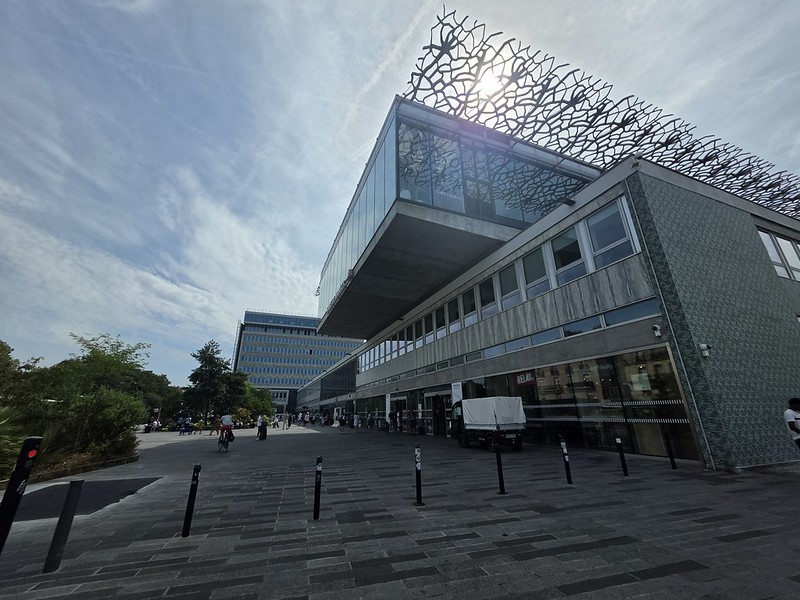
And safely at the railway station with just 53 minutes to spare before my train as I like plenty of time to find my platform. This transpired to involve 18 minutes of staying in front of a giant fan, 14 minutes finding Carrefour to get a drink and 1 minute finding the platform before boarding the train early.