Author: admin

  • Ashley – All Saints Church (Silverley)

    Ashley – All Saints Church (Silverley)

    20240319_101606

    There’s something quite meaningful about visiting a church which is effectively slowly falling down. Long gone are the sounds of people getting married, the sadness of funerals and the joy (well, generally) of a baby being Christened. This church is near to the village of Ashley, but it’s actually the former parish church of the long gone village of Silverley.

    20240319_101536

    Only the tower remains and that’s in a sub-optimal condition to say the least. The nave, the churchyard and any other remnants of the building’s history have long since gone.

    20240319_101752

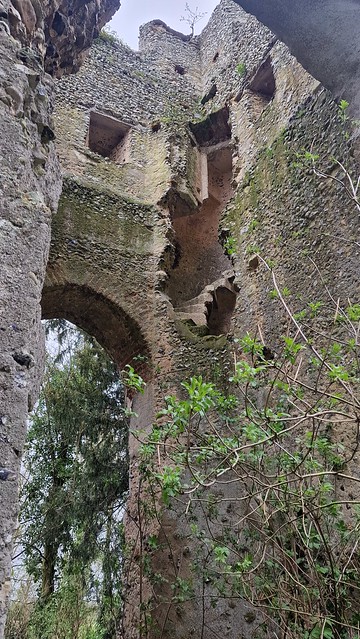
    The former church is especially intriguing as the former staircase to the higher levels of the tower is still visible.

    20240319_101705

    I wonder who the last person was to successfully walk up these stairs and whether they had any indication that they would be the last to do so. It’s sealed at the bottom now to prevents any local pesky kids (or adults) from trying to climb up and promptly falling down or something similar.

    20240319_101724

    It has been solidly built to ensure that it stays in even this condition.

    20240319_102345

    It’s partly hidden from the road and I only knew that it was there because of Google Maps indicating that it was there.

    There are obviously a whole heap of stories about a church in this condition and it relates to the whole situation with Ashley and Silverley being joint parishes. Silverley was once the larger of the two settlements, but the two villages merged and the last burial at All Saints was in 1564 with nearly nothing of Silverley left today. Not that this helped Ashley, as both churches closed in the sixteenth century and the present church in the village is Victorian. But, once again, I digress and I’ll jump forwards a bit in the story.

    There was considerable anger in 1971 when some of the remaining part of the church was demolished. H.E. Thistle of Ousden wrote to the Newmarket Journal noting:

    “I was appalled to read in the Journal of the partial destruction of Silverley church tower. It would be bad enough if those responsible for this act of vandalism were under-privileged louts who knew no better, but it seems from the report that those who decided to destroy the tower were people who were in a position to know exactly what they were doing and yet went ahead in cold blood to demolish a very beautiful and ancient landmark.”

    The correspondent was rightly angry, the church’s destruction was backed by Bidwells and with the accidental approval of the Department of the Environment who it seems got a bit muddled up. That means it’s perhaps possible to partly blame Peter Walker, the then Secretary of State, but it appears to have been something of an administrative error that five tonnes of stone was carted away. The land agents locally claimed that the building was structurally unsafe, but this was proven to be something of an untruth when the demolition team struggled to demolish the structure. All very much sub-optimal and an unnecessary destruction of an historic building. It’s fair to say that the actions of Bidwells were a disgrace and showed huge contempt to the local population and the heritage of the building. Even after the controversy, Bidwells said “it’s all really a question of economics”. Twas ever thus……

    The church had been listed in August 1959 and so should have been protected, although there’s not a vast amount known about its history. It’s thought to have been constructed primarily in the fourteenth century (although it’s likely that there was a religious building on the site before this) and was in use until the sixteenth century when the village faded away, with the building used for a period as a barn. It was though derelict by the seventeenth century, with likely the tower being the only part used. And thank goodness that villagers in 1971 were able to interrupt the demolition to save at least some of the structure. Unfortunately, today the church is I think on private land and there are no interpretation signs or information about the history of the building and bit by bit the structure is likely to slowly fall apart.
  • Lidgate and Dalham – Old Suffolk Road

    Lidgate and Dalham – Old Suffolk Road

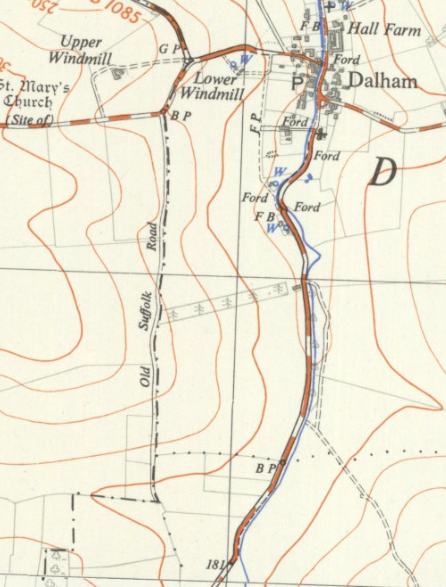
    My posting frequency, and indeed plan to restore a heap of the missing images on this blog, has been a little sub-optimal recently if I’m being honest. I hope to fix that a little now, so riveting content will come pouring out. And what more fascinating place to start than the Old Suffolk Road? It’s the straight line through the middle of the above map, whilst the road had evolved to go through the village of Dalham. It intrigued me as the initial route is a far more sensible one and it also appeared to be higher up, suggesting an ancient route. There are also Roman roads in the area and this track is certainly fairly straight, even though it’s now just grass and there’s no firm surface.
    It’s more evident from this more recent Ordnance Survey map from the 1950s (this is out of OS copyright, I’m not randomly stealing their maps).

    20240319_113757

    There’s the northern entrance to it, the width of a road but no evidence that it has even been a firm surface.

    20240319_113818

    It’s certainly a sizeable trackway.

    20240319_113944

    The view over the local countryside, including the windmill at Dalham.

    20240319_115956

    It started to become evident from this that the pathway was an ancient route.

    20240319_120126

    And then it suddenly stops dead and walkers have to cross the field to rejoin the road. It says that it’s a permissive path (well, permitted path here), although there appears to be evidence that this was a footpath and should perhaps be registered before the 2026 deadline, but there don’t appear to be any access issues here anyway.

    20240319_120441

    The tree line to the right is where I walked, straight ahead is where the path stops and to the left there’s still some evidence from the ground where the track went, although it’s hard to see in this photo. What’s also interesting (well, to me anyway) is that this stretch of track is the border between Suffolk and Cambridgeshire, so there must be some historic element for this route for that to be the case.

    This route is very near to the Icknield Way, the ancient trackway that went from Norfolk to Wiltshire, much of which is today the Ridgeway and Peddar’s Way. I can’t find out anything in detail yet about the origins of this route, but I’ve decided that for the moment I’m placing it as a pre-Roman road which was an ancient route that has just happened to survive in part in today’s landscape. Quite why much of it hasn’t been ploughed up, I’m not entirely sure, although that’s what has happened to the southern end of it nearer to Lidgate. As usual, I’m over-thinking this no doubt, but I find it all rather intriguing to think that I walked along a route that has been in use for thousands of years.

  • 200 Years Ago in Norwich : New Prison on Castle Hill

    200 Years Ago in Norwich : New Prison on Castle Hill

    There are currently quite extensive works going on at Norwich Castle to try and restore the keep to what it might have looked like in medieval times. However, 200 years ago this week, it was decided to approve work on the new prison that would be going into the keep. It was reported in the Norfolk Chronicle:

    “At the general Quarter Sessions for this county, held yesterday se’nnight, it was agreed that the whole of Mr Wilkins’s plan for erecting the new gaol on the Castle Hill should be carried into execution and we understand that the entire expence of the gaol and Courts of Justice should not exceed 46,000l”.

    I still like the word ‘se’nnight’, meaning week (or seven days and nights), it’s a shame that it’s fallen out of usage.

    And, indeed, it fell out of usage in the early nineteenth century.

    On that matter, the usage of the word ‘expence’ was soon overtaken by ‘expense’.

    As for the new prison, the previous one had only stood for thirty years, but there’s more about this at the Norwich Castle web-site. The new prison was built by William Wilkins and it was designed with the new radial structure, something rather forward thinking for its time. Anyway, I digress once again, I was just intrigued to think that there was an exciting building project 200 years ago to the week that this new one is taking place.

  • Craft Beer : 365 Beers in the World – Citra

    Craft Beer : 365 Beers in the World – Citra

    Screenshot_20240124_235137_Readly

    And on another one of my random sojourns, I was browsing through the latest issue of ‘Craft Beer – 365 Best Beers in the World’ and was pleased to note that the first beer in the magazine was one sitting just two metres away from me.

    20240124_235734

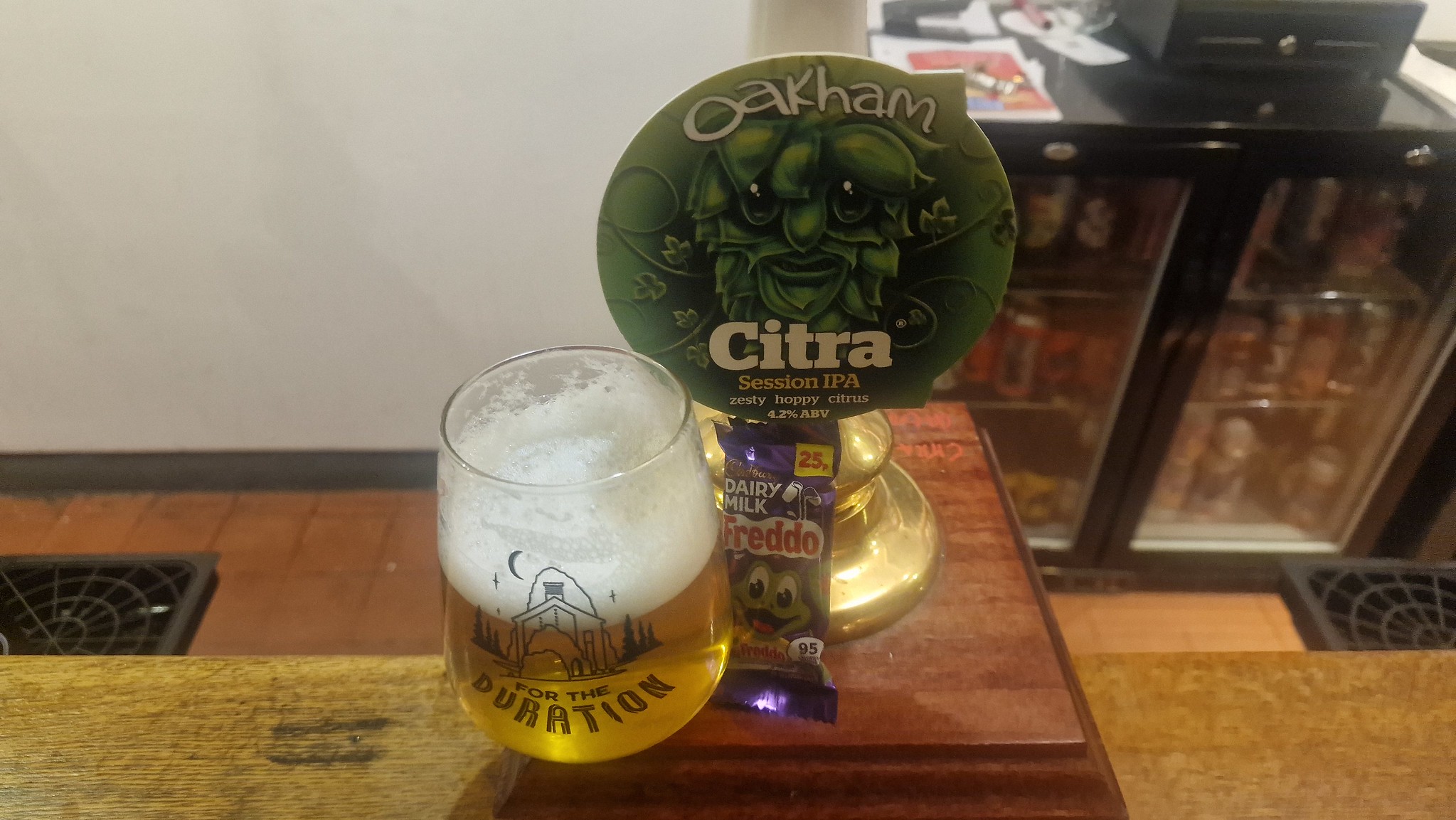
    And here it is, with my favourite Duration glass, a half pint of Citra from Oakham Ales. Alongside a perfect food pairing of a Freddo bar. I hadn’t thought of this beer as being one of the best 365 in the world, but it is a really rather lovely real ale. It’s the first beer that used the Citra hop commercially and it’s certainly been used by many breweries since. Quoting the article:

    “The first sip is a mouth-puckering, palate-popping burst of soft, chewable fruit. A light malt base provides a simple biscuit base as the Citra hops march out all-singing, all-dancing. Rather than muddled bursts of different fruity, butter flavours, Oakham Citra is a smooth, rolling wave of juicy grapefruit and lime that coats the tongue and leaves a sticky, resinous finish without becoming too cloying. The finish is quite sharp, quenching and dominated by grapefruit, each sip offers a little more: peach, melon, papaya and juicy white grapes.”

    My own description of the beer was:

    “Light and fluffy. Is that a beer word?”

    What a beer aficionado I am…. Or something like that.

    That’s 1 out of the 365 that I’ve tried. Let’s see how many more of the 365 I’ll be able to try, or have tried. There might be another series of posts on this whole matter.

  • Pizza and Beer

    Pizza and Beer

    20240115_222202

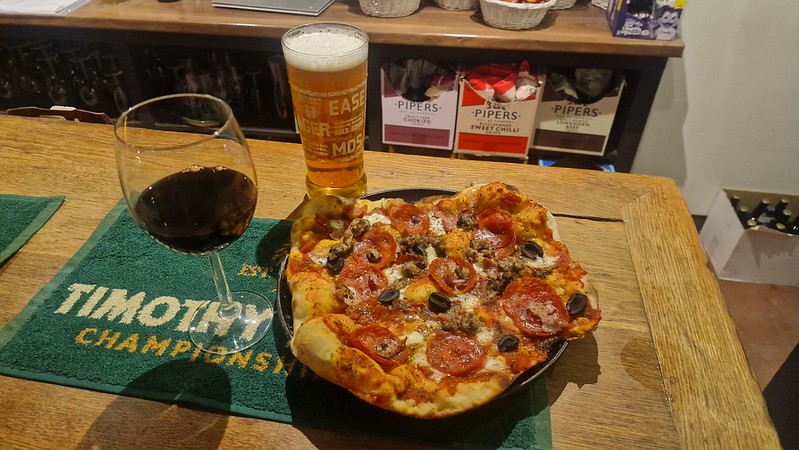
    We have beer and pizza (not to forget crisps).

    What a time to be alive.

    I have some good ideas occasionally, I really do   🙂

  • London – Visiting London Underground Stations in 2023

    London – Visiting London Underground Stations in 2023

    How exciting, I’ve never had an e-mail before from TFL telling me how many tube stations I’ve visited in the year. This is a very poor performance for someone who loves London and the underground so much, especially as I did a quiz this weekend on how many tube stations I knew and I think I did rather well (on the same theme, try this…..). Anyway, I aspire to beat 59 tube stations this year   🙂   In other statistics, I made 108 journeys on TFL in the year and made the most in August. I’m sure my two loyal readers will be thrilled to know this. Oh, and if anyone wants an adventure involving craft beer, London breweries and visiting underground stations later in the year, let me know  🙂

  • Bucharest Trip : Manuc’s Inn

    Bucharest Trip : Manuc’s Inn

    20231115_221559

    It’s fair to say that my blog sort of curtailed itself half way through the Bucharest trip when I got distracted with something else, but I think it’s time to now rivet my two loyal readers with a few final posts about this very marvellous trip. Bev had ruled out my idea to go back to Excalibur to get another chicken, so instead we decided to go somewhere a little more decadent and we opted for Manuc’s Inn. This is something of a local institution and there are numerous elements to the dining area, but we were seated downstairs in the rather captivating cellar area. There’s plenty more information on the restaurant’s Wikipedia page, but it’s over 200 years old and the oldest remaining hotel building in Bucharest.

    20231115_194300

    I hadn’t had this beer before and if I’m being honest, I’m unlikely to have it again. All very average, but decent enough as we weren’t in a craft beer bar and I knew we were going to one later on. I’m very tolerant and patient like that.

    20231115_195904

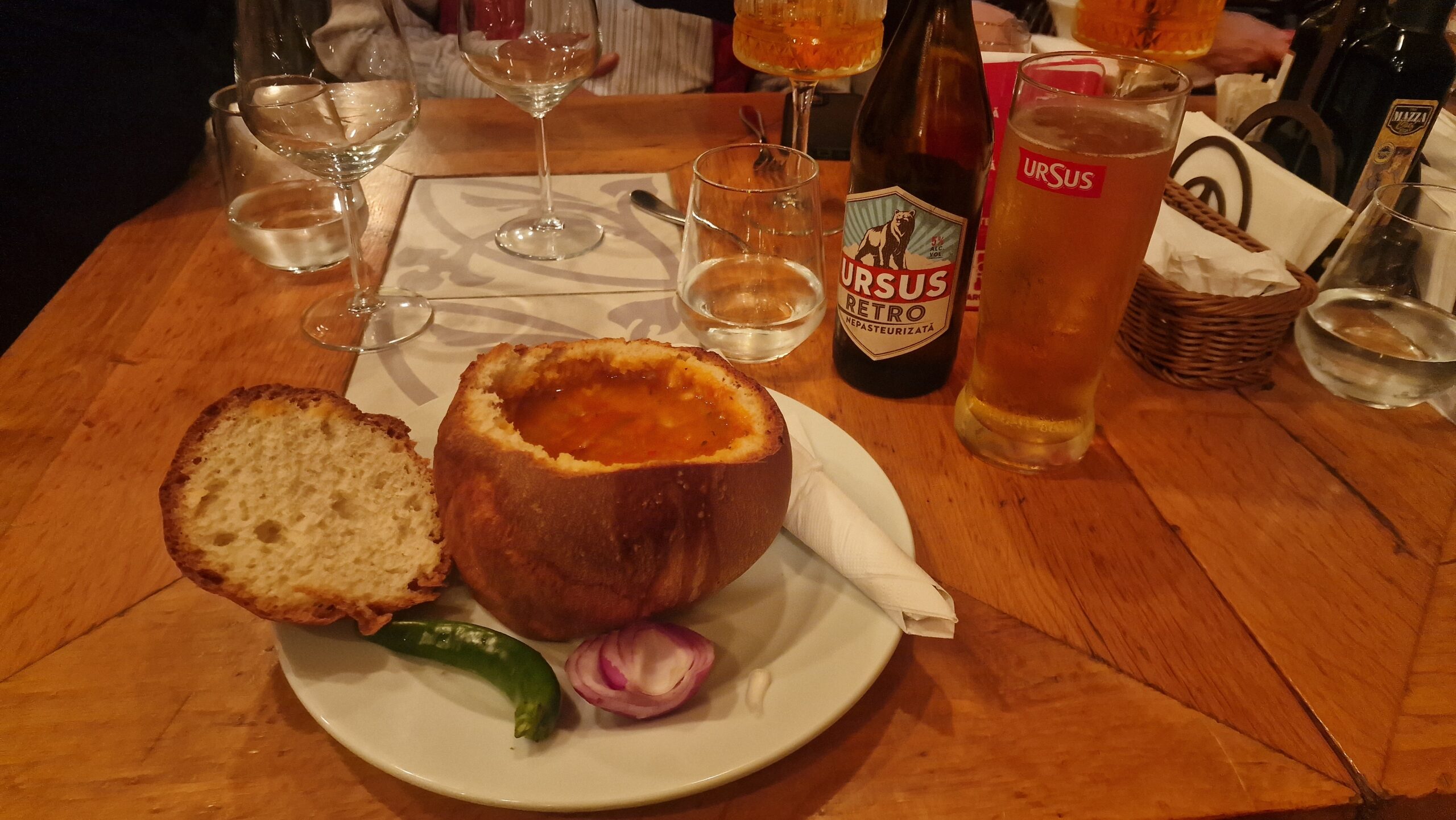
    This was the bean soup with smoked pork served in a bread bowl, far more filling than I needed for a starter if I’m being honest. But, there was a depth of flavour to the soup, I stupidly ate half of the chilli which was far too hot and then enjoyed the moist bread. A suitably entertaining starter for the meal, whilst Bev was busy annoying the waiter. He coped admirably.

    20231115_200158

    Thim likes his wine and he approved of this vessel.

    20231115_200954

    I correctly identified it as red wine. I’m not really into red wine, I’m too much imbued in the whole beer culture, but it had a pleasant taste.

    20231115_201445

    There was a relaxing atmosphere to the whole arrangement, I liked it.

    20231115_203132

    No, not chicken strips, but chicken schnitzel, although I suppose that’s not far removed from it. Served with chips, which is very classy of me. Forgetting that the green chilli had been too hot for my starter accompaniment, I had Steve’s chilli and remembered again that it was too hot. I don’t get out much…

    20231115_215548

    Goodness knows what Bev was doing, getting ready to complain about something I imagine.

    20231115_221532

    We lingered for quite a while so the restaurant became quiet, but we had to leave as I had demanded another visit to Hop Hooligans.

    20231115_221708

    An enjoyable evening, especially since Thim treated us to the whole meal which was an unexpected surprise at the end of proceedings. He’s always been one of my favourite people that Thim. But, back to the restaurant, I found the service attentive, the environment was inviting and the food was reasonably priced given that this is one of the main tourist destinations for food in the city. It was the last night that we were all together in Bucharest and I think that we were all pleased with the choice. The on-line reviews are positive and it’s worth visiting not just for the food, but also because of the history to the building and its courtyard.

  • Humber Doucy Brewery – Meet the Brewer at the Lidgate Star

    Humber Doucy Brewery – Meet the Brewer at the Lidgate Star

    20240112_194508

    Meet the Brewer events are some of my favourite things and I’m delighted that the Lidgate Star has two a month of them. We have a lot of very lovely and supportive brewers in the area who are really keen to engage with pubs. John from Humber Doucy brewery was at the Star talking through six of his beers. One of the nicest brewers you could imagine, the brewery are a father and son team based in Bacton in Suffolk. Their brewery, which I’m going to get to soon I hope, is in a former 1950s MOT garage and it all looks very smart from the photos. The brewery name is inspired Our name is inspired by a road in Ipswich, said to have been named by French prisoners of war in the 1800s.

    20240112_202822

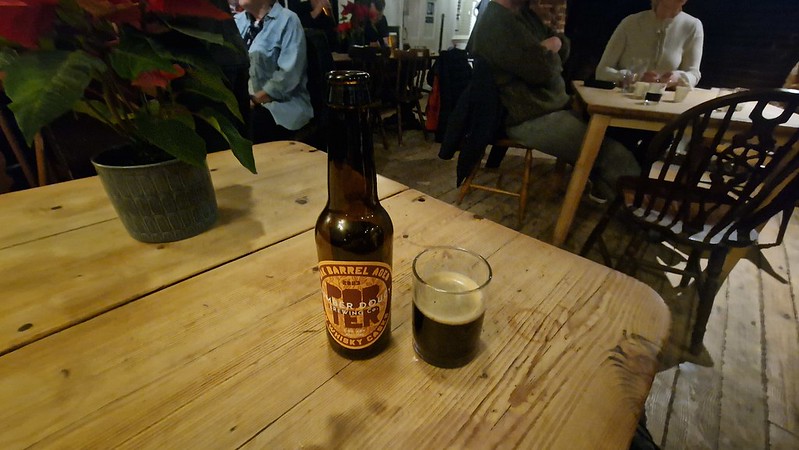
    My favourite beer of the evening was the oak barrel aged porter, a rich and decadent little number with plenty of richness. They also have a more usual porter, a nettle & elderflower saison, a red ale and a bitter, all intriguing and interesting. John talked through each beer, spoke about the brewery which all proved entertaining. Their web-site is at https://humberdoucybrew.co/ and their Instagram is at https://www.instagram.com/humberdoucybrew/. The pub’s next two meet the brewers are Mauldons and Three Blind Mice.

  • 200 Years Ago in Norwich : Wheat Sheaf on Bethel Street

    200 Years Ago in Norwich : Wheat Sheaf on Bethel Street

    From the Norfolk Chronicle and Norwich Gazette from 200 years ago, I noticed this little advert:

    “WHEAT SHEAF

    Bethel Street, Norwich

    John Woolterton, late of the Flower in Hand at St. Mary’s,

    Returns his best thanks for the favors conferred on him in his late situation, and begs to inform his Friends and the Public, that he has taken the above Inn, the Wheat Sheaf, where he hopes to merit their support, by furnishing the best of wines, spirits and malt liquors, with a strict attention to the comfort of his customers, in the supply of good beds, stabling and a bountiful but economical table.”

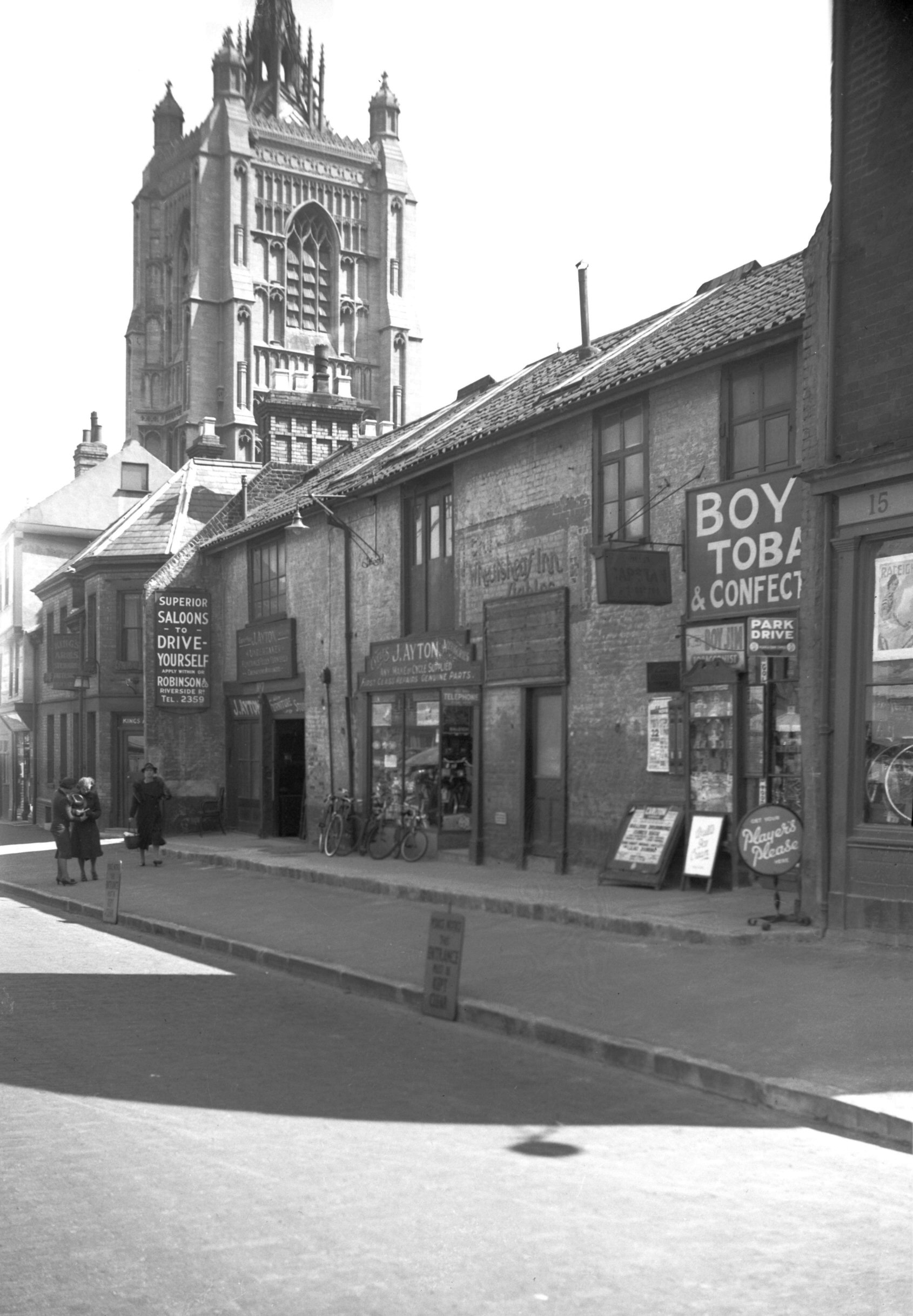
    As a side note, interesting to see that the spelling of ‘favors’ without the ‘u’ was still common. The Flower in Hand was run by John Woolterton between 1810 and 1822 and was located on what is now Pitt Street. It was damaged during the Second World War, repaired and then closed in the 1960s. The Wheat Sheaf on Bethel Street was demolished in 1936 to make way for the new fire station, which has now in turn been converted into a school. The wonderful George Plunkett was able to get a photo of the pub’s former stables in 1938.

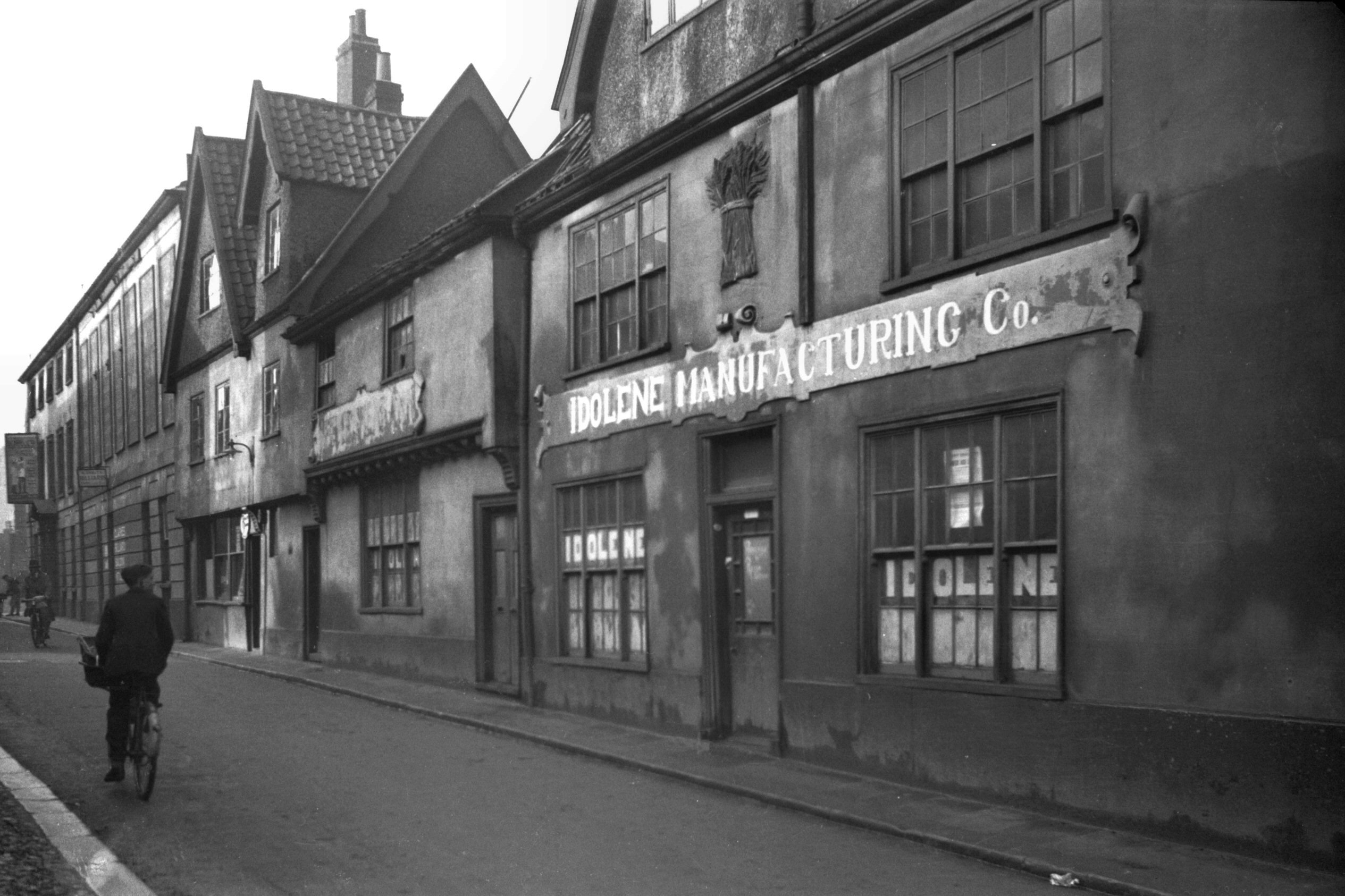
    And more importantly, he got a photo in 1934 of the pub just before it was demolished. By this stage it was no longer a pub and George Plunkett wrote:

    “At No 14 was latterly the Idolene Manufacturing Company, occupying premises formerly the Wheatsheaf inn and retaining its sign above the door, moulded in plaster. It has been suggested that this was intended for a sheaf of barley, for the old Barley Market dating back to the reign of Edward I was formerly held in an adjacent yard. One of the chief attractions here was the skittle alley, but the inn also afforded stabling on the opposite side of the road for the accommodation of carriers. These stables in fact outlasted the inn, surviving until 1960 as lock-up shops, including those of a tobacconist and a secondhand furniture dealer. The inn itself was a Tudor building of several gables, and it was reported at the time of its demolition that certain of its oak beams were to be preserved at one of the city’s museums. There is no record that this was ever done.”

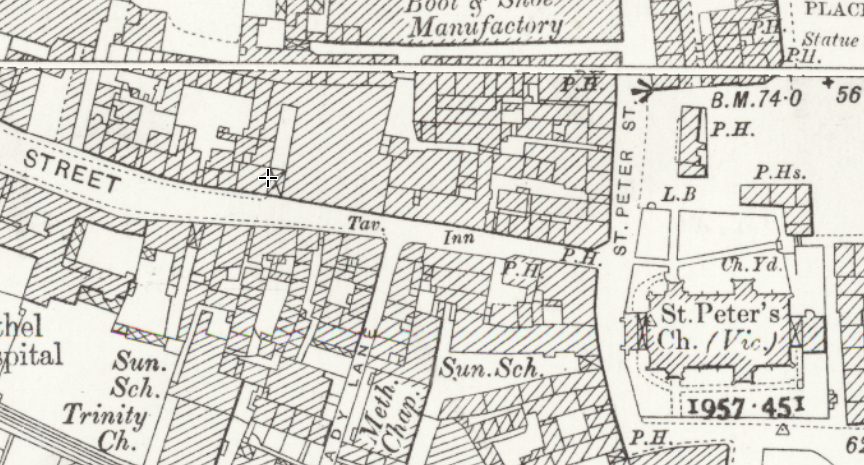
    The pub is the one in the middle of the above image. It’s actually now under Bethel Street before City Hall and the Forum as the street line has moved a little, a rather unfortunate loss to the city as that area is now a little sterile. Anyway, once again, I digress.

  • 200 Years Ago in Norwich : Discovery of a Chalk Mine

    200 Years Ago in Norwich : Discovery of a Chalk Mine

    In the latest in my series of posts from the Norwich Mercury of 200 years ago…..

    “Singular Discovery – On Tuesday, as some men were employed in sinking a well upon a piece of land belonging to Mr. Sendell, situated within a hundred yards of the site of St. Giles’s gate, they suddenly found themselves over a vault when about 35 feet from the surface of the earth; naturally alarmed at such an appearance, they left their work until the afternoon, when they provided themselves with stronger tackle and proper implements for ascertaining the “depth below”, they soon found that no danger was to be apprehended in descending to explore the cavern, and accordingly proceeded with a supply of lights, and found very beautiful and extensive vaults, running in almost all directions.

    Encouraged by this account, Mr. Sendall and some friends descended to view these unexpected excavations. The air was perfectly pure, and the soil, which is a fine solid chalk, quite dry and of snowy whiteness. On lights being placed at various turnings the appearance was extremely interesting; at what period these places were in use cannot be ascertained, as neither record or remembrance of them exist. They they are growing over the mouths of 60 to 70 years of age, yet the marks of the tools appear very fresh, and the stains of smoke remain in the small niches where lamps were placed by the workmen. A great anxiety to see them has been manifested by the public, and in order to gratify such curiosity we understand Mr. Sendell has waited upon our worthy Chief Magistrate for permission to exhibit them, which permission has been very handsomely granted, and the exhibition will commence as soon as a comfortable entrance can be effected at the front of the hill. It is a singular fact that many marine shells have been taken from the solid chalk in the sides of these arches.”

    There’s a whole network of these chalk mines around Norwich which have caused some excitement over the years, not least when a bus fell into one near to the Roman Catholic Cathedral on Earlham Road. They were caused by mining for flint and chalk and plenty are still under the city centre, although many have also been filled or their entrances closed by nervous  property owners and councils. The city council makes reference to these discoveries in their recent notes for the St Giles conservation area.

    “It is believed that for several hundred years after the 11th century (and maybe earlier) the area was closely associated with chalk and flint mining. In 1823 an extensive system of tunnels were rediscovered under Earlham Road. They became a tourist attraction and candle-lit tours took people through various tunnels with names including Beehive Lane, Bacchus Street and Royal Arch. One cave was found to contain the inscription ‘John Bond 1571’.”

    There is a map of the streets in the area from 1823, but I haven’t yet been able to locate a copy. Although tucked a little away in the Norwich Mercury, the discovery was certainly one which caused some general excitement amongst the denizens of Norwich. Urban explorers still try and find entrances to various chalk mines across Norwich, but I’m not brave enough to do that (there are limits to even my bravery).