Tag: Tczew

  • Tczew – Hotel Vela

    Tczew – Hotel Vela

    My stay earlier on in the week when I visited Tczew was at the Hotel Vela, where I also ate in the evening. It appears to be part of a large German hotel chain judging by the brochure in the room and I can imagine this is a thriving location in the summer when things are a little warmer. There was a friendly welcome at the reception desk, which is within the main restaurant part of the building. Unusually the hotel uses physical keys rather than keycards and I was told that although the reception desk closed at 23:00 I could still use the key to get back into the building. However, I wasn’t entirely sure what I would be doing in Tczew at that time of night since most things seemed closed in the day, but it’s an handy option.

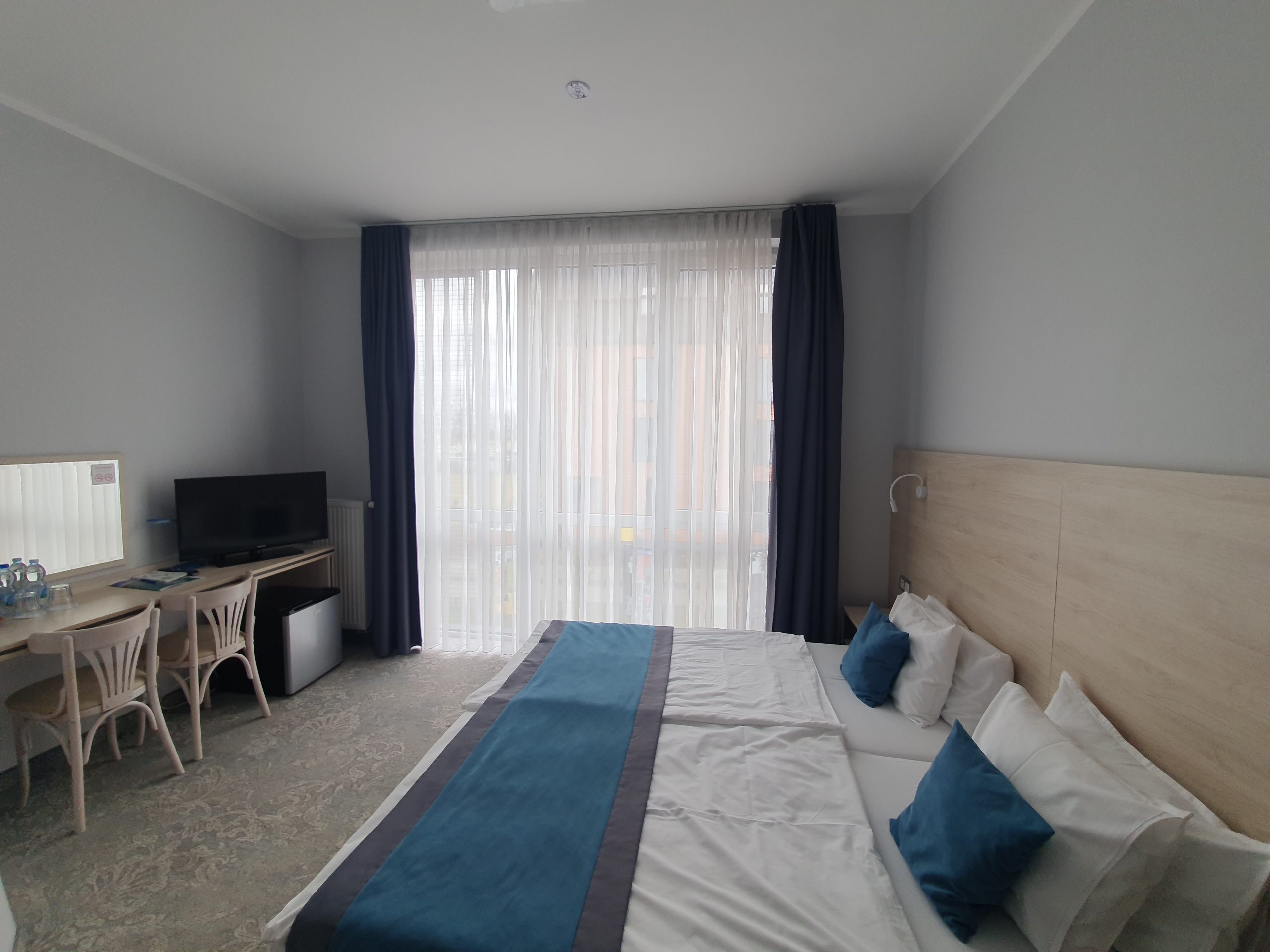
    The room was clean and bright, with quite a modern and Scandinavian feel to the arrangement.

    A handy selection of coffee and teas, along with bottled water.

    I had been hoping for a view of the bridge that I had come to the town to look at, but I did get a river view of sorts if I stood by the window.

    The breakfast arrangement was adequate, nothing exceptional and lacking in any rolls, but there were the standard range of basic options available and I liked the appearance of the olives as part of the offering. They did ask if I would like a hot breakfast as well, but I declined that option. I’m not entirely sure how many guests the hotel had, but I didn’t see anyone else at breakfast. That does make a slightly awkward arrangement when there are three staff members and just me, but that isn’t a rare occurrence when travelling January.

    The room was moderately priced and there were no noise issues internally or externally. I think I’d stay here again if visiting Tczew as it was a quiet hotel and it’s a nice part of the town. The breakfast didn’t surprise and delight me, but it was entirely adequate and I suspect it was catering for a very low number of people. There’s further information about the hotel here.
  • Tczew – Tczew Bridge

    Tczew – Tczew Bridge

    Right, let’s start with a video.

    If the video doesn’t auto-play, it’s at https://julianwhite.co.uk/20220130_112310.mp4 (the co.uk is correct in this case!).

    I think that this is quite exciting, a bridge of this length in a state of disrepair obviously had quite a story behind it. I didn’t know much about this bridge until I was in the train going over it last week, and I thought that I’d spend one night in Tczew on my way back to go and visit it. I carefully booked by seat on the train so that I could sit by the window and make this video, with that fortunately all going to plan.

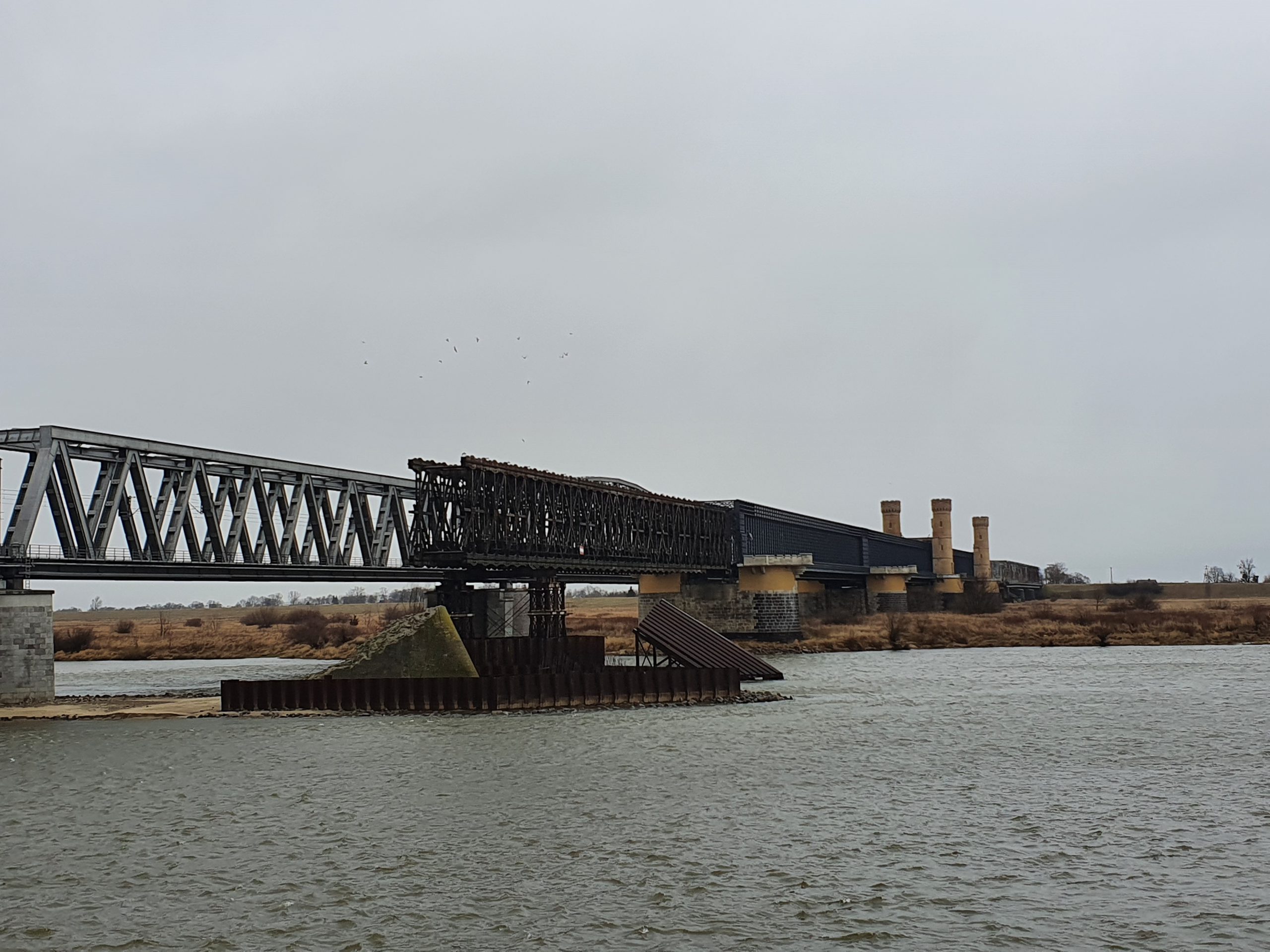
    There are two bridges here, behind is the rail bridge which is fully operational, and in the front is the broken bridge. Going back in this bridge’s story, it was first constructed between 1851 and 1857 and was designed by Carl Lentze. The bridge was 873 metres long, a phenomenal distance that made it the longest bridge in the world at the time (or certainly the longest in Europe, the claims vary). It was all a bit more decorative once, there were ten turrets on the pillars and two at each gate, but only four of these turrets remain today and they’re visible in my video. They were a bit dithery with finishing these, the bridge had been open for a year before the turrets were completed in 1858.

    The 150th anniversary stone placed here in 2007. The bridge was initially both a road and rail bridge, but it soon became apparent that a separate rail bridge was needed and this was completed between 1888 and 1891. What is now the broken bridge was then only used by vehicles and pedestrians. The broken bridge (I’m not sure that’s its technical name) was lengthened in 1912 with three additional spans, meaning that it’s now 1030 metres long. Well, it isn’t, as there’s a hole in it, but it would be if there wasn’t a bit missing.

    It was the Polish military who blew the bridge up on 1 September 1939, right at the beginning of the German invasion of Poland, and they destroyed the sixth span across. German troops were held up on the railway line as they wanted to secure the bridge to enable their troop movements, but it was successfully destroyed by the Poles. It’s fair to say that the Germans were considerably annoyed about this.

    The railway bridge was destroyed in 1945, leaving no vehicular structure connecting the two sides of the river, although a pedestrian crossing was rigged up. The bridges were swiftly repaired after the end of the Second World War and normality resumed, a separate road and rail bridge. However, in 2000, the road bridge was closed due to it being damaged and unable to cope with the volume of traffic. This wasn’t meant to be a permanent closure and rebuilding work was planned to fix things again.

    There are conflicting stories about this on-line, but it seems that work was planned to rebuild the road, but it has become mired in architectural disputes and delays. I don’t quite understand why the road bridge has been left like this, at first I thought it was just unfixed war damage, but the whole issue is much more recent. It seems that the architectural repairs made after the Second World War are seen as important, as very few survive in this form, so the initial plan to just demolish them to rebuild the bridge had to be scrapped.

    This is the old approach road to the bridge from Tczew, with a diversion required now for cars.

    And that’s the road to nowhere. Well, straight into the river.

    And some views of the bridge from the river path, and it’s an impressive sight. There are a few interpretation boards which give some information about the bridge’s history and I think it’s still one of the most intriguing things that I’ve seen in Poland. I accept it’s not the medieval castle of Malbork, but the bridge does tell its own story.

  • Tczew – Restauracja Vela

    Tczew – Restauracja Vela

    There were a fair number of closed places in Tczew, so I thought it’d just be easier to get an evening meal at the hotel that I was staying at. I would say that there were views over the river, which there technically are, but it was dark and so I couldn’t see them.

    There was a reasonably good choice of beers, about six different ones, which is a decent effort that I was pleased to see. This is the Komtur from the Browar Gościszewo brewery, a perfectly acceptable, if not exceptional, black lager. But it’s something different, and that’s always good to see. The venue isn’t hugely featured on Untappd, I was only the third person to tag a beer in at the restaurant, and the last time was over two years ago. I have noted it’s being used more even in remote Polish towns, hopefully that trend will continue.

    The service was polite and attentive, although the staff weren’t overly strained by the number of customers in the restaurant, which made that easier.

    I wondered in advance why a restaurant which has signs for pizza up everywhere, including a large banner outside, had no photos of pizzas on their on-line reviews. It transpires they’re not doing pizzas at the moment, which seems an odd arrangement given they seemed to have them as something of a priority in their marketing. But, perhaps their wood fired pizza oven they refer to is broken, or too expensive to operate in the winter.

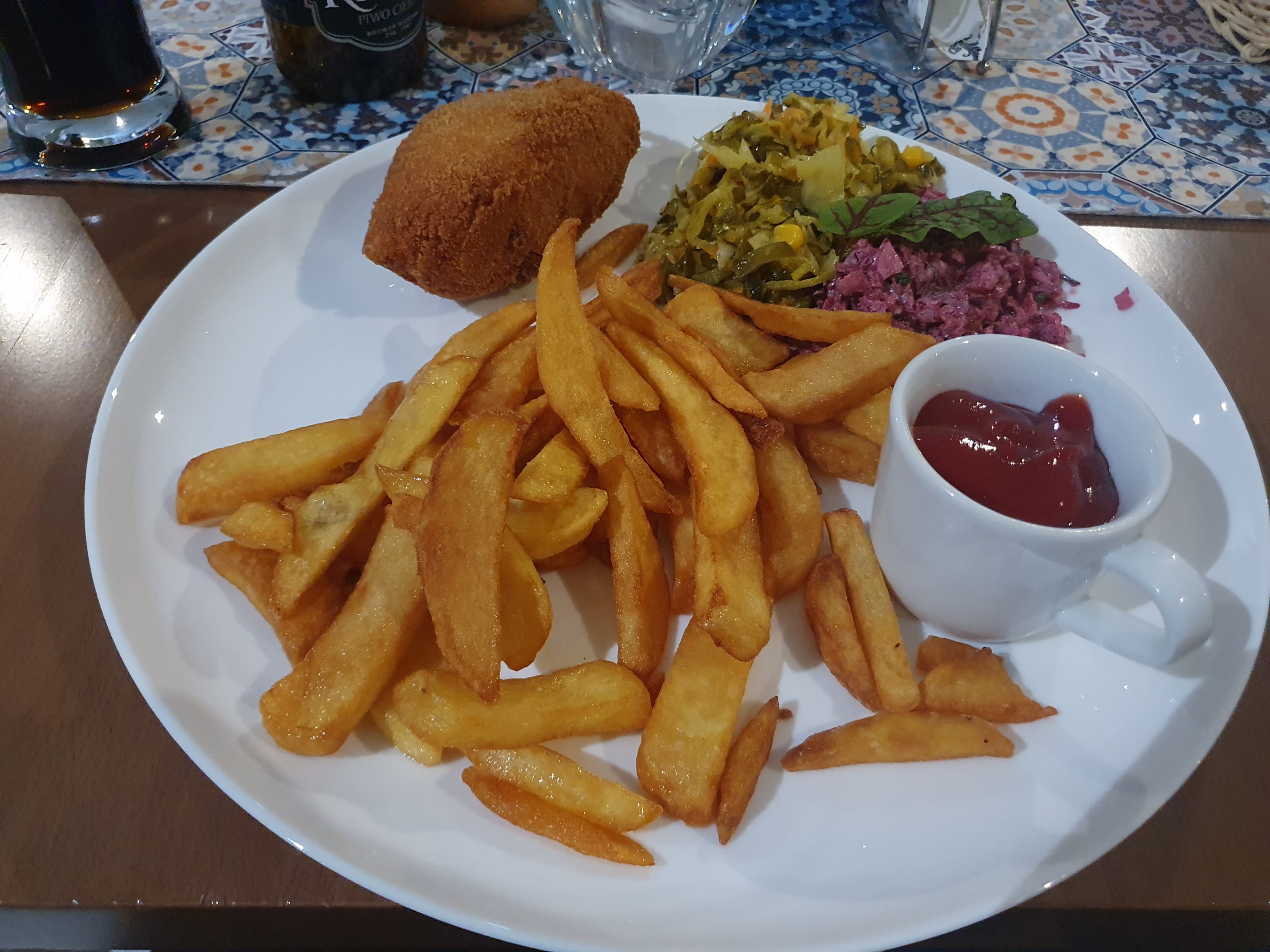
    Back to the food, the photo here is a bit distorted, the elements on the side look large and so this chicken kiev looks smaller than the tomato ketchup container. It was much large than this photo suggests, the chicken was tender and the chips were very moreish. That heap of pickled (or fermented, I get them muddled up) vegetables added some nice sourness to the arrangement, and the chips were suitably moreish.

    The prices were all reasonable here, although the atmosphere was a bit muted since for the most part I was the only customer. I accept that my asking at check-in if I needed to reserve a table was a bit aspirational, but it had been quite busy earlier on in the day so I thought best to check. I probably would have had a pizza if they were available, but the chicken kiev turned out to be a good choice, so I left happy. I’d say this is probably quite a safe bet for a meal, especially during the summer months when it’s possible to see the river and bridge and there’s some external seating as well for when it’s not snowing.

  • Tczew

    Tczew

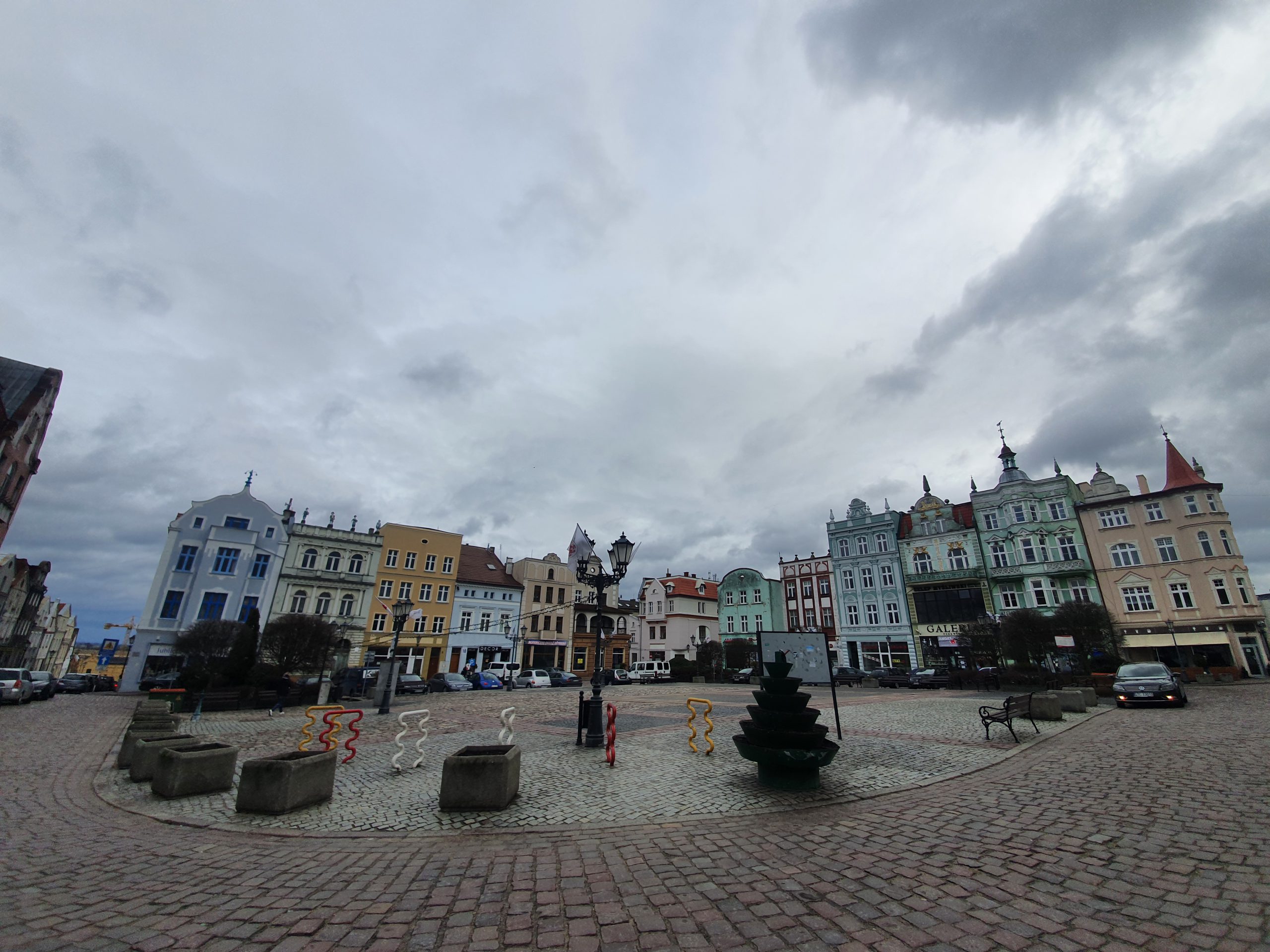
    Some photos from my visit to Tczew a couple of days ago. Unlike the other towns I visited this week, namely Elbląg and Malbork, this town was part of Poland after the First World War, not part of East Prussia. On a cold Sunday in January, there are a lot of locations that can feel a little drab, but there seemed to be a lot of buildings that needed restoration and repair in Tczew, some quite urgently. Not least the Post Office, which had to be cordoned off on the Monday morning as some of the roof tiles had fallen off and smashed onto the pavement.

    There are a few cafes and restaurants in the town, but they were generally closed and there didn’t seem to be many people about. I’m not sure that the town is ever that touristy, most visitors are perhaps like me, particularly interested in the bridge, but more of that in another post. There are some areas which are looking like they’re receiving investment, but the old town is in need of a lot of funding. Although that partly means that the old town area has retained some of its charm, there’s an authenticity about it which isn’t evident in those towns which have been over-developed commercially.

    It was also evident just how many monuments to war and death there are in Tczew, but this area has been fought over for centuries and it received a particularly bad time during the Second World War. In the communist influenced post-war period, the town wasn’t given the investment that it needed and it is fortunate that it is something of a rail hub to ensure that some money comes in. A small new shopping centre has been built, but the commercial development that is present in many Polish towns hasn’t reached Tczew yet. That importance of the rail network is evident in the modern railway station that they have, but there were hordes of Polish teenagers meandering around Tczew who were perfectly well behaved, but they looked bored. I get the impression that there isn’t much for them to do here, and if there is, they don’t want to do whatever it is that is in offer.

    There’s something about this town that makes me think that its best years are ahead of it, as I can imagine economic growth and increased prosperity will come. The town council has launched a regeneration campaign to improve housing, transport and facilities, and they’re keen to increase the population size and enhance the charm and resources of Tczew. As for tourists, unless they want to walk along the river bank or go cycling, there’s not a vast amount here to see, although there is a branch of the Maritime Museum. But if facilities do improve, I can see more people happily spending a night here as part of a wider trip to Gdansk, as the town has a quirky and interesting feel to it.

  • PKP – Tczew to Gdansk

    PKP – Tczew to Gdansk

    After a week of visiting a number of towns in Northern Poland, it was time to go back to Gdansk. As mentioned when I arrived in Tczew, this is a modern railway station but it’s a bit soulless and lacking in much character.

    The main foyer area isn’t as grand and historic as the one in Malbork. There’s a fair amount of seating dotted around the station, both in this area and in the corridor above the platforms, although it was warmer in this bit.

    The usual sheet of train times, mine was the 11.25 into Gdansk.

    It’s not easily visible from this photo, but the train was delayed by 15 minutes, which was far from ideal. The train going to Vienna is listed above the train to Gdynia and it was apparent to me that it was unlikely to come in on the same platform as listed here, as the trains were coming from different directions. My train knowledge is sufficient to know that two trains due within one minute of each other and coming from different directions is a problem for signallers.

    As an aside, this train on another platform belongs to http://shortlines.pl/ who were an open access operator with high hopes, but their services have been dramatically reduced over the last few years.

    I’m not sure what the police (I think these are the equivalent of the British Transport Police) were doing with their big dog, but it looked quite friendly and was safely muzzled. This is the Vienna train coming in and it’s by now apparent that the train I want is coming in shortly and they’re going to have to use another platform. And that’s what happened, in Polish only (I mention this as in Gdansk there would usually be an announcement in English as well) there was a last-minute announcement that they shifting the Gdynia service to platform 2. So we all rushed over there…..

    I have to add, this travel can be a bloody nuisance and public transport operators don’t make things as easy as they perhaps could as they must have known some time before there was a platform change needed. There was a fallback that I could see a train to Gdynia with the regional network was leaving soon if I missed my booked service, but it’s all quite challenging to work out where to go.

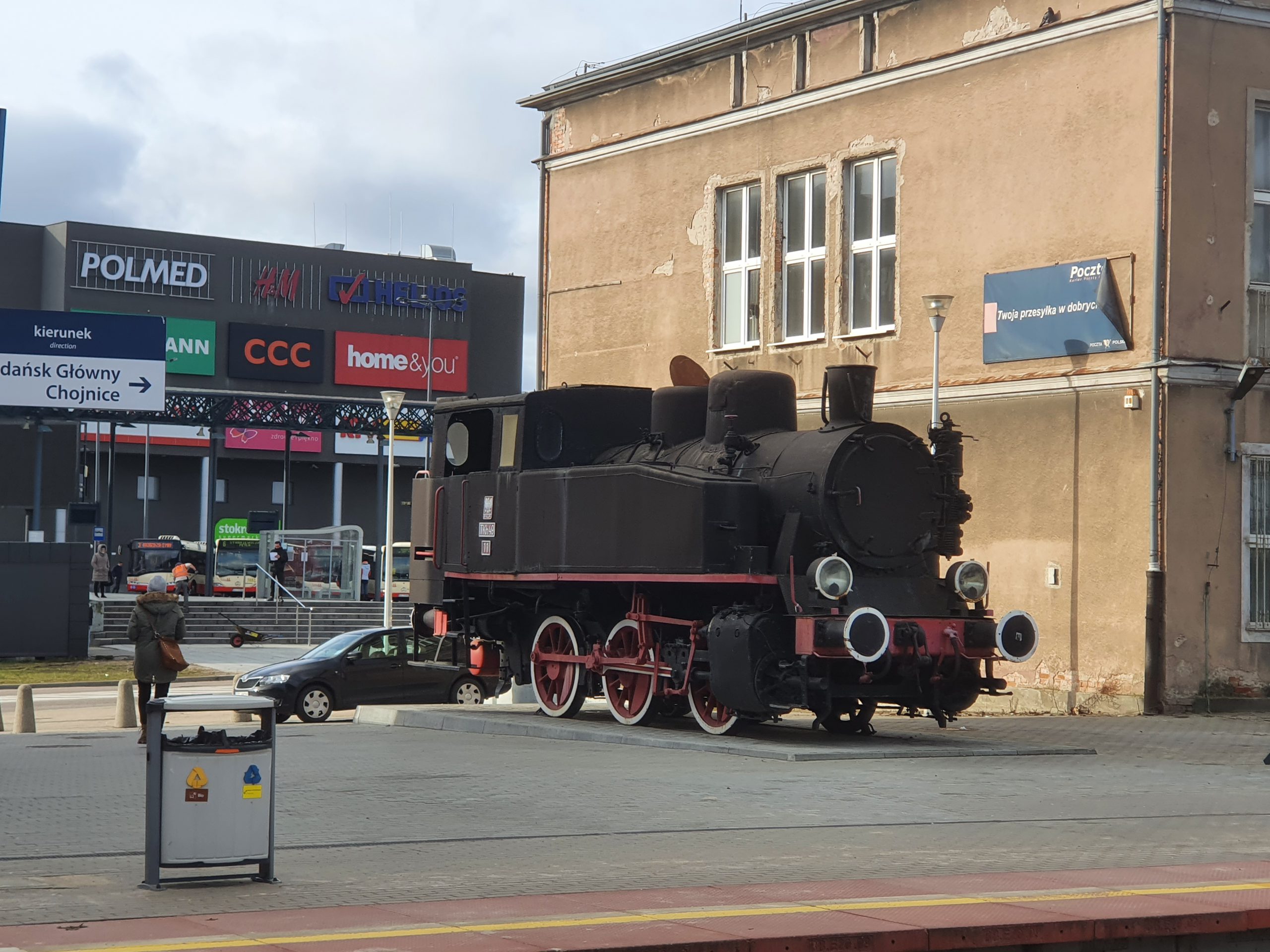
    Apparently this is steam engine TKh 5699, in use on the Polish rail network between 1961 and 2002, when it was brought here to sit on the concourse.

    On board the train, I frankly couldn’t be bothered to find my reserved seat as I was getting off at the next stop and this group of chairs was empty. The screen gives updates on the service and that it’s running 15 minutes late.

    They’re quite a comfortable arrangement, the table extends for those wanting to use a laptop of spread out their bakery purchases, with power available under the seat.

    My ticket wasn’t checked during the journey, and there’s the train to the right and Gdansk railway station (still under modernisation) on the left.

    And back into Gdansk….. The journey was a nuisance in terms of trying to board the appropriate train, but everything was comfortable enough after that. The cost of the journey was about £2 and I purchased my ticket on-line in advance, although there are ticket machines at the railway station.

  • Tczew – Tczew Pig Market Massacre of 1940

    Tczew – Tczew Pig Market Massacre of 1940

    For reasons that aren’t entirely surprising, there’s not a great deal mentioned about this side of Tczew’s history, but I went to look for this after reading about the atrocity that happened here on 24 January 1940. As an example, there’s a very brief mention on the UK Wikipedia site about the mass murder, but only on the Polish Wikipedia site is there a page with details of the event.

    On the night of 23 January into 24 January 1940 there was a fire in a metal products factory in the town, likely caused by incompetent German troops who put an open fire too near cars to keep them warm in the cold conditions. That fire destroyed eleven cars and the German officials decided that they’d blame Polish dissidents who didn’t like the new German regime that had been imposed on them a few months before. The local Nazi officials wanted individuals to pay for this, some said that one person must die for every car destroyed.

    A number of local Polish men were rounded up, partly by chance, but mostly as they were on lists of people that the Nazis didn’t entirely trust. They were arrested and their families told that they would be released after questioning. That was untrue, the thirteen men were taken to the pig market in the town and were executed. This was botched by the Nazis, it was said that some of their men were drunk and incapable of firing accurately, so the local Gestapo leader had to kill some at short range. This was Adolf Leister, who I understand was executed in 1944 by Soviet troops.

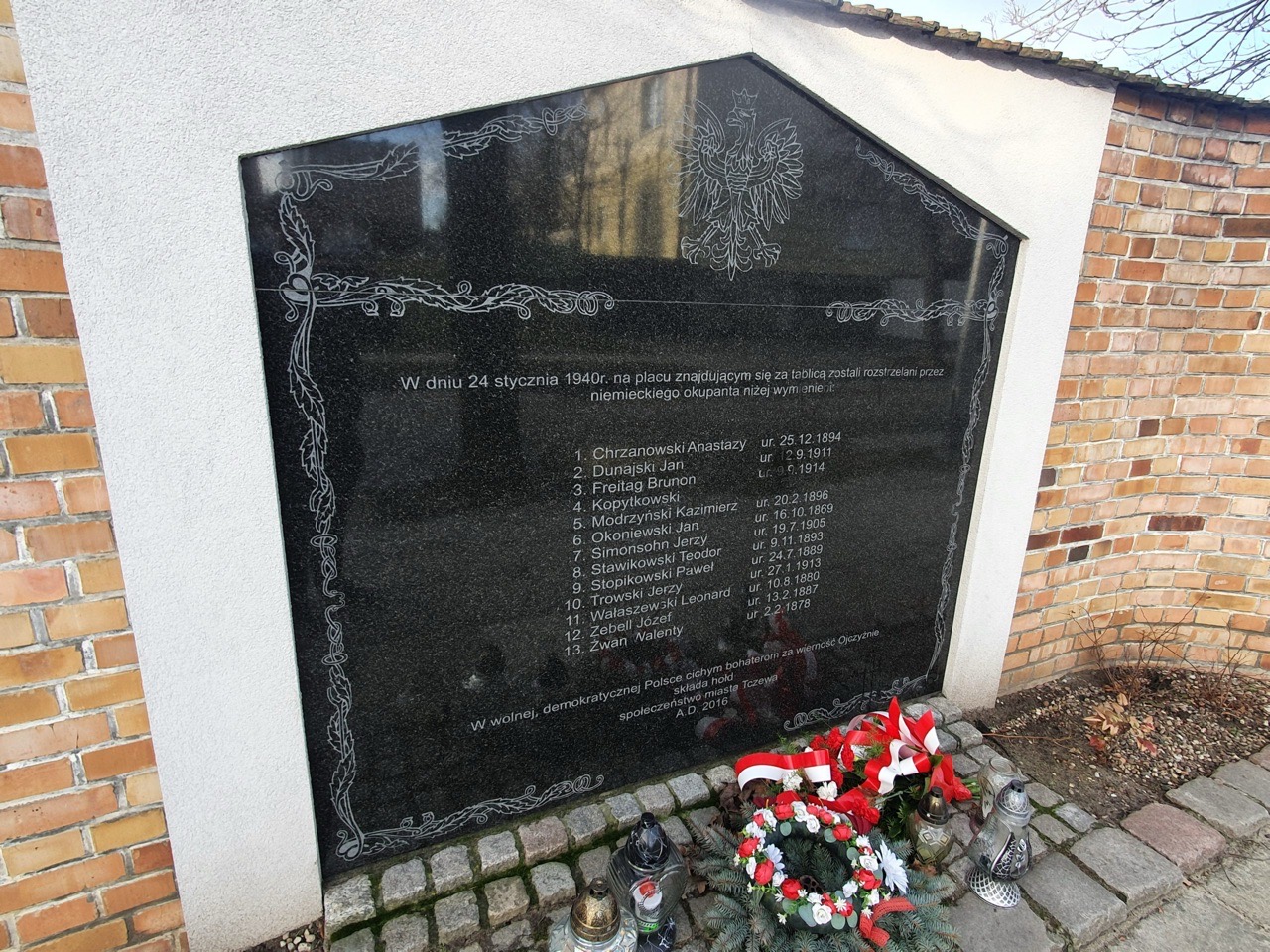
    The memorial has the names of the thirteen men who died, a range of ages, with the victims being born between 1869 and 1914, with their bodies being dumped in the Szpęgawski Forest. This forest was used frequently to get rid of the dead, with 39 mass graves having been found here. No-one was ever caught for their involvement in this massacre in the town, despite attempts to hold Walter Becker, one of the commanders of the unit, responsible.

    A plaque was placed by the site in 1945, although it has since been replaced with the current one and moved a few times because of nearby developments, not least the construction of the fire station that is now on the site. There seems to be a lot of confusion as well about the exact names of the dead and a lack of clarity about exactly what happened that night. What is certain though is that it was a war crime that took place so early on during the war, marked by one of many memorials around the town.

  • PKP – Malbork to Tczew

    PKP – Malbork to Tczew

    Moving a bit closer to Gdansk again today by going to Tczew, this is the railway station in Malbork which dates from 1891, with a previous building serving the railway from 1852.

    This was a Prussian railway station until the end of the Second World War and the decoration is certainly quite Germanic. This was the railway station that the Poles managed to stop the Red Army from setting on fire in 1945 and they did well to protect it given its heritage.

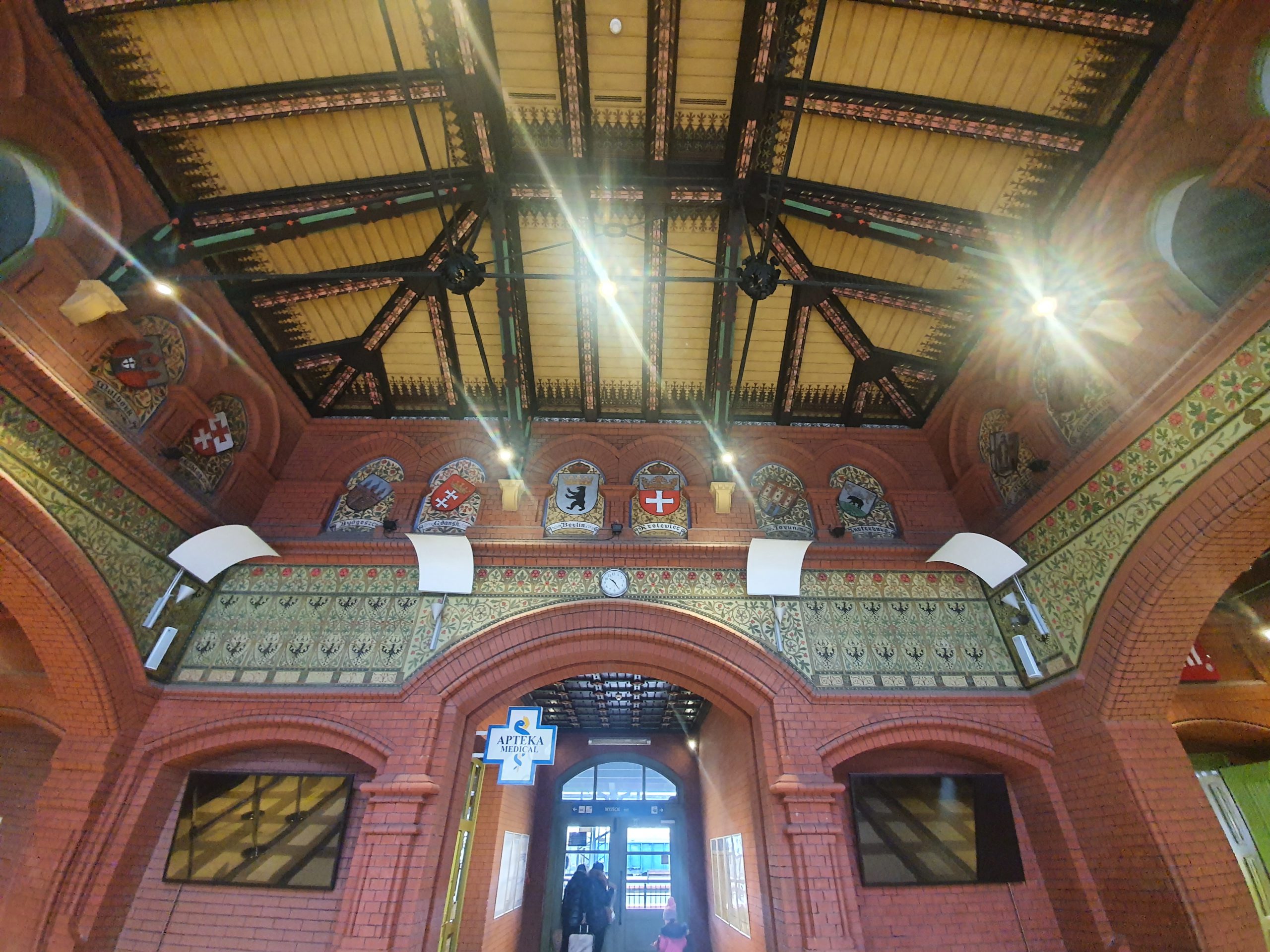
    The grand entrance foyer, with a shop to the left, a waiting room straight ahead and a ticket machine to the right. It really is a beautiful building and money was deliberately spent on it so that it could be the pride of Malbork. It was also a border railway station between the two wars, so the Polish and German trains used this as a changing point.

    The inside of the large waiting room, with several rows of wooden seats and a television for some entertainment. It was rather cold today, but this waiting room had been heated to ensure passengers didn’t have to endure the Arctic outside conditions.

    The entrance foyer again, from the other side to the previous photo. The ticket desk is visible in the background and there is a change visible just above it, they changed the Prussian emblem to the Polish eagle after the war.

    There’s the train I was getting, the 11:15 to Tczew. I hadn’t realised that this is also the train that comes from Krakow and Warsaw, before going to Gdansk and Gydnia.

    The very wide platform at Malbork, the reasons for which I haven’t worked out.

    I’m not really sure those narrow chimney things at the railway station are entirely ideal, although most are now propped up with metal supports.

    This was another short journey, so safely into Tczew within twenty minutes or so. The train, which is on the left, was quite busy and there were numerous school parties on board. I had carefully reserved a window seat this time so that I could video Tczew Bridge when going over it, but more about that in another post. Unlike many stations, such as Malbork, there’s an overhead corridor between platforms at Tczew rather than an underground one.

    Tczew railway station, not as glamorous as the Malbork buildings and its interiors, but it was functional and organised. As it was on the same line then as well, this railway station first opened in 1852, just as in Malbork. Tczew is a railway junction town which means that the station is relatively important, being the 32nd busiest in the country, which is proportionally much more than the town’s population. The fare was just under £2, so again, another comfortable and efficient journey with PKP Intercity.