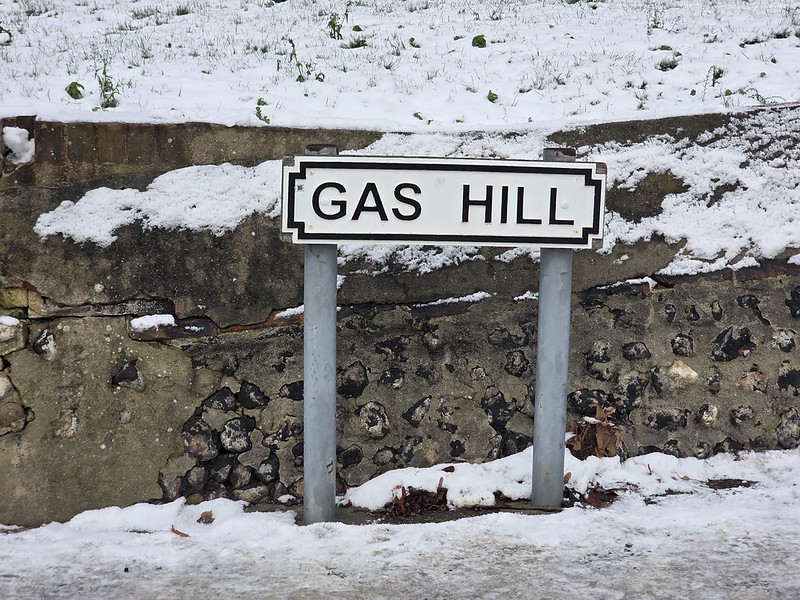
There are some people who don’t realise how hilly Norwich is, Norfolk isn’t the flat county that some expect. And this is Gas Hill Mountain, clearly impassable on its upper slopes and the road has been closed following a car accident. I mean, who would have realised that this might have been dangerous to cars…..
Incidentally, this is one of the very few streets in Norwich where the pavement has been gritted and not the road, rather than the other way around. Not that I’ve been moaning about this.
Gas Hill was named after the gas holder that was located half-way up, but that was demolished a couple of years ago. But, this is just one of the things that we have to bear in this mountain community in which we live, although I’m in the foothills rather than near to the summit.
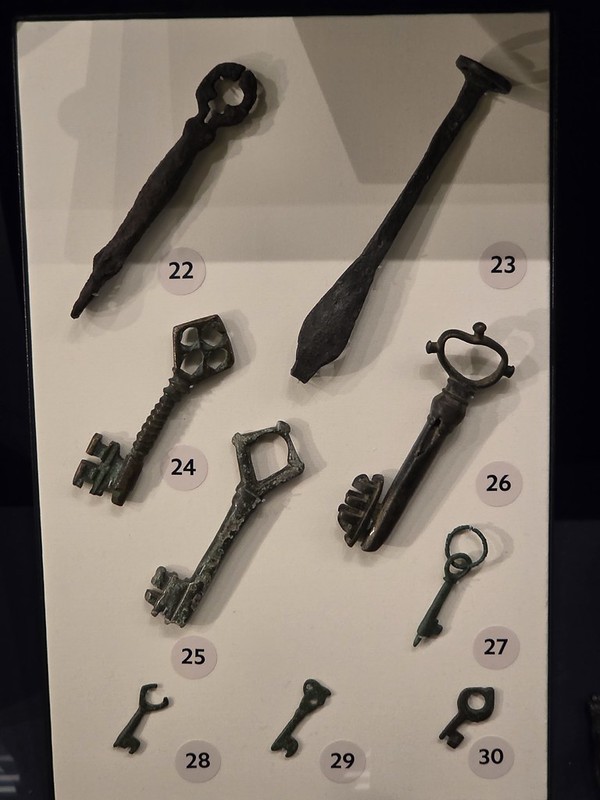
Maybe a heap of old medieval keys in a museum isn’t at first sight very interesting, but there are certainly some stories hidden away here, even if it’s not clear exactly what they are. As a summary of the keys:
22 : From St. Martin at Palace in Norwich (dated between 1000 and 1200)
23 : Found at Castle Acre Castle (dated between 1100 and 1500). This is an iron barrel padlock key that entered the museum collections in 1984.
24 : Found at Snettisham (dated between 1200 and 1300). This is a copper alloy key that entered the museum collections in 1907.
25 : Found at Hardingham (dated between 1200 and 1500). This is a copper alloy key that entered the museum collections in 1999.
26 : Found in Old Buckenham (dated between 1200 and 1500). This is a copper alloy key that entered the museum collections in 1966.
27 : Found on Botolph Street (dated between 1200 and 1400). It is perhaps a little sub-optimal that this street has gone, I moan periodically that the street line of this could be restored with a little thought with the new Anglia Square replacement development.
28 – 30 : Found in Caistor St Edmund (dated between 1200 and 1500)
The museum appears to have put nearly all of their medieval keys on display, so perhaps it’s a little random, but at some point in history these keys would have guarded treasures and resources. There’s a fair amount of engineering that has gone on with some of these and some of them have a fair amount of styling to them.
I’m not sure that much more is known about any of them, but I rather like the snapshot of history they provide even if their stories have been lost to time. And every treasure once had a keeper….
For over a decade, it’s been a tradition now for my friend Liam and myself to take part in the Stansted Stagger, a 26 mile challenge event put on by the Essex & Herts LDWA group. A walk at this time of the year is always a bit of excitement as there is the potential for a lot of mud, a lot of ice, a lot of rain and a lot of complaining from me. The drive there was marked by a series of Greggs being shut when they weren’t meant to be, so that was sub-optimal but I was too tired to be be pre-annoyed.
Liam got us safely to Stansted Mountfitchet where the walk starts. There were around 180 people taking part and there was a positive atmosphere whilst I focused on how many biscuits I could eat without looking greedy.
It was time for the walk to start and Liam and I seemed to be at the back, which is where we kept ourselves for much of the day. Some of the Norfolk & Suffolk contingent rushed off, but someone mentioned that it was probably just Simon H showing off. Someone in our group also mentioned that they were hungry, but fortunately, this event has 2.5 checkpoints so there was certainly lots to look forwards to.
We strolled past St. Mary the Virgin’s Church which is located just outside of Stansted Mountfitchet.
This is Arthur Findlay College, located at Stansted Hall, which is managed by the Spiritualists’ National Union. Arthur Findlay (1883-1964) was a stockbroker who became very involved with the spiritualist movement and he was one of the founders of the Psychic News. Stansted Hall, which is mostly from the late seventeenth century, was purchased by Findlay in 1923 and it was left to the Spiritualist movement in 1964 following his death.
Very pretty ice formations. We were fortunate that there was no snow, unlike the Norfolk we had departed, and relatively little ice. I have near zero ability to walk on ice, so this pleased me greatly. On reflection, this was the least muddy Stansted Stagger I’ve ever taken part in and that suited me on this occasion even as an experienced mud run person.
I appeared to be the only one in shirt sleeves as I thought it was getting a bit hot. The sun was quite clearly blazing down at this point, which is a field near to the village of Pledgdon Green.
The route that the organisers chose was a new one to me and it circumnavigated Stansted Airport. This was my favourite route that the event has taken, as it changes from year to year, although I was surprised just how little of the airport we saw as it seems to be landscaped away a bit. It was harder for them to blend the aircraft into the background though, so we were able to do some plane spotting.
The tilted sign amused me. I don’t get out much.
This was Mill Race, the former water channel for powering the mill at Tilty Abbey.
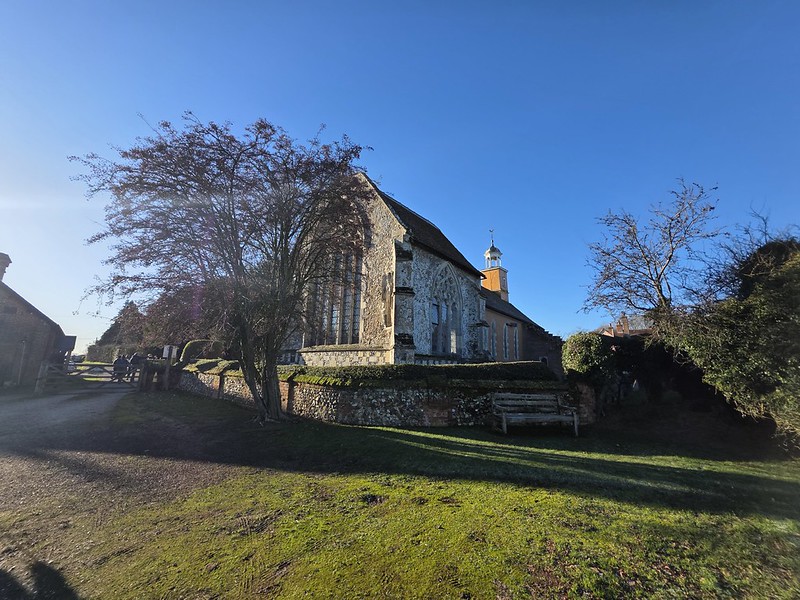
We then approached the Church of St. Mary the Virgin, which is the former chapel outside the walls of the abbey. When the abbey was suppressed following the Reformation, this became the parish church. But, I’ve written about this separately as well.
Sub-optimal and a reminder of the dangers of the cold weather. The police were aware of the car, but this looks like it must have been a frightening thing to happen.
And safely into the first checkpoint at Great Easton. I was surprised and delighted to see that there were some cheese & pickle sandwiches, which are one of my favourite things, so I had several of those. There were also jelly babies, crisps, mince pies, hot cross buns, biscuits and chocolate and so that’s all my main food groups covered. There was some fruit as well I think for those that like that.
The volunteers across the whole event were brilliant, full of enthusiasm and the LDWA is very fortunate to have so many people willing to help. And, from personal experience, it’s a lot of fun volunteering at events as well.
The church of St. John & St. Giles at Great Easton. It’s not a great photo as I was balancing crisps and jelly babies in my hand whilst trying to take a photo.
Rob had dropped a bit to walk with Liam and I for the next stage, here there are waiting for me to balance my snacks whilst taking a photo of the village of Great Easton.
Horse Pond in Little Easton, located opposite from the Great Pond and the manor house.
Despite never being far away from Stansted Airport, it was rarely visible, but the control tower did appear from time to time. We certainly had no shortage of planes taking off and landing to look at during the walk.
This is All Saints Church at Canfield End with the walk going through the churchyard. It wasn’t known who the original dedication of the church was to, so in February 1900 it was dedicated to All Saints by the Bishop Suffragan of Colchester. The nave is from the twelfth century, but the chancel and most of the interior is from the nineteenth century.
The second checkpoint was located near to Great Canfield and it had plenty of seating for the weary. Obviously, as an athlete I didn’t need a seat.
Well, how lovely.
Those warm apple pies with custard towards the front were the standout food item here, and there was a lot of competition. I actually didn’t even notice the wraps until looking at this photo, such was the choice, although I think I was focused on the crisps.
The checkpoint menu. Bear in mind this entire event costs £15 or so for members, we get that much value from the food alone. Well, I do.
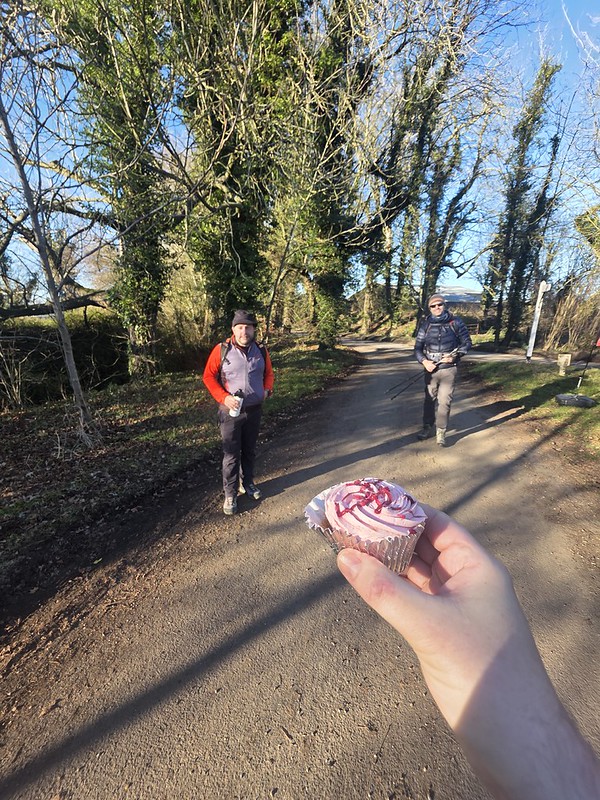
I took a cake to help sustain me for the next part of the walk.
An interesting tree near Great Canfield.
I can think of a few people who could go in these at Hellmans Cross.
The former railway station at Takeley, I’ll write about this separately and drop the link in here later.
The bridge underneath the appropriately named Station Road, this is the stretch on the former railway line from Braintree to Bishops Stortford which is now known as the Flitch Way.
Rob decided he would rush off at this point, but Liam and I decided we would just amble along. We rushed the Capital Challenge last year and sometimes it’s best to just take it easy.
The final checkpoint by the Dunmow Road which was advertised as a water stop but actually had some snacks as well, which pleased me. But my two loyal blog readers would have guessed that.
Then it was a series of bridge and tunnel crossings to get over the M11.
The bendy signage at Birchanger.
And back to the start at Stansted Mountfitchet….
Julian “I’m not very hungry, I likely won’t have anything at the end” White….. That carrot cake was delicious.
I accept that this wasn’t our fastest time, but it’s not a race and we had a really rather lovely day. For anyone tempted to take part, absolutely do, it’s a manageable distance with plenty of food, drink and encouragement at the checkpoints. The volunteers were all wonderful and so many thanks for all the time they put in to planning this event, which really is great value. We’ll be back next year!
St. Mary the Virgin church in Tilty, a rather fine Grade I religious building that we walked by on the Stansted Stagger. It was once the ‘chapel outside the gates’ that belonged to Tilty Abbey, being used by the locals or travellers who didn’t have permission to worship in the abbey itself. When the Reformation saw the end of the main abbey building and its stone was carted away, this chapel was turned into the village’s new parish church.
The stone section is the former abbey church from the 1220s, the section on the right is from the 1340s. It’s fair to see that they didn’t try and blend the two parts of the buildings together for consistency. Some of the beams supporting the chancel roof still date from the thirteenth century, making them some of the oldest in the country.
The downside of being on the walk was not being able to have time to go inside, but I’ll remember that this is here to try and visit another time.
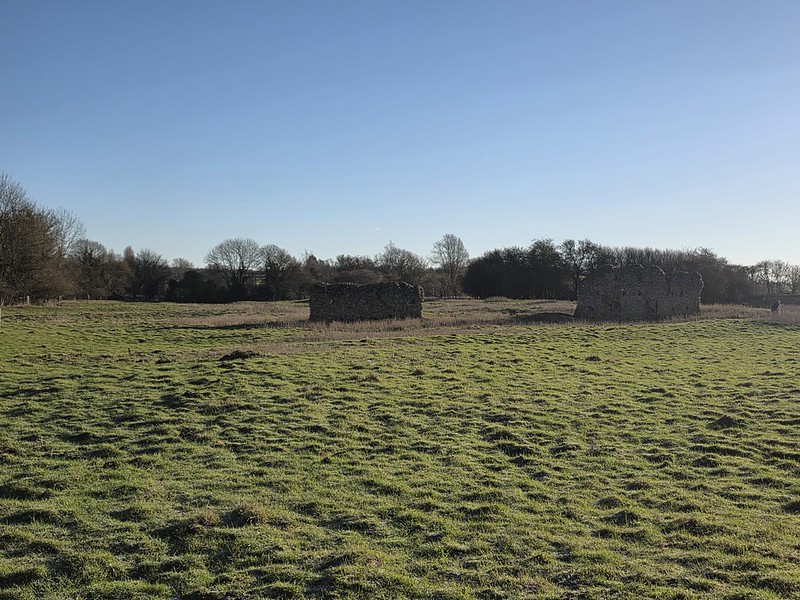
It was an unexpected surprise to walk into a field on the Stansted Stagger and see the remains of a former Cistercian abbey.
To be fair, there isn’t much of this abbey left, but at least there’s something. The bits that remain here are two fragments of the west range of the abbey. I would have explored them more thoroughly but I didn’t want to faff about looking at bits of old stone when I was meant to be on a 26 mile walk. Although I did think about it.
The abbey was founded in 1153 having been established by Maurice fitz Geoffrey and his overlord, Robert de Ferrers, who was the Earl of Derby. The first monks to populate the abbey came from Warden Abbey in Bedfordshire.
The abbey was situated on a tributary of the River Chelmer in north-west Essex and its dedication is believed to have taken place on 22 September 1153, which corresponds with St Maurice’s feast day, chosen in honour of the founder. While founded in the middle of the 12th century, the construction of the entire monastery complex is often credited to the second abbot, Simon, who served from approximately 1188 to 1214.
The site experienced significant hardship on Christmas Day 1215 when it was pillaged by the army of King John. Soldiers reportedly broke into the church during mass, ransacking chests and carrying off valuables, an event that required the monks to spend the next five years reconstructing the church. It’s fair to say that they probably considered this as completely sub-optimal.
The abbey functioned as a Cistercian community until its dissolution on 28 February 1536 under the religious reforms of King Henry VIII. Today, very little of the original monastic buildings remain, except for some stone wall fragments in the above photo and the chapel by the gate. This chapel, known as the capella extra portas, was built around 1220 for the use of visitors and now serves as the Tilty parish church, but a little more about that in the next post.
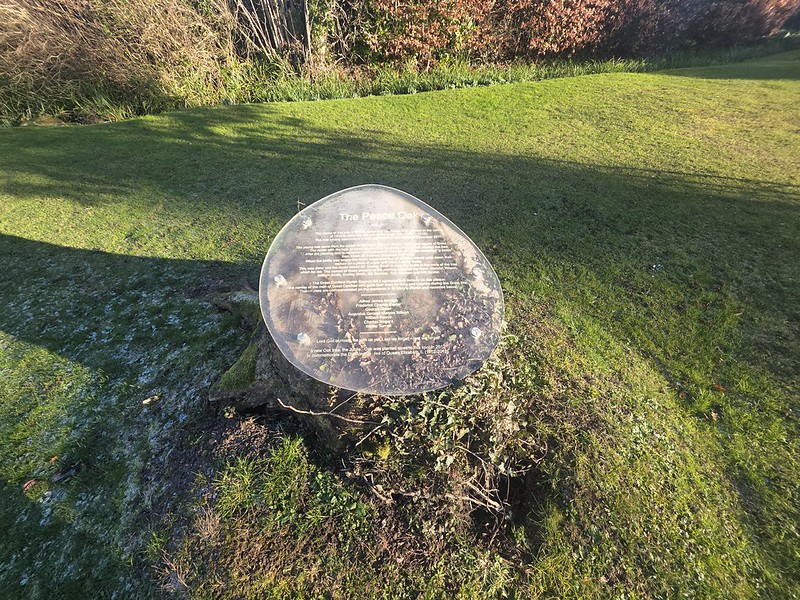
This is a rather lovely touch of history in the hamlet of Hellmans Cross, near to the village of Great Canfield. It’s the remains of the peace tree that was planted in 1919 to mark those who lost their lives in the First World War.
The local village website notes:
“The young oak came from the estate of the Revd. Maryon Wilson, rector and squire of Great Canfield. The rector with the help of some seven other residents of the parish planted the tree. After the planting and to replenish their exhausted strength, the rector produced “a bottle” from which all involved assuaged their thirst. When the bottle was empty the rector suggested that all present should write down their names on a piece of paper and place it in the bottle. This was done and the rector asked Mr. Dudley Smith to bury the bottle in the roots of the tree, which he did.
The names of those present at the planting included the Revd. Maryon Wilson, William Smith, Dudley Smith, Bill Barwick, Tom Yeoman and Will Easter.”
Unfortunately, they had to cut the tree down in 2011 due to a fungus infection, but they planted the Jubilee Tree in 2012 to replace it.
It’s a little hard to read on the plastic protective screen, but the village used this opportunity to commemorate the lives of the local men who died during the conflict. They were:
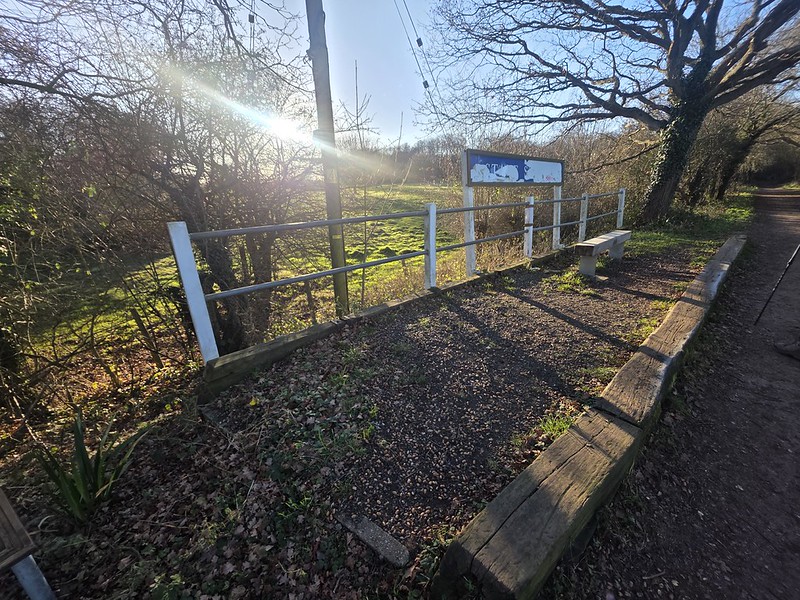
One of the interesting parts of the Stansted Stagger challenge walk (a separate post is coming on that) was this former railway line from Braintree to Bishop’s Stortford. It always struggled and was closed in 1952 as the area around it was too rural to justify a service. Now, there’s a slight irony that around 500 metres to the right of this photo is Stansted Airport and this railway line would have been potentially enormously useful for that.
This is the site of Stane Street Halt railway station, which was added to the line in December 1922 in an attempt to boost passengers numbers. A full station couldn’t be justified here as the population was too small, but they hoped to encourage some of the Takeley residents to use it. The station was named after the nearby Stane Street Roman Road which went from Ermine Street in Hertfordshire to Colchester in Essex.
The introduction of these halts, which were by request only, meant that they had to change the rolling stock to allow passengers to disembark without a platform to disembark onto. Although all rather positive in terms of trying to increase usage, the line was closed to passengers in March 1952. It continued to be used by freight services until 1972 and then it was all ripped up and all evident of the halt removed.
There were services to Northumberland Park, where Tottenham Hotspur’s White Hart Lane football stadium was located, directly from the halt which showed some initiative in getting people straight into London. The Westminster Gazette made reference to it in 1926 noting:
“It is not more than 30 miles from London, and it has a railway station – if such a name can be applied to Stane Street Halt, whose only evidence of being a station is a little platform barely ten years long.”
The Friends of the Flitch Way helped to restore the station halt back in 2011. They also added a useful information board which gives some more details about the history of the halt, which is a really helpful thing to add.
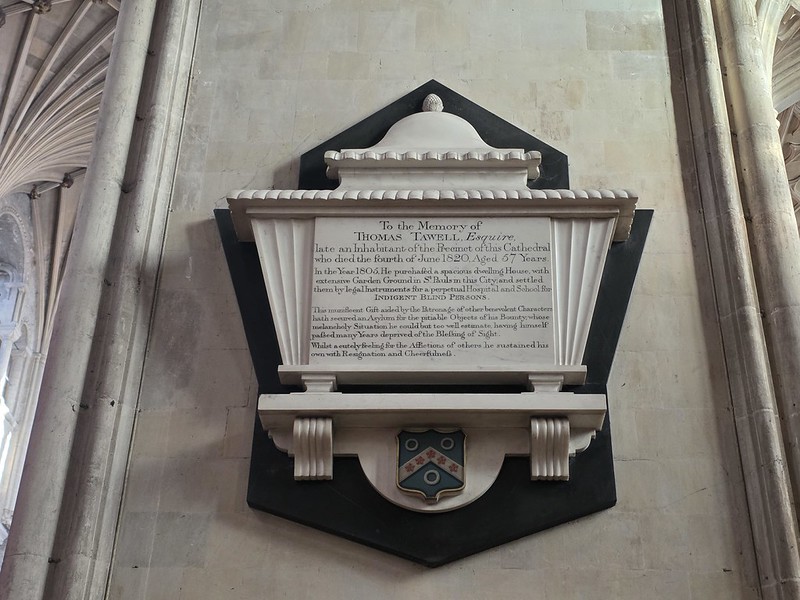
This is certainly a rather lovely place to have a memorial tablet and it commemorates the life of Thomas Tawell (1763-1820). Tawell was born in Wymondham in 1763 and he was born into a wealthy family, although his father died when he was just ten. He went to work for his uncle, a Norwich ironmonger, and Thomas managed to build up quite a wealth for himself.
Perhaps now best known for his generosity, his turn toward charity was rooted in his own experience with sight loss. While he was a successful merchant buying and selling his iron, he became blind, a condition that lasted for several years before he partially recovered his sight. This ordeal inspired him to help those who did not have the means to support themselves in a similar situation.
In January 1805, Tawell spoke at a public meeting at the Norwich Guildhall to propose an institution for the blind. To ensure the project moved forward, he took direct action by purchasing a large house and three and a half acres of land in Magdalen Street for the cause. He also donated 1,000 guineas, which is estimated to be worth approximately £86,000 in modern terms. He was particularly adamant that the institution should not just educate the young but also care for the elderly, a requirement he made a central part of the charity’s rules.
The building on Magdalen Street was known as the Asylum and School for the Indigent Blind (I didn’t know what ‘indigent’ meant, but it’s someone who is poor and/or needy). That building has since been demolished, but the organisation lives on, later called the Norfolk and Norwich Association for the Blind and, since 2020, now the more snappy ‘Vision Norfolk’.
The text reads:
“To the Memory of THOMAS TAWELL, Esquire, late an INHABITANT of the Precinct of this Cathedral who died the fourth of June 1820, Aged 57 Years.
In the Year 1805, He purchased a spacious dwelling House, with extensive Garden Ground in St. Paul’s in this City; and settled them by legal Instruments for a perpetual Hospital and School for INDIGENT BLIND PERSONS.
This munificent Gift aided by the Patronage of other benevolent Characters hath secured an Asylum for the pitiable Objects of his Bounty; whose melancholy Situation he could but too well estimate, having himself passed many Years deprived of the Blessing of Sight.
Whilst acutely feeling for the Afflictions of others he sustained his own with Resignation and Cheerfulness.”
He sounds a really quite positive man by all accounts. Incidentally, I’m very impressed at this art collection which was sold off a couple of months following his death, the auction catalogue notes:
“ALL the valuable PICTURES, Prints, Coins, and curious Articles, of THOMAS TAWELL, Esq. deceased, at his late Dwelling-house, in the Upper Close, Norwich; comprising some fine specimens of the old Masters, Ostade, M. A. Carraveggio, Wyke, Zuccorelli, Frank Hall, Old Frank, Teniers, Rysdael, &c. &c. proofs and fine impressions from Bartolozzi, Vasseau, Wille, Earlom, Sharpe, Edelinck, Woollet, &c. Cupid in Psyche, Bacchus and Ariadne, Venus in statuary marble—Italian workmanship, very fine; a large collection of gold, silver, and copper coins, Roman urns, and a variety of curious antique articles.
In the Books will be found Jeremy Taylor’s Works, Shakspeare’s in folio, Mant’s Bible, Josephus, Clarendon’s Rebellion, Statutes at Large, Robertson’s Charles, America and Scotland, Hume’s England, Burke’s Works, Annual Register, 62 vols. Blackstone’s Commentary, Hook’s Roman History, &c. &c.”
Owning a Caravaggio is really quite exciting. Although if I owned one, I’d be stressed worrying someone would pinch it and I dread to think what the insurance cost would be. I’d worry about it every time I looked at it, so I think on that basis I won’t buy a very valuable old painting for several million pounds. Although there’s another limiting factor within that last sentence, but I digress.
At least this memorial is of a man who made a great contribution to the people of Norwich, and not a tomb to a bishop that oversaw the execution of people who had a slightly different belief to him.
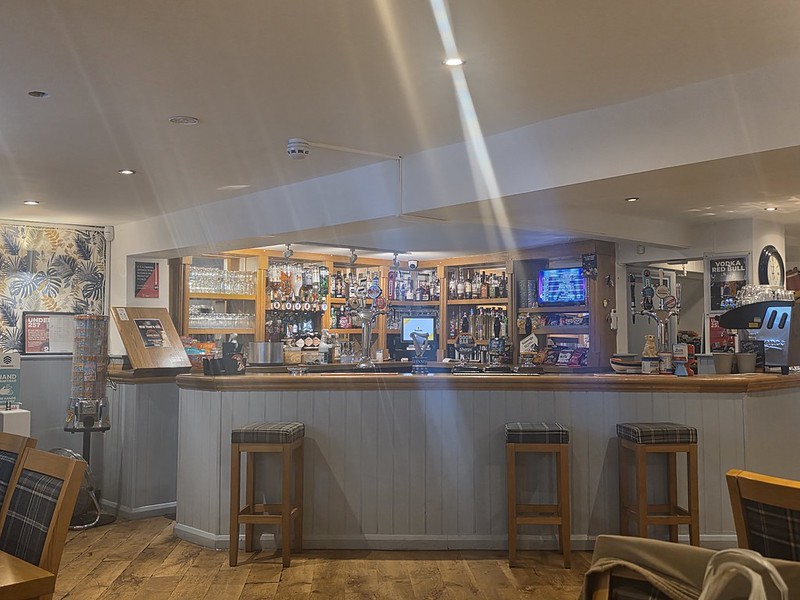
The next pub on our study day tour in Oulton Broad was the Lady of the Lake. Apologies for the slightly blurry photos, I’m blaming the Monster Munch in the previous pub.
An interesting marketing opportunity inside the front door. The venue first opened in the 1840s and is now managed by the small LEC pubs chain.
There’s a large dining area and I think that the venue is quite food led and the prices aren’t unreasonable. It was quiet when we were there, just one other table with drinks.
The bar is bright and open with a few stools for those that want to perch by it. There was a prompt welcome and they had two real ales on, with the prices being reasonable.
I ordered half a Ghost Ship from Adnams and I only noticed when back at the table, but it smelled slightly vinegary and had a sharp off taste. It might have been the end of a barrel, maybe just lingering in the lines for a while, but these things happen. I’m not entirely sure that the team member looked keen to replace it, and indeed they left the beer on sale, but they did replace it without any query so that was positive.
The replacement was Wainwrights Golden Ale, with quite a lot of bubbles sticking to the side of the glass, but it was well kept and had its usual hoppy taste. Julian had also gone for this and was entirely satisfied with his, so that was all good.
There’s live music every Saturday night and a variety of other events held here, with the venue seemingly getting positive reviews online. I like that their website specifically mentioned that it’s fully wheelchair accessible, as although venues often are, it’s positive that this is something that’s made clear.
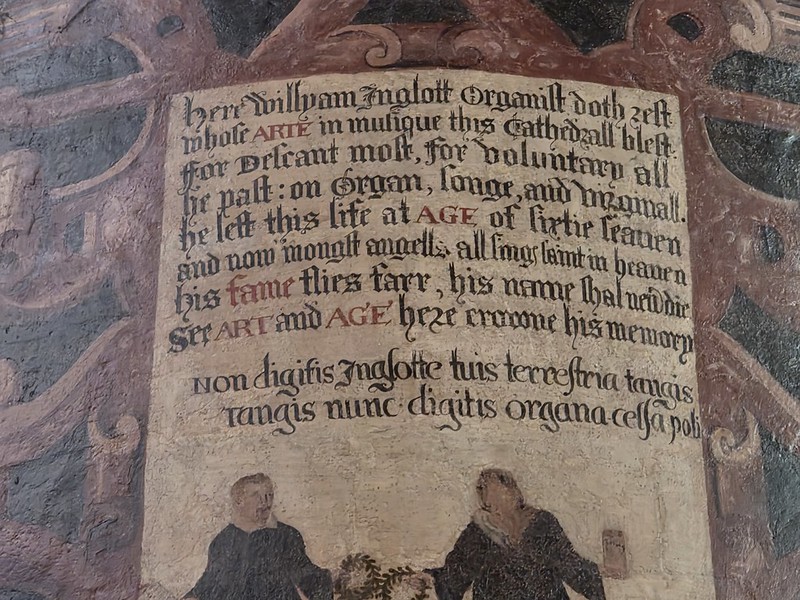
This is a rather nice memorial, commemorating the life of William Inglott (1554–1621), a celebrated organist and composer at Norwich Cathedral during the Elizabethan and Jacobean eras. This image shows the memorial to William Inglott (1554–1621), a celebrated organist and composer at Norwich Cathedral during the Elizabethan and Jacobean eras. The monument is a painted mural located on a pillar near the presbytery screen with the obligatory skull located on the memorial to note the inevitability of death.
William Inglott was the son of Edmund Inglott, who was also an organist at the cathedral. William began his musical journey as a chorister under his father before eventually becoming the cathedral organist himself from 1587 to 1591. After a period working at Hereford Cathedral, he returned to Norwich in 1611 to replace the famous composer Thomas Morley.
He died on the last day of December 1621 and they had painted this within six months. This feels like a nice memorial and it’s still in excellent condition today, although the face of one of the two choristers seems to be blurred out. Maybe he wanted to be redacted.
I’ve had AI transcribe this, so it might not be entirely accurate….
“Here William Inglott Organist doth rest whose ARTE in musique this Cathrall blest for Descant most, for Voluntary all he past: on Organ, longe, and virginall. he left this life at AGE of fiftie yeares and now ’mongst angells, all sing laud in heaven his fame flies farr, his name shal not die See ART and AGE here crowne his memory
NON digitis Inglotte tuis terrestria tangis tangis nunc digitis organa celsa poli”