Category: Norfolk

  • Bawdeswell – All Saints’ Church (Reconstruction After the Second World War)

    Bawdeswell – All Saints’ Church (Reconstruction After the Second World War)

    20250511_143034

    There’s a display board at the church which shows the post-war reconstruction of the building after it was mostly destroyed following an aircraft crash during the Second World War. The RAF Mosquito bomber crashed into the building on 6 November 1944, the only incident during the Second World War where a church was destroyed by an aircraft hitting it, as opposed to a bomb or other aerial attack. The task of rebuilding the church fell to the War Damages Commission and it took a few years to get going, with the work commencing in March 1953. The design for the new church was entrusted to Norwich architect J. Fletcher-Watson, who also designed the Bishop’s House in Norwich. He envisioned a Neo-Georgian style structure, a distinct contrast to many other village churches and one which I think looks rather elegant.

    20250511_142806

    There was an argument though which started before the reconstruction started, when the Parochial Church Council objected that the new spire was a potential hazard to low flying aircraft. I can see their concern given what had happened, but the architects rejected the complaint that this wasn’t a traditional Norfolk church design and the Chancellor of the Diocese made the adjudication that construction could begin.

    20250511_142903

    The foundation stone for the new All Saints’ Church was laid by Sir Edmund Bacon, Bt. on 21 July 1953. The Rector at the time, the Reverend Heywood Gerard Benson Folland (1903-1976), who had arrived in Bawdeswell only a few weeks before the plane crashed, demonstrated great fortitude in organising the building of the new church in what was obviously a sub-optimal situation. While the new church was under construction, the congregation used a Primitive Methodist Chapel in the village for worship. The construction, carried out with Messrs Philip Pank & Partners as Quantity Surveyors, was completed and the new church was dedicated by the Bishop of Norwich, the Revd P M Herbert, on 27 September 1955. The primary costs for the rebuilding were £12,500, with additional expenses for the spire (almost £700), furnishings (£1,000), and the organ (£650) among other fittings.

  • Bawdeswell – All Saints’ Church (Destruction During the Second World War)

    Bawdeswell – All Saints’ Church (Destruction During the Second World War)

    20250511_143623

    On 6 November 1944, an aircraft accidentally crashed into All Saint’s Church in Bawdeswell and effectively destroyed it. Two British pilots, James McLean and Melvin Tansley, lost their lives in the tragedy.

    20250511_143641

    Part of the aircraft has been kept as a reminder of the tragedy.

    20250511_143355

    There’s a photo in the church of the damage done to the building that night. Two houses were also badly damaged during the incident, which caused a large fire in all three buildings. The church was rebuilt to a different design after the end of the war.

  • Bawdeswell – All Saints’ Church (Grave of Edward Peterson from 1733)

    Bawdeswell – All Saints’ Church (Grave of Edward Peterson from 1733)

    20250511_143957

    I am completely puzzled by this and although my being confused isn’t rare, I can’t really understand what has happened here. There is the oldest grave that I can recall seeing in a Norfolk churchyard and it commemorates the life of Edward Peterson who died in 1733. All Saints’ Church has an odd history as it effectively fell down in 1739 and was rebuilt, before a plane crashed into it during the Second World War and it was entirely rebuilt once again (and not to mention the Victorian rebuilding). This gravestone shouldn’t really have survived for so long, so it seems likely that there are some special circumstances that apply here. I’ve sent Google Gemini on a long mission to find a solution, but it has come back without any documented evidence, just its best guess.

    The gravestones were moved in the late Victorian period, so I can only assume that the gravestone had been in a protected area until then. Perhaps it moved position during that time to tidy the churchyard up and it has just been made from a sturdy limestone that has protected it, but it has also certainly been moved since the plane crash in 1944 which destroyed the church so it’s likely been in a few locations over the centuries. But, it’s relatively rare to find gravestones from the eighteenth century, let alone one so early on in the century. However, Google Gemini has tried to consider all possibilities, even mentioning:

    “The general environmental conditions of Bawdeswell, situated in East Anglia, involve a temperate maritime climate with moderate rainfall and seasonal temperature variations that include regular frosts in winter. This provides the overarching weathering regime. Historically, as a rural village, Bawdeswell would likely have experienced lower levels of atmospheric pollution compared to industrial urban centres during the 18th, 19th, and early 20th centuries.”

    And it suggested a very real possibility that:

    “Burial, particularly in well-drained soil, can offer significant protection from atmospheric weathering agents such as acid rain, freeze-thaw cycles, direct solar radiation and the colonisation of surface-dwelling organisms. If the Petersen stone was subsequently uncovered and re-erected during one of the churchyard clearings or the formal re-laying of memorials 11, it would likely have emerged in a considerably better state of preservation than if it had remained continuously exposed for the entirety of its existence. This period of unintentional interment could be a crucial, albeit undocumented, factor in its current condition.”

    Or, maybe, the gravestone was even inside for a period, although this feels unlikely. A little of Edward life is known, he was born in 1658, the son of William Peterson and Margaret Peterson, and he was baptised at Hackford with Whitwell Church on 9 April 1658. He died on 11 February 1732, but the year discrepancy on his gravestone is likely because the burial is so early it dates back to a period when the year end was late March and not December. Anyway, I suspect that his gravestone was made of high quality limestone, it’s been protected in some form and it has been fortunate to have been placed in well drained areas. But it intrigued me by being quite so old….

  • Norwich – Compleat Angler [Old Receipt]

    Norwich – Compleat Angler [Old Receipt]

    Why is this old receipt here?

    Firstly, that Stella wouldn’t have been for me…. And it reminds me of just how over-priced the pub was back then, that’s still quite a punchy price for a Pepsi even today.

  • Food from Every Stall on Norwich Market (2025 Edition) – Week 11 and Go Crepes

    Food from Every Stall on Norwich Market (2025 Edition) – Week 11 and Go Crepes

    20250508_131933

    This week’s visit on our quest to eat at every food venue at Norwich Market was Go Crepes, which we visited when we did all this before in 2023. I must admit that I briefly forgot that we had done it before when the number was randomly drawn to come here, but it was last visit that we did and so perhaps my memory was clouded with sadness that it was all over…. I have to add here that every lunchtime is getting more ridiculous as it’s now turning into a “how many times will someone say hello to James?” as we walk around the city, it’s usually about five different people. This having lunch with a social supernova is getting quite exhausting.

    20250508_131501

    The menu board, which is now a price free enigma, but the increases have been moderate over the last two years and seem to be around 50p for each crepe.

    20250508_131623

    In addition to the sweet and savoury crepe options, there are some pasta options as well which I think might be a relatively new addition and James was tempted to go for one of these, but the pricing was a little punchy. The service here was friendly and immediate, with the stall taking both card and cash payments. There wasn’t the engagement that I remember from the stall holder a couple of years ago, but it was still welcoming and everyone was served in turn.

    20250508_131644

    There’s my crepe cooking and I must admit that I’ve broken my intention of always having something different. I went for banana, Nutella and coconut, forgetting that’s what I had before. It came to £5.50, which is an increase of 50p. There was an entire banana included, along with a generous amount of Nutella and coconut flakes.

    20250508_131930

    And there we go. This isn’t my sort of go to food for lunch, but it was warm, generously filled and it had a depth of flavour. I thought that it represented decent value for money, it was quick and a handy lunchtime snack.

    IMG-20250508-WA0002

    James faffed about getting a classy photo of his crepe with Norwich Castle in the background. Unfortunately, in his eagerness to eat, the strategic intent of the photo failed.

    IMG-20250508-WA0005

    So James has drawn it in. He went for a cheese and a pepperoni crepe and I asked him about the food and he said:

    “Upon presentation, the galette délicieuse, a thin farinaceous creation of Gallic origin, enveloped a savory melange of lactescent curd and thinly sliced suine preparations, yielding a surprisingly replete sensation upon consumption. The constituent elements exuded an aura of recent provenance, their individual gustatory profiles harmoniously intermingling to produce a discernible and rather pleasing savor. Furthermore, the entire culinary opuscule was ensconced within a sumptuous and texturally refined cellulose-based towelling, hinting at an elevated level of epicurean consideration.”

    He was particularly keen that I mention that he liked the quality of the paper towel that was used, which isn’t something I think that I would have otherwise added here.

    I’m not sure that the lunch was quite as filling as some of the other market options, but that’s basically because I’m quite greedy and isn’t a criticism of the stall as their portion size for what I ordered was generous. The service was friendly, the food was freshly made and I felt that there was reasonable value for money.

  • 200 Years Ago in Norwich : Madame Tussaud Visits Great Yarmouth

    200 Years Ago in Norwich : Madame Tussaud Visits Great Yarmouth

    And another in my series of posts from articles and adverts in the Norwich Mercury from 200 years ago this week, this advert was placed in the newspaper in the first week of May 1825.

    “MADAME TUSSAUD, ARTIST,

    Has the honour most respectfully to announce to the Ladies and Gentlemen of Yarmouth and its vicinity, that by the kind liberality of the Worshipful the Mayor, she will have the honour to Exhibit her Collection as above announced, where she hopes to meet with that acknowledgement which Yarmouth is known to afford to Exhibitions of merit.

    The Collection consists of TWO MAGNIFICENT CORONATION GROUPS, one representing the AUGUST CORONATION of his MAJESTY GEORGE IV.; the other the CORONATION of BONAPARTE; the whole got up at an immense expense, and such as have never failed of giving general satisfaction, having been viewed in Liverpool, Manchester, Birmingham, Bristol, and Bath, by 136,000 Persons.

    There will be a PROMENADE every Evening from Seven till Ten, accompanied by a MILITARY BAND.

    ADMITTANCE ONE SHILLING. SUBSCRIBERS’ TICKETS FIVE SHILLINGS EACH. OPEN EVERY DAY From Eleven till Four, and from Six in the EVENING till Ten.”

    Marie Tussaud (1761-1850) has been unable to return to France as a result of the Napoleonic Wars, so she spent most of her time in England. She started a touring exhibition in 1824, which is the one that reached Great Yarmouth, and in 1833 she eventually settled on a permanent location in Baker Street in London. The growth of the galleries meant that new premises were needed in 1884, where Madame Tussauds is still located today. This must have been quite a sight to behold for the lucky denizens of Great Yarmouth.

  • 200 Years Ago in Norwich : A Case of Poisoning in Great Yarmouth

    200 Years Ago in Norwich : A Case of Poisoning in Great Yarmouth

    Part of my occasional series of newspaper articles from the Norwich Mercury from 200 years ago this week.

    The year 1825 saw the Neal family – Mary, and her adult children Susan and William – at the centre of a grave accusation which was the attempted murder of shoemaker William Halls (or Hales) and his family through arsenic poisoning. Arsenic, readily available and difficult to detect in that era, was a feared agent of clandestine violence, and its alleged use in this case invoked particular societal horror. The crime was not only shocking for its malicious intent but also for its familial dimension, with a mother and her children implicated in a conspiracy against their neighbour and employer. The trial was held at the Great Yarmouth Quarter Sessions and presiding over the whole arrangement was Robert Alderson.

    This is quite a long and interesting article from the newspaper, which I’ll quote in full:

    “From its being generally known that the trial of the Neals for poisoning would be the first on Friday morning, the Court was crowded to excess, and the Recorder took his seat. Mary Neal, aged 42, Susan Neal, aged 21, and William Neal, aged 18, were placed at the bar, charged with having feloniously put a quantity of white arsenic into a boiler containing beef broth, with intent to cause the death of William Hales and his family. It appeared in evidence that Mr. Hales is a cordwainer, residing in Howard-street, Yarmouth.

    His family consisted of himself, Mrs. Hales, three children, and a servant. On the day previous to that on which his family were taken ill, Mrs. Hales boiled a piece of beef in an iron boiler for dinner, of which they all partook, but they did not experience any illness from it. The liquor in which the beef was boiled remained in the boiler, as Mrs. Hales intended to make it into soup the following day for the family. The boiler was placed in a room under the keeping room, and in which Mr. Hales and his apprentices worked at their business. On the following morning the boiler was put upon the fire a short time before dinner, with the liquor in it, and when hot, Mrs. Hales took about a teacup full out of the boiler to taste, and gave her little boy (about three years of age) some at the same time. The servant was then ordered to put in the different ingredients to make it into soup.

    In about ten minutes after Mrs. Hales had taken the liquor, the little boy complained of illness, she therefore took him up-stairs and laid him down on the bed. Mrs. Hales had scarcely done this when she herself was taken ill. Mr. Hales, with his other two children and servant girl, then sat down to dinner, having of course no idea of the cause of Mrs. Hales’ illness. They all at table partook of this soup, and shortly after they were seized with similar symptoms, which caused Mr. Hales to suspect they had been poisoned. He therefore immediately sent for a surgeon, who, on his arrival, administered proper antidotes, which had the desired effect, or a few hours more would have terminated their existence. The whole family were under the surgeon’s hands for some time, but Mrs. Hales and one of the children still retain the effects of the poison, and are very likely to do so. The surgeon took the remaining part of the soup out of the boiler, some of which he gave to a dog, which immediately ejected it: the remainder he submitted to Mr. Davies, an eminent chemist on the Quay, who, on analysing it, found it to be deeply impregnated with white arsenic. It was afterwards discovered that Mrs. Neal and her daughter had purchased a pennyworth of arsenic at the shop of Mr. Suthern, a chemist in Gaol Street.

    They were in consequence, with Mr. Hales’ apprentice, immediately taken into custody, and on their examination before the Mayor, Mrs. Neal stated she was not troubled with rats or mice, nor did she know what arsenic was; but on her being confronted with the young man who sold her the poison, she could no longer conceal the fact, but she said she bought it to kill the mice with which her house was troubled; she, however, had previously stated that they had none in the house. On being questioned as to what they had done with the poison, an altercation ensued between the mother and daughter, as to the possession of it, the mother saying she gave it to the daughter, and the daughter saying she gave it to her mother; the daughter, however, at last informed the officer where he might find it, and on going to the house he discovered it on the top of the clock-case. On examining the paper in which it was enveloped, the chemist’s assistant stated that about one half of the quantity which Mrs. Neal and her daughter received had been taken out. Mrs. Neal stated that the part missing from the paper had been put on some bread and butter, and placed in different parts of the house, for the destruction of the mice.

    Mr. Hales stated that he had been lately compelled to take Wm. Neal, his apprentice, before the Mayor, for misconduct at two different periods, and that his mother wished him to leave, but that he refused to give up his indenture. On the evening previous to the day on which the family were poisoned, Mr. Hales went to his club, leaving Wm. Neal in the kitchen alone, where he was asked, and where the boiler was placed with the liquor in it. The apprentice did not board or lodge with the family. Mr. Hales also stated that Mrs. Neal, the mother, had contracted a debt with him, for the settlement of which he had repeatedly pressed her, but he had as repeatedly been abused by her; and she had lately expressed her fears to a neighbour that he intended to summon her before the Court of Requests. The whole of the evidence against the prisoners being entirely circumstantial, the Recorder stated the law upon the case with his usual ability and perspicuity, and left it to the Jury to consider whether the prisoners at the bar were guilty or not guilty of the dreadful offence of which they stood charged.—The Jury deliberated for a short time, and returned a verdict of guilty against all the prisoners. Sentence of Death was therefore recorded. This trial commenced at half-past nine in the morning, and did not terminate until half-past six in the evening.”

    The crime is one of the most infamous that took place in the town in the nineteenth century and it was followed widely with some considerable interest. The sentence was the final ever death sentence issued by the Great Yarmouth Sessions Court as it lost that power in 1835. And, in this case, it was decided to commute the sentences to transportation. They were held at the Tolhouse Gaol in Great Yarmouth and then sent to Australia for life on different ships.

    Mary Neal, the mother, was assigned to the female convict ship Midas which sailed from London on 24 July 1825 carrying 108 convicts. The ship’s master was James Baigrie, and the surgeon superintendent responsible for the health of the convicts was Charles Cameron and he noted that Mary was “very much emaciated” and she unfortunately died en route on 5 October 1825. The fate of Susan Neal, the daughter, isn’t known but there’s a high chance that she also died during transportation.

    William Neal, the son, was sent on the convict ship the Medway on 2 August 1825, arriving in Van Diemen’s Land (Tasmania) on 14 December 1825. He married Eliza (Clayton) Rowley on 31 December 31 1847, in Avoca, Tasmania. At the time of his marriage, his occupation was listed as a shoemaker which was the very trade he was learning as an apprentice under Mr. Hales, the man he was convicted of trying to poison. He and Eliza had several children and I do wonder whether he actually ended up having a better life with more opportunities than he might have had staying in Great Yarmouth.

  • Bar Billiards – Out of Retirement

    Bar Billiards – Out of Retirement

    20250507_190626

    I had decided this year not to play in the Norwich bar billiards league, but just to loiter around a couple of games and go to the international events in Sudbury. I’ve decided international games are really the future for my natural bar billiards talents where I continue to aspire just not to come last. However, sometimes, a hero is needed and as the Serengeti team captain Roy couldn’t find one, I agreed to play for the team once again. I got to the White Lion a little early to calm my nerves and I went with the landlord Oscar recommended Racing Pigeons from Electric Bear Brewing Company of Bath. As an aside, many things from Bath are a bit exceptional and this was a decent hazy, light, stone fruit packed little number. Anyway, pint in hand, nerves only partially frayed, I was ready.

    20250507_194626

    The draw was completed and I always hope to not be drawn third or fourth as that means the food might be brought out and my game play is heavily impacted. First is handy, it gets the game out of the way although last isn’t great as it might be the deciding game and I might crack with the pressure of it all.

    20250507_194636

    Right, we’re off. We were playing the team from the Artichoke and my opponent was playing her first league match, which is something that’s usually a curse as beginner’s luck and all that.

    20250507_201603

    I’ll take that, but I must admit to feeling the pressure a little and had a fair few rather sub-optimal shots for a while. I always think that playing first is a bit like doing karaoke sober, although to be fair, I’ve never done karaoke but I’ve listened to other people screeching. There’s a choice between grinding in the 10 and 20 shots to try and build up a steady score, or going for some of the bigger shots. I went for a few bigger shots, but only a couple came off, so I reverted to my more normal boring play. But, there’s a job to do, it’s not meant to be pretty.

    20250507_202459

    Then watching the next few games and I’d note that this is a sub-optimal shot to have to play. The Serengeti lost the second and third singles games, but there was then a flurry of excitement as the team won the next five matches.

    20250507_204157

    And the main event is now here. This year things have changed so players pay £2 each for the food which is provided, but that seemed more than agreeable to me as Oscar does provide a generous spread. Fortunately it was sufficiently generous for me to get two plate fulls (and I would add that I didn’t take these two plates at once) so I was suitably surprised and delighted.

    20250507_204649

    Incidentally, I did ask John, the Artichoke’s captain, if his team wanted to have a go at the food first. However, I think he knew that I hoped he would say no, which meant I was the ready volunteer to test matters.

    20250507_210342

    The two team captains, John and Roy. Both really wonderful welcoming people and a credit to the league.

    20250507_222425

    The pressure was off at this point so I got a Black Stag from Peak Ales, a coffee and chocolate stout with some liquorice evident in the taste.

    20250507_224629

    After the five wins in a row, it was time for Guy and I to see what we could do in the final game, although the pressure was now off us. The father and son team of John and Jack were just too strong for Guy and I, but their win was well deserved. The end result was 6-3 to the Serengeti, but there were several close games and it could have gone either way. We did miss Emma shouting about “it’s a timed game” which normally pierces the air like a bar billiards air-raid siren but we did miss her! I’m intending to go back into retirement now, just turning up to a few games to watch and to see if there’s any food going spare….

    And, as another aside, I’ve really enjoyed this whole league thing and there are a record number of teams in the league this year. It’s a way that people can be brought together and hopefully there will be more people engaged and interested with the process, with maybe even more teams next year. Pete has a Youtube bar billiards channel going at https://www.youtube.com/@NorwichBarBilliards and there’s a chance, if he isn’t scared off by editing several hours of me missing 50 shots in a row, then Zak (my official bar billiards trainer and spiritual tormentor when he’s in good form which is nearly always) and I might just embark on a tour of every table in the league. The goal? For me to finally beat him somewhere, anywhere even if I have to tilt the table slightly in my favour. But that’s a saga for another post. Watch this space.

  • Food from Every Stall on Norwich Market (2025 Edition) – Week 10 and Deb’s

    Food from Every Stall on Norwich Market (2025 Edition) – Week 10 and Deb’s

    20250506_130955

    This week’s visit on the plan that James and I have to eat at every food stall at Norwich Market was Deb’s, which we visited when we did this market tour in 2023.

    20250506_131001

    The hot food options. We were welcomed promptly by a friendly team member who took the order and checked if we were eating at the stall or taking away. I went for a sausage & bacon large bap which was £5.50, an increase of £1.10 since we last visited which is in keeping with the general price inflation of the market. I also asked for the bacon to be crispy and the team member was happy to accept that request, as I sometimes think that some people find my bacon demands as a little sub-optimal.

    20250506_131436

    Wise advice, although the bloody things circulate freely around the market now.

    20250506_131444

    My bacon and sausage cooking away. James went for a double cheese burger, encouraged by myself to be fair as he was intending to have a single one, and that’s starting to cook on there as well. It was agreed by myself that I wouldn’t wait for his food to arrive before I started mine, as I wanted to ensure I started my meal at the temperature that the stall intended.

    20250506_131439

    It’s all a bit cluttered, but I like an authentic feel to a cafe rather than polished steel all over the place. Craft beer bars I like to be on-trend and shiny though of course, I don’t compromise on my standards there. I make this point as this felt like a traditional market stall, the kind of set-up that one might hope to find for a traditional lunch-time snack.

    20250506_131837

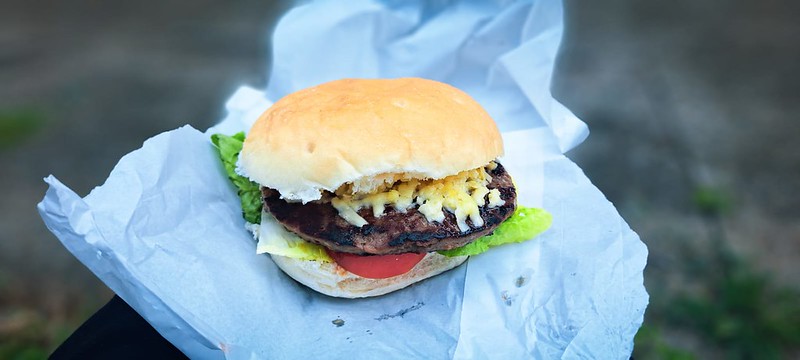
    The sauce is sweet chilli that I’ve put on. And as a food review, this is as good a bacon and sausage roll as I could desire from a market stall. But let’s take this opportunity to talk bacon, shall we? This wasn’t the anaemic, apologetic stuff you sometimes encounter. This was bacon as it’s meant to be, each rasher a crispy, bronzed warrior having bravely faced the heat and emerged victorious, with absolutely no sign of that dreaded, flabby surrender. I reject the out-dated concept that the fat is somehow the tasty bit, it isn’t, the meat is the tasty bit. I want crunch to this arrangement and that’s what I received. The portion size of the bacon was generous, perhaps overpowering the sausage slightly, but the food all tasted fresh and of a decent quality. I was left surprised and delighted by this roll, it felt like value for money to me.

    IMG-20250506-WA0004

    IMG-20250506-WA0005

    James and his artistic photos. I have to move out of the way of these as he doesn’t want me cluttering them up. He mentioned afterwards that he saw two frozen burgers being cooked and that he wasn’t expecting a gourmet experience. But, he thought they were excellent in terms of their depth of flavour, so that’s another win. He also said:

    “When asked, I must recount a recent gastronomic encounter with a seemingly unassuming double cheeseburger, procured from a purveyor of street-side sustenance – a quintessential market stall, if you will. The bovine patties themselves presented a quite remarkable profundity of flavour, a veritable symphony of umami notes that danced upon the palate with unexpected sophistication. Encasing this delight was a bun of demonstrable freshness, its delicate crumb yielding with pleasing softness. The accompanying verdant assemblage, colloquially termed ‘salad’, provided a most welcome textural counterpoint, its crispness juxtaposing splendidly with the tender succulence of the meat and the molten embrace of the fromage. Furthermore, the entire construction was served at a most agreeable temperature, ensuring optimal sensory engagement. Indeed, this offering transcended its humble origins, representing a paradigm of market stall culinary artistry, a truly delightful and surprisingly nuanced gustatory experience.”

    I was very pleased with this food, the service was friendly, the surroundings were clean and it’s a welcoming stall. I liked that there was quite an array of different sauces and condiments, all which the customer could access themselves so they could have as much as they wanted. The bacon was cooked perfectly, I felt that the pricing was reasonable and this is one of my favourite market stalls so far this year. I also noticed that there seemed to be a higher proportion of regulars than at other stalls, so they’d soon recognise me and my bacon requirements if I went on a regular basis.

  • Norwich – Ship (Two Julians)

    Norwich – Ship (Two Julians)

    20210309_125522

    This is a slightly different visit to those I usually write up, it’s a pub on King Street that unfortunately closed all the way back in 1969. It was known as the Ship, or the Ship Inn, and it is the building in the photo which is painted red. This means that I haven’t visited it, although Julian probably has in his younger days. Firstly, it’s useful to have a look at the photo that George Plunkett took of the pub in 1939 from a very similar position to mine. The main door of the pub is in the centre of the photo and the former cellar hatch is underneath the window just to the left of the door.

    The building was a licensed premises from at least 1760 and it was acquired by Youngs, Crawshay & Youngs in the nineteenth century and their branded pub sign is visible in George’s photo. The company was then bought by Bullards and then that was in turn acquired by Watney Mann. After closing its doors on 26 May 1969, it was then purchased by Norwich City Council who in the following years turned it into two residential properties. The ownership by Youngs, Crawshay & Youngs was rather handy as their brewery, the Crown Brewery, was located nearby on the other side of the road, so the beer didn’t have far to go.

    The brewery advertised in the Eastern Daily Press in September 1889 that a boozer was available (fortunately, the newspaper didn’t actually keep calling every pub that in the nineteenth century) opposite the Crown Brewery and this was taken on by James Catchpole and he ran it until he died in 1898 and his wife then carrying on operating it for another five years. There was a large auction in the pub in October 1889 which included 150 lots of “useful furniture” and if that wasn’t a sale on behalf of someone else, the recently deceased landlord Walter Blyth must have liked his chairs, tables and headboards.

    20210309_125545

    Ship Yard is located behind the pub and I won’t give any prizes for those who work out how it got its name. This is the entrance to Big Ship Yard and there’s an entrance to what was Little Ship Yard on the right hand side of the pub.

    Here’s a map from the 1880s which might make things a little clearer.

    20210309_125549

    The rear of Ship Yard and the buildings down here were demolished around 1970 and rebuilt to provide more modern accommodation. George Plunkett took a photo down here in 1938 and I suspect it might be the only one surviving of this courtyard.

    20210309_125534

    Quoting the great George Plunkett, he noted that “The yard to its south has at some time been partly built over, so that while formerly wide enough for the passage of carts it will now accommodate only pedestrians. The finely carved lintel above bears a design of foliage together with the rather contradictory inscription “Princes In”; it is believed that this was brought here at some time from the famous inn of that name, first mentioned in 1391, which once stood in St George Tombland parish on the north side of Princes St.” This feels a logical argument to me, meaning that this lintel could date back to the late medieval period or Tudor period with a bit of imagination.

    20210309_125701

    That’s the former main door to the pub and I rather like that those timber surrounds to the door are original. The building dates back to around the seventeenth century and was constructed from flint rubble and topped with a pantile roof. The casement windows, the ones either side of the door, are thought to date to when the building was constructed, although the sash windows are later.

    20210309_124856

    During the period after lockdown, Jonathan and I went on an expedition to look for all the parish boundary markers in Norwich. I need to return to the posts I’ve made about these and fix the broken images, but then Jonathan and I can start completing our project.

    The loss of this pub is a huge shame and I don’t say that about absolutely everywhere, although Julian often has a crack at that line of argument. There are no pubs remaining on the stretch of King Street and imagine the heritage of this building if it was still a licensed premises, I suspect that it would be something of destination real ale venue given the history. The building was listed in 1954 and it was that which perhaps meant that the city council decided against demolishing it and instead repurposed it, so at least it has survived in some form.