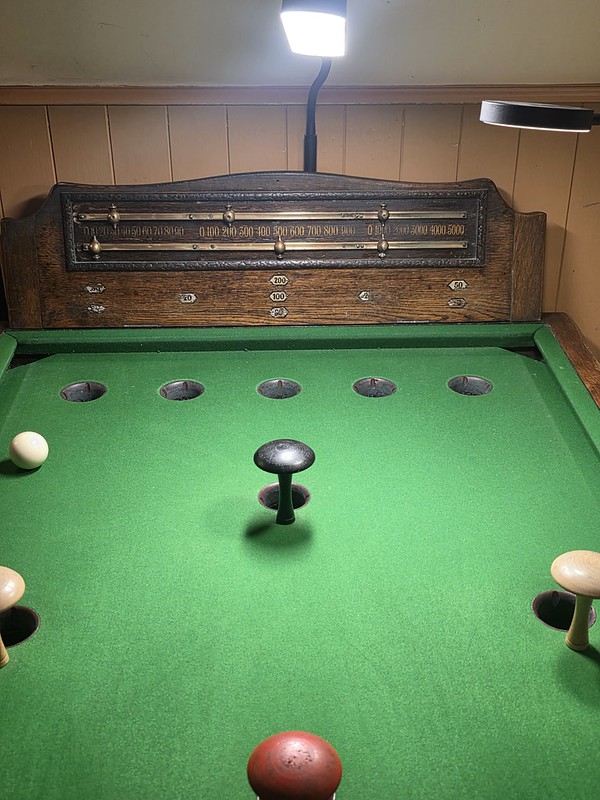
And thanks to Pete for videoing the conclusion of the final game of this match…..
Category: Norfolk
-

Norwich – Bar Billiards Singles Tournament Round 2

After the first round a few weeks ago, it was time for the second round of the Norwich bar billiards cup singles last night, with Oscar playing his game before it was time for my second round game. After three games, which were very well refereed I thought, Oscar was triumphant but there was a lot of surprising and delighting going on.
Then for my three games….. The first one went well for me, despite my struggling somewhat with this table as it’s narrower than the White Lion table. Quite a high scoring game, it’s positive to get the first game in.
The second game went to the final ball part of the proceedings, played differently in Norwich to some other areas. This one involves going off the side cushion into the 200 hole and I promptly missed it…. I didn’t get a second chance, so that was 1-1 on frames.
I slid behind by quite a margin on the third game and it looked all a bit forlorn. To cut a long story short, some fortune and a decision to play the second final ball concluding game quickly meant that I managed to win the final frame.
It was a really close game, so many thanks to Rufus, although it was all a bit tense for my liking, especially when there were about 12 people watching. I know that it’s not exactly the San Siro stadium with its 80,000 seats, but it felt a bit like that at times.
My third round game is against Oscar at the VR rooms….. Whatever happens now, I’ve got further than I expected. The results will go on https://www.norwichbarbilliards.co.uk/Singles at some point.
-
Saturday Expedition Around West Norfolk Pubs
It’s always a delight to spend the day with Roy and Jen, and on this occasion we decided to tour some pubs in West Norfolk. Jen, who promised to be on her best behaviour all day, offered to drive which was very helpful to Roy, who is always on his best behaviour, and myself, again also always impeccably behaved. I won’t comment whether she was on her best behaviour, as I’m not one for gossip, but I very much appreciated the excellent driving she provided.
The reason for the pub choice is that they’ve appeared in previous Woodforde’s pub trails and Roy and Jen are merrily ticking them off. I like these completionist type challenges so I was very engaged with the whole logic of their project. I did wonder whether or not the pubs would be ones which surprised and delighted me, but I’m delighted to say that they did. It was also a bonus to visit some Good Beer Guide pubs to tick off my own list, which is entirely unachievable in its scale.
It’s fair to say that there were some great publicans behind the pubs that we visited, it’s a very difficult time for pubs at the moment and country pubs in particular are finding this challenging. All of the pubs offered a friendly welcome and some were just exceptional, such as the beer choice in the White Hart at Ashill and the warmth from the staff and customers at the Chequers Inn in Thompson. It would also be wrong for me not to mention the landlord Barry from the White Horse in Longham, he’s clearly an institution in his own right and that was another highlight.
I’d note that Roy managed a pint in each venue, which shows just how tough he is. I went for half a pint in each venue, but I had snacks at just about every pub in order to compensate slightly. He’s very rufty tufty is that Roy.
The pubs we visited were:
Wretham, Dog & Partridge (permanently closed)
The Indian is in what was the Mill pub, it was very welcoming although excuse that I’ve written a bit at length about the food as I get excited visiting new Indian restaurants and feel the need to comment. We also visited the Artichoke in Norwich for a few post-event drinks, but I frequently write about that and will do so even more in the future.
Roy and Jen were once again great company and I’m looking forwards to the next little adventure.
-
Yaxham – Rani’s Indian Dining (formerly Mill pub)
Our chosen food location of the day was Rani’s Indian Dining at Yaxham, located near to Dereham. This was something of a perfect combination of a former pub that Roy wanted to visit, originally the Mill, alongside an Indian restaurant which is one of my most favourite things to visit. And it was also my first time in Yaxham for a few years, this is a village that I’ve led a few walks around.
What is now the restaurant was originally the miller’s house, with the current mill dating from the middle of the nineteenth century. Its being a licensed premises is more recent, becoming a restaurant in the 1990s and it became an Indian restaurant in around 2018.
We hadn’t booked, but fortunately there was enough space for us, although it was busy when we arrived. There were a few people waiting for takeaways and combined with the positive online reviews, they’re evidently pleasing lots of people.
The poppadoms and dips, the lime pickle was my highlight here and the poppadoms were suitably crispy.
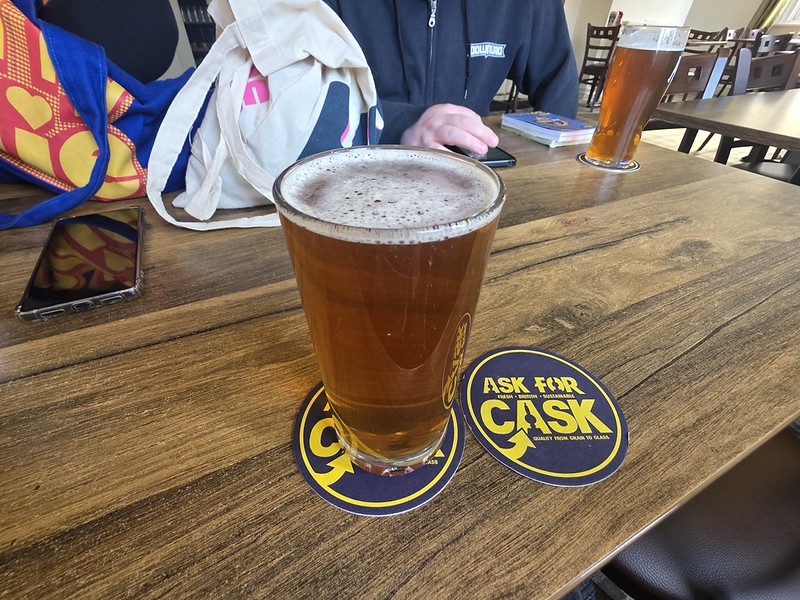
I’m not entirely sure that this was the pint advertised….
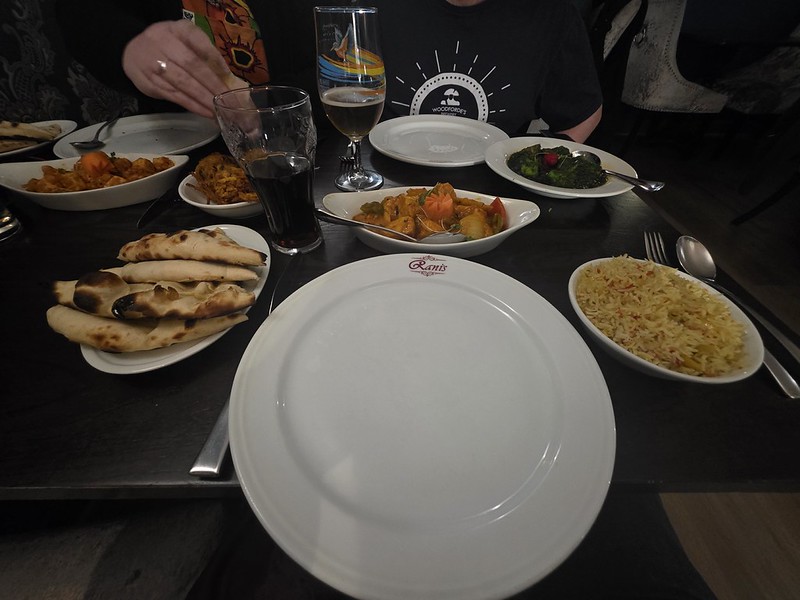
The highlight here was the lemon rice, which was light with plenty of lemon in the taste. The peshwari naan was a little heavy in texture, but had a pleasant enough taste. Without trying to be overly negative, the chicken Dupiaza was lacking in sauce and it’s not meant to be a dry curry so that did impact the whole arrangement.
The chicken was generous in quantity and it was tender, but this meant to be a medium hot curry and there was an absence of any depth of taste to the sauce and certainly no heat so that felt sub-optimal. The onion element was a little heavy and needed cooking down more, but it was really the lack of flavour that was the major limitation alongside with the lack of sauce. As a meal it was perfectly enjoyable, but it shouldn’t really be the case that there’s more heat and depth of flavour from a JD Wetherspoon curry.
The service was just a little disjointed, but it was friendly and the environment was clean and comfortable. The surroundings were inviting and it felt a warm atmosphere, with the service always being attentive and I’m always pleased to get a chocolate with the bill as a positive final touch.
Although it’s often something of a shame that a pub is lost to be a restaurant, it’s marvellous that the venue has survived. And some history has remained, the mill is still located behind the restaurant and there’s some accommodation here as well. And there’s more about the history of the mill at https://www.norfolkmills.co.uk/Windmills/yaxham-towermill.html.
-
Longham – White Horse
The next in our exploration around country pubs of Norfolk was the White Horse at Longham. This had one of the longest histories of any of the pubs that we visited, having been a licensed premises since the middle of the seventeenth century. As with many pubs of the time, it was linked in with another business, in this case it was for a long time also a blacksmiths.
Initially the pub was part of the Swaffham Brewery estate, before becoming part of Steward & Patteson and then Watney Mann. There was something of a modernisation before it became a Chef & Brewer and then after a short period of closure between 1977 and 1978, it became a free house. It has been run by Barry White since 1995, fortunately free of Pubco influence and interference.
A list of the landlords since 1640.
There was a homely feel when we entered, it was warm and comfortable with the TV showing films. There was a slight omission of any customers or staff, but other than that, all seemed well.
There was a bell to get the attention of a staff member and we decided that Roy was the bravest to ring it.
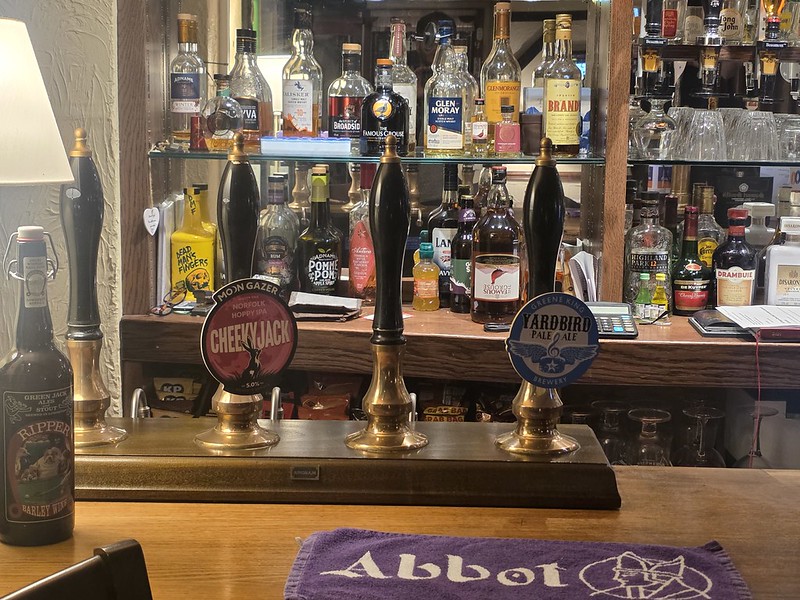
There were two real ales available, the Cheeky Jack from Moon Gazer and the Yardbird from Greene King. It wasn’t a difficult choice.
I went for the Cheeky Jack which tasted in fine form and it appeared to have been served from gravity which I like. It had a taste of orange with a crisp taste, very agreeable. The food pairing at this pub was with BBQ Mini Cheddars and I was pleased with my ordering combination.
The service was polite, personable and it appeared to be the landlord Barry White, who has been here since the middle of the 1990s. He’s certainly doing a fine job, the pub was spotlessly clean and we felt very welcome during the visit.
One of the two dining areas which also looked in a good state of repair. There are also three rooms upstairs for those wanting B&B, with the online reviews for these being positive. There’s also the option of camping outside and the owner welcomes camper vans as well.
This pub certainly surprised and delighted me, it was a proper survivor and I hope that it has a sustainable future. Food is served and I was pleased with how well-kept my real ale was, it all felt organised and the landlord Barry is evidently very much of a character, but for all the right reasons.
-
Castle Acre – Ostrich Inn
The next pub on our little expedition was the Ostrich in Castle Acre and please excuse the lack of quality of the external photo, but it wasn’t the most lit up pub that I’ve ever seen. The rather odd name of the pub relates to the Coke family and the Holkham estate, who had some involvement with this venue. Although as a pub name it’s relatively rare, it’s common in Norfolk and around ten venues have had the name.
It has been a licensed premises since the end of the eighteenth century, once in the Steward & Patteson estate, but now part of Greene King. It received a substantial refurbishment in 2022 which saw its six en-suite bedrooms revamped and the historic interior restored. This was when the venue seemed primarily food-led and that had been my expectation for our visit, not that we were intending to eat there.
There were four real ales available, although as three were from Greene King I was going to have the Duration keg beer before I realised that it sold out. The pub had Greene King IPA, Greene King Fireside IPA, Greene King Abbot and Woodforde’s Nog. I would have preferred a beer that wasn’t local as an option, but at least there was a choice.
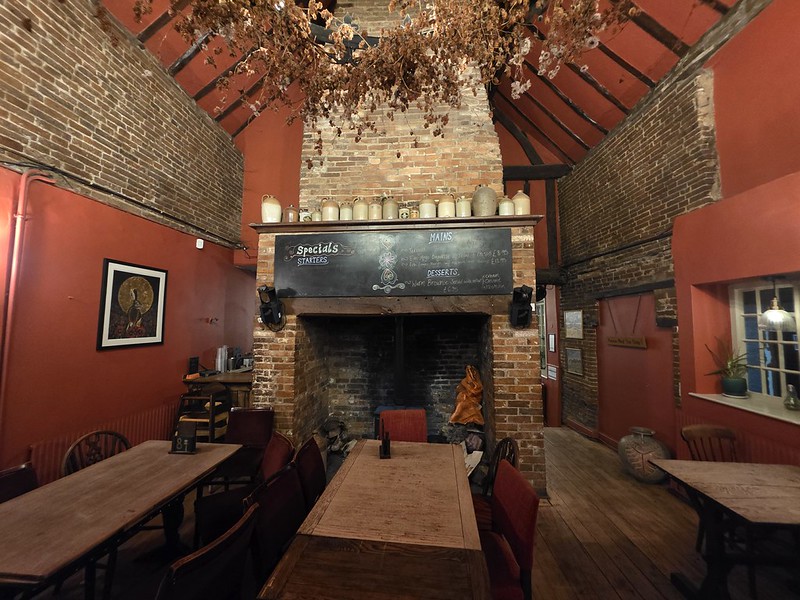
The large rear room and the specials menu is visible above the rather lovely fireplace. This venue wasn’t the only one that day, but I did think it was entirely unclear whether or not they were serving food. As mentioned, I didn’t progress the matter as we had another food destination in mind, but I’m not sure that this pub is as food led as I thought it might be any more.
The same room from the other perspective and I felt for the venue here as it was quite cold in parts of the building, but this must be a nightmare to heat. The toilets were very cold and some of them needed repair, so this must be a financial challenge for the operators. If the venue is mostly tied to Greene King, this must present something of a challenge to the operator in numerous ways.
The front bar was just a little more lively and it had more of a homely and warm feel. The service from the team members was friendly and immediate, with the pub feeling welcoming.
We sat in front of the lower fireplace, although this wasn’t on and was a bit more of a storage area. The venue does seem to be struggling at the moment and has been hit by a wave of negative reviews on TripAdvisor and a fair few on Google. Some are villagers claiming that they’re annoyed, although I might be a little wary there, all they might achieve is losing their pub entirely. Indeed, I always thought of this village having two pubs, but that’s as I was here in 2009 and it has transpired that the Albert Victor closed in 2010, leaving just the Ostrich.
The prices were towards the higher end of the scale and they might have to be careful there if they’re going to be reliant on their local audience. Anyway, this is the Nog from Woodforde’s Brewery and it tasted as I hoped, a bit of liquorice, malty and rich. In terms of food pairings, I’m not sure that the bacon fries were robust enough to stand up to the Nog, but they certainly didn’t take away from it.
I think it’s nearly fifteen years since I’ve been here and so it’s good to be back, not that I can remember anything from my first visit. It’s great that the pub is still going, although I would like to have seen more about the venue’s name and history within the pub. I mention this as a lot of sources refer to this as a sixteenth century building, but the listed building record and licensing documents suggest an eighteenth century building.
Anyway, I felt welcome during the visit and I rather wonder if the pub comes more to life during the summer months when the tourists come flocking to the area and I suspect things liven up a bit.
-
Ashill – White Hart
I can’t say that I was entirely confident that this would be a great pub when looking at the exterior, but I’m pleased to note that not only is it listed in the Good Beer Guide, it’s a really decent venue.
Some of the reason for it not looking perhaps as decadent as it might is that it’s not the original pub from the late eighteenth century. The pub had a little issue when it burnt down in the late 1930s and so it was rebuilt between 1938 and 1939. It went from the Bullards brewery set-up to Watney Mann and then it found itself lumbered up as part of the Pubmaster estate before they were able to make a bid for freedom and it became a freehouse.
Someone thought it was a good idea to name it as McTaggarts between 2011 and 2020, but, fortunately, wiser heads prevailed and it went back to its old name. Matters have clearly improved since it reopened in 2021 as CAMRA have awarded it a series of accolades and awards over the last few years.
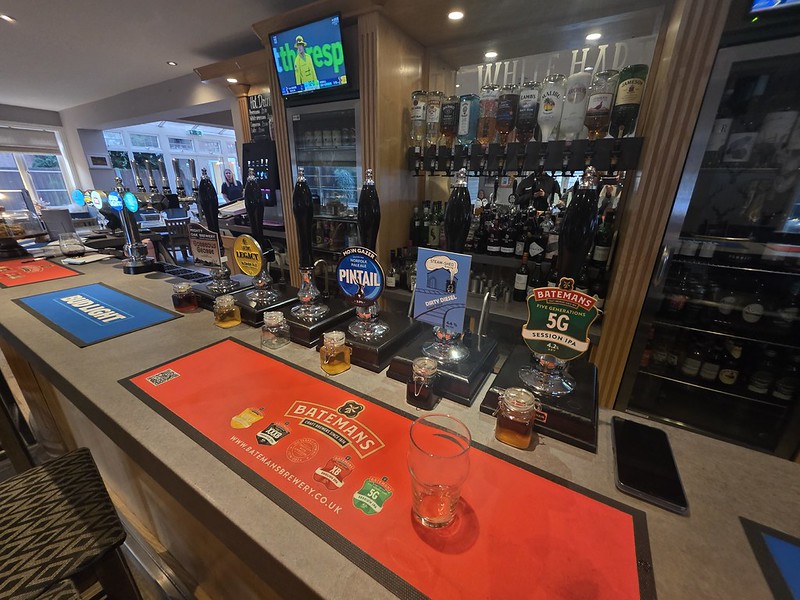
There were five real ales available which is quite something for a country pub. There was a range of styles and local and more further afield breweries, so it all felt well curated.
I went for the Dirty Diesel from Steam Shed brewery, a small outfit from Swaffham who brew some very decent beers, as I hadn’t had that one before. This was a very acceptable beer with chocolate and coffee flavours. As an aside, although they might look premium, I’m not a huge advocate of Salty Dog crisps, I find them a bit bland in taste.
It might not have been a very suitable option for a cold Saturday in January, but the pub does have a nice little beer garden.
Overall, this venue certainly did surprise and delight with an excellent selection of real ale for a country pub, a friendly service and a clean and comfortable environment. A very justified entry into the Good Beer Guide.
-
Saham Toney – The Old Bell
The next pub on our little meandering around West Norfolk was the Old Bell at Saham Toney. As an aside, I like the village name with its first word being Saxon and then the second word being a Norman word shoved on.
Back to the pub, originally known as just the Bell Inn (as it obviously wasn’t old when they opened it), and this has been a licensed premises since the late eighteenth century, being owned over time by the Watton Brewery, the Wymondham Brewery, Morgans, Bullards and then Watney Mann who closed it in the early 1980s. It remained closed for a few years and was then reopened, which feels like a fortunate thing for the village as it could have easily been permanently lost. This is another pub that once had accommodation available upstairs, but I don’t think there are rooms now for visitors.
Arthur Lister ran the pub briefly in 1937 and early 1938, but it didn’t go entirely well and he ended up bankrupt. It was something of a tale of woe, he decided to also go into farming and decided to rear ducks but his 1,000 birds died from illness and he lost £200. He then got some pigs and fed some of his dead ducks to the pigs, which then in turn got ill and died. He decided to move onto something else and grew sugar beet and then that crop promptly failed. He was able to get alternative employment and the brewery let his wife run the pub for a short while.
As an historic aside, pubs were often held for inquests and that was the case in 1870 when a local woman Ann Payne the wife of the local shopkeeper, died. It was concluded that after being in a low and desponding state for some time, she had deliberately drowned herself. The newspapers are full of this sort of story in the nineteenth century, the levels of depression must have been high and it’s certainly not a new thing.
I didn’t get a photo of the real ale selection, but there were three to choose from, including the Woodforde’s Wherry. I went for the Proper Job from St. Austell Brewery which was light, fluffy and well-kept, with the French Fries adding a certain extra charm to proceedings.
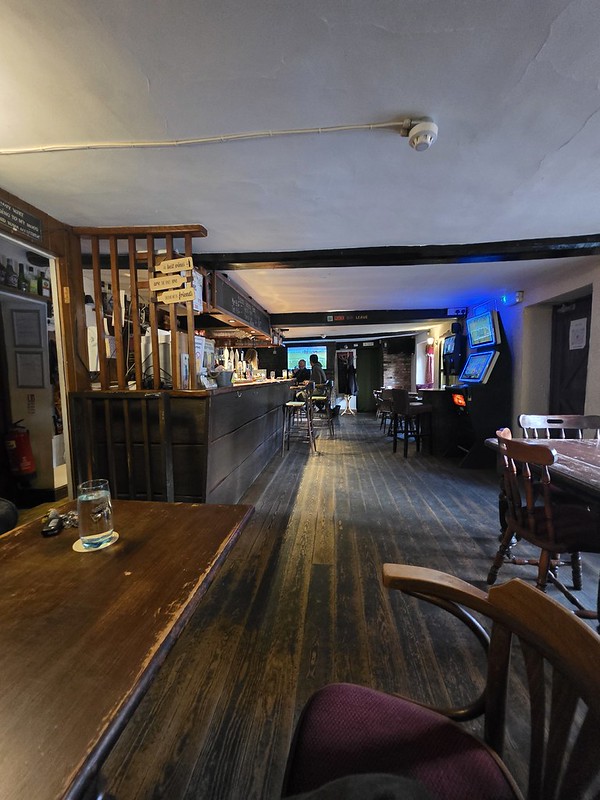
It’s a long pub with the bar opposite the main entrance door, with a TV and small sports area to the far end. Food is served here most lunchtimes and evenings.
Large fireplace.
A map of the old parish of Saham Toney.
A little out of date perhaps, but an award’s an award.
There’s a pleasant outside area, although that’s closed off at this time of the year. There’s also a large mere at the back of the pub and I had to look up what the difference between a mere and a lake was, but it seems to be primarily that the former is shallower.
Anyway, I wasn’t sure what this pub would hold when we approached, but it felt like a friendly venue and the atmosphere was welcoming. The team member at the bar was personable, there was a decent choice of real ales and the beer that I chose was well-kept. The selection of bar snacks was above average and I rather enjoyed this visit.
-
Watton – Kings Arms
The next pub on the Jen, Roy and Julian expedition was to the Kings Arms in Watton. This is a wet-led pub which is listed in the Good Beer Guide, so that’s another one to tick off for me.
This has been a licensed premises since the late eighteenth century, initially owned by the Thetford Brewery before becoming part of the Youngs, Crawshay and Youngs pub estate and then Bullards, Watney Mann and Brent Walker, although it’s now a freehouse.
There was some excitement in 1866 when Charles Clements pinched a basket of eighty oranges owned by the dealer Thomas Newman and in court, he said that “it was just a joke”, with the newspaper noting that the court accepted that. I’m not entirely sure that the owner of the fruit thought that, but the miscreant had to reimburse him.
It was traditionally known as the Kings Arms Inn and so would have had accommodation and in 1989 they were advertising their four bedrooms and good food. The venue doesn’t seem to offer this accommodation now, but they do have a large function room for events.
It was a little challenging to see what real ales were available as it’s one of those venues which has customers sitting at the bar right in front of them. But there are three real ales, Greene King IPA, Eastern Gold from Barsham and the Golden Bicycle from Fixed Wheel Brewery.
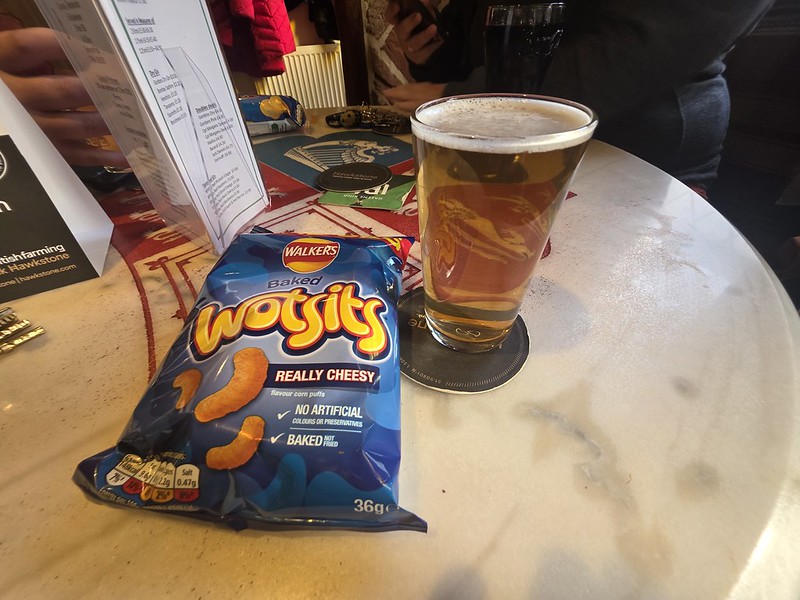
I went for the Golden Bicycle from Fixed Wheel Brewery which was a well-kept and gentle beer with a fruity edge to it, paired beautifully with the Wotsits.
It’s a relatively large venue and there’s a pool table in the back room. The service at the bar was friendly, with the venue having a welcoming and inviting feel to it. I like that carpet and wooden flooring combination, it looks modern and warm, whilst also being functional.
There’s no food, but there is a shots menu.
Bottomless beer and chicken wings, what could possibly go wrong?
The nicely decorated ceiling and the male toilets had a similar design set-up.
This feels very much a community driven venue with darts and pool teams, as well as regular board games evenings. The venue is proud of their real ale selection and I liked their choice which had a couple of local beers alongside one which was from further away. All really rather lovely.
-
Thompson – Chequers Inn
Next on our meander around pubs in West Norfolk was the Chequers Inn in the village of Thompson. I wasn’t entirely sure what to expect from the beautiful exterior and we weren’t initially confident that it was even open.
The building dates from the sixteenth century and it has been a licensed premises since the late eighteenth century. Throughout its history it has mostly been owned by the landlord so it’s been a free house that hasn’t fallen into the hands of any breweries.

The venue struggled by 1997 but was taken over by new owners in 1998 and given a new lease of life by Heather McDowell and Richard McDowell and they’re still there today, so that’s some considerable achievement. There had traditionally been accommodation here and there remain three rooms that are let out on a bed and breakfast arrangement.
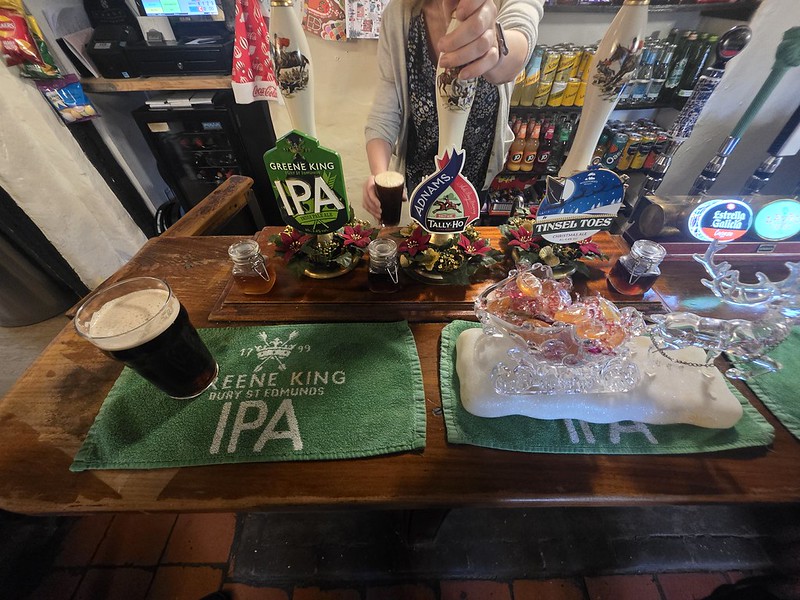
There was a friendly and immediate welcome, with the pub having an inviting atmosphere. There was a selection of three real ales, but there was only one that I was really drawn to (my eyes were immediately drawn away from Greene King IPA) and that was the Tally-Ho from Adnams which I don’t think that I’ve had before. I cautiously had a half pint of this 7.2% ABV barley wine style beer, although Roy was merrily going for a pint of it which seemed brave as the second beer of the day.
It’s the first time that I’ve had Tally-Ho and it didn’t disappoint, it was punchy, strong and had a touch of sweetness. Walkers isn’t my preferred crisp brand, but it did pair well with the beer.
There’s a dining area and also a snug, but this room is the only bar area and it’s certainly quite compact. I did warn Roy to be careful when he stood up, but he forgot and hit his head on the low beam. As an aside, I noticed that there were a couple eating in the snug and their food looked really rather lovely and the online reviews look positive.
The pub is used to customers hitting their heads, despite their warnings….
I very much liked this pub as it felt genuinely friendly with customers talking to each other in the small bar area. The staff member was welcoming and personable, with the whole arrangement being clean, comfortable and organised. The prices were reasonable and I’ll remember this pub positively.