Category: Norwich

  • Norwich – The Old Barge and Henry Goulder

    Norwich – The Old Barge and Henry Goulder

    150 years ago today, on 25 February 1871, the Norwich Mercury reported that Henry Goulder of King Street had become “drunk and riotous” and had broken a square of glass in the window of the Old Barge pub. He had caused damage that cost 3 shillings to repair, and in a court hearing chaired by the Mayor of Norwich he was fined 1 shilling and ordered to pay 5 shillings 6d in costs.

    George Plunkett has a photo of King Street from 1935 where the Old Barge is visible, along the sign noting that ales and stouts were available. It’s also possible to see the sign noting that the pub was owned by Youngs, Crawshay & Youngs Ltd. The pub was damaged during air raids during the Second World War, but it re-opened and it continued trading until 1969. I quite like that the boot scraper from the pub’s entrance is still visible in my photo of the building today, although the door has been converted into a window.

    Sadly, this isn’t a pub today, it’s part of Dragon Hall, but a pub would be a fine way to allow the public to get access to the building now that the Dragon Hall museum has closed. Although I think lots of buildings would be better used as pubs, but rarely does that seem to happen at the moment.

    Back to the crime though, Henry Goulder worked as a waterman and had clearly got a little over-excited with the drinks sold by the pub. But it’s rare that in the Victorian period that someone committed one crime and then nothing more was heard of them. Goulder seems to have been a bloody nuisance to the community and to the police. He had been arrested by Constable Emms in 1848 and brought before the court and its chair Samuel Bignold, charged with riotous assembly on Mousehold Heath where he had to give sureties totalling £20. That’s around £1,600 in today’s money, so I take it that he annoyed Samuel, who was also the General Secretary of Norwich Union.

    This punishment clearly didn’t help, as in 1850, Goulder and two others entered the Prince of Orange pub on King Street and ordered beer which they then refused to pay for. Goulder hit the landlord, Thomas Adcock, and continued to beat him whilst he was on the floor, and he then attacked the landlord’s wife who came to help her husband. Goulder was fined £10 and told he would go to prison if he didn’t pay it. He was in court again for drunken behaviour in 1863 as well, but it was said that he was an industrious man when sober. It was clear that he had problems with alcohol and I can imagine he had a reputation on King Street for that.

    His demise was reported by the Norfolk Chronicle in July 1881, as Goulder had been swimming (and this was known as the media reported noted “he had his swimming drawers on”) and fell from the wherry Dart, which was moored against the quay on Fye Bridge. He was drowned and it was reported that he had had a seizure which had caused him to fall, with his address noted as being in the Lanes Buildings on King Street.

  • Norwich – Augustus Jessopp and Vaccines 150 Years Ago

    Norwich – Augustus Jessopp and Vaccines 150 Years Ago

    150 years ago today, on 25 February 1871, the Norwich Mercury printed a letter from Augustus Jessopp, the Headmaster of Norwich School, about the matter of vaccinations. He was referring to the small-pox vaccination and he noted a report that said:

    “It is advisable that when small-pox appears in a neighbourhood, all persons who have not distinct well-marked scars of vaccination on their arms should be re-vaccinated. It is doubtful whether any ill effects ever follow careful vaccination from a healthy child, but if all that is said against it by its enemies is true, it cannot for one moment outweigh the benefits which can be traced as distinct results of its performances”.

    The Government had enforced a compulsory vaccination programme for children against small-pox in 1853, but this was fought against a backdrop of those who didn’t support vaccines as it was a myth, that it was unnecessary or that it would harm children. I wonder if anything really changes over the centuries…..

  • Norwich – St. George’s Church, Tombland (John Coppin)

    Norwich – St. George’s Church, Tombland (John Coppin)

    This stone tablet (clicking on the photo makes it larger) is located on the external wall of St. George’s Church in Tombland and it commemorates the life of John Coppin, who was born in 1630.

    John was the long-serving (probably from 1660 until 1711) rector of Winfarthing church, located near Diss, and he died on 23 November 1711 at the age of 81. It seems, slightly surprisingly, that John Coppin wasn’t a rare name at the time, so I can’t quite ascertain where he was born or died, nor what his relationship was with this church in Norwich.

    A short distance away from this church is Red Well, which is where in 1701 Francis Burges set up the Norwich Post, which is considered to be the first provincial newspaper in England. Unfortunately, very few copies of this newspaper remain, the earlier survivor being from 1707. I wonder whether John’s death would have been mentioned in the newspaper, although I think the aim of provincial newspapers was often a little more political than the more mundane reporting of local obituaries.

    Sometimes graves are moved onto the structure of the church at a later date, but it appears this was placed here following John’s death. A book of the city’s history written by Francis Blomefield at the beginning of the nineteenth century notes that the stone was in its current location in 1806. Much of the stone tablet is blank suggesting at some stage it was thought more might be added. Inside the church is (or was) a memorial to Dorothy Mettyer, the daughter of John, who died in 1722. It seems possible that perhaps it was initially planned to add her details to that of her father.

  • Norwich – St. George’s Church, Tombland (William Martin Seppings)

    Norwich – St. George’s Church, Tombland (William Martin Seppings)

    Tucked away at the back of the churchyard of St. George’s Church in Tombland, Norwich is the gravestone of William Martin Seppings. William was born in 1785 and lived in South Acre, a village located nearby to Castle Acle and he married Anne Squire (born in 1791) in 1811.

    The electoral register of 1835 notes that he held a freehold estate at Tombland which gave him the right to vote. He was also one of the first chairs of the East of England Bank following its establishment in 1836, a bank which got into financial difficulty in 1864 and was reformed as the Provincial Banking Corporation, later becoming part of Barclays Bank. In his various roles on the council, William served alongside Samuel Bignold, the general secretary of Norwich Union and son of its founder.

    At the 1841 census, William was living at Tombland (although no more precise address is given) with his wife Anne, along with Beatrice Ellis (aged 40), Elizabeth Jessup (aged 35) and Sarah Smith (aged 20). The ages at the 1841 census aren’t always perfect, and William was listed as being aged 50. I can’t find any evidence that the couple had any children.

    William died at his house at Tombland on 19 March 1846, at the age of 61. The death was reported by the local press, who noted that William had been one of the first batch of magistrates appointed by Sir Robert Peel’s administration after the Whigs had lost power. Perhaps more telling is the comment that “although he possessed no inconsiderable portion of eccentricity, he was an independent and honourable man and generally respected”.

    Anne lived much longer, she died in 1883 at the age of 92, having lived at a property at Castle Meadow with two servants for over three decades. Elizabeth Jessup remained as a servant until the late 1860s, having served the family for over thirty years.

    There’s not enough information that I can readily find to tell the whole story of William Martin Seppings, although we know he did well financially and was well respected. We also know that he was quite eccentric, thanks to his obituary, and that he was afforded a decent headstone which has lasted well. What he would think about being in the corner of the graveyard next to some bricks and compost I’m not sure. But the church remains in use, he’s near to Tombland where he lived and worked for much of his life, and so perhaps he’d be quite content knowing that not that much has changed here.

  • Norwich History by Parish : St. George Tombland

    Norwich History by Parish : St. George Tombland

    And a new little project that Jonathan and I are undertaking because this lockdown is clearly here for at least a few more weeks. It’s a bit niche (our project I mean, not the lockdown), I’ll accept that, but there we go. Effectively, it’s walking around Norwich, ancient parish by ancient parish and seeing what is there now compared to a map from the 1880s (the map above is from 1789, but the one from the 1880s is more detailed, which is why we used that). There’s a PDF of these boundaries to provide some extra background to this whole project.

    St. George Tombland is the fifth parish we’ve done this for and, again, there’s substantially more history than I can mention in this post, a reminder of just how much heritage remains in Norwich.

    The parish of St. George Tombland isn’t large geographically, but there are over thirty listed buildings in what is a relatively small area.

    A map of the area from the late nineteenth century.

    We started in Tombland itself, slightly challenging as there’s an extensive renovation of the area taking place at the moment. This area was the heart of Anglo-Saxon Norwich and was where their market was located. Its name origin is from the Viking word ‘tom’ meaning an empty space rather than a tomb as in grave. Tombland was also at the effective centre of the four Anglo-Saxon settlements of Coslany, Conesford, Norwic and Westwic. When the Normans took over the city they moved the centre of their settlement to be at Norwich Castle, although Tombland remained as a market area.

    There were until very recently underground public toilets here, although they’ve long since been closed, and the council’s plan is to open the area up with its renovation project. Tombland had, unfortunately, all become a little run down and wasn’t a pleasant place to sit. Visible in the background are the phone boxes, which are listed, and an old water fountain.

    The buildings on one side of Tombland have been built against the wall of the Cathedral Close.

    The parish boundary is to the right of this doorway, which leads to St. Mary the Less Church.

    For many years this has been Prezzo, although it was announced this week that the restaurant is now permanently closed in Norwich, meaning both the chain’s outlets in the city have gone. The building itself was a former residential property and it’ll be interesting to see what its future is.

    Looking towards the eastern side of Tombland.

    Today a Japanese restaurant, this is 6 Tombland which was built as a residential property in the eighteenth century.

    Turning the corner into Princes Street, of which the section further down is in the parish of St. Peter Hungate. The white-fronted building on the right is 26 Princes Street, a residential property built either in the late sixteenth or early seventeenth century. The building behind it, facing the churchyard of St. George, is 1 Tombland Alley and that was built in the seventeenth century, also as a residential property. Access to that property is now only possible by going through 26 Princes Street. George Plunkett took a colour photo of these buildings in 1936 and not much has really changed.

    The entrance to Plumbers Arms Alley, which I’ve written about before…..

    The parish boundary with St. Peter Hungate and there is a link on that page to a photo George Plunkett has showing that there were three of these markers here until not that long ago.

    Looking back down Princes Street towards Tombland, with nearly all the properties on the left hand side being listed.

    That bulging window (I admit that’s probably not the technical term) is delightful. It’s located at 18 Princes Street and the window dates from the eighteenth century.

    The small area of churchyard in front of the church of St. George, from which the parish takes its name. Not many gravestones remain here, but the soil is piled up a little, with no doubt many hundreds of burials having taken place in this small area until the practice was stopped in the middle of the nineteenth century.

    Inset into the church is this memorial to Mary Barber, who died in 1689. I find these are really useful ways of connecting with the past, people who lived and worked in Norwich over three centuries ago. Times were turbulent in the seventeenth century with civil war and the the battle over religion being major issues for the people of the country, there must have been great uncertainty. And life, as with Mary who died aged 32, was often short.

    Looking towards the south side of the church of St. George. It’s Grade I listed and there has likely been a church on this site since the late Anglo-Saxon period. The current structure dates from the fourteenth and fifteenth centuries, with the tower dating from 1445 and then having major repairs in 1645. There’s a monument of note inside from 1617 which commemorates the life of Thomas Anguish (more on whom further down this post).

    Unfortunately, the church is closed at the moment, but public entrance is usually allowed. This is the northern side of the church, where a path cuts across which is known as Tombland Alley. There were iron railings on the church side, but these were removed during the Second World War to be used as part of the war effort. The north porch of the building has been closed off and is now in use as a small chapel.

    The rear of Augustine Steward’s House which dates from the mid-sixteenth century. This is a substantial building, and quite a survivor, with three floors and a basement, stretching back some way from its frontage onto Tombland. The property takes its name from the man who commissioned it, Augustine Steward, who was the Sheriff of Norwich in 1526 and Mayor of Norwich in 1534, 1546 and 1556. It’s thought that the building was completed in 1549, although it was in a state of some disrepair towards the end of the nineteenth century and needed substantial renovation. The roof was also badly damaged during a fire which took place in 1944. There’s a George Plunkett photo of these properties which he took in 1935.

    Augustine Steward’s house is to the left and straight ahead is Tombland and Norwich Cathedral. There’s something quite delightful about the wonkiness of these buildings and how repairs have had to work around these little idiosyncrasies.

    This was once the house of Christopher Jay, the Mayor of Norwich, and he wanted something quite grand at the entrance to his residence. So, he installed statues of Hercules and Samson, likely in around the late 1640s. They have become something of a Norwich icon, but the two wooden statues there now are modern replacements. The originals were removed in the 1990s and were left to dry out by Norfolk Museums Service so that they could be restored and put on display. It was discovered that the statue of Samson was covered in sixty layers of paint and was original, dating to 1647, although Hercules was a Victorian replacement. The building which they’ve guarded has been used for multiple usages, including perhaps most famously a nightclub for some decades. There was some controversy, and perhaps quite rightly, when these statues were painted red when a restaurant took over the premises a few years ago.

    Next door is the Louis Marchesi pub, which has been a licensed premises since around 1770, when it was known as the Waggon & Horses. There was previously a fourteenth century building here and the crypts of that were retained when the newer structure was added on top and the Tudor effect is fake and dates to the early twentieth century. The pub was renamed the Louis Marchesi in 1976 and changed again to the quite drab name of Take Five in 2004, but since 2017 the Louis Marchesi name is back.

    Louis Marchesi (1898-1968) was a local man and he founded the Round Table movement, a charitable organisation for young men. Wikipedia notes that Marchesi was also the man who came up with the “There are things we must do, there are things we can do and there are things we should do”, although I haven’t checked that little bit of information….

    Today this is known as Waggon and Horses Lane, after the pub (before it was renamed to the Louis Marchesi), but it was previously referred to Elm Hill Lane and it connected to Elm Hill Street at its other end. This was all a bit confusing, so Elm Hill Street became known simply as Elm Hill, and this street was renamed.

    The Black Horse pub, the section on the left which until recently was the Black Horse bookshop and is now an Indian restaurant.

    This was Jonathan’s favourite discovery of the day and I must admit, I’ve never noticed it here. It’s the “Black Horse Skittle Saloon”, the former skittle alley of the Black Horse pub. There’s plenty more information about the Black Horse at the Norfolk Pubs web-site.

    The main part of the building is now an opticians, but the black horse remains.

    The parish boundary cuts across Wensum Street and includes the rear of the Maid’s Head hotel.

    The frontage of the Maid’s Head hotel, which claims to be the oldest hotel in the UK. I think that’s perhaps a little arguable (more on that on the Guardian’s web-site), but there’s certainly a long heritage to this building and a long history of hospitality. The hotel notes on its web-site:

    “The first Norman Bishop of Norwich, Herbert de Losinga had his original palace here, so we base our claim on the site’s continuous use for hospitality since the middle of the 1090s.”

    They also have some old images of the hotel, both internally and externally. The mock Tudor frontage on this section dates from the 1890s and George Plunkett has a photo of this side of the hotel which he took in 1934.

    This door is a modern recreation and it’s to note that Thomas Anguish (1538-1617), the Mayor of Norwich in 1611, lived here. Anguish left money in his will for a children’s hospital and this was founded in 1618, the year after his death.

    This is the rear of the Maid’s Head and the old map notes that there was a Bishop’s Palace in this area, which fits in with the information provided by the hotel itself. I feel that I need to learn more about this, as I didn’t know that such a building ever existed on this site.

    The Erpingham Gate isn’t in the parish, but the boundary reaches the wall.

    The statue of Edith Cavell, which was moved here a few years ago from the traffic island that was located a short distance away. It’s easier to see the statue in its current location, as there’s less chance of being run over, but George Plunkett has a photo from 1932 which shows its former position in front of the Maid’s Head.

    Edith Cavell (1865-1915) was the first of four children of the vicar of Swardeston and she worked in this area and in Brussels in a role looking after children. She then trained as a nurse and worked in London and Manchester, before moving permanently to Brussels, which would have been quite an adventure for the time. She decided to stay in Brussels to help British and French soldiers, which included hiding over 200 of them from the Germans. Someone betrayed her to the Germans and she was sentenced to death by a military court, being shot at dawn on 12 October 1915. She was buried at Norwich Cathedral on 15 May 1919 following a memorial service which took place in Westminster Abbey.

    Cavell’s death was used as propaganda by the British and the allies, to show the horrors of the Germans in shooting a nurse. There was significant international condemnation for the Germans and numerous attempts were made by countries to get the execution suspended. This wasn’t one of those decisions which was undertaken by an impulsive German soldier, this was a real dilemma for the German authorities who gave consideration to what they were doing. They didn’t want Cavell inspiring a wave of young women to offer resistance to the Germans, so they went ahead with the execution as a warning of what would happen to others who sought to repeat her rebellious efforts.

    This stretch of wall behind Edith Cavell’s monument had buildings that joined onto it in the past and although they’ve now been swept away, some of the marks are still visible.

    Most of the Edith Cavell branding has been removed from the pub, having been replaced by Prime Restaurant signage. The Norfolk Pubs web-site mentions that it was opened in the mid-nineteenth century when it was known as the Tombland Stores until 1879, then the Army & Navy Stores until 1981 before taking its current name (bar a short spell as Coles).

    The bottle and jug entrance to the pub, for those customers who wanted to take beer away with them, with what is likely Victorian etching which has survived the decades.

    And that’s another parish done, surprising me that there were a considerable number of historic bits and pieces that I hadn’t noticed before, not least some of the graves around the church of St. George and also the skittle alley at the rear of the Black Horse.

  • Norwich – Black Lives Matter Graffiti

    Norwich – Black Lives Matter Graffiti

    I don’t intend to veer into politics on this blog, but this graffiti has appeared under the flyover on Magdalen Street and it seems nicely done. Something which tells a story and adds some interest to the area near Anglia Square is perhaps really quite welcome.

    As an aside, this is a ugly area, it’s a shame that nothing in the past could have been built under the flyover to tidy this whole site up. This rather beautiful building is what used to stand here…..

  • Norwich History by Parish : St. Peter Hungate

    Norwich History by Parish : St. Peter Hungate

    And a new little project that Jonathan and I are undertaking because this lockdown is clearly here for at least a few more weeks. It’s a bit niche (our project I mean, not the lockdown), I’ll accept that, but there we go. Effectively, it’s walking around Norwich, ancient parish by ancient parish and seeing what is there now compared to a map from the 1880s (the map above is from 1789, but the one from the 1880s is more detailed, which is why we used that). There’s a PDF of these boundaries to provide some extra background to this whole project.

    St. Peter Hungate is the fourth parish we’ve done this for and although it’s relatively small in size, it has got some considerable heritage packed into it. There’s substantially more history than I can mention in this post, a reminder of just how much heritage remains in Norwich.

    The parish boundaries map.

    And a map of the area from the 1880s.

    The parish boundary goes right through the middle of this building, better today known as the Halls and it’s where Norwich Beer Festival is held. It’s actually though two buildings, St. Andrew’s Hall on the left and the building off to the right is Blackfriars’ Hall. We ignored the former today, as it’s in a different parish, just looking at Blackfriars’ Hall which is named after the Dominican Order which took over here in 1307. There’s imagery of inside of Blackfriars’ Hall on their official web-site.

    The area next to Blackfriars’ Hall, which isn’t accessible to the public, but the parish boundary runs through the middle of it, along the line of the concrete wall.

    This keyboard mould was pushed into the concrete in around 2000 by Molly Sole, a local art student, and there was a wave of public interest about it in 2020.

    Formerly one residential property, this house has now been divided into two and in the nineteenth century a corner shop was opened. It’s been used for numerous purposes since then, including as a cafe.

    At the top of Elm Hill, a pair of eighteenth century residential houses, with a plaque noting that the Friars de Sacco settled in a property on this site which was given to them by William de Gissing in around 1250.

    The rear of Blackfriars’ Hall, this is the most complete friary complex remaining in the country. Volunteering at Norwich Beer Festival has numerous exciting benefits, including free beer and food (and meeting people and all that stuff), but also being able to explore this wonderful building.

    The entrance to Monastery Yard.

    This area is now a car park (I think the city council have a plan for Norwich to become the European City of Car Parks), but there were residential properties which were on the left-hand side here. On the right-hand side is a monastery chapel which was built by Father Ignatius (more on him later), but which was forced to close in 1876.

    The rear wall of Monastery Street and there used to be residential properties which backed onto it.

    It’s now possible to walk by the River Wensum, but there were once buildings all along here which went down to the riverside. The situation here was that in the medieval period there were some grand properties owned by wealthy merchants on Elm Hill and they would have gone down to the river. Over time, these rear areas were filled with often poor quality residential properties and industrial buildings accessed by courts and yards, most of which were pulled down during slum clearances.

    This was once Crown Court Yard and its entrance remains, but the buildings have gone and it’s just a car park now. This really isn’t a great use for a site such as this in a prime part of the city.

    This is the remains of Towler’s Court which connects from the river to Elm Hill, with the buildings here being demolished as part of the 1920s slum clearances.

    And these are the parish boundary markers on Elm Hill, with the boundary of St. Simon and St. Jude on the left from 1842, and St. Peter Hungate on the right from 1814 and 1834. The parish boundaries are rarely logical, twisting and turning through buildings, so these iron markers really were essential.

    And the same parish boundary markers on the other side of the road, a real legacy of this system of dividing up the city.

    37 Elm Hill, with an entrance to Norris Court Gardens.

    Elm Hill is one of the more historic streets in Norwich and there are numerous Tudor buildings and undercrofts along here. So, what did the city council want to do in the 1920s? They proposed demolishing the properties along here so that they could build a swimming pool. Fortunately, local opposition and the intervention of the Norwich Society saw off these misguided plans and fortunately this marvellous area survived.

    Some on the council were entirely blindsided by the local opposition, with Mr Manning saying in a council meeting in 1926:

    “The city would be purer and better if the site was cleared. It is one of the festering sores in the city and the council would be well advised if they cleared the whole of the street away and made a public restplace”.

    Just weeks later, the city said that it was reversing its decision and the City Engineer was drawing up plans to restore the frontage of the buildings along Elm Hill, working with William Weir, the architect to the Society for the Preservation of Ancient Buildings.

    As an aside, there was a meeting in early 1926 held by the Norfolk and Norwich Archaeological Society and the chairman said that he was hopeful that there were some members of the Labour Party present. The chair said that he was aware that it wasn’t everyone in the Labour Party who wanted old buildings pulled down as “some members in the Labour Party were now very cultured and fond of anything artistic and antique”.

    I mentioned Crown Court Yard earlier in this post, and this is the sign visible from Elm Hill.

    And the entrance to Crown Court Yard from Elm Hill, not that there’s much of a yard to go through to.

    Looking back down Elm Hill.

    There’s a parish pump and an elm tree, although both are modern replacements.

    An old doorway with a plaque commemorating the life of Father Ignatius (1837-1908) who was an Anglican Benedictine monk who wanted to bring back the monastery system. He purchased this house on Elm Hill, definitely suitably located given he could see Blackfriars’ Hall from his window, which must have been a constant inspiration. George Plunkett has a photo from 1935 of this doorway.

    Briton’s Arms is currently closed and is for sale, after being run by sisters Sue Skipper and Gilly Mixer for 45 years. The building likely dates to the middle of the fourteenth century and was a beguinage, or a house for religious women. It was the only house in the street to survive the fire in 1507 and for the next couple of centuries it was used by barbour surgeons and individuals involved in the wool trade. Timothy Gridley, a woolcomber, was perhaps the first landlord here when he was listed as a licensee in 1760. The pub was initially known as the Kings Arms, being changed to the Briton’s Arms in the early part of the nineteenth century. It remained in use as a pub until 1945, when it became a restaurant and cafe.

    Looking back down Elm Hill.

    A drawing, from around the same spot as the above photo, drawn in the 1920s as part of the plan to restore the street.

    The porchway of St. Peter Hungate, the first church in the country to be repurposed when it was declared redundant in 1936. It housed a museum of church art, an inspired and forward-thinking idea, but sadly it closed in 1995. Now under the management of the Norwich Historic Churches Trust, the church is now home to Hungate Medieval Art, a charity which promotes the city’s medieval history.

    Inside the porch, which can’t be accessed and I took this photo through the gate…. I will at some point hopefully find my photos of when I visited this church during the Flintspiration weekend in 2017. There are some photos of how the church looked on the web-site of Hungate Medieval Art.

    There may have been a church on this since the Anglo-Saxon period, although most of the current building dates to the fifteenth century. Much of the cost of this was paid for by John Paston and Margaret Paston, best known perhaps for the Paston Letters. The chancel and tower had been built in 1431 under the supervision of Thomas Ingham, although the chancel had to be rebuilt in 1604 when it fell down, which wasn’t entirely ideal. The church tower was shortened at the beginning of the twentieth century and the belfry was also knocked down, a period when the building was in generally a poor state of repair.

    The chancel end of the church with the graveyard behind, which is currently inaccessible to the general public.

    This building is on Prince’s Street and it used to be a shop, visible in this 1936 photo from George Plunkett. We went to stand by the entrance to where the shop was, but there’s no trace of it left at all, although the grate is in the same place.

    Two more parish markers, St. George Tombland 1777 and St. Peter Hungate from 1834. George Plunkett has a photo of these from 1934, and unfortunately one has gone missing, as his photo showed a St. George Tombland 1828 marker as well.

    Located on a new building on the other side of Princes Street is this parish boundary marker from 1834, a real survivor since this had to be taken off an older building and placed onto its replacement.

    And that was the end of our little tour, which was quite a moist expedition given the amount of rain. There are 16 listed buildings in this one parish and the streetlines haven’t really changed in this parish for over 500 years, so it’s an area of the city that is worth meandering to.

  • Norwich History by Parish : St. Edmund

    Norwich History by Parish : St. Edmund

    And a new little project that Jonathan and I are undertaking because this lockdown is clearly here for at least a few more weeks. It’s a bit niche (our project I mean, not the lockdown), I’ll accept that, but there we go. Effectively, it’s walking around Norwich, ancient parish by ancient parish and seeing what is there now compared to a map from the 1880s (the map above is from 1789, but the one from the 1880s is more detailed, which is why we used that). There’s a PDF of these boundaries to provide some extra background to this whole project.

    St. Edmund is the third parish we’ve done this for and it’s been the most challenging in terms of trying to compare it to the past, since there’s nearly nothing left with the exception of the medieval church itself.

    On the above map from the 1880s, the street of Fish Gate is at the base (now known as Fishergate), Peacock Street is at the left hand side (now known as Blackfriars) and Cowgate Street is on the right hand side (now known as Whitefriars). All of the buildings inside of that have gone, demolished as part of slum clearances, property redevelopment and road building. This entire site is now taken over by Smurfit Kappa, or the building perhaps still better known by most as the Norwich Corrugated Board, or NCB building.

    The premises of Smurfit Kappa, who produce various types of packaging. Once on this site there were schools, shops and residential buildings, including the courtyards known as Staff of Life yard and Fleece Yard.

    This is the side of the factory and this rather resolved a query we’d had the previous week. The factory wasn’t built in the 1980s as I had thought, it had been refronted in the 1980s and this older part of the building shows the original element of the structure.

    Rather helpfully, a staff member from the company came out at this point, as I don’t think they get many tourists taking photos of their building. It’s lovely, but I suspect more people take photos of Norwich Cathedral and Norwich Castle. What the helpful staff member did provide us with were photos of what the building used to look like, and there’s a walkway here over the road that I didn’t know about.

    This is another photo provided, showing the factory after it had been refronted, with the walkway now removed. The factory building which that walkway led to has now been demolished and has recently been replaced by residential properties. It was also nice for the two long-standing staff members to help us in this quest, they’d worked there for a considerable period of time and added lots of context to how the area had developed. I also very much appreciated their sending me the photos of the site, the one above shows just how much this area has changed, along with the roundabout to the top of the photo which was built for the inner ringroad.

    This is what was formerly known as Peacock Street, which I’ve written about before. These properties are standing on the site of the former Tiger Inn, demolished for road widening in 1936. George Plunkett’s photo of the building shows just what impressive buildings the council has pulled down in its quest to satisfy car drivers.

    Over the road is Hansard Lane, which I’ve written about before.

    This is the the church of St Edmund, from which the parish takes its name. The church has a small footprint with nearly no graveyard, although it perhaps had one in the medieval period. The church became redundant in the late nineteenth century, one of the early casualties of the sheer volume of churches that Norwich had. There has been a church here since the Anglo-Saxon period, but the current structure is from the fifteenth century onwards. The Anglo-Saxon origins are pretty certain, as the church is dedicated to Edmund the Martyr, the Saxon King of the East Angles. Inside the building, there’s a single nave and chancel, with the porch visible in the left of the above photo dating from the nineteenth century.

    Although the building is Grade I listed, it wasn’t far from being demolished in the early 1970s, following a Church of England which seemed to have forgotten that it was the protector of historic churches. Fortunately, the community took an interest into what the church was planning with its disposal of buildings, and it was saved. It’s currently used as a Christian house of worship once again, although has been used for storage and also as the Norwich Pregnancy Crisis centre.

    A shed at the rear of the church which is of no historic interest, I just liked the icicles…. I’m so easily pleased.

    The church was once surrounded on three sides by a factory building which is visible from the overhead photo earlier on. Today these are riverside residential properties and it’s impossible to walk along the river here as it’s gated off.

    It’s possible to reach the river as there’s a car park behind the GP’s surgery.

    The view of the River Wensum.

    Back on the other side of Fishergate, this is the area behind what was Thompson’s Yard, all now council housing which seems to date from around the 1970s. It’s all sadly devoid of history.

    I quite like little stumps of former buildings, a reminder of what was once here. George Plunkett is of help here (yet again), the rest of the building is in one of his photos from 1936. The now demolished building was once the Rampant Horse pub, which had been a licensed premises since the early nineteenth century and was closed in 1912, another pub lost in the wave of forced pub closures.

    The building still standing next to this stump of wall was also a pub, the Duke of Marlborough, at 29 Fishergate and George Plunkett excels himself again by providing a photo of the landlord and customers in the pub in March 1939. This pub had started to serve customers from 1708 and traded until its closure in 1952.

    It’s hard to establish where the parish boundaries were, but I’ve decided that some of Thoroughfare Yard was probably in the parish of St Edmund. The Church of England don’t supply boundaries of this particular parish, which is likely as the church isn’t in their use any more, and the definitive map doesn’t have them on, so they must have shifted at some stage.

    It’s George Plunkett who once again helps me here, as he has a photo from 1936 which has the parish plates visible, and one of them marks the parish boundary of St Edmund.

    Thoroughfare Yard goes through to Magdalen Street, but I feel I need to investigate it further on a future expedition to ascertain whether those parish plates are still visible (likely not, as the buildings have gone), or where these parish boundaries were. For the moment, here’s another photo from 1936 that George Plunkett took of how the yard once looked.

    So, this wasn’t the most historic of areas that we’ve covered so far, but there were elements that remain from the past. Thanks again to the staff of Smurfit Kappa for their assistance, much appreciated! And, after this walk we went to get chips, just in case anyone wondered.

  • Norwich – Rosary Cemetery (Alfred Edward Hubbard)

    Norwich – Rosary Cemetery (Alfred Edward Hubbard)

    Alfred Edward Hubbard was born on 22 June 1889 and was baptised on 16 July 1889 at St. Peter Parmentergate in Norwich. He was the son of George Hubbard, who worked as a telegraph clerk, and Bertha Hubbard. The family lived on Synagogue Street, a street off Mountergate sadly now lost, although George Plunkett has a photo of how it looked.

    Alfred was one of a large family, at the 1891 census he had older brothers Frank, Charles and Harry, along with older sisters Alice and Bertha. Tragedy hit the family in the 1890s with the death of George Hubbard, meaning that Bertha was left alone to support her family. A later census noted that she had six children and they were all still alive, which wasn’t all that common, often children died young.

    At the 1901 census, Bertha ran a lodging house at 88 Chapelfield Road, living with her children Frank (working as a carpenter), Alice, Bertha (a pupil teacher), Henry (a clerk) and Alfred. By the time of the 1911 census, the family had moved to 73 St George’s Street, including Bertha and her children Frank (working as a carpenter), Alice, Bertha Constance (a teacher employed by Norwich City Council), Harry (a brewer’s clerk) and Alfred (now working as a teacher employed by Norfolk County Council).

    In early 1915, Alfred married May Mann and they lived on Yarmouth Road in Caister-on-Sea. He joined the Norfolk Regiment, service number 15653.

    Unfortunately, Hubbard’s war records are amongst those which were destroyed in an air raid during the Second World War, but he was in the 7th Battalion, which was formed of volunteers, also known as Kitchener’s Army. Alfred was injured in Hulluch, in northern France, in October 1915. The regimental records written in the field survive, although Hubbard isn’t specifically mentioned, but the above image is from that battalion in the Hulluch area from earlier in October 1915, showing the scale of the losses.

    Copyright Imperial War Museum (45786).

    This image is posted on Wikipedia, showing the state of the area between Loos and Hulluch in 1917. The British trenches are on the left, the German trenches on the right, with a now heavily damaged road going through them.

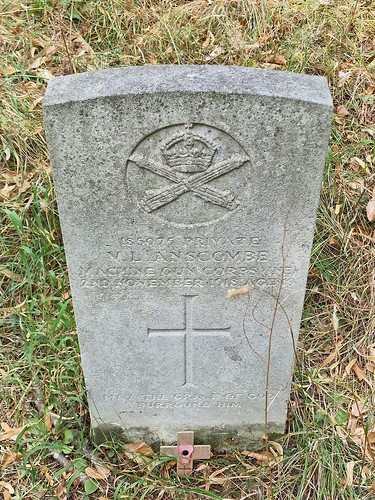
    Alfred died on 19 December 1919, at the age of 30, likely because of the injuries occurred during the First World War. The inscription on his gravestone reads “having fought a good fight in life and war, rest on”. There aren’t that many burials of the war dead at the Rosary Cemetery in Norwich, they’re mostly at Earlham Cemetery, so this stood out amongst the nearby graves. The uniformity of war graves ensures their visibility in a graveyard, and is a reminder that in death everyone was equal regardless of rank.

    It’s hard to imagine what Alfred’s brothers and sisters must have thought when standing at his graveside in late December 1919, it’s a far cry from the time of the 1911 census when they were all embarking on their new careers. And Alfred’s new career as a teacher was cut short, fighting a battle in a country to which he might never have otherwise visited.

  • GeoGuessr (Norwich Version) – Walk 2

    GeoGuessr (Norwich Version) – Walk 2

    I already have a better explanation (well, longer explanation anyway) for this plan. In essence, whilst lockdown is on, I need to find ways of walking nearby to Norwich in quiet areas for my LDWA 100 training. So, I’m using GeoGuessr to pick out five random locations within a certain area which I’ve defined and then walking to them, to see what kind of story I can uncover.

    So, this was the second of these walks, this time Nathan was dragged out to walk in the dark. We were using a map which used the ring-road as our limit, simply for time reasons, although we did manage to get the B&Q right on that line. Tonight’s little expedition was 11.2 miles, in the rain……

    This was the start of the walk, there really was no beginning to our bravery tonight…..

    Once we had summited Gas Mountain, we had a little rest and looked back down towards the city of Norwich, nestled in the foothills. We had walked around thirty metres at this point.

    My local voting station. How lovely.

    The Gordon pub, which I haven’t visited for a while, it’s a reasonably popular community pub though.

    And we reached our first location. We didn’t make much effort to match the photos up exactly, life’s too short…. Well, actually, it doesn’t seem too short to do this walking thing, so perhaps we could have made more of an effort.

    Past Thorpe St. Andrew School and I had a look on Wikipedia to see which former pupils went there. There are four listed and I haven’t heard of three of them, but I have discovered that Ben Bradshaw MP went to school there.

    In the diminishing light we strolled into some woods, which wasn’t perhaps ideal. The inaugural tree at Queen Elizabeth II Woods was planted by Chloe Smith, another fascinating fact that people should know.

    The second location, which wasn’t lined up at all, primarily as I didn’t want to stand outside someone’s house at night taking photos.

    Nathan had just spent thirty minutes complaining that he couldn’t get his phone to display the map, so I led us efficiently during that time. In a crisis, I’m always calm and reassured. Then Nathan, after a fit of pique, announced that he had worked out how to turn his phone on (or whatever he was faffing about doing) and he would lead us. So, here we went, entering some park with minimal lighting.

    The “please consider” is perhaps in vain, the careful and caring dog owners would anyway, and those inconsiderate ones won’t. Always worth a try though, passive aggressive signs can work.

    Remember I mentioned that Nathan was in charge of navigating? He found the muddiest path in Norfolk to walk down in Norwich City Centre, which isn’t generally known for its muddy paths. I didn’t complain though.

    After walking miles through a sea of mud, we decided that a road might be nice. This is the Norfolk Regiment War Memorial, located near to Mousehold Heath, and I’ll take a better photo in the day as this warrants that.

    The Rishi Indian, which was the Duke of Norfolk pub between 1938 and 2009, re-opening as a restaurant in 2011.

    We then popped into the Co-operative, and their beer selection wasn’t entirely dreadful. But, I wasn’t sufficiently tempted and I couldn’t be much bothered to carry it. Tonight didn’t feel like a drinking night, although I suspect the next walk might well have a few craft beer delights along the way.

    I could though be bothered to carry my five custard doughnuts for 21p that I found in the reduced section. Not that I had to carry them for long if I’m being honest, they were very moreish.

    Nathan, who is much more decadent than me, splashed out 34p on sausage rolls. We had been intending to get chips, but this seemed satisfactory under the circumstances.

    The third stop was the B&Q car park. It’s not ideal is it? But, we have to get walk training in for the LDWA 100, so this is as good a place as any. There were a fair few people around at B&Q, but we couldn’t much complain about that whilst standing in the middle of their car park. On the bright side, we walked past nearly no other pedestrians, just a few joggers.

    Walking back into Norwich city centre, these are the houses looking out onto St. Augustine’s Church.

    Our fourth location, which was sort of lined up, this is St. George’s Street.

    I faffed about taking photos of this willow tree, located by the River Wensum.

    St. Andrew’s Hall and Blackfriars’ Hall, the scene for one of my highlights of the year, Norwich Beer Festival held at the end of October every year. Fingers crossed that this year’s can go ahead, I’m missing doing my annual volunteering effort at glasses and tokens.
    Tombland road works, there were toilets here, but they’ve been removed. I had expected the council to be building another car park, but they’re creating some open space (which will likely happen to have cars parked on it if the council get their way). The council spent some money a couple of years ago putting in traffic lights for cyclists, but they’ve been ripped out.

    And our fifth location and we could have had much worse than Norwich Cathedral Close which looked rather beautiful in the fading light. Incidentally, it was actually pretty dark, my phone was in night setting and the images look much lighter than the reality.

    St. Ethelbert’s Gate, built in 1316 and still maintaining its beauty.

    And I couldn’t resist a photo of Norwich Cathedral, taken from under the Erpingham Gate.

    That concluded this little adventure, which we did at quite a fast pace. Given how quickly the whole evening went, it’s given us some more confidence about the 100, that if we can just gossip and complain about our friends for 40 hours or so (this is quite likely) then we might just get round. Well, maybe.