Category: Lübeck

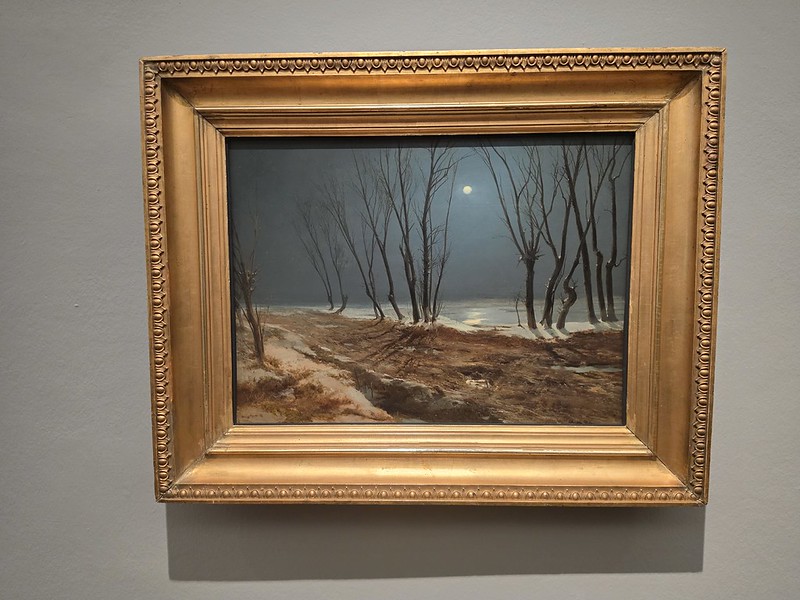
  • Lübeck – Museum Behnhaus Drägerhaus (Winter Landscape at Moonlight by Carl Blechen)

    Lübeck – Museum Behnhaus Drägerhaus (Winter Landscape at Moonlight by Carl Blechen)

    This artwork is by Carl Blechen (1798-1840) is perhaps a much easier painting to like than Xaver Fuhr’s tense little sailing boat. There is moonlight, snow, bare trees and a winter road disappearing into the distance, which is the sort of arrangement that is easy on the eye. Painted in 1829, it belongs to a much older Romantic tradition in German art and Blechen’s work represented a style that the Nazis were far more willing to absorb into their own cultural story. Unlike modernist painters such as Fuhr, whose work was treated as suspect, degenerate and politically dangerous, a winter landscape like this could be understood as rooted, traditional, solemn and apparently unthreatening.

    Some of Blechen’s works were intended to be displayed at the Fuehrermuseum and if the Nazis had won the war, this is precisely the sort of scene that would have had pride of place in their national museums. The artist’s life was actually quite traumatic and he had serious mental illnesses, not something that would have been entirely celebrated by the Nazi regime and I’m sure that they would have airbrushed that out from the narrative. Blechen withdrew from teaching in his mid-30s and died at the age of just 41. To my non-artist’s eye, I think that his artworks feel quite modern and timeless. And indeed, I should probably stop viewing these artworks from the perspective of 1930s and 1940s Germany, but there’s so often a story there.
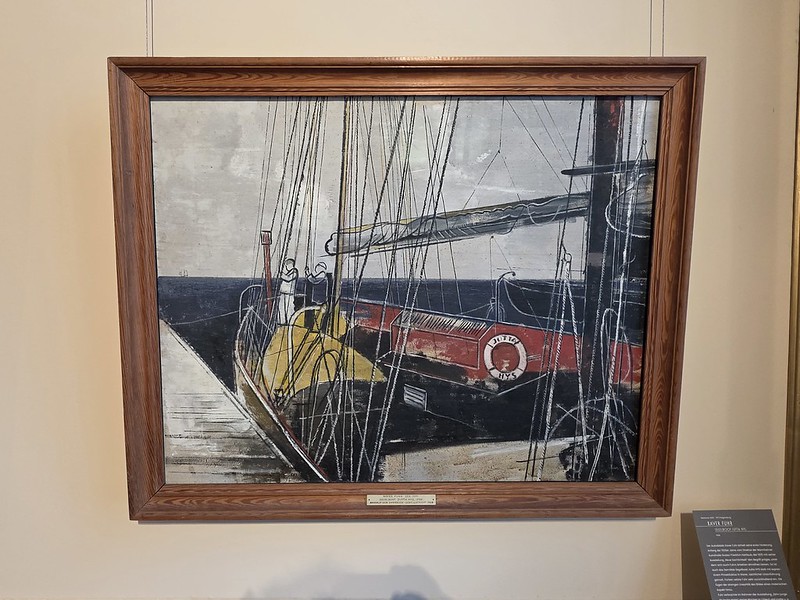
  • Lübeck – Museum Behnhaus Drägerhaus (Sailboat Jutta YHS by Xaver Fuhr)

    Lübeck – Museum Behnhaus Drägerhaus (Sailboat Jutta YHS by Xaver Fuhr)

    The museum notes this as a work by Xaver Fuhr (1898-1973) that was part of the New Objectivity movement of artwork in Weimar Germany. The HYA is the Hanseatic Yacht School and it was painted in 1928. This is all noteworthy in its own right, but I find this period of German culture to be fascinating because of what was unfolding nationally, so I had a focus that was in a different direction.

    Fuhr was inspired by artists such as Vincent van Gogh and Paul Cézanne, but he developed his own style and his artworks were not traditional Prussian heavy landscapes or paintings of heroic peasants. So, the Nazis hated him and labelled his work as degenerative art as they didn’t like things that might be culturally appealing. Between 1936 and 1945 he focused on watercolour painting that would be tolerated by the regime, although his studio in Mannheim was destroyed by an air raid in 1943 which I’m sure he considered as far from ideal.

    Many of Fuhr’s works were stripped from museum and gallery walls, but his reputation was restored after the end of the Second World War. He became a professor at the Academy of Fine Arts in Munich and retired in Regensburg. And that’s what intrigued me, the artist behind this scared the Nazis because of that individual approach. It made me like the painting even more.

  • Lübeck – St. Anne’s Museum Quarter (Christ in Distress)

    Lübeck – St. Anne’s Museum Quarter (Christ in Distress)

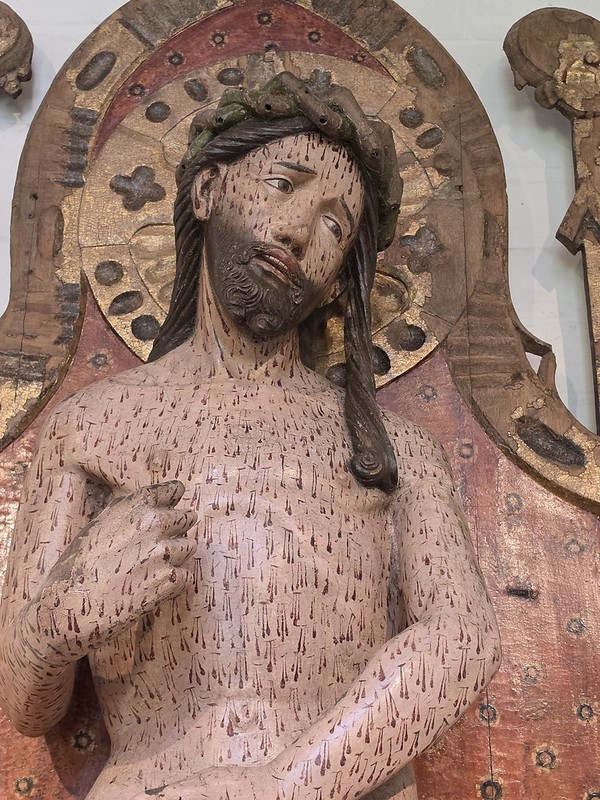
    Well, this is a cheery little number. This carving of Christ in distress was made in around 1410 and it doesn’t give the viewer much room to hide. Christ sits exposed on a rock in front of a throne-like backrest, wounded, crowned with thorns and covered with the marks of the scourging. It was located at the Holy Spirit Hospital in Lübeck and that’s an interesting building in itself as it is currently a retirement home, but it dates to 1286 and is one of the oldest social institutions in the world. As an aside, it wouldn’t have been an entirely grim place despite it catering for the poor, sick and impoverished, as it was rooted in charity.

    The missing hand once probably held a scourge, the instrument of Christ’s torment, and he does look quite annoyed here. Lübeck has many beautiful things, including a craft beer bar, but this is not beautiful in a simple sense. It’s deliberately difficult and I’m not sure what the residents of the hospital would have thought about the arrangement in the Middle Ages. I’m not entirely sure that it would have cheered me up or made me feel better if I’m being honest.

  • Lübeck – St. Anne’s Museum Quarter (Seated Holy Bishop)

    Lübeck – St. Anne’s Museum Quarter (Seated Holy Bishop)

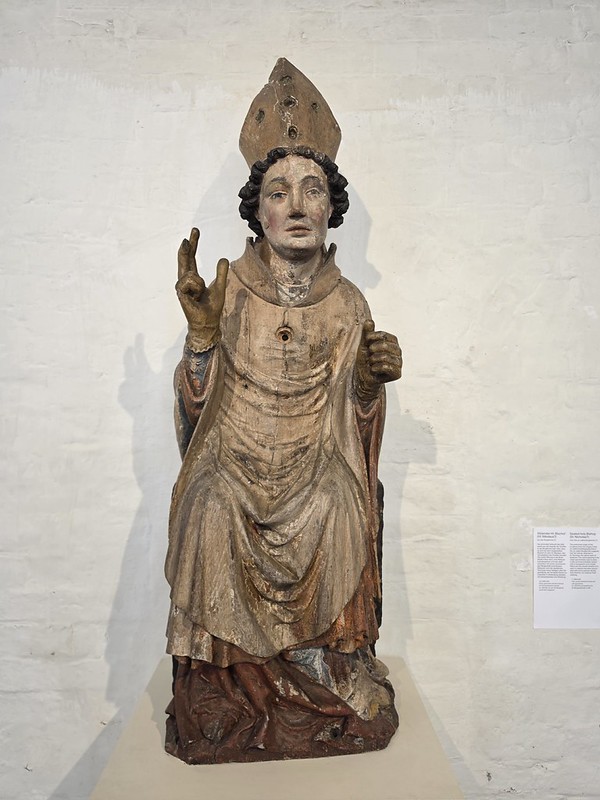
    This seated holy bishop from Lübeck is one of those objects which manages to look both battered and quietly magnificent. It probably once formed part of the carved decoration at the Schiffergesellschaft (or the shipmasters’ guild) at the Burgkirche. The figure sits in full episcopal dignity, wearing a mitre and raising one hand in blessing.

    In the period around 1380 to 1400, it was carved in oak and would originally have been much richer in colour, with traces of paint and gilding although that has mostly all gone now. I get intrigued by pieces like this because of their heritage and the journey that it has had through history. It’s thought that it’s probably St. Nicholas who is the patron saint of boatmen, although there’s some guesswork there.

    The Burgkirche in Lübeck was the church of the Burgkloster, the former Dominican monastery. Unfortunately, and in a rather sub-optimal manner, it mostly fell down in 1818 and so it was thought best to demolish the rest. Bits of the building have survived, but it’s the surviving decorations and sculptures that almost feel the most authentic part of the whole arrangement now.

  • Lübeck – Stolpersteine (Stumbling Stone) of Eva Emmering

    Lübeck – Stolpersteine (Stumbling Stone) of Eva Emmering

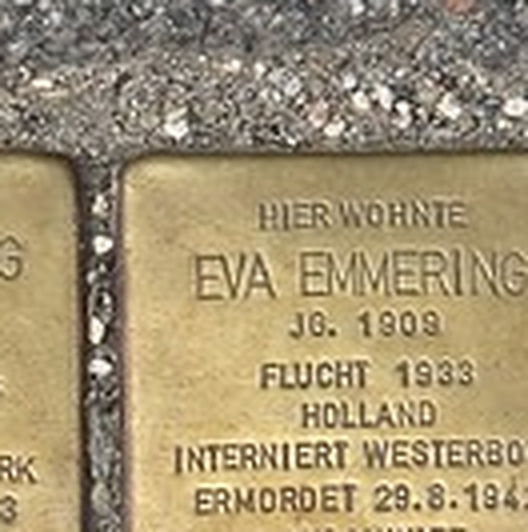
    This is a group of three stumbling stones located at St. Annen-Straße 12 where the Emmering family lived and had their shop.

    Eva Emmering was born in Lübeck on 27 October 1909, the youngest of Benjamin and Sara Emmering’s three children. Unlike her older sister Elena, who had been born in the Netherlands, Eva’s earliest life was directly tied to Lübeck and he attended St. Marien Girls’ Primary School from Easter 1916 until 1922, then St. Jürgen Girls’ Middle School, and took religious classes in the synagogue diagonally opposite her family’s home.

    Eva became a sales clerk, while her brother Aron Adolf also entered commercial work and later ran his own business. After their father Benjamin died in 1932, Eva and Elena returned from Hattingen to Lübeck to support their mother, Sara, whose illness led to her admission to Strecknitz Mental Hospital. In 1933, Eva fled to the Netherlands with Elena, and by 1941 the two sisters were living in Amsterdam at Govert Flinckstraat 98. After what must have been a hugely challenging few years, Eva and Elena must have felt some safety in Amsterdam away from the Nazi horrors. Unfortunately, the invasion of the Netherlands put them in danger once again.

    Eva was interned at Westerbork and deported to Auschwitz, where she was murdered on 29 August 1942. She was 33. The death certificates for both sisters recorded Auschwitz I, and the doctor who signed them was Johann Paul Kremer (1883-1965), notorious for his involvement in experiments on prisoners. I don’t think I want to know what happened there, this family suffered terribly over the years as it was. Kremer was sentenced to death for his war crimes, but it was commuted to a prison sentence before he was released.

  • Lübeck – Stolpersteine (Stumbling Stone) of Sara Emmering

    Lübeck – Stolpersteine (Stumbling Stone) of Sara Emmering

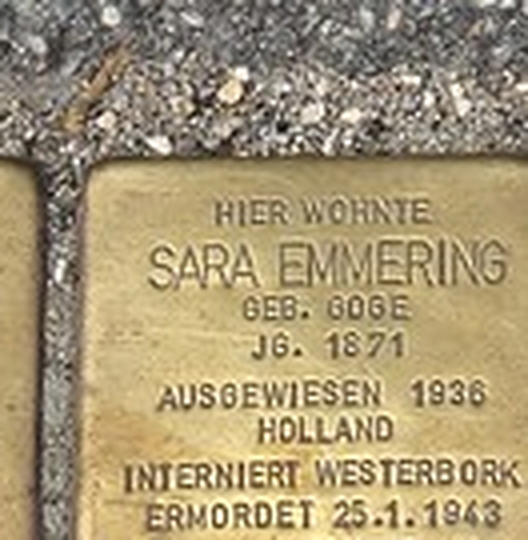
    This is a group of three stumbling stones located at St. Annen-Straße 12 where the Emmering family lived and had their shop.

    Sara Emmering, born Sara Goge, came from Moisling, now part of Lübeck, where she was born on 25 April 1871. She married Benjamin Emmering, a Dutch cattle dealer from near Groningen, in Lübeck in 1903, and through that marriage she and her later children became Dutch citizens. Sara and Benjamin eventually settled at St. Annen-Straße 12, where they lived with their family and ran a shop dealing in clothing, linen and furniture.

    By the early 1930s, the family had already been shaken by loss. Benjamin died suddenly in September 1932 after long-standing heart problems, and Sara appears to have been seriously ill by then. She was admitted to the Strecknitz Mental Hospital, while the family home was rented out to fund her care. Her daughters Elena and Eva, who had been living in Hattingen, returned to Lübeck after their father’s death, but they fled to the Netherlands in 1933 following the Nazi oppression they suffered from. Sara remained in the hospital until 1936, when the Lübeck authorities declared her an “unwanted foreigner” and deported her to the Netherlands. The family home was then lost through enforced auction and it’s unlikely that they received anywhere near a fair price.

    In the Netherlands, Sara was admitted under her maiden name, Sara Goge, to Het Apeldoornsche Bosch, a Jewish psychiatric hospital. After the German occupation, even that place of care was not spared from the Nazi hate. On the night of 21 January 1943 and into the following morning, the institution was emptied, the patients were beaten, forced onto trucks and then into cattle wagons heading for Auschwitz-Birkenau. Sara was murdered on arrival on 25 January 1943. She was 71.

    There is a website about the history of Het Apeldoornsche Bosch and that notes:

    “On the night of January 21–22, 1943, the occupying forces brutally evacuated Het Apeldoornsche Bosch. Over 1,100 patients and staff members were put on a transport to Auschwitz and murdered. On January 22 and February 1, another 282 people, including five pregnant women, were taken to Westerbork. Ultimately, only 21 people from these two transports survived the war.”

    Without these stumbling stones, these stories might start to be lost and the individuals forgotten about.

  • Lübeck – Stolpersteine (Stumbling Stone) of Elena Emmering

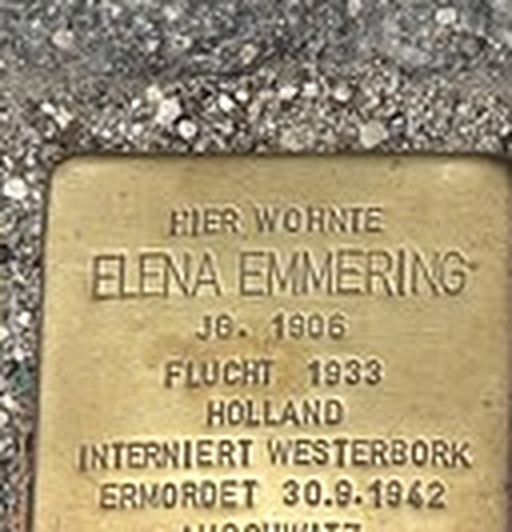
    Lübeck – Stolpersteine (Stumbling Stone) of Elena Emmering

    This is a group of three stumbling stones located at St. Annen-Straße 12 where the Emmering family lived and had their shop.

    Elena Emmering was born on 25 August 1906 in op ’t Zandt, a village near Groningen in the Netherlands, but her childhood belonged to Lübeck. Her parents, Benjamin Emmering and Sara Goge, had married in Lübeck in 1903 and moved between the Netherlands and Germany before settling at St. Annen-Straße 12, where the family lived above and beside their business buying and selling clothing, linen and furniture. Elena, her sister Eva and their brother Aron Adolf grew up in Lübeck and their family became part of the local community. Elena moved to Hattingen with her sister Eva, but returned in 1932 after their father’s sudden death.

    This was a difficult time for the family which was already marked by grief and illness as Sara was suffering from serious mental illness and was admitted to Strecknitz Mental Hospital, while the family home was rented out to help pay for her care. In 1933, as Nazi persecution intensified, Elena and Eva fled to the Netherlands where they thought that they would be safe. They later lived together in Amsterdam at Govert Flinckstraat 98, forced away from their home but trying to stay secure.

    The German occupation of the Netherlands meant there was no lasting refuge. Elena was interned at Westerbork and deported from there to Auschwitz, where she was murdered by the Nazis on 30 September 1942. She was 36.

  • Lübeck – St. Anne’s Museum Quarter (Epitaph for Margarethe Wittinghoff)

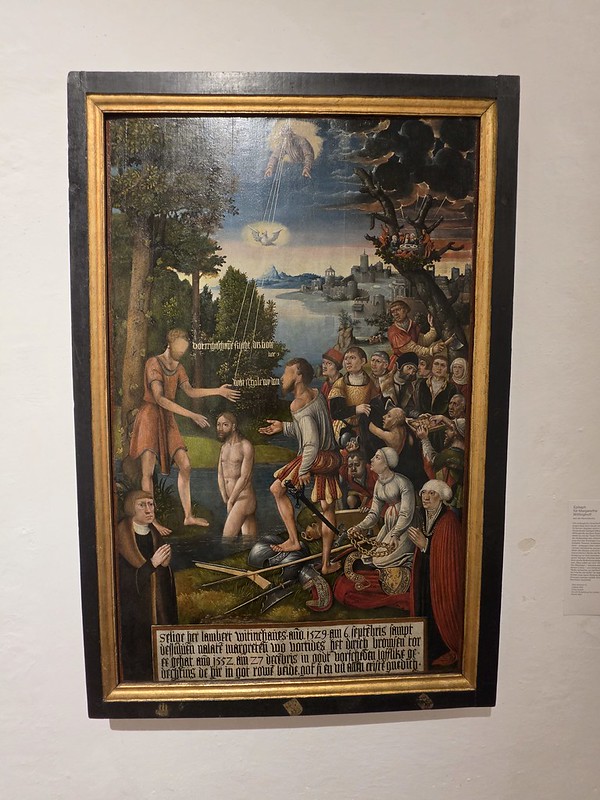
    Lübeck – St. Anne’s Museum Quarter (Epitaph for Margarethe Wittinghoff)

    This epitaph for Margarethe Wittinghoff was painted in Lübeck in 1552 by Hans Kemmer, who was also the artist behind the Hans Sonnenschein artwork. It has that slight Reformation-period tension where everyone is clearly trying to work out exactly what devotional art is now allowed to do as I can imagine that the rules weren’t exactly clear. I’m not sure why two faces are blurred out, but I suspect that it’s something to do with those rules not being very clear….. I’m genuinely fascinated about this period when everything changed and all the religious traditions were thrown in the air and it wasn’t clear how it would all settle.

    The artwork came from St Mary’s Church in the city and was made at a time when old Catholic visual habits had not simply vanished, but were being carefully rearranged into something that could sit within the new Lutheran world. The painting shows Christ’s baptism, with John the Baptist standing beside him and a crowd of onlookers gathered on the right. Above, the Holy Spirit descends as a dove, while God the Father appears from the clouds, completing the theological arrangement rather nicely. Margarethe herself is shown kneeling in prayer at the lower left which feels a little bit self-indulgent to me.

    As I’ve accused Margarethe of being self-indulgent, I thought I’d ask AI to draw a little something up for me. I must say that I quite like this, although I don’t drink tea so I must have words with it about that.

  • Lübeck – Willy Brandt House (3/3)

    Lübeck – Willy Brandt House (3/3)

    Although Brandt stood down as the Chancellor of West Germany in 1974, he remained the leader of the SPD until 1987. Although he hadn’t always been sure that Germany would reunite, he saw the collapse of communism across Central and Eastern Europe as well as the beginnings of German integration. He was known for the phrase “Now grows together what belongs together” for Germany and he is seen as one of the greatest of all German leaders.

    There were plenty of media screens around the place and they switched to subtitles in English when I placed my card against the panel. All nicely done.

    A series of photos of Brandt.

    There was a little special exhibition at the end of the museum tour with this section pointed away from the main doors. The letter in the display is in French and was written by Brandt to Jacob Walcher (1887-1970) on 31 October 1936. Walcher sent Brandt to do political work in Norway and their friendship broke in 1946 as their political views diverged too much.

    A photo of the building from 1930 when it was used as a library.

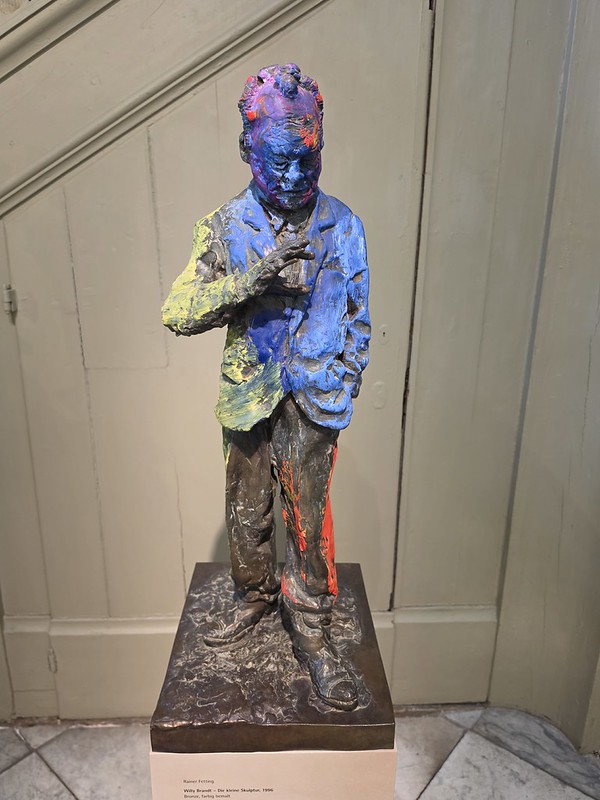
    A sculpture of Brandt created by Rainer Fetting in 1996.

    Willy Brandt (1913-1992).

    I very much liked this small museum, although it only took around thirty minutes to look around it. The team members were friendly and welcoming, with much of the text in English. I liked how the media had English subtitles for those that wanted it and I learned a great deal about European politics from this period as well as about Willy Brandt. There’s no admission charge and I thought that it was all really quite lovely.

  • Lübeck – Willy Brandt House (2/3)

    Lübeck – Willy Brandt House (2/3)

    Continuing my riveting account of the Willy Brandt House in Lübeck, this is a photograph of Brandt along with JF Kennedy and Konrad Adenauer on 26 June 1963. This is was when Kennedy made the speech:

    “Two thousand years ago — Two thousand years ago, the proudest boast was ‘civis Romanus sum.’ Today, in the world of freedom, the proudest boast is ‘Ich bin ein Berliner.’”

    Although I rather like his line in the same speech:

    “Freedom has many difficulties and democracy is not perfect. But we have never had to put a wall up to keep our people in.”

    Anyway, Brandt was here in his role as the fourth governing Mayor of Berlin, a role that he held from 3 October 1957 until 1 December 1966.

    The Nobel Peace Prize that was awarded to Willy Brandt on 10 December 1971. He was awarded the Peace Prize for both his work in unifying Europe and the development of the EEC, as well as reconciling West Berlin with the countries in eastern Europe.

    Political campaigning posters.

    This large space was used to put some televisions on as part of a media room, but it did feel like they were trying to stretch their exhibits out a little bit. There’s probably much more that could be done in a space like this. There were lots of interesting film clips here telling the story of Brandt being the Chancellor of West Germany between 22 October 1969 and 7 May 1974. His resignation came about following the Günter Guillaume scandal, he was one of Brandt’s advisers who it was revealed was a Stasi informant.

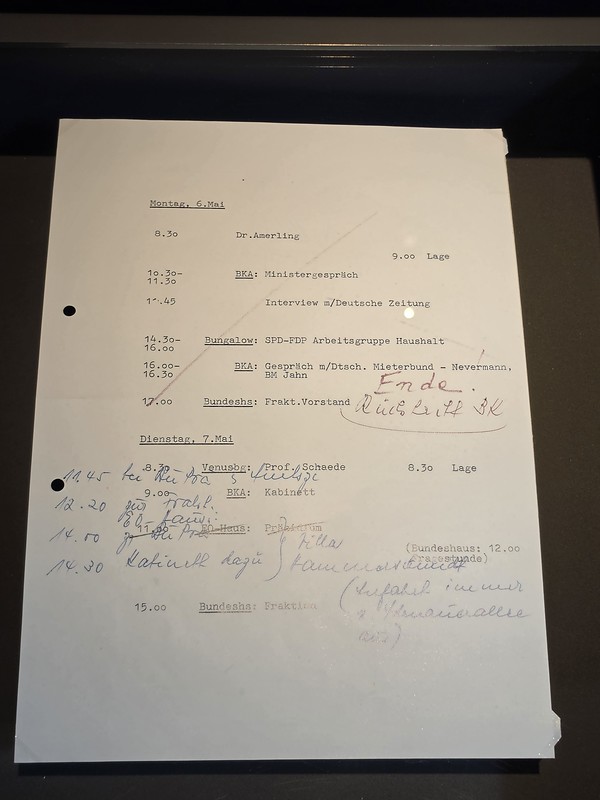
    Brandt’s schedule for his last day as Chancellor.

    Brandt’s resignation letter to the Federal President Gustav Heinemann on 6 May 1974.

    It was the end of an era, but his work on foreign policy was hugely significant and hence the Nobel Peace Prize. Brandt’s Government also pursued domestic reforms, including expansion of education, welfare and civil liberties, all leading towards a more socially liberal and outward-looking West Germany. His time of office saw Germany becoming more democratic, more self-confident and more honest about its past.

    The thing that I learned was that his kneeling at the Warsaw Ghetto memorial in 1970 became one of the great symbolic gestures of post-war reconciliation. I will look out for the memorial to his visit which is in Warsaw and I hadn’t noticed before, but he knelt as a sign of atonement for the Nazi damage to Germany. It was controversial amongst Germans, but shifted the entire debate. Very brave.