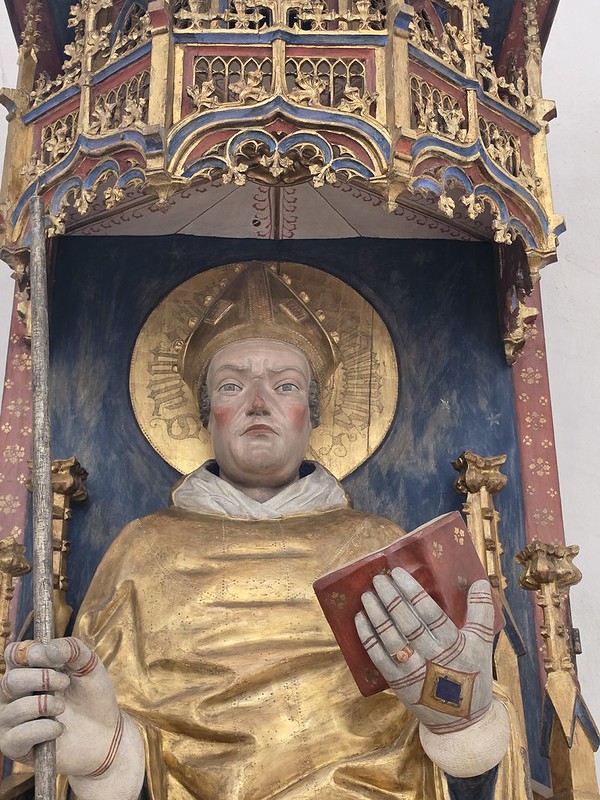
It’s moments like this which are a reminder of how interconnected religious figures were around northern Europe. This figure of St Thomas Becket of Canterbury is a good example, although this is a 1927 copy. The original was made in Lübeck by Bernt Notke (1440-1509) for the church of Skeppstuna in Sweden. I’d been trying to establish where I’d heard of him before, but it’s because of his Danse Macabre in Tallinn.
It shows how far the cult of Becket travelled after his murder in Canterbury Cathedral in 1170. A saint violently and sub-optimally dispatched in England somehow ended up represented in splendid painted and gilded wood for a Swedish church. The face is especially compelling as it’s pale, stern, pink-cheeked and direct, with the slightly fixed expression of someone who has seen the workings of power from rather too close a distance. The detail is decadent without being delicate; the gloved hands, the red book, the halo, the painted canopy and the little flashes of blue and gold all turn the sculpture into something quite noteworthy.
I like a political museum and The Willy Brandt House in Lübeck occupies a restored patrician house at Königstraße 21. The idea of creating a memorial to Brandt in his home city was encouraged by Günter Grass, who has his own museum nearby and which I also visited. This building was given by the city and it had previously served the Zirkelgesellschaft of long-distance merchants, later housed the appeal court for the four free cities of Bremen, Hamburg, Frankfurt am Main and Lübeck, and was also used as the city archive and public library. In short, it’s been used for lots of different purposes and has no direct link to Brandt, which felt slightly sub-optimal.
I didn’t know much about Willy Brandt when I entered the museum, I just knew that he was a German statesman who served as Chancellor of West Germany from 1969 to 1974. He was a leading Social Democrat, a former mayor of West Berlin and one of the key figures in post-war European politics, but that was as far as my knowledge went. There’s no admission charge and there was a friendly welcome from the staff member and I was given a brief introduction and a media card so that I could access audio elements in English.
This is the typewriter owner by Martha Szperalski (1893-1964), born Martha Klinge, who was a Lübeck stenotypist and anti-Nazi resistance figure linked to the young Willy Brandt, then still Herbert Frahm. She worked as a shorthand typist, including recording sessions of the Lübeck Senate, and was active with her husband Johann Szperalski in the underground Socialist Workers’ Party, the SAP, after the Nazis came to power.
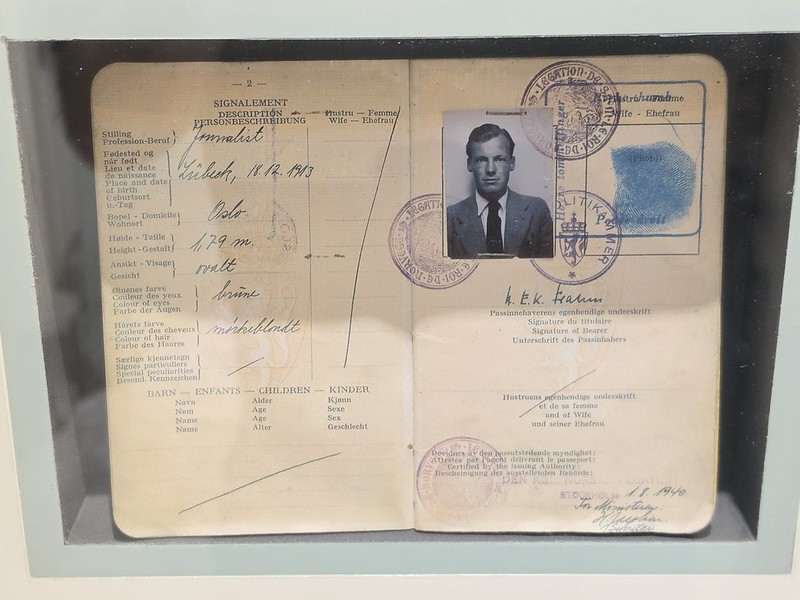
This is Willy Brandt’s Norwegian passport issued to him on 1 August 1940. On this matter, Willy Brandt was born Herbert Ernst Karl Frahm. He changed his name because he went into anti-Nazi exile after Hitler came to power in 1933 and needed a safer political identity. “Willy Brandt” began as a pseudonym during his underground socialist resistance work and exile, especially while he was in Norway. He stuck with the name after the Second World War came to an end and then in 1949 he made it his legal name, but more on that in a moment.
This is an October 1944 political letter from German socialist exiles in Stockholm to the leadership of the SPD group there. It is dated from Stockholm, 9 October 1944, and addressed “An den Vorstand der SPD-Gruppe Stockholm” or “To the executive committee of the SPD group Stockholm”. The signatories are applying to be accepted into the local SPD organisation and this is significant as it is a formal political statement by exiles who want to join, or rejoin, the Social Democratic Party framework. The people signing the letter had belonged to the SAP, the Sozialistische Arbeiterpartei Deutschlands, the Socialist Workers’ Party of Germany. This was a left-socialist breakaway from the SPD, founded in the early 1930s.
The peace objectives of the democratic socialists, published on 1 May 1943.
And here’s the formal confirmation of his name change, issued on 11 August 1949.
This is Willy Brandt’s provisional mandate card for the first Bundestag of the Federal Republic of Germany. It dates from 1949, just as West Germany’s new democratic parliament was being created after the war, so it is a rather small piece of paper carrying a very large constitutional moment. West Berlin had a peculiar and in some ways sub-optimal status after the war. It found itself politically tied to West Germany, but because of the Allied occupation arrangements it was not a full federal state in the ordinary way. Berlin representatives could take part in the Bundestag, but they did not initially have the same full voting rights as directly elected members from the West German Länder. The Cold War certainly led to some awkward situations….
Anyway, more of this riveting (or something like that) account of the museum in the next post.
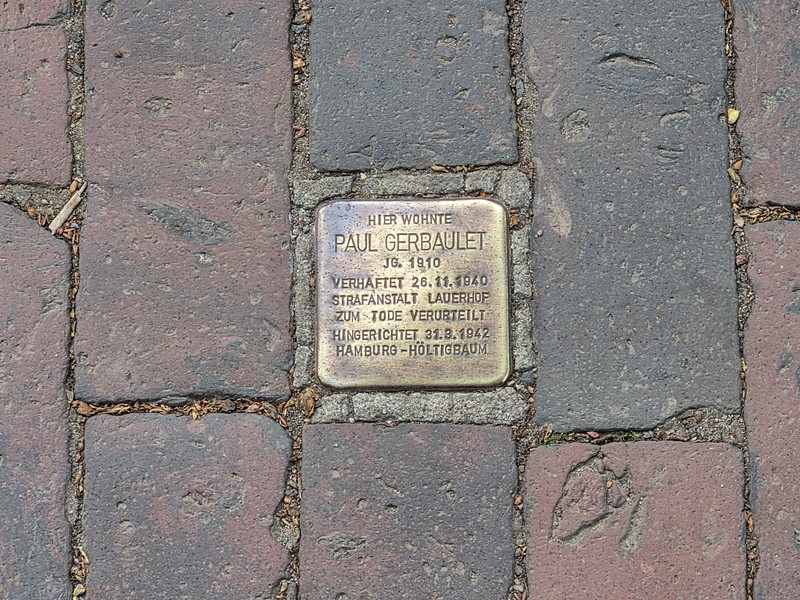
This stumbling stone is located outside Katharinenstraße 53 in Lübeck, commemorating the life of Paul Gerbaulet, who was born on 1 April 1910 in Epe, in western Münsterland. He came from a family of blacksmiths, cattle traders and butchers, but his father’s work as a dispatcher allowed the children a good education. Paul studied veterinary medicine in Münster and he enjoyed working as a vet.
After the outbreak of war, Gerbaulet was called up for military service. In September 1940 he moved to Lübeck, lodging with the Ahrens family at Katharinenstraße 53, a household which appears to have had connections with people opposed to the Nazi regime. He had only been in the city for a little over two months when, on 26 November 1940, he was arrested by the Lübeck criminal police. He was facing prosecution under Paragraph 175, the law used by the Nazi state to persecute men for homosexuality, and was taken first to Lübeck-Lauerhof before being transferred to Hamburg.
The last part of his story is almost unbearable. Gerbaulet served in various military units, was wounded in action in 1941 and was later held in Hamburg. On 31 March 1942, the day before his 32nd birthday, he was shot at the Höltigbaum military training ground in Hamburg-Rahlstedt after being sentenced to death. His parents travelled to Hamburg; his father accompanied him, under guard, from the cell to the shooting range. Gerbaulet was asked whether he wanted to be blindfolded. He refused. Then he was shot in front of his parents.
This story is horrendous at every single level. His parents must have been haunted for the rest of their lives at not just the loss of their child, but the manner in which it happened. There is very little information about Paul online, just that provided by the organisation that places the stumbling stones and they’ve done a marvellous job in ensuring that he won’t be entirely forgotten. The bravery that Paul showed is astounding, he is one of the heroes that should be remembered in this city and I’m not entirely sure that he is.
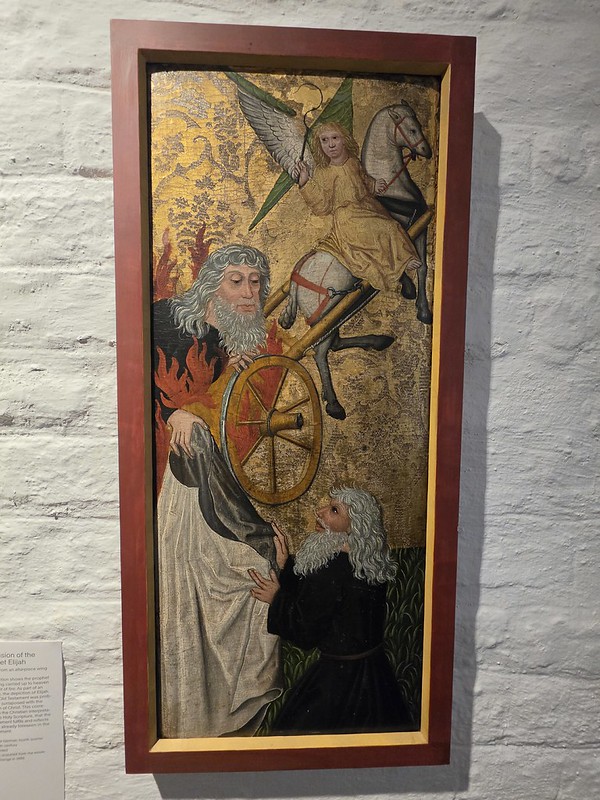
This is a surviving wing of an altarpiece that I assume has been lost somewhere over time. It all looks like it’s a medieval Lübeck painting which depicts a scene in which nobody has had time to hold a proper planning meeting, but it appears that it is of religious significance. The prophet Elijah is being taken up to heaven in a fiery chariot, while Elisha, his follower and successor, kneels below and reaches towards him. I’d add that I didn’t know that, I copied it from the information panel at the museum.
The panel was painted in Lübeck at the end of the fifteenth century, at a time when the city still had the wealth, workshops and devotional culture to produce works of real beauty like this. I was strangely drawn to this, although I think I’m always intrigued by things where half the artwork is missing, or over half in this case. I don’t have the religious knowledge to make much comment about the artwork and I’m not sure I even understand the museum’s account that it “could be read as a prefiguration of Christ’s ascension”.
It’s painted on pine and is in reasonably good shape, although the museum doesn’t know where it came from other than they acquired it in 1866. There’s a level of awe that the average fifteenth century viewer of this artwork might have perhaps thought, I rather like it.
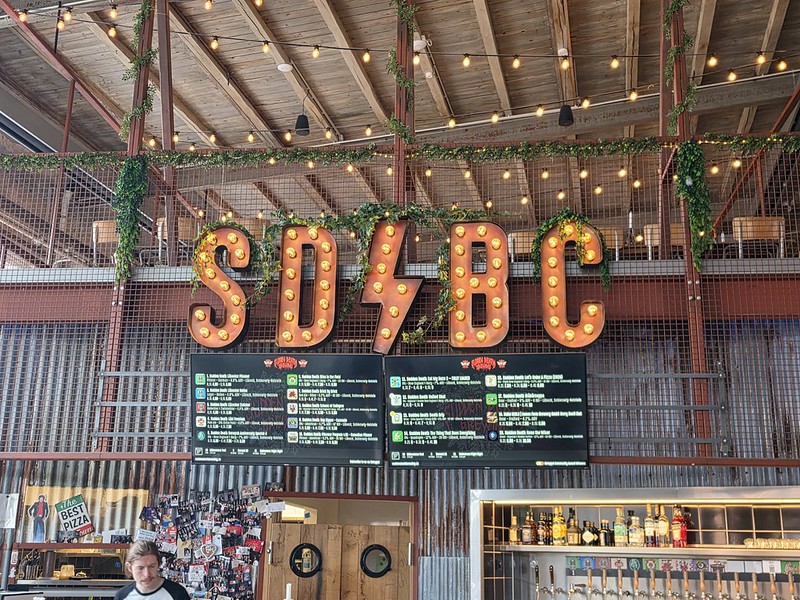
Sudden Death are one my favourite brewers in Germany, but I hadn’t realised that they were based in Lübeck until I actually got to the city, so I was very surprised and delighted. Although it goes to show that my knowledge of German brewers is quite weak, but there are relatively few craft beer outfits like this in the country, so I think that they need support and I was happy to oblige.
I was one of the first people there when they opened at 17:00 because I had limited time to get to my train which left a couple of hours later and the railway station was nearly a thirty minute walk. There was a friendly welcome from a team member although she noted that she’d have to move things about as I didn’t have a reservation. That was helpful, although they were able to seat everyone coming in without a reservation for the next hour, but I appreciated the engagement and immediate welcome.
This is a taproom and so their main brewery equipment dominates the environment and it all looks clean, shiny and well presented. There was table service offered to customers which made matters easier, so I didn’t have to go to the bar at any stage.
It started to get busy with a couple of large groups taking up the tables near the brewing equipment, but it felt organised and well managed. There are some fridges with cans in, but I thought I’d just try the beers in their home environment as it were.
I looked at the menu and decided quite quickly that I’d like food. I’m decisive like that.
I asked if they did flights and I was pleased to discover that they did, with a choice of (i) their core beers, (ii) their newer releases or (iii) anything you wanted. I decided to go with the middle option initially and the beers were from left to right:
Bliss in the Field – anything inspired by Trillium is likely to be good and this was punchy in the hops, almost a TIPA intensity, hazy and rounded.
Brick by Brick – a bit rustic, bit smooth, there was a bitter flavour and it was quite intense, all being something a little different.
Hop Ripper (Cascade) – this was piney, light coloured and maybe slightly thin, but it was pleasant enough.
Pilsener Program v.01 – it’s a Pilsner and they don’t excite me, but it was clean and light.
The pizza arrived and it was slightly heavy, but I didn’t let that stop me. It was the taco pizza with some Mexican based toppings and the flavours were robust and it all was all rather lovely.
I then got muddled up and ordered another flight, but these things happen. This time I chose my own four beers from their brewery and they were from left to right:
Brewpub Anniversary Special 4 – this was hazy, tropical, punchy and hoppy.
Echoes of Collapse – juicy, rich, hazy, tropical and fruity.
Eat My Haze 2 Fully Loaded – hazy, peach and mango flavours, tropical and nicely rounded with plenty of hops.
Blabarsoppa – this was the best of all the eight beers that I tried, so I left the best until last. Flavours of blackcurrant, blueberry, cherry and plum, with the whole arrangement being lightly tart. Absolutely delicious and it was good to see them making sours.
There were a couple of guest options as well, but I thought I might as well try beers from the brewery whilst I was here. I’ve had beers from Sudden Death a few times before, but all of the eight I tried here were new to me.
There’s the Untappd screen and two of my check-ins. I still get excited about this despite having been on Untappd for eight years, so I really should get out more.
Some of their can art, it’s decorative and interesting.
Overall, I really enjoyed this visit and it was like being in a brewpub in the United States, this was as on-trend as a German brewery is going to get. The team members were friendly, the venue was spotlessly clean, the glasses were in good condition and all of the beers were above average and some verged towards excellent. They deserve their reputation of being one of the best breweries in German and I’m hoping that this sort of venue is very much part of Germany’s brewing future. When I left all of the seats were taken, so things seem to be going well and the reviews are all very positive. All really very lovely.
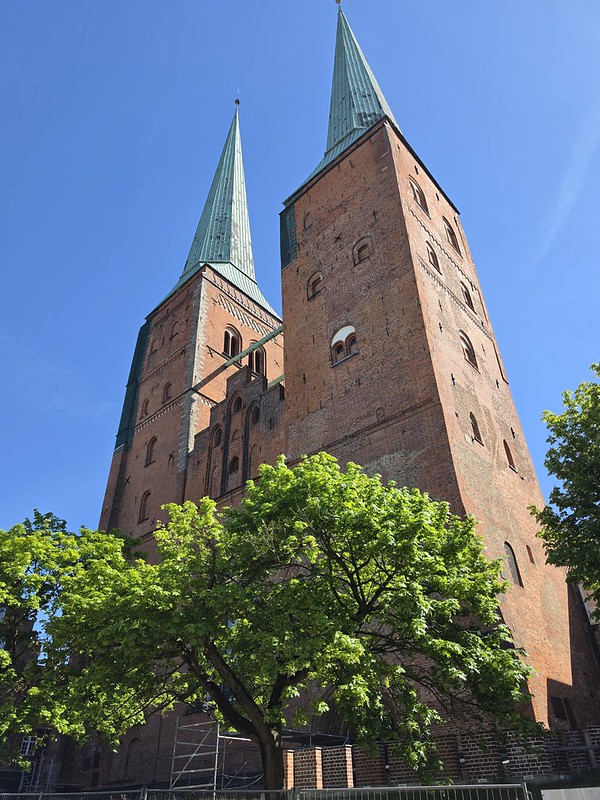
My friend Liam is a civil engineer (not that he’ll read this, some best friend…..) and I thought of him when reading the cathedral’s comments that their structure has four quite big construction problems. Now, a medieval version of Liam would have blamed the architects and it’s clear that they made a few little errors as well.
The first problem is that they built the cathedral in the wrong place. There is the story that God chose whether to site the building by making a miracle happen, but he chose a place that was very sandy which feels sub-optimal. The engineers got building their lovely new cathedral and discovered almost immediately that the tower was sinking and leaning, which caused quite a commotion. They built brick ribs and added walls to fix the little problem, but that didn’t much help.
The second problem is that they couldn’t make bricks. They couldn’t afford to ship stone in from France, which would have been the sandstone that most cathedrals at the time used, so they instead used brick as that worked for the Romans. So they got some people together to make bricks, but the things they made were riddled with cracks and crumbled. The cathedral’s new facade crumbled away within years and so had to be rapidly replaced with some new bricks as they had become more experienced by this point.
The third problem was a bit later when the repairs to fix the earlier problems started. They used Portland cement which was unsuitable and led to some bulging of the stonework and bits promptly fell off the towers. I can imagine the annoyance of the engineers who whilst trying to fix earlier problems ended up creating new ones.
The fourth problem is that they had to keep patching up the frontage because of the succession of building errors. They, on numerous occasions, patched up the outer layer of brickwork, but failed to actually attach it to the stonework behind it. This led to cracks of the outer layer and, once again, bits kept falling off. Recent investigations have shown that just 11% of the original masonry has survived, the other 89% is more modern and attempts to fix the construction errors that have occurred.
All of this has combined today to mean that the cathedral is currently faced with another major restoration, because the towers are still not stable. I think it’s clear that the bombing of the cathedral in 1942 didn’t much help matters, but the problems are much longer-term. I rather liked the whole engagement that the cathedral showed with this, it’s clear that many cathedral projects didn’t go to plan, although this one seems to have had more problems than most.
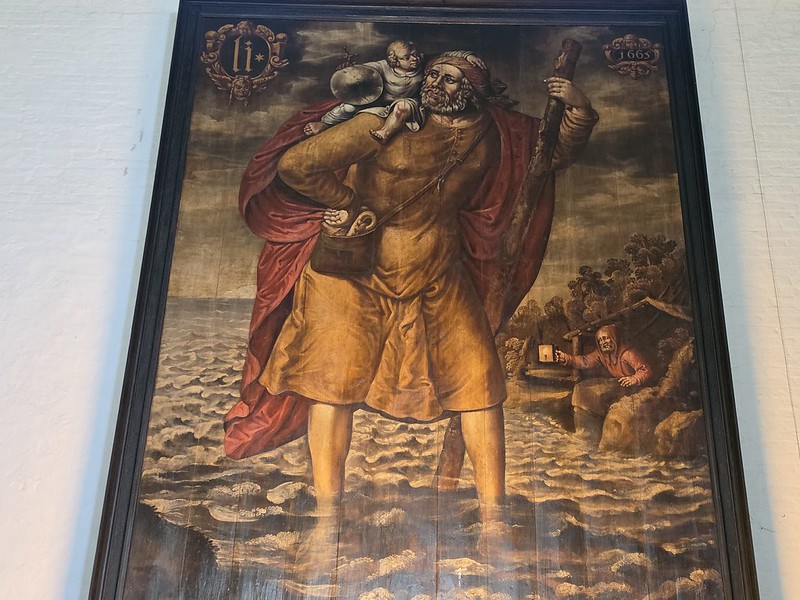
I’m slightly puzzled by this painting, although I’m frequently puzzled by many things so I don’t let that surprise me. It’s evidently St. Christopher, but the cathedral gives no other information about the artwork other than referencing the saint himself and how he looks after travellers. There can be few more noble things than looking after travellers and pilgrims, so he’s quite high on my list of favourite saints. I’m not sure whether you’re supposed to have a list of favourite saints, perhaps there’s another blog post there one day….
It’s not a subtle little piece, but it’s in remarkably good condition for something which is dated 1665 in the top right hand corner. This meant I assumed that it was a modern painting which replaced an earlier artwork that was damaged during the Second World War. However, there are mentions online that this is the original and so I’m puzzled as to why the cathedral in its guide doesn’t want to make more reference to it.
It seems to me that this is the original painting which shows him carrying travellers along a dangerous river, but it seems that some sort of restoration is likely. But maybe that’s just out of hope that it somehow survived the Second World War, I think it’s one of the highlights of the cathedral.
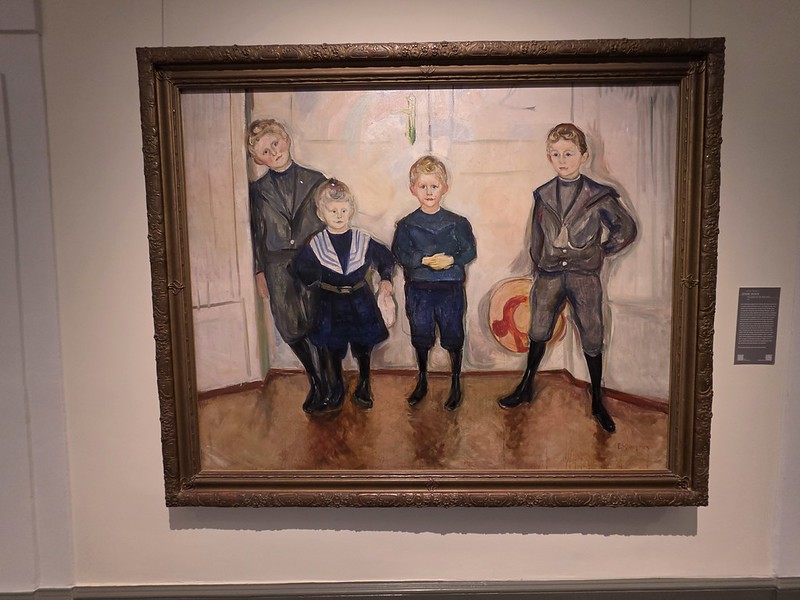
Edvard Munch’s (1863-1944) Die Söhne des Dr. Max Linde is apparently one of the landmark family portrait paintings of the twentieth century, or at least that’s what it says online and so it must be true. Painted in 1903, it shows the four sons of Dr Max Linde (1862-1940), a Lübeck eye doctor, collector and important early German supporter of Munch. The boys are not presented as neat little decorative cherubs, but they have individual personalities, varying levels of patience and the faint air of children who have been told to stand still by adults who are not fully in control of the situation.
The museum’s own account notes that Linde first encountered Munch’s work in 1902 and went on to commission portraits of his family, views of his house, garden and collection, as well as what became known as the Linde portfolio. Its presence in the Museum Behnhaus Drägerhaus is appropriate given that Munch was repeatedly active in Lübeck between 1902 and 1907, largely because of his relationship with Linde, and this work is one of the great results of that connection.
In terms of the children, Hermann leans in from the left, Lothar seems barely able to keep still, Theodor occupies the right-hand side with considerable confidence and Helmuth in the centre who looks straight out. I wonder what the children thought of it, it does show a sense of mischief between the two of them, I rather suspect that they liked it.
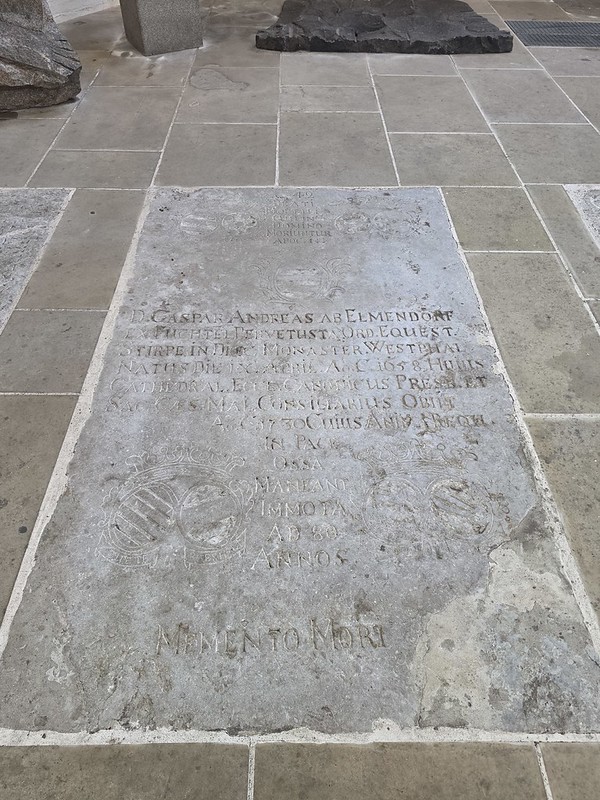
I’m more amused about AI’s response to whether it could tell me anything about this as it replied:
“The stone is very worn, and Latin inscriptions are unforgiving little beasts even before several centuries of feet have gone over them. I can provide some words with reasonable confidence but why put these stones where people walk over them?”
It seems to be humouring itself now, but I like its style. Anyway, the ‘Memento Mori’ which means something like ‘remember, you’ve got to die’ is a cheery little number at the bottom of the stone. It dates to 1730 although it’s not clear whether they’ve moved it because of the damage done during the Second World War. I suspect that it hasn’t moved very far, if at all, and in response to AI, it’s likely a good thing that they didn’t have this as a memorial on the wall, as that would have been less likely to survive the various attacks that there have been on this building.
However, this stone is readable enough without AI and it’s the tomb of Kaspar Andreas von Elmendorff (1658-1730). He was born in 1658 at Füchtel, located to the south west of Bremen, and became a Catholic canon in the otherwise mostly Lutheran cathedral chapter of Lübeck. Remarkably, he received the expectation of a canonry at Lübeck Cathedral when he was only ten, which goes to show what happens when you’re from a wealthy family.
He later held a canonry at St Alexander in Wildeshausen, before being ordained subdeacon in Münster in 1681 and priest in Hildesheim in 1700. He moved permanently to Lübeck in 1697, became an Imperial Councillor in 1705 and eventually served as senior of the cathedral chapter. He was also caught up in the rather tangled 1705 Lübeck bishopric succession dispute, supporting the Danish candidate Prince Carl, who ultimately lost out to Christian August of Schleswig-Holstein-Gottorf after a diplomatic intervention which all sounds very complex.
Elmendorff died in Lübeck in 1730 and was buried in the southern choir ambulatory of Lübeck Cathedral. Rather surprisingly perhaps, some of his donated liturgical silverwork survives, which is some achievement although it’s primarily just a saucer that is left.
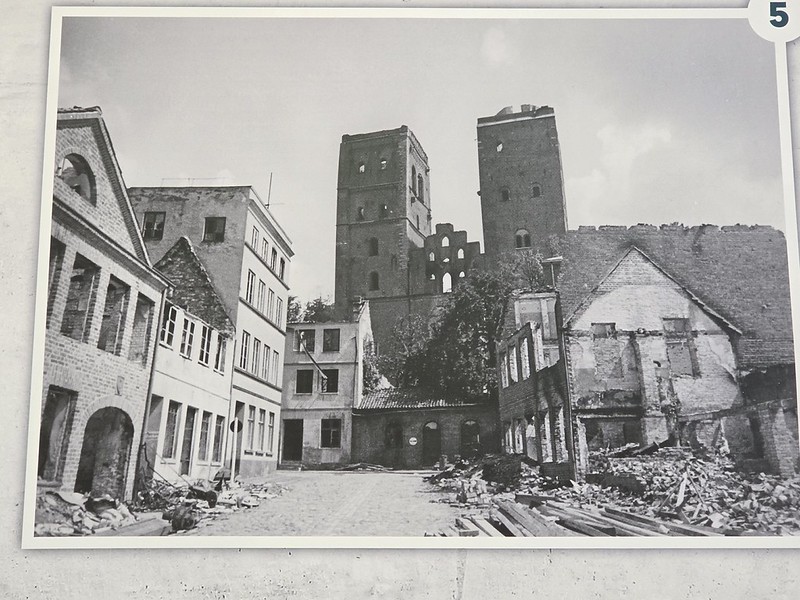
There was an interesting little museum area at Lübeck Cathedral, but these two images tell the story of the damage done here during the Second World War. This photo of the cathedral was taken in 1930.
And here’s what is left following the air raid on Palm Sunday (Psalm Sunday if you’re Robert Jenrick) on 28 March 1942, with this photo being taken a month after the attack. A city left in ruins and a cathedral primarily reduced to rubble. Work to restore the building wasn’t completed until 1982, although the interior of the cathedral has been rebuilt with some considerable care.
More in future posts, but the cathedral authorities are challenged at the moment as their building is starting to fall down and they’ve decided that they’d better fix that. This is a long-term historic issue, although not really helped by the 1942 destruction.