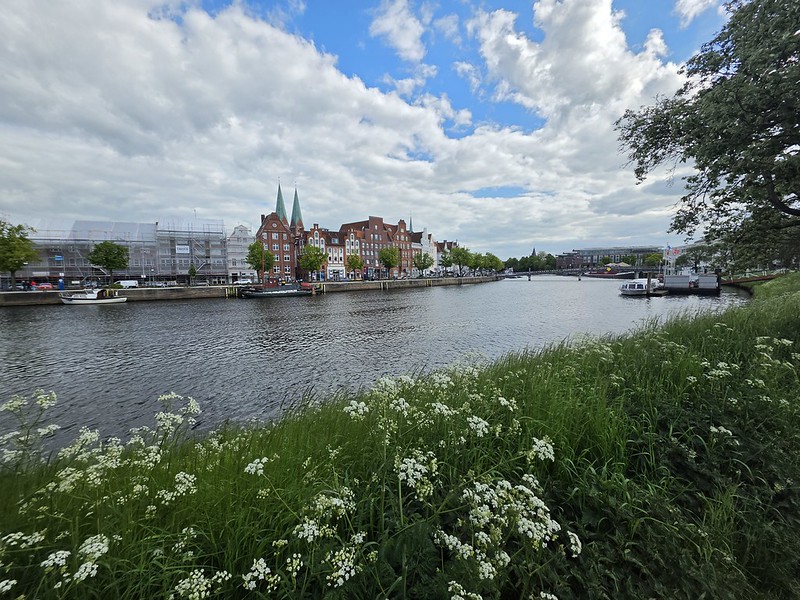
Mainly just a few photos in this post, it’s the rather beautiful frontage in Lübeck along the River Trave. Originally this would have all been a trading space where goods were shipped, stored and handling, so primarily working warehouses. In the nineteenth century, it all became rather more industrial with cranes, slipways and docks being added along the river.
It’s all really rather beautiful now, there are plenty of spaces to sit, walking routes, restored buildings and it’s much more touristy. I didn’t have time to walk as far along the river as I would have liked, but another time…..
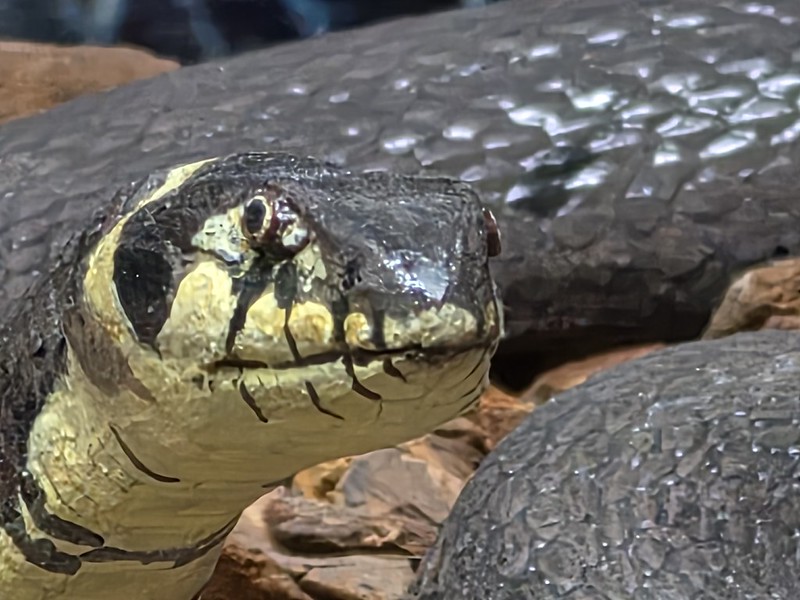
It took me a short while to notice that this was a stuffed snake and not a real one. I don’t like getting too close to them to inspect them, but it soon became apparent that it wasn’t moving and a lazy snake was hardly likely to stay in that position.
It’s fake nature was more obvious when I zoomed in. I don’t trust snakes though, they can be shifty little things, so I’m glad I checked.
Although there were other clues, like this sign that mentioned at the moment there wasn’t any “living” snake in the terrarium.
There should have been a grass snake here, for which the German is ‘Ringelnatter’. The word ‘natter’ can mean a snake or adder and it’s what came across into English as ‘nadder’ for snake. In middle English ‘a nadder’ became ‘an adder’, so by the seventeenth century or so the spelling had changed.
In the UK, very few Indian restaurants seem to open at lunchtime in some sort of moral statement, but across northern Europe there are no such restrictions. Given the very high online reviews for Namaste, which was also opposite the museum I was visiting, it proved to be sufficiently tempting for me to pop in for lunch.
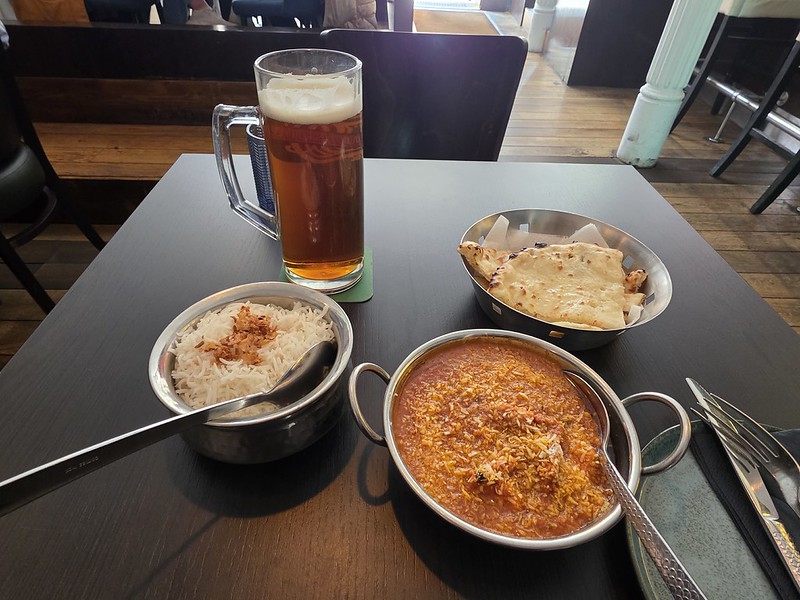
I went for the chicken madras which seemed slightly expensive, but then I realised it came with rice which was entirely agreeable.
The environment was clean, modern and felt on-trend. The welcome from the team member, who helpfully spoke English, was immediate and he was personable and helpful. The surfaces were clean, the atmosphere was comfortable and it seemed an inviting location, it seemed a good choice at this stage.
The beer is the Duckstein Rotblond which I haven’t had before and it was inoffensive, malty and didn’t annoy me. I mean this wasn’t going to change humanity I suppose, but the beer went well with lunch and not every drinking option can be rated highly on Untappd….
After trying the food, I was pleased with my decision to go here. The chicken madras had some spice, although it wasn’t particularly hot, but the meat was tender and plentiful with the sauce being rich. The coconut added texture and the rice was light and fluffy. The peshwari naan had coconut and almonds running through it with a slight crispiness to it.
Overall, I very much liked it here with the service being attentive, the food and drink being of a good quality and the atmosphere being inviting. All really rather lovely and I can see why they’ve picked up so many positive reviews. I like making sound decisions.
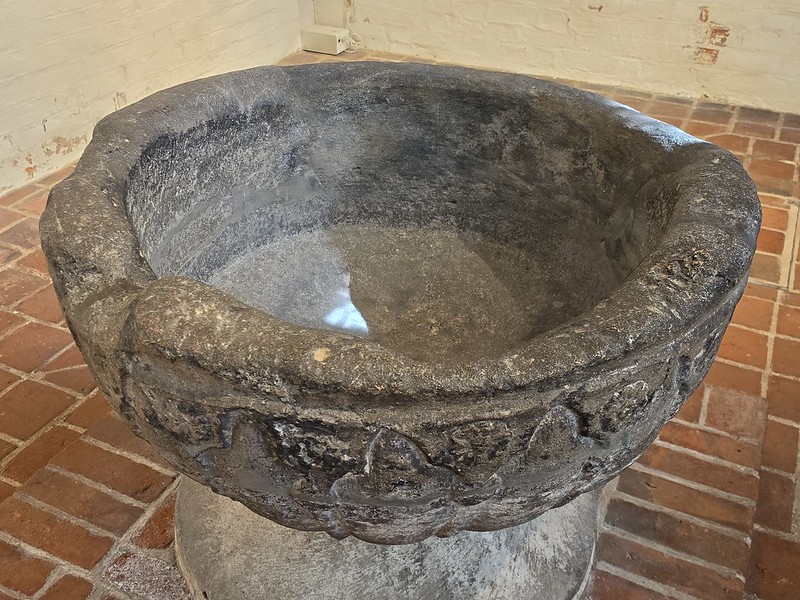
This is a thirteenth century font and I always very much like these because of the history and heritage that they hold. It’s from the church in Behlendorf, located a little to the south of Lübeck, which was built in around 1250. The church partly fell down in 1837, so it was decided that they’d build a new one as they didn’t want the old one that was evidently not structurally sound. They got themselves a new font, designed by C. A. Schönemann, as they thought the older one was getting a bit worn. They kept it for a bit, perhaps to see if they liked the new one, but then decided that it would be sent to a museum (or somewhere, I’m not sure where as this museum is from the early twentieth century) in 1882.
I accept that it’s a bit knocked about, but I think that’s part of the charm and it would have seen nearly 600 years of baptisms. When this was installed in the church, the area was part of the Holy Roman Empire before becoming part of the Hanseatic Free City of Lübeck. The stone from the church had been imported from the island of Gotland in Sweden, so it had been on a bit of a journey to get there.
I think it’s rather charming and it has pride of place in one of the exhibition rooms of the museum.
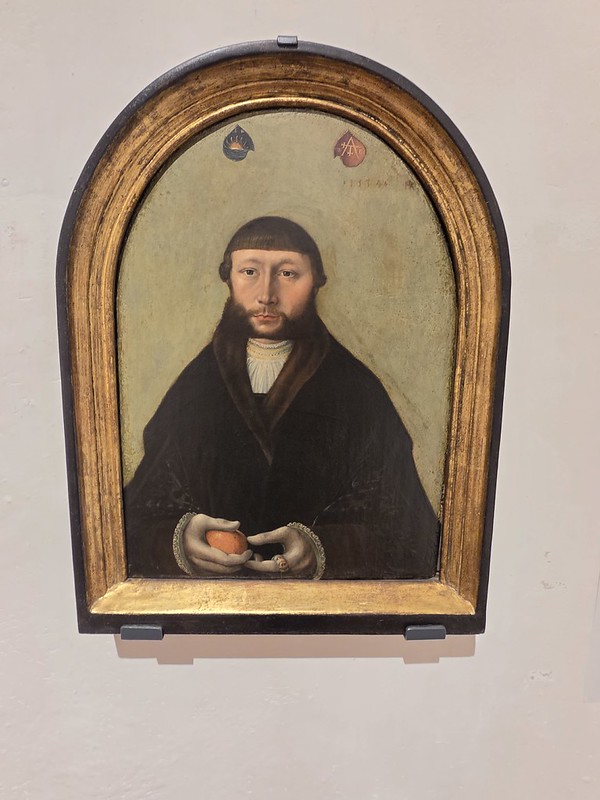
Hans Kemmer’s (1495-1561) portrait of Hans Sonnenschein shows a wealthy Lübeck merchant with the calm expression of a man who has no intention of being impressed by frivolities. I like that sort of realism. The artwork was painted between around 1520 and 1534 and it belongs to a moment when Lübeck was not only a prosperous Hanseatic city but also caught up in the great religious and political changes of the Reformation. Indeed, this must have been a confusing and often sub-optimal time to try to be a political or business figure, the whole religious movement of the region was changing quickly and that direction wasn’t clear.
Sonnenschein was not just a wealthy merchant but he was influential, playing a role in promoting the new evangelical movement in the city. The artwork didn’t originally look like this, it’s assumed that his widow had his clothing painted black to use the portrait as something of a memorial and he was given a citrus fruit to hold as a symbol of eternal life. On the reverse of the painting, a skeleton was painted which is really cheery for all concerned.
AI has had a go at restoring the painting to how it might have looked and this doesn’t feel like an unreasonable attempt. It certainly looks better than the later efforts to blacken his clothing and shove fruit in his hand….
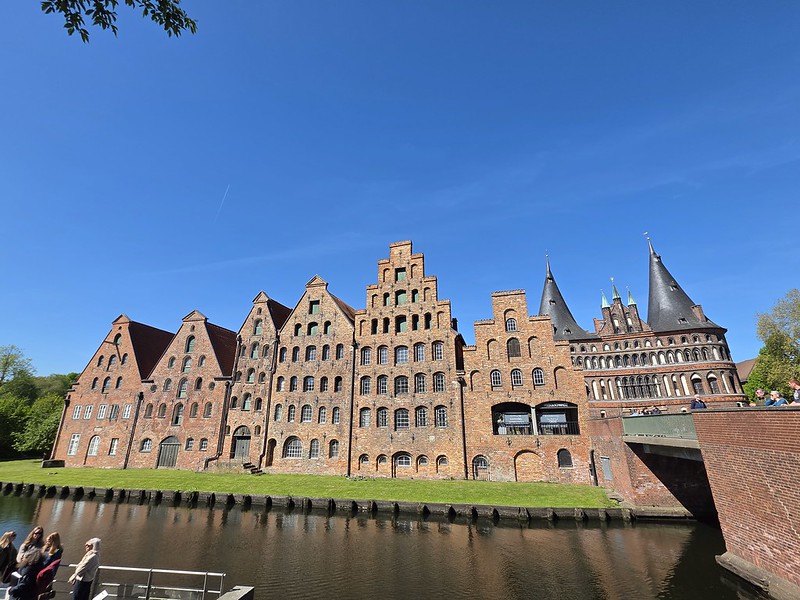
These are the Salzspeicher, six old salt warehouses beside the Holstentor in Lübeck, next to the River Trave. They are among the city’s most photogenic buildings, which seems slightly unfair given that their original purpose was basically storage. Built between the late sixteenth and eighteenth centuries, they were used to hold salt brought from Lüneburg, much of it arriving via the Stecknitz Canal before being exported onwards through Lübeck’s Baltic trading networks. Before refrigeration, salt was not just something delicious to add to crisps, it was used for preserving food and, in particular, fish.
The buildings look more decadent than perhaps any warehouse has a right to, but that is rather the point. Lübeck was one of the great Hanseatic cities, and its wealth came from the practical business of moving useful things around with ruthless efficiency and the occasional architectural flourish which is evident here. Over time, the warehouses were adapted for other goods as the salt trade declined and they are still used for commercial purposes.
Having already written about the Holstentor Gate, I thought that I would have a little look around the museum which is located inside it.
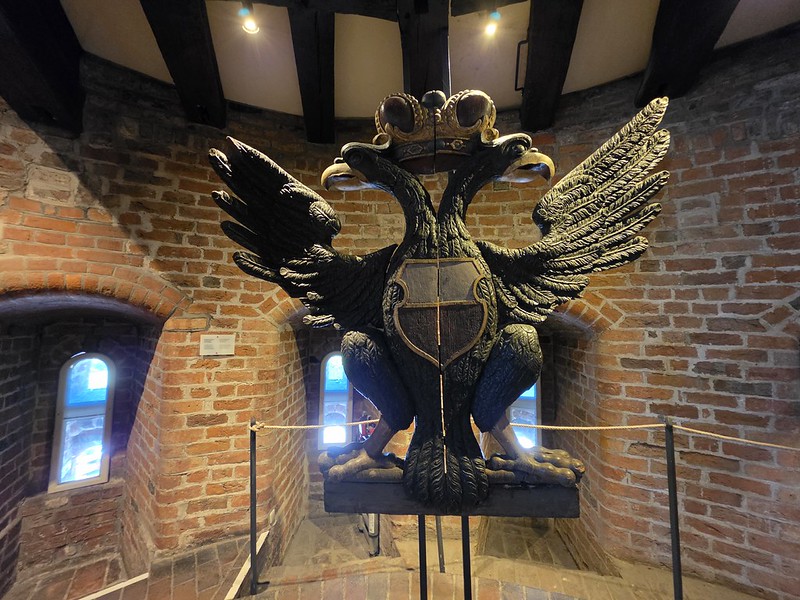
This was one of my favourite exhibits at the museum, it’s the sixteenth century oak double eagle that was originally on display above the outer gate. For hundreds of years, visitors to the city would have entered underneath this eagle, I like the significance of that.
The outer gate (on extreme left of this model in the museum) was removed in 1853 to allow the railways in as plans started to demolish the entire structure, with the inner gate (the other side of the river) already having been demolished in 1828.
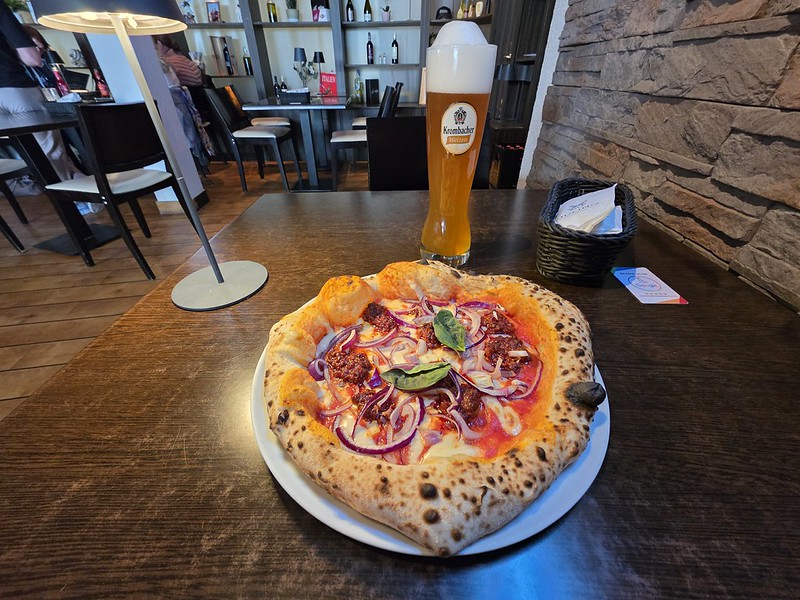
I’m not entirely sure that I made much effort to try local German cuisine, but this independent pizza restaurant is run by two brothers and has excellent online reviews. The restaurant state that all the dough is left to mature for 48 hours and the Neapolitan style pizzas are heated in an authentic oven to 450°C.
The menu options and the service was friendly, personable and efficient. The server, who appeared to be one of the owners, spoke fluent English, Italian and German which is a skill that I never cease to be impressed by.
Firstly, the beer is the Krombacher Weizen, which is a gentle and slightly sweet wheat beer with the expected banana notes.
Onto the food, the ‘nduja pizza was really rather very lovely, the base was light and fluffy, with the toppings being generous and there were plenty of ‘nduja. Cooked perfectly with some leopard spotting, this was suitably decadent. I’m not sure how healthy the whole arrangement is, but there we go, it tasted delicious.
I suspect that reservations are usually helpful here, there were only a couple of non-reserved tables when I visited early on a Friday evening, so I imagine that walk-ins would have been less likely later on during the evening.
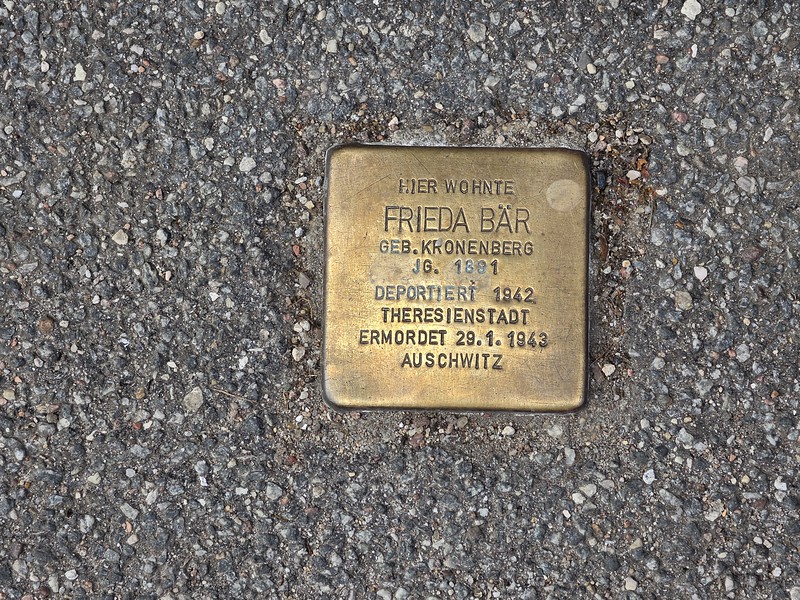
These stolpersteine (stumbling stones) are located all across Europe and there are now over 100,000 of them, mostly in Germany. They mark the last place that an individual chose to live before they were killed or persecuted by the Nazis. This stone was laid on 21 April 2010 at St. Annen-Straße 20.
Frieda Bär (1891-1943) lived here with her husband Selig Semmy Bär, who was born in the city on 14 January 1891. Frieda, nee Kronenberg, had come from Gierhagen in Westphalia and was born on 24 August 1891. In 1935, they moved into a flat together on the first floor at St. Annen-Straße 20 from their previous residence at Königstraße 45.
The Jewish couple avoided the deportation to Riga in December 1941, although soon after this they were forced out of their flat and had to move into the asylum of the Jewish community at St. Annen-Straße 11. There was space at this location because 90 Jews had been sent to Riga and they were nearly all killed. On 14 April 1942, Semmy died at the age of 57 at the house, with the doctor noting that he had a heart weakness and the cause of death was a stroke.
She lived next to the Jewish synagogue, although this was destroyed internally in 1938 during to Kristallnacht. It’s thought that the building wasn’t demolished by the Germans as it was next to St. Anne’s Museum. The building has since been restored and returned to the Jewish community, remaining as a synagogue.
On 19 July 1942, Frieda was sent to Theresienstadt, leaving Hamburg on the following day. On 29 January 1943, she was sent from Theresienstadt to Auschwitz where she died.
I visited St. Anne’s Museum during my day in Lübeck, the area is now middle-class, clean, refined and peaceful. It is difficult to imagine the synagogue being trashed and residents of the street forced out of their homes, ultimately to be killed at concentration camps.
The airport has helpfully signposted the nearest bus stop which is a walk of around 150 metres as the bus doesn’t come into the airport itself. I thought that I could manage that sort of distance.
It might have be handy to pop this bus stop just a little nearer to the airport, but there we go….
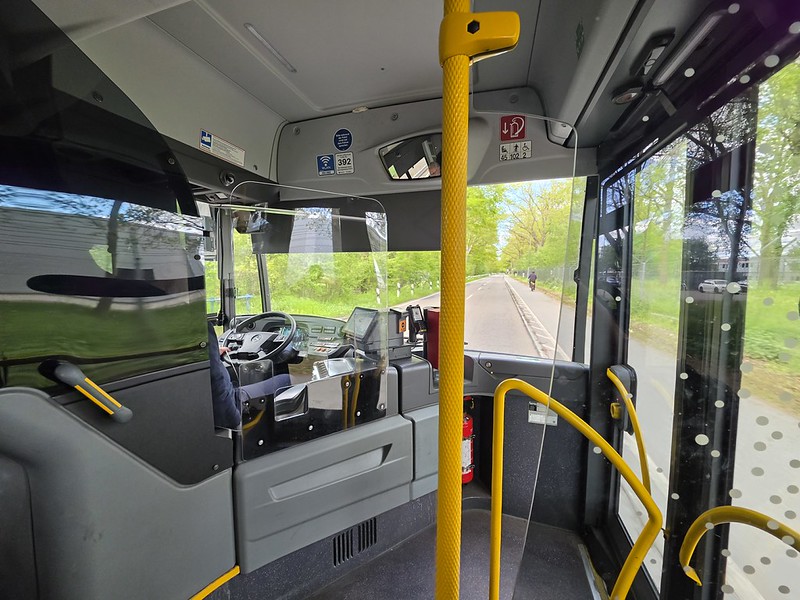
Paying for this bus was not obvious as information online isn’t consistent, which is the main reason for this post. I downloaded the bus company’s app, but they don’t let passengers buy single tickets, they have to be purchased from the driver. It says that drivers may accept cards or notes, which seemed vague to me, but it’s clear that the bus company wants the exact change or for passengers to use season tickets. The bus in the photo is the one going the other way as I was trying to see if they had a card machine.
I’m pleased to note that the driver accepted cards, which was handy as I wasn’t going to be able to be able to pay with cash. A fair number of passengers paid with card, so I assume that it is now a standard thing on the buses in the region.
This maximum number of standing passengers seemed a bit aspirational. I assume they mean that passengers should hold the pole rather than they should be some sort of warlock with a stick.
There’s a bus every thirty minutes during the day from the airport and it takes around thirty minutes to get to Lübeck City Centre.