
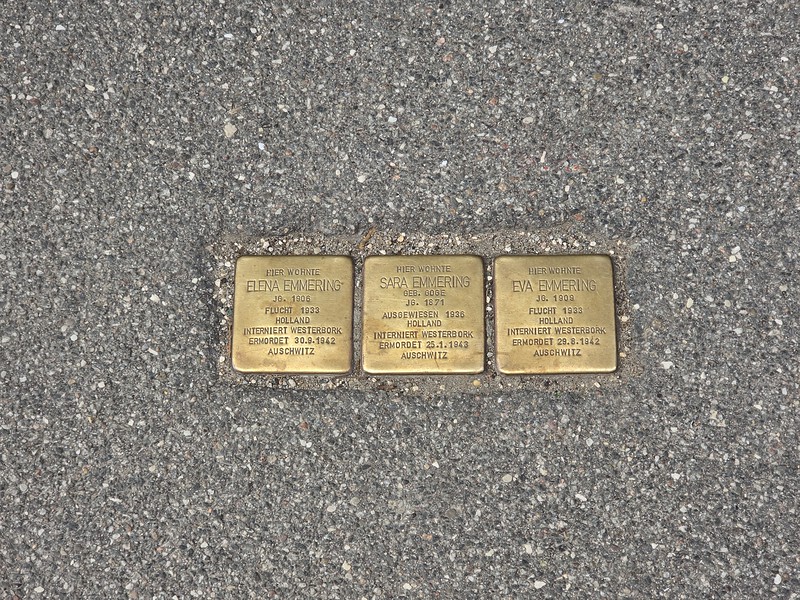
This is a group of three stumbling stones located at St. Annen-Straße 12 where the Emmering family lived and had their shop.
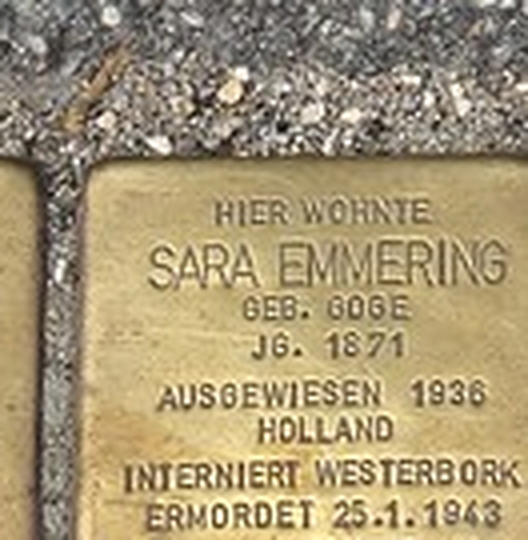
Sara Emmering, born Sara Goge, came from Moisling, now part of Lübeck, where she was born on 25 April 1871. She married Benjamin Emmering, a Dutch cattle dealer from near Groningen, in Lübeck in 1903, and through that marriage she and her later children became Dutch citizens. Sara and Benjamin eventually settled at St. Annen-Straße 12, where they lived with their family and ran a shop dealing in clothing, linen and furniture.
By the early 1930s, the family had already been shaken by loss. Benjamin died suddenly in September 1932 after long-standing heart problems, and Sara appears to have been seriously ill by then. She was admitted to the Strecknitz Mental Hospital, while the family home was rented out to fund her care. Her daughters Elena and Eva, who had been living in Hattingen, returned to Lübeck after their father’s death, but they fled to the Netherlands in 1933 following the Nazi oppression they suffered from. Sara remained in the hospital until 1936, when the Lübeck authorities declared her an “unwanted foreigner” and deported her to the Netherlands. The family home was then lost through enforced auction and it’s unlikely that they received anywhere near a fair price.
In the Netherlands, Sara was admitted under her maiden name, Sara Goge, to Het Apeldoornsche Bosch, a Jewish psychiatric hospital. After the German occupation, even that place of care was not spared from the Nazi hate. On the night of 21 January 1943 and into the following morning, the institution was emptied, the patients were beaten, forced onto trucks and then into cattle wagons heading for Auschwitz-Birkenau. Sara was murdered on arrival on 25 January 1943. She was 71.
There is a website about the history of Het Apeldoornsche Bosch and that notes:
“On the night of January 21–22, 1943, the occupying forces brutally evacuated Het Apeldoornsche Bosch. Over 1,100 patients and staff members were put on a transport to Auschwitz and murdered. On January 22 and February 1, another 282 people, including five pregnant women, were taken to Westerbork. Ultimately, only 21 people from these two transports survived the war.”
Without these stumbling stones, these stories might start to be lost and the individuals forgotten about.