
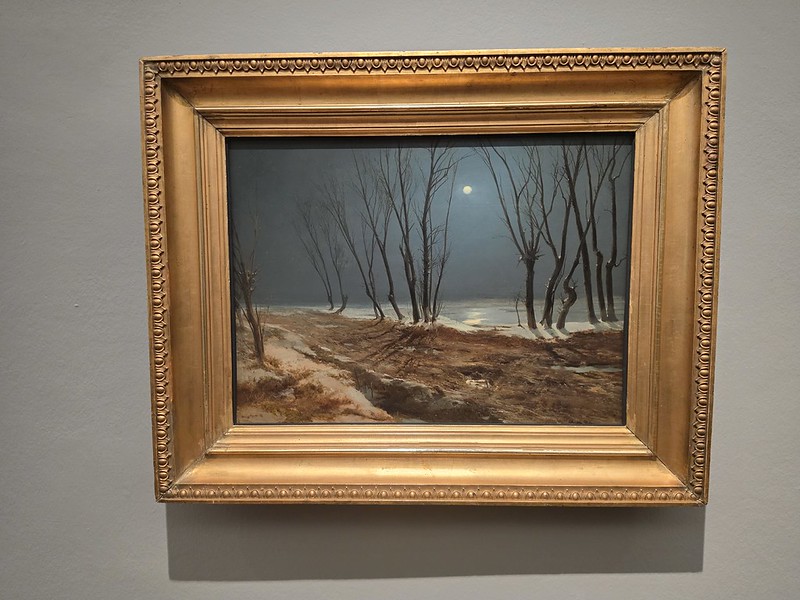
This artwork is by Carl Blechen (1798-1840) is perhaps a much easier painting to like than Xaver Fuhr’s tense little sailing boat. There is moonlight, snow, bare trees and a winter road disappearing into the distance, which is the sort of arrangement that is easy on the eye. Painted in 1829, it belongs to a much older Romantic tradition in German art and Blechen’s work represented a style that the Nazis were far more willing to absorb into their own cultural story. Unlike modernist painters such as Fuhr, whose work was treated as suspect, degenerate and politically dangerous, a winter landscape like this could be understood as rooted, traditional, solemn and apparently unthreatening.
Some of Blechen’s works were intended to be displayed at the Fuehrermuseum and if the Nazis had won the war, this is precisely the sort of scene that would have had pride of place in their national museums. The artist’s life was actually quite traumatic and he had serious mental illnesses, not something that would have been entirely celebrated by the Nazi regime and I’m sure that they would have airbrushed that out from the narrative. Blechen withdrew from teaching in his mid-30s and died at the age of just 41. To my non-artist’s eye, I think that his artworks feel quite modern and timeless. And indeed, I should probably stop viewing these artworks from the perspective of 1930s and 1940s Germany, but there’s so often a story there.