Blog

  • Norwich – Bar Billiards Singles Tournament Round 3

    Norwich – Bar Billiards Singles Tournament Round 3

    It all came to a head on Saturday at 12:00 at the VR rooms in Norwich…. Oscar and I had both won two games, my first at the White Lion and then my second at the King’s Head. This surprised and delighted me since I’ve hardly played in four months, although, to be fair, I’m not sure I’m any better after playing more anyway as I play solely with muscle memory and pure delusion.

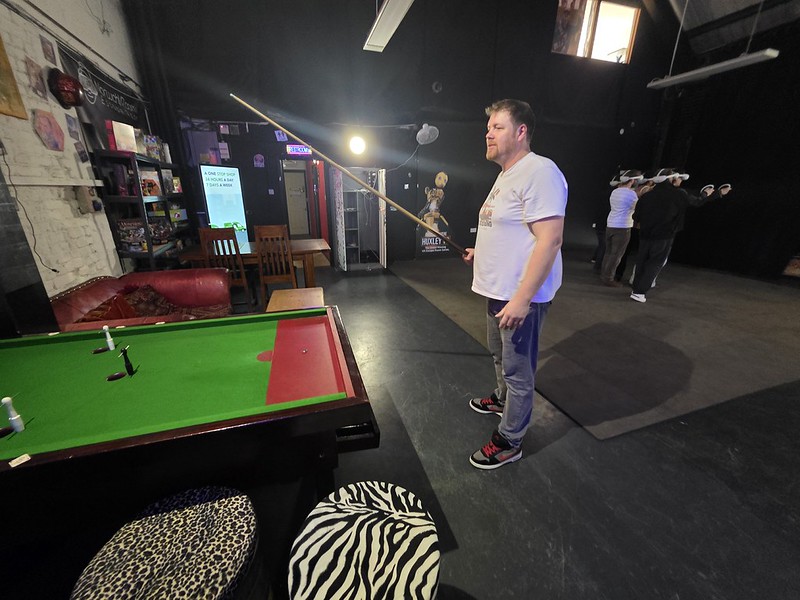
    It was my first time in the VR rooms, so I wasn’t sure what to expect. Here’s the table, which is on free play, but you just buy drinks from the bar instead. I very much liked the table, it was slower off the back than I expected which meant I fell short on a few shots, but it was a bit wider than the King’s Head table which I liked. The pegs are very delicate indeed though, they blow over easily.

    I don’t think that Oscar will mind me saying, but he turned up looking dead to the world as if from some zombie movie and I was secretly very pleased about that as I hoped he’d fall over or similar to distract himself from the game. However, at heart, I know that Oscar is a master at performing even when feeling terrible, so I wasn’t very confident.

    We had some VR action behind us, but in the excitement of our game, I mostly forgot about them as I was locked into my own tragedy. As an aside, we had no scorer, so we had to do the adding up ourselves which was challenging as Oscar kept scoring large breaks. The first two games were relatively close, but Oscar won them both, so that was the end of that for my amazing run in the competition. I also lost the third frame, but by more, but I had rather lost the killer instinct by then….. And, let’s face it, Oscar is a very good player.

    Anyway, that’s that now, I’ll just have to watch the other games to see who wins in this fine competition. And, maybe I might even get to reach the hallowed quarter finals next year. But I might need to practice more and also hope that I don’t meet Oscar in the 2027 competition.

    For anyone concerned about his well-being, I’m pleased to note that Oscar was in good shape again in the pub in the evening, but I ignored his comments about victory because it’s not about the winning, it’s about the taking part. Unless I win, then I upload videos and blog posts all over the place. And, I confess, if I’d won, half of Norwich wouldn’t be able to open a social media app without seeing a slow-motion montage of my genius.

    And, also, lovely people at the VR rooms, I hope to be able to play some games there in the future, a really nice set-up.
  • Timișoara – Memorial to Radian Belici

    Timișoara – Memorial to Radian Belici

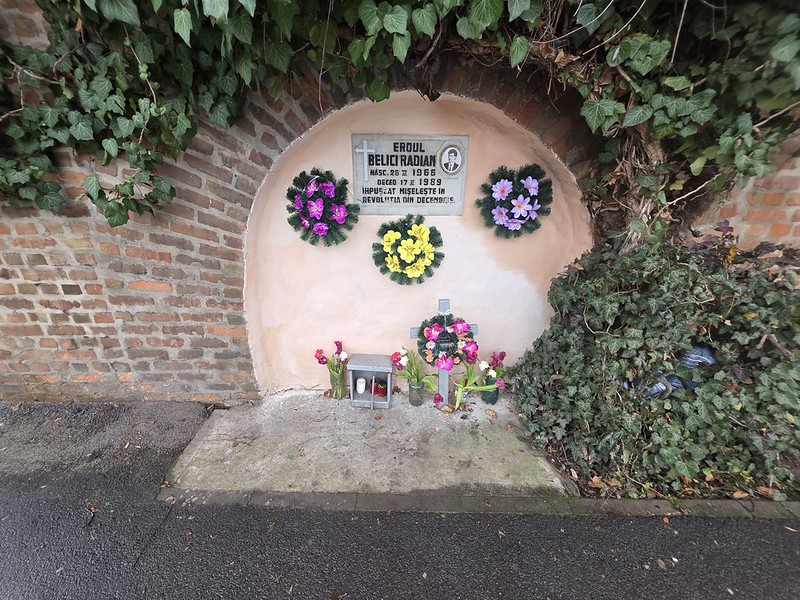
    This is the memorial to Radian Belici, who was murdered on 17 December 1989 by the Romanian army on the orders of the dictator Nicolae Ceaușescu. Ceaușescu’s regime was collapsing and he was desperately doing what he could in order to save himself, although it failed and he was executed alongside his wife on 25 December 1989.

    Belici was just 23 and he believed in a better future for Romania, so he had joined protesters in the city against the regime. Ceaușescu was a brutal dictator, he didn’t fear killing anyone who got in his way, he feared democracy and freedom in every aspect.

    Radian was the son of Ana and Ion Belici, who lived in the nearby town of Jebel. Radian had a wife and daughter who he sent home to safety when it was clear what the regime’s forces were about to do in terms of suppressing the protest.

    The memorial is located at Timișoara 700 Square, by where Radian Belici was murdered.

    This is Nicolae Ceaușescu, who was found guilty (albeit in somewhat of a kangaroo court) of a genocide against the people of Romania. After Radian was executed, his body was sent to Bucharest and cremated alongside other protesters so that the family couldn’t have the ashes. Radian’s mother took a handful of earth from the sewer pipe where the remains were dumped in the hope that they contained some of her son’s ashes. She visited where her son had been killed every day for as long as she was physically able.

  • Timișoara – Ibis Hotel

    Timișoara – Ibis Hotel

    I try and stay loyal to Accor Hotels and they handily had this Ibis in Timișoara where I stayed for two nights.

    These rooms are fine for me on my own, but they are getting a little too small now for those couples who might want to spend a few days here. I liked that the large picture by the bed was actually just a painted wall with a frame around it. They don’t have any larger rooms for upgrades, but I was given my preferred top floor room.

    The view from my window.

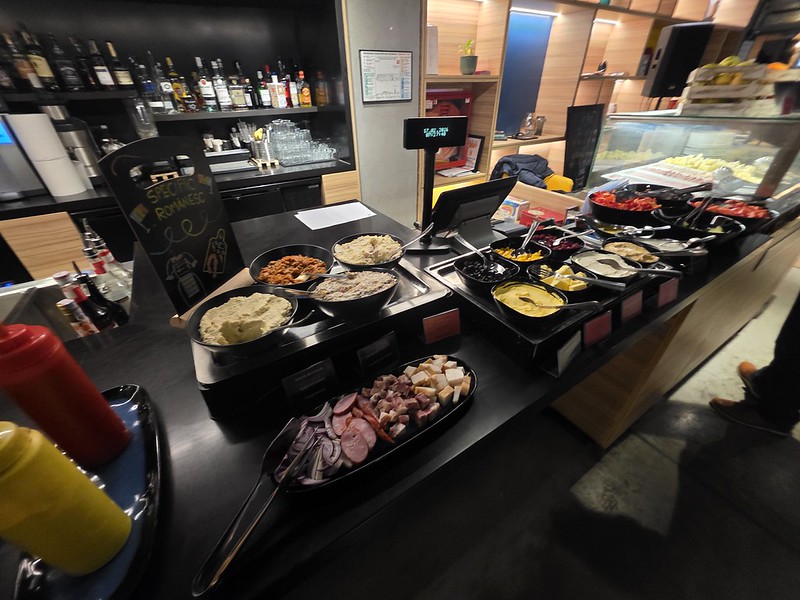
    Some of the cold options and at the rear dish in the middle of the photo is ajvar, something which I’m overly obsessed by. The meat quality here wasn’t great, so I ignored that. The breakfast room was also really odd, it simply wasn’t large enough despite all of the space that they have here, it’s poorly laid out. I managed to come down at times that there were tables free, but many guests were struggling to find a space to sit.

    The breads and apple pies.

    A big dollop of ajvar. Those sausages were odd, they looked delicious but were chewy and lacking in any depth of flavour.

    I suspect the hotel staff were wondering where one of their dips kept going.

    The welcome drink of Timișoreana lager which tasted mostly of metal and disappointment. The croissant was mine, but there was a welcome gift of chocolates from the hotel.

    The online reviews of the hotel are very positive, so they’re clearly surprising and delighting lots of people. I rather liked this hotel, although their restaurant and bar area was frequently dominated by private groups. On the first night, they had closed the restaurant for a private group and although I had no intentions of eating there, it’s a little sub-optimal for guests. Anyway, if I’m back in the city, I’d likely stay here again.

  • Timișoara – Euro Hotel

    Timișoara – Euro Hotel

    I had spent my first two nights in Timișoara at the Ibis hotel, but I decided to switch to a more thrifty option on my final night as I was leaving it at 02:30 to get a taxi to the hotel. The staff member at the reception desk was friendly and it all felt an efficiently run operation.

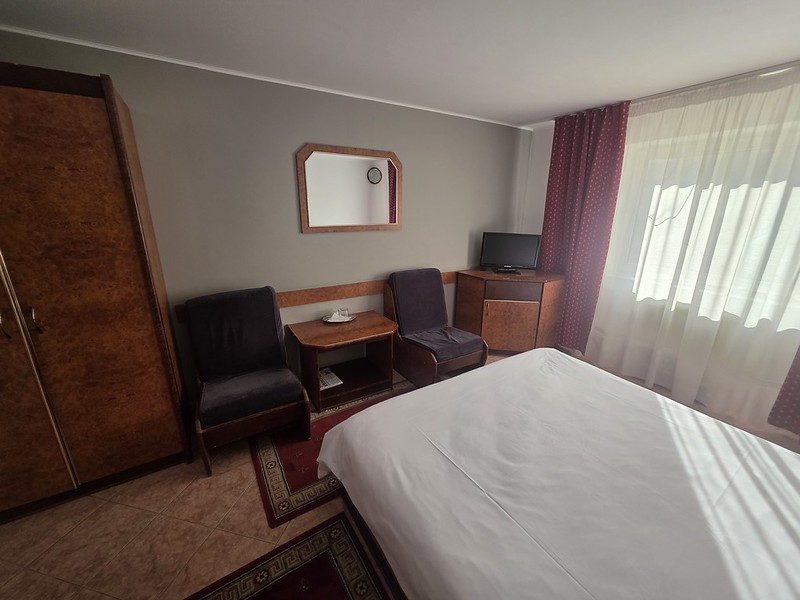
    This is some retro look, I really rather liked it, although it’s likely looked like this for around three decades. Chunky wooden furniture which I imagine would be a right faff to remove, but it’s all got a certain style and I’ve glad that it’s still here

    The room was clean, tidy, warm and in a period of its own. However, for the money, which was just over £20 a night including the hotels.com discount, it represented excellent value for money. The bathroom was basic, but functional, with no noise issues either internally or externally.

    Here’s what it looks like at 02:30….

  • Timișoara – Timișoara Art Museum (Stefan Tenecki – 1762 Church Art)

    Timișoara – Timișoara Art Museum (Stefan Tenecki – 1762 Church Art)

    There isn’t any medieval art at the Timișoara Art Museum, but there is a collection of primarily eighteenth century pieces of religious art on display.

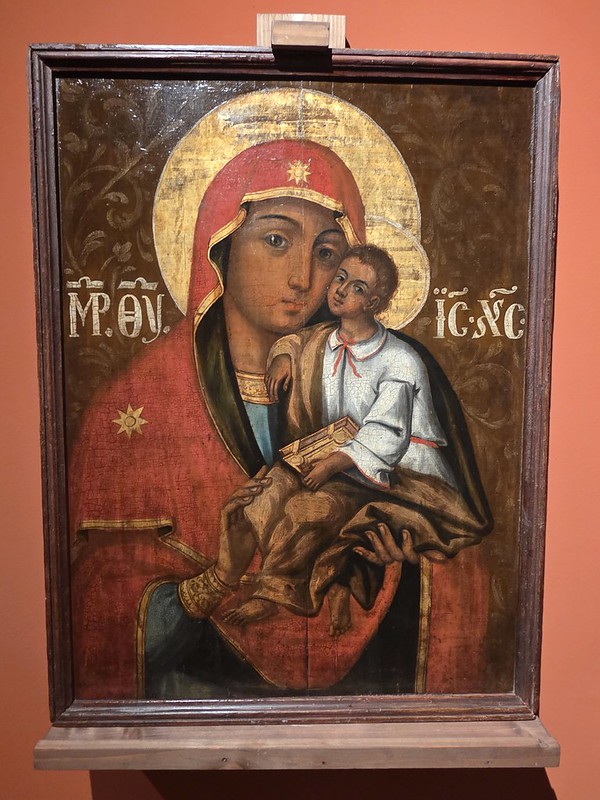
    This artwork is by Stefan Tenecki, painted with oils directly onto wood. It was originally on display at the wooden church in Hodoș, Timiș County, which was originally constructed in the late eighteenth century.

    The church was pretty much falling down by the early 1970s, despite a renovation in the 1920s, and it was moved to Timișoara. This is one of the pieces, dating from around the 1760s, which was moved to the museum.

    This style of painting Jesus with an almost adult like face is a Byzantine thing which I think looks quite odd, but it must have suited the church at the time. And I rather like that this artwork was being looked at a rural church over 250 years ago.

  • Timișoara –Timișoara Art Museum (What is This?)

    Timișoara –Timișoara Art Museum (What is This?)

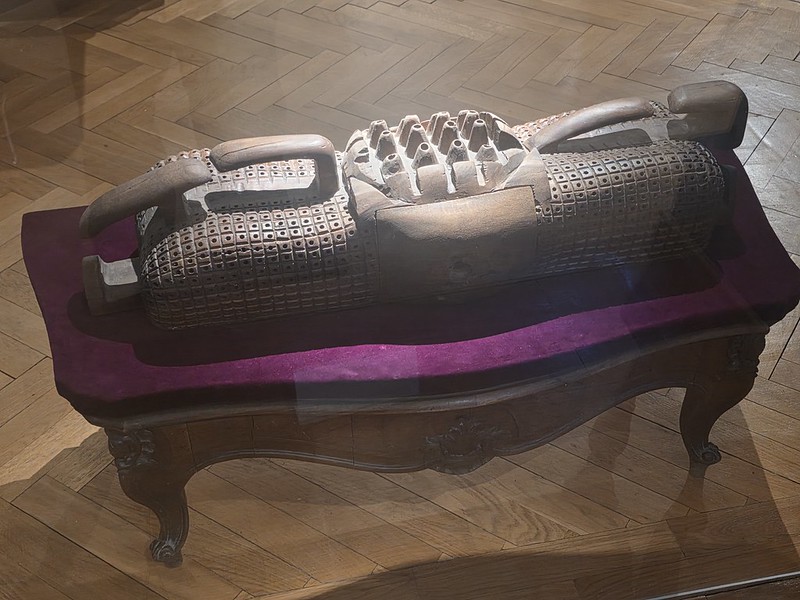
    I have no idea what this at the Museum of Art actually is.

    Google Gemini suggested that it’s either a Mukoku slit drum or a Chokwe slit drum, where as ChatGPT goes for a communal grinding stool with spikes or a palm oil extraction press component.

    All very creative, but I’m not convinced. Answers on a postcard…

  • Timișoara – Timișoara Art Museum (Stefan Bognia by József Ferenczy)

    Timișoara – Timișoara Art Museum (Stefan Bognia by József Ferenczy)

    This artwork is by József Ferenczy (1866-1925), an artist who moved to Timișoara in 1901 when it was part of the Austro-Hungarian empire. This was the golden age of the city, grand new buildings were being constructed and it was very much a cultural hub. Ferenczy also brought up his children in the city and it’s also where he died in 1925.

    The gallery names the sitter in the artwork as Stefan Bognia, but I can’t find out anything about him, but I assume he has some military role from his appearance. But it’s the theme of this being very much the golden age of the city that appealed to me, the grandeur that is now faded (but is being restored) was very much in evidence back then.

    Whoever the man was, this is how AI thinks he would look today in modern clothing.

  • Timișoara – First European City with Electric Street Lighting

    Timișoara – First European City with Electric Street Lighting

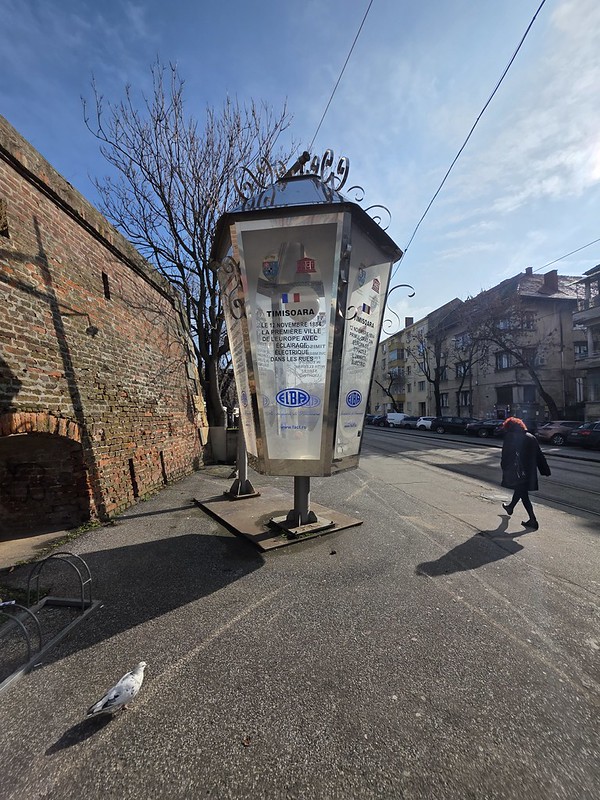
    Timișoara are quite proud that they were the first city in Europe with electric street lighting when it was introduced on 12 November 1884. There were over 700 street lamps, so it was all something of an effort.

    It’s perhaps in some need of cleaning, but it’s a nice little commemoration of their forward thinking. The reality is slightly more complex though, as it often is, as the city’s gas lighting contract was coming to an end and the company wanted a lot more money. The city wasn’t prepared to sign, but the infrastructure was owned by the gas company and so Timișoara could have been plunged into action if they hadn’t acted…..

  • Timișoara – Carol Küttel

    Timișoara – Carol Küttel

    Although with the limitation of history is told by the winners, I like seeing that statues and sculptures there are in a city. It’s always intriguing to see whose memory they want to be remembered. I wonder if Nicolae Ceaușescu ever thought that his statues would stand proud across Romania, or whether he was aware of the inevitably that they would be pulled down.

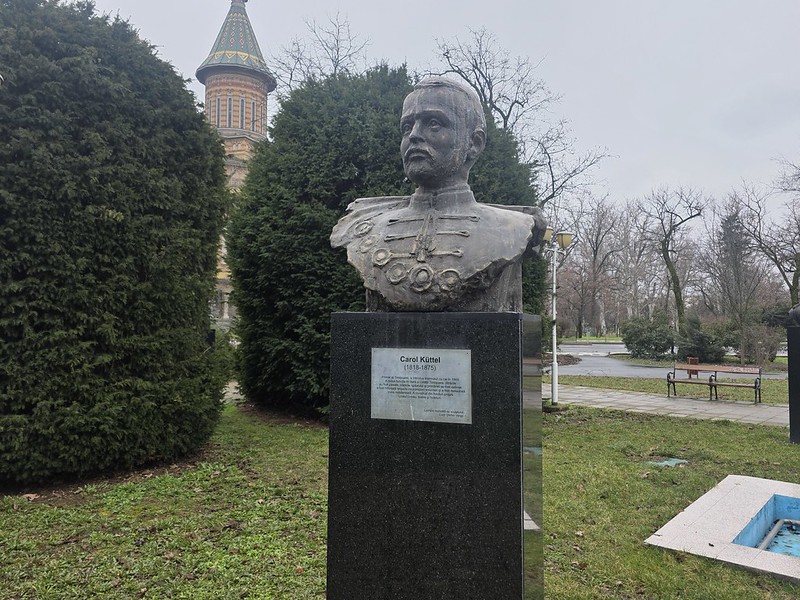
    Anyway, I digress. This is Carol Küttel (1818–1875), often referred to as Karl or Károly, who was a pivotal figure in the urban development of Timișoara, serving as the city’s mayor during two distinct terms from 1859 to 1861 and again from 1867 to 1872. A jurist by training, Küttel is widely celebrated for his role in modernising the city’s infrastructure, most notably for initiating the establishment of the horse-drawn tram system in 1869, making Timișoara one of the first cities in the world to adopt this form of public transport. His administration was also instrumental in the decision to construct the city’s theatre, a move that furthered Timișoara’s reputation as a “Little Vienna” and a cultural hub within the Austro-Hungarian Empire.

    This statue of him was unveiled in 1999, but I’m quite focused on his horse-drawn tram escapades. Although this was the first city in what is now Romania to get them, they were only just ahead of the Romanian city of Arad, which isn’t far away at all. It was one of the earliest in the world to have trams and I like the innovators who must have been very much ahead of the game here. And, the city still has trams, unlike those places which got in early and then got rid of them far too early.

  • Timișoara – Crucifixion

    Timișoara – Crucifixion

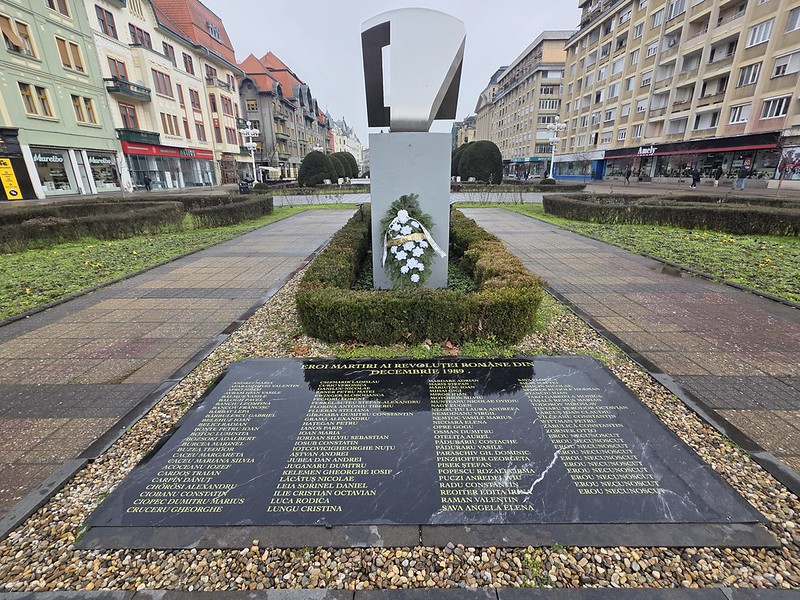
    With the city’s cathedral in the background, this is the Crucifixion monument, designed by Paul Neagu.

    In front of the monument are names of those who died in the 1989 Romanian Revolution. The revolution began in Timișoara and the city is still very much defined by that today, it is not something that is kept a secret and they seem very proud at being at the forefront of change. And, to stand up to Nicolae Ceaușescu much have taken some considerable bravery and courage.