Guy Evans created this interesting infographic of where the retirements took place on the 100 this side, it’s an interesting snapshot of what happened along the route. The actual number was 471 started and 209 finished, the tracking data is slightly faffy but this is still an intriguing use of data. Over 100 retirements by CP5 shows how the hot weather was impacting entrants, many of them just didn’t feel that they could carry on.
We had what could only be described as a sub-optimal match in the league last week where we lost 8-1. And next up was the top division team the King’s Head, so my aspiration was to try and not to lose 8-1 again. There’s nothing like a bit of optimism to start the night, so I focused on having a light and functional Schöfferhofer.
The Sublime from Floc, a tropical edge and a bit of citrus. There’s Luke the Lion practising in the background, we thought we’d get there early in the hope of only losing 7-2 if we upped our game from last week. Marginal gains and all that.
Then the draw with Graham from the King’s Head, we were ready to roll. I liked their cards which had their players on the other side.
I was drawn last in both the singles and doubles, the latter always gives the challenge of it potentially being the deciding match. This is the sort of pressure that elite athletes train for. I mostly cope by looking concerned, eating crisps and pretending that I have a plan.
Off we go, promptly losing the first match.
Kirsty pulled it back for us and the thought of losing 9-0 subsidised. This was positive as there are only so many character-building experiences one team should be expected to endure in two weeks.
The snacks then appeared. Some teams rely on coaching, tactics and psychological resilience. We rely quite heavily on crisps.
To cheer me up a bit, as we were losing 3-1 at this point, I went for the Peach Me Up from Woodland Brewing, a gentle and not overly tart sour which went well with the M&Ms.
Then PJ played a robust and confident game, which is exactly the sort of thing we needed, not least because some of us had already begun quietly calculating how bad the final score might look on paper. I decided to referee this one to distract me from doing too many of those calculations.
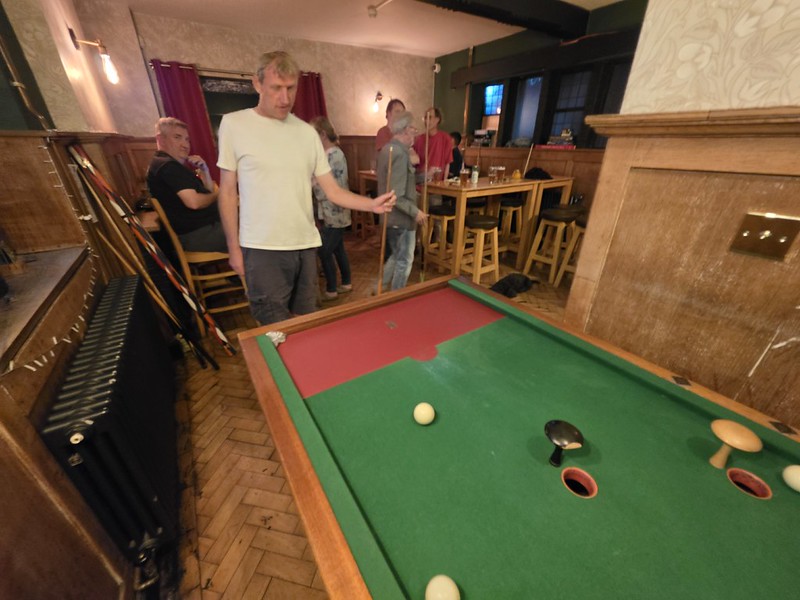
And then it was my game. Channelling everything that Zak and Nathan have taught me, or what I’ve learned when refereeing, my back cushion game actually worked, with 5 balls in the 100 pocket and 1 ball in the 200 pocket that I actually aimed for rather than just fell in by mistake. This was unusually decadent play for me and likely won’t be repeated all year….. And it was enough for it to be 3-3 at the end of the singles.
Luke the Lion treated me to a Flump for scoring over 1,000, which is precisely the sort of vice-captaincy that builds morale. He is definitely becoming the best vice-captain in the league, and I say this not just because he brings sweets, although that is clearly a major part of modern leadership.
Ivan came along to say nice things to me, although he disappointed me by telling me that the CAMRA coach trip I’m on with him on Friday night isn’t going to the Ber Strete Gates.
Kirsty and PJ had a dilemma towards the end of their game as Kirsty would need to get the ball into the 200 and then also hit the final ball in the 200. And she only went and bloody did it, one of the best doubles games that I’ve seen. Positively optimal. Then more delights came for our team, with Luke and Vaughan taking the pressure of Terri and myself by winning their doubles match.
We very nearly won the final game as Terri got the 200 final shot in, but the peg wobbled and fell over. But Ivan was the true star of the show, nearly collapsing the table while refereeing. I liked his style. Not necessarily in a safety-conscious way, but certainly in an entertainment sense.
And 5-4 in what was a great game, although quite stressful for me once again when it was close. The King’s Head are a lovely team and it was all very close. We were one of the first cup matches to be played, so it might be a while for the draw for the next round giving us plenty of time to become overconfident and then immediately regret it.
And my usual rule is that if we win, then I go to the King’s Head after the match which was particularly appropriate this evening. Thanks to PJ, Ivan and Julian for coming along, a very lovely night and many thanks to the King’s Head for a fun match.
James and I always look out for what we consider decadent dining options, which normally involve market stalls or places that serve chicken. I’ve walked by here a number of times and been tempted to go in, so when James and I discovered that our preferred market lunch option was closed, we came here. This venue is one of two in the chain, with the other being located in Milton Keynes.
The menu is quite substantial and the ordering system is a little unclear, although ultimately it’s seat yourself and then go to the counter to order. There is an online ordering system but it doesn’t have the discounted prices available.
The lunch menu and I wanted this, so I ordered at the counter. I accidentally decided that I should also order five chicken wings as that meant I got another five free as it was Wings Wednesday. There are times that I try and be dignified and moderate, but then things go a little awry….
The interior was mostly quite dirty when we entered with only one clean table, although that seemed to be more a lack of staff rather than a lack of effort.
There were a range of sauces in a style similar to Nando’s although I didn’t use these as the food arrived with more than enough sauce already on it.
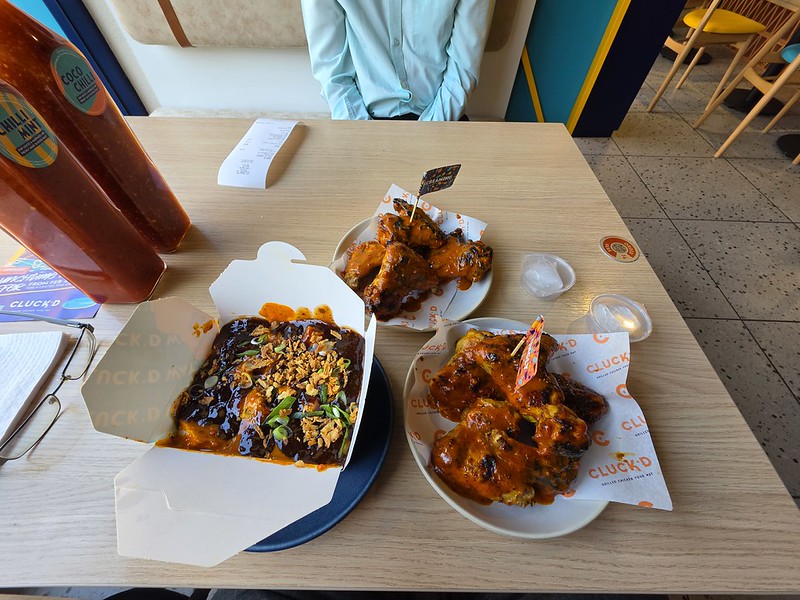
I went for the £5 chicken and rice box with the Screaming Hot sauce and Korean BBQ, along with five chicken wings with the Screaming Hot sauce and the free five chicken wings which had the Tingly sauce on. Firstly, the Screaming Hot sauce was lacking in any sort of heat which for something advertised as “try it if you dare!” is perhaps rather sub-optimal. The Korean BBQ was a bit too sweet for me and the whole arrangement was also a little salty.
The chicken and rice box were rather swamped by the BBQ sauce and the rice was a bit bland, with the chicken pieces being tender but also lacking in much depth of flavour. The chicken wings were generous in size, as it included the entire wing, and they were all fine although they weren’t particularly impactful in terms of the taste with the chicken seeming to be slightly watery. I preferred the wings where the skin was blackened as it gave it some texture, but everything was cooked appropriately. But, if I had my way, chicken wings would always be crispy.
In terms of value for money, this was very reasonable and the portion size was generous for the price paid, although I accept that I leaned into the offers that they had. I struggled to finish all of the food because of the portion size, so that was a positive that I didn’t leave hungry.
James went for chicken pieces and fries, which fell outside of their lunchtime offer, but he’s far more decadent than me. He enjoyed his, probably rating it all a little higher than me. James also made less mess than me, it took me some time to get the sauce off my fingers although they did provide gloves which would have been far more sensible for me to use. However, James would have commented negatively on that as he has a laddish side, so I didn’t.
The team members here were friendly and personable throughout, and they did eventually get back on top of cleanliness in the venue. It’s all well reviewed online and it was a perfectly agreeable lunch, although I’m not sure that there was anything unique enough here to make me want to visit again. This might be one of those times where the problem is the quality of the meat they’re buying, rather than any particular problems of how they’re cooking it.
They are perhaps a little unfortunate to be so close to a Wingstop who have some dry rub options which can pack some spicy hit, as well being more flavoursome chicken going by my previous experiences. However, it’s all on trend and the restaurant was reasonably busy for a lunch-time, so they look as though they’re doing well. Anyway, I wasn’t blown away by the meal, but it was competent, the team members were helpful and I might return to try some other chicken items on the menu as locations are often best tried twice.
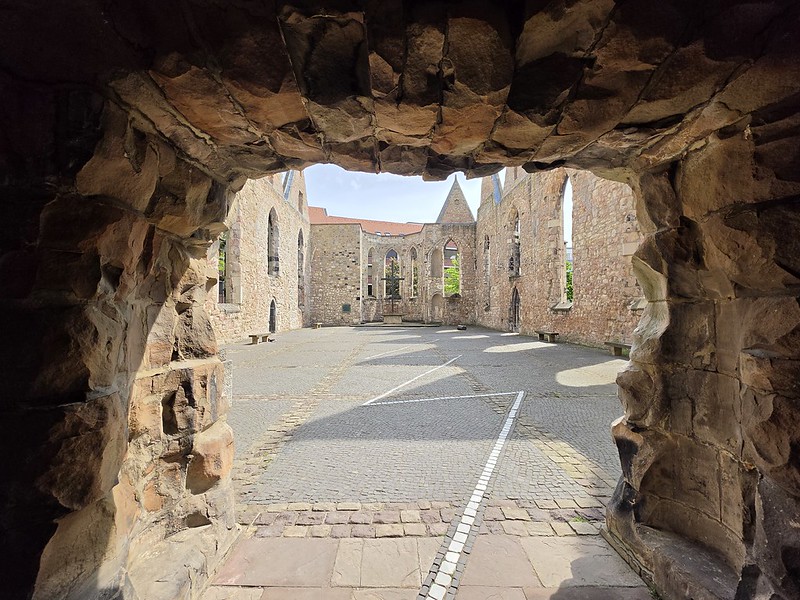
The Aegidienkirche probably began as a small chapel in the tenth century, though it wasn’t until 1163 that a three-aisled Romanesque church was formally documented at the site, mentioned during a court feast of Henry the Lion (c.1129-1195). The Gothic building that most people would have known was begun in 1347 and dedicated to Saint Giles (or Aegidius), one of the Fourteen Holy Helpers.
Hanover’s sixteenth century Reformation began in the Aegidienkirche giving it some religious significance. The church then went through the usual cycles of modification that such religious buildings do. Between 1703 and 1711, the steeple received a slightly decadent Baroque facade designed by Sudfeld Vick, and then between 1826 and 1829, Georg Ludwig Friedrich Laves remodelled the interior to modernise matters a little, with the introduction of cast-iron columns in the nave. By the beginning of the twentieth century, the Aegidienkirche was one of the three great churches of Hanover’s old town.
On the night of 8 October 1943, over 500 British Royal Air Force warplanes conducted an aerial bombardment of Hanover and the Aegidienkirche was effectively destroyed in the raid with the only the blackened shell remaining standing. The Aegidienkirche wasn’t alone, the other two great churches, the Marktkirche (Market Church) and Kreuzkirche were also destroyed.
In 1952, nine years after the bombing, the decision was made to preserve the ruins rather than rebuild. The church became an official war memorial dedicated to the victims of war and of violence. The Marktkirche and Kreuzkirche were rebuilt, but this one feels so much more powerful because of the visible reminders of the Second World War.
The site was reasonably busy when I visited, although there were moments of peace and quiet which gave time for contemplation. Certainly one of the most powerful reminders of the Second World War in the city and it was worth the little meander to go and see it.
Enfys was one of the entrants that I interviewed before the Hunnypot 100 and she kindly agreed to answer some questions about her experience of the whole hot 100. Enfys reached checkpoint 8, a considerable achievement in itself with the heat.
Q. What are your main memories of the Hunnypot 100?
A. My main memories of the Hunnypot are the heat. That made this event so incredibly challenging, as just two days before I had been on the beach in 12-degree weather with hailstones pounding down on me. The contrast was crazy. Other than that, I’ll remember the volunteers keeping me cool and taking the time to play Pooh sticks, which I lost.
Q. Along with over half the entrants, you retired during the event. Was it mostly heat related for you?
A. It was definitely heat related. My feet had blistered, as had my back, with more hot spots coming. I had to make a choice between finishing early on a high, having completed an excellent route with a medium amount of blistering, or finishing like last year, when I was in tears from the pain. I chose happy and satisfied, with wonderful memories.
Q. Which part of the walk did you enjoy the most?
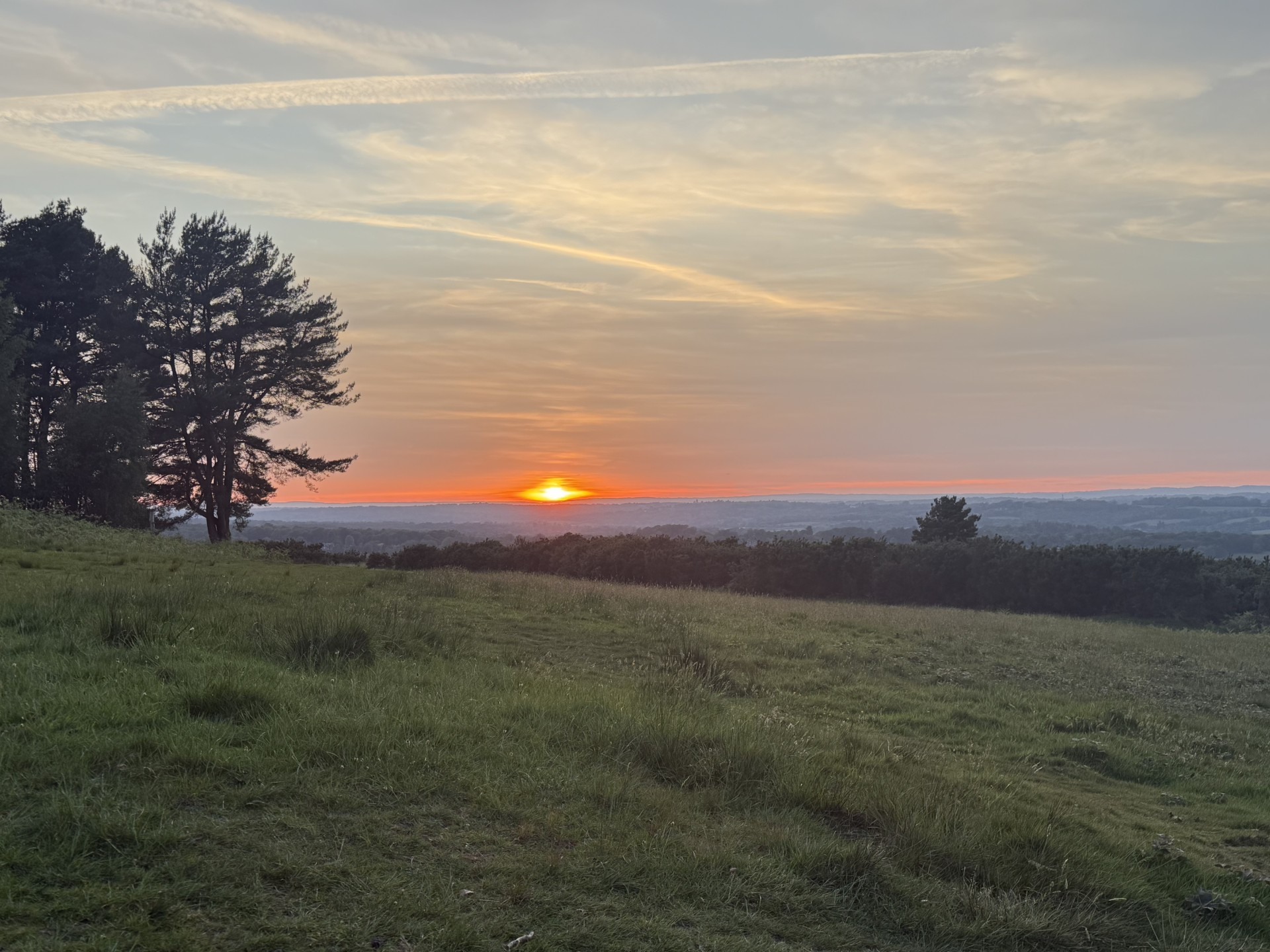
A. The route delivered picturesque villages, shaded woodland and some lovely hills. My favourite part was climbing the hill from Pooh Bridge just as the sun was setting.
Q. Will you be doing it again? Or is it too early to say?
A. Of course I will be doing it again, it’s so much fun. In 2027 I’m taking a year out to do some events that I normally can’t do, as I prioritise the Hundred. However, in 2028 I will be back and can’t wait to get on the paths in the place where my long-distance walking began.
Q. Do you have any suggestions for organisers of future LDWA 100s?
A. The organisation and volunteers on the Hundred are unmatched. However, I would be interested to know if it is logistically possible to move event start times forward in the future, if we encounter another hot event.
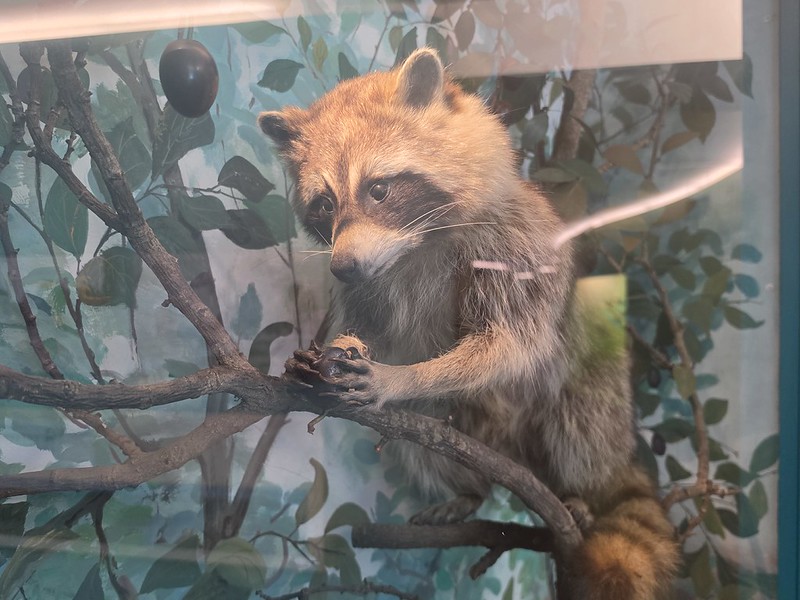
This is a stuffed raccoon, but I was more interested in discovering that the Germans call it a Waschbär, which translates directly as ‘wash-bear‘ which I find is really rather lovely.
A raccoon is a raccoon because English borrowed the word from the Powhatan people of Virginia, who called the animal ‘aroucoun’ or something similar. By the time anyone thought to ask what the word actually meant or whether it was entirely optimal, the Powhatan language was largely gone, and ‘raccoon’ just meant the mask faced thing that raided rubbish bins.
The Germans, by contrast, encountered the animal later and through a different route, mostly through trade goods, specimens, and the general European obsession with cataloguing the natural world. When they needed a word, they didn’t borrow from anyone. They looked at what the animal actually does. Raccoons are notorious for their habit of wetting their food before eating it, dunking things in water and washing their little paws compulsively. So someone decided that was definitely a wash-bear or ‘Waschbär’. Problem solved.
Although the initial theory falls apart here, as it has since been discovered that raccoons aren’t washing their food, they’re making it wet as that enhances their sense of touch. Anyway, I think it’s the right name for the wrong reason, but there’s something honest about that. And, once again, I think I need to get out more rather than thinking about why the Germans and English have different words for an animal.
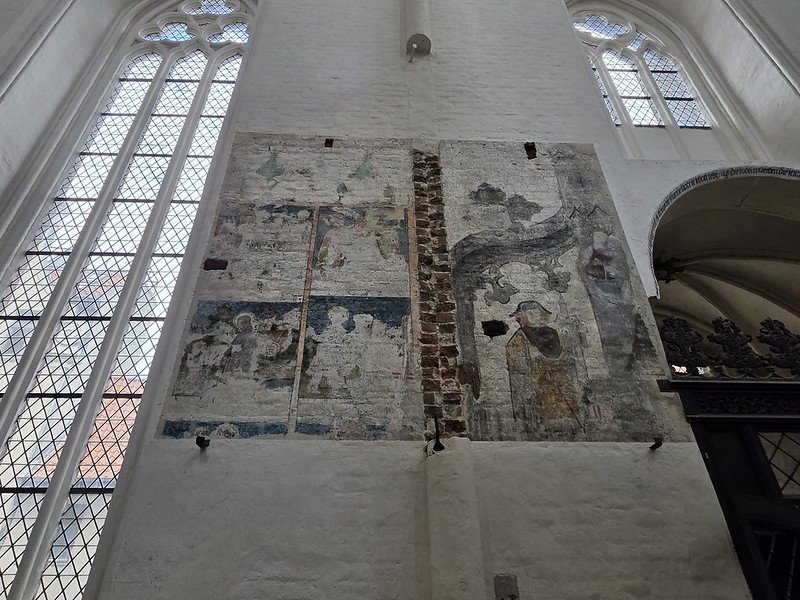
St. Catherine’s Church in Lübeck is no longer a church, which has provided a different dynamic in terms of the visitors, they are there now to see a museum. These wall paintings were made in the fifteenth century for a very specific kind of looking, the distracted, devotional gaze of people kneeling in prayer, or walking through during services, or simply existing in a space that was meant to remind them of their faith. St. Jacob the Elder was painted at monumental scale, surrounded by scenes from his life, the Virgin Mary and Child positioned where they would draw the eye during worship. The paintings were functional and told a religious message.
Now they hang, mostly fragmentary, revealed during restoration but still incomplete. Instead of being part of the furniture of devotion, they’ve become art objects and things that I can take photos of without worrying about interrupting anyone’s private prayer. Maybe there’s something a little sub-optimal about the arrangement now as the paintings were made to be part of a living, functioning space. They were meant to compete for attention with real people and with a real purpose.
In my attempt to find meaning in everything, including things where there likely isn’t much meaning to be had, this evolution of important messaging to a rather pretty piece of history is rather appealing to me even if I can’t really work out much of the faded image.
This is the fifth podcast (yes, I know the fourth might come after the fifth, but successful podcast editing comes in many forms and the strategy is not always necessarily linear or defensible…..) in the series as part of a trial and apologies that it has taken some time to get the season continuing! There will now be an episode every two weeks so that’s something to look forward to with some cautious optimism.
Firstly, this episode had serious technical issues from my end and so apologies it doesn’t quite flow right and the audio quality from my end isn’t perfect. But this is part of practising these and getting better. I was very fortunate in having an interviewer as helpful and personable as Andy Kind, he was a delight and very tolerant of my faffing about which at times was reaching professional standards.
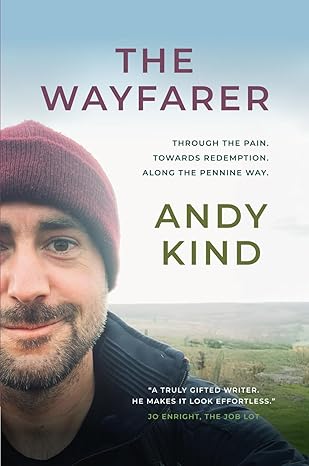
Andy is a comedian and a preacher, he’s written a number of books which include Stand Up and Deliver, which is about his experiences of entering the world of stand-up comedy. He then wrote the Wayfarer, a book about Andy’s walk along the Pennine Way. It’s written in an informal manner which is humorous and is very much based on the characters he meets along the way. These adventures are good for the soul and reading Andy’s book made me want to start doing more long distance trails in the UK. He reminded me of the people you can meet along the way, which is one of the great joys of walking, assuming they are not blocking the only available bench.
Very many thanks again to Andy for his patience, good humour and willingness to endure my technical shortcomings. Sorry that listening to me is even more challenging than usual, but at least this episode proves that the podcast is improving in the most traditional way possible: by making mistakes in public.
This is the third podcast in the series as part of a trial and apologies that it has taken some time to get the season continuing! There will now be an episode every two weeks so that’s something to look forward to 🙂
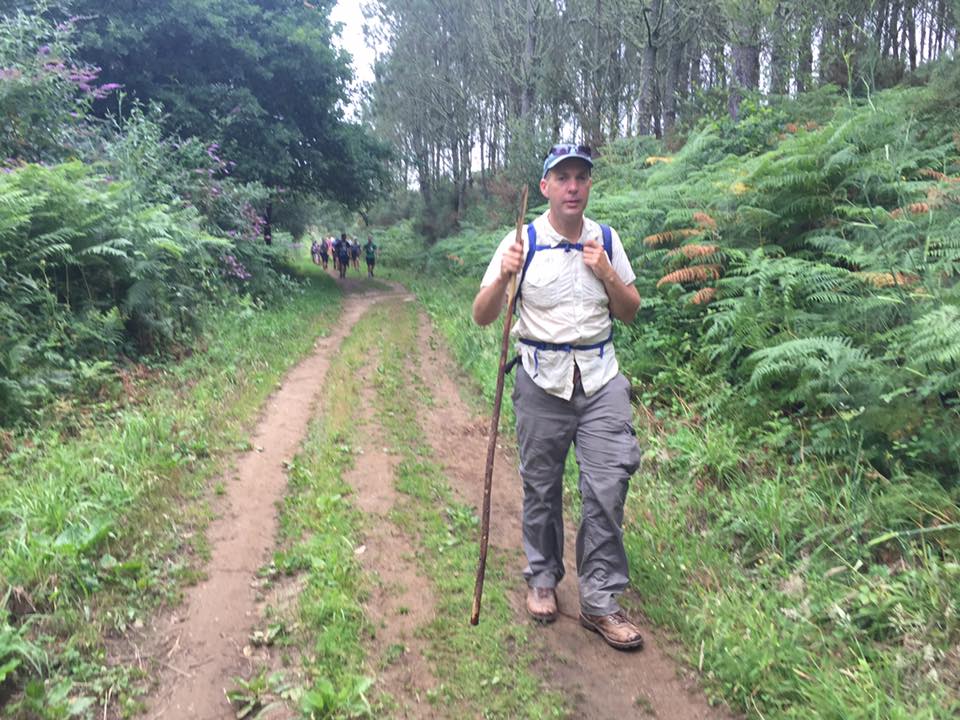
This episode is with Jonathan Smith, an experienced traveller who has visited over 100 countries and has meandered along long distance paths across the world. There will be more interviews with Jonathan, but we started with Caminos in this episode.
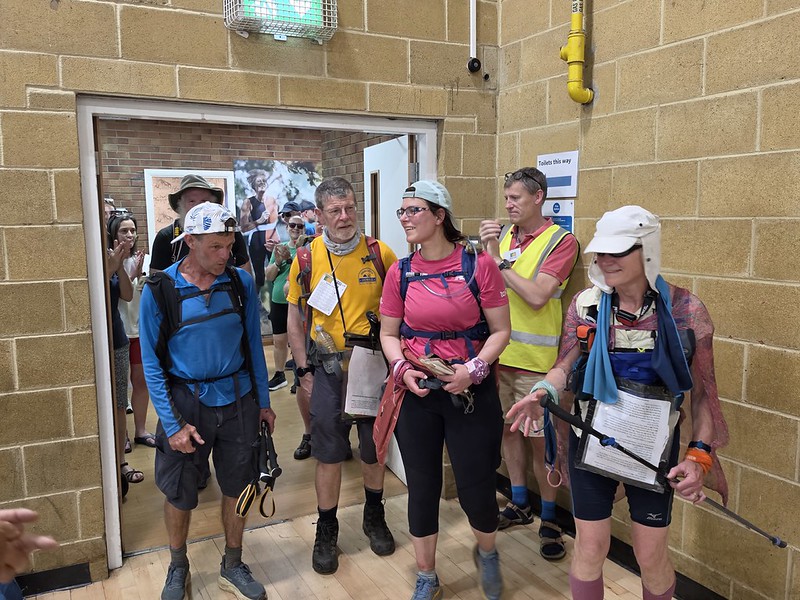
Huge congratulations to Fiona Gosling, Adrian Gosling, Alan Gray and Alzbeta Benn, who were the final four entrants to come back in. They were within the 48 hour time limit and their achievement is astounding, to walk for that length of time and in those extremely hot conditions is pushing the human body to what it can achieve.
To have the willpower to carry on with the requirement not to be timed out during the event is amazing. Heroes I tell you…… To come in at that point, still moving forward after everything the event had thrown at them, was a wonderful and rather humbling sight.