Neil, one of those entrants who has been inspired by me (but I don’t go on about it other than in conversation, writing and most available public forums) didn’t make it this time round as the heat was just too much. But he was very brave and in typical Neil style, he was full of positivity and remained upbeat.
It’s Sunday morning at 08:00 and I’m getting ever closer to Kent, but I’m informed that we’ve now reached 150 retirements so far. The total number of retirements last year in Norfolk & Suffolk was 114, so the heat and hills seem to be having some impact on entrants.
But well done to everyone who has taken part and good luck to those still on the walk. So very brave…
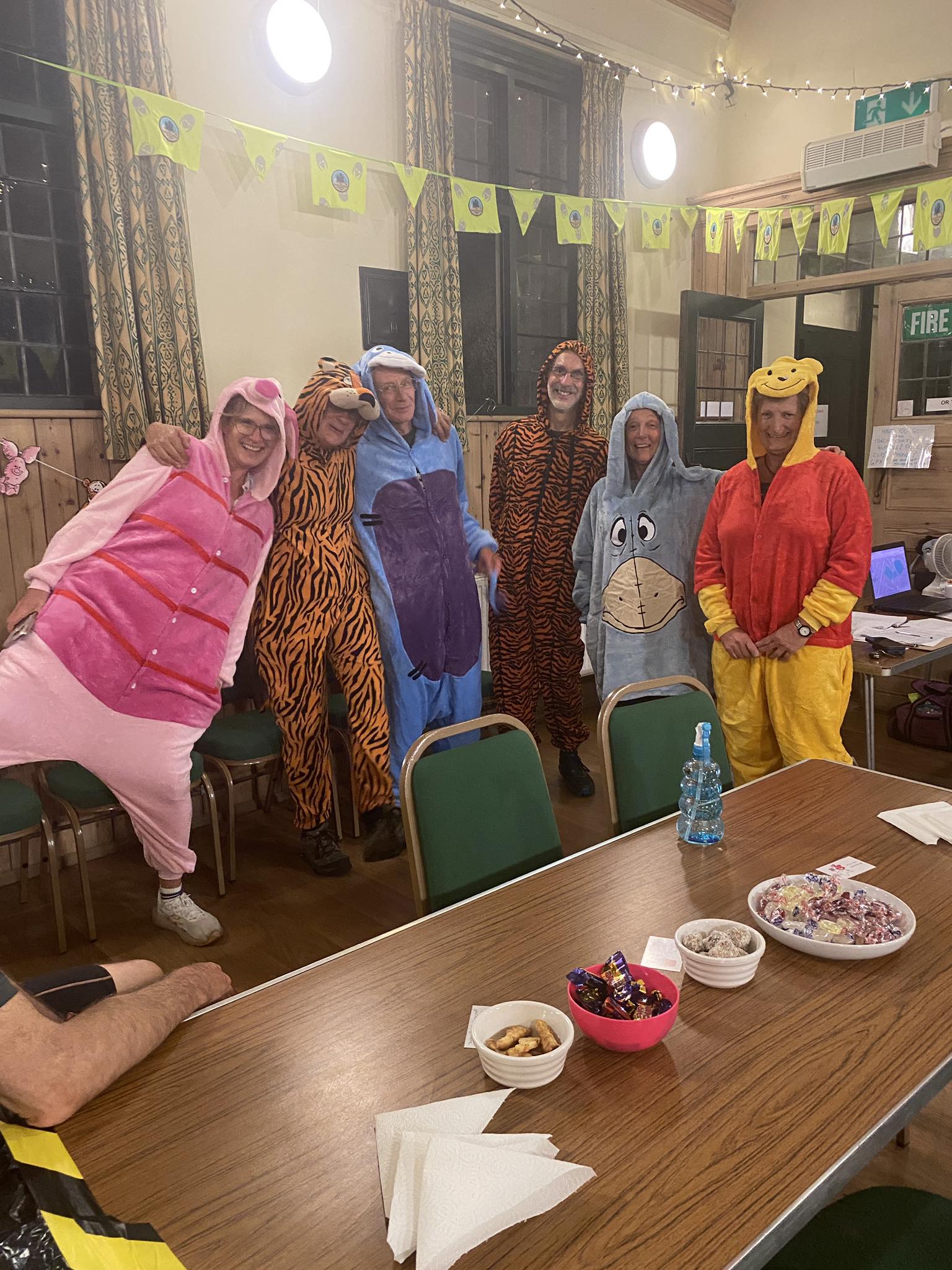
A photo from the always understated Pam, this is the Norfolk & Suffolk checkpoint. My eye is first drawn to the chocolates at the front and the Cheesy Feet that Chelle makes, which helpfully distracts me from this entirely unnecessary frivolity from Jane, Michael, Yvonne and Hilary amongst others…. But I won’t say anything.
There are a number of interviews with entrants of the 100 at https://www.julianwhite.uk/ldwa-100/ with more coming, but I thought that I’d summarise some of the interviews that have been received so far. And add my own commentary of my 100 in 2021 which I of course hardly mention….. This is the second summary of the interviews, with the first here.
Hundred miles, many sandwiches and the quiet heroism behind the Hunnypot 100
The LDWA 100 is, on paper, a walking event. In practice it is also a test of sleep deprivation, footcare, navigation, catering, human kindness and the ability to make sensible decisions after the point at which most people would have taken a taxi, booked a hotel and reassessed their life choices. The interviews with Helen Strong, Guy Evans, Anne Wade and Annette Merchant show the 2026 Hunnypot Hundred not just as a long-distance challenge, but as a huge collective effort by walkers, organisers and marshals.
Helen Strong, LDWA General Secretary and a Kent Group committee member, has been closely involved with the organisation of this year’s event, including as Entries Secretary. She described a year of work involving qualifying event records, SiEntries pages, cancellations, the waiting list, tally cards, trackers, joining instructions and registration volunteers. It is a reminder that a 100 begins long before anyone reaches the start line, although naturally some entrants may assume it has all emerged by magic, perhaps from a spreadsheet-bearing woodland creature. In reality, the application to hold this 100 was received by the LDWA’s NEC in 2019, so this event has been seven years in the planning. Helen said the organiser’s side had shown her that “there are many elements that need to be perfect, but a few elements which do not”, adding that while many entrants had been appreciative, some messages had come from people with “absolutely no idea what is involved”.
That unseen work is a theme picked up strongly by Anne Wade, the LDWA 100s Coordinator on the NEC, who has herself completed 22 hundreds. She said that local groups face major challenges in finding a suitable HQ, parking, catering facilities, changing rooms, volunteers and the long lead-in time needed to make the event happen. For entrants, she said, the two most important things are “the route and the food”, which is perhaps the most LDWA sentence ever constructed. The route needs to be scenic, interesting and maybe not too cruel in the final quarter, while the food needs to be plentiful, varied and available at exactly the moment a walker begins to view custard as a major philosophical necessity.
Anne and Helen both walked the marshals’ event, and their comments suggest that the Hunnypot route will be beautiful, varied and rather more demanding than anyone hoping for a gentle wander through Kent might have wished. Anne praised the “views and variety”, including fields, forest, heath and down, but also remembered the night section when rain and fog made route-finding harder and the descent to Kemsing followed by the climb back up felt especially challenging. Helen was even more direct, warning that the Kent landscape is “hilly – both slow climbs and steep ones”, with the Greensand Ridge and North Downs combining to produce a final section she described in one word, namely “Brutal.”
Guy Evans brings the perspective of an experienced entrant who has already completed four LDWA 100s and still, with an admirable lack of self-preservation, wants to keep coming back. He described the event as “iconic” and praised its “understated, unpretentious, laid-back, friendly atmosphere”, saying it has a very different feel from other ultra events. His journey into the 100 also carries the familiar LDWA logic of escalation: family walks led to long-distance events, then 50s, then the thought that he would do just one 100 because “only mad people walk a 100 miles”. He now wonders whether a 100 is enough, which suggests the madness has settled in nicely and should no longer be disturbed.
For Guy, one of the secrets is not thinking about the full distance. He said the lesson from his first 100 was simply to think about getting to the next checkpoint, adding that “a very large part of finishing is mental not physical”. His advice to first-timers is rooted in that same approach which is namely do not overthink it, know your reason for doing it, remember that lows pass and smile even when you do not feel like it. There is a lovely understatement in his description of the later stages, where the event is 70 or 80 per cent complete, the walker is tired and the end still feels distant. His wife might call what keeps him going stubbornness although he prefers determination, which is the same thing with better publicity.
Annette Merchant offers another essential perspective, having been involved with the hundred since the 1994 Dartmoor event and describing Hunnypot as her 30th hundred. She first became involved because her husband Les was entering the events, but over the years the annual gathering of walkers and marshals became something she wanted to keep returning to, even after Les died in 2020. She said she realised early on that a checkpoint could “really make a difference”, especially for mid-paced and slower walkers trying to complete the event. That is the practical heart of the 100 which is tired people arriving at a hall, sometimes in the small hours, needing food, reassurance, sympathy and possibly to be protected from their own rash decision to sit down for too long.
Annette’s view of checkpoints is refreshingly practical. The hall needs space, the kitchen needs the right equipment, the food needs to match the facilities and walkers should not have to queue when what they really need is to change socks, sort gear and be gently encouraged back into functioning humanity. She said marshals need to understand how walkers feel, be “prepared to have a joke” and be sympathetic when people are nauseous or fatigued. She is also careful about retirements, saying that a potential retiree’s tally is not taken until they have stopped, eaten, drunk, rested and still decided to retire. No point rushing these decisions….
Food, inevitably, runs through all four interviews with the emotional force normally reserved for major family events. Anne says LDWA walkers are “powered by tea and fuelled by cake” and Helen says food is critical, though on the marshals’ event she relied heavily on her own sweet snacks, savoury food at checkpoints and an uncharacteristic fondness for full-fat Coke. Annette argues for a good mix of sweet and savoury, not too much in any one portion and enough variety to suit people arriving at very different times of day. In the civilised world this is called catering; on a 100 it is morale, medicine and emotional support in edible form.
Taken together, the four interviews present the Hunnypot 100 as something much richer than a long walk. It is a demanding route through Kent and Sussex, a logistical exercise, a community reunion, a test of personal resolve and a tribute to the volunteers who keep smiling even when they have had very little sleep. Helen is looking forward to visiting the checkpoints by car after completing the marshals’ event, which may be the most sensible aspiration expressed in the entire set of interviews and might be something that Richard and I do this weekend.
Guy remembers the moment around mile 90 when a walker knows they are going to finish. Anne reminds entrants to eat from the first checkpoint because they cannot run on empty. Annette says marshalling should be treated as “a social event, a weekend away with friends and like-minded people, helping colleagues to succeed in a significant challenge”. That may be the best summary of the LDWA 100, an unreasonable distance made possible by very reasonable people.
To my disappointment, other things meant that I can’t get to the LDWA 100 in Kent (more information about that at https://www.julianwhite.uk/ldwa-100/) until Sunday morning. However, as of Saturday evening, there have been a fair number of retirements which is not unexpected in the extreme heat that is out there. I’ve heard that checkpoints have been offering huge amounts of support, lots of liquids and a place in the shade.
The tracking for this event is at https://track.trail.live/event/hunnypot-100 and I hope to be posting a fair amount more over the next 36 hours about the event. So many brave entrants….
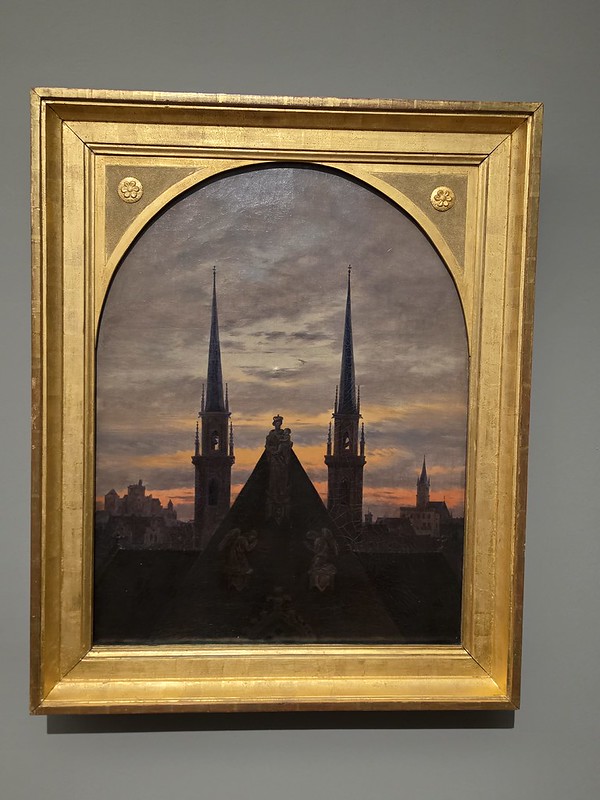
There’s something rather appealing to me, in that way that I should really get out more, about a painting of a place that doesn’t exist. Carl Gustav Carus (1789–1869) painted “Stadt in Abenddämmerung”, of City in Twilight, in around 1845, and the curious thing is that he didn’t bother painting an actual city at all. This is an invention, a vision of a medieval town silhouetted against a dusky sky, with the slight twist that this painting has now ended up in Lübeck, which has a cathedral and a church with twin towers.
Carus had studied Gothic architecture in England in 1844, and what he created here was an imaginary artwork, a greatest hits of medieval German architecture assembled from memory and imagination rather than from life. It’s all a bit sub-optimal that it’s not real and I think that I’d be annoyed to have a painting of something that didn’t exist. Carus was an interesting character though, he painted Romantic scenes and he ran a maternity hospital, which feels like a rather ambitious use of his lifetime. He’s become quite controversial due to some of his writings about race, which I accept is something rather more important than drawing a fake church…..
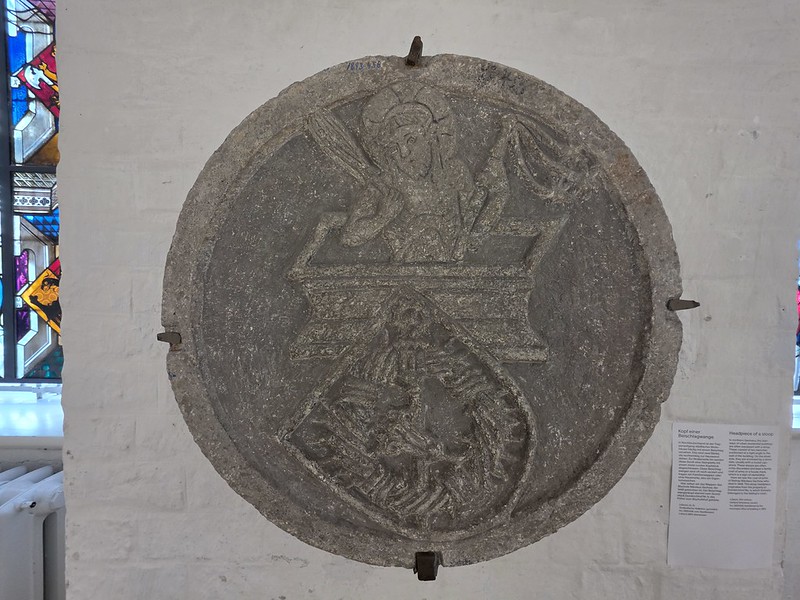
In the prosperous merchant towns of northern Germany, status was displayed not through grand façades, although those came later, but through elaborate architectural fittings attached to residential buildings. The stoop, or Beischlagwange, was one such statement of intent, and I find the whole arrangement rather intriguing although I must admit that I thought it was a manhole cover at first such is my architectural prowess.
A stoop consisted of two benches positioned at a right angle to the building’s wall, creating a small gathering space where the street met your home. The benches were typically enclosed by a stone slab on one side, often richly decorated with heraldic coats of arms or the symbols of a building’s owner. To sit on someone’s stoop was to acknowledge their status in the town and to commission an ornate one was to announce it loudly. So my friend Richard would have a very big porch, whereas I wouldn’t want visitors and I wouldn’t.
The stoop in the photo above dates from the fifteenth century and comes from a merchant’s house in Lübeck, originally belonging to the family of Bishop Nikolaus Sachow. It’s modest enough now, removed from its original context and mounted on a museum wall, but I find myself rather drawn to what it once represented.
The example above is how this whole arrangement might have worked, a little bit of decadence….
After a slightly sub-optimal rail journey from Lübeck to Hamburg, I had a thirty minute wait before taking another train from Hamburg to Hanover.
I haven’t been to Hamburg for some years and I’ve forgotten whether I ever visited the railway station, but it feels modern and functional.
The station was busy and lacking in obvious seating, but at least my train was operating nearly to time.
The 21:28 was my train and it was a joint service between the Swiss and German rail networks. I was a little confused as it was stating that NJ741 required a reservation and IC60471 didn’t, but it transpired that reservations were only needed for those crossing over into Switzerland. As reservations were around £5 on top of the ticket, I hadn’t bothered getting one as I like a little uncertainty in life.
I did wait in the queue to ask the Deutsche Bahn information desk about the reservation system, but they were overwhelmed and understaffed so I gave up after around ten minutes.
The train arrives which was a promising development for those of us who had invested emotionally in whether we had a seat.
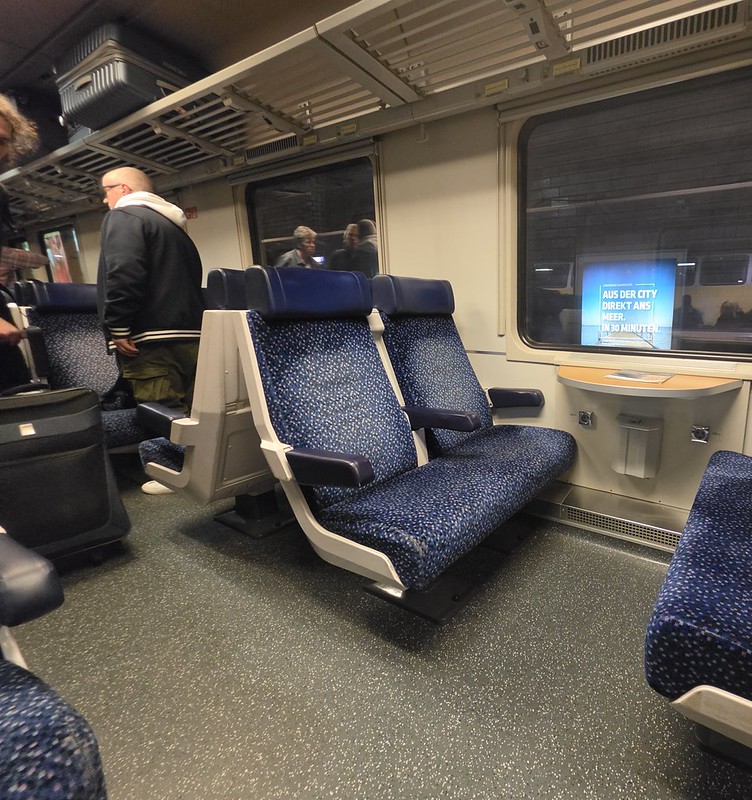
I had wondered if I’d get a seat as I hadn’t reserved a ticket, but I found this seat by a table and power point, so I was content and felt that I was in a civilised location.
These two seats were reserved and they changed hands over ten times as there was chaos with people confused over reservations. I didn’t much care, I had my seat, but the system is clearly flawed somewhere.
I felt that the reservation system was clear, but there we go….
There was a family of four here and I was quite worried as they, along with half the carriage, were told off by the guard and had to pay more. I don’t know what was happening, maybe they had the monthly pass that was for regional trains only. I showed my ticket and the guard looked pleased, so that was a relief as there are few pleasures in life greater than being judged administratively adequate by a German train guard.
And safely in Hanover, the first time that I’ve visited this city. All told, I was very pleased with the whole journey, the train was clean, the service was friendly, the ticketing was clear and I was very happy that Deutsche Bahn got me in on time. It wasn’t the cheapest ticket at around £20, but that wasn’t unreasonable. After the earlier journey between Lübeck and Hamburg, arriving in the right city at the right time and with no need to sit on a staircase felt almost decadent.
This interview is with Annette and although she’s completed an LDWA 100, she has some interesting perspectives from a view of being an event organiser and marshal.
Q. Could you briefly introduce yourself and say how you came to be involved with the LDWA?
A. I am Annette Merchant, I became involved with the LDWA when my husband, Les, started walking the annual hundred mile challenges in 1985. Initially I left him to do the event, but when Cornwall and Devon group hosted the 1994 Dartmoor hundred, I got involved in the organisation of the event and then started to marshal at the C&D checkpoint, going to Marches in 1995 where we did breakfast at Clun. I have been involved every year since. The Hunnypot will be my 30th hundred.
Q. You’ve been marshalling hundreds since 1994. What has kept bringing you back to help with these events for so many years?
A. Initially, because Les was entering the event I wanted to be there to see him through our checkpoint and support him, but I made so many friends over the years amongst the other regular entrants and marshals that I looked forward to seeing them each year, both at the start and our checkpoint and then at the finish. So even after Les died in 2020, I found I wanted to keep coming to the hundred. Also, early on, I realised that we could really make a difference at our checkpoint, especially to the mid and slower paced walkers and their being able to complete the event which gives me huge sense of satisfaction.
Q. Cornwall and Devon group will be manning Ide Hill on this year’s event, which is around 75 miles in. What makes a good checkpoint from the marshal’s side?
A. We look for a kitchen with the right equipment matched to the food we are being asked to serve. Plenty of space, so that we can have drinks station and prep cold food away from the kitchen. A lobby for check in, a good hatch from the kitchen directly into the hall. A good amount of parking (quite a few of our marshals have campers for staying overnight before we open).
Q. What do you think walkers most need from checkpoint teams when they arrive tired, hungry or beginning to wonder whether sitting down was a tactical error?
A. They need to be able to concentrate on themselves, changing socks, sorting gear, head torches etc., not queue for food and drinks. They need marshals who can understand how they are feeling and can encourage them, prepared to have a joke, but sympathetic and helpful if they’re feeling nauseous or fatigued. The food needs to be appetising and easily eaten when they are likely to be dehydrated and finding it difficult to get food down.
Q. You’ve been involved in organising four hundreds, including the 2027 Jurassic 100. What are the biggest things that need to come together behind the scenes to make a 100 work well?
A. The people dealing with each of the main aspects – Route, HQ, checkpoints, catering and transport need to communicate and work together to ensure that the route is safe and passes through checkpoint locations at appropriate distances. That the food provided matches the facilities available at the halls and the halls can provide the appropriate food needed at that point (hot, cold, etc.) Transport needs to be able to deliver food and equipment to checkpoints efficiently and try to minimise retirement waiting times. They all need to work together, along with the communication on the day.
Q. From an organiser’s perspective, what are the details that entrants might not notice when everything goes smoothly, but which make a huge difference to the event?
A well written route description, providing the right food in the right places. Marshals that are sympathetic and understanding, especially in the latter stages. Providing information to supporters.
Q. You’ve attempted two hundreds and completed one. How has being on the walking side helped you understand what entrants need from the organising and marshalling teams?
A. Having retired on one and seen Les retire on a few hundreds, I understand how you can feel as though you just can’t go any further but can regret the decision within hours of making it. That is why we never take a potential retiree’s tally until they have stopped, had some food and drink and rested for a while and then still decided to retire. I also know the euphoria of having completed and how all the bad bits of the walk fade quickly, which makes me want to help those that are struggling at our CP to achieve that and have that feeling of euphoria.
Q. Food can become rather central on a 100, sometimes with the emotional weight of a major life decision. What do you think makes good checkpoint food on an event of this length?
A. A good mix of sweet and savoury. Not big portions. Some checkpoints are open for a long time a CP could be lunch for one person and evening for another, so versatile food with different options for different tastes.
Q. What advice would you give to entrants taking part in their first 100?
A. Don’t get swept up into walking too fast at the beginning, walk at a comfortable pace that you can keep up for hours at a time. Don’t be overwhelmed by the whole distance, just concentrate on getting to the next checkpoint. Have target times for arriving at each checkpoint to help you keep your pace, but don’t let them rule you.
Q. What would you say to someone interested in marshalling LDWA challenge events?
A. You need to aim to have fun. Treat it as a social event, a weekend away with friends and like-minded people, helping colleagues to succeed in a significant challenge. The camaraderie and atmosphere is amazing.
Q. Finally, tell us what entrants can look forwards to at the Jurassic 100 in May 2027.
A. Some fabulous walking along the Jurassic coast, with a mix of riverside, common and countryside walking and some lovely Devon villages. There will also be some great food and plenty of encouragement from their LDWA colleagues.
Our fourth game was away to the Red Lion in Coltishall and they’re a new venue and a new team to the league. I’ve also never been to the pub before and I really liked going somewhere new, so I’m all in support of having more non-Norwich venues in the league. Or at least I was until we lost heavily, at which point my commitment to rural expansion became rather more nuanced.
Still, I suppose I had better write about it so I do not look like a bad loser, which is important because I am obviously a gracious and reflective loser, provided nobody mentions the score. Many thanks to Luke for getting me to the pub safely and nice and early, so we could have a proper look at their table and begin forming opinions that would later prove tactically irrelevant.
The table is up against the wall which is an interesting location in quite a large room, although I quite liked making shots whilst having a little sit down on the window ledge. Bar billiards is a sport of immense physical endurance, so it is important to conserve energy wherever possible, ideally before missing. Here’s Luke getting warmed up for the big event.
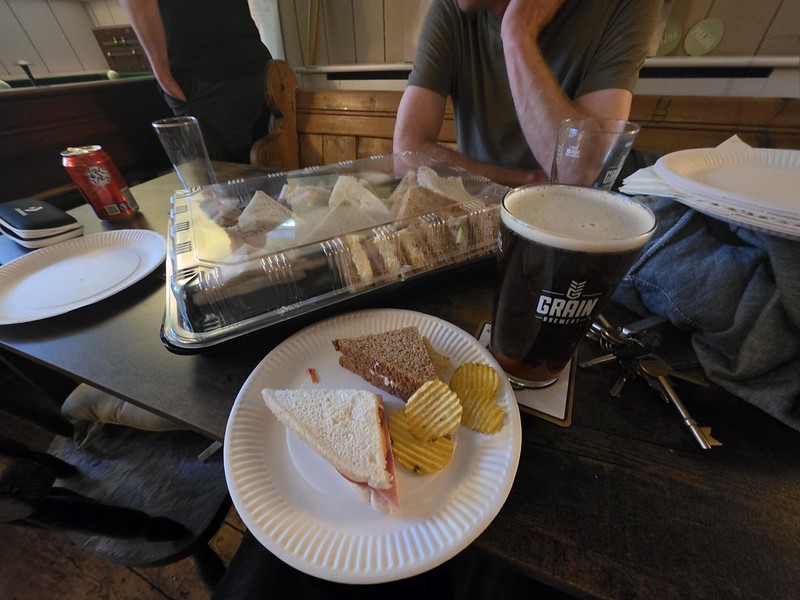
I had a practice with the final game shot and then had a sit down with a pint of ThreeOneSix from Grain Brewery. This was a fruity, hoppy and slightly toffee flavoured beer, all very agreeable.
Here’s Luke and a lion. Luke’s on the left.
The anticipation before the draw.
And the completed draw, what could possibly go wrong? We soon found out in the rather comprehensive way that someone might discover a roof leak during a thunderstorm.
PJ and Vaughan started us off and let’s just say that we lost the first two games.
The Red Lion kindly provided us with some free sandwiches and when they were placed down I pretended that I wasn’t desperate to start eating them. I waited for a reasonable period, I think around twelve seconds, and started in the hope that no-one noticed. I tested a lot of these on behalf of the team as leadership comes in many forms and this week it involved bread.
It was a friendly pub and they had three real ales available, with the two I tried being well-kept. This was a decent distraction during the controlled demolition process taking place in the bar billiards room.
The set-up requires some short cues….
My second beer was the Best Bitter from Grain, malty and good with my third helping of sandwiches.
Luke the Lion won his game, I didn’t doubt him. That brought it back to 3-1 and it was me up next against Jon. My normal tactic of getting to 1,000 was a success, indeed, I got 1,260. Unfortunately, Jon scored 1,710 so that tactic didn’t bring us to 3-2.
It’s evident that my enthusiasm towards this blog must have waned, this was my only other photo of the game. We lost quite a few of the games after Luke’s success. Well, actually, all of them. Bloody game….
Luke and I have no further statement to make and we will not be responding to any further media enquiries about the situation.
But back to the pub, which is a really quirky shape with lots of character across a couple of different levels. The staff were friendly and many thanks for the beer choices, the free sandwiches and the welcome. The Red Lion team led by Tom were also great fun and it was a very enjoyable evening out. Well, quite enjoyable, that score was sub-optimal.
But, from failure comes strong leadership and we hope to lose by less when we play the King’s Head next week in the cup.