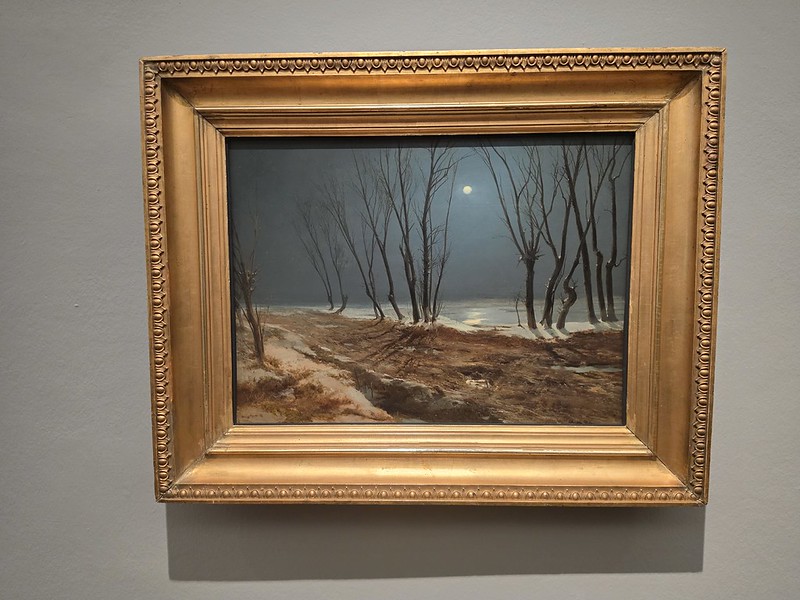
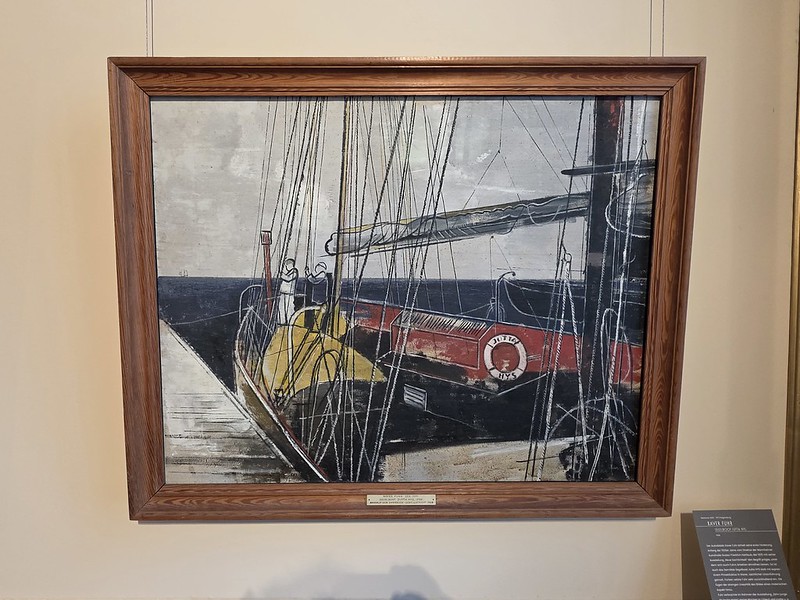
This artwork is by Carl Blechen (1798-1840) is perhaps a much easier painting to like than Xaver Fuhr’s tense little sailing boat. There is moonlight, snow, bare trees and a winter road disappearing into the distance, which is the sort of arrangement that is easy on the eye. Painted in 1829, it belongs to a much older Romantic tradition in German art and Blechen’s work represented a style that the Nazis were far more willing to absorb into their own cultural story. Unlike modernist painters such as Fuhr, whose work was treated as suspect, degenerate and politically dangerous, a winter landscape like this could be understood as rooted, traditional, solemn and apparently unthreatening.
Some of Blechen’s works were intended to be displayed at the Fuehrermuseum and if the Nazis had won the war, this is precisely the sort of scene that would have had pride of place in their national museums. The artist’s life was actually quite traumatic and he had serious mental illnesses, not something that would have been entirely celebrated by the Nazi regime and I’m sure that they would have airbrushed that out from the narrative. Blechen withdrew from teaching in his mid-30s and died at the age of just 41. To my non-artist’s eye, I think that his artworks feel quite modern and timeless. And indeed, I should probably stop viewing these artworks from the perspective of 1930s and 1940s Germany, but there’s so often a story there.
The museum notes this as a work by Xaver Fuhr (1898-1973) that was part of the New Objectivity movement of artwork in Weimar Germany. The HYA is the Hanseatic Yacht School and it was painted in 1928. This is all noteworthy in its own right, but I find this period of German culture to be fascinating because of what was unfolding nationally, so I had a focus that was in a different direction.
Fuhr was inspired by artists such as Vincent van Gogh and Paul Cézanne, but he developed his own style and his artworks were not traditional Prussian heavy landscapes or paintings of heroic peasants. So, the Nazis hated him and labelled his work as degenerative art as they didn’t like things that might be culturally appealing. Between 1936 and 1945 he focused on watercolour painting that would be tolerated by the regime, although his studio in Mannheim was destroyed by an air raid in 1943 which I’m sure he considered as far from ideal.
Many of Fuhr’s works were stripped from museum and gallery walls, but his reputation was restored after the end of the Second World War. He became a professor at the Academy of Fine Arts in Munich and retired in Regensburg. And that’s what intrigued me, the artist behind this scared the Nazis because of that individual approach. It made me like the painting even more.
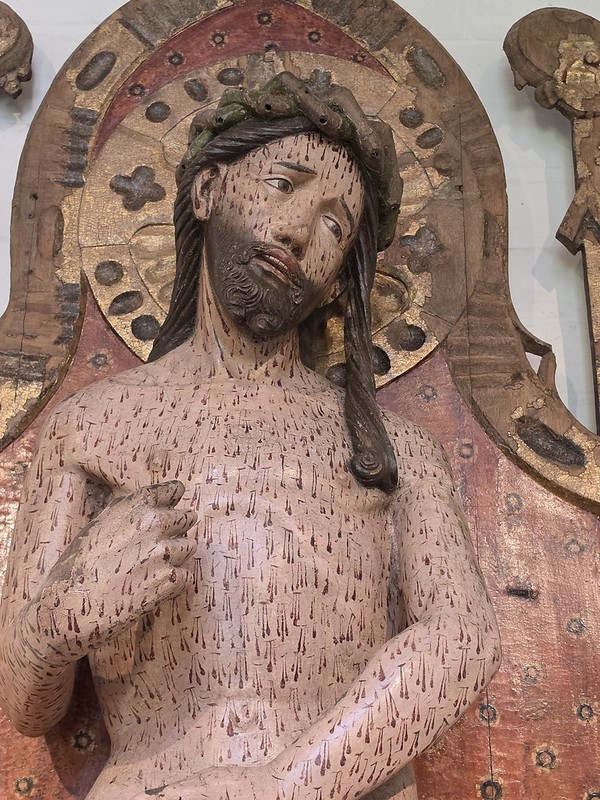
Well, this is a cheery little number. This carving of Christ in distress was made in around 1410 and it doesn’t give the viewer much room to hide. Christ sits exposed on a rock in front of a throne-like backrest, wounded, crowned with thorns and covered with the marks of the scourging. It was located at the Holy Spirit Hospital in Lübeck and that’s an interesting building in itself as it is currently a retirement home, but it dates to 1286 and is one of the oldest social institutions in the world. As an aside, it wouldn’t have been an entirely grim place despite it catering for the poor, sick and impoverished, as it was rooted in charity.
The missing hand once probably held a scourge, the instrument of Christ’s torment, and he does look quite annoyed here. Lübeck has many beautiful things, including a craft beer bar, but this is not beautiful in a simple sense. It’s deliberately difficult and I’m not sure what the residents of the hospital would have thought about the arrangement in the Middle Ages. I’m not entirely sure that it would have cheered me up or made me feel better if I’m being honest.
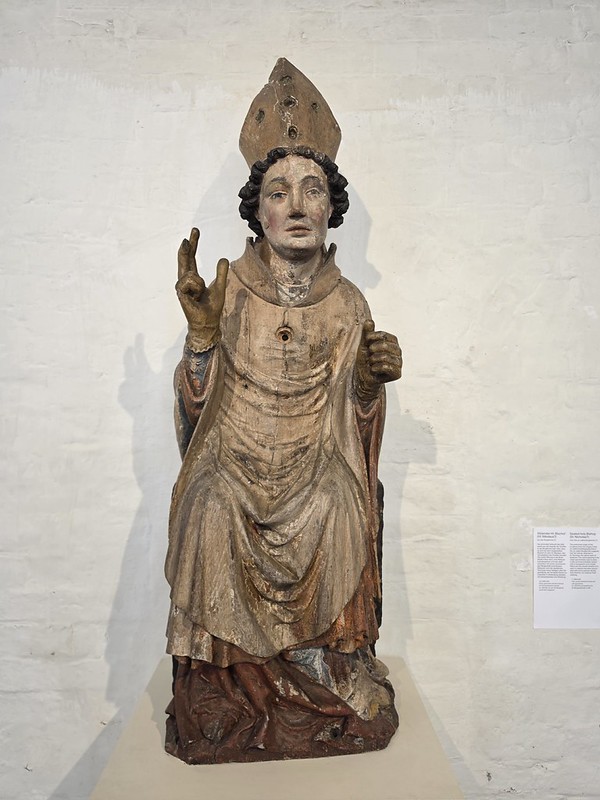
This seated holy bishop from Lübeck is one of those objects which manages to look both battered and quietly magnificent. It probably once formed part of the carved decoration at the Schiffergesellschaft (or the shipmasters’ guild) at the Burgkirche. The figure sits in full episcopal dignity, wearing a mitre and raising one hand in blessing.
In the period around 1380 to 1400, it was carved in oak and would originally have been much richer in colour, with traces of paint and gilding although that has mostly all gone now. I get intrigued by pieces like this because of their heritage and the journey that it has had through history. It’s thought that it’s probably St. Nicholas who is the patron saint of boatmen, although there’s some guesswork there.
The Burgkirche in Lübeck was the church of the Burgkloster, the former Dominican monastery. Unfortunately, and in a rather sub-optimal manner, it mostly fell down in 1818 and so it was thought best to demolish the rest. Bits of the building have survived, but it’s the surviving decorations and sculptures that almost feel the most authentic part of the whole arrangement now.
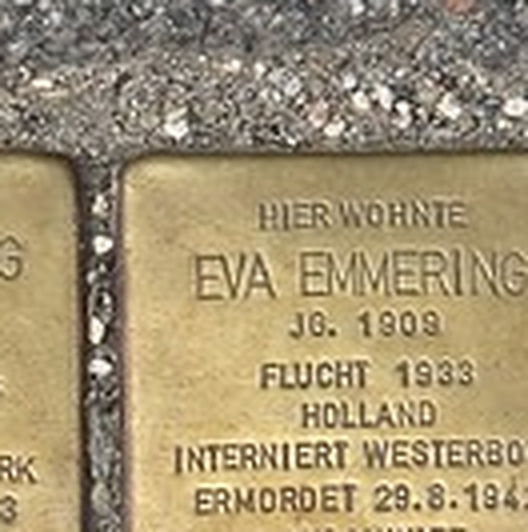
This is a group of three stumbling stones located at St. Annen-Straße 12 where the Emmering family lived and had their shop.
Eva Emmering was born in Lübeck on 27 October 1909, the youngest of Benjamin and Sara Emmering’s three children. Unlike her older sister Elena, who had been born in the Netherlands, Eva’s earliest life was directly tied to Lübeck and he attended St. Marien Girls’ Primary School from Easter 1916 until 1922, then St. Jürgen Girls’ Middle School, and took religious classes in the synagogue diagonally opposite her family’s home.
Eva became a sales clerk, while her brother Aron Adolf also entered commercial work and later ran his own business. After their father Benjamin died in 1932, Eva and Elena returned from Hattingen to Lübeck to support their mother, Sara, whose illness led to her admission to Strecknitz Mental Hospital. In 1933, Eva fled to the Netherlands with Elena, and by 1941 the two sisters were living in Amsterdam at Govert Flinckstraat 98. After what must have been a hugely challenging few years, Eva and Elena must have felt some safety in Amsterdam away from the Nazi horrors. Unfortunately, the invasion of the Netherlands put them in danger once again.
Eva was interned at Westerbork and deported to Auschwitz, where she was murdered on 29 August 1942. She was 33. The death certificates for both sisters recorded Auschwitz I, and the doctor who signed them was Johann Paul Kremer (1883-1965), notorious for his involvement in experiments on prisoners. I don’t think I want to know what happened there, this family suffered terribly over the years as it was. Kremer was sentenced to death for his war crimes, but it was commuted to a prison sentence before he was released.
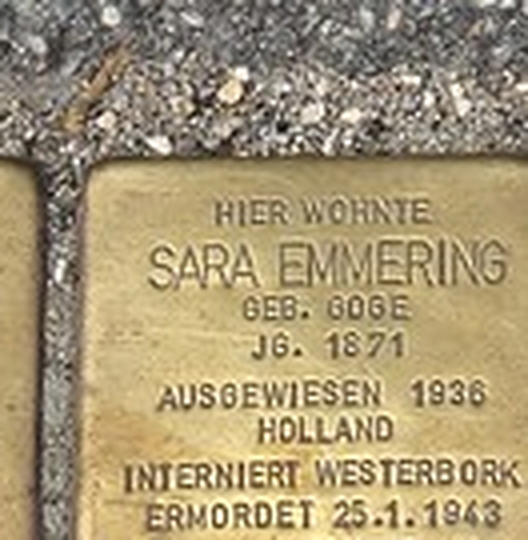
This is a group of three stumbling stones located at St. Annen-Straße 12 where the Emmering family lived and had their shop.
Sara Emmering, born Sara Goge, came from Moisling, now part of Lübeck, where she was born on 25 April 1871. She married Benjamin Emmering, a Dutch cattle dealer from near Groningen, in Lübeck in 1903, and through that marriage she and her later children became Dutch citizens. Sara and Benjamin eventually settled at St. Annen-Straße 12, where they lived with their family and ran a shop dealing in clothing, linen and furniture.
By the early 1930s, the family had already been shaken by loss. Benjamin died suddenly in September 1932 after long-standing heart problems, and Sara appears to have been seriously ill by then. She was admitted to the Strecknitz Mental Hospital, while the family home was rented out to fund her care. Her daughters Elena and Eva, who had been living in Hattingen, returned to Lübeck after their father’s death, but they fled to the Netherlands in 1933 following the Nazi oppression they suffered from. Sara remained in the hospital until 1936, when the Lübeck authorities declared her an “unwanted foreigner” and deported her to the Netherlands. The family home was then lost through enforced auction and it’s unlikely that they received anywhere near a fair price.
In the Netherlands, Sara was admitted under her maiden name, Sara Goge, to Het Apeldoornsche Bosch, a Jewish psychiatric hospital. After the German occupation, even that place of care was not spared from the Nazi hate. On the night of 21 January 1943 and into the following morning, the institution was emptied, the patients were beaten, forced onto trucks and then into cattle wagons heading for Auschwitz-Birkenau. Sara was murdered on arrival on 25 January 1943. She was 71.
“On the night of January 21–22, 1943, the occupying forces brutally evacuated Het Apeldoornsche Bosch. Over 1,100 patients and staff members were put on a transport to Auschwitz and murdered. On January 22 and February 1, another 282 people, including five pregnant women, were taken to Westerbork. Ultimately, only 21 people from these two transports survived the war.”
Without these stumbling stones, these stories might start to be lost and the individuals forgotten about.
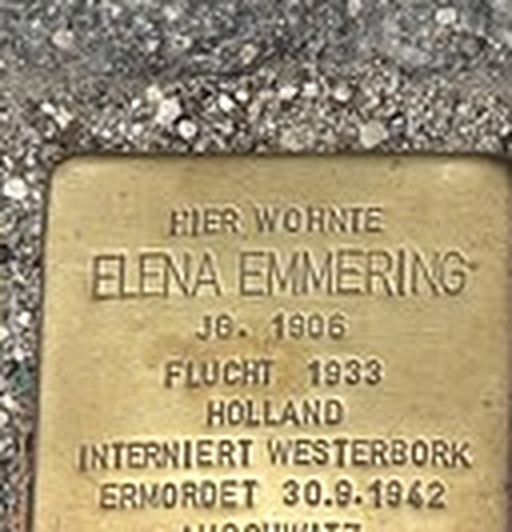
This is a group of three stumbling stones located at St. Annen-Straße 12 where the Emmering family lived and had their shop.
Elena Emmering was born on 25 August 1906 in op ’t Zandt, a village near Groningen in the Netherlands, but her childhood belonged to Lübeck. Her parents, Benjamin Emmering and Sara Goge, had married in Lübeck in 1903 and moved between the Netherlands and Germany before settling at St. Annen-Straße 12, where the family lived above and beside their business buying and selling clothing, linen and furniture. Elena, her sister Eva and their brother Aron Adolf grew up in Lübeck and their family became part of the local community. Elena moved to Hattingen with her sister Eva, but returned in 1932 after their father’s sudden death.
This was a difficult time for the family which was already marked by grief and illness as Sara was suffering from serious mental illness and was admitted to Strecknitz Mental Hospital, while the family home was rented out to help pay for her care. In 1933, as Nazi persecution intensified, Elena and Eva fled to the Netherlands where they thought that they would be safe. They later lived together in Amsterdam at Govert Flinckstraat 98, forced away from their home but trying to stay secure.
The German occupation of the Netherlands meant there was no lasting refuge. Elena was interned at Westerbork and deported from there to Auschwitz, where she was murdered by the Nazis on 30 September 1942. She was 36.
This interview is with Helen Strong who has been closely involved with the organisation of this 100 and she’s also on the NEC. She mentions hallucinations and that the hills on this event are brutal, although I personally think all hills are brutal but I might have mentioned that….
Q. Could you briefly introduce yourself and say how you came to be involved with long-distance walking, along with how many LDWA 100s have you entered?
A. My name is Helen and I am currently General Secretary of the LDWA and am also a committee member for the Kent Group.
I got involved in long distance walking in the early 2000s. I wanted to get fit after my second child and joined a local power walking group. I completed my first Moonwalk in 2003 and completed two others after that. In that group was someone called Susan Cannell, she walked with the London group and she encouraged me to do the UK Three Peaks Challenge and the Beachy Head Marathon. I was also a bit of a runner, but a recurring injury in 2016 meant I needed to stop running for 12 weeks. I wanted to keep fit, go back to walking long distances and asked Susan who she walked with. She put me in touch with someone from the London group and I joined their walk. I loved it from day one. I have entered and completed five 100s now.
Q. As someone from the Kent group, what does it mean to have this year’s LDWA 100 taking place on home territory?
A. Well, although the event is in Kent, it isn’t a Kent group 100, and we actually spend a fair amount of time in Sussex too. What it means for me is that I have been able to recce the route – and actually this has been invaluable. It is rather a complex route and I was particularly glad I had recced the Ashdown Forest sections – they are not easy to navigate in the dark! The other benefit was knowing how tough the last 30 miles are and preserving some energy for that.
Q. You were entries secretary for the event. What has that involved, and has it changed how you look at the 100 from the organiser’s side?
A. As Entries Secretary I have been busy for a whole year. I started by constructing a database for all the qualifying events and then working on the SiE pages. I have been involved in my partner David’s challenge event, so know my way around SiE, but there’s much more to consider with a 100. The team at SiE are very responsive and helpful in answering questions. When entries opened, it is my job to check the qualifiers, and have had a constant stream of questions from participants. I have had to deal with cancellations and the waiting list, but everyone on there was offered a place. As the weekend of the event gets nearer, there’s a lot of admin to do, sorting the entrant list, ordering the tally cards, trackers and writing the joining instructions. I’m leading the Registration Team too – so I have been communicating with the volunteers for that.
I’ve also been involved in committee meetings and general discussions on pretty much everything to do with this event. What I have learnt being on the organiser’s side is that there are many elements that need to be perfect, but a few elements which do not. I’ve had some lovely emails which reflect the appreciation of all the time and effort as well as some frankly rude messages which are clearly from individuals who have absolutely no idea what is involved.
Q. You completed the marshals’ event, but had to walk through a second night. What was going through your mind during that second night, and how did you keep yourself moving?
A. Nobody likes going through a second night. On the Flower of Suffolk 100 we came in at 01:00, this year it was gone 07:00! We walked a steady slower pace from the 50 mile stage at Horsted Keynes.
Going through the second night you just get more tired and I had a funny hallucination which involved me thinking a cut tree trunk was someone’s rucksack. What kept me going was the knowledge that we were going to finish but accepting it would be daylight.
Q. Having walked the route yourself, what parts do you think entrants will particularly enjoy?
A. The start is particularly nice. I happened to have a social walk which takes in some of the first five miles. I love walking through the Silverhand Estate and as I only live a couple of miles down the road from CP1, it’s very much home territory for me.
Q. What do you think entrants should know about the Kent landscape before they arrive, especially if they are expecting it all to be gentle and civilised?
A. It’s hilly – both slow climbs and steep ones. I can see the North Downs from the back of my house. When people on the 100 think they are going up the North Downs – after Ide Hill – it’s actually the Greensand Ridge they are skirting, that’s before the route goes up and down the North Downs several times. Brutal.
Q. Food is an important part of the event, what kept you going on the marshals’ event, and what food do you most look forwards to seeing at a checkpoint?
A. Food is critical – what kept me going was a good stash of my own sweet snacks which I needed to eat between CPs. At the CPs I had mostly savoury food. I missed the fish finger sandwich this year, and generally the food was poor. I don’t like tea or coffee on the 100 but have developed a penchant for full fat coke which I never drink any other time.
Q. How important is the support from volunteers, marshals and checkpoint teams when people are getting tired, hungry or a little bit existential?
A. The support from the volunteers is fantastic. I like it when we chat with Brian Layton about everything LDWA. When people offer food and then run off to fill your order while someone else offers to refill your water.
Q. If you could give one piece of practical advice to someone heading into their first LDWA 100, what would it be?
A. Take it easy – you have 48 hours to finish and so they should concentrate on finishing, not getting a good time. Especially on this route.
Q. Finally, after being involved with the event so closely, what are you most looking forward to when the 100 weekend itself arrives? Seeing the main crowd depart at 10am, then 12 & 2pm starters.
A. As I am responsible for the Registration Team, I hope that goes smoothly. I’m also looking forward to visiting all the CPs – but this time, by car.
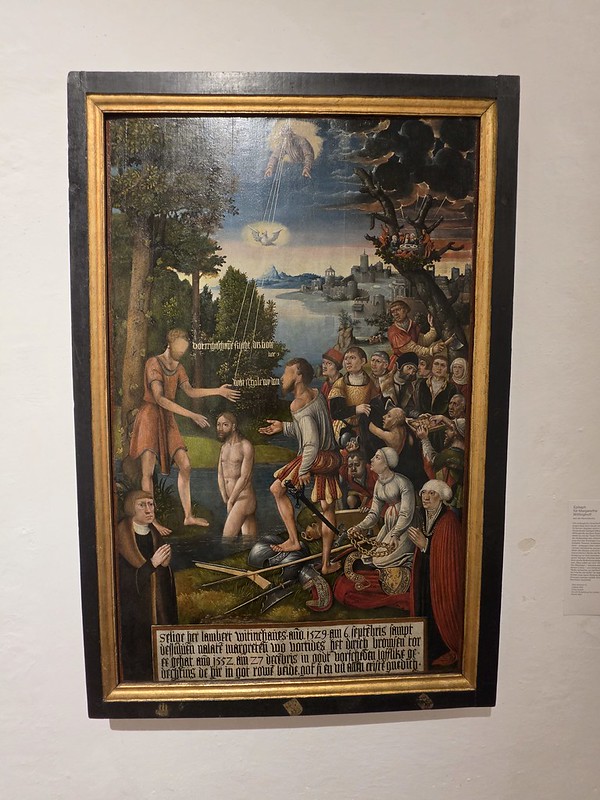
This epitaph for Margarethe Wittinghoff was painted in Lübeck in 1552 by Hans Kemmer, who was also the artist behind the Hans Sonnenschein artwork. It has that slight Reformation-period tension where everyone is clearly trying to work out exactly what devotional art is now allowed to do as I can imagine that the rules weren’t exactly clear. I’m not sure why two faces are blurred out, but I suspect that it’s something to do with those rules not being very clear….. I’m genuinely fascinated about this period when everything changed and all the religious traditions were thrown in the air and it wasn’t clear how it would all settle.
The artwork came from St Mary’s Church in the city and was made at a time when old Catholic visual habits had not simply vanished, but were being carefully rearranged into something that could sit within the new Lutheran world. The painting shows Christ’s baptism, with John the Baptist standing beside him and a crowd of onlookers gathered on the right. Above, the Holy Spirit descends as a dove, while God the Father appears from the clouds, completing the theological arrangement rather nicely. Margarethe herself is shown kneeling in prayer at the lower left which feels a little bit self-indulgent to me.
As I’ve accused Margarethe of being self-indulgent, I thought I’d ask AI to draw a little something up for me. I must say that I quite like this, although I don’t drink tea so I must have words with it about that.
This interview is with Nick who has been doing lots of training ready to aim for his first LDWA completion.
Q. Could you briefly introduce yourself and say how you first became involved with long-distance walking?
A. I first learnt about long distance walking and the LDWA through a friend Breeze Rowlands, some people frown upon walking in the world of running as its slower, I was a keen fan of Jeff Galloway who encouraged it but it’s nothing different for me, I think of it as a conversational pace, its still can be very tough. I have also been the support for Breeze on countless events over the past 10 years.
Q. How many LDWA 100s have you completed before, and do any of them particularly stand out?
A. I’ve only had one attempt, that was the EBB in 2023, got to 68 miles and my body just gave up, I had so much going on around me before, I learnt so much about myself in 2023 and with my preparation for this year. I’ve got lots of memories from various 100s with being the support for Breeze, one memory with her is meeting her up the top of Mam Tor with a coffee at 4am.
Q. What made you decide to take on this year’s 100 in Kent?
A. I was in a position to have a go at the Flower of Suffolk 100 in 2025, but a hip issue followed by a broken arm stopped that, So quite naturally the next choice would be the HP100, I am also a big Disney nerd, and to go over the pooh sticks bridge in a event is so cool, who know I might bump into Christopher Robin, or find a Heffalump or even see a woozle!
Q. How has your training been going, and have you done anything differently this time?
A. Training has been going really well, I’ve had lots of back to back events, also working out how i go on with the lack of sleep, and working out how to deal with, for example I did the Reverse London Marathon (starts at midnight nine hours before main event) had a hour to chill then I did the actual London Marathon. I did the Calverdale way over 2 days and last weekend I did the Marsden Moor marathon followed by Leeds Marathon, it’s all about being up and on your feet, getting your body used to doing crazy things.
Q. How prepared do you feel at this stage, physically and mentally?
A. I feel fab, ready to deal with it, bring it on!
Q. What are you most looking forward to about the event?
A. Pooh sticks bridge.
Q. Is there any part of the route, the distance, the weather or the logistics that you’re feeling slightly nervous about?
So just need the man upstairs to decide on the weather, and the ascent that we have overall, Kent and Sussex isn’t flat apparently.
Q. Food can become strangely important on a 100-mile event. What do you usually rely on to keep yourself going, and is there anything you absolutely cannot face after enough miles?
Food is a hard one, and a thing that I have had to experiment with a lot, I’ve got everything I need prepped, I am coeliac and I work in catering, and I really don’t get why the LDWA overthinks it, and makes it so hard. From experience if your saying you get a pie and gravy at a checkpoint or the end of an event, I want pie, folk around me are eating it , why can’t I have it? On the route I plan to have flapjack and jam sandwiches.
Q. When things get difficult during a long event, what helps you keep moving?
A. The conversations you have while you’re out, you meet some cool people, all doing the same cool thing, I’ve learnt that from doing a few 50s now and my experience from the Elephant, Bear and Bull in 2023, every person you meet is a friend that you haven’t met yet and and hopefully will see them somewhere else either in a few hours or weeks at another event.
Q. What would make this year’s 100 feel like a success for you?