Blog

  • CAMRA Coach Trip – Pub 1/4 (White Horse at Upton)

    CAMRA Coach Trip – Pub 1/4 (White Horse at Upton)

    The pre-party completed (I might have made that sound more exotic than it was), it was time to board the coach to be transported to our first mystery pub location.

    Safely boarded and ready to go. I had discovered that the first stop wasn’t the Ber Strete Gates and it would be about 25 minutes on the coach, that was the limit of my knowledge of where we were going.

    And we arrived at our first stop and I was pleased with this one as it’s been around a decade since I’ve been here. This has been a community run pub since 2012 and although they’ve had some minor financial issues in recent years, they’ve bounced back and all that. There are frequent events held here, beer festivals, musical performances, morris dancers and the like, along with food being served throughout the week.

    The venue has been a licensed premises since the late eighteenth century and it was owned by the Coltishall Brewery in the early nineteenth century before they sold it in 1841 and later on it was taken over by Bullards. It then passed into the hands of Watney Mann and then Brent Walker before the community took it on.

    A coach load of customers did surprise the venue, but the team members were all friendly and welcoming. I had deliberately taken cash in case that was preferred in these rural areas, but everyone seemed to be paying by card.

    The choice of real ales and I liked this selection, a range of beer styles and there are some options there that I haven’t had before.

    Some of the events.

    We went to sit in the rather nice beer garden and as there were children on the bouncy castle, we thought we’d better not try it out. It was moderately busy in the beer garden and busier inside mostly with diners, but the atmosphere all felt informal and well managed.

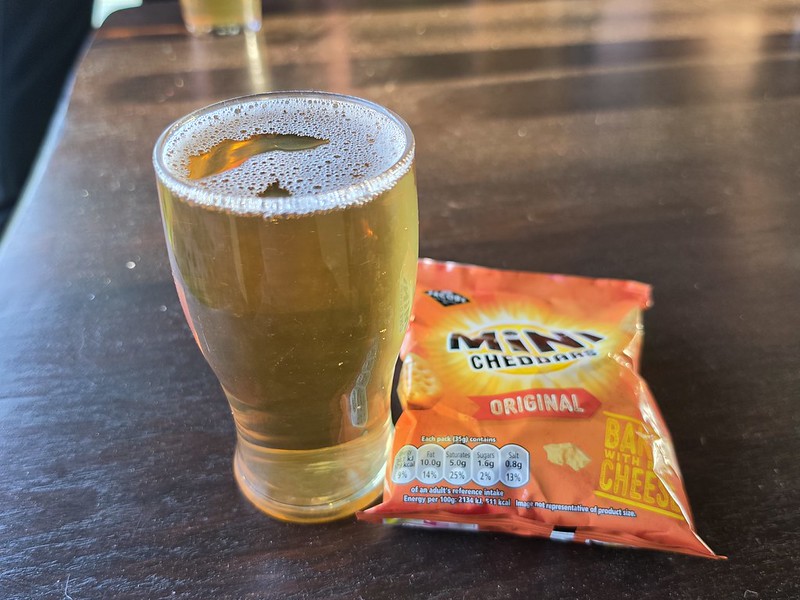
    I went for the Yellow Tail from Wantsum Brewery from Kent alongside some Mini Cheddars. The beer was clean, hoppy and well-kept, a decent light start to the evening.

    This was going around the table and I thought that it was a strange thing to do at CAMRA events but assumed that it was some kind of ritual that they do.

    It kept Ivan amused though who was very good indeed at colouring in and it transpired that this isn’t a standard CAMRA activity, it was a one-off.

    One of the advantages of visiting here is that that’s another ticked off in my vague attempt to visit every Good Beer Guide pub in the country. A very good first selection by Ivan and after thirty minutes here, we boarded the coach to discover where he was taking us next.
  • CAMRA Coach Trip – Pre-Party at the Bell

    CAMRA Coach Trip – Pre-Party at the Bell

    Young Ivan kindly invited me on a CAMRA coach trip, an experience that I haven’t been on before. In short, for these evening trips he organises four pubs to visit, keeps it a secret from everyone on the trip (other than the driver) and then we drink beer and eat crisps at the pubs. It’s a concept I was on board with, literally in this case. There isn’t really a pre-party to this whole event, but three of us met at the Bell in Norwich, the JD Wetherspoon venue in the heart of the city. As for the beers, there were five guests and their normal selection of regular real ales, with the prices all being at the lower end of the scale.

    I went for the Honey Porter from Conwy Brewery, a sweet dark beer with a slight honey flavour which was all a little quirky.

    Ivan had quickly eaten a main and a side, which I thought was very sensible and I should have got there earlier to do something similar. But, I knew that there were plenty of bar snacks ahead during the evening, although I was disappointed to discover that Ivan didn’t walk up and down the coach selling snacks en route. There’s a learning point there for future trips.

    It’s all happening now!

  • Lübeck – St. Anne’s Museum Quarter (13th Century Font from St. Giles’s Church)

    Lübeck – St. Anne’s Museum Quarter (13th Century Font from St. Giles’s Church)

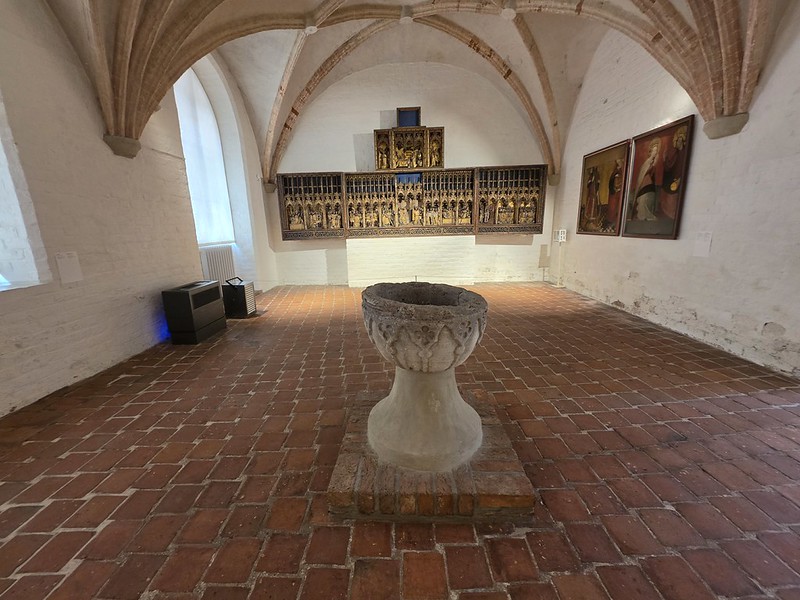
    This font came from St Aegidien in Lübeck, or St Giles’s Church in its English form, and it dates from the early thirteenth century. It was made in Gotland, so very much part of the whole Baltic trade route arrangement. It’s solid, chunky and another marvellous survival over the centuries. It’s been given central billing in one of the museum rooms to add to the whole impact.

    I do like the heritage of these things, which is why a lump of carved rock gets a blog post to itself and there’s another font with a similar history in a neighbouring room. It’s a link to the medieval past of Lübeck and it has outlasted all of the infants who were baptised in it. The church itself is still standing, a little dented from the 1806 Battle of Lübeck and the Second World War, but still there.

    I’ve never really, until now, pondered when fonts became something of a thing in church, so now seemed to be a good time to find out as if I haven’t got anything better to do…. Anyway, baptisms initially took place in rivers or in other bits of water that the church found, but then there started to be a plan to construct pools within churches. This proved to be a bit of a hassle, as every church was starting to need its own swimming pool (although perhaps this might have ensured more people went along if they had continued that tradition) and so they changed the rules from immersion to just having water poured over the head. By the twelfth century, there had been a shift to fonts such as the one in the museum, although there was a new challenge as the churches frequently had to put font covers on as people kept stealing the holy consecrated water to protect themselves from witchcraft or similar such side projects.

  • Hanover – Former New Synagogue

    Hanover – Former New Synagogue

    The New Synagogue in Hanover, designed by architect Edwin Oppler and completed in 1871, stood as one of the most impressive synagogues in Germany. On the night of 9 November 1938, during what became known as Kristallnacht, the New Synagogue burned and fire fighters were ordered only to ensure that no neighbouring buildings were damaged. On the morning of 10 November, emergency services blew up the dome of the burned-out building, and its ruins were later dismantled at the expense of the Jewish community. The destruction was photographed by Wilhelm Hauschild who was able to climb a church tower to be able to take a photo of the synagogue on fire.

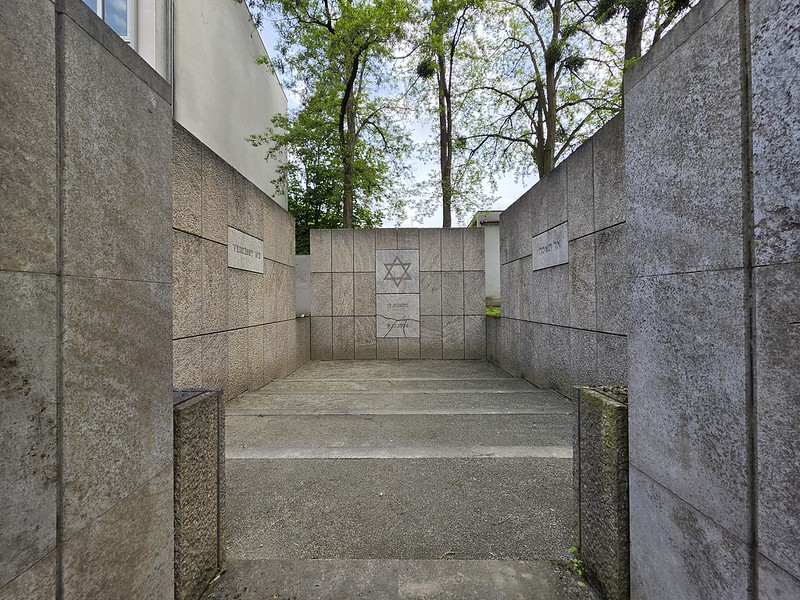
    This is what is left today, just a small memorial that stands as a reminder of the former grand synagogue that was once here. In the early hours of 11 November, 275 detainees from Hanover and the region were taken to the railway station and transported to Buchenwald concentration camp. The large majority of the Jewish population of Hanover were killed by the Nazis over the course of the war and of those who survived, many didn’t want to return to the city after the end of the Second World War.

    This monument was added to the site in 1978 to prevent the location being forgotten about and it’s a stark and minimalist affair.

    This is what the building once looked like, it’s hard to imagine this in the modern landscape and it was a quite beautiful structure.

  • LDWA – Hunnypot Hundred 2026 (Main Event – Post Event Interview with Entrant Guy Evans)

    LDWA – Hunnypot Hundred 2026 (Main Event – Post Event Interview with Entrant Guy Evans)

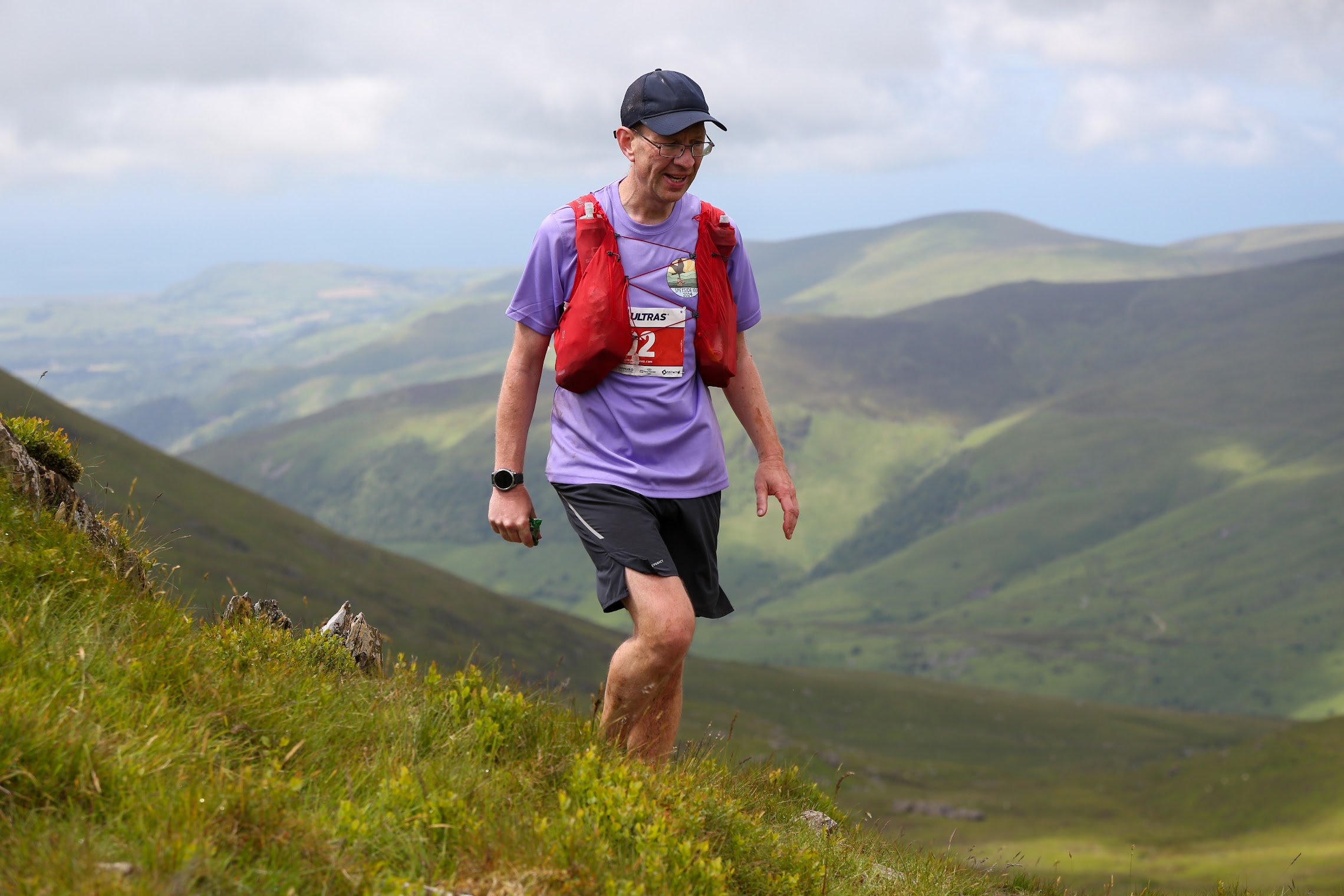
    Before the Hunnypot 100, I interviewed a number of entrants about what they expected from the event and how their training was going. One of the entrants was Guy Evans, and he has kindly agreed to answer some post-event questions as well. It was also rather lovely to walk Guy in at the end, well, the last fifty metres anyway.

    Q. What are your main memories of the Hunnypot 100?

    A. Well the sun and the heat are the obvious and overriding memories. I’ll also remember the route – Kent might not have massive hills but it also doesn’t seem to have any flat bits either!

    Q. You completed the event and came in the fastest 30 entrants. What strategies did you use to get around what appears to have been the hottest ever 100?

    A. I slowed down. For the first 10 miles I was jogging the downhills, but after the first CP I walked everything. Even walking, I was still overheating. It quickly became apparent that it was much more about finishing lines than finishing times. I resolved to take it easy – in particular on the hills. I had a rough plan for when I was expecting to get to each checkpoint but I threw it away.

    I was also taking more time at the checkpoints than normal to help cool down and recover. The volunteers at the checkpoints were brilliant. They must have been hot and tired too but were very patient and understanding – having water tipped onto the back of my neck was bliss.

    I had a wetted buff but I’m not sure how much that helped – it dried out very quickly after each checkpoint! I also had electrolytes and salt tablets. I think I should have taken more of these. I made sure I was well hydrated – but from reading around afterwards suspect I might have taken on too much water and that was causing my blood sodium levels to drop.

    Above all else, I took it from checkpoint to checkpoint. I had a wobble very early on when the thought of carrying on in this heat for the whole of Saturday, the whole night and then for the whole of Sunday (which was forecast to be hotter) just seemed too much. But just focus on the next checkpoint and the overall distance will take care of itself.

    Q. Which part of the walk did you enjoy the most?

    A. I said before that the night section wasn’t my favourite. This time it was! The coolness when the sun eventually set on Saturday was wonderful. The scenery in the last quarter was great and I just about had enough energy left to enjoy it (although I had a bit of a loss of sense of humour with the repeated ascents and in particular descents into Ide Hill checkpoint).

    Q. Will you be doing it again? Or is it too early to say?

    A. Another LDWA 100? Yes, for sure. 100%. I’m really looking forward to the next few which are in great parts of the country. I hear that the provisional Devon and Cornwall route has a lot of elevation – great!

    Q. Do you have any suggestions for organisers of future LDWA 100s?

    A. For me personally, don’t be afraid of making the route challenging. But, I really don’t feel in a position to make any suggestions. I’m incredibly grateful to the organisers and volunteers of the 100s for all the time and energy that they invest in putting them on. It’s a real privilege to be able to turn up and take part.

  • LDWA – Hunnypot Hundred 2026 (Main Event – Post Event Interview with Entrant Phoenyx Harritt)

    LDWA – Hunnypot Hundred 2026 (Main Event – Post Event Interview with Entrant Phoenyx Harritt)

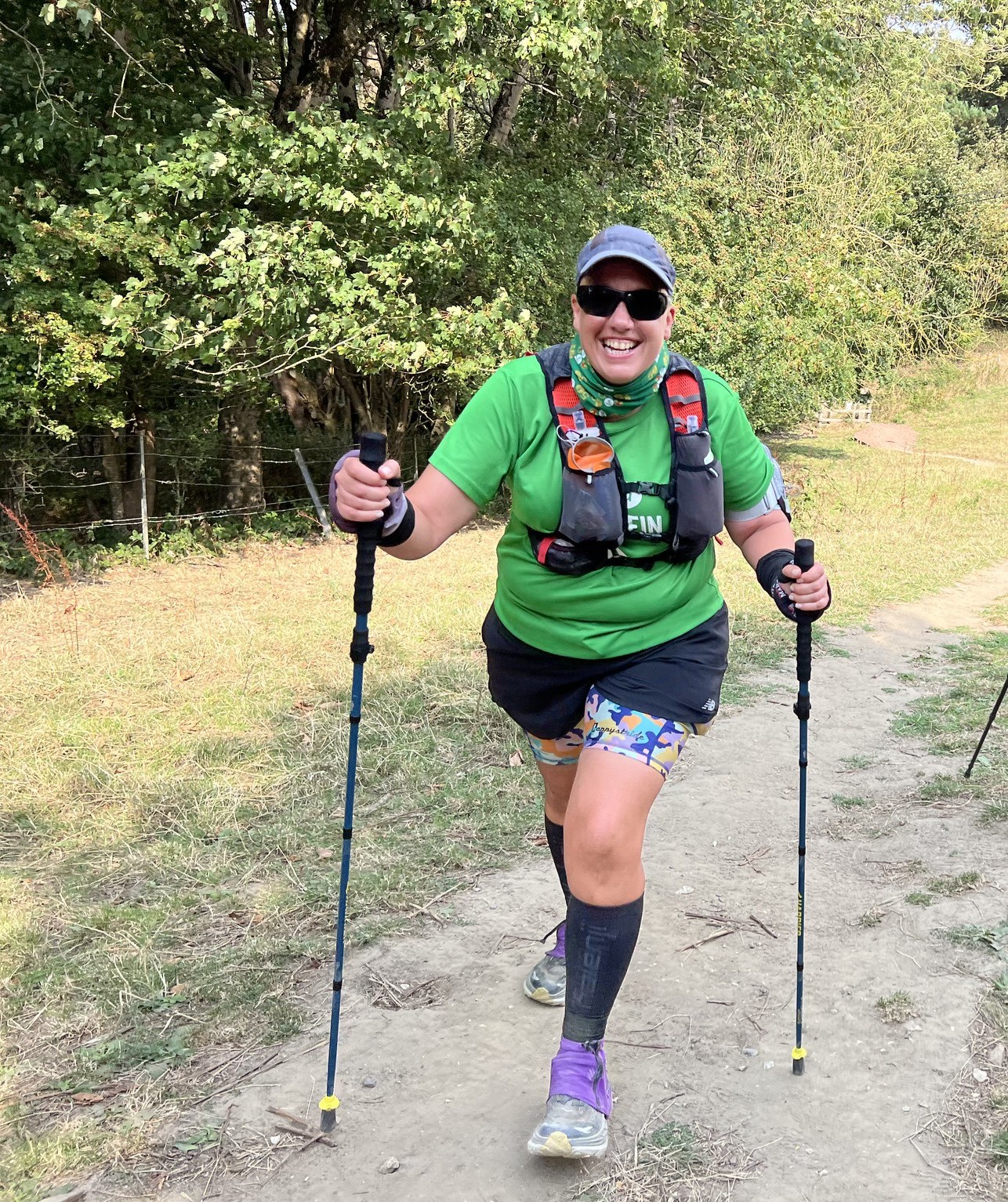
    Before the 100, I interviewed a number of the entrants and so I’m catching up with some to find out how it all went. I love the phoenix from the ashes comment!

    Q. What are your main memories of the Hunnypot 100?

    A. I feel in some ways like the specifics are a bit of a blur, but the beautiful rolling countryside, and the chatter and buzz of the people is what pervades.

    Q. Along with over half the entrants, you retired during the event, was it mostly heat related for you?

    A. The heat was an indirect cause for me, in that I didn’t feel hot or ill at any point on the walk, but because I took too many electrolyte tablets, I felt uncomfortably thirsty for a couple of legs. I didn’t learn this until I spoke to the medic at checkpoint 4. Essentially I retired because knowing I had messed up, and sensory overload caused by a combination of several factors, prompted me to have a meltdown / panic attack. At that point I didn’t want to push through and risk needing assistance in the middle of nowhere in the dark, potentially jeopardising the finish for my walking buddy. Ultimately it comes down to lack of experience, and I have learned a lot from it that I will take forward to future events. Before the Hunnypot finished I had booked the Sussex Stride so that I can qualify for the Jurassic 100 next year.

    Q. Which part of the walk did you enjoy the most?

    A. I genuinely enjoyed all of it. The scenery was fab, the volunteers were amazing, the food was great, and the other participants were lovely. One thing I love which I think is a bit unusual is being overtaken by the speedy folk on the later starts as I love to see how smooth their form is and the glide past.

    Q. Will you be doing it again? Or is it too early to say?

    A. A phoenix always rises from the ashes and this Phoenyx is no exception.

    Q. Do you have any suggestions for organisers of future LDWA 100s?

    A. I’d like to see a more evenly staggered start. The entrants were split across the three start waves in 450/50/6 proportion which makes for a logistical nightmare. I arrived at HQ as soon as it opened so I didn’t get stuck in queues for registration, but as a mid pack walker I was right in with the masses at checkpoints. This meant queueing in hot stuffy halls, and I witnessed lots of people struggling to find space to sit. I think splitting the 450 across 9am, 9:30 and 10am starts would resolve this. I appreciate it means an hour earlier start for many volunteers, but I think it would make it less stressful for them too in terms of replenishing stocks at checkpoints.

    I think with the unprecedented heat this year, now is a good time to look to the future and create a heatwave-proof contingency to set people up for success after the massive drop out rate this year. This might mean adjustments like a hot weather mandatory kit list where waterproofs can stay in the breakfast bag, checkpoints being closer together [I notice FOS100 had 16 vs HP100 having 13] or moving the south of England events to Easter and Mayday rather than Mayday and Spring Bank Holidays.

    Either way, I have had such a positive experience I will be entering more LDWA events, and I even took the opportunity mid-walk, to volunteer myself to help at the Stansted Stagger as I have completed it twice now. I’ve also signed up for the BBN Pic n Mix this Sunday so I might see some of you there.

  • Hanover – Aegidienkirche Ruins (Japanese Bell)

    Hanover – Aegidienkirche Ruins (Japanese Bell)

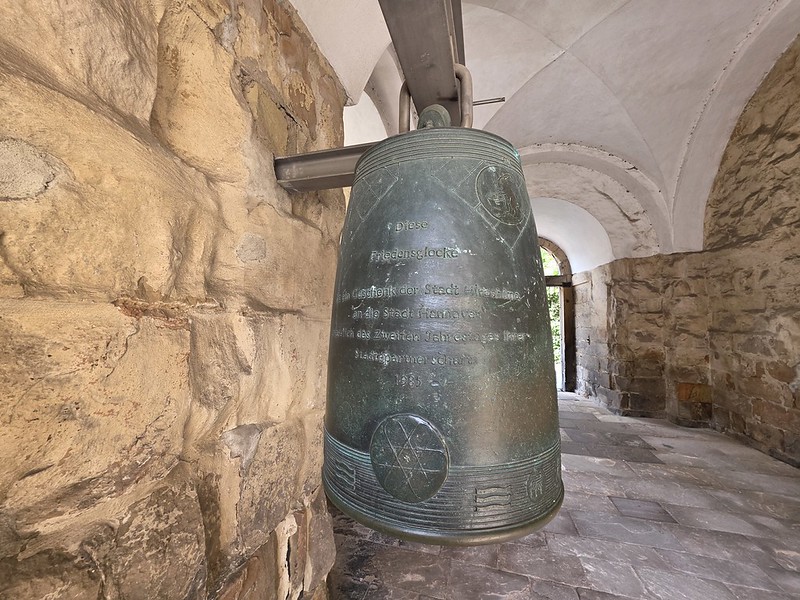
    This bell is located at the Aegidienkirche in Hanover and it was donated in 1985 by the city of Hiroshima which is Hanover’s sister city. It’s a bonshō, a traditional Japanese temple bell, which has been placed in the tower of the Aegidienkirche. The gesture was one intended to show international solidarity between two cities that understood what it meant to be destroyed by war.

    Each year, on 6 August, the bell is rung during a memorial service honouring the victims of Hiroshima and I can imagine that it must feel like a powerful event. The ringing of the bell takes place at 08:15, when the atomic bomb was dropped on Hiroshima, killing around 150,000 people.

  • 200 Years Ago in Norwich : Paul Pry at Norwich Theatre Royal

    200 Years Ago in Norwich : Paul Pry at Norwich Theatre Royal

    200 years ago this week in the Theatre Royal Norwich there was a performance of the play Paul Pry on 20 May 1826. The theatre had reopened in late March 1826, so this performance advertised in the Norwich Mercury would have been one of the first in the new shiny building.

    Paul Pry was a comedy that had become the theatrical sensation of the decade, so it’s not a surprising choice that Norwich Theatre Royal made to put it on. The play, written by John Poole and first performed in 1825, had become something of a public obsession, like an early day Inbetweeners. Well, maybe not quite like that and more like Ever Decreasing Circles, but the catchphrase “I hope I don’t intrude” became a popular refrain that lingered in the national vocabulary for some time. By the time this play was put on the audience knew at least what they were getting.

    The character of Paul Pry is fundamentally unlikeable and a man without boundaries or self-awareness. For this performance, the provincial theatre here in Norwich was nicely on-trend, the cultural excitement had moved fast in the days before the railways had reached the city. There’s a pub called Paul Pry in Rayleigh in Essex which is a reminder of this piece of cultural excitement, although it’s operated by Greene King so I won’t add anything further on that. I can’t see that the play is performed any more, but perhaps there’s a need for a comeback at some point….

  • 200 Years Ago in Norwich : Housewarming at Crown Inn in Swaffham

    200 Years Ago in Norwich : Housewarming at Crown Inn in Swaffham

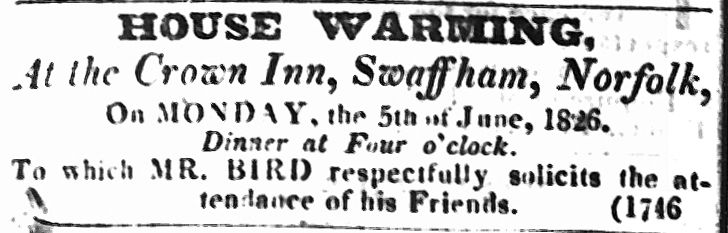
    This advertisement appeared in the Norwich Mercury on 20 May 1826:

    “HOUSE WARMING, At the Crown Inn, Swaffham, Norfolk, On MONDAY, the 5th of June, 1826. Dinner at Four o’clock. To which MR. BIRD respectfully solicits the attendance of his Friends.”

    I’ve never much thought about the heritage of house warming until I saw this in the newspaper of 100 years ago this week. However, it appears that the term itself comes from an era when houses genuinely needed warming. The practice is medieval in origin and when someone built a new house or took over an existing one, friends and neighbours would be invited to the opening ceremony. Rather than bringing a potted plant or a bottle of wine (well, craft beer now), guests would contribute something rather more essential, namely firewood. This led to the optimal situation of a warm house and a social gathering included at the same time, all rather handy for those who like people.

    As for this little party at the Crown Inn, it was hosted by the former military man James Bird who was to run the venue until his death in 1832. The Crown Inn had been Swaffham’s principal hotel and social hub in the eighteenth century, serving as a meeting place, exhibition hall, ballroom, auctioneers and occasional courthouse. It was first documented in 1648 and Emma Hamilton, Nelson’s mistress, entertained here on numerous occasions. The inn closed in 1879 after which shops occupied the site until its demolition in around 1952, with the new building housing Salters shoe shop (1956–89), Breakers clothing (1990s), and eventually the Sue Ryder charity shop from 1992.

    I wonder what was at this dinner, it sounds like a fine arrangement, although at least they had access to plenty of beer. I’d note though that the buildings on the site today look like a pale imitation of the once quite grand inn.

  • LDWA – Hunnypot Hundred 2026 (Main Event – Retirements Infographic by Guy Evans

    LDWA – Hunnypot Hundred 2026 (Main Event – Retirements Infographic by Guy Evans

    Guy Evans created this interesting infographic of where the retirements took place on the 100 this side, it’s an interesting snapshot of what happened along the route. The actual number was 471 started and 209 finished, the tracking data is slightly faffy but this is still an intriguing use of data. Over 100 retirements by CP5 shows how the hot weather was impacting entrants, many of them just didn’t feel that they could carry on.