Blog

  • Royal Air Force Museum Hendon – Marcus Dyce Manton

    Royal Air Force Museum Hendon – Marcus Dyce Manton

    This is one of the photos on display at the Royal Air Force museum and it’s in the section which honours those who received a Royal Aero Club Aviator Certificate. To achieve this, the pilot had to complete two 5km flights and one 50m altitude flight.

    In the photo is Marcus Dyce Manton (1893-1968) who was born in Sheffield on 14 September 1893. He obtained his Aviator Certificate on 4 June 1912 and I have to comment on just how brave that must have been. It’s all very easy on a scheduled Wizz Air flight to find flying really quite interesting, it was slightly less decadent in 1912 and the risks were real and high. He obtained the nickname of the ‘Boy Looper’ and completed hundreds of ‘loop the loops’ which excited and delighted many at air shows. This all seems like a rather unusual relationship with danger as early aircraft did have that sub-optimal habit of falling out of the sky.

    It was no surprise that Manton was an important part of what was then known as the Royal Naval Air Service, being appointed as the Head Pilot Instructor at Hendon (where the museum is now based) at the start of the First World War. Until 1918, there were separate divisions which were the Royal Naval Air Service, which was the air arm of the Royal Navy, and the Royal Flying Corps, which were part of the Royal Army.

    After the end of the First World War, he worked as a test pilot for Samuel White and English Electric, later becoming involved in gliding through the London Gliding Club. During the Second World War he served with Armstrong Whitworth as a Service Liaison Officer, and afterwards worked with Hawker Siddeley. Manton managed to get a fine in 1941 for not having a current driving licence which seems an omission for someone who had a licence to fly aircraft.

    Manton died in April 1968 in Dorset, having seen aviation progress from fragile early contraptions to the jet age, something which must have given him endless excitement over the decades. His son, Graham Ashley Leonard Manton (1910-2005), also became something of a hero in the air force during the Second World War.

  • Royal Air Force Museum Hendon – Falklands Chapel

    Royal Air Force Museum Hendon – Falklands Chapel

    This is quite a powerful exhibit, it’s the chapel that was at RAF Stanley in the Falkland Islands. Initially a tent had been used as the chapel, but the General Engineering Flight converted this shipping container to create something more appropriate by adding a door and two windows.

    Inside the chapel, with the altar made out of wood off-cuts and spent shell cases.

    Badges.

    The chapel was dedicated by the Rev. Philip Sladen (?-2003) on 27 July 1983 and it remained open on the islands until 1986. It was then returned to the UK and has now been moved to this museum.

  • Royal Air Force Museum Hendon – Personal Mine Extraction Kit

    Royal Air Force Museum Hendon – Personal Mine Extraction Kit

    This is what the Royal Air Force museum calls a personal mine extraction kit. It’s a little collection of objects to ensure that lives can be saved by finding landmines, all something of a contrast to the large bits of military aircraft located nearby.

    These are the instructions and I have to note that using these little bits of stainless steel prods to try and find land mines sounds like a sub-optimal way to spend an evening. I get annoyed at cryptic crosswords, so I can’t imagine the amount of patience and bravery must be involved to be crawling about in the sand somewhere trying to prod for mines.

    I liked that the museum had made these little notes visible that were an aide memoir into the use of the kit, it made it seem really rather more real.

  • Royal Air Force Museum Hendon – Sir Samuel Hoare’s Briefcase

    Royal Air Force Museum Hendon – Sir Samuel Hoare’s Briefcase

    I’ve been meaning to visit this museum for a little while after having seen it from the train when travelling between Luton and London. The museum is free of charge and asks visitors to register online, but I don’t think it’s essential.

    This exhibit is a briefcase from the 1920s that was owned by Sir Samuel Hoare, the 1st Viscount Templewood (1880-1959), who was a pivotal figure in the development of British civil and military aviation during the interwar period. Serving as the Secretary of State for Air on three separate occasions throughout the 1920s, he became a tireless advocate for the ‘imperial air routes’ that sought to connect the distant corners of the British Empire. Hoare was not merely a desk-bound administrator; he famously took to the skies himself, embarking on a landmark 10,000 mile flight to India in 1927 alongside his wife to demonstrate the safety and potential of long-distance air travel. In reality, at this time, air travel wasn’t entirely safe, but it was certainly right to make others aware of the potential.

    In a different world, Hoare could have easily become Prime Minister and he remained one of the most important and influential Cabinet Ministers in the late 1930s and early 1940s. Unfortunately for him, Churchill didn’t like him and threw him out of Government when he became the wartime Prime Minister.

    Hoare was one of the most important Ministers during the twentieth century in terms of the evolution of air travel. I like exhibits such as this as they’re a personal connection to a very different time during history and it’s something of a contrast to the huge bits of aircraft that are dotted around the rest of the museum.

  • Wizz Air (Katowice to London Luton)

    Wizz Air (Katowice to London Luton)

    [Apologies I published this early if anyone saw a half finished post!]

    I was connecting at Katowice Airport to fly to London Luton, although there was no airside connection available. I also discovered that the security area at Terminal A wasn’t open for thirty more minutes, so the process was hardly rushed.

    Mine was the 19:45 flight and I had the advantage of popping to the airport lounge, but I wrote about that separately.

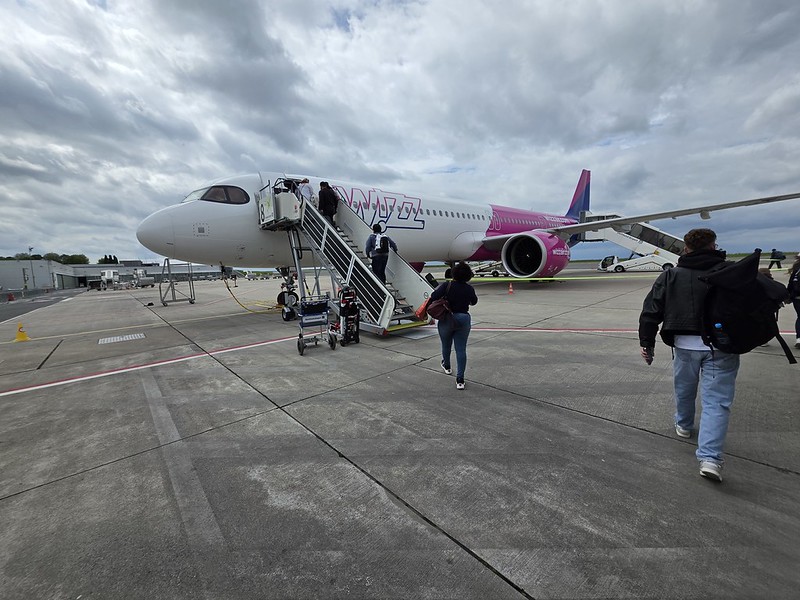
    The boarding process was all efficient, but there was a particular focus on checking bag sizes on this flight. The lady was walking down the queue and she spoke to me briefly before telling me that my bag was fine, but a fair few were being stopped and charged extra money. One guy was charged four times for his family, so around £320, so it was a profitable exercise for Wizz Air. Although, the rules are very clear, so the customers took a risk.

    This lady was charged £80, she might have been a little unlucky. It’s fair to say that she wasn’t very pleased and she asked a couple of us whether we’d been charged as well.

    The aircraft is 9H-WAD, yet another one that I haven’t been on before and this has been part of the Wizz Air fleet since 2022.

    Everything was smooth and well managed yet again, although the seating Gods had given me a middle seat which wasn’t ideal. However, the flight was only two hours so it’s hardly traumatic. The flight cost the usual £8.99 with my Multipass and the aircraft was clean, the crew were friendly and everything worked as it should.

    We landed into London Luton on time and I had a hotel just a short walk away from the airport, which is always something that I look forward to. This marked the end of my one week stay in Poland, Romania and Germany, another successful trip that was made a lot easier with my cheap Wizz Air flights.

  • Katowice Airport – Business Lounge (Terminal A)

    Katowice Airport – Business Lounge (Terminal A)

    With around three and a half hours before my flight from Katowice to London Luton, I thought I’d see how busy the lounge was. Fortunately I was flying on a non-Schengen flight departing from Terminal A, as the lounge at Terminal B has now stopped accepting Priority Pass. I hadn’t realised I had been to this lounge before, but it seems that I came here in 2019. I am a creature of habit sometimes.

    There was a friendly welcome from the team member at the reception desk and it was evident that there weren’t any capacity issues as I was the only customer in the lounge. Indeed, that was the situation for nearly two more hours. That gave me a choice of seats, so I sat near the runway to look out. I’m easily pleased.

    This was the limit of the food (other than for some yoghurts and sausage rolls) and the Caesar salad on the right didn’t look entirely fresh, but the Greek salad was entirely acceptable. And those jelly sweets on the left, let’s just say that the team member in the lounge had to refill those.

    I was impressed at the beer fridge with five different local options from the Cieszyn brewery, which is the longest continually operated set-up in the country. I tried a couple of the beers and it’s a shame that more UK airports don’t offer a local beer, even if they can’t manage five of them.

    This wasn’t a bad set-up, there was a decadent 9% beer, coffee, salad, sausages with insufficient pastry and jelly sweets. This pleased me…. And there were also plenty of power points in the lounge which was handy.

    The facilities were a little limited with just one toilet, but when you’re the only person in the lounge, that proves to be less of a challenge. I’m not sure that it would be worth paying full price for, unless you wanted to drink several beers, but I found it a useful resting and working place for the few hours that I was in there.

  • Wizz Air (Dortmund to Katowice)

    Wizz Air (Dortmund to Katowice)

    Dortmund is one of the older airports which is simply too small to deal with the number of passengers it currently has to handle. There are over three million passengers using the airport every year now and they have been creative about using the space that they have.

    Mine was the 13:25 flight and I took this photo just after I went through security, showing how perilously close I was. Well, by my standards. The security process was slightly problematic as some drunk, mostly older, Polish football fans barged by a few of us in the security line. I decided to take the opposite security line to them and managed to get through quite a bit quicker, and certainly had a quieter time.

    And the aircraft arrives, albeit a little late. The seating arrangement at the airport wasn’t dreadful, but they do need more seats for passengers as quite a few just opted for the floor. There were no power points and the general facilities at the airport were quite limited, but everything seemed to work efficiently.

    I was slightly nervous of a delay as I had a flight from Katowice four hours after this one arrived, but fortunately, there was no impact of note.

    This is aircraft HA-LVD, yet another one that I haven’t been on before, with this one in operation since 2019. The seating Gods had given me a window seat near the back, which suited my needs entirely for a flight of a little over one hour.

    Somewhere over Dortmund.

    What looks like a pretty town, this is Soest in Germany.

    And safely into Katowice and we we hardly late at all, giving me more than enough time at the airport to sit in the lounge for hours….

    The flight cost £9 with my Multipass and was another competently managed operation, with the aircraft being clean, the crew being friendly and the pilots sounding professional. It’s becoming a bit samey I know with Wizz Air, but routinely good isn’t a bad thing…

  • Dortmund City Centre to Dortmund Airport (with some slight faffing about)

    Dortmund City Centre to Dortmund Airport (with some slight faffing about)

    I left the Ibis hotel in Dortmund just four and a half hours before my flight to Katowice left, so that was positively cutting it fine as far as I’m concerned. I had a vague plan of how to get to the airport and since I’ve done this before, albeit in a different way, I didn’t think much about it. Although therein lies the first problem….

    Dortmund Stadthaus isn’t perhaps likely to win any design awards for the frontage, despite the efforts made with the mural above it. Anyway, my plan was to get a U-Bahn from here to near the airport and walk the 50 minutes to the airport itself.

    I get to the railway station ticket machine and notice that there’s a cheap ticket to the airport as one of the options. I knew that there was a more expensive train to the railway station, but I refused to spend that much and liked the idea of the cheaper ticket that I hadn’t thought about.

    So, I leave the station and walk twenty minutes back to the central station. It was a nice walk, but I’m not entirely sure why I did that. What actually happened here is that this cheap ticket is the combined U-Bahn and bus to get to the airport, I hadn’t realised that’s what they meant, I think I thought there was a cheaper train direct to the airport from Dortmund Hauptbahnhof.

    I got to Hauptbahnhof and downloaded the app to buy a ticket, having by this time worked out how the ticket worked. I missed the train that I needed as apparently they need an address in Germany to buy the ticket. I have no idea why they have this requirement, so I slightly grumpily walked back to the ticket machine to buy it there instead.

    And here’s the U47 to Aplerbeck. This doesn’t actually go the airport, but they’ve sensibly signed it to make clear that it’s the one to get to be able to connect to a bus that does go there directly.

    Safely on board the U47 and it was only at this point that I realised the train went through Dortmund Stadthaus, where I had been an hour before. This explained why they sold tickets to the airport from there, namely, because the train to the airport went from there. Logical really.

    The U-Bahn stops at Aplerbeck and passengers then get off and walk around 50 metres to the bus stop.

    Rather oddly, the buses were only once every hour, although fortunately, I only had a wait of fifteen minutes. I was there on a Sunday, so perhaps the service is less regular then, but it was a busy bus when I got on.

    On the bus and I was able to get the front seat, I still get a childlike sense of excitement about that.

    I liked that there was a button there which is by the window of the front seat, as often buses don’t have anything nearby (I don’t think many people spend time worrying about things like this). This is a minor design detail, but sometimes the simplest things are the best.

    And safely at the airport with just two hours to go before the flight. Perilously close I tell you… Anyway, everything went smoothly despite my faffing about. The moral of this entire, and slightly dull, story is that the direct train costs nearly €10 whereas the combined train/bus costs around €4, so I liked the latter one best.

  • Cologne to Dortmund with FlixTrain

    Cologne to Dortmund with FlixTrain

    I have a lot more to write about Cologne, as I’m partial to wittering on, but I’d better catch up with the rest of the trip I made last week before I forget the last bit of it. I had spent three nights in Cologne and I was then spending one night in Dortmund before leaving Germany. So, that meant a train journey and I like a train journey.

    Mine was the 12:14 train to Leipzig.

    This is Cologne’s main railway station and it first opened in 1859, replacing the rather awkward and sub-optimal arrangement of separate railway termini that had grown up as different companies did their own thing in the traditional nineteenth century manner. Putting the station beside the cathedral was, on one level, completely logical, because it placed rail travellers right in the middle of the city. On another level, it was a bold little decision to squeeze one of Germany’s key railway hubs next to one of Europe’s great Gothic buildings and simply hope the whole arrangement would somehow look dignified.

    And they’ve failed in my view with the new building, there’s the grand cathedral on the right and the rather dumpy frontage of the railway station. But, it’s rare for a central railway station to be this central, I’m impressed at their forward planning.

    It is an odd mix really, but anyway, back inside.

    The current railway station is largely the result of rebuilding in the late nineteenth century and then, of course, the rather undesirable outcome on the city from the Second World War. After 1945, the station was rebuilt and it remains one of Germany’s most important railway interchanges, at least being quite grand inside.

    I was meant to be getting the train from platform 5, but then the Brussels train was running late, so we were shunted to platform 4. This was not much of an inconvenience, since it’s a walk of around three metres.

    And here comes the FlixTrain storming into the platform. I’ve taken many FlixBus journeys, but this is the first version by train. I’d note that the prices were low, this journey cost under £10. Trains in Germany are generally cheap as it’s possible to pay £60 a month and then get unlimited free local travel on trains, something I’d love to be introduced in the UK. This FlixTrain isn’t included in that offer as it’s a private operator, but they made lots of clear announcements about that.

    Everyone is given a seat, although passengers can change it on the app, and mine was in the front carriage. Unfortunately, that was quite a way from where I was standing, and there were quite a lot of passengers shuffling along to the appropriate place. I meandered slowly, there were some passengers that seemed entirely panic-stricken by the whole process.

    The interior was spacious and everything was clearly signed.

    The train wasn’t that busy and there was no-one in the window seat for the journey, so it felt spacious. There were no power points, but the seats were comfortable enough.

    I was impressed that there was enough space to use my laptop, it’s often the situation on trains where the tray isn’t wide enough or the seat pitch doesn’t allow it.

    A photo of the carriage with its wavy ceiling.

    We arrived into Dortmund 35 minutes late, but I’m used to lengthy delays on the German rail network.

    And the outside of Dortmund railway station.

    I was impressed at the whole arrangement as the booking process was easy and used the same app as the bus service. It was clear where to get the train from, the seating options were easy to understand and the pricing was firmly towards the lower end of the scale. I’d certainly use this again and I hope that FlixTrain continues to expand their operations.

  • Cologne – Schnütgen Museum (Gravestone of Maria Sophia Bawyr von Frankenberg)

    Cologne – Schnütgen Museum (Gravestone of Maria Sophia Bawyr von Frankenberg)

    Located outside of the museum is the gravestone of Maria Sophia Bawyr von Frankenberg (1667-1737). It reads:

    “To God, the Best and Greatest.
    The most reverend and most excellent Lady, Lady Maria Sophia de Bawer, Countess of Frankenberg, confirmed and blessed abbess of the illustrious collegiate church of St Cäcilia, Lady of Rondorf etc., enrolled in the most august Order of the Ladies of the Starry Cross. After increasing divine worship, completing the abbess’s building works, and restoring the church of St Maternus, she died in the year of Christ 1737, aged 70, after 52 years in religion and 24 years in the dignity of abbess. Rest in peace”

    I often take photos of gravestones, as I don’t get out much, to try and understand something about who they commemorate. Usually when I’m overseas it’s something of a forlorn exercise as I can’t work out anything about them. But, this is a little different as she has her own Wikipedia page, albeit only in Germany.

    A countess by birth and abbess of the collegiate church of St Cäcilien in Cologne (which is where this museum now is), she was also Lady of Rondorf and a member of the Order of the Starry Cross. She sounds quite decadent and rich…. She came from a large family, she had five siblings and five half-siblings, with two of her full siblings being military generals, which must help in feeling more safe and secure in life.

    Her memorial inscription makes clear that she took her responsibilities seriously and it credits her with increasing divine worship, completing abbey building works and restoring the church of St Maternus (which still exists), which is a fairly respectable administrative record for anyone. The stone has become a little smashed up over time, but it has been repaired although perhaps the museum could put a little information panel by it.