Blog

  • Derby – Babington Arms (no longer JD Wetherspoon)

    Derby – Babington Arms (no longer JD Wetherspoon)

    The Babington Arms in Derby closed last week as a JD Wetherspoon venue and has reopened nearly immediately under the same name but operated by a private company. So, rather belatedly, I thought I’d better note my experiences of visiting this pub in the past and how it was really rather one of my favourites.

    The chain explained why they had given the pub the name that they did in 1997:

    “This pub’s site was once part of the gardens immediately behind the long-demolished Babington House. This 17th-century mansion was the home of the Babington family, whose coat of arms depicted two baboons on a large beer or wine cask.”

    I’ve been here a few times over the last couple of years and it’s a comfortable pub, but it did feel in need of a renovation. The price point was the lowest in the chain, despite them having another pub around a ten minute walk away which has higher prices.

    This does feel like those JD Wetherspoon pubs that opened in the 1990s, lots of wood and a traditional feel. This venue felt more like a pub than some of their other locations, it evidently had a community and loyal set of locals. It was also quite a small pub for the chain, which is perhaps the reason that they no longer wanted it.

    The real ale selection in June 2025, which was all keenly priced and a perfectly decent selection.

    And a small breakfast which I recall was entirely as I would want it to be

    I mentioned the refurbishment that was needed earlier and this little waterfall arrangement last year was perhaps testament to that.

    Having a look at previous reviews, there’s the near obligatory one that someone has gone to a chain that doesn’t allow dogs and is annoyed that their dog isn’t allowed in.

    “Cannot go inside or outside with my dog. Obviously they do not want regular customers that are sensible. I feel discriminated against, when I am willing to sit outside with the smokers, in the rain. Most pubs in Derby are pub friendly. DOWN MARKET WETHERSPOON WHAT A LOAD OF CRAP.”

    Anyway…

    “Only one checkout working all week, large queues on self-service and checkout. Customers moaning about the service. What a way to lose a lot of customers.”

    How on earth can someone get a pub confused with a supermarket?

    “This place starts selling alcohol at 8am. I don’t drink at that time but often take a morning walk. For years I’ve ordered a pint of soda and lime with just a single measure of lime. Soda water is free so I’ve just paid for the lime, which has recently increased from 20p to 55p. Still I don’t mind this as the company has rent and other costs to cater for.

    Last time I was there they said I had to pay for 2 measures of lime because I wanted a pint drink. The manager confirmed to me that I had to pay for something I wasn’t buying!!! This company has two other pubs in Derby who don’t do this. This pub is blatantly biased against none alcoholics.

    After contacting their head office, I confirmed that soda water is free. My tip to help change this rip off is to order a small soda and lime and then as many free pints of soda water as you like. More work for the staff, more washing up and a chance of changing policy.”

    The last paragraph tells me what I need to know about the customer, but this was back in the day when venues were allowed to reply, and the manager at the time responded with “you are entitled to your opinion” and I like this sort of passive aggressive response.

    Anyway, the reviews from the first new days of the new operator aren’t great, but I don’t envy them. Taking over a new pub is hard enough, but it’s especially difficult when you’re following a JD Wetherspoon with its cheap prices, generally efficient service and the wide selection of food and drink. Fair play to anyone for trying though as they’ve at least kept the pub open.

  • Royal Air Force Museum Hendon – Downed Halifax

    Royal Air Force Museum Hendon – Downed Halifax

    This is a Halifax Mk II Series 1, serial W1048, built in 1942 and flown by No. 102 Squadron and No. 35 Squadron. On 27 April 1942, during its first operational mission, it took part in an attack on the German battleship Tirpitz in a Norwegian fjord. Damaged by anti-aircraft fire, it came down on a frozen lake where it eventually sank, which does rather explain its current look.

    Seen from the front, what survives feels less like a machine and more like evidence. Sensibly, no attempt has been made to flatter the thing back into glamour. The aircraft was recovered from the lake in 1973 and it eventually made its way to this museum. In what must have been a slightly odd reunion, members of the flight crew came here in 1983 to be reunited with the aircraft when it was installed here in this exhibition.

    It must have been rather sub-optimal for the RAF to lose W1048 on her first mission, but at least there was a controlled landing and no-one was killed, although there were injuries. The crew members were:

    Pilot Plt Off Don P MacIntyre (a 24 year old Canadian)

    Observer Plt Off Ian Hewitt (Also operated as bomb aimer and Navigator, had been commissioned 23 Mar 42; posted to No.35 Squadron 31 Mar 42; later received the DFC and became a Squadron Leader navigator with the Pathfinder Force; a chartered accountant in later life, he died in June 2015, aged 94)

    1st WOP/AG 908781 Sgt Dave Perry

    2nd WOP/AG R56057 Sgt Pierre Blanchet (Mid upper gunner. A Canadian)

    Tail Gunner 633143 Sgt Ron Wilson (A London cabby in later life)

    Flight Engineer 524209 Sgt Vic Stevens

    It was thanks to the Norwegian resistance that these crew were able to make their way to neutral Sweden and then safely back to the UK. I won’t recount the entire story, but it’s at http://www.archieraf.co.uk/archie/1048tls.html and it shows just how challenging it was for the airmen to get back home. It’s still hard to comprehend how difficult it must have been for them to try and get back to some sort of a normal life after the Second World War ended.

  • Royal Air Force Museum Hendon – Strike Hard, Strike Sure

    Royal Air Force Museum Hendon – Strike Hard, Strike Sure

    “Strike Sure, Strike Hard” is one of those wartime mottoes that sounds blunt, confident and entirely uninterested in moral hesitation. Indeed, this is something that the museum does confront, the sheer damage caused by the British bombers. The promise that violence, properly directed, could produce victory and scare the German population into surrender.

    I think it’s fair to say that being a member of aircrew during the Second World War was not going to be a quiet back office job. Of those on a tour of 30 operations, over half were killed and a quarter became prisoners of war, with just 16% surviving unhurt.

    Although it is now controversial, the bombings of German cities was seen as essential at the time in regaining the upper hand. Arthur Harris (1892-1984), later known as Bomber Harris, became the most famous advocate of that thinking, and Cologne was central to it. The city was the target of the first thousand bomber raid in May 1942, a deliberate and highly symbolic demonstration of overwhelming force. And this was particularly relevant to me as I had spent three days in Cologne a few days before visiting this museum.

    The “Strike Sure, Strike Hard” was also the name of this whole exhibition about the Second World War. I thought it was all quite balanced, not focusing entirely on military might and destruction, but also on the more complex and nuanced matters of war in general. But the museum was very sure to mention the bravery of those involved and quite rightly so.

  • Norwich – Bar Billiards (Game 1 – Artichoke Hearts vs Serengeti)

    Norwich – Bar Billiards (Game 1 – Artichoke Hearts vs Serengeti)

    It’s a new season for Norwich bar billiards and time for the first league match for the Artichoke Hearts. Now I appear to be captain (which is either a mark of trust or a sign that standards have slipped, I’m fairly sure I know which it is), this meant that I had the honour of being involved with the draw for the evening. As I don’t get out much, this was all very exciting. The team we were playing was the Serengeti, who I used to play for, which added to the potential drama and I was inevitably going to be on my best behaviour. Many thanks to Roy, the Serengeti captain and one of the nicest people going, for all of this excitement.

    And there’s the draw, six singles matches and three doubles. As the Serengeti had seven players, I randomly drew one to not play a singles game and that by chance was my friend Emma, but she was very calm about the matter. We only had five players and poor Terri found herself playing two singles games in a row and it was Luke that was drawn to play two doubles matches.

    I thought I’d better have a beer to calm my nerves, this is the Best Laid Plans from Salopian Brewery, a fruity, fluffy and light beer.

    It’s all happening now. Emma took charge in the role of being the official scribe which involved writing all the results up on the board, and she generally did this quite well. I think Emma sort of agreed that I was on my best behaviour throughout.

    After four games, it was 2-2 and so this all felt quite stressful, so I went to get another beer. This is the Foamy Dome from Three Blind Mice Brewery, which had some orange punching through in terms of the flavour. There was then food and I managed to forget to photograph it, a slightly sub-optimal arrangement. Landlord Oscar marched across the room at this point and everyone was stunned into silence, we think he was trying to pick up some tactics for his team games.

    Matters didn’t become less stressful for me, as we found ourselves 4-2 down with the three doubles matches still to play. Luke and Vaughan won their match, then Terri and I won in a very close game against Emma and Roy. That meant it was 4-4 with one game left and not only was it tense, it went down to the final ball. There’s Luke taking his shot and, to cut a long story short, it was all enough and we found ourselves 5-4 up. I pretended that it was all just a game and it didn’t matter, but I was already planning my next beer as I needed a celebration.

    And here’s my reward for our team’s performance, a pint of Creme Bearlee and I must have been very stressed as I’ve realised that I didn’t put this on Untappd. And poor Vaughan and PJ in their first league game, I’m pleased that they seemed to enjoy it enough to come back again and not be put off.

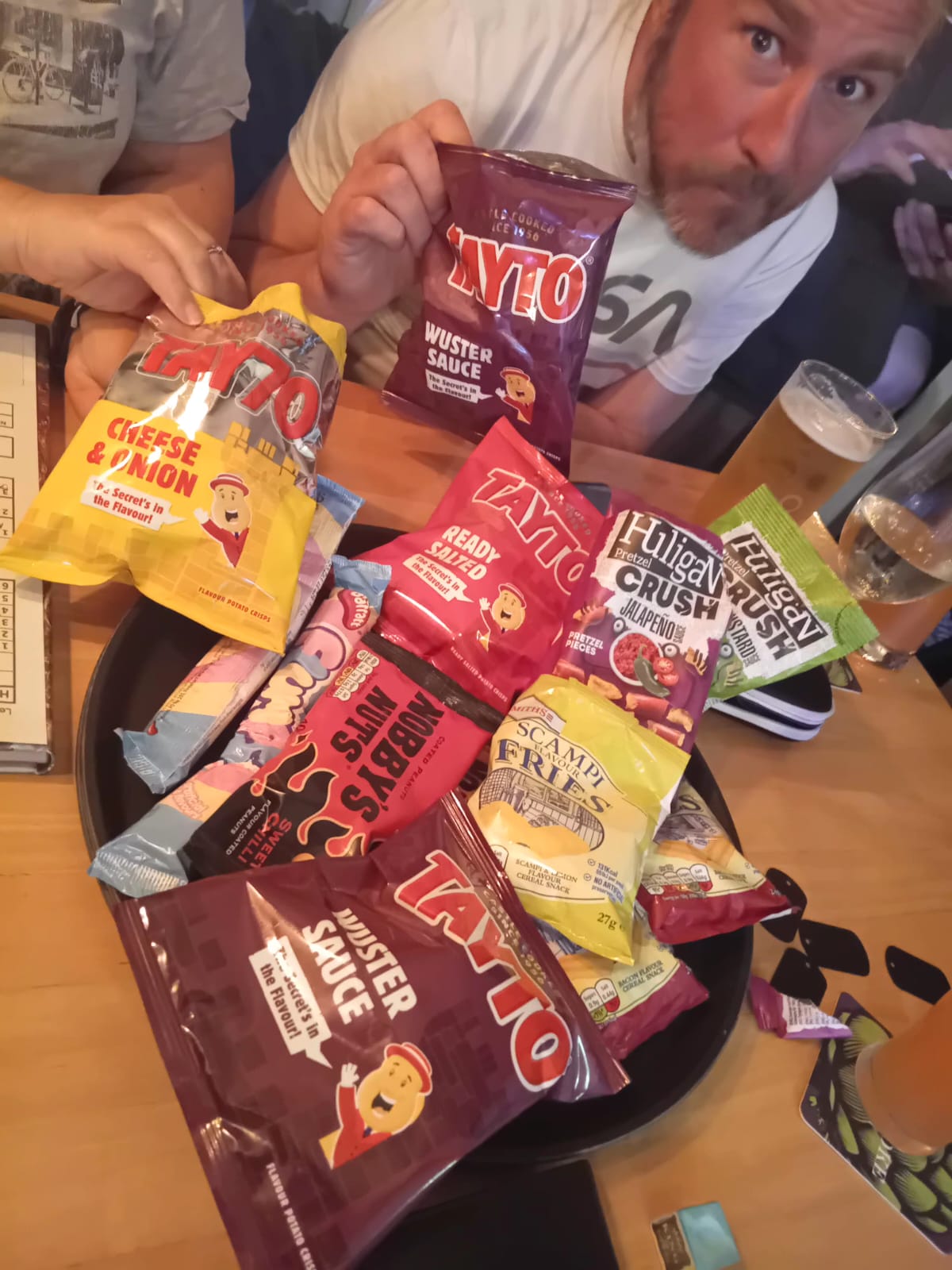
    The final result, 5-4 to the Artichoke Hearts. Anyway, the Serengeti are a fine team, the games were very close and they were unlucky not to come out ahead. But, that’s enough praise, we all had a lovely time and at least I know we won’t end the season on zero points. And I had an excuse to pop to the Weaver’s and the King’s Head afterwards to settle my nerves. The main thing is though there’s lots of great people involved, it’s a fun thing to do and if anyone is interested in coming along to watch, please do! The next match is at home to the Black Stars next week and they are known to be pretty formidable. I’m wondering if we could have a strategy of overdosing them on bar snacks, that might be our best plan here.

  • Norwich – Anglia Square Demolition (22 April 2026)

    Norwich – Anglia Square Demolition (22 April 2026)

    I was walking by the other side of the Anglia Square development yesterday and realised I could see the cathedral from Edward Street for the first time now the demolition is progressing. And the whole lot is now coming steadily down, so there might be posts every couple of days now to excite and delight my two readers.

  • Cologne – Kölnisches Stadtmuseum (Leper Relief)

    Cologne – Kölnisches Stadtmuseum (Leper Relief)

    Melaten is Cologne’s great cemetery, but before it became a nineteenth century burial ground, the area was associated from the twelfth century with a medieval leper hospital and the communities pushed to the edge of urban life. This relief from around 1629 is a small but rather direct reminder of that older rather hidden history, as lepers were not at all welcome in the city centre. As is visible in the relief, any lepers who were potentially getting close to others were expected to shake a rattle to alert everyone as to their presence. Seems rather less than ideal for those with leprosy, especially as it isn’t actually that contagious.

    Leprosy was not just a slightly sub-optimal medical condition in the medieval imagination, but a moral and communal category as well, wrapped up in ideas of sin, contagion and charity to try to mitigate the guilt. It’s something of a reminder that although the inhabitants of the leper hospital were to be helped and prayed for, they were also going to be shut away.

  • Cologne – Hahnentorburg

    Cologne – Hahnentorburg

    The Hahnentorburg is one of the surviving medieval city gates of Cologne and it does look quite impressive from this side. It was built in the thirteenth century as part of Cologne’s vast defensive wall and it once marked the western approach to the city. The twin rounded towers and heavy basalt base do suggest strength, but the gate is today looking a little adrift in the landscape.

    I think it’s fair to say that this postcard showing the gate at the turn of the twentieth century does make it look rather more impressive. Unfortunately, the gate was badly damaged during the Second World War, so the whole arrangement is today somewhat less decadent.

    This is the other side of the gate today, it has very much lost its former glory. But, it has stubbornly held on when other city gates have been entirely lost and it’s a useful reminder of the street layout that Cologne once had, somewhat now battered by post-war developments.

  • 200 Years Ago in Norwich : Death of John Hammont Cooper

    200 Years Ago in Norwich : Death of John Hammont Cooper

    This news article appeared in the Norwich Mercury 200 years ago this week, although it had evidently taken them some time to hear of the news.

    “In August last, on board the Honourable Company’s ship, Vansittart, on his passage from Bombay to China, John Hammont Cooper, aged 17, youngest son of T. H. Cooper, Esq. late of North Walsham, most sincerely lamented by his family and friends.”

    In situations like this, I find it intriguing what a young man from the North Walsham area would have been doing travelling from Bombay to China at this time.

    The Vansittart was a merchant ship owned by the British East India Company and at the time, although for not much longer, they had a monopoly in terms of their UK trade with India and China. The ship had launched in 1813 and John Hammont Cooper went on its seventh voyage.

    The ship left Downs (a shipping area of the North Sea) on 9 January 1825, bound for the Cape, Bombay, and China. The ship reached the Cape on 13 March, and Bombay on 31 May. It left Bombay on 11 August, and arrived at Whampoa, Hong Kong, on 1 October 1825. That was the section of the journey that Cooper didn’t complete.

    John Hammont Cooper had been born on 24 December 1807 and was baptised on the following day which was quite festive. He was the son of Thomas Hammont Cooper and Mary Vernon. The family don’t appear to have been hugely wealthy, although they did own some land in North Walsham.

    Thomas Hammont Cooper was a Captain-Lieutenant in the Norfolk Militia Western Regiment, a rank now abolished and this was more of a Dad’s Army type set-up in case the French invaded North Norfolk. However, Thomas wrote two books on infantry and military work, so he must have had some military knowledge.

    One thing I’ve never much thought about, as this doesn’t impact on my daily life, is how many people would be on one of these ships. It seems that they might have a crew of 100 people and would take 50 or so passengers, although the numbers varied widely. Unfortunately, the crew and passenger lists aren’t available for this journey, so it’s not clear to me whether Cooper was a passenger on some commercial trade, whether he was crew or whether he was some sort of military presence on board.

    But, either way, this must have been some considerable adventure…..

  • Norwich – 1905 Lame Mare Owned by Artichoke Owner

    Norwich – 1905 Lame Mare Owned by Artichoke Owner

    Just a random article in the 5 October 1905 about the then landlord of the Artichoke pub in Norwich.

    “At the same Court, Frederick Sinclair, the Artichoke, Magdalen Gate, Norwich, was summoned for working a mare in an unfit state.—Inspector Adams said the mare was very lame and not fit to be driven. The animal was suffering from sprained tendons.—Defendant admitted that the mare was not in a fit state to be driven when the Inspector stopped him, but he contended that he (defendant) saw the lameness as soon as the Inspector, and was then about to turn round. He sent the animal home by train.—After further evidence, the Chairman said the Magistrates believed there was a doubt about the case, and defendant would have the benefit of it. The case was therefore dismissed.”

    So many questions….. I’m disappointed that it’s not clear in the newspaper article where this mare was discovered. Just popping it on a train home seems like something off a faff and it’s certainly not a service offered by Greater Anglia at the moment. There’s sometimes not enough space for bikes, let alone mares with sprained tendons.

    And which railway station? Maybe the now closed Norwich City railway station which would have been the nearest to the pub. And I can imagine that Frederick Sinclair would have been most annoyed by the intrusion into his day, especially as the case was dismissed when he went to court.

    • – as I became intrigued by this case, I looked into it more and it transpired that Sinclair wasn’t with the mare when it was stopped and he claimed that it hadn’t been in pain when he had last seen it. And the mare had reached Great Yarmouth, so that resolves which train it was….
  • Cologne – Schnütgen Museum (1640 Painting of Cunibert)

    Cologne – Schnütgen Museum (1640 Painting of Cunibert)

    In the centre of this painting is Cunibert, or Saint Kunibert, who was a seventh century bishop of Cologne and one of the more important church figures in the Frankish Rhineland. He was bishop from roughly the early 620s until his death, usually dated to around 663, and he also seems to have played a political role at the Merovingian court. That was seemingly quite common for senior bishops of the period across Europe, who were expected not merely to pray and look solemn, but also to help hold together the fragile early systems of governance.

    I was a bit muddled up at the museum as I couldn’t work out which one was Cunibert, but the artist has done a bit of a job lot of Cuniberts here, so he’s in the artwork twice. This time he’s looking pleased having discovered the tomb of St. Ursula in the church of the same name, which is where this painting is on loan from. There was a medieval story that Ursula walked about with 11,000 companions, but this story isn’t taken particularly seriously by anyone today. I can’t imagine why…. The artwork was painted for the church in around 1640 and perhaps it is the skull of Ursula that has been discovered which is exciting and delighting them.

    That seemed to me to be the most interesting thing about this arrangement, a reminder of two of the most important saints in the city, asserting the power of the church and its reason for existence. And this was at a time when work had been stopped on Cologne Cathedral, religious continuity was not guaranteed…..