
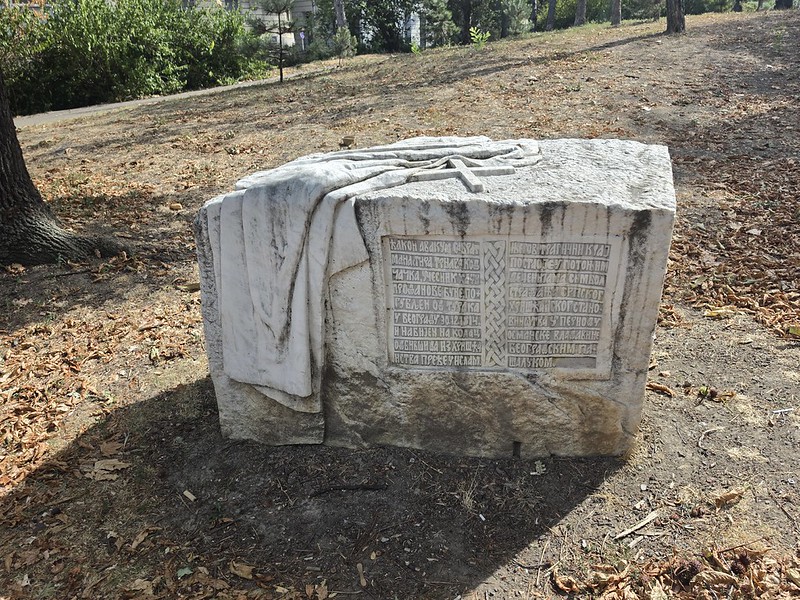
I had to look up this stone monument after seeing it in Little Kalemegdan, a habit I have of continuing to photograph unidentified pieces of masonry and then ask questions afterwards. It commemorates Deacon Avakum, a young Serbian Orthodox monk associated with Trnava Monastery near Čačak. The monastery played a part in the unsuccessful Hadži Prodan uprising against Ottoman rule in 1814, after which Avakum and a number of other Serbian Christians were arrested and taken to Belgrade.
According to Serbian Orthodox tradition, the Ottoman authorities offered to spare Avakum’s life if he converted to Islam. He refused and was executed by impalement on 30 December 1814. He was only about twenty years old and was later canonised by the Serbian Orthodox Church as a martyr. His refusal to renounce his faith, despite knowing the appalling death awaiting him, was an extraordinary act of courage. There’s also a story that not only did his snub the demand to convert to Islam, but he carried the stake intended for his execution whilst singing.
Unveiled in 2009, the understated memorial consists of a roughly cut stone block topped by what appears to be a carved religious garment or shroud and an Orthodox cross. Its inscription describes Avakum’s death as a symbol of the suffering experienced by Serbian Christians under Ottoman rule. It does not stand on the precise site of his execution, which is believed to have been nearer the former Stambol Gate around today’s National Theatre. I was pleased that I stopped to investigate it, although photographing a stone without knowing what it is and then making myself undertake several hours of historical research is essentially my entire travel blog business model and I like hearing about bravery.