And another in my meanderings into newspapers from 200 years ago…. In February 1826, the Anchor Inn on Surrey Street was for sale at a public auction held at the Swan Inn in the city.
The auction listing said:
“An excellent freehold public house called the Anchor, with a cottage adjoining, in the parish of St. Stephen in Norwich with a frontage of thirty feet on the best side of Surrey Street. At the back of the house is a wash-house and a large yard and garden, well adapted for building.
This is now in the occupation of Messrs. Finch, Brewers and their under-tenant Robert Ramsey, and the Widow Tee. Land tax £2 2s. 0d.”
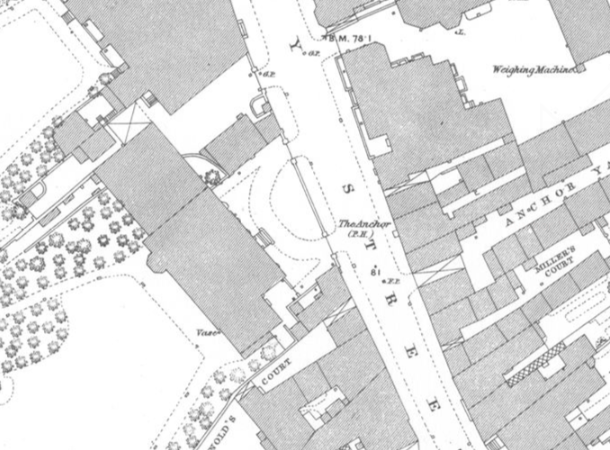
There’s the Anchor, although all of this on the north of Surrey Street has been trashed by the generic buildings (this one now known as Rosso) put up by Norwich Union and so nothing remains. It was located pretty much opposite the current entrance to the bus station.
The pub itself continued trading until 1913, having later been taken over by Steward & Patteson Brewery, although the building itself survived until after the Second World War. I think there’s only one photo surviving of the entrance to Anchor Yard, named after the pub, which is at http://georgeplunkett.co.uk/Norwich/S/Surrey%20St%2018%20to%2020%20[1027]%201936-06-14.jpg. I assume that’s the former pub building in the photo, although this photo is from 1936, so twenty years after the pub closed.
I have written about this pub before when I visited in 2021, but I’m not going to let that stop me from writing about it again. I was in Leeds again in the middle of January 2026 because of an LDWA meeting and I’ll add that I visited a number of independent craft beer and Good Beer Guide listed pubs at the same time.
I won’t repeat the history of the venue as I wrote about that in my last post, but, it was formerly a bank and that’s what they named it after.
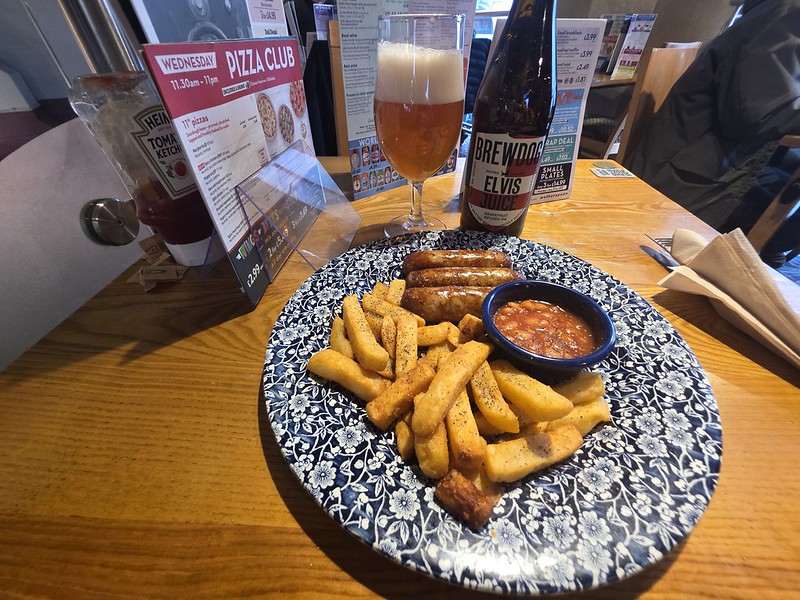
The sausage, chips and beans was just £7.05 including the large bottle of Elvis Juice from Brewdog, so it’s hard to complain about the value being offered here.
I perched myself upstairs in the hope of some Hogarthian (of the William Hogarth type) debacle happening down below. Nothing of that nature occurred.
And my now obligatory carpet photo. Yes, I know that I need to get out more. Once again into the reviews section as I always like the treasures that this can uncover. The reviews for the venue are towards the higher end of the scoring for a JD Wetherspoon pub, so all seems generally well.
“Staff served meals however no drinks, I had to tell 4 Staff members about the drinks and even then I had to go downstairs and collect while my meal was going cold.”
In fairness, this happened with my meal. The food arrived just five minutes after ordering, which is slightly ridiculous really, whereas the drink took eight minutes. It plays havoc with my trying to take photos for Untappd. And, yes, I know there’s more to the world than Untappd.
“I ordered the Shawarma Chicken Topped Chips via the Wetherspoons app. The menu said the dish included sauces, but nowhere did it say the sauces would be drizzled all over the food. I couldn’t eat it and asked for it to be replaced or refunded — the manager refused and blamed me for not asking beforehand, despite there being no option to do so on the app. I also selected a straw for my drink in the app, but staff told me they don’t have any straws at all. I contacted customer services, and after a few dismissive replies, they told me they were closing the complaint — without addressing my key points.”
I do feel a little sorry for the manager, having to throw away food because of queries like this after the food is delivered must be quite painful. Although perhaps JD Wetherspoon might just have to relent and show photos of every single dish in the app for those who don’t want to ask at the bar….
“Wall decor with a biography on ‘Cuthbert Brodrick’ led us to believe this was the pub we were in since that was one of the close by options according to our location. We had no menus to tell us otherwise. When our drinks did not came, we went to the bar and asked about them, and we were told that the pub had never received our order, so we showed them the app. They explained that we had ordered to the wrong place and that, despite the misleading decor, they would not refund or replace the drinks.
Normally, I’d agree that selecting the correct location is the individual’s responsibility, but the decor directly in our eyeline matched with the name of an option on the app. Since each location of Wetherspoons has unique decor based on the location’s history, and further due to the inavailability of menus to confirm the location, we certainly felt that weren’t totally to be blame. When I contacted customer services, I asked only for acknowledgement that the decor was misleading, but the company refused to say as much and closed the matter. Wetherspoons does NOT value its customers – we have, like many, been going since our teens for both food and drink – but over £15, I will never go to any of their locations again, and I suggest you don’t, either.”
Much as I think the ordering system is actually really robust with all of its multiple warnings about location, the pubs are only a three minute walk away from each other so I think I would have rushed to the other one to try and salvage my food and drink….
“We ordered some chicken bites, we ate them but were vod. We only ate as was starving and waited 45 minutes for the food. My partner ran to the toilet 15 min after eating and was sick and spent 25 mins on the toilet. I told a female manager and she said, what do you want me to do. You can’t get food poisoning that quick . She was dismissive, rude and had a bad attitude”
That would be bloody fast food poisoning to be fair to the manager….
“Was told by security I couldn’t take my chicken bites outside (I understand alcohol. But chicken bites). Why dont I leave my food unguarded in a spoons (That is a great idea). At worst, you will come back to no food. Well, I guess I won’t be going back. Staff were nice, but security lets it down. I would not recommend when security is at the door. Btw the chicken bites are nice.”
I like this review as they’ve left 5 stars for the food.
Anyway, I digress once again. Everything else was good with the pub, it was clean, seemingly well managed and I was happy with the value for money. And with that, I felt the need to go to a craft beer bar for balance.
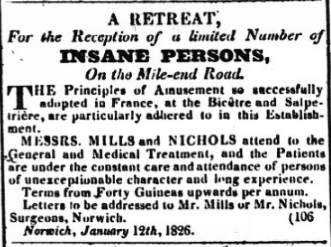
On my series of articles from Norwich newspapers of 200 years ago, there was an advertisement posted by two surgeons, Mills and Nichols, in the Norwich Mercury in February 1825. They were planning to open an asylum for “insane people” on Mile End Road, which is just off Newmarket Road in the city. They were intending to charge 40 guineas a year for treatment based on that from the Pitié-Salpêtrière Hospital in France.
What interests me about this pair, and this is another rabbit hole I’ll likely get lost in at some point, is that later in 1826 they opened their dissecting rooms in what I assume were premises nearby. This is in the period before bodies could legally be acquired in any number, so until the 1832 Anatomy Act, they were mainly sourced by body-snatchers. And on this, I can only suspect that Mills and Nichols were sourcing bodies in such a fashion. I will endeavour to find out more…..
Back to 200 years ago, as I’ve been neglecting this series of posts….
This is an article about the “State of the City” from the Norwich Mercury from February 1825, which I’ve pasted below. It shows just how tense matters were in the city, as the weavers in Norwich were upset by work being sent out to countryside where they suspected it was being completed for lower wages.
The manufacturer on Elm Hill found that their stock was destroyed, their premises smashed up and the rioters then ran amok damaging other locations in the city. The authorities acted in a robust manner to try and take back control, but manufacturers also decided to make a promise not to send any more work outside the city to try and calm the situation.
The magistrates took action anyway, they didn’t want a repeat of such occurrences in the city and they promised to take the firmest action possible against the rioters. And they were right to be concerned, the weaving trade was in a state of continued decline in Norwich and ultimately much work ended up being shipped out to Yorkshire in the 1830s. The 12,000 or so looms in Norwich in 1800 fell to under half that level by 1830, it was the beginning of the end of the trade that had led to so much wealth in the city.
“During the last few years, while the manufactures of the city have been in great and constantly increasing demand, the masters have been necessitated, notwithstanding the vast emigrations that have taken place from the country to the city, to send a large quantity of work into the country, where it has been manufactured. Great jealousy has existed for some time past between the city and country weavers, not only on this account, but because it was generally reported and as generally believed, that the wages were much less. The almost entire want of employment pervading the weaving population has turned the attention of the weavers to this point. The consequence has been, that on Tuesday evening about seven o’clock, having some suspicion, from seeing the Forncett carrier’s cart standing against the warehouse of Mr. Wright, a manufacturer, on Elm-hill, that he was about to send some work off to the country, the carrier was watched and seen to enter the warehouse with goods, but on his coming out, it was discovered that he was about to carry away a quantity of work. The weavers, who were assembled in a large body near the spot, drove away the cart, and after taking out the horse, completely destroyed it. They then as directly broke the windows in Mr. Wright’s factory.
Almost at the termination of these proceedings, Mr. Ald. Francis (the Deputy Mayor), Sheriff Brooks, J. J. Gurney, Esq. and several other gentlemen, came down to the spot, when Mr. Francis addressed the persons assembled, saying that every thing should be done for the purpose of relieving them, and requested their immediate and peaceable return to their homes. This address was received by them with loud shouts, and they quietly dispersed. On Wednesday morning a large body of weavers proceeded to almost all the public-houses from whence the carriers set out, and searched the carts. Some materials for work were found, and directly deposited in the Sword-bearer’s office, in the Hall—but we have not heard of any damage having been sustained either by carriers or innkeepers. The principal part of the day was thus passed, until between six and seven o’clock, when a large body of men came from Eaton, near this city, where they had seized some yarn. This they carried to the Hall, from whence they proceeded to Messrs. Willett’s factory, in Pottergate-street, where (these gentlemen being suspected of sending work out of the city) they demolished not only the windows, but the frames of the lower rooms.
Messrs. Bullamore and Hawkins’ warehouse, in Magdalen-street, Messrs. Bolingbroke’s, Brownfield’s, Willement’s, Herring’s, and several other houses, were visited, at each of which the proprietors were called for and questioned, both as to the quantity of work each had in the country, and as to whether they intended to send any more into the country while the citizens were unemployed. Answers to these questions having been satisfactorily given, no violence was offered. Mr. Purdy’s warehouse, in Peacock-street, was also very seriously damaged.
After the populace had been to the warehouses of the gentlemen we have mentioned, they proceeded to Mr. A. Beloe’s factory, St. John’s Timberhill, where, unfortunately Mr. Beloe being absent in London, and no person being present to address them, they immediately broke nearly all the windows of this extensive building, which is four stories high. The Deputy Mayor came about this time to the scene of tumult, where he immediately read the Riot Act. The market place then became thronged with people, where the Riot Act was again read by Mr. Francis, and a number of special constables sworn on. It was then deemed necessary to send to the barracks for the Scots Greys. Col. J. Harvey addressed the persons assembled upon the impropriety of their conduct, both at Mr. Beloe’s, in the Market, and on the Castle Ditches, and recommended their immediate return to their homes. At the Hall great discussion among the Magistrates took place upon the propriety of the Dragoons being sent for; fortunately there was no necessity to employ them. A party of special constables were sent to each of the manufactories, and the rest of the night was passed in quietude.
In the early part of the day, while very many weavers were assembled in the Market-place, they were addressed by Mr. Alderman Francis, who promised that he would call a meeting of the manufacturers, and urge the necessity of their not sending any more work out of the city while it was in its present state. Pursuant to this promise, many of the principal manufacturers met at the Hall—J. Harvey, Esq. the High Sheriff, (the chairman of the committee of manufacturers in this city) in the chair, and it was unanimously agreed that they would send no more work out of the city, and a paper was sent round for the signature of such manufacturers as were not present. After this was agreed upon, a deputation of the weavers were called in and acquainted with the fact.
The city on Thursday morning exhibited an unsettled and stormy appearance, and in the streets during the whole day were to be seen numbers of idle hands. In the morning the magistrates sent officers to summon every respectable inhabitant to the Hall for the purpose of swearing them on as special constables. A very large number were sworn in during the afternoon, and at half-past five they assembled, in case any fresh disturbance should take place. About four o’clock a part of Colonel Harvey’s Yeomanry Cavalry marched up to the Hall, where they received orders to proceed to Mulbarton, and put themselves under the direction of Dr. Beevor, the magistrate at that place, as it was surmised by the magistrates that Mr. Beloe’s factory there might be attempted. Shortly afterwards the Mayor issued the following bill:
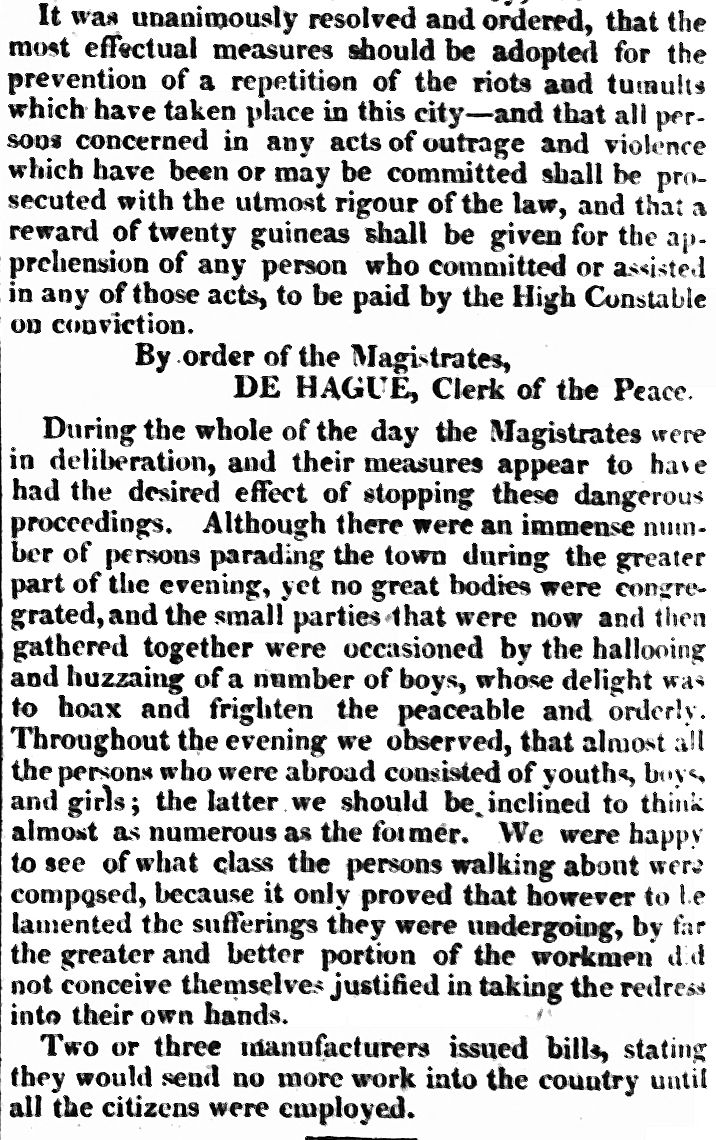
Twenty Guineas Reward.—At a meeting of the Magistrates for the city and county of Norwich, held at the Guildhall on the 2d of February, 1826— It was unanimously resolved and ordered, that the most effectual measures should be adopted for the prevention of a repetition of the riots and tumults which have taken place in this city—and that all persons concerned in any acts of outrage and violence which have been or may be committed shall be prosecuted with the utmost rigour of the law, and that a reward of twenty guineas shall be given for the apprehension of any person who committed or assisted in any of those acts, to be paid by the High Constable on conviction.
By order of the Magistrates, DE HAGUE, Clerk of the Peace.
During the whole of the day the Magistrates were in deliberation, and their measures appear to have had the desired effect of stopping these dangerous proceedings. Although there were an immense number of persons parading the town during the greater part of the evening, yet no great bodies were congregated, and the small parties that were now and then gathered together were occasioned by the hallooing and huzzaing of a number of boys, whose delight was to hoax and frighten the peaceable and orderly. Throughout the evening we observed, that almost all the persons who were abroad consisted of youths, boys, and girls; the latter we should be inclined to think almost as numerous as the former. We were happy to see of what class the persons walking about were composed, because it only proved that however to be lamented the sufferings they were undergoing, by far the greater and better portion of the workmen did not conceive themselves justified in taking the redress into their own hands.
Two or three manufacturers issued bills, stating they would send no more work into the country until all the citizens were employed.”
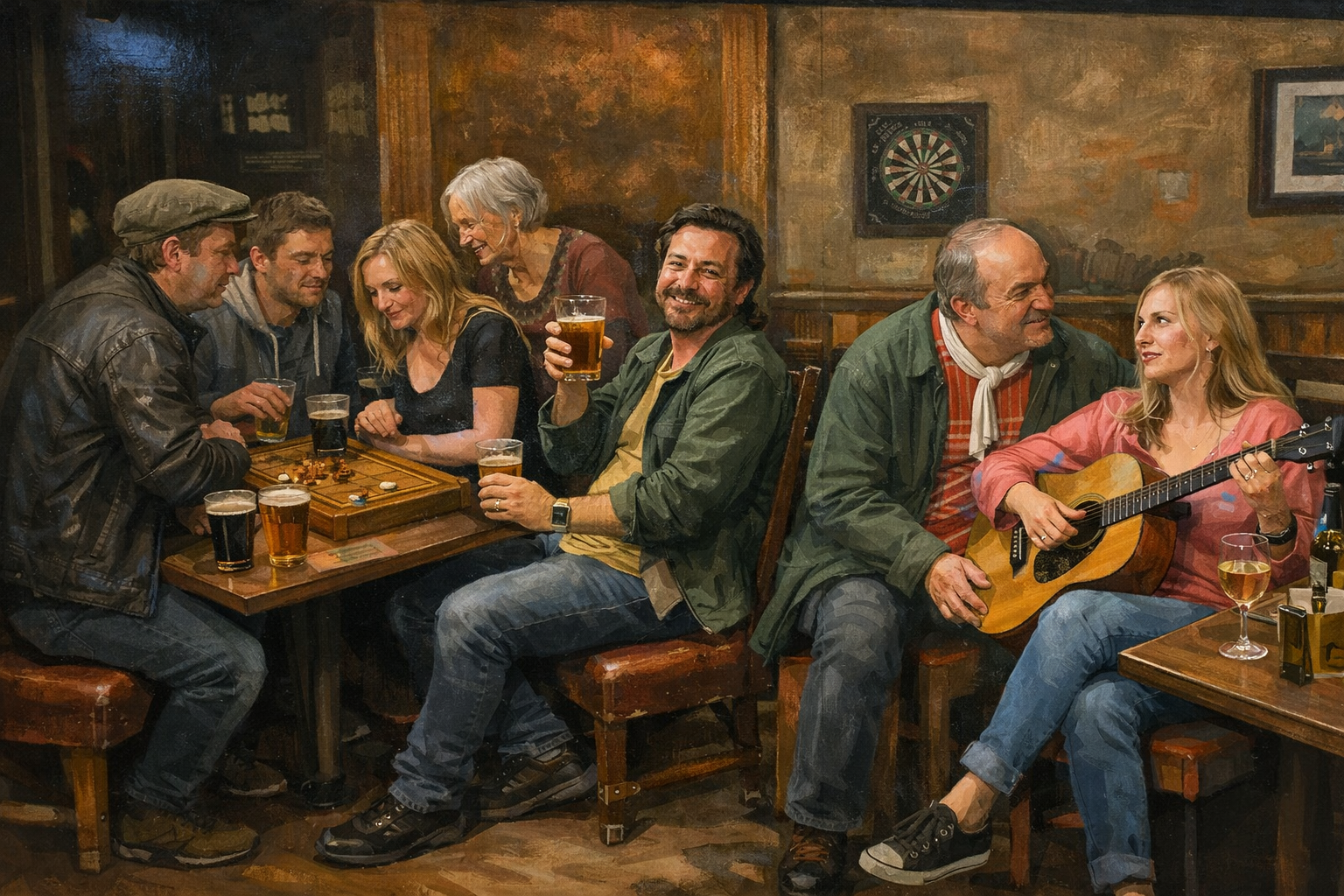
The gallery doesn’t know who painted this, but it’s likely a Dutch painter from the middle of the seventeenth century. Although that’s not what amused me about this, it’s just imagining what a modern scene would look like. I do like just how many paintings there are from this period from within Dutch and Flemish taverns. Incidentally, I don’t like the painting’s name of ‘Feast’ given the lack of food, but I suspect that this might be a slight translation issue.
AI comes to the rescue here (and my new caveat of I’m aware of the limitations and challenges of AI, but I like its contribution to knowledge) at modernising the painting. Bringing a guitar wouldn’t go down well in quite a few pubs, but it’s not a scene that would be entirely unrecognisable.
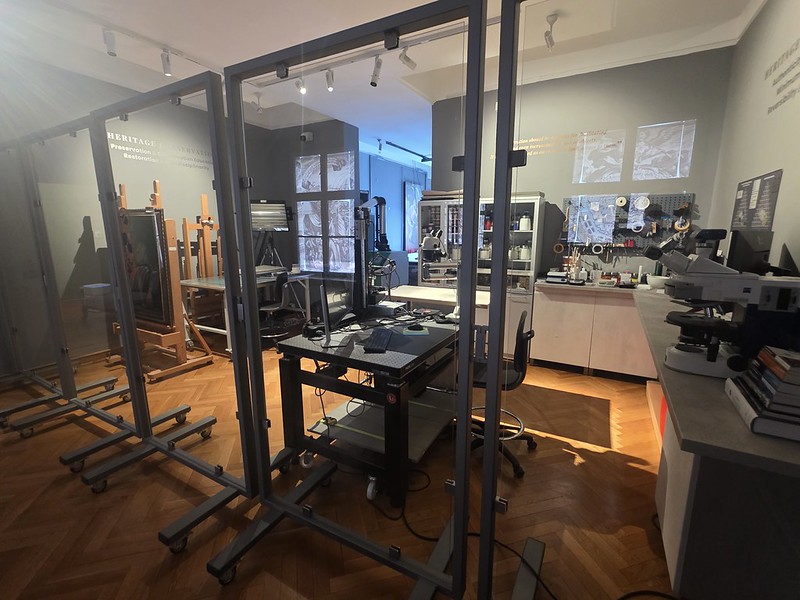
This is the VRL room, or in short, it’s a restoration area which is visible to visitors to the gallery. The text in the above image reads:
“The Visitable Restoration Laboratory is the first painting restoration laboratory in the narrative circuit of a permanent exhibition in Romania and the Euroregion and is integrated in the Zsigmond Ormós Gallery alongside works of art of international importance. The mission of the laboratory is to open up insights into the behind-the-scenes of the museum and to show the unseen side of the museum’s work, where science and art work together for the benefit of our memory, community and history. The pedagogical dimension of this laboratory, the workshops, activities and cutting edge equipment (advanced microscopy, multispectral technology, low pressure table with thermosetting etc.) in the workshop’s equipment create a dynamic window to and from the public, attracting various categories of visitors who are drawn to accompany the museum team on the path of interdisciplinary knowledge, to become aware of the importance of research and in-depth understanding of the artefacts that have been passed down to us with responsibility through generations of remarkable people, from Zsigmond Ormós onwards, to Ioachim Miloia and Aurel Ciupe.”
I do like this as it’s interesting to see the inner workings of an institution, although I can’t help but think that the staff think this is a bit of a nuisance to be live exhibits. They were working in the area at the back otherwise I’m not sure I would have taken this photo. It must be somewhat distracting to be trying to research something carefully with a hoard of visitors standing there gawping in. It shows transparency though which can only be a good thing.
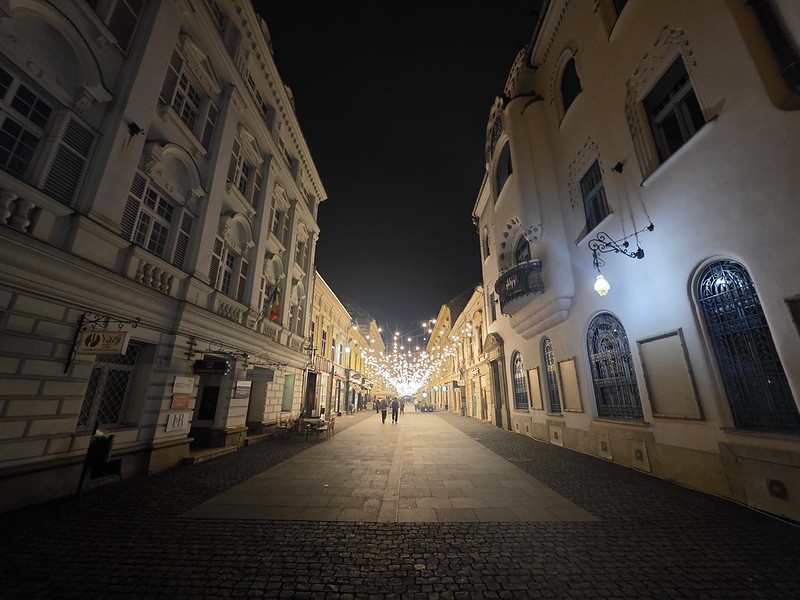
There are many old grand palaces in the city, many in a state of disrepair, but things seem to be getting better as many have been repaired. There are some impressive pieces of architecture, much of which was from when this was a city in the Austro-Hungarian Empire.
The city was the European Capital of Culture in 2023 and there was a substantial investment in art funding, historical boards and improving facilities. This signage is a reminder of that event and the city was perhaps fortunate that the UK left the European Union, as 2023 was the year that the city chosen would have been in the UK.
Around a five minute walk away from the city centre is this large development of offices, residential and retail. There’s a large shopping centre and it’s all on-trend and exciting, clearly an area where a huge amount of money has been pumped in.
This lounge opened around 100 minutes before the sole flight of the day departed, so I can’t imagine that they’re making a great deal of money from this arrangement. It’s the Horizons Lounge and this photo shows most of the lounge, the door is to the left, the coffee is behind me, the little payment area is to the right and the main seating area is ahead.
The seating area which overlooks the airport apron. There were three passenger groups in here, so it wasn’t busy, but it also had some atmosphere. It was clean and tidy, although I did wonder whether they could have got some tables that didn’t look like rubbish bins.
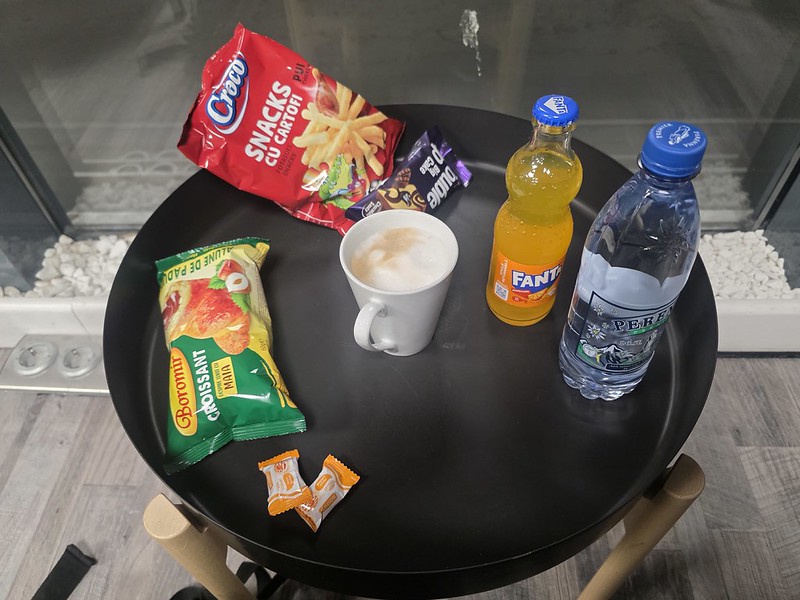
There was something of a reliance on pre-packaging snacks and I’m not going to complain about a lounge which has lots of crisps, biscuits and chocolates. There’s also a coffee machine to the left which proved useful given how early in the morning it was. There was a beer available in the fridge, but I really wasn’t in the mood that early.
Well, there we go, what more could I want for breakfast?
I was impressed that the airport had opened this lounge up, there are some reviews which said it opened late or not at all, so my expectations were limited. The reviews are broadly low for the whole arrangement, but I suspect that some passengers expected sandwiches, caviar and a selection of fine wines, but that’s not going to be realistic when there’s one flight a day.
I booked a taxi to the airport which picked me up from the Euro Hotel at 03:00, which is earlier than I would have ideally liked. Indeed, this was so early that my friend Julian was still in the pub in Norwich to keep my company via WhatsApp during this little journey. Excuse the blurred photo, but I rather like it in a strange way.
I booked the taxi with Uber and it was there within three minutes, which did surprise and delight me. The cost quoted for the 25 minute journey was just £3.05 which very much pleased me.
We arrived before terminal one, where I was flying from, had even opened.
I walked the 25 metres to Terminal 2, where there was a bit more going on. Not much more to be fair, but they had lights.
It was a little frosty outside, just the sort of temperature for my temperament.
Terminal 1 was dark, empty but warm.
I had arrived around two and a half hours before my flight, which I already thought was cutting it fine.
Once the lights finally flickered to life, the transition from a dark warehouse to an active terminal was almost instantaneous.
This was not a busy terminal, there was a grand total of one flight departing for the entire day. At this point, I went through security and all was well, before getting a chance to pop into the lounge, but I’ll post about that excitement separately.
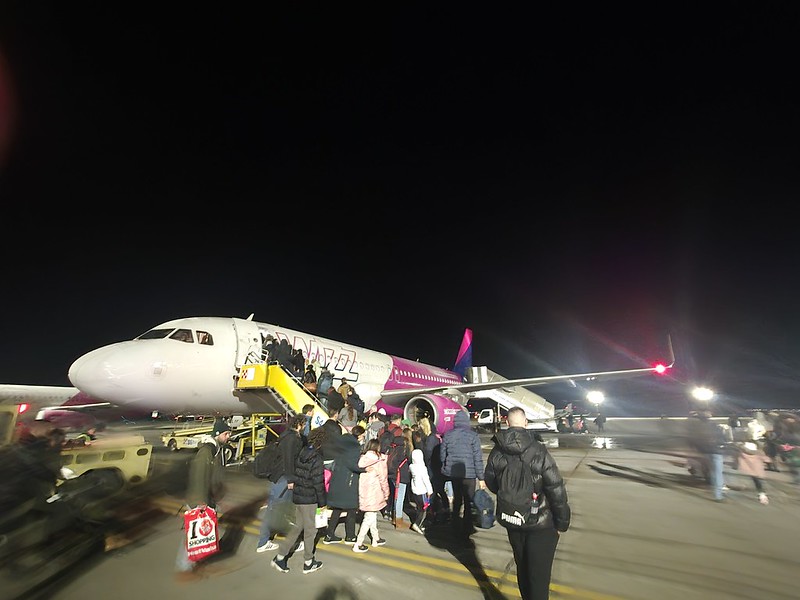
And waiting to board. The boarding process didn’t feel very organised in terms of priority and non-priority passengers, but I’m not sure that it made much difference in the grand scheme of things.
After the plane had been de-iced, we were able to board and we were on schedule. The aircraft is HA-LYF, not one that I’ve been on before although they do all look quite alike….
I had enjoyed my three nights in Timișoara, the first time that I’d been there. I wasn’t keen on the early morning flight, but at least it allowed me to get back to London Luton at an early hour.
The seating Gods had given me a middle seat, but I was pleased to board and find that a group of lads wanted to sit together and one politely asked if I would take his window seat a few rows forwards. This was a very agreeable situation, it meant that I was able to sleep for just about all of the flight.
The cabin crew, who were polite and helpful, kept the cabin dark for about an hour. I was aware that they did a trolley run, but they were quiet and efficient, so they were able to sell what they needed to without disturbing everyone. I find that Ryanair can be just a little less subtle.
And safely into London Luton Airport, always a delight. Well, sort of. Because of the time difference, we landed at around 07:00, which gave me the day to get back to Norwich thanks to the car share arrangement that I have with my friend Liam. Anyway, another bargain flight for just £8.99.
This artwork is by the Austrian Anton Romako (1832-1889) and I think is noteworthy for the huge loaf of bread in the painting. The gallery notes that this is about realism and perhaps it’s the case that the painter is very good at painting bread, but even so, I can’t help wondering what exactly the mid-nineteenth century middle classes thought they were getting here. Perhaps a celebration of honest labour, a wholesome emblem of daily sustenance, or just a rather accomplished bit of bread painting, but the poor girl in the painting seems to be playing a rather unsupported role (excuse the pun) in the whole arrangement.
But, I digress, it’s Romako that’s interesting here as he travelled Europe widely and was something of a success as a painter. He had great sadness as two of his daughters committed suicide in 1887 and he never recovered from that, died in a state of some disarray in 1889. As an aside, some of Romako’s artworks were purchased by Jewish families and they were stolen from them during the Nazi period and ‘acquired’ by art dealer Wolfgang Gurlitt who it’s fair to say wasn’t the most wholesome of figures.
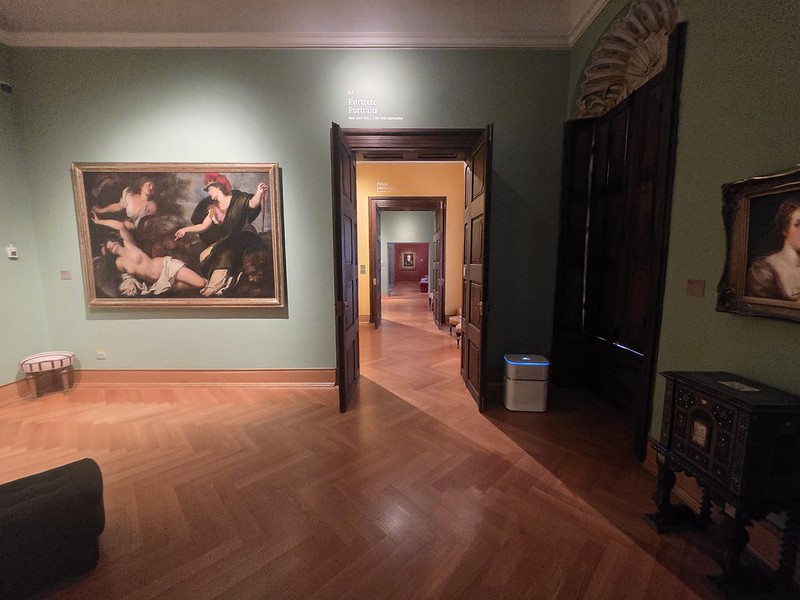
The gallery doesn’t have provenance information about their artworks on their website, but it’s likely from the collections donated by Ormós Zsigmond who was an art collector in the mid nineteenth century and he not only founded this gallery, but donated all of his collection to it.
















![http://georgeplunkett.co.uk/Norwich/S/Surrey%20St%2018%20to%2020%20[1027]%201936-06-14.jpg](http://georgeplunkett.co.uk/Norwich/S/Surrey%20St%2018%20to%2020%20[1027]%201936-06-14.jpg)