
An article which caught my eye from the Norwich Mercury which was published 200 years ago this week.
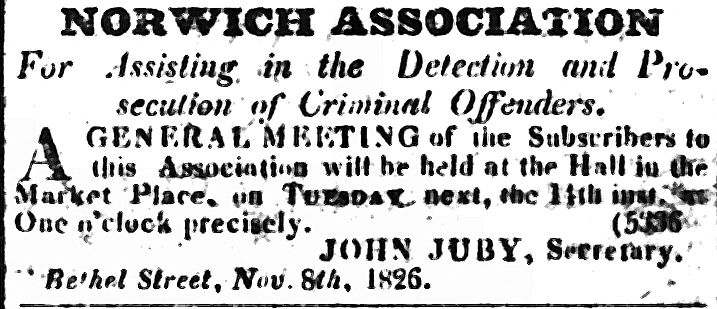
At one o’clock on Tuesday 14 November 1826, the subscribers to the Norwich Association for Assisting in the Detection and Prosecution of Criminal Offenders were due to gather at “the Hall in the Market Place”. One o’clock precisely, according to the notice in the Norwich Mercury, so arriving late would at least have spared anyone the experience of hearing the organisation’s name read out in full. Behind that rather substantial title was a practical question. If someone stole from you in Georgian Norwich, who was going to investigate and who was going to pay to bring them to court?
The association was then just short of its first birthday. Charles Mackie, who compiled his Norfolk Annals from the files of the Norfolk Chronicle, dates its foundation to a meeting at Norwich Guildhall on 23 November 1825. The Guildhall had been busy that week. Two days earlier, the Norwich and Norfolk Law Library had met there to adopt its rules and arrange somewhere to keep its books. The prosecution association gets a single sentence in Mackie’s account, but he gives its full name, the date and the building. The Guildhall is therefore also the most likely setting for the following November’s meeting, although the Mercury assumed its readers knew which hall was meant.
The important word in the advertisement is “subscribers”. Bringing a prosecution in early nineteenth-century England often fell to the person who had suffered the loss. A victim might have to pay for notices, offer a reward for information and engage a solicitor, all before knowing whether anyone would be convicted. Prosecution associations spread those costs among their members. There was a deterrent in the arrangement too. A thief might reasonably reckon that one householder would think twice about pursuing a modest loss. A group of householders who had already put money aside for the purpose was a different proposition.
For an idea of how this worked in Norfolk, there’s a surviving handbill from Aylsham, where 41 subscribers formed an association in December 1786. Each put in ten shillings and sixpence, with further annual subscriptions of the same amount payable if the fund needed replenishing. A member whose poultry, wood or turnips had been stolen was to tell the treasurer. He could have handbills printed, offer a reward payable on conviction and place an advertisement in the Norwich newspapers. Even an accomplice could claim the reward for giving information, and the association promised to try to obtain a pardon for him. It’s important to be pragmatic when there’s the possibility of a large turnip theft.
Each society decided what its members’ money would cover. Aylsham’s original association expressly excluded horse theft, whereas the Fakenham Association Against Horse-Stealers had its rules printed in Norwich in 1782. In 1825, the very year the Norwich body was founded, a new Aylsham and South Erpingham association specifically included horse-stealers in its title. The Norwich subscribers chose the much broader wording “criminal offenders”. I’m not entirely clear how broadly they interpreted that wording.
By November 1826 the Norwich subscribers had a secretary, John Juby, who issued the notice from Bethel Street on 8 November. It appeared in the Mercury on Saturday 11 November, giving members three days’ notice of the Tuesday gathering. The city’s arrangements for dealing with crime changed considerably over the following decade. Norwich formed its police force in January 1836, following the Municipal Corporations Act of 1835. Even then there was a distinction between policing Norwich by day and by night. The daytime establishment had eighteen ward constables and three additional men under a superintendent, while the night watch had thirty-two men with another six available. By the 1840s the watchmen had been incorporated into the force as night constables.
The arrival of a professional police force may have reduced the need for the association, although I haven’t established when it ceased operating although the Fakenham Association for the Prosecution of Felons was still offering a reward in 1858, on that occasion for information about grapes stolen from a garden. That sounds like quite the most sub-optimal of crimes to have to endure. But I’d quite like to go back 200 years to go to this meeting at the Guildhall although I’d likely sit in the back in case I managed to end up as the comms officer.