Tag: Rosary Cemetery

  • 200 Years Ago in Norwich : Rosary Cemetery Extended

    200 Years Ago in Norwich : Rosary Cemetery Extended

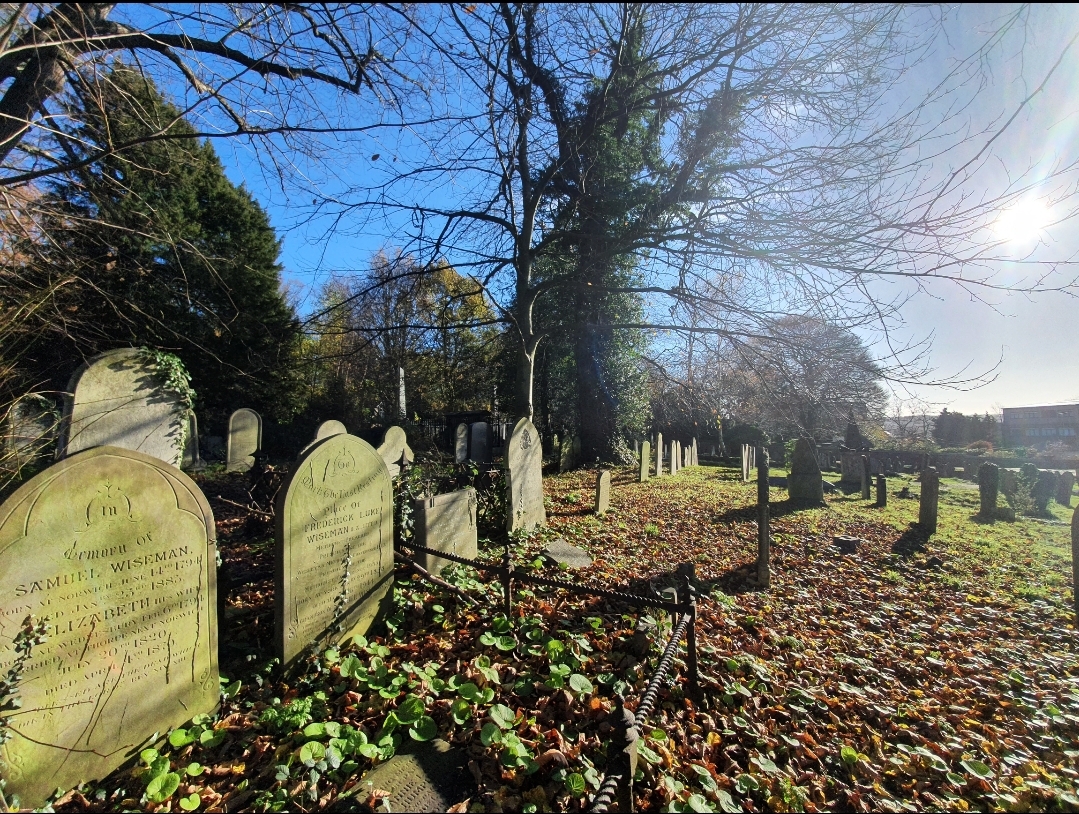
    And in my continuing series of posts from the Norwich Mercury of 200 years ago this week, there was an announcement about the extension of Rosary Cemetery. The cemetery was the first non-denominational one to have opened in the UK, with the first burial taking place in 1821.

    The shareholders had met at the Old Library Room at St. Andrew’s (now demolished) and they were pleased at the progress made in the first few years of the cemetery’s operation. The first few years hadn’t really stressed the gravediggers (although it made it easier to guard against body-snatchers), as there was one burial in 1821, two burials in 1822 and three burials in 1824 (goodness knows what happened in 1823).

    The decision made 200 years ago was very sensible as although their priority was actually keeping the church out of their affairs, there was to be a cholera epidemic in 1831 and the land at Rosary Cemetery was a useful overflow to church graveyards. And, in 1855, after a major national cholera epidemic, all new burials in churchyards were banned. The original five acres were filled by the end of the nineteenth century, so the additional land they had already acquired proved to be very useful.

    ROSARY BURIAL GROUND,
    NEAR THE FOUNDRY BRIDGE ROAD.

    At a MEETING of the Shareholders, held at the Old Library Room, St. Andrew’s, Norwich, on the 22nd of September, 1825:

    MR. THOMAS MARTINEAU in the Chair,
    Statements of the number of Interments since the appropriation of the Ground as a Public Burial Ground, and of the number of Shares engaged by individuals, having been read by the Registrar,

    IT WAS RESOLVED,
    That the Rosary, from its situation and the extent of ground belonging to it, is admitted to be well calculated for a permanent Cemetery, for persons of all denominations, and will be found of great benefit and utility.

    That from the number of Interments which have already taken place, and the number of Shares engaged, it is expedient the proper measures should be adopted for permanently establishing and securing the whole of the ground originally proposed for a Cemetery, without further delay.

    That the Solicitors be instructed to prepare forthwith the requisite deed or deeds, to be enrolled in Chancery, for vesting the Rosary Burial Ground in Trustees, to be held as a Public Place of Interment for ever, subject to the management of Directors, to be chosen from among the Shareholders.

    That notice be given, that applications for Shares remaining undisposed of must be made on or before the 27th day of October instant, on which day the list shall be closed.

    That applications for Shares be made to the undermentioned Shareholders: to Mr. Drummond, at the Rosary; or to the Solicitors, Messrs. Parkinson and Staff, St. Andrew’s, Norwich, of whom prospectuses of the plan may be obtained gratis.

    Mr. Thomas Martineau
    John Taylor
    Joseph Geldart
    Wm. Davey
    Thomas Hitchen
    John Athow
    Robert Blake, jun.
    Wm. Wilde
    J. Darken
    R. Miller
    Samuel Wiseman
    J. Mottram, sen.
    E. Cotman
    J. H. Balls
    G. Sothern
    Wm. Newson
    Thomas Hawkins
    Henry Bolingbroke
    George Kitton

    Mr. Isaac Wiseman
    J. Mottram, jun.
    Wm. Busley
    Manning
    E. Martin
    Hewett
    Rev. F. Tagart
    Mr. Wm Chapman
    W. Stark
    G. Grout
    C. Geldart
    Wigham
    E. Brown
    Carter
    Bluth
    R. Morgan
    Joseph Geldart, jun.
    N. Rue”
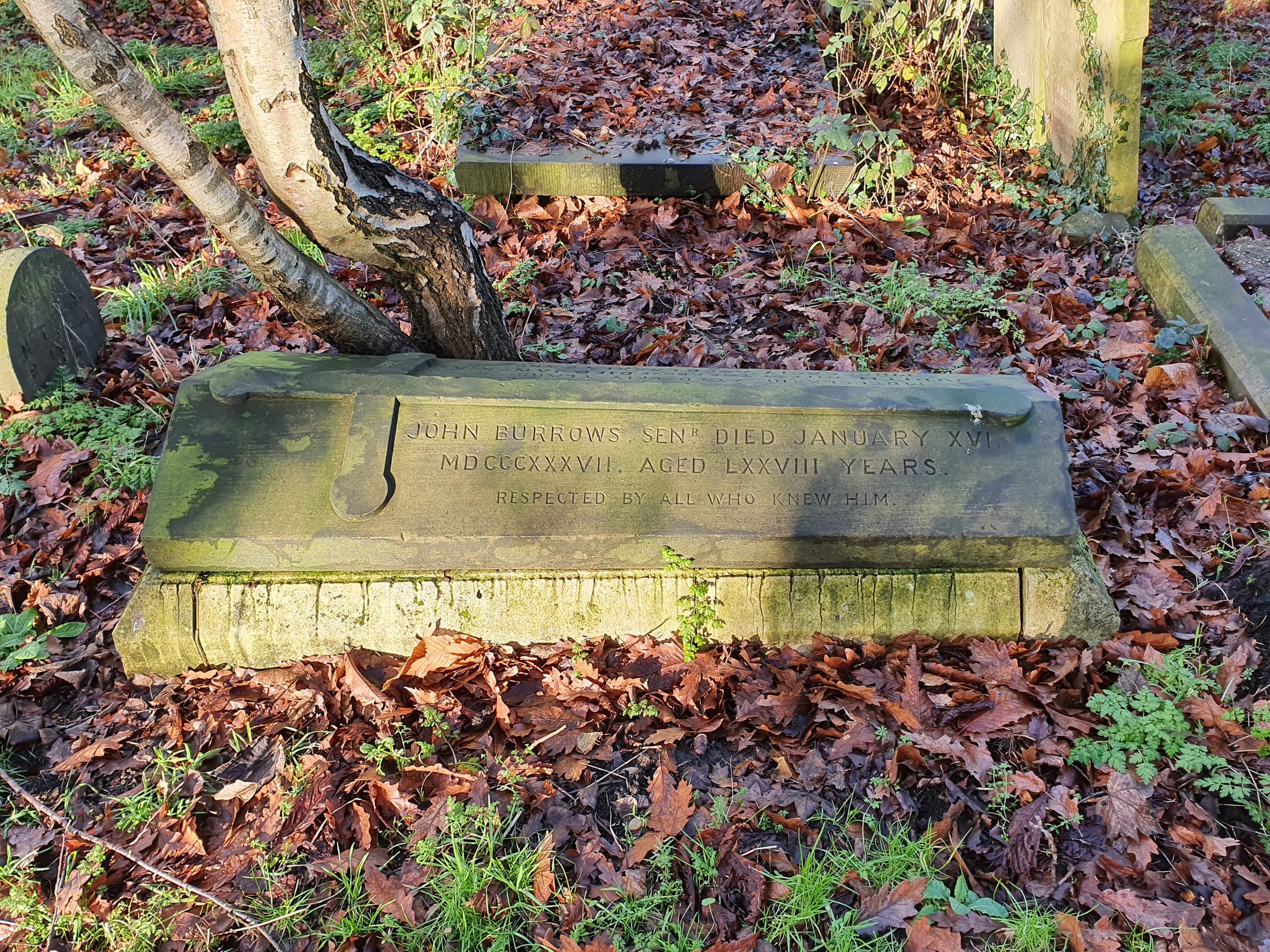
  • Norwich – Rosary Cemetery (John Burrows)

    Norwich – Rosary Cemetery (John Burrows)

    [This is a repost with minor amendments, I’ve tried again to find out more about John Burrows but have had no breakthroughs of interest]

    This grave at the Rosary Cemetery in Norwich caught my eye because of the use of Roman numerals, which require some thought (well, they do to me) to resolve…. It’s the grave of John Burrows who died on 16 January 1837 aged 78 years old. There are also two other names listed on the other side, also with Roman numerals used, which are Paul Thomas Edwards and Judith Edwards, but more of them anon.

    The first burial in the Rosary Cemetery was in 1821, but as the established church didn’t really engage with this non-denominational site there weren’t that many more burials over the next decade. This means that John’s birth of 1758 is probably one of the earliest in the cemetery.

    John was born on 30 November 1758 and was baptised on 3 December 1758 at St. James with Pockthorpe Church in Norwich, which is now better known as Norwich Puppet Theatre, and he was the son of John and Mary Burrows.

    John was married on 22 October 1780 to Judith Yeomans of Trowse in the same church as he was baptised. They had their first child, again called John, who was born on 4 November 1785 and was baptised two days later, again at St. James with Pockthorpe Church. They had another child, Judith, who was born on 15 May 1791 and baptised seven days later, with no prizes for guessing at which church….

    Judith, the wife of John, died at the age of just 42 on 24 June 1804 and was buried at St. James with Pockthorpe Church, yet another event for the family at this particular church.

    John died on 16 January and was buried in the dissenters area of the cemetery on 22 January 1837. This is interesting, as something has happened that has made John not want to be buried at the church in which he was baptised, he was married, where his children were baptised and where his wife was buried. Instead, he’s deliberately been buried and listed as a dissenter.

    I mentioned at the beginning that on the other side of the grave were the names Paul Thomas Edwards and Judith Edwards, and Judith was John’s daughter and Paul was his son-in-law. They married in January 1833, with John being listed as now living in Thorpe Hamlet and Thomas was working as a lime burner. And more about them in another post.

    But, I can’t yet resolve what happened to John between the death of his wife in 1804 and his own burial in 1837, a period where his religious beliefs either changed or he felt able to freely express them. That meant that he ended up being buried along in the Rosary Cemetery until his daughter and son-in-law were buried with him a few decades later. I’m sure that there’s a fascinating story here, but I’m less sure that the documentary record exists to tell me what it is.

  • Norwich – Rosary Cemetery (Averill Woollsey and Benjamin Woollsey)

    Norwich – Rosary Cemetery (Averill Woollsey and Benjamin Woollsey)

    Another in my random series of posts about gravestones in Rosary Cemetery in Norwich.

    20220728_140427

    Two things caught my eye about this gravestone at Rosary Cemetery, firstly, it’s very clean and secondly, the dates of death are very close. I assumed that it had been cleaned recently and so there might be a story on-line, but if there is, I can’t find it.

    The grave is that of Averill Woollsey (nee Mitchell) who was born in 1775 and she died at the age of 69 on 15 April 1844. Benjamin Woollsey, the son of Benjamin Woollsey and Susanna Wells, was born on 13 December 1786 and baptised in St. Nicholas Church in North Walsham on 31 December 1786. The couple were married at St. Nicholas Church (now the Minster) in Great Yarmouth on 6 December 1812 and they moved to Norwich at some point to live on Magdalen Street.

    Benjamin died on 16 April 1844, just one day after his wife, so unless he died very quickly of a broken heart, I assume that there was an illness or accident. However, there’s nothing in the media about it, just a notice that Robert Burcham, who was Benjamin’s business partner in running a corn and seed merchant, would continue the business alone.

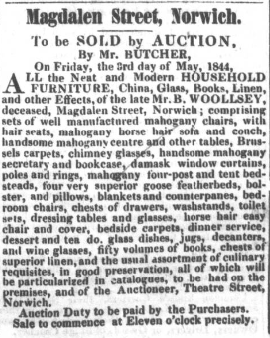
    This appeared in the local newspaper on 27 April 1844, the quick sale of all of the property which the couple owned. I can’t establish exactly which property he lived at on Magdalen Street, it would have added some colour to the thought of Benjamin’s stuff being carted out of it on Friday 2 May 1844. This remains another blog post without much of an answer, just a story without resolution of why they died so close together, and who has arranged for their gravestone to be cleaned and restored.

  • Norwich – Rosary Cemetery (James Foreman)

    Norwich – Rosary Cemetery (James Foreman)

    Another in my series of posts about the Rosary Cemetery in Norwich.

    20220728_140408

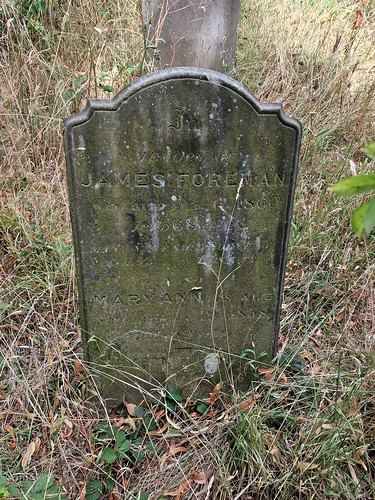
    This is one of the photos of graves that I took at random in the Rosary Cemetery and I’ve failed to establish much about it. This goes into the category of hoping someone sends me something useful to add to this page, which does happen occasionally.

    In short, it’s the grave of James Foreman, who was born in 1792 and died on 6 February 1860 at the age of 68, with his wife, Mary Ann Foreman who died on 19 December 1858 at the age of 59. They had four children, including Walter, Randal, Byron and Mary. There’s only two mentions of James that I can find in the press, which is when his daughter got married to Richard Middleton at Surlingham Church in late 1855 and when she died in 1870.

    James was a miller at Surlingham Mill, now demolished, but I think it stood around here on the appropriately named Mill Street. Which got me thinking, as he lived in Magdalen Street in 1841 when he was a miller, and that’s quite a trek to get to work, about a 4 mile walk each way. Cycles were rare before 1850, so I have no idea whether millers stayed where they were in the mill or commuted to work as it were. I’m suspecting the latter, as the family entirely disappeared for the 1851 census, so they must have been holed up somewhere odd where they were missed. Given his daughter got married at Surlingham church, I’m going with the idea they lived locally and didn’t fill in the census. It’s either that or the family moved to Newmarket, where some of the 1851 census is missing, but that sounds unlikely. I also can’t work out exactly where on Magdalen Street the family lived in 1841 and the enumerator seems to have been slightly drunk when traversing his way across the city.

    This has led me to spend some of my evening wondering how exactly people moved about the place in the 1840s (I probably need to get out more), although Brundall railway station opened in 1844 and he could have caught that from Norwich and got the ferry across the river Yare. The railways must have been such an empowering moment for those who needed to get about the county and I like to think that James caught them every now and then to get to Surlingham. Quite why I find that reassuring, I have no idea.

  • Norwich – Rosary Cemetery (Victor Lambert Anscombe)

    Norwich – Rosary Cemetery (Victor Lambert Anscombe)

    rosarycemetery

    Back to my much neglected little series about burials at the Rosary Cemetery in Norwich. During lockdown I looked up quite a few CWGC graves and also found some errors in the official record, which they kindly always corrected for me, which I accept was quite an odd little hobby.

    20220728_140332

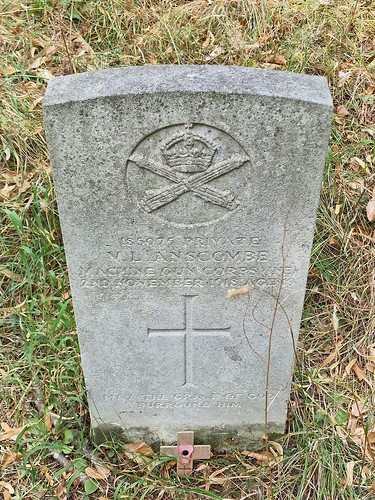
    This is the war grave of Private Victor Lambert Anscombe. There’s a photo of Victor at https://norfolk.spydus.co.uk/cgi-bin/spydus.exe/ENQ/WPAC/BIBENQ?SETLVL=&BRN=721081&FMT=IMG. Norfolk County Council stomp their feet very loudly about not allowing use of these images directly on third party sites, which I think is a shame, particularly when it’s someone who died in the First World War whose image deserves to be shared widely.

    Victor was born in Wicklewood, near Wymondham, in 1899. Victor’s father was Frederick Anscombe who had been born in 1871 and worked as a shopkeeper, but he had died a few years before the outbreak of the First World War. Victor’s mother was Emma Sophia Anscombe, nee Tuttle, and he also had a little brother, Alan Frederick Anscombe, who was born in 1902.

    At the 1901 census, the family had lived at Rattle Row in Wymondham, but by 1911 and following the death of Frederick, they had moved to Damgate Street in Wymondham. They lived there with Emma’s parents, Frederick J and Sophia Tuttle. Just before the advent of the First World War, they had moved to 37, St Julian Street in Norwich. Sadly, this street was destroyed during some badly planned slum clearance, although the line of the street is similar to that of Rouen Road today. I’ve moaned about this damage in another blog post. There’s something additionally sad when so little trace of the life of a young person remains, with the old properties in Rattle Row having also been pulled down, although the street remains.

    Victor went along to the Drill Hall (I think the Chapel Field one, rather than the Bethel Street one, a gothic style building constructed in the Victorian period which incorporated part of the city wall but which was demolished to build the ring road in 1963) in Norwich on 8 July 1915 to sign up and he was given service number 185075. His records have survived, so avoided the fate of many others which were destroyed during an air raid fire during the Second World War, showing that he was 5’3″ tall, he had a 33 inch waist and green eyes. He was working at a cycle engineer at the time of his signing up and he joined the 4th Norfolk Regiment. He was then moved to the Machine Gun Corps, B Training Battalion, although it’s not clear to me where he served after that. Victor was injured on 18 October 1918, moved to the military hospital at Cannock Chase, where he died of pneumonia on 2 November 1918.

    When Victor was away, his mother married James Gasson (born in 1886) in the second quarter of 1917, who worked as a carpenter. Victor’s estate went to probate and it was valued at £127 19s. The years after Victor’s death must have been difficult for his mother, as she had already lost her first husband, her son in the war and then her other son, Alan, died in 1951. Emma died on 28 December 1967.

    The memorial on Victor’s grave reads “may the grace of God surround him”.

  • Norwich – Rosary Cemetery (Alfred Edward Hubbard)

    Norwich – Rosary Cemetery (Alfred Edward Hubbard)

    Alfred Edward Hubbard was born on 22 June 1889 and was baptised on 16 July 1889 at St. Peter Parmentergate in Norwich. He was the son of George Hubbard, who worked as a telegraph clerk, and Bertha Hubbard. The family lived on Synagogue Street, a street off Mountergate sadly now lost, although George Plunkett has a photo of how it looked.

    Alfred was one of a large family, at the 1891 census he had older brothers Frank, Charles and Harry, along with older sisters Alice and Bertha. Tragedy hit the family in the 1890s with the death of George Hubbard, meaning that Bertha was left alone to support her family. A later census noted that she had six children and they were all still alive, which wasn’t all that common, often children died young.

    At the 1901 census, Bertha ran a lodging house at 88 Chapelfield Road, living with her children Frank (working as a carpenter), Alice, Bertha (a pupil teacher), Henry (a clerk) and Alfred. By the time of the 1911 census, the family had moved to 73 St George’s Street, including Bertha and her children Frank (working as a carpenter), Alice, Bertha Constance (a teacher employed by Norwich City Council), Harry (a brewer’s clerk) and Alfred (now working as a teacher employed by Norfolk County Council).

    In early 1915, Alfred married May Mann and they lived on Yarmouth Road in Caister-on-Sea. He joined the Norfolk Regiment, service number 15653.

    Unfortunately, Hubbard’s war records are amongst those which were destroyed in an air raid during the Second World War, but he was in the 7th Battalion, which was formed of volunteers, also known as Kitchener’s Army. Alfred was injured in Hulluch, in northern France, in October 1915. The regimental records written in the field survive, although Hubbard isn’t specifically mentioned, but the above image is from that battalion in the Hulluch area from earlier in October 1915, showing the scale of the losses.

    Copyright Imperial War Museum (45786).

    This image is posted on Wikipedia, showing the state of the area between Loos and Hulluch in 1917. The British trenches are on the left, the German trenches on the right, with a now heavily damaged road going through them.

    Alfred died on 19 December 1919, at the age of 30, likely because of the injuries occurred during the First World War. The inscription on his gravestone reads “having fought a good fight in life and war, rest on”. There aren’t that many burials of the war dead at the Rosary Cemetery in Norwich, they’re mostly at Earlham Cemetery, so this stood out amongst the nearby graves. The uniformity of war graves ensures their visibility in a graveyard, and is a reminder that in death everyone was equal regardless of rank.

    It’s hard to imagine what Alfred’s brothers and sisters must have thought when standing at his graveside in late December 1919, it’s a far cry from the time of the 1911 census when they were all embarking on their new careers. And Alfred’s new career as a teacher was cut short, fighting a battle in a country to which he might never have otherwise visited.

  • Norwich – Rosary Cemetery (James Light)

    Norwich – Rosary Cemetery (James Light)

    Located at Rosary Cemetery in Norwich, this is the grave of James Light, who was born in Southampton in 1849, the son of Isaac Light and Lucy Light. Isaac and Lucy (nee Sillince) had married on 4 July 1847 in Southampton.

    At the 1851 census, James lived at St Faith’s Lane in Norwich with his parents, and they were lodging with another family. Isaac Light was an engine driver on the railways and he would have been one of the first to have that role in Norfolk, as the first line in the county was Yarmouth & Norwich Railway which opened in 1842. I’m not sure why the family made a move from Southampton, but perhaps it was so that Isaac could secure employment in this new industry.

    By the time of the 1861 census, James and his parents were living at Garden Street in the city, along with their other children, Emma, Richard and George. They had moved to Wilderness Place by 1871, with Isaac, Lucy, James, Richard and George living there. Isaac, James and Richard were all working for the railways and although I’m guessing here, I suspect they would have found this a more exciting job to have than some others which were available at the time (mostly shoe manufacture in Norwich). The railways were still relatively new and exciting, there must have been something of an element of adventure and a knowledge that the railway network was expanding.

    However, bad things were to take place. Whilst working as a fireman on the train, James died on 10 September 1874 at the age of 25 in what is known as the Thorpe rail accident. This incident, which took place near what is now known as the Rushcutters pub, caused the death of 25 people and over 75 others were injured. It occured when a mail train and a passenger train hit each other head on due to some confusion and poor communications. When the crash took place it was the second worst rail incident that had taken place in the country in terms of fatalities, with more people having died only at the Abergele rail crash of 1868. One of the legacies of this major incident at Thorpe was the introduction of the tablet system, to try and prevent head-on crashes.

    I’ve marked the scene of the crash on the above map from the 1920s, which was very close to the Rushcutters, although the pub was known as Thorpe Gardens at the time. The coroner at the time insisted during the trial that the phrase “railway accident” wasn’t to be used, it was to be referred to as “a railway collision”. Shortly after, he said “it is due to the public to know how this collision did happen, whether it was through carelessness or accident; though I am afraid we cannot bring it to the latter, for everything at present appears to contradict that”. It’s clear that the coroner didn’t intend to oversee a whitewash with his inquest.

    The saddest element was the identification of the dead. For James, this was done by his brother Richard, who said:

    “I live in Wilderness Place, King Street and I am a fireman. The deceased James Light was my brother. I have identified his body lying here. My brother was a fireman in the employ of the Great Eastern Railway Company. He was twenty-five years of age and lived at Wilderness Place”.

    This must have been a hugely emotional task for Richard to perform, especially as he had the same job on the railways as his brother.

  • Norwich – Rosary Cemetery (George Johns)

    Norwich – Rosary Cemetery (George Johns)

    This is the gravestone of George Johns, located in the Rosary Cemetery in Norwich. George was born in Ludham in 1833, the son of John Johns, who was an innkeeper. George trained as a carpenter, but for reasons unknown, perhaps by necessity or in search of adventure, he decided to embark on a new career in the military.

    George joined the Royal Regiment of the Horse Guards on 9 October 1862, at the age of 31. His army records show that he was 6 foot tall (well, 5 foot 11 and 3/8 inches which seems ridiculously precise to me) and had brown hair. His service record seems a bit patchy, and there’s an absence without leave in there.

    George, who by now had retired from the army, married Lydia Bond, who was 12 years younger than him, on 22 October 1874. Eugene had already been born on 16 December 1870, which is perhaps the reason that George thought he’d better request to leave the army.

    At the 1881 census, George was living with Lydia and his 10 year old son Eugene at 3 Chester Place in Norwich. This road still exists, it’s located off of Earlham Road, near to the Roman Catholic Cathedral. Indeed, when George and his family were living here, work would have been taking place to demolish the Norwich City Gaol which was on the site to replace it with the Cathedral.

    The three family members were also living in the same location in 1891, with George still working as a starch maker and Eugene was now working as a shoe maker. I do wonder what someone like Eugene would have been doing today, perhaps a computer programmer or working in finance, there would be plenty of choice. For men in the late nineteenth century in Norwich, the choice was often limited to work in the shoe trade.

    George died on 19 May 1892, at the age of 59 years old and Lydia, George’s wife, died on 25 May 1922.

    Eugene married Kate and at the 1901 census, he was living with her at 12 Patteson Road, along with their children Harry, Hilda, George and Ivy. Eugene is listed on the 1939 register, by this time retired from the shoe industry, living with his wife Kate at 45 Midland Street in Norwich. Eugene’s home on Midland Street was only a two or three minute walk from where he had lived at Chester Place for many years. Eugene died in 1959, at the age of 89.

  • Norwich – Rosary Cemetery (Arthur Thomas Woodard)

    Norwich – Rosary Cemetery (Arthur Thomas Woodard)

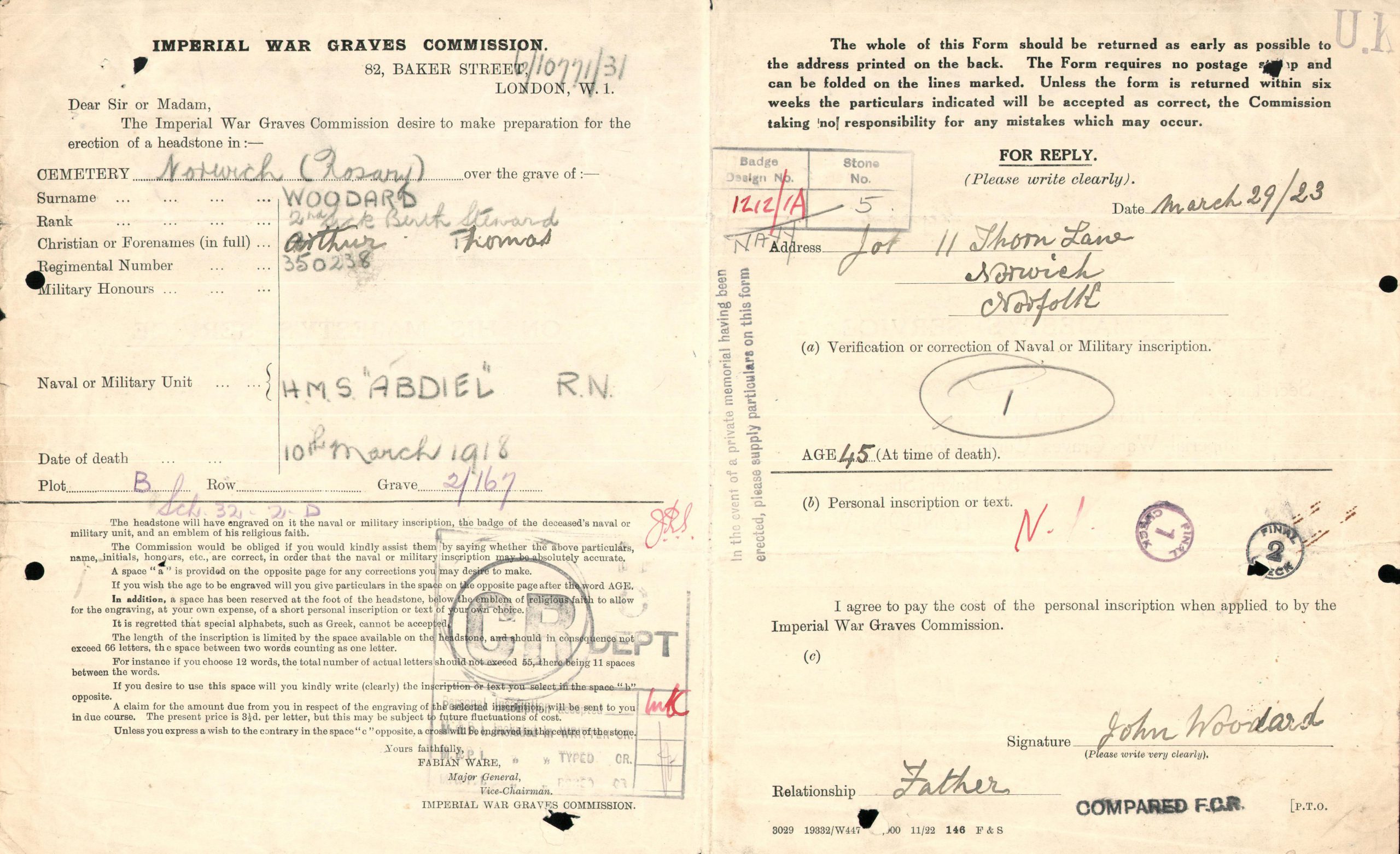
    Arthur Thomas Woodard was born on 6 June 1873, the son of John and Charlotte Woodard. He was baptised at St John de Sepulchre Church in Norwich on 27 August 1879.

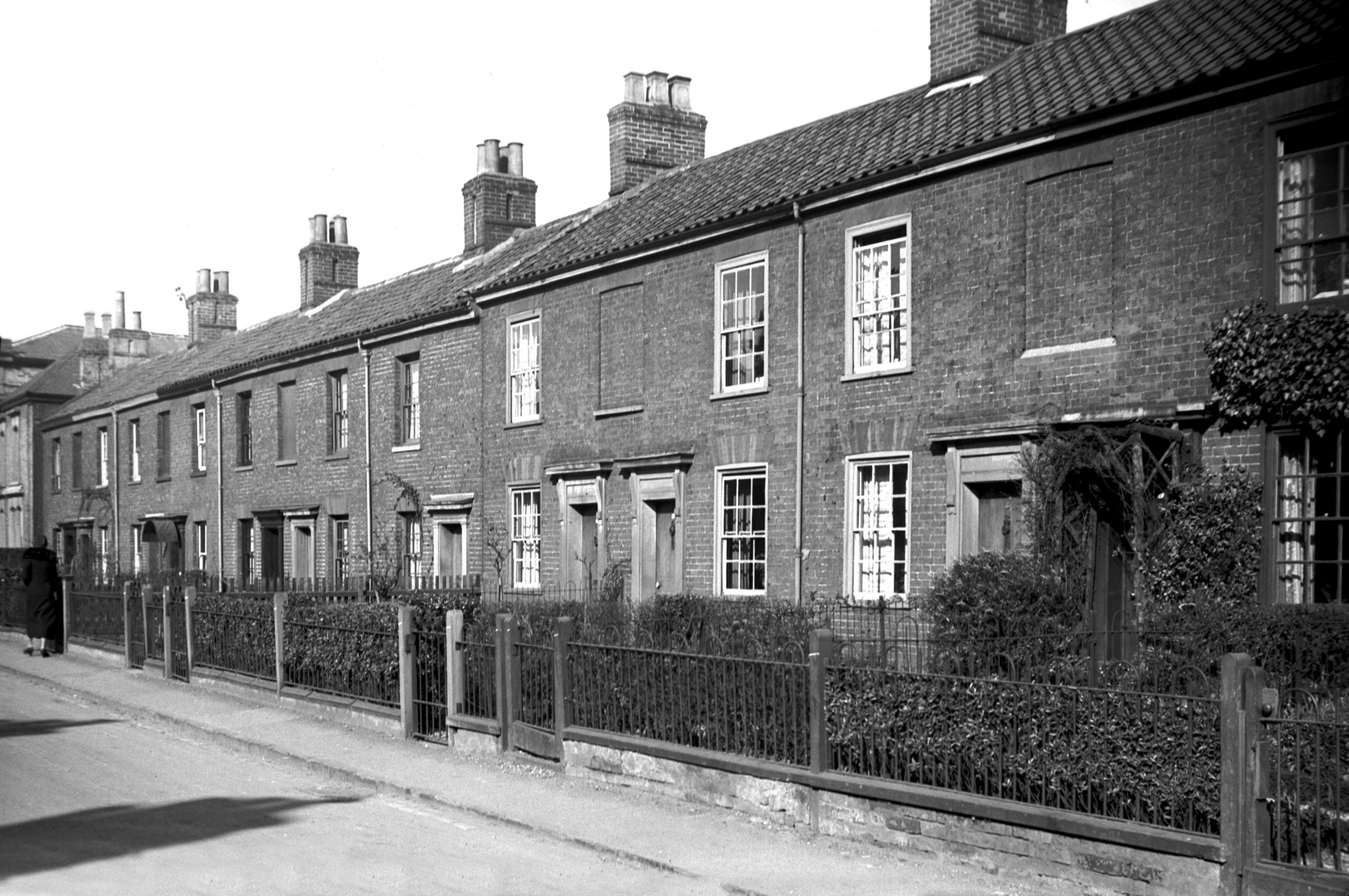
    At the 1881 census, Arthur was living with his parents at Brown’s Yard, off St. Stephen’s Street in Norwich. Later renamed Mansfield Court, this was all swept away with the post-war widening of St. Stephen’s Street. Arthur’s father John was working for the railways, and Arthur had numerous siblings also living in the same property, namely William, Elizabeth, Robert, Jemima and Mary Ann.

    Arthur served in the Royal Navy on HMS Abdiel and his service number was 350238. HMS Abdiel was a minelayer which launched in October 1915 and it laid 6,293 mines during the course of the First World War.

    Arthur died on 10 March 1918, at the age of 45. Arthur was a 2nd class sick berth steward and although the ship was involved in dangerous military action, his death followed a heart attack he had on board. Arthur’s job title sounds like it was something akin to a cruise ship, but here it’s just the rank for what is better known today as medical assistants. The ranks were, from more junior to senior, 1st & 2nd class boys, sick berth attendant, sick berth attendant 2nd class, sick berth attendant 1st class and chief sick berth steward.

    At the time of his death, Arthur’s parents were living at 11 Thorn Lane in the city and his father had to sign this letter to confirm the details of what they wanted on their son’s grave. I can’t quite imagine the emotions that parents and loved ones went through when sending these forms back to the Imperial War Graves Commission. It’s nice though to see that someone is still tending his grave, with Arthur being one of 31 Commonwealth War Graves at the cemetery.

  • Norwich – Rosary Cemetery (James Arthur Lake)

    Norwich – Rosary Cemetery (James Arthur Lake)

    This is the grave of James Arthur Lake, located in Norwich’s Rosary Cemetery. James was baptised on 1 October 1861 in Poringland and he was the son of Nevil, a labourer, and Ellen, who had also had their daughter Louisa baptised the week before.

    The 21-year old James married Eliza Gray, aged 20, at St. Mark’s Church in Lakenham on 27 November 1882. Eliza was the daughter of the shoemaker Thomas Gray, and they lived at Queens Road in the city. At the 1891 census, James and Eliza lived at 18 Cherry Street in Lakenham and they also had a four year old daughter.

    Tragedy then hit the couple, and this is also mentioned on the gravestone itself, when there here was a train crash on 24 December 1891. It was reported in the local press on 28 December 1891 that three men had been killed, Walter Forster Mallett (aged 21, an engine fitter from Lowestoft), Harry John Reed (aged 26, a fireman from Lowestoft) and James Arthur Lake (aged 28, a guard from Norwich). There were over thirty other people injured and the inquest was adjourned until early January 1892.

    The preliminary inquest at Lowestoft Police Court in January 1892 was well attended, and Eliza went along to hear the enquiry. Representatives from the Great Eastern railway company were also present and their representative, Mr. Moore, expressed their deep regret at the incident and offered their full co-operation. The coroner explained why he had arranged for the three bodies to be taken to Lowestoft, as although he said it was unusual to move the bodies five miles or so from the incident, he felt it had been the most appropriate course of action.

    The members of the inquest jury were taken to the town’s mortuary, which was described by the coroner as “a disgrace to the Lowestoft”, before noting that it was “a happy fact” that the Great Eastern railway company were having it demolished for the expansion of the Trawl Basin. I’m not entirely sure that the relatives of the dead were heartened by this fact. The jury then went to look at the bodies and it was reported that “the corpses of the guard and the firemen were very repulsive, the nature of the injuries which each had sustained being such as to render their features well nigh unrecognisable”. The Victorian press certainly liked some graphic descriptions…..

    There was a little confusion over the bodies and the coroner made some efforts to ensure that the bodies were identified correctly, although there was a delay when one witness refused to swear the oath. George A Howes, of 70, The Wilderness in Norwich swore that the body in the mortuary was James Arthur Lake. It was noted that James’s widow was in the court, but I assume that she didn’t look at the body.

    There were a few more meetings of the coroner’s court to look into what happened, although the Great Eastern railway company admitted liability immediately and so there was no need to pursue this element. The Board of Trade then issued their summary of proceedings in March 1892, in a bid to ensure that there was no repeat of the catastrophe.

    The report found that “the very serious collision was primarily caused by the driver of the up train, Alexander Boag, having completely miscalculated his position when approaching Barnby passing loop, where he was perfectly aware he had to stop”. Boag said that he overran the location that the Carlton Colville bridgeman should get on the train and then confused the bridgeman’s light for a signal to go. Boag then proceeded to Carlton Colville railway station (this is today known as Oulton Broad South station) without the bridgeman, “though there is an absolute rule to the contrary”. The thick fog meant that visibility was near zero and Boag said that there should have been fog signalmen in place to assist the train driver.

    William Borrytt, the driver of the train going in the other direction, was seriously injured and had to give his evidence from bed at his home. He said that he had no time to apply his brake when he saw the train coming in the other direction, and the two engines collided. They didn’t hit each other full on due to the positioning of the engines, but it was clear immediately how bad an accident this was. It was mentioned with regards to James Arthur Lake that “the guard, who was in the third class brake carriage next the engine, which carriage was nearly destroyed, was killed on the spot, the deceased passenger being in the same carriage.”

    The report concluded saying that it was the 26-year old Boag whose actions were the primary reason for the accident, but it noted that he was sober on the journey and was experienced with the route. Although he had only been a train driver for nine months, he had worked for the company for twelve years and had been a fireman for seven years. It was concluded that there was no blame at all attached to James Arthur Lake, although some other individuals were mentioned as being partly responsible.

    Eliza, the wife of James, died on 20 April 1937 at the age of 73 and she is buried with her husband. The husband and wife were buried not far short of 50 years apart, and I can imagine her in her later years going to visit James’s grave and remembering him only as a young man in his 20s.