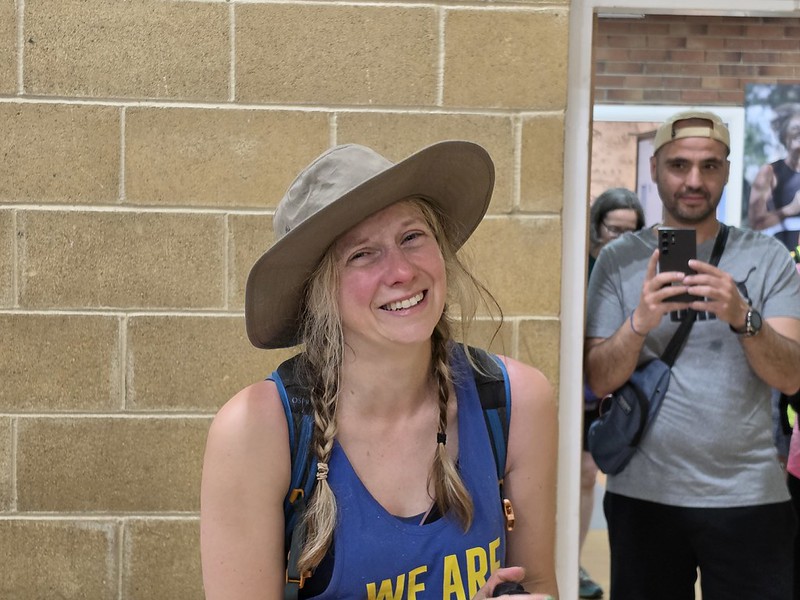
Phoebe Smith is an award-winning travel writer, adventurer, photographer, presenter and broadcaster, with a particular focus on walking, wild camping, sustainable travel, family adventure and wildlife conservation. She’s also the President of the LDWA and here she is completing the 2026 LDWA 100 with Helen Strong, the LDWA General Secretary, on the right.
But, as for so many entrants, there is a story here. Phoebe was battling checkpoint times throughout her walk, meaning that she had to keep up a pace in the blistering heat and at times it looked like it might just be too much. However, Phoebe is steadfast and tough, she didn’t give up and her mental and physical persistence saw her complete the event.
Phoebe is a huge friend to the LDWA and it was a marvellous moment to be able to take these photos of her arriving back into Meopham.
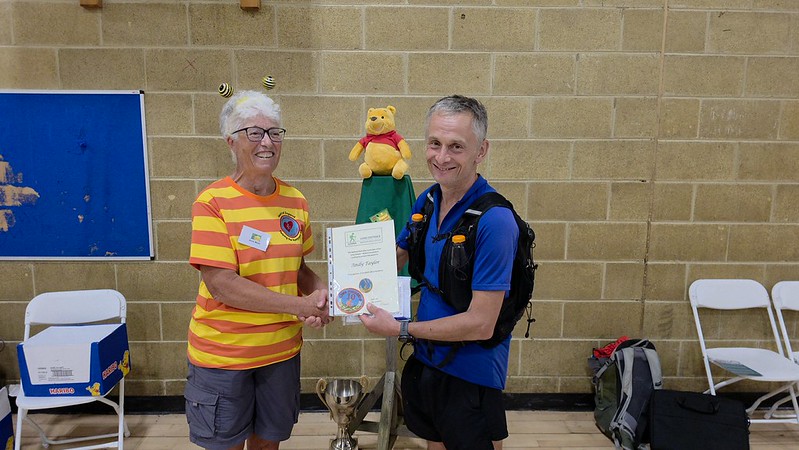
What a way for Simon to celebrate his 60th birthday weekend, walking around in this heat. However, his much younger wife Jane keeps him young and youthful and, if truth be told, I didn’t really ever doubt that he would get round. Simon can be very stubborn, which in normal life can be occasionally inconvenient, but over 100 miles definitely becomes a recognised endurance strategy.
And here he is, at the very reasonable time of just over 34 hours, making Simon the 24th fastest* completion of the event. Given that he’s a walker and not a runner, this was a really quite impressive pace.
Simon and I think that there need to be more pies at checkpoints and he very much deserved this one.
I hope that he enjoys his birthday cake, but completing an event like this shows some considerable style. *-Simon reminds me that he was joint 23rd with Kim…
Simon kindly answered a few questions after the event:
Q. What are your main memories of the Hunnypot 100?
A. The heat! The temperature, mixed with the challenges of the route, especially the later parts, made for a brutal event at times. That said, the marshals at each checkpoint did a brilliant job in trying to keep us all hydrated, fed and motivated.
Q. You completed the event and came in 23rd place, which I mention as that is a very fast pace for a walker. What strategies did you use to get around what appears to have been the hottest ever 100?
A. Set a sensible pace that reflects the conditions, keep hydrated and put one foot in front of the other.
Q. Which part of the walk did you enjoy the most?
A. The last 100 metres! All joking aside, I enjoyed all the route, but given the heat I was more focused on making sure I kept on moving.
Q. Will you be doing it again? Or is it too early to say?
A. Absolutely. It’s an addiction!
Q. Do you have any suggestions for organisers of future LDWA 100s?
A. The value of making sure there are sufficient checkpoints along the route cannot be overstated. Keeping walkers hydrated, fed and motivated is a critical part of the event’s success.
This is checkpoint 13, managed by David Findel-Hawkins, located at Hodsoll Street & Ridley Village Hall at it was at about 96 miles into the route.
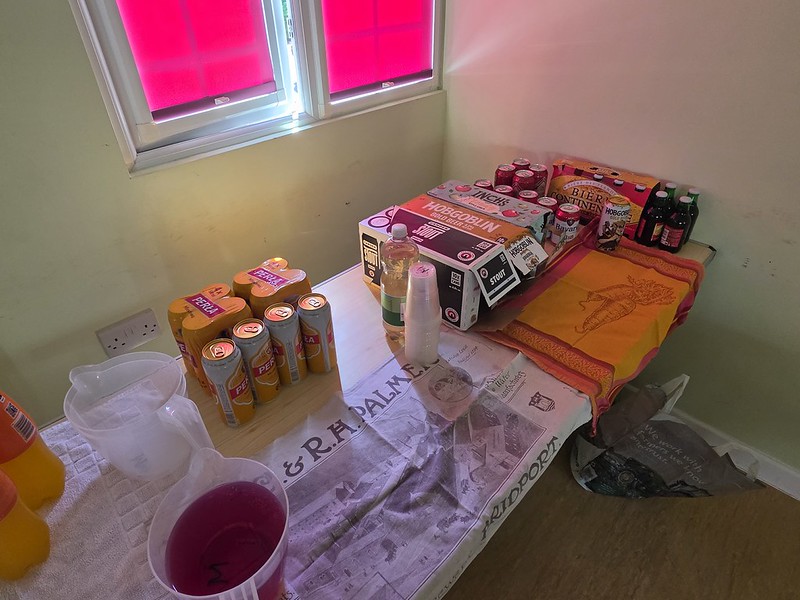
This is one of those checkpoints where there is beer available. This is a rather lovely way for entrants to perhaps momentarily forget the absurd distance that they were walking.
Some of the little snacks available although entrants at this checkpoint know that the end isn’t far away and so not many linger for too long here.
Richard cheered up after eating several Jaffa cakes. Here he is gossiping with Elizabeth after his chocolate boost, looking very much like a man restored to polite society.
And here’s Lisa coming in, the first entrant to arrive at the checkpoint. It was clear here that she had a chance of finishing the event in under 24 hours, the only entrant at this checkpoint that was in a position to do that.
We think that this is the hottest 100 on record and that is evident in the number of retirements, 243 entrants have now retired which is over half of all the entrants. This is also the highest percentage of retirees at an LDWA 100 event, showing just how extreme heat is making this such a tough walk. Huge credit to all those who have walked as far as they did and to those who are still out in the countryside making their way around.
Neil, one of those entrants who has been inspired by me (but I don’t go on about it other than in conversation, writing and most available public forums) didn’t make it this time round as the heat was just too much. But he was very brave and in typical Neil style, he was full of positivity and remained upbeat.
It’s Sunday morning at 08:00 and I’m getting ever closer to Kent, but I’m informed that we’ve now reached 150 retirements so far. The total number of retirements last year in Norfolk & Suffolk was 114, so the heat and hills seem to be having some impact on entrants.
But well done to everyone who has taken part and good luck to those still on the walk. So very brave…
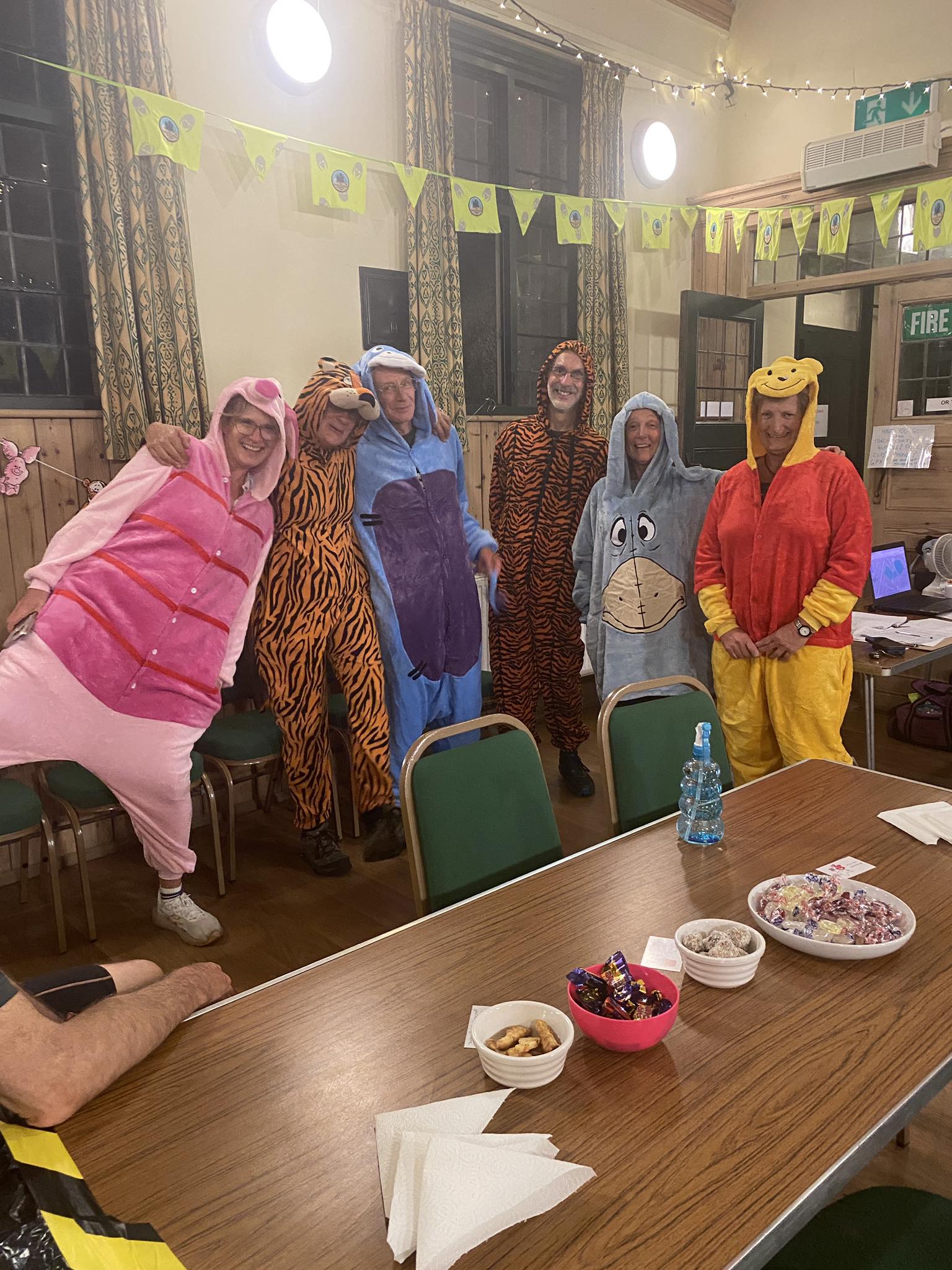
A photo from the always understated Pam, this is the Norfolk & Suffolk checkpoint. My eye is first drawn to the chocolates at the front and the Cheesy Feet that Chelle makes, which helpfully distracts me from this entirely unnecessary frivolity from Jane, Michael, Yvonne and Hilary amongst others…. But I won’t say anything.
There are a number of interviews with entrants of the 100 at https://www.julianwhite.uk/ldwa-100/ with more coming, but I thought that I’d summarise some of the interviews that have been received so far. And add my own commentary of my 100 in 2021 which I of course hardly mention….. This is the second summary of the interviews, with the first here.
Hundred miles, many sandwiches and the quiet heroism behind the Hunnypot 100
The LDWA 100 is, on paper, a walking event. In practice it is also a test of sleep deprivation, footcare, navigation, catering, human kindness and the ability to make sensible decisions after the point at which most people would have taken a taxi, booked a hotel and reassessed their life choices. The interviews with Helen Strong, Guy Evans, Anne Wade and Annette Merchant show the 2026 Hunnypot Hundred not just as a long-distance challenge, but as a huge collective effort by walkers, organisers and marshals.
Helen Strong, LDWA General Secretary and a Kent Group committee member, has been closely involved with the organisation of this year’s event, including as Entries Secretary. She described a year of work involving qualifying event records, SiEntries pages, cancellations, the waiting list, tally cards, trackers, joining instructions and registration volunteers. It is a reminder that a 100 begins long before anyone reaches the start line, although naturally some entrants may assume it has all emerged by magic, perhaps from a spreadsheet-bearing woodland creature. In reality, the application to hold this 100 was received by the LDWA’s NEC in 2019, so this event has been seven years in the planning. Helen said the organiser’s side had shown her that “there are many elements that need to be perfect, but a few elements which do not”, adding that while many entrants had been appreciative, some messages had come from people with “absolutely no idea what is involved”.
That unseen work is a theme picked up strongly by Anne Wade, the LDWA 100s Coordinator on the NEC, who has herself completed 22 hundreds. She said that local groups face major challenges in finding a suitable HQ, parking, catering facilities, changing rooms, volunteers and the long lead-in time needed to make the event happen. For entrants, she said, the two most important things are “the route and the food”, which is perhaps the most LDWA sentence ever constructed. The route needs to be scenic, interesting and maybe not too cruel in the final quarter, while the food needs to be plentiful, varied and available at exactly the moment a walker begins to view custard as a major philosophical necessity.
Anne and Helen both walked the marshals’ event, and their comments suggest that the Hunnypot route will be beautiful, varied and rather more demanding than anyone hoping for a gentle wander through Kent might have wished. Anne praised the “views and variety”, including fields, forest, heath and down, but also remembered the night section when rain and fog made route-finding harder and the descent to Kemsing followed by the climb back up felt especially challenging. Helen was even more direct, warning that the Kent landscape is “hilly – both slow climbs and steep ones”, with the Greensand Ridge and North Downs combining to produce a final section she described in one word, namely “Brutal.”
Guy Evans brings the perspective of an experienced entrant who has already completed four LDWA 100s and still, with an admirable lack of self-preservation, wants to keep coming back. He described the event as “iconic” and praised its “understated, unpretentious, laid-back, friendly atmosphere”, saying it has a very different feel from other ultra events. His journey into the 100 also carries the familiar LDWA logic of escalation: family walks led to long-distance events, then 50s, then the thought that he would do just one 100 because “only mad people walk a 100 miles”. He now wonders whether a 100 is enough, which suggests the madness has settled in nicely and should no longer be disturbed.
For Guy, one of the secrets is not thinking about the full distance. He said the lesson from his first 100 was simply to think about getting to the next checkpoint, adding that “a very large part of finishing is mental not physical”. His advice to first-timers is rooted in that same approach which is namely do not overthink it, know your reason for doing it, remember that lows pass and smile even when you do not feel like it. There is a lovely understatement in his description of the later stages, where the event is 70 or 80 per cent complete, the walker is tired and the end still feels distant. His wife might call what keeps him going stubbornness although he prefers determination, which is the same thing with better publicity.
Annette Merchant offers another essential perspective, having been involved with the hundred since the 1994 Dartmoor event and describing Hunnypot as her 30th hundred. She first became involved because her husband Les was entering the events, but over the years the annual gathering of walkers and marshals became something she wanted to keep returning to, even after Les died in 2020. She said she realised early on that a checkpoint could “really make a difference”, especially for mid-paced and slower walkers trying to complete the event. That is the practical heart of the 100 which is tired people arriving at a hall, sometimes in the small hours, needing food, reassurance, sympathy and possibly to be protected from their own rash decision to sit down for too long.
Annette’s view of checkpoints is refreshingly practical. The hall needs space, the kitchen needs the right equipment, the food needs to match the facilities and walkers should not have to queue when what they really need is to change socks, sort gear and be gently encouraged back into functioning humanity. She said marshals need to understand how walkers feel, be “prepared to have a joke” and be sympathetic when people are nauseous or fatigued. She is also careful about retirements, saying that a potential retiree’s tally is not taken until they have stopped, eaten, drunk, rested and still decided to retire. No point rushing these decisions….
Food, inevitably, runs through all four interviews with the emotional force normally reserved for major family events. Anne says LDWA walkers are “powered by tea and fuelled by cake” and Helen says food is critical, though on the marshals’ event she relied heavily on her own sweet snacks, savoury food at checkpoints and an uncharacteristic fondness for full-fat Coke. Annette argues for a good mix of sweet and savoury, not too much in any one portion and enough variety to suit people arriving at very different times of day. In the civilised world this is called catering; on a 100 it is morale, medicine and emotional support in edible form.
Taken together, the four interviews present the Hunnypot 100 as something much richer than a long walk. It is a demanding route through Kent and Sussex, a logistical exercise, a community reunion, a test of personal resolve and a tribute to the volunteers who keep smiling even when they have had very little sleep. Helen is looking forward to visiting the checkpoints by car after completing the marshals’ event, which may be the most sensible aspiration expressed in the entire set of interviews and might be something that Richard and I do this weekend.
Guy remembers the moment around mile 90 when a walker knows they are going to finish. Anne reminds entrants to eat from the first checkpoint because they cannot run on empty. Annette says marshalling should be treated as “a social event, a weekend away with friends and like-minded people, helping colleagues to succeed in a significant challenge”. That may be the best summary of the LDWA 100, an unreasonable distance made possible by very reasonable people.