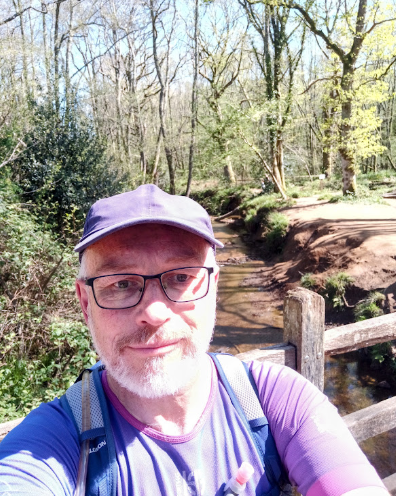
To my disappointment, other things meant that I can’t get to the LDWA 100 in Kent (more information about that at https://www.julianwhite.uk/ldwa-100/) until Sunday morning. However, as of Saturday evening, there have been a fair number of retirements which is not unexpected in the extreme heat that is out there. I’ve heard that checkpoints have been offering huge amounts of support, lots of liquids and a place in the shade.
The tracking for this event is at https://track.trail.live/event/hunnypot-100 and I hope to be posting a fair amount more over the next 36 hours about the event. So many brave entrants….
This interview is with Annette and although she’s completed an LDWA 100, she has some interesting perspectives from a view of being an event organiser and marshal.
Q. Could you briefly introduce yourself and say how you came to be involved with the LDWA?
A. I am Annette Merchant, I became involved with the LDWA when my husband, Les, started walking the annual hundred mile challenges in 1985. Initially I left him to do the event, but when Cornwall and Devon group hosted the 1994 Dartmoor hundred, I got involved in the organisation of the event and then started to marshal at the C&D checkpoint, going to Marches in 1995 where we did breakfast at Clun. I have been involved every year since. The Hunnypot will be my 30th hundred.
Q. You’ve been marshalling hundreds since 1994. What has kept bringing you back to help with these events for so many years?
A. Initially, because Les was entering the event I wanted to be there to see him through our checkpoint and support him, but I made so many friends over the years amongst the other regular entrants and marshals that I looked forward to seeing them each year, both at the start and our checkpoint and then at the finish. So even after Les died in 2020, I found I wanted to keep coming to the hundred. Also, early on, I realised that we could really make a difference at our checkpoint, especially to the mid and slower paced walkers and their being able to complete the event which gives me huge sense of satisfaction.
Q. Cornwall and Devon group will be manning Ide Hill on this year’s event, which is around 75 miles in. What makes a good checkpoint from the marshal’s side?
A. We look for a kitchen with the right equipment matched to the food we are being asked to serve. Plenty of space, so that we can have drinks station and prep cold food away from the kitchen. A lobby for check in, a good hatch from the kitchen directly into the hall. A good amount of parking (quite a few of our marshals have campers for staying overnight before we open).
Q. What do you think walkers most need from checkpoint teams when they arrive tired, hungry or beginning to wonder whether sitting down was a tactical error?
A. They need to be able to concentrate on themselves, changing socks, sorting gear, head torches etc., not queue for food and drinks. They need marshals who can understand how they are feeling and can encourage them, prepared to have a joke, but sympathetic and helpful if they’re feeling nauseous or fatigued. The food needs to be appetising and easily eaten when they are likely to be dehydrated and finding it difficult to get food down.
Q. You’ve been involved in organising four hundreds, including the 2027 Jurassic 100. What are the biggest things that need to come together behind the scenes to make a 100 work well?
A. The people dealing with each of the main aspects – Route, HQ, checkpoints, catering and transport need to communicate and work together to ensure that the route is safe and passes through checkpoint locations at appropriate distances. That the food provided matches the facilities available at the halls and the halls can provide the appropriate food needed at that point (hot, cold, etc.) Transport needs to be able to deliver food and equipment to checkpoints efficiently and try to minimise retirement waiting times. They all need to work together, along with the communication on the day.
Q. From an organiser’s perspective, what are the details that entrants might not notice when everything goes smoothly, but which make a huge difference to the event?
A well written route description, providing the right food in the right places. Marshals that are sympathetic and understanding, especially in the latter stages. Providing information to supporters.
Q. You’ve attempted two hundreds and completed one. How has being on the walking side helped you understand what entrants need from the organising and marshalling teams?
A. Having retired on one and seen Les retire on a few hundreds, I understand how you can feel as though you just can’t go any further but can regret the decision within hours of making it. That is why we never take a potential retiree’s tally until they have stopped, had some food and drink and rested for a while and then still decided to retire. I also know the euphoria of having completed and how all the bad bits of the walk fade quickly, which makes me want to help those that are struggling at our CP to achieve that and have that feeling of euphoria.
Q. Food can become rather central on a 100, sometimes with the emotional weight of a major life decision. What do you think makes good checkpoint food on an event of this length?
A. A good mix of sweet and savoury. Not big portions. Some checkpoints are open for a long time a CP could be lunch for one person and evening for another, so versatile food with different options for different tastes.
Q. What advice would you give to entrants taking part in their first 100?
A. Don’t get swept up into walking too fast at the beginning, walk at a comfortable pace that you can keep up for hours at a time. Don’t be overwhelmed by the whole distance, just concentrate on getting to the next checkpoint. Have target times for arriving at each checkpoint to help you keep your pace, but don’t let them rule you.
Q. What would you say to someone interested in marshalling LDWA challenge events?
A. You need to aim to have fun. Treat it as a social event, a weekend away with friends and like-minded people, helping colleagues to succeed in a significant challenge. The camaraderie and atmosphere is amazing.
Q. Finally, tell us what entrants can look forwards to at the Jurassic 100 in May 2027.
A. Some fabulous walking along the Jurassic coast, with a mix of riverside, common and countryside walking and some lovely Devon villages. There will also be some great food and plenty of encouragement from their LDWA colleagues.
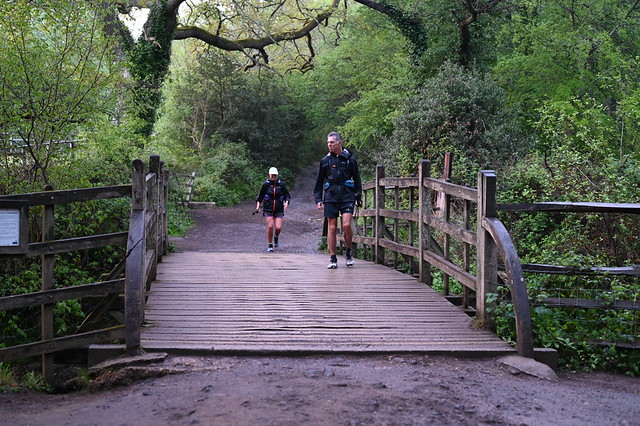
This interview is with Anne, the 100s Coordinator, and she completed the marshals’ event in early May with her husband Vaughan. Here they are in the photo on Pooh Sticks Bridge which is on the route of the 100. There’s some great advice here!
Q. Could you briefly introduce yourself, your role as the national 100 organiser and how many LDWA 100s have you entered?
A. Hello. I’m Anne Wade. LDWA 100s Coordinator on the NEC. This means that I support and help future 100 organising committees to organise our annual flagship 100-mile events. Since these take place all over the country, the role involves a lot of travelling, a lot of sharing of documents and information, and responding to lots of requests for advice and to carry out specific tasks. I have now completed 22 100s and they have all been very different in terms of location, ascent, terrain and weather. What remains steadfast is the warm, friendly welcome at checkpoints and the delicious food.
Q. From your perspective, what are the biggest challenges for a local group in putting on an event of this size?
A. Finding a suitable HQ with adequate spaces, parking, catering facilities and changing rooms. Finding able and enthusiastic volunteers for the various committee roles and the long lead-in time.
Q. What do you think makes a really good LDWA 100, both for entrants and for the volunteers who make it happen?
A. As an entrant, the 2 most important things are the route and the food:
Route – well-thought-out and designed to be scenic and to visit places of interest. Not too many steep hills or stiles, especially in the last quarter. Nice clear footpaths and tracks.
Food – range of plentiful and good quality food. Sweet and savoury at every checkpoint. Variety of hot meals.
As a volunteer, it’s so rewarding to see entrants achieve their goals. Smiling, jolly and grateful entrants make volunteering worthwhile. There are so many roles to be filled in organising a 100-mile event and over both weekends, there is certainly a job for you! Why not be an entrant on one weekend and be a volunteer on the other? Best of both worlds!
Q. You completed the marshals’ event with Vaughan. How did you find the route, and did anything particularly stand out from walking it together?
A. Yes. We always walk together. Now that the trees and bushes are in leaf, the route was even more beautiful than on our recce in March. There were plenty of bluebells, wild garlic and birdsong to keep our senses busy. Walking the route together gives us another shared experience for our life-long memories and reminiscences.
Q. What do you think entrants should most look forward to on this year’s route?
A. Views and variety. The views from the tops of the hills and variety (fields, forest, heath and down). The warm encouraging welcome and amazing food at checkpoints.
Q. Was there a particular stretch that felt mentally tougher than expected, even if it was not necessarily the hardest on paper?
A. When it rained and was foggy during the night. Makes route-finding more tricky and being outside less pleasurable. The descent from the Downs to Kemsing (CP12) immediately followed by the ascent back up to the Downs felt particularly challenging.
Q. How do you get through moments where things feel tough, tiredness creeps in and you start to question your sanity on why you entered?
A. You don’t question it, you just keep going. Surely you know that LDWA walkers are powered by tea and fuelled by cake!
Q. Food becomes rather important on a 100 and is the highlight of the event for many. Are there any particular checkpoint foods or walking snacks that you find especially helpful on a long event?
A. Vaughan eats constantly throughout the event. He takes stashes of food from every checkpoint, munches his way along and is starving again by the time we get to the next one. I tend to eat lots at the checkpoints and that lasts until the next one. Initially, I like sweet foods and coca cola. Then I prefer savoury foods and anything dairy-based. I like to drink milk or weak tea. I especially like the hot meals.
Q. What advice would you give to someone taking on their first LDWA 100 this year?
A. Footcare is going to be the most important factor in completing the event with some degree of comfort. The Weald clay has dried into lumps, which are not kind to 100-mile feet. Top tip – stick sanitary towels to the insoles of your shoes – the extra padding works wonders!
Do not go out too fast. Save some energy for the relentless steep hills in the last quarter.
Eat plenty right from the first checkpoint. You will burn around 10,000 calories and you cannot run on empty.
Q. Finally, when you look at the amount of work that goes into each 100, what do you hope entrants remember about the people behind the event whether it be the organisers or the marshals at the checkpoints?
A. Smiling and encouraging from the start all the way through to the finish, even though they will be just as tired and will have had very little sleep.
Walking and eating are the easy parts. While rewarding, marshalling at HQ and the CPs is really difficult at times and there are always crises to deal with, of which entrants will be blissfully unaware. Then there are the unseen heroes, like the control team, media team, transport team, baggage team, sweepers, as well as the caterers and cleaners.
This interview is with Guy Evans and I like who inspired him during Covid! And there’s some great advice here.
Q. Could you briefly introduce yourself and say how you first became involved with long-distance walking?
A. I’m a long-time walker, more recently turned into a sometime runner. I’m an addict. A long distance addict. It started with family walks, then one thing led to another and I entered my first long distance event, the Bath Beat organised by a certain David Morgan at the time. But after a while that wasn’t enough and I stepped up to 50s. I still have the mug from my first ever 50, the Poppyline 50 back when it was held in the summer. Fortunately, the appalling blisters that I also acquired eventually healed! It took me a long time to get my head around doing a 100 miles and I was partially inspired by Julian’s blog posts during Covid to take the plunge. “I’ll just do the one then I know I can do it. Only mad people walk a 100 miles.” Now I’m at the point where I’m wondering if a 100 is enough. So I’m an addict. But I figure there are worst things to be addicted to!
Q. You’ve completed four LDWA 100s already. What keeps bringing you back to the event?
A. It’s iconic. Above all, I love the understated, unpretentious, laid-back, friendly atmosphere. It has a very different feel than other ultra events. As it’s in a different part of the country each year the route and scenery is always new. Finally, I don’t currently need to worry about cut-offs. I plan to do them as long as I am able.
Q. What did you learn from your first 100 that still feels useful now?
A. Not to think about the overall distance. Just think how far it is to the next checkpoint. A very large part of finishing is mental not physical.
Q. How does your approach to a 100 change with experience? Are you calmer now, better prepared, or just more aware of the various little indignities waiting along the way?
A. For sure, I’m more relaxed. There is confidence in knowing I can do the distance and in knowing my kit, what to put in the drop bag etc. But there are always doubts, a 100 miles is a long way. I’m better mentally prepared but due to injury less physically prepared.
Q. What are you most looking forward to about this year’s Hunnypot 100 in Kent?
A. Catching up with people who I haven’t seen for a while, a number of them since last year’s 100. I’ve heard the scenery in the last quarter is good, so I hope I’m not too tired to enjoy that. And of course dodging the heffalump trap.
Q. Are there particular parts of a 100 that you especially enjoy, whether that is the early miles, the night section, the checkpoints or the final stretch?
A. I love the absurdity of the breakfast stop and in particular the full English. That and the beer at the last checkpoint 🙂 A wonderful juxtaposition that somehow sums up the LDWA so well!
I’ve always had a second wind after the breakfast stop that carries me through for a bit, then there is “just” a good day’s walk to the finish. Night sections I used to despise, but I’m beginning to appreciate the stillness more.
Q. What do you find hardest about the later stages of a 100, and how do you keep yourself moving when tiredness starts to take over?
A. The general fatigue. However long the event it’s about 70%-80% of the way through that I often find hard, you’re tired but the end isn’t yet in sight. As to how to cope, I saw a sign on an ultra that really resonated with me: “You didn’t come this far to come this far”. That’s so true. Determination keeps me going, my wife would say stubbornness. In some perverse way, I’m looking forward to that feeling of fatigue. I feel I may regret saying this.
Q. Food can become rather central on an event like this, sometimes alarmingly so. Are there any checkpoint foods or walking snacks that you particularly hope to find on a long event?
A. I’m lucky in that I can usually eat anything. Hot cross buns are a favourite but tend to be seasonal!
Q. What advice would you give to someone taking on their first LDWA 100 this year?
A. 0. You’re amazing for getting to the start line. It’s too easy to get into a bubble and forget that we are all ordinary people doing extraordinary things.
Don’t overthink it. Just concentrate on getting to the next checkpoint.
Know your “why”, that could be something worthy, such as setting an example to your young kids or raising money, something personal, such as I want to prove to myself that I can, or something intrinsic, such as I’ll feel so proud on Monday, or whatever. But know your why. Your head is much more likely to give up before your body does.
There will be lows but remember, it doesn’t always get worst.
Smile, especially when you don’t feel like it.
Q. Finally, when you look back on the 100s you’ve completed, what moments tend to stay with you most?
A. Great question. It seems somewhat random. Being alone on the Great Ridge in the dark and wind, chatting with someone on the canals going into Stratford, in Scotland summiting a hill at sunset well past 10pm, a pretty river section. Those and the moment around mile 90 where you know, really know, that you’re going to finish and you just need to walk it in. I remember ringing my wife nearly in tears on my first 100 at that point.
This interview is with Helen Strong who has been closely involved with the organisation of this 100 and she’s also on the NEC. She mentions hallucinations and that the hills on this event are brutal, although I personally think all hills are brutal but I might have mentioned that….
Q. Could you briefly introduce yourself and say how you came to be involved with long-distance walking, along with how many LDWA 100s have you entered?
A. My name is Helen and I am currently General Secretary of the LDWA and am also a committee member for the Kent Group.
I got involved in long distance walking in the early 2000s. I wanted to get fit after my second child and joined a local power walking group. I completed my first Moonwalk in 2003 and completed two others after that. In that group was someone called Susan Cannell, she walked with the London group and she encouraged me to do the UK Three Peaks Challenge and the Beachy Head Marathon. I was also a bit of a runner, but a recurring injury in 2016 meant I needed to stop running for 12 weeks. I wanted to keep fit, go back to walking long distances and asked Susan who she walked with. She put me in touch with someone from the London group and I joined their walk. I loved it from day one. I have entered and completed five 100s now.
Q. As someone from the Kent group, what does it mean to have this year’s LDWA 100 taking place on home territory?
A. Well, although the event is in Kent, it isn’t a Kent group 100, and we actually spend a fair amount of time in Sussex too. What it means for me is that I have been able to recce the route – and actually this has been invaluable. It is rather a complex route and I was particularly glad I had recced the Ashdown Forest sections – they are not easy to navigate in the dark! The other benefit was knowing how tough the last 30 miles are and preserving some energy for that.
Q. You were entries secretary for the event. What has that involved, and has it changed how you look at the 100 from the organiser’s side?
A. As Entries Secretary I have been busy for a whole year. I started by constructing a database for all the qualifying events and then working on the SiE pages. I have been involved in my partner David’s challenge event, so know my way around SiE, but there’s much more to consider with a 100. The team at SiE are very responsive and helpful in answering questions. When entries opened, it is my job to check the qualifiers, and have had a constant stream of questions from participants. I have had to deal with cancellations and the waiting list, but everyone on there was offered a place. As the weekend of the event gets nearer, there’s a lot of admin to do, sorting the entrant list, ordering the tally cards, trackers and writing the joining instructions. I’m leading the Registration Team too – so I have been communicating with the volunteers for that.
I’ve also been involved in committee meetings and general discussions on pretty much everything to do with this event. What I have learnt being on the organiser’s side is that there are many elements that need to be perfect, but a few elements which do not. I’ve had some lovely emails which reflect the appreciation of all the time and effort as well as some frankly rude messages which are clearly from individuals who have absolutely no idea what is involved.
Q. You completed the marshals’ event, but had to walk through a second night. What was going through your mind during that second night, and how did you keep yourself moving?
A. Nobody likes going through a second night. On the Flower of Suffolk 100 we came in at 01:00, this year it was gone 07:00! We walked a steady slower pace from the 50 mile stage at Horsted Keynes.
Going through the second night you just get more tired and I had a funny hallucination which involved me thinking a cut tree trunk was someone’s rucksack. What kept me going was the knowledge that we were going to finish but accepting it would be daylight.
Q. Having walked the route yourself, what parts do you think entrants will particularly enjoy?
A. The start is particularly nice. I happened to have a social walk which takes in some of the first five miles. I love walking through the Silverhand Estate and as I only live a couple of miles down the road from CP1, it’s very much home territory for me.
Q. What do you think entrants should know about the Kent landscape before they arrive, especially if they are expecting it all to be gentle and civilised?
A. It’s hilly – both slow climbs and steep ones. I can see the North Downs from the back of my house. When people on the 100 think they are going up the North Downs – after Ide Hill – it’s actually the Greensand Ridge they are skirting, that’s before the route goes up and down the North Downs several times. Brutal.
Q. Food is an important part of the event, what kept you going on the marshals’ event, and what food do you most look forwards to seeing at a checkpoint?
A. Food is critical – what kept me going was a good stash of my own sweet snacks which I needed to eat between CPs. At the CPs I had mostly savoury food. I missed the fish finger sandwich this year, and generally the food was poor. I don’t like tea or coffee on the 100 but have developed a penchant for full fat coke which I never drink any other time.
Q. How important is the support from volunteers, marshals and checkpoint teams when people are getting tired, hungry or a little bit existential?
A. The support from the volunteers is fantastic. I like it when we chat with Brian Layton about everything LDWA. When people offer food and then run off to fill your order while someone else offers to refill your water.
Q. If you could give one piece of practical advice to someone heading into their first LDWA 100, what would it be?
A. Take it easy – you have 48 hours to finish and so they should concentrate on finishing, not getting a good time. Especially on this route.
Q. Finally, after being involved with the event so closely, what are you most looking forward to when the 100 weekend itself arrives? Seeing the main crowd depart at 10am, then 12 & 2pm starters.
A. As I am responsible for the Registration Team, I hope that goes smoothly. I’m also looking forward to visiting all the CPs – but this time, by car.
This interview is with Nick who has been doing lots of training ready to aim for his first LDWA completion.
Q. Could you briefly introduce yourself and say how you first became involved with long-distance walking?
A. I first learnt about long distance walking and the LDWA through a friend Breeze Rowlands, some people frown upon walking in the world of running as its slower, I was a keen fan of Jeff Galloway who encouraged it but it’s nothing different for me, I think of it as a conversational pace, its still can be very tough. I have also been the support for Breeze on countless events over the past 10 years.
Q. How many LDWA 100s have you completed before, and do any of them particularly stand out?
A. I’ve only had one attempt, that was the EBB in 2023, got to 68 miles and my body just gave up, I had so much going on around me before, I learnt so much about myself in 2023 and with my preparation for this year. I’ve got lots of memories from various 100s with being the support for Breeze, one memory with her is meeting her up the top of Mam Tor with a coffee at 4am.
Q. What made you decide to take on this year’s 100 in Kent?
A. I was in a position to have a go at the Flower of Suffolk 100 in 2025, but a hip issue followed by a broken arm stopped that, So quite naturally the next choice would be the HP100, I am also a big Disney nerd, and to go over the pooh sticks bridge in a event is so cool, who know I might bump into Christopher Robin, or find a Heffalump or even see a woozle!
Q. How has your training been going, and have you done anything differently this time?
A. Training has been going really well, I’ve had lots of back to back events, also working out how i go on with the lack of sleep, and working out how to deal with, for example I did the Reverse London Marathon (starts at midnight nine hours before main event) had a hour to chill then I did the actual London Marathon. I did the Calverdale way over 2 days and last weekend I did the Marsden Moor marathon followed by Leeds Marathon, it’s all about being up and on your feet, getting your body used to doing crazy things.
Q. How prepared do you feel at this stage, physically and mentally?
A. I feel fab, ready to deal with it, bring it on!
Q. What are you most looking forward to about the event?
A. Pooh sticks bridge.
Q. Is there any part of the route, the distance, the weather or the logistics that you’re feeling slightly nervous about?
So just need the man upstairs to decide on the weather, and the ascent that we have overall, Kent and Sussex isn’t flat apparently.
Q. Food can become strangely important on a 100-mile event. What do you usually rely on to keep yourself going, and is there anything you absolutely cannot face after enough miles?
Food is a hard one, and a thing that I have had to experiment with a lot, I’ve got everything I need prepped, I am coeliac and I work in catering, and I really don’t get why the LDWA overthinks it, and makes it so hard. From experience if your saying you get a pie and gravy at a checkpoint or the end of an event, I want pie, folk around me are eating it , why can’t I have it? On the route I plan to have flapjack and jam sandwiches.
Q. When things get difficult during a long event, what helps you keep moving?
A. The conversations you have while you’re out, you meet some cool people, all doing the same cool thing, I’ve learnt that from doing a few 50s now and my experience from the Elephant, Bear and Bull in 2023, every person you meet is a friend that you haven’t met yet and and hopefully will see them somewhere else either in a few hours or weeks at another event.
Q. What would make this year’s 100 feel like a success for you?
There are a number of interviews with entrants of the 100 at https://www.julianwhite.uk/ldwa-100/ with more coming, but I thought that I’d summarise some of the interviews that have been received so far. And add my own commentary of my 100 in 2021 which I of course hardly mention…..
There are many reassuring things about the LDWA 100 such as Richard at the registration desk fending off a crisis, supportive volunteers along the route and a few sore feet. The entrants that I’ve spoken to already at the 2026 Hunnypot Hundred in Kent have already produced a splendid collection of optimism, experience, mild alarm and food-based strategising. I think it’s fair to say that a reasonable number of entrants are at this stage wondering what they’ve let themselves in for, but this is a big thing to do and it’s good to be prepared.
Mira Nair is approaching it with the correct level of determination, saying that “my mindedness is as bloody as ever”, which is perhaps the most useful quality to possess when the event involves 100 miles, hills and the inevitable moment when the human body asks whether a shorter hobby might have been available. Ercole Lugari, taking on his first LDWA 100, is looking forward to the “unique atmosphere” of the Hundreds and seeing the Kent countryside, while Mark Pennington offers the wonderfully realistic answer that he is most looking forward to “Saturday and Monday”, which does at least have the advantage of leaving out most of Sunday which is something of a sub-optimal day for many entrants.
A strong theme running through the interviews is that entrants are not simply looking forward to completing a route, but to being part of the intriguing village, if I may refer to LDWA groups in that way, that forms around the 100. Sab describes the event as his “annual pilgrimage”, with the camaraderie, new friends, marshals and the chance to see another part of the country all pulling him back.
Phoenyx Harritt, taking on their first Hundred, is looking forward to Pooh Sticks on Pooh Bridge, Ashdown Forest and “the camaraderie of the shared achievement”, while Graham Sherwood is anticipating “shared adversity and pain, and hopefully a few laughs”, which is a beautifully LDWA sentence because it manages to make discomfort sound like a perfectly legitimate social activity. Actually, don’t quote me on this as I’m the national LDWA comms officer, but this is perhaps why the LDWA has never needed a comms department in the conventional sense, the product rather proudly advertises itself as uncomfortable and people still keep signing up merrily.
This reminds me of when I asked Jayne Cook, one of the heroic Norfolk & Suffolk entrants, how much of the challenge walk 100 that she actually enjoys. Her response a couple of years ago was “you’re not supposed to enjoy it, it’s a challenge”, but I know she secretly loves every moment.
Simon Hodgin, having supported the marshal’s event, thinks entrants will especially enjoy the last 100 metres, before generously conceding that there is also plenty to enjoy before then, especially anything in daylight. But he’ll have to be careful not to let his mind wander too much with his thoughts of entering one of the Spine races….. And I wonder whether Chelle, who completed her twentieth LDWA 100 this year at the marshals’ event will be back next year. She says not, but I think in early 2027 we’ll see her studying the route with a suspiciously interested look in her eye.
The route itself is also getting plenty of attention, not least because this year appears to contain more hills than some recent Hundreds, which may come as unwelcome news to anyone who had mentally filed Kent under “gentle orchards and nice tea rooms” which is what I had perhaps done. But, I mentally block out hills, they’re bad for the mind (well, and calves, morale and general happiness, but I’m from Norfolk and we’re not hill trained). David Morgan, who has walked, marshalled and organised more 100s than most people have owned pairs of walking socks, says the route feels surprisingly rural given its proximity to London, with the North Downs particularly pretty, although he also warns that the steepest rises come in the final third and that entrants should not go too hard too soon. I think that piece of advice is one of the most sensible, this is not an easy 100, although I accept that none of them actually are.
Rebecca Lawrence, who has started 15 Hundreds and completed 11, says Hunnypot feels special because she loves trees and the area is full of them, while Enfys Bosworth is looking forward to a hillier route after last year’s flatter event, as well as the community and a healthy bit of FOMO. Jane Bates, meanwhile, offers a useful reminder from the back of the field which it is not about speed, it is about doing what is needed to finish within 48 hours, even if that includes accepting a second night and perhaps a cheeky little power nap. And, it really isn’t about speed, this isn’t a race but a personal journey. Quite a long personal journey, but there we go.
And then, inevitably, there is food, which is perhaps my favourite topic which might not mark me out as an elite endurance athlete, but it does make me unusually well suited to checkpoint-based commentary. I was delighted to become an official food tester at the marshals’ event, but that’s not the first time I’ve selflessly taken on that role. No civilised discussion of the LDWA 100 can avoid food, because after enough miles catering stops being a practical matter and becomes a branch of moral philosophy.
Mira is hoping for mac and cheese, homemade flapjacks or cake, crumpets, pizza and little yoghurts. Ercole gives perhaps the purest answer of all “tea and cake” because a cup of tea always makes things better, or a 15% stout, whatever suits the individual’s mindset. Mark looks forward to cereal, rice pudding and tea in the small hours, while David praises crumpet with tomato purée and melted cheese, plus homemade dhal and naan breads. Enfys looks forward to macaroni cheese, fish finger butties, fresh fruit and sandwiches, and Phoenyx is making a beeline for cola while avoiding anything spicy, which seems sensible when one’s digestive system is already being invited into several days of negotiation.
The food answers also reveal the deep tactical wisdom that only long-distance walking can produce. Sab finds melon and orange easier to eat when other food becomes difficult, with peanuts and crisps working well too, though bread sandwiches become hard to face after about 70 miles. Jane is clear that food is key, warning that not eating enough early on can cause problems later, and says that anything homemade is what she really looks forward to. I think this is a good point, nutrition is hugely important although I accept that if I ran the event every checkpoint would just have pies.
Graham needs plenty of salty food and stresses the importance of eating at every checkpoint before nausea makes it harder. I remember on my 100 that I sometimes genuinely didn’t want food and was bemused why my body didn’t crave more, but eating is important. Rebecca’s advice is equally direct which is to eat and drink as much as needed, take rehydration salts and, perhaps most importantly, do not go into any pubs en route until the end. This is a cruel rule, but probably a necessary one, particularly for those of us who regard pubs as cultural institutions. There are few downsides to pubs in my eyes, but they are quite hard to leave after seventy miles and especially if they have delicious real ale, craft beer, Mini Cheddars and comfortable chairs.
What comes through most strongly is that the Hunnypot Hundred is not just a test of walking fitness. It is a test of judgement, humour, appetite, patience and the ability to treat each checkpoint as both salvation and a time-management threat. People are looking forward to the scenery, the trees, the hills, the company, the daylight, the finish, the conversations, the little acts of kindness and, quite reasonably, the food. There will be tough moments, of course. There will be sore feet, late hills, odd thoughts in the night, perhaps hallucinations and probably at least one personal conversation with a cheese crumpet.
But if these interviews show anything, it is that the LDWA 100 has a strange ability to turn discomfort into memory, strangers into companions and a very long walk into something people somehow want to do again. Which is either inspiring or medically fascinating, and possibly both. Most of all it’ll be fun, well, looking back, it’ll seem like fun and that’s the main thing.
This interview is with Sab and I liked how he refers to himself as a lazy runner, I think I’m not dissimilar to that! This will be his fourth LDWA 100 and he was kind enough to answer some questions for me.
Q. Could you briefly introduce yourself and what got you into long distance walking?
A. Myself Sab, moved to UK 8 years ago. I am originally from India, currently lives in Middlesbrough. As I was a lazy runner and didn’t do any solo running during Covid, I joined a walking group after Covid. My best friend from that walking group mentioned about LDWA and my first walk was the Kettlewell challenge event in 2022, there I met another walker who has done more than 20 hundreds by then. That was the first time we as a group heard about the 100, and 8 of us where at the starting line of EBB100 the following year.
Q. How many LDWA 100s have you completed before, and what keeps bringing you back to the distance?
A. Three hundreds so far. This is now my annual pilgrimage, if I can say that 🙂 Plan is not to miss out on one as long as I can do a 100. Plenty of reasons to do the event. To name a few, it is a great holiday where you spend time with friends, challenging yourself, hitting the wall, find the strength which you never knew you had, making new friends, meeting friends from allover the country and seeing another part of the country, the wonderful marshals etc.
Q. How has your training been going, and has anything surprised you about the preparation this time?
A. Training was great, done plenty of miles in April, including a few 50 milers. It shouldn’t be a surprise, but I was worn out by end of April.
Q. How prepared do you feel at this stage, physically and mentally?
A. Feels that I am extremely well prepared both physically and mentally.
Q. What are you most looking forward to about the event?
A. The camaraderie. Exploring the part of the country I have never been before.
Q. Is there anything about this particular 100 that feels especially challenging, whether that’s the route, the distance, the timing or simply staying cheerful at 3am?
A. The route got more elevation than my past 100s. So waiting to see how the body will cope with the ascents later in the event.
Q. Food can become strangely important on a 100-mile event. What do you usually rely on to keep yourself going, and is there anything you absolutely cannot face after enough miles?
A. I find it easier to eat fruits (melon and orange) even when I could not eat other food items. Peanuts and crisps work well for me too. I found it difficult to eat bread sandwiches after around 70 miles last time.
Q. Do you have any little routines, habits or bits of advice that help you through the harder parts of a long event?
A. “This too shall pass” true for both good and bad times, but remember it more when you have a bad time. The one thing I do when I feel sleepy while walking, just change the pace infrequently (walk fast, slow, change gait, cadence etc) so that the brain can’t find a rhythm to settle in.
Q. When you look back afterwards, what do you think will make this year’s 100 feel memorable?
A. New friends I made, any funny stories from the walk, the sunrise on Sunday and may be on Monday too.
Here’s entrant Simon Hodgin with me at the marshal’s event as we needed refreshment as supporting the Norfolk & Suffolk group was exhausting. There’s a long interview with Simon and volunteering on the podcast, of which much more very soon! But here’s a quick interview about what he’s expecting at the main event.
Q. Could you briefly introduce yourself and how many 100s you’ve completed?
A. Simon Hodgin, a member of the Norfolk and Suffolk group. I’ve entered and completed seven 100s to date.
Q. Having supported others on the marshal’s event, what were your first impressions of this year’s Hunnypot 100?
A. Like all 100s, it’s different to the others. More hills than the Suffolk 100, but with some spectacular countryside to enjoy.
Q. Are there any particular sections of the route that you think entrants will especially enjoy or that you’re looking forward to?
A. I think entrants will especially enjoy the last 100 metres of the route! Joking aside, there seems a lot to enjoy. For me, it’s anything in daylight.
Q. Do you think there are any parts of the route that seemed more challenging than expected, either because of the terrain, navigation, timing or the general little arrangements that make a 100 what it is?
A. There are more hills to navigate in the final section, so it’s a reminder to everyone to pace themselves. Generally, I really think it depends on who you are and, importantly, how you are feeling at any particular part of the route.
Q. What makes a good checkpoint or marshal interaction when someone arrives tired, hungry or wondering why they have made such a lifestyle choice?
A. It’s the support and encouragement you get when entering any checkpoint. The marshal role really is important, not only to make sure you are drinking and eating enough, but also to mentally help those who may need a little encouragement from time to time.
Q. What advice would you give to someone taking on their first 100, especially if they’re nervous about the distance, the night section or keeping themselves moving?
A. Walk at your pace and don’t get carried along in the early miles by faster walkers. Remember, if you’ve done the training, the chances are you can go the distance.
Unless you are very unlucky with an injury, it’s all about overcoming the mind in the later miles when it questions why you are doing this. Ignore the questions, put one foot in front of the other and keep going.
Q. What do you think makes the LDWA 100 special, both for the people walking it and for the people helping to make it happen?
A. It’s a unique event: the challenge, the atmosphere and the support you get all the way along the route. Ultimately, you are challenging yourself. Everyone there, be it other walkers, marshals or supporters, wants you to succeed.
Q. Finally, could you be tempted to enter one of the Spine races?
A. You’ll just have to wait and see! [I think he will, he’s still young enough to do it! – Julian]
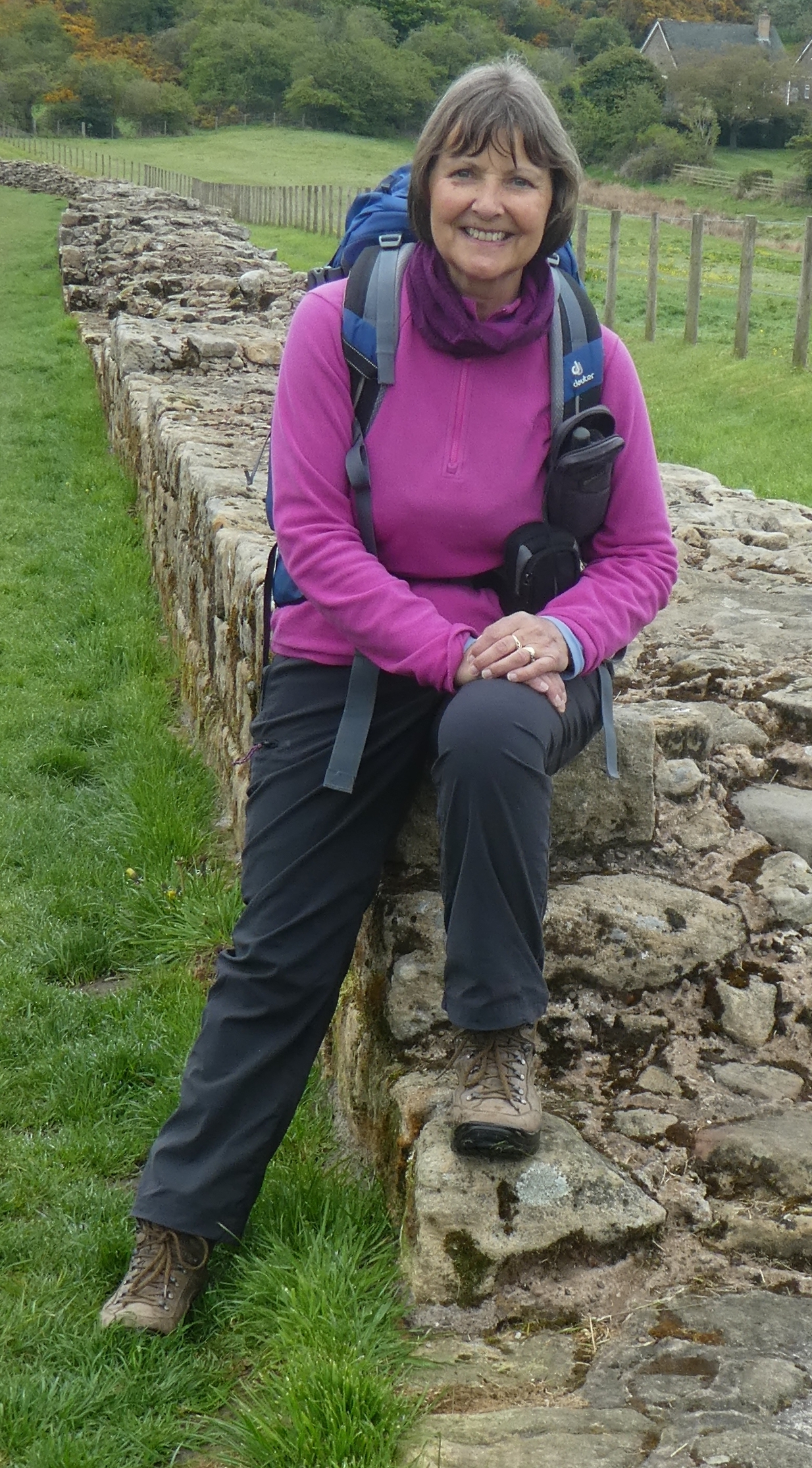
This interview is Graham Sherwood, a member of the NEC, who gives some great advice on completing 100s. And what a debut for a social walk that he got himself mentioned in Strider! This photo of Graham was taken at Pooh Bridge on the Kent social walk in April 2026.
Q. Could you briefly introduce yourself, including your role as LDWA groups officer, and how many LDWA 100s have you entered?
A. I’m Graham Sherwood, LDWA local groups officer, secretary of Merseystride LDWA and co-organiser of the Open to Offas challenge event. As local groups officer, my role is to help the 41 local LDWA groups, who are the backbone of the organisation, to thrive. I joined the LDWA in 2018 having heard good things about it from fellow participants on a 35 mile charity challenge walk along the Llangollen Round. Although I did a couple of 50 mile events shortly after joining, the thought of a 100 was just crazy. However, in May 2019, I somehow found myself on the Hadrian 100, and thanks to the support I received from other walkers and encouragement from marshals I managed to complete the event. In total now I have started five and completed four 100s – on the Trans-Pennine 100 I retired at 67 miles.
Q. What made you decide to take on this year’s LDWA 100 in Kent?
A. Once you start doing 100s, they become addictive. I know I can walk a hundred miles over two days and two nights and I want to prove to myself that I can do it again.
Q. What are you most looking forward to about the route and the event weekend?
A. I’m looking forward to getting to know this part of Kent and East Sussex better. I’m also looking forward to the social aspect of the 100 – shared adversity and pain, and hopefully a few laughs.
Q. Have you walked much in Kent before, and is there anything about the landscape or area that particularly appeals to you?
A. Having grown up in the Chilterns, I love chalk landscapes. I am most familiar with the area around Dover. Although I live in North Wales, my very first LDWA social walk was with Kent group in June 2018 – a 42 mile dawn to dusk walk led by this year’s 100s chair, Peter Jull. I distinguished myself by having a funny turn in the pub we called into in the afternoon and getting written up in Strider as a “fainting episode”. I’ve also completed the White Cliffs challenge four times and the Sevenoaks circular once.
Q. How has your training and preparation been going so far?
A. I hope reasonably well. I try to get out on a social walk at least once a week, mainly with The Irregulars or Merseystride, but I’ve also joined walks organised by East Lancs and Kent in the last few weeks. I managed to complete the Cymoedd Sir Fynwy 50 in South Wales this year, something I failed to do two years ago and I’ve also completed challenge events organised by Lakeland, West Lancs and Essex and Herts groups this year.
Q. When you think about the 100, are you mainly focused on finishing, enjoying the route, managing the pace or some slightly alarming combination of all three?
A. I am a slow walker and I will be focussing on getting round this route within the 48 hours – I walked a 12 mile section of the route through Ashdown Forest to Crowborough with Kent group a few weeks ago and know it’s going to be tough underfoot and very challenging. This is the first time I have ever done anything resembling a recce. My normal recce consists of a couple of fly-throughs on OS Maps and checking the gpx route on my Locus Map app.
Q. What do you most enjoy about the atmosphere of a 100-mile event?
A. The 100 brings the LDWA membership together – talking about it on social walks before and after the event. The support you get from other participants and volunteers at checkpoints.
Q. Do you have any advice for entrants, particularly at times when they’re tired and when perhaps the enthusiasm has dimmed a little?
A. The 100 is a mental as well as a physical challenge – I find the first night tougher than the second as I always feel sick. The hallucinations on the second night are rather fun. On my first hundred I got to the Kent checkpoint some 30 hours in determined to retire. Graham Smith told me to sit down, have a cup of soup and wait half an hour. That was great advice.
Q. Food can become rather important on a long event, sometimes to a level that would alarm anyone outside the LDWA. Are there any checkpoint foods or walking snacks you’ll be especially hoping for?
A. I need plenty of salty foods to keep me going. It’s essential to keep eating at every checkpoint as if you aren’t careful you start feeling sick and it gets really hard to eat.
Q. As someone involved with LDWA groups nationally, what do you think events like the 100 show about the strength of the association and its volunteers?
A. The 100 is a fantastic showcase for the LDWA and goes to show the dedication and determination of its members. I really admire those at HQ and at the checkpoints who help the participants complete the challenge – their support, encouragement and, of course, food are invaluable – we couldn’t do it without you.
Q. Finally, when you reach the start line in Kent, what do you think will be going through your mind?
A. I’m going to be glad to see familiar faces but nervous – this is going to be a particularly challenging route because it is hilly, the ground is rough underfoot and there are a lot of stiles.