
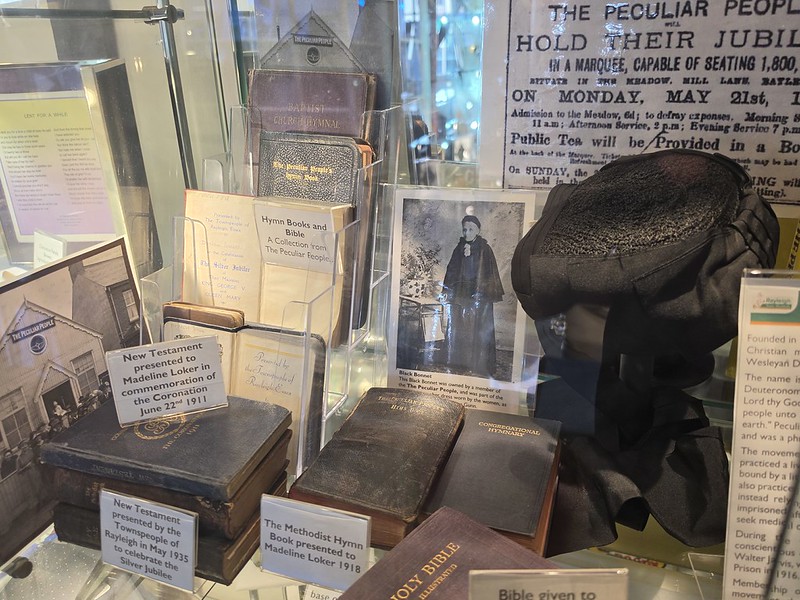
There’s a black bonnet in Rayleigh Town Museum that once belonged to a member of the Peculiar People. Beside it is a photograph of a woman wearing a similar bonnet, which gives a much better idea of how it sat than seeing it propped up in a glass case. It’s a rather sober-looking piece of clothing for a congregation whose jubilee arrangements, judging by the notice behind it, included a marquee with seats for 1,800 and tea for the public. That seems all quite decadent.
The Peculiar People began in nearby Rochford in the late 1830s. James Banyard, a shoemaker and Wesleyan preacher, began holding meetings in his cottage after falling out with the local Wesleyans. Taking an argument home is one thing, but inviting the congregation round strikes me as quite a commitment and I’m impressed by the whole arrangement. The movement took its name from the King James Bible, where ‘a peculiar people’ meant a people chosen by God and set apart for him. I would add that this was a name that the group chose for themselves as something of a badge of honour, it’s not some form of negative names given to them by others.
The movement became known for its belief that prayer alone could heal the sick, and its members refused conventional medical treatment, a policy I’m not sure was entirely wise. Banyard himself eventually called for a doctor when his young son was ill and went on to argue that prayer and medical care could go together. Very convenient. This arrangement caused a split in the church and cost him his position as one of its bishops, although he continued to preach despite all the arguments. At its height the movement had dozens of chapels, mostly in Essex, with others in London and Kent. Rayleigh had a chapel on Eastwood Road, and in 1956 the denomination changed its name to the Union of Evangelical Churches.
Among the Bibles and hymn books in the case are a New Testament given to Madeline Loker for George V’s coronation in 1911 and a Methodist hymn book presented to her in 1918. Another New Testament was presented by the townspeople of Rayleigh for the king’s Silver Jubilee in 1935. Rayleigh evidently took the view that a royal occasion was best marked by giving someone something to read.