
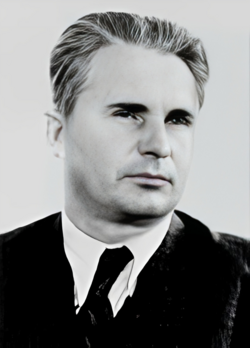
One of the political figures connected with Lublin’s rather complicated twentieth century history is Edward Osóbka-Morawski. He was just 34 when he became chairman of the Polish Committee of National Liberation in July 1944, placing him at the head of an administration which would help shape Poland’s postwar future. Within a few years, however, he had lost the premiership and was heading towards the political sidelines. There’s something striking perhaps about a career in which the most important chapter was largely over before its subject reached 40.
His connection with Lublin comes through that committee, usually known by its Polish initials, PKWN. Although closely associated with the city, it was actually formed in Moscow under Stalin’s patronage, before establishing its headquarters in Lublin in August 1944. It presented itself as an authority for territory emerging from German occupation, directly challenging the established Polish Government in exile in London.
That Government in exile maintained Poland’s legal continuity and had the allegiance of the Polish Underground State, but the committee had the backing of the Soviet Union and the army advancing across the country. These were competing claims to govern Poland, with military power increasingly determining which would prevail. It’s this element that I was most interested in as I hadn’t previously realised, although really should have done, that there were competing visions of who should govern Poland after the Second World War.
Władysław Raczkiewicz, the President of Poland in exile, found himself left in the UK after 1945, living in Ruthin in Wales until his death in 1947. There were elections in Poland in 1947 that were rigged to ensure victory for the communist led bloc. I’m not sure how I’ve missed this rigged election either, it’s not something that seems to be covered in the museums I’ve visited.
Osóbka-Morawski came from the socialist movement rather than the Communist Party, having joined the Polish Socialist Party in 1928. His presence helped give the new administration a broader political appearance, although he actively participated in establishing the Soviet backed order. He was also forceful in attacking the rival government in London, publicly dismissing its supporters as isolated political failures. At the end of December 1944, the committee became the Provisional Government, with Osóbka-Morawski as Prime Minister. In June 1945, he retained the premiership of the Provisional Government of National Unity, which brought in the former London based Prime Minister Stanisław Mikołajczyk.
His own decline was gradual rather than a single dramatic disappearance. Józef Cyrankiewicz replaced him as Prime Minister in February 1947, although Osóbka-Morawski remained Minister of Public Administration until 1949. He subsequently spent years directing the country’s central spa administration, a considerable change from leading a government during the reconstruction of Poland. He had helped establish the new political system, but his own position within it proved much less enduring.
He lived until 1997, surviving long enough to see Communist rule collapse and even attempting to revive a socialist party in 1990, without significant political success. For Lublin, his story belongs to that brief period when the city became the headquarters of an administration claiming the right to govern the country. The rival Polish Government remained in London, but Osóbka-Morawski’s administration could exercise authority on Polish soil under Soviet protection.
I find it difficult to imagine what it must have been like going from leading a government to running the country’s spa administration, then living for another half a century. He had helped establish a political system which pushed him aside, and eventually lived long enough to see that system collapse. Anyway, that’s another rabbit hole that I’ve ended up going down.