Category: UK

  • London – Visiting London Underground Stations in 2023

    London – Visiting London Underground Stations in 2023

    How exciting, I’ve never had an e-mail before from TFL telling me how many tube stations I’ve visited in the year. This is a very poor performance for someone who loves London and the underground so much, especially as I did a quiz this weekend on how many tube stations I knew and I think I did rather well (on the same theme, try this…..). Anyway, I aspire to beat 59 tube stations this year   🙂   In other statistics, I made 108 journeys on TFL in the year and made the most in August. I’m sure my two loyal readers will be thrilled to know this. Oh, and if anyone wants an adventure involving craft beer, London breweries and visiting underground stations later in the year, let me know  🙂

  • Humber Doucy Brewery – Meet the Brewer at the Lidgate Star

    Humber Doucy Brewery – Meet the Brewer at the Lidgate Star

    20240112_194508

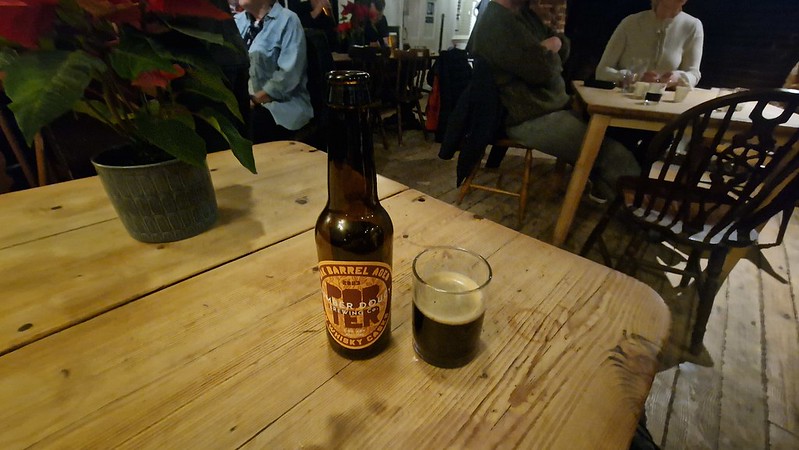
    Meet the Brewer events are some of my favourite things and I’m delighted that the Lidgate Star has two a month of them. We have a lot of very lovely and supportive brewers in the area who are really keen to engage with pubs. John from Humber Doucy brewery was at the Star talking through six of his beers. One of the nicest brewers you could imagine, the brewery are a father and son team based in Bacton in Suffolk. Their brewery, which I’m going to get to soon I hope, is in a former 1950s MOT garage and it all looks very smart from the photos. The brewery name is inspired Our name is inspired by a road in Ipswich, said to have been named by French prisoners of war in the 1800s.

    20240112_202822

    My favourite beer of the evening was the oak barrel aged porter, a rich and decadent little number with plenty of richness. They also have a more usual porter, a nettle & elderflower saison, a red ale and a bitter, all intriguing and interesting. John talked through each beer, spoke about the brewery which all proved entertaining. Their web-site is at https://humberdoucybrew.co/ and their Instagram is at https://www.instagram.com/humberdoucybrew/. The pub’s next two meet the brewers are Mauldons and Three Blind Mice.

  • 200 Years Ago in Norwich : Wheat Sheaf on Bethel Street

    200 Years Ago in Norwich : Wheat Sheaf on Bethel Street

    From the Norfolk Chronicle and Norwich Gazette from 200 years ago, I noticed this little advert:

    “WHEAT SHEAF

    Bethel Street, Norwich

    John Woolterton, late of the Flower in Hand at St. Mary’s,

    Returns his best thanks for the favors conferred on him in his late situation, and begs to inform his Friends and the Public, that he has taken the above Inn, the Wheat Sheaf, where he hopes to merit their support, by furnishing the best of wines, spirits and malt liquors, with a strict attention to the comfort of his customers, in the supply of good beds, stabling and a bountiful but economical table.”

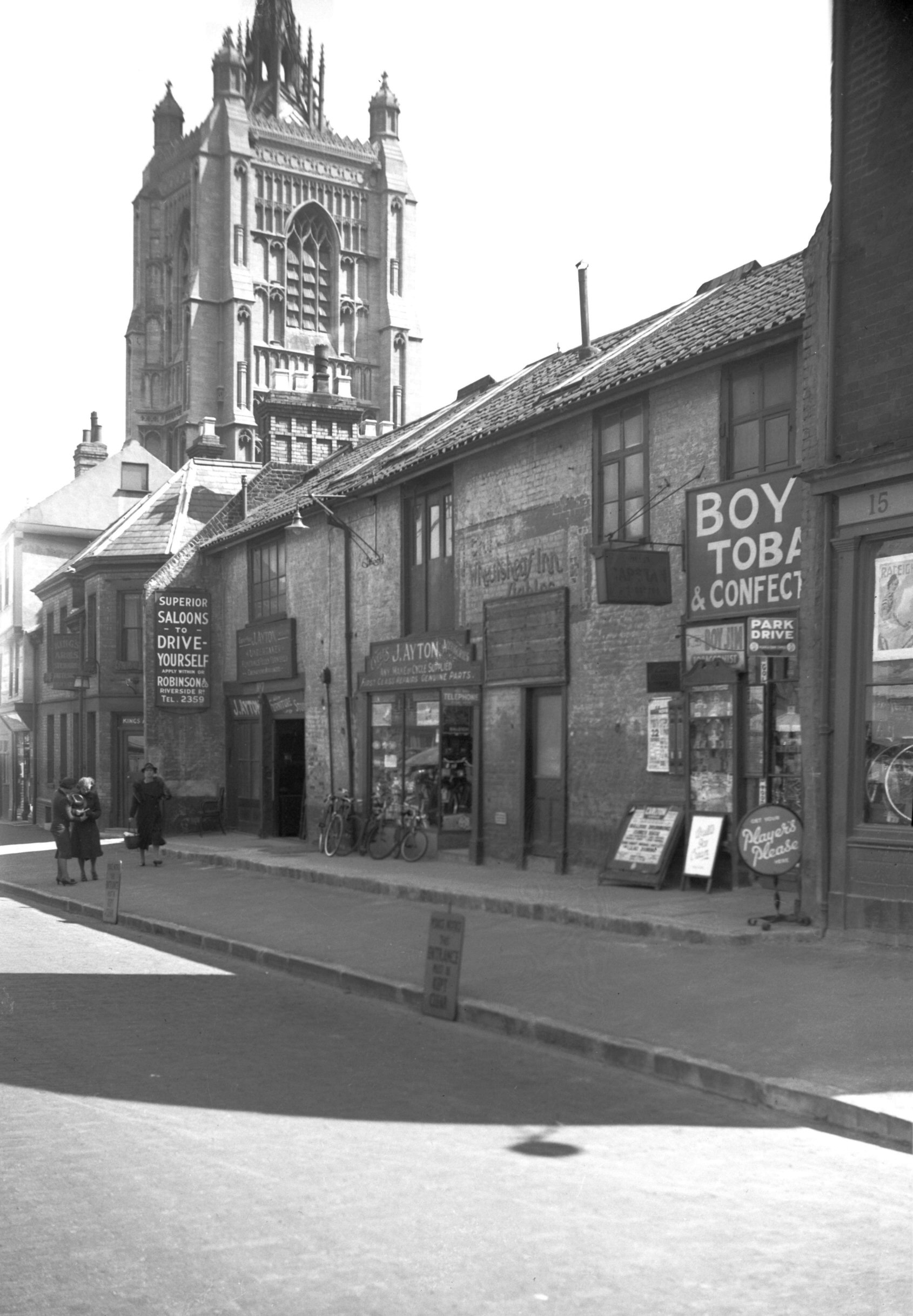
    As a side note, interesting to see that the spelling of ‘favors’ without the ‘u’ was still common. The Flower in Hand was run by John Woolterton between 1810 and 1822 and was located on what is now Pitt Street. It was damaged during the Second World War, repaired and then closed in the 1960s. The Wheat Sheaf on Bethel Street was demolished in 1936 to make way for the new fire station, which has now in turn been converted into a school. The wonderful George Plunkett was able to get a photo of the pub’s former stables in 1938.

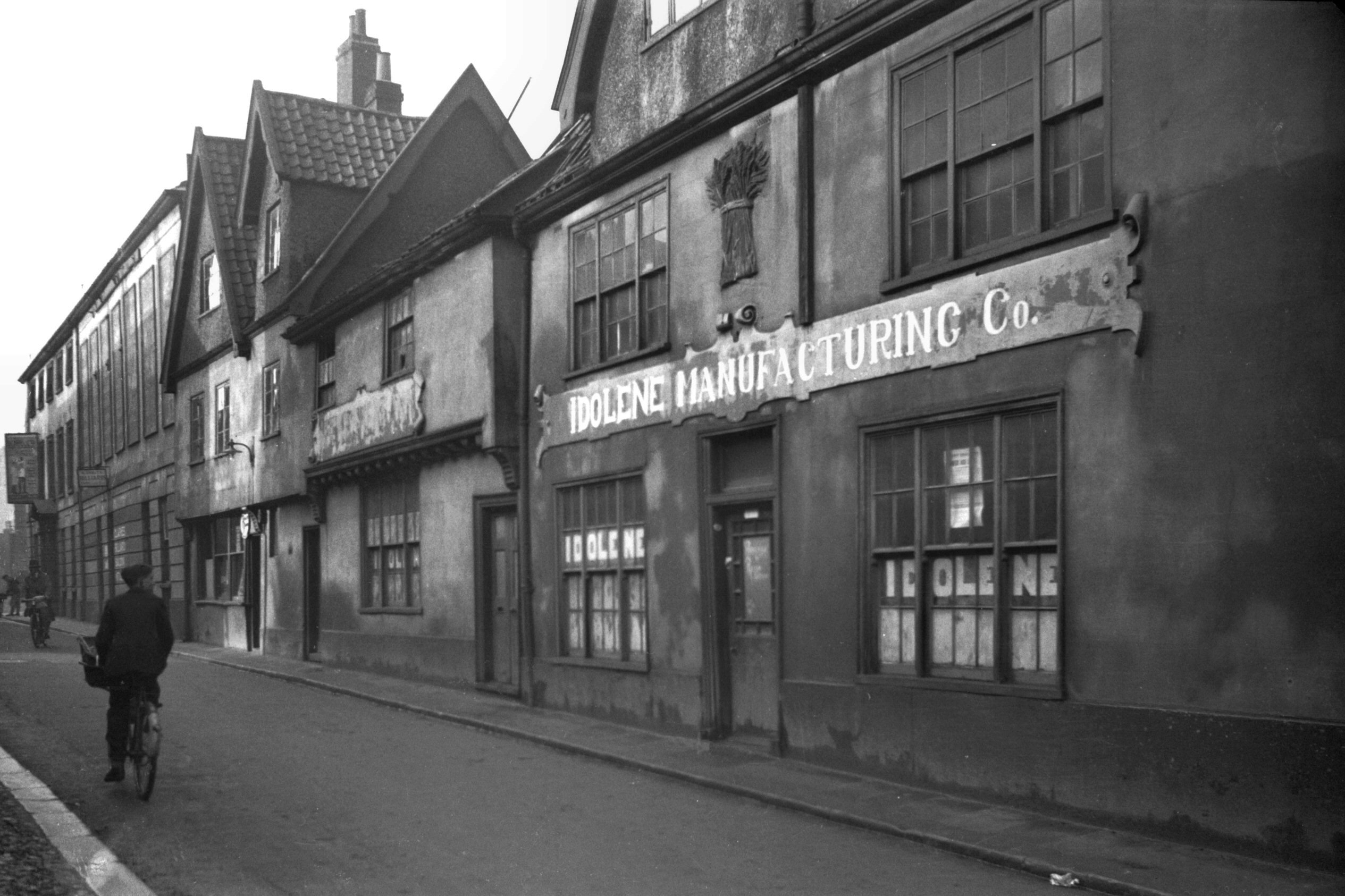
    And more importantly, he got a photo in 1934 of the pub just before it was demolished. By this stage it was no longer a pub and George Plunkett wrote:

    “At No 14 was latterly the Idolene Manufacturing Company, occupying premises formerly the Wheatsheaf inn and retaining its sign above the door, moulded in plaster. It has been suggested that this was intended for a sheaf of barley, for the old Barley Market dating back to the reign of Edward I was formerly held in an adjacent yard. One of the chief attractions here was the skittle alley, but the inn also afforded stabling on the opposite side of the road for the accommodation of carriers. These stables in fact outlasted the inn, surviving until 1960 as lock-up shops, including those of a tobacconist and a secondhand furniture dealer. The inn itself was a Tudor building of several gables, and it was reported at the time of its demolition that certain of its oak beams were to be preserved at one of the city’s museums. There is no record that this was ever done.”

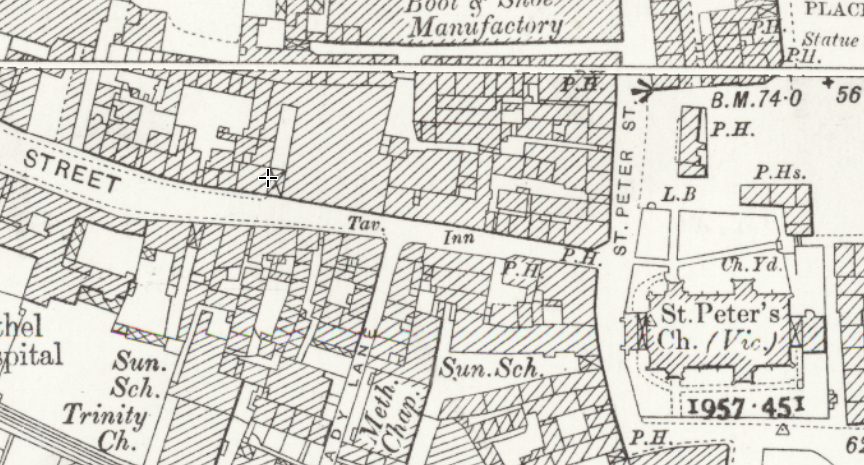
    The pub is the one in the middle of the above image. It’s actually now under Bethel Street before City Hall and the Forum as the street line has moved a little, a rather unfortunate loss to the city as that area is now a little sterile. Anyway, once again, I digress.

  • 200 Years Ago in Norwich : Discovery of a Chalk Mine

    200 Years Ago in Norwich : Discovery of a Chalk Mine

    In the latest in my series of posts from the Norwich Mercury of 200 years ago…..

    “Singular Discovery – On Tuesday, as some men were employed in sinking a well upon a piece of land belonging to Mr. Sendell, situated within a hundred yards of the site of St. Giles’s gate, they suddenly found themselves over a vault when about 35 feet from the surface of the earth; naturally alarmed at such an appearance, they left their work until the afternoon, when they provided themselves with stronger tackle and proper implements for ascertaining the “depth below”, they soon found that no danger was to be apprehended in descending to explore the cavern, and accordingly proceeded with a supply of lights, and found very beautiful and extensive vaults, running in almost all directions.

    Encouraged by this account, Mr. Sendall and some friends descended to view these unexpected excavations. The air was perfectly pure, and the soil, which is a fine solid chalk, quite dry and of snowy whiteness. On lights being placed at various turnings the appearance was extremely interesting; at what period these places were in use cannot be ascertained, as neither record or remembrance of them exist. They they are growing over the mouths of 60 to 70 years of age, yet the marks of the tools appear very fresh, and the stains of smoke remain in the small niches where lamps were placed by the workmen. A great anxiety to see them has been manifested by the public, and in order to gratify such curiosity we understand Mr. Sendell has waited upon our worthy Chief Magistrate for permission to exhibit them, which permission has been very handsomely granted, and the exhibition will commence as soon as a comfortable entrance can be effected at the front of the hill. It is a singular fact that many marine shells have been taken from the solid chalk in the sides of these arches.”

    There’s a whole network of these chalk mines around Norwich which have caused some excitement over the years, not least when a bus fell into one near to the Roman Catholic Cathedral on Earlham Road. They were caused by mining for flint and chalk and plenty are still under the city centre, although many have also been filled or their entrances closed by nervous  property owners and councils. The city council makes reference to these discoveries in their recent notes for the St Giles conservation area.

    “It is believed that for several hundred years after the 11th century (and maybe earlier) the area was closely associated with chalk and flint mining. In 1823 an extensive system of tunnels were rediscovered under Earlham Road. They became a tourist attraction and candle-lit tours took people through various tunnels with names including Beehive Lane, Bacchus Street and Royal Arch. One cave was found to contain the inscription ‘John Bond 1571’.”

    There is a map of the streets in the area from 1823, but I haven’t yet been able to locate a copy. Although tucked a little away in the Norwich Mercury, the discovery was certainly one which caused some general excitement amongst the denizens of Norwich. Urban explorers still try and find entrances to various chalk mines across Norwich, but I’m not brave enough to do that (there are limits to even my bravery).

  • 200 Years Ago in Norwich : Murder by Blackfriars Bridge

    200 Years Ago in Norwich : Murder by Blackfriars Bridge

    Back to my series of posts about what was happening in Norwich 200 years ago this week. And, it’s yet another reminder of just how dangerous a city it was at that time, crime seemed to be rocketing and this is another example of the problems that were faced. The Norwich Mercury reported:

    “On Sunday last an inquisition was held at the Workhouse, in the parish of St. Andrew, before Mr William Bell, coroner, on the body of Elizabeth Chaney, aged 19 years, who was picked up in the River Wensum, near Blackfriars Bridge. Septimus Sterey and John Plummer deposed, that they took the body out of the water that morning about 9 o’clock; marks of violence appeared on her face and blood on her cap. Jane Nixon, of the parish of St. Andrew, stated that she has known the deceased upwards of seven months, who, occasionally, came to her house to clean; that deceased was a very steady girl, and was a good character; had in her pocket, when she left witness’s house, one shilling in silver, which she had not had when found; deceased left between 10 and 11 o’clock on Saturday night.

    John Cook, living in the Water Lane, in the parish of St. George’s Colegate, said he heard a scuffle in the lane about 11 o’clock on Saturday evening; went to the door, and saw a man and woman (cannot say that she was the deceased). The man appeared to use violence, and the woman ran away; the man followed her. The man had on a dark coloured coat and light trowsers [I like this old style of spelling trousers]. Jeremiah Sexton stated he lived in Water Lane; on the Saturday morning, sweeping there, found a pair of pattens near the staithe, and by the water side saw foot steps. Sarah Nixon deposed, that the deceased lodged at her father’s, and slept with her; knew the pattens to belong to the deceased by the strings, for she gave them to her.

    The Coroner said, as there was no evidence adduced to prove how or by what means the poor girl came into the water, the Jury could return no other verdict than found drowned under very suspicious circumstances.”

    As the Coroner hinted, this was a murder, but with no evidence to ever prove anything, but it seems to me to the worst of domestic abuse. I didn’t know what a ‘patten’ was, but it’s a clog or sandal. St. Andrew’s Workhouse, housed in St. Andrew’s Hall, was in operation between 1712 and the 1850s, before larger premises were constructed in Dereham Road. Also, Water Lane is now known as Hansard Lane. These were certainly challenging times for the city.

  • Streets of Norwich – Hansard Lane

    Streets of Norwich – Hansard Lane

    And another from my Streets of Norwich project….. [updated in January 2024]

    1260365

    This small lane off of Fishergate goes down to the River Wensum and it separates the Church of Saint Edmund from what is today an NHS building, but was once a large sawmill site.

    1260366

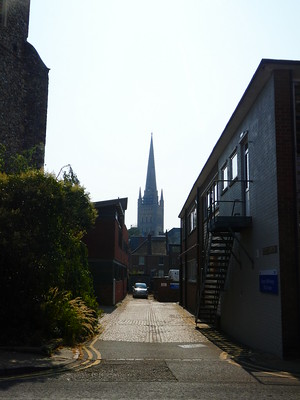
    There’s a rather nice view of Norwich Cathedral when looking down Hansard Lane. Before it was renamed in honour of local Norwich man Luke Hansard (of Parliamentary printing fame) in around 1890, this street was more simply known as Water Lane. Here’s an article about what was likely a murder near Water Lane that was reported in January 1824.

  • 200 Years Ago in Norwich : Papered Pane Cut on Magdalen Street

    200 Years Ago in Norwich : Papered Pane Cut on Magdalen Street

    In the latest in my riveting series of posts from 200 years ago, this was published in the Norwich Mercury in January 1824.

    “On Monday evening some person or persons cut a hole in a papered pane of the shop window of Mr Steward’s repository, in Magdalen Street, and took through the same three bottles in japan ink. A similar trick was played a week or two since at the window of Mr Brown, baker, of the same street.”

    I hadn’t heard of papered panes before, although having thoroughly researched the matter (looked briefly on Google), they seem to have been relatively common and were also a feature in the early United States (https://en.wikipedia.org/wiki/Greased_paper_window) for those who couldn’t afford glass or weren’t able to have anyone nearby who had the skills to make it. Indeed, glass windows in residential properties wasn’t much of a thing for the poorer classes until the early seventeenth century. Having paper windows certainly feels rather sub-optimal though, not least because some pesky people cut through them to steal stuff.

    Anyway, I digress, more interesting posts to come.

  • 200 Years Ago in Norwich : Sam Garwood Steals Piece of Wood

    200 Years Ago in Norwich : Sam Garwood Steals Piece of Wood

    The latest in my series of articles from the Norwich Mercury of 200 years ago this week. It’s crime related and just a short note that:

    “Sam Garwood was sentenced at Norfolk Adjourned Sessions for stealing a piece of wood. He was sent to Walsingham Bridewell for three months.”

    Interestingly, the courtroom is still there in what is a museum in Walsingham, although not one that I’ve visited. The Petty Sessions for the area were held there until 1974 and it’s one of those perhaps mistaken attempts by Government to try and centralise everything. The Bridewell was a separate building, constructed in 1787 and built along the lines of John Howard’s vision for a modern and reforming prison. It was built on the site of the former leper hospital and it was expanded in 1822 to add 16 more cells. In the year that Garwood was sentenced, five tread wheels for grinding corn were added and I assume that he was forced to use them. The Bridewell closed in 1861, but it’s still there and nearly untouched with access possible by getting the key from the Shirehall Museum. Indeed, I now want to go as I last went to Walsingham during partial lockdown and most things were shut.

    As for poor Sam, it seems a harsh punishment, but he had been imprisoned the year before and perhaps the court took that into account. Indeed, there was a Sam Garwood who was imprisoned in the same area on 31 July 1843, so this whole prison thing didn’t seem to work (unless it was a different Sam Garwood). Unfortunately, there are a few Samuel Garwoods who were in Norfolk at the time, so I can’t work out which one it was.

  • 200 Years Ago in Norwich : State of the City

    200 Years Ago in Norwich : State of the City

    And another in my series of posts from the Norwich Mercury of 200 years ago, this one was published on 13 December 1823, and it relates to the condition of the streets of Norwich. I rather like the picture that this article conjures up of the state of Norwich streets at the time, albeit clearly greatly improved in the years that preceded this article.

    “The inhabitants and the visitors of Norwich must have (for some time past) regarded with no slight satisfaction the attractions which have been going on in various parts of the city. We well remember the anticipations of the friends of the act for watching, paving, lighting and cleansing our streets, and it appears to us the time is now come when the realisation of so much of what they prophesied is come to pass, that they have cause for triumph. Certain it is that many of the streets of the city are greatly improved: the shops are in themselves more elegant as well as more convenient, and the display of goods of all sorts is more varied and tasteful. The progress of things has, without doubt, effected many of these desirable changes, but no little is owing to the spirit of improvement, which, when once excited into action, is unlimited in its operation.

    One present purpose however is not so much to speak of general as of a local alteration, which appears to be to be amongst the most beneficial the city has yet undergone. We allude to the striking improvement in the market and the streets adjoining. Never, we will venture to assert, has any thing been done since the passing of the Act (near seventeen years) more worthy of public regard and approbation, than this will be when its completion, which is nigh approaching, is effectuated. In tracing its progress, we observe that a sewer of considerable length and capacity has been made sufficient to receive the filthy tide of waters which formerly flowed on the surface from offensive private drains and channels, to the great annoyance and inconvenience of the inhabitants, and the utility of common sewers was never made more perceptible.

    The pavement between White Lion Lane and Brigg’s Lane, which was of late absolutely unsafe for carriages, from its irregular surface, broken into deep ruts and holes, is now brought to a smooth and commodious level, with a spacious foot-way on its sides, and is indeed in no respect inferior to the best-paved streets of the metropolis. The Hay Hill, from its rude, mis-shapen and irregular form, intersected as it was by channels in all directions, and almost impassable, is now made of easy ascent, and perfectly safe both as a carriage-way and to foot passengers.

    These improvements are continuing to Bethel Street. And here we are most forcibly struck with the metamorphosis which the public spirit of a single gentleman has wrought. It is within every one’s remembrance, that this street was amongst the vilest in the whole city – the houses dirty and squalid, the pavement all but impassable, while the wretched inhabitants of the adjacent yards and thoroughfares were of a description to reduce and almost annihilate the value of the few decent habitations the street contained. Since Mr Hawkes came to live in it, he has gradually removed every one of these objections; and while he has advantaged his own property, he has ornamented the whole length of the street, and set a noble example of what may be effected by a spirited individual. For the other improvements, the city is indebted to the contribution of £300 from the Corporation and the liberal subscription of £200 from the inhabitants of St. Peter’s Mancroft, which have enabled the Commissioners, who are always anxious to do their utmost, to effect the work.

    Nor can we conclude our article without paying to Mr Rooks, the surveyor, the tribute that is due to his talent and attention. This gentleman has been resident here during a long and active life, and he has been employed in great public works and in many private undertakings, which, if less conspicuous, are scarcely less ornamental or less useful according to their degree. It is therefore with particular pleasure that we offer our best acknowledgements to him for he combines zeal with judgement and both with the feelings and the manners of a man of taste and talent.

    This subject matter naturally leads us to something further. One of the most narrow and dangerous avenues to the market is the confined street called Brigg’s Lane. St. Stephen’s Street is greatly bettered, and wants but little to render it a good and open approach. Rampant Horse Street is still more spaciou, but those advantages are incalculably lessened by the existence of the insufficient passage which Brigg’s Lane presents. If we remember rightly, the Rev. Henry D’Oyley, a Clergyman of Hempnall, devoted some of the last years of his life to soliciting from parish to parish and from house to house a subscription for the purpose of enlarging this avenue.”


  • Streets of Norwich – Bishopgate and Norwich Lower School Gone By

    Streets of Norwich – Bishopgate and Norwich Lower School Gone By

    Screenshot-2020-05-15-at-12.08.12

    Linked to my Streets of Norwich – Goldsworths Buildings post…..

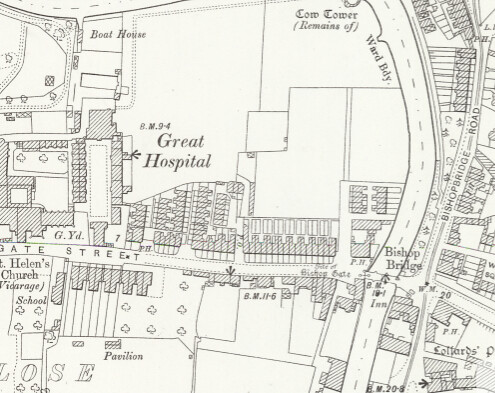
    John kindly got in touch regarding Norwich Lower School, which is a little further down Bishopgate. This is relevant as pupils had to walk by the former Goldsworths Buildings to get to the football pitch near to the river.

    There will be a longer interview in the new year on this, but John mentioned:

    “The Lower School was built in the old fashioned style common to state schools in the late 19th and early 20th centuries, with high windows and a pitched roof. Think of it as an elongated rectangle divided laterally into three classrooms. The room nearest Bishopgate was the 2 J classroom (Mr Christopher Smith, known by us as Smithy), then Form 2 (Mrs Edith Stephenson, the headmaster’s stepmother, who we referred to as Ma Stevo) and furthest back was Form 1 (Mrs Spruce, known irreverently as Fanny – we had no concept of the more slangy meaning of this word as it is often used nowadays, it was just a female name as used by Jane Austen for Fanny Price). We were turned out at break times on to the School Field. The loos were also outside and froze up in the cold spells which happened every winter in those days, accompanied by snow and ice. The whole setup would have failed a modern school buildings inspection and the place was demolished after the next Lower School was built in (I think) the mid 1960s.”

    I hadn’t known much about the old Lower School, which was replaced in either the late 1970s or early 1980s with the current building. There was an arson attack in something like 1989 which caused significant damage, but the general structure of the building was restored, although extended.

    Unfortunately, the late and great George Plunkett doesn’t have any photos of the school in its current or former incarnation, so I’ll go on the hunt elsewhere for those.