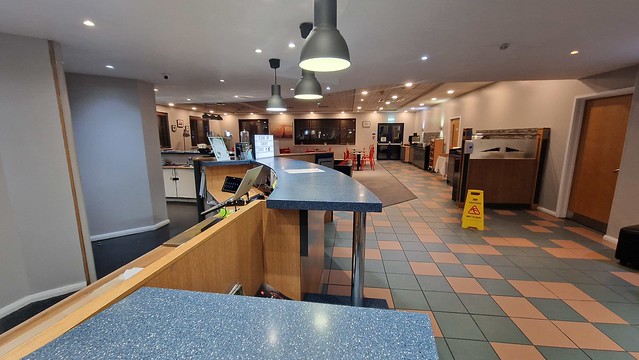
Stansted Airport long ago gave up with any attempt of having seating in their main departures section of the terminal, unless sitting on the floor is in the management’s action plan for customers. However, a short walk to the airport’s bus station terminal leads to a positive smorgasbord of seating options, so we rushed there positively giddy with excitement for the trip. I accept that a breakfast, or perhaps brunch is more appropriate, of King Queen Knave and Adnams Ghostship crisps might not feel premium, but adventures that start with a Pressure Drop beer at least have a positive beginning. Also, the prices in the terminal were far too indulgent for Liam and I, so this was a much more practical thrifty option. Also sitting in the bus station lets me dream of travel, seeing such glorious destinations on the departing coaches which included Braintree, Harlow and Luton. Does travel get any more decadent than that? I don’t think so.
Category: UK
-

Carcassonne Day One : Getting to Stansted Airport
I don’t get much chance to get away at the moment, so there will be a small deluge of excited posts about a weekend away which can surprise and delight my two loyal blog readers. Thanks to Susanne for driving Liam and I to Stansted Airport for the adventure, with the added excitement for me of being a passenger in a left-hand drive car so I could pretend momentarily that I was driving. As I mentioned, I don’t get out much and this is all I can muster for this blog to liven up the drive to the airport. One thing about living nearer to Stansted Airport is that it feels much more convenient, although less so for Liam who had driven all the way from Norwich already.
Stansted Airport doesn’t allow for free drop-off any more as they can excitedly collect money from drivers who want convenience, but it does allow you to park for up to an hour in the medium stay car park without charge and then get a free shuttle to the terminal. As usual, I couldn’t risk being late at the airport, so we arrived nearly four hours before the flight, which to me is cutting it fine. Anyway, I digress. Hopefully I’ll be able to write this weekend up before getting distracted and taking nine months to complete it.
-

Lidgate – Lidgate Star Census from 1911
[I’ll come back and add more to this post as I find out more….]
Old census returns are fascinating things, this one is from the Lidgate Star in 1911. It’s the Leach family, who were a couple who had four children, all female, although two children had already died. William and Margaret had married in Newmarket in the final quarter of 1893.
William James Leach (born in 1867)
Margaret Leach (born in 1867)
Margaret Leach (born in 1895)
Winifred Leach (born in 1896)
Dorothy Leach (born in 1898)
Florence Leach (born in 1899)
William Crick (born in 1874)
William and his family had also been at the pub at the 1901 census, with William Crick being Margaret’s brother.
William James Leach died on 6 August 1947 at the age of 81.
-

200 Years Ago in Norwich : Transportation for Stealing Rope

And another in my little series of posts relating to articles in the Norwich Mercury from 200 years ago this week. The list of crimes, as usual, was extensive and it’s evident from the media of the time that Norwich was a dangerous city in which to live. Crime was seemingly out of control and the judicial system was desperately trying to deter people from committing offences by having harsher and harsher sentences. And this was certainly one of them:
“John Challis, charged with stealing a quantity of rope, the property of Samuel Jay, transported for 14 years”.
Challis had been caught committing crimes before, and indeed had been flogged to stop him repeating his misdemeanours, but that clearly didn’t work. This sentence isn’t some extreme offence either, the courts of the time liked transportation. John was 19 years old, so wasn’t really a hardened criminal and he was sent to Van Diemen’s Land (Tasmania) on the Princess Charlotte, which departed on 3 July 1824 and arrived on 9 November 1824. It’s hard to imagine just what that journey must have been like, but I’m imagining it was traumatic. Those who saw their sentences out were allowed to remain as free settlers in Australia or be given a ticket home, but the story isn’t a happy one for John. He died on 1 January 1827 at the age of 22 and he’s buried in the Cypress Street Anglican Cemetery in Launceston City.
-

200 Years Ago in Norwich : Little Public Spirit Amongst Norwich Citizens?
Going back 200 years ago and the journalism in the Norwich Mercury….. I’m more amused by the editor’s response to a letter rather than what the correspondent had sent, but let’s deal with that first:
“Sir,
It has often been a subject of regret to many of the inhabitants of this city, and not less to many of the country families who resort hither for medical advice, that in a place where there are so many public and scientific societies, and in which public improvements have kept pace with its increased population*, that there exist not in the city of Norwich any public baths, either for the benefit of the invalid or the gratification of the luxurious.
There is no doubt that if baths were established here, our medical men would be still more resorted to for advice, by distant patients, than they now are, and many families might be thus encouraged to take up a temporary residence here, who, under present circumstances, must go to Yarmouth or London for the sake of such conveniences.
As an establishment of this nature could not fail to succeed, it is, I conceive, worthy the attention of some spirited individual to invest a small capital in the scheme, as a source of emolument, sure to repay him liberally for his trouble. A lodging house upon a respectable scale might be attached to the baths. Should no individual be found who would undertake this, possibly there might be found twenty gentlemen who, by subscribing 25l each, would become shareholders of such an undertaking, or as a joint stock company, for their own personal comfort or convenience.
There are, perhaps, few places which possess such advantages as this city, in regard to pure water, daily into the very houses, besides the facility of carrying off the water at a very trifling expence.
I am Sir, an Invalid.”
As an aside, Norwich didn’t get baths for some time after this letter, but it was response of the editor that moderately amused me.
“*We wish we could confirm the compliment our correspondent pays the citizens. There certainly is no place in the kingdom where so little public spirit is exhibited, and where improvement is so far behind wealth and population”.
I’m not sure that the present editor of the EDP, or indeed a similar journal, would get away with that.
-

Ashley – St. Mary’s Church (the old one)
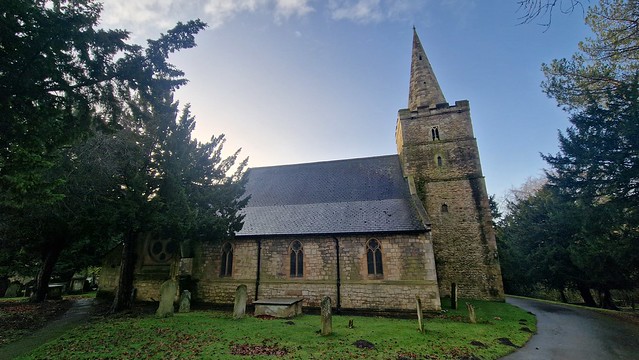
There’s not really anything to see of the former St. Mary’s Church in Ashley, the low walls that apparently still survive have been taken over by foliage over the last few decades. Ashley, and its neighbour Silverley which it had been merged with, lost both their churches to dereliction and a new one was constructed in Ashley in the 1870s to service the religious needs of the local denizens. More on that in a later post though.

As an aside, I wondered why on the modern landscape there’s a patch of trees near to the church, but the map solves the query, it’s because it was once a chalk pit. It’s possible to walk on a footpath around the church, but there are signs saying to keep out and it didn’t look easy to battle a way in. It all means that the ghosts of the people buried here remain safe from being disturbed. The former church of St. Mary’s isn’t in the village itself, it lies on the Dalham Road around a kilometre to the west. The churches here and in Silverley were made redundant in the middle of the sixteenth century and there were accounts of some laxness with regards to the parishioners attending a church at all. It’s not really a great surprise, but the residents of Ashley were left without a church for 200 years. In the early nineteenth century, the local village schoolroom was pressed into action for the residents, but it was thought that a grand new church was needed and that’s what was delivered in 1872.
The church that now can’t be seen was constructed in the thirteenth century, built with flint rubble and there was a rood loft in the structure. Money was given to save the church in the 1550s and 1560s, but its time was up and it was entirely derelict by the seventeenth century. I would have liked to have seen some evidence of it, as I was able to with Silverley Church, but I’m a few hundred years too late. Sometimes nature just wins on matters such as this, I can’t imagine many people will be able to penetrate the centre of this site to find any walls and leaving it undisturbed seems the most appropriate choice.
-

Streets of Norwich – Stepping Lane
Part of my Streets of Norwich project…. [updated in April 2024]

There’s not much of Stepping Lane left that was here in this 1880s map and it’s now less than half of its previous length. A clumsy post-war rebuilding plan of the area meant that nearly all of the property here was demolished, Scoles Green is under a car park and Rouen Road ploughs right through the middle of the lane’s former route. I have no idea what the mention on the map of ‘site of Hendon’s City House’ is referring to.

The entrance to the lane from King Street, with the plot on the left-hand side once being the Steam Packet public house. George Plunkett, as usual, has a suitable photo here, taken looking back towards King Street. I like the quirky buildings which were once here, at least the older wall on one side has survived.
In March 1873, it was reported in the Norwich Mercury that:
“For auction, all those four cottages, in eight tenements, in Stepping Lane, with garden ground and use of yard, in the occupation of Robert Eagle, Widow North, Samuel Pyne, Widow Edwards, Widow Francis, Widow Southgate, Widow Sword and Widow Thompson, at rental amounting to £31 8s 4d per annum. This lot is leasehold from the Dean and Chapter of Norwich for a term of 40 years from the 7th December 1862.”

And that’s about as far as the lane goes now, running into a lane called Normans Buildings, a throwback to when that was a street with residential properties on. It’s not exactly somewhere to make a special visit to if I’m being honest.
-

Lacons – Meet the Brewer at the Lidgate Star
The latest in the series of ‘meet the brewer’ events at the Star was with Adam from Lacons. Although not the brewer himself, he was still knowledgeable and enthusiastic about beer and the history of Lacons. There was also a tasting of three beers from the brewery, Encore, Old Nogg and Yarmouth Strong.
Lacons was founded in 1760 and started in the sunlit uplands of Great Yarmouth in Norfolk. It has some longer origins even than that, beginning in 1640 as a brewery which was owned by the Ward family, passing by marriage into the hands of Paul Lacon. The brewery was a large employer in the nineteenth century with a large estate of pubs particularly in Great Yarmouth, but also across East Anglia. All was well, or mostly well, until Whitbread decided that they would acquire Lacons in 1965, paying £3.2 million for it and they acquired 354 pubs into the bargain. Excited at their new purchase and keen to do more with it, they promptly shut it in 1968. Sub-optimal. However, this amalgamation of brewing had been happening for some time and Lacons themselves had purchased the Diss Brewery in 1897 and shut it down.
But, back to the more recent past, the brewery was brought back in 2009 and the new owners were able to use yeast samples from the National Collection of Yeast Cultures (there’s some forward planning there, setting that up in the first place) to recreate some of the beers. That was useful with the introduction of the brewery’s heritage range, including Old Nogg (a beer name that has been brought back) and Yarmouth Strong. On which point, I thought for reasons of professional research that I should try both of these beers.

Starting with the Old Nogg, this recipe is from 1926 and let’s just say that they evidently knew how to brew beer back then. There’s a bit of chocolate and liquorice to the taste, with a rich aftertaste. This is my favourite beer from the Lacons range so far, I was suitably impressed.

This is the Yarmouth Strong and my beer writing skills were rather limited on Untappd as all I could note is that it was like a strong bitter. I’m not likely to win any beer writing awards soon I’m afraid with that sort of description, although apparently my description wasn’t inaccurate. It’s quite a weighty number at 7% ABV and it’s based on a recipe from 1916.
It was an enjoyable evening to watch proceedings, and I was impressed at how some others remembered some trivia from the evening and won themselves some drinks.
Finally, as part of my riveting blog content, I’ll see if Adam will do a little Q&A for the blog as well, watch this space.
-

Lidgate – Lidgate Star and Any Questions in 1957
I’m always intrigued as to news articles about the Star and in the Bury Free Press on 21 June 1957 it was reported:
“History was made in Lidgate on Thursday when a panel of parsons visited the Star Inn in Lidgate to conduct an “Any Questions” session. This was quite an innovation in the village and the room in which it was held was well filled. The questions referred to the difference between the denominations, varying dates of Easter, the right age for confirmation and the untidyness of some graveyards. Major General RH Dewing was questionmaster”.
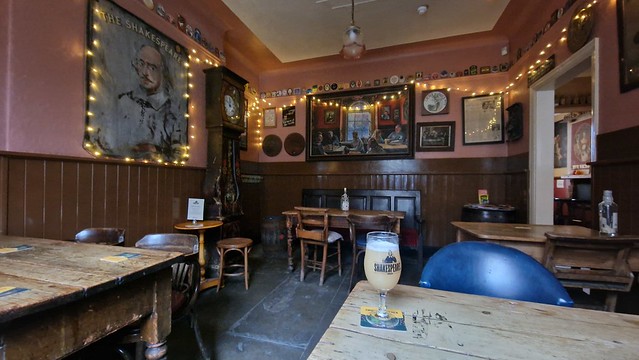
I’m not sure which room they were in, but I like the idea of the religious debate that would have taken place in the pub. Major General RH Dewing (1891-1981) was an interesting character and his service history was:
1931-09-05 – 1933-10-01 General Staff Officer 2 Southern Command
1934-XX-XX – 1935-XX-XX Attending the Imperial Defence College
1936-04-03 – 1937-09-30 General Staff Officer 1, War Office
1937-10-01 – 1939-09-04 Instructor at Imperial Defence College
1939-09-05 – 1940-10-26 Director of Military Operations & Plans, War Office
1940-10-27 – 1941-06-20 Chief of Staff Far East Command
1941-11-14 – 1941-12-19 Specially employed
1942-02-22 – 1942-07-26 Head of the British of Army Mission Washington
1942-07-27 – 1942-10-21 Senior Army Liaison Officer in Australia
1942-10-22 – 1944-09-01 Head of Army-RAF Liaison Staff Australia
1945-XX-XX Head Supreme Headquarter Allied Expeditionary Force in Denmark
1945-XX-XX Member British Military Commission in Berlin
1946-05-06 RetiredThere’s a much longer detail of his life at http://www.badwellashheritage.co.uk/badwell-ash-soliders/dewing-richard-henry/, I imagine that he would have been an interesting chair and questionmaster of the meeting. I doubt that the Easter question will ever be settled, the complexity of it is explained well at https://en.wikipedia.org/wiki/List_of_dates_for_Easter. Even at a location as auspicious as the Star, it would be unlikely to get any agreement on changing the current system.
-

Ashley – All Saints Church (Silverley)
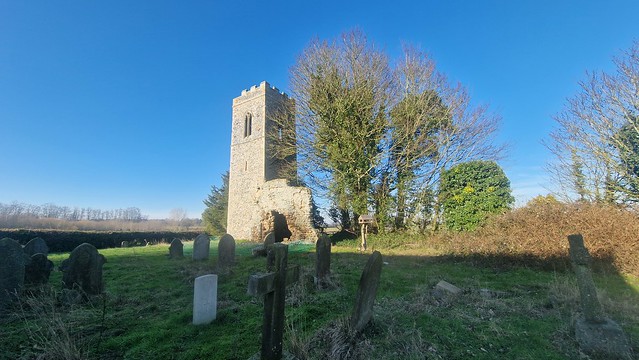
There’s something quite meaningful about visiting a church which is effectively slowly falling down. Long gone are the sounds of people getting married, the sadness of funerals and the joy (well, generally) of a baby being Christened. This church is near to the village of Ashley, but it’s actually the former parish church of the long gone village of Silverley.
Only the tower remains and that’s in a sub-optimal condition to say the least. The nave, the churchyard and any other remnants of the building’s history have long since gone.
The former church is especially intriguing as the former staircase to the higher levels of the tower is still visible.
I wonder who the last person was to successfully walk up these stairs and whether they had any indication that they would be the last to do so. It’s sealed at the bottom now to prevents any local pesky kids (or adults) from trying to climb up and promptly falling down or something similar.
It has been solidly built to ensure that it stays in even this condition.
It’s partly hidden from the road and I only knew that it was there because of Google Maps indicating that it was there.
There are obviously a whole heap of stories about a church in this condition and it relates to the whole situation with Ashley and Silverley being joint parishes. Silverley was once the larger of the two settlements, but the two villages merged and the last burial at All Saints was in 1564 with nearly nothing of Silverley left today. Not that this helped Ashley, as both churches closed in the sixteenth century and the present church in the village is Victorian. But, once again, I digress and I’ll jump forwards a bit in the story.
There was considerable anger in 1971 when some of the remaining part of the church was demolished. H.E. Thistle of Ousden wrote to the Newmarket Journal noting:
“I was appalled to read in the Journal of the partial destruction of Silverley church tower. It would be bad enough if those responsible for this act of vandalism were under-privileged louts who knew no better, but it seems from the report that those who decided to destroy the tower were people who were in a position to know exactly what they were doing and yet went ahead in cold blood to demolish a very beautiful and ancient landmark.”
The correspondent was rightly angry, the church’s destruction was backed by Bidwells and with the accidental approval of the Department of the Environment who it seems got a bit muddled up. That means it’s perhaps possible to partly blame Peter Walker, the then Secretary of State, but it appears to have been something of an administrative error that five tonnes of stone was carted away. The land agents locally claimed that the building was structurally unsafe, but this was proven to be something of an untruth when the demolition team struggled to demolish the structure. All very much sub-optimal and an unnecessary destruction of an historic building. It’s fair to say that the actions of Bidwells were a disgrace and showed huge contempt to the local population and the heritage of the building. Even after the controversy, Bidwells said “it’s all really a question of economics”. Twas ever thus……
The church had been listed in August 1959 and so should have been protected, although there’s not a vast amount known about its history. It’s thought to have been constructed primarily in the fourteenth century (although it’s likely that there was a religious building on the site before this) and was in use until the sixteenth century when the village faded away, with the building used for a period as a barn. It was though derelict by the seventeenth century, with likely the tower being the only part used. And thank goodness that villagers in 1971 were able to interrupt the demolition to save at least some of the structure. Unfortunately, today the church is I think on private land and there are no interpretation signs or information about the history of the building and bit by bit the structure is likely to slowly fall apart.