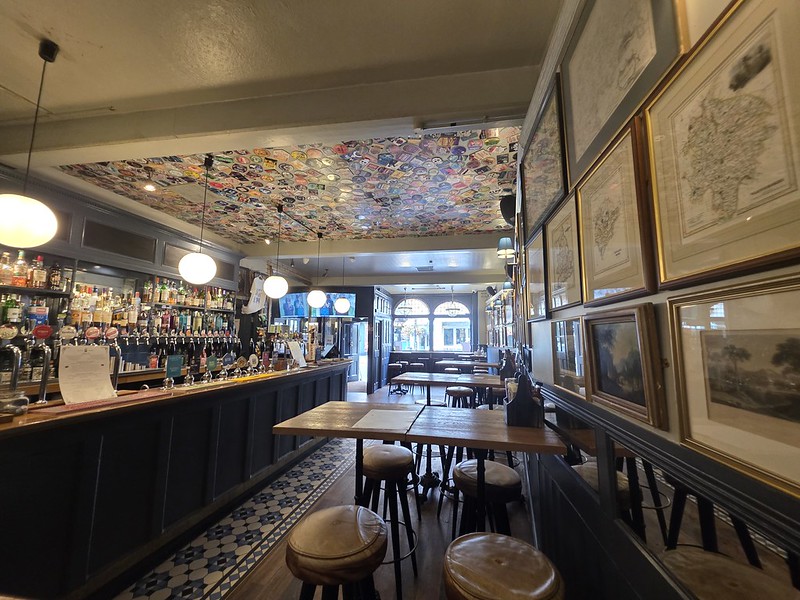
I’m just placing the history of the Lidgate Star pub in Suffolk here so that it doesn’t get lost.
History of the Lidgate Star (in .pdf format)

I’m just placing the history of the Lidgate Star pub in Suffolk here so that it doesn’t get lost.
History of the Lidgate Star (in .pdf format)

I was interested in this stained glass window at All Saints’ Church as that’s a rather impressive period to be the churchwarden, from 1912 to 1968. Major Quintin Edward Gurney was born on 20 February 1883 and he was the son of Richard Hanbury Joseph Gurney, aged 28 at the time of Quintin’s birth, and Sarah Evelyn (Buxton) Gurney, then aged 29. His siblings included Christopher Richard Gurney, Rachel (Gurney) Bruce, Richenda Evelyn Gurney, and Gladys Catherine (Gurney) Wynn.
In 1911, Quintin Edward Gurney married Emily Ada Pleasance Ruggles-Brise in Braintree, Essex. His wife, born in 1880, lived until 1972 and the Ruggles-Brise family was also well-established, particularly in Essex, further solidifying Gurney’s social standing through this union. Together, Quintin and Emily had a substantial family, documented as having at least four sons and two daughters. Their known children were Pleasance Evelyn (1913–1996), Richard Quintin (1914–1980), Ruth Cecilia (1917–2017), Edward Ralph (1919–1937), John Romer (1920–1932) and Archibald James (1932–2004). He held the rank of Major in the British Army, specifically serving with the Norfolk Yeomanry. The Norfolk Yeomanry was a unit often associated with the county’s gentry and farming communities, so this wasn’t really a working class lad done good and indeed he was from the wealthy Gurney family whose bank was taken over by Barclays, with Quintin himself being a director of the TSB.
Here he is when he was at Harrow School in the late nineteenth century. As can be noted from the stained glass window, following his death in 1968, his son Richard Quintin took over the role of churchwarden until his own death in 1980.

It’s fair to note that All Saints’ Church at Bawdeswell has had something of a troubled history in terms of its physical building over the centuries. The first building on this site was either late Saxon or early Norman, but the main medieval church here was constructed in the fourteenth century. There was a sub-optimal situation in 1739 when the tower fell down and took half the church with it, so they rebuilt it. Then, in 1828, the tower fell down again and so it was thought something should be done.
In 1843, the Norwich Mercury published this article:
“Bawdeswell Church.
Bear ye one another’s burdens, and so fulfil the law of Christ.—GAL. vi. 2.
IN 1740, the Tower and the body of the Parish Church of Bawdeswell became a heap of ruins, since that event the Chancel has been fitted up with Pews and Sittings, and thus some cramped and insufficient accommodation has been obtained for about 200 persons. The present population exceeds 600. In consequence of its dilapidated state, it has become necessary to take off the roof of that remaining part of the original building, and the walls have been found to be in a very unsound condition. Under these circumstances, it could not be recommended to the Parishioners to make any considerable outlay upon the reparation of this remnant of their Church, the narrow dimensions of which will not admit of its being made a suitable place for the decent celebration of the services of the Church for so numerous a population. It has therefore been determined to attempt to raise a fund for the rebuilding of the Church, and as it is unfortunately too well known that this parish is peculiarly overburdened, its average being very disproportionate to its population, and is therefore not in a condition to meet the necessary expenses of such a building without assistance, it is hoped that the appeal to the members of the Church in the neighbourhood for their help and co-operation in this work will be considered one which the circumstances of the case will fully justify.
Subscriptions may be received at Messrs. Harvey and Hudson’s, Messrs. Gurney’s, and the East of England Bank. (3143
LIST OF PRESENT SUBSCRIPTIONS.
By Rate and Old Materials £150 0 0
The Bishop of Norwich . . 25 0 0
The Earl of Leicester . . 20 0 0
Lady James Townshend . . 20 0 0
The Rev. Henry Tracy, Swanton Morley 20 0 0
Mrs. Lloyd, Bawdeswell . . 50 0 0
Miss E. Lloyd, ditto . . . 50 0 0
Clarke Stoughton, Esq. ditto . 25 0 0
Mrs. Stoughton . . . . 5 0 0
Revd. P. Du Val Aufrere, Rector of } 15 0 0
Bawdeswell }
Revd. Aufrere (additional) . . . 5 0 0
Mrs. Aufrere . . . . . 10 0 0
Mr. Ront, Leeds, Bawdeswell . . 10 0 0
Mrs. Leeds, ditto . . . . 5 0 0
Mr. Robert Leeds (additional) . . 5 0 0
J. P. Leeds, Esq. Hack Hall . . . 5 0 0
Revd. H. Blake, Thirning . . . 2 2 0
Miss Blake, ditto . . . . . 1 1 0
Rev. W. Howard, Witchingham . . 2 0 0
Friends by Rev. W. Howard . . . 3 8 0
Rev. T. S. Norgate, Sparham . . . 5 0 0
Mr. Middleton, Sparham . . . 2 0 0
Mr. Nelson, Sparham . . . . 2 0 0
A Friend, by Mr. Stoughton . . . 2 0 0
Rev. J. A. Norfolk, Foxley . . . 3 0 0
Rev. J. Spurgeon, Twyford . . . 2 0 0
Rev. W. Blyth, Hackford . . . 1 1 0
Rev. Henry Evans, Lyng . . . 2 2 0
Mr. John Bidewell, Thirning . . . 1 1 0
Mrs. J. Bidewell, Thirning . . . 1 1 0
Rev. F. Hilward, Swanington . . . 2 0 0
Rev. U. O. Knatchbull, Elmham . . 1 0 0
Rev. T. Green, Fulmodeston . . . 1 0 0
Col. Packe, Twyford . . . . 5 0 0
Miss Emily Morse . . . . . 10 0 0″
In the early 1840s, a plan was developed to allow for the rebuilding of the church with the usual Victorian gusto and excitement and this is the plan from 1845. That should have been the end of the matter, until an aircraft crashed into the church in the Second World War. However, I’ve written separately about the destruction during the Second World War and also the rebuilding of the church. And also the rather impressive survival of the 1733 gravestone commemorating the life of Edward Peterson.
The tower of the Neo-Georgian building.
The font is made from Ancaster stone with lead lapping over the top of the wooden font.
The interior looking towards the chancel and it’s a bright and open space.
The triple-decker pulpit which is a nod towards the Georgian style architecture.
The rather stark chancel.
Looking back from the chancel towards the end of the nave, with the organ located on the upper tier. Much as I like a medieval church, this is a clean and functional building which feels modern with at least a nod towards the Georgian architecture to make it feel as though it has some heritage.

There’s a display board at the church which shows the post-war reconstruction of the building after it was mostly destroyed following an aircraft crash during the Second World War. The RAF Mosquito bomber crashed into the building on 6 November 1944, the only incident during the Second World War where a church was destroyed by an aircraft hitting it, as opposed to a bomb or other aerial attack. The task of rebuilding the church fell to the War Damages Commission and it took a few years to get going, with the work commencing in March 1953. The design for the new church was entrusted to Norwich architect J. Fletcher-Watson, who also designed the Bishop’s House in Norwich. He envisioned a Neo-Georgian style structure, a distinct contrast to many other village churches and one which I think looks rather elegant.
There was an argument though which started before the reconstruction started, when the Parochial Church Council objected that the new spire was a potential hazard to low flying aircraft. I can see their concern given what had happened, but the architects rejected the complaint that this wasn’t a traditional Norfolk church design and the Chancellor of the Diocese made the adjudication that construction could begin.
The foundation stone for the new All Saints’ Church was laid by Sir Edmund Bacon, Bt. on 21 July 1953. The Rector at the time, the Reverend Heywood Gerard Benson Folland (1903-1976), who had arrived in Bawdeswell only a few weeks before the plane crashed, demonstrated great fortitude in organising the building of the new church in what was obviously a sub-optimal situation. While the new church was under construction, the congregation used a Primitive Methodist Chapel in the village for worship. The construction, carried out with Messrs Philip Pank & Partners as Quantity Surveyors, was completed and the new church was dedicated by the Bishop of Norwich, the Revd P M Herbert, on 27 September 1955. The primary costs for the rebuilding were £12,500, with additional expenses for the spire (almost £700), furnishings (£1,000), and the organ (£650) among other fittings.

On 6 November 1944, an aircraft accidentally crashed into All Saint’s Church in Bawdeswell and effectively destroyed it. Two British pilots, James McLean and Melvin Tansley, lost their lives in the tragedy.
Part of the aircraft has been kept as a reminder of the tragedy.
There’s a photo in the church of the damage done to the building that night. Two houses were also badly damaged during the incident, which caused a large fire in all three buildings. The church was rebuilt to a different design after the end of the war.

I am completely puzzled by this and although my being confused isn’t rare, I can’t really understand what has happened here. There is the oldest grave that I can recall seeing in a Norfolk churchyard and it commemorates the life of Edward Peterson who died in 1733. All Saints’ Church has an odd history as it effectively fell down in 1739 and was rebuilt, before a plane crashed into it during the Second World War and it was entirely rebuilt once again (and not to mention the Victorian rebuilding). This gravestone shouldn’t really have survived for so long, so it seems likely that there are some special circumstances that apply here. I’ve sent Google Gemini on a long mission to find a solution, but it has come back without any documented evidence, just its best guess.
The gravestones were moved in the late Victorian period, so I can only assume that the gravestone had been in a protected area until then. Perhaps it moved position during that time to tidy the churchyard up and it has just been made from a sturdy limestone that has protected it, but it has also certainly been moved since the plane crash in 1944 which destroyed the church so it’s likely been in a few locations over the centuries. But, it’s relatively rare to find gravestones from the eighteenth century, let alone one so early on in the century. However, Google Gemini has tried to consider all possibilities, even mentioning:
“The general environmental conditions of Bawdeswell, situated in East Anglia, involve a temperate maritime climate with moderate rainfall and seasonal temperature variations that include regular frosts in winter. This provides the overarching weathering regime. Historically, as a rural village, Bawdeswell would likely have experienced lower levels of atmospheric pollution compared to industrial urban centres during the 18th, 19th, and early 20th centuries.”
And it suggested a very real possibility that:
“Burial, particularly in well-drained soil, can offer significant protection from atmospheric weathering agents such as acid rain, freeze-thaw cycles, direct solar radiation and the colonisation of surface-dwelling organisms. If the Petersen stone was subsequently uncovered and re-erected during one of the churchyard clearings or the formal re-laying of memorials 11, it would likely have emerged in a considerably better state of preservation than if it had remained continuously exposed for the entirety of its existence. This period of unintentional interment could be a crucial, albeit undocumented, factor in its current condition.”
Or, maybe, the gravestone was even inside for a period, although this feels unlikely. A little of Edward life is known, he was born in 1658, the son of William Peterson and Margaret Peterson, and he was baptised at Hackford with Whitwell Church on 9 April 1658. He died on 11 February 1732, but the year discrepancy on his gravestone is likely because the burial is so early it dates back to a period when the year end was late March and not December. Anyway, I suspect that his gravestone was made of high quality limestone, it’s been protected in some form and it has been fortunate to have been placed in well drained areas. But it intrigued me by being quite so old….

St. Mary’s Church in Great Bealings was mentioned in the 1086 Domesday Book, with reference made to Anund, the first priest, but there’s evidence that there might have been a pagan burial site here before that. I’m a little confused about the age of the church, the listed record dates it to the sixteenth century with substantial alterations in the nineteenth century, but parts of the nave seem older than that to me. But, I’m not a church historian, so there we go….
The church in the early 1840s, before the Victorians faffed around with it. Comparing it with my photo above, it’s an excellent way of seeing just how much of this church was rebuilt in the subsequent renovations and the Victorian obsession with fiddling with these historic buildings.
From the other side of the building, the tower of the church is later, likely from around the 1450s, although this date again isn’t tying into the listed building record. When we parked, which took Richard some time although I obviously didn’t comment, we parked on Lower Street where it meets Boot Street.
This felt an odd piece of land and it transpires (and is evident from the above map) that this is where the Manor House was located until it was demolished in 1775 and relocated nearby.
This is mentioned to be an original Tudor wooden door and portal into the nave, although it’s in notably decent condition.
The interior is bright with the large windows and gives something of a Georgian vibe at first look.
Bench end carvings and that black and white floor dates from the late eighteenth century when it was relaid in the Georgian period.
The pulpit is Jacobean, from the early seventeenth century and is made from oak, although it was faffed about with the in the Victorian period to add more decoration.
The Seckford Memorial was erected in 1583 to commemorate the life of Thomas Seckford, who died in 1575. It’s notable that there are no effigies, although since they’d only recently gone through the Reformation when a lot of them had been destroyed, perhaps they thought that was wise.
The Seckford Porch, made from brick and added here in the 1520s, which was really when the church was arguably at its greatest power and influence following the reconstruction and patronage.
This is the Clench Monument, which was erected in 1628 for John Clench and his wife, a notable piece of Jacobean art. There was an attempt to depict the Puritan piety and the emphasis on religious commitment.
The chancel which has a strong nineteenth century feel to it.
The stained glass windows are mostly from the Victorian refurbishment.
Looking back down the nave, designed in the early English Gothic style.
I’ve already written about the church’s font (which is one of the earliest items still in the church as it dates from the thirteenth century), the link with the Mayflower Pilgrims and the grave of John Julian Ganzoni.
The village war memorial in the churchyard and I’ve also written separately about the only casualty from the village in the Second World War, Edward Charles Porter.
![Norwich – Compleat Angler [Old Receipt]](https://www.julianwhite.uk/wp-content/uploads/2025/05/Screenshot-2025-05-09-18.29.15.png)
Firstly, that Stella wouldn’t have been for me…. And it reminds me of just how over-priced the pub was back then, that’s still quite a punchy price for a Pepsi even today.

This week’s visit on our quest to eat at every food venue at Norwich Market was Go Crepes, which we visited when we did all this before in 2023. I must admit that I briefly forgot that we had done it before when the number was randomly drawn to come here, but it was last visit that we did and so perhaps my memory was clouded with sadness that it was all over…. I have to add here that every lunchtime is getting more ridiculous as it’s now turning into a “how many times will someone say hello to James?” as we walk around the city, it’s usually about five different people. This having lunch with a social supernova is getting quite exhausting.
The menu board, which is now a price free enigma, but the increases have been moderate over the last two years and seem to be around 50p for each crepe.
In addition to the sweet and savoury crepe options, there are some pasta options as well which I think might be a relatively new addition and James was tempted to go for one of these, but the pricing was a little punchy. The service here was friendly and immediate, with the stall taking both card and cash payments. There wasn’t the engagement that I remember from the stall holder a couple of years ago, but it was still welcoming and everyone was served in turn.
There’s my crepe cooking and I must admit that I’ve broken my intention of always having something different. I went for banana, Nutella and coconut, forgetting that’s what I had before. It came to £5.50, which is an increase of 50p. There was an entire banana included, along with a generous amount of Nutella and coconut flakes.
And there we go. This isn’t my sort of go to food for lunch, but it was warm, generously filled and it had a depth of flavour. I thought that it represented decent value for money, it was quick and a handy lunchtime snack.
James faffed about getting a classy photo of his crepe with Norwich Castle in the background. Unfortunately, in his eagerness to eat, the strategic intent of the photo failed.
So James has drawn it in. He went for a cheese and a pepperoni crepe and I asked him about the food and he said:
“Upon presentation, the galette délicieuse, a thin farinaceous creation of Gallic origin, enveloped a savory melange of lactescent curd and thinly sliced suine preparations, yielding a surprisingly replete sensation upon consumption. The constituent elements exuded an aura of recent provenance, their individual gustatory profiles harmoniously intermingling to produce a discernible and rather pleasing savor. Furthermore, the entire culinary opuscule was ensconced within a sumptuous and texturally refined cellulose-based towelling, hinting at an elevated level of epicurean consideration.”
He was particularly keen that I mention that he liked the quality of the paper towel that was used, which isn’t something I think that I would have otherwise added here.
I’m not sure that the lunch was quite as filling as some of the other market options, but that’s basically because I’m quite greedy and isn’t a criticism of the stall as their portion size for what I ordered was generous. The service was friendly, the food was freshly made and I felt that there was reasonable value for money.

This is the list of rectors at St. Mary’s Church in Great Bealings and there’s something interesting that took place during the period that Richard Larwood was the rector here and at this font. This is the baptism of John Carver in the church on 12 March 1580/1581 and there’s more information about this at https://mayflowerhistory.com/carver-john and some of this might be recent discoveries as older documents don’t mention it. He appeared in the records of the local Seckford Hall but he sold off all of his holdings there in 1605 and then disappeared from the record before reappearing in Leiden.
Carver was a member of the Leiden congregation of Separatists who fled religious persecution under the Church of England. Deeply involved in organising the Mayflower voyage, Carver played a critical role in securing funding and negotiating the charter that allowed the Pilgrims to settle in the New World. Carver was elected governor of the colony shortly after the Mayflower arrived in November 1620 and was a key figure in drafting the Mayflower Compact, the first governing document of the colony. Known for his leadership and diplomacy, particularly in maintaining peaceful relations with local Wampanoag peoples, Carver’s tenure was tragically brief and rather sub-optimal. He died in April 1621, likely from illness brought on by the harsh conditions of the first winter, and was succeeded by William Bradford. His legacy remains as one of the founding leaders of early colonial America.