Category: UK

  • London – Westminster (Borough of) – Trafalgar Square Fourth Plinth

    London – Westminster (Borough of) – Trafalgar Square Fourth Plinth

    This is the current art installation on the fourth plinth in London’s Trafalgar Square and it’s the thirteenth to be placed there since this project started in 1998. The installation is by Heather Phillipson and the description reads:

    “This sculpture attempts to address the specific physical context of the square, whilst considering a broader ideological one. How do we negotiate congregation, the intimacy of personal experience, broadcast and surveillance in one space?”

    That puts it better than I can as I didn’t really understand it.

    What I hadn’t realised before is that if you go to https://web102.secure-secure.co.uk/theend.today/, then it’s possible to see a live feed from the drone which is on the fourth plinth. I was in a bit of a rush to get a train and so I’m not really that visible in the above image, but that’ll do, it is definitely me (although mostly my shadow, but perhaps that’s in keeping with the art installation).

  • Hull Daily Mail – “Real Ale Aficionado”

    Hull Daily Mail – “Real Ale Aficionado”

    Happy with being called a “real ale aficionado” in the Hull Daily Mail today, and thanks to Tony at the wonderful Hop and Vine for telling me about it   🙂   I’ll be there again soon.
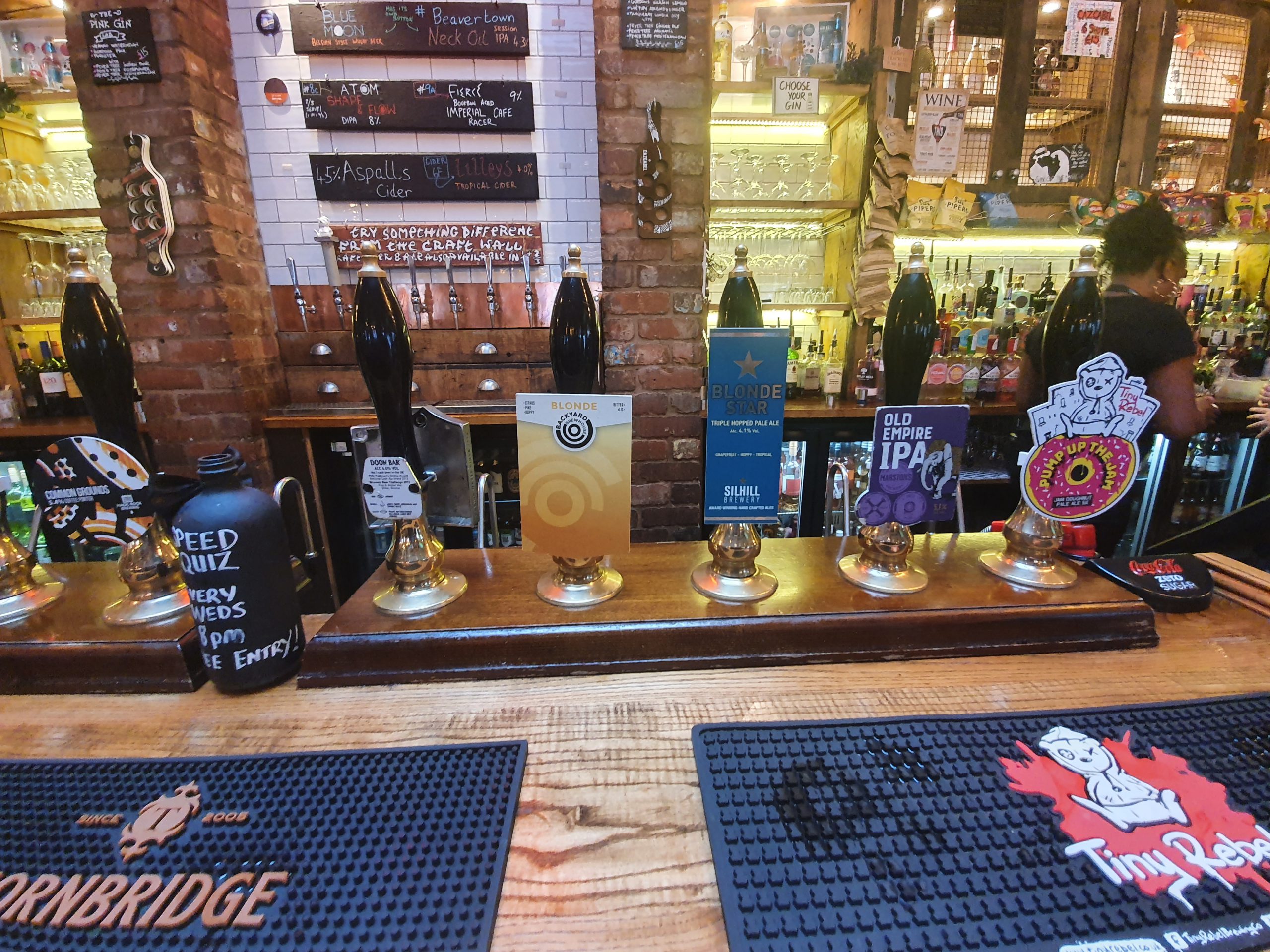
    https://www.hulldailymail.co.uk/whats-on/food-drink/uks-smallest-beer-garden-lockdown-5399775

  • London – Greenwich (Borough of) – Blackheath – Zerodegrees Microbrewery

    London – Greenwich (Borough of) – Blackheath – Zerodegrees Microbrewery

    This is the Zerodegrees brewery outlet in Blackheath and although they now have other outlets around the country, this is where it started. Blackheath is located just a short walk away from Greenwich (with its meridian line), hence why they chose that name for the business in 2000. They were early adopters of the pizza and craft beer concept, one which I very much applaud.

    Only the outside of the pub is open at the moment and there are also only a handful of tables available. Most people were ordering food as well, but my stop wasn’t for a decadent lunchtime purpose. Staffing was excellent, plenty of helpful staff and they were knowledgeable about the beers, so there was a welcoming feel to the whole arrangement.

    The specials list, which wasn’t entirely balanced in terms of the types of beer, but these are challenging times and at least there were three additional options. The brewery has also produced a ferocious number of beers over the years, with some rather interesting and innovative flavours and beer types.

    There are some standard Zerodegrees beers, alongside the specials. One thing that I’ve never seen at anywhere that is interested in beers is that sort of price differential between a half pint and a pint. CAMRA don’t like this and it really seems to try and discourage people from trying numerous different beers. It gave me a bad vibe about Zerodegrees, almost that they knew their product was of a poor quality and they thought people wouldn’t try additional products after trying one. It meant that I scrapped my intention to have a pint of Lollipop and half of the Linus Blanket to just half a pint of the former, as I had doubts about their quality. I did try and just cut it down to 2/3rds of a pint, but the pub doesn’t serve anything in thirds. I forget the luxury of places like the Artichoke in Norwich.

    The Lollipop milkshake IPA was fine, at the appropriate temperature as someone I won’t mention will be pleased to know, although it’s a slightly strange drink given it’s got a sour element. I quite liked it, although half a pint was actually enough.

    All told, I rather enjoyed this visit, but I still don’t entirely understand why the brewery isn’t keen to promote people trying a variety of their beers. Having a third of a pint samplers which customers could buy seems near universal at breweries, but here they seemed to be wanting customers to stick to the same product. So nothing really bad, but I’m not really sure whether I understand whether this place is pushing their food, their cocktails or their beer. I rather got the impression that beer was third on their list of priorities.

  • Greater Anglia : Norwich to London Liverpool Street

    Greater Anglia : Norwich to London Liverpool Street

    This is my first rail journey of 2021 and it’s certainly a step-up from the bus travel that I’ve been limited to for the last few months. It wasn’t busy at Norwich railway station with just a few people walking around the concourse, a couple peering into the M&S that has remained closed since March 2020. I still think that should have been a Greggs, but I don’t go on about it…..

    This is one of the Greater Anglia fleet that has no tables, as passenger surveys have apparently told them that customers don’t like them. I make no comment….. Anyway, the train was clean, shiny and nearly completely empty. Everything on the train was working though, including the power and even all the toilets were functional. How lovely.

    One of the slight problems with the rail journey into London is that it stopped at Witham, one of the few towns in Essex that I haven’t visited. I looked at TripAdvisor to see the top four rated attractions in the town and they are (i) a walk by the river, (ii) the library, (iii) the statue of Dorothy L Sayers and (iv) the town hall information centre. Given that, and with respect to the denizens of the town, I might wait just a little longer before making a proper visit.

    Anyway, there were plenty of Greater Anglia staff to guide customers onto the buses which would take us to Newbury Park. I’m not sure where Greater Anglia had found these staff, but they were particularly friendly and engaging, all a really organised effort.

    I try not to complain about things, but on my bus travels in recent years I’ve discovered that just about every vehicle has no more than four seats across. This is because there is only space for four seats and an aisle between them. But, no, this bus company has decided that more is better and have crammed in five seats across. I accept that if all the passengers were five years old, then this would be a perfectly sensible transportation move. But, the rail passengers were all above 18, which presented me with an interesting time watching them try to fit into the space provided, which was made more exciting as the bus company have given customers no real amount of leg room either. One man looked positively annoyed. I’d add that wasn’t me.

    I moved to the back of the bus to get some space, and I’m pleased to say that unlike the Inbetweeners, I wasn’t moved off those seats by anyone. The fortunate thing is that social distancing means that customers are kept apart, so there were only about 12 of us on the vehicle. About 105 seats, but only 12 people sitting on them.

    The rail replacement bus arrived into Newbury Park, where we were politely told to get on the Central Line into London. I asked the gateline staff if I was allowed to continue travelling down the Central Line to Oxford Circus, or whether I needed to get off at London Liverpool Street. To cut a long story short, he told me that I should really get off at London Liverpool Street, but that wasn’t what he recommended I should do. He suggested winging it with the gateline staff at Oxford Circus as that would be much quicker. He mentioned though that this was all at my own risk. Indeed, he mentioned that three times.

    I worry if I don’t have the right ticket, so I decided not to spend an hour worrying and I got off at London Liverpool Street. That also meant I didn’t have to try and enter into protracted negotiations with the gateline staff at Oxford Circus, which didn’t sound an exciting game to play. I had to faff about finding a member of gateline staff to let me out of London Liverpool underground station, and he looked slightly annoyed to watch me then go back through from where I had come from around thirty seconds later. But, my journey was now fully compliant with railway rules and I didn’t have to fear any TFL ticket inspectors. And more excitingly, I was back in London after way too many months.

  • London – Camden (Borough of) – Hampstead Heath Sightline

    London – Camden (Borough of) – Hampstead Heath Sightline

    There are a number of these protected views and sightlines in London and they’re listed on Wikipedia. This is from Parliament Hill in Hampstead Heath and I think it’s quite beautiful. Clicking on the image makes it larger and it’s possible to see not just the big skyscrapers, but also buildings such as St. Paul’s Cathedral which are all about six or so miles away.

    A slightly different view and this is the spot where it’s said that Guy Fawkes and Robert Catesby stood on 5 November 1605 when waiting to see if the Houses of Parliament blew up. There’s no certainty about this at all, but it seems conceivable and it would have been easy to see the destruction of the buildings if the plot had been successful.

    The name of Parliament Hill isn’t from the view, it’s thought to be from when the Parliamentary troops were stationed here during the English Civil War. Incidentally, it’s also the highest point in London, standing at 98 metres in height, so that’s another mountain that I’ve climbed.

    There are numerous benches for people to sit and gaze over London city centre, along with a little map of the various things to look out for.

    The BT Tower is the most obvious in this photo, but just to the left of that is the Houses of Parliament.

  • London – Camden (Borough of) – The Stone of Free Speech

    London – Camden (Borough of) – The Stone of Free Speech

    This ‘stone of free speech’ looked quite exciting on the map, although it was perhaps just a little less riveting when I got to it. However, it’s said that this might have some considerable heritage, although all of the evidence appears to be a little woolly.

    The official Hampstead Heath web-site says that “the origins are sketchy”, which often just means someone made it up about 30 years ago and no-one can really disprove it now. It might though have been the centre for religious and political meetings in the eighteenth and nineteenth centuries, and that is quite exciting if it’s true. I can’t find any mention of it though in newspapers from the nineteenth century, so even if it did exist then, I’m not convinced that had a reputation for being the location in the park for free speech.

    The myth suggests that this stone dates from the late seventeenth century and it could have been some form of marker post for surveying perhaps. I don’t know if it was at this exact spot, but there was a suffragette meeting at the park in April 1913, but the female speakers were shouted down and then what the media called “a youth” chucked a wooden box at the speaker. After twenty minutes of this, the police decided they were stopping the meeting and so everyone went home.

    Even if it’s not true, I like the idea that large meetings took place here in the open air, so I’ve decided I buy into the whole concept.

  • Corton – St. Bartholomew’s Church

    Corton – St. Bartholomew’s Church

    The signage perhaps tells its own story, but this is the Church of St. Bartholomew in Corton.

    From the corner of the churchyard, it’s not entirely obvious that this church was mostly abandoned for many centuries, having been a victim of the Dissolution of the Monasteries. It was ruined by the seventeenth century, although repairs have been made in the eighteenth, nineteenth and twentieth centuries, as some of the building has remained in use for religious purposes.

    When approaching the church it becomes apparent that the tower is derelict and only part of the structure is in use.

    This section lies between the tower and the nave, creating a peaceful little sitting area where the section of the nave that joined onto the tower once stood. A more modern community centre type addition has been made within the nave, which has been incorporated with sensitivity.

    One of the former windows has ironwork in to prevent access, but at least it’s decorative. Crowell’s 1846 history of Suffolk notes about the church:

    “At Corton, dedicated to St. Bartholomew, was once a noble structure, of which the chancel only is now used for divine worship, the body of the church having long been a roofless ruin. The walls are mantled with ivy, and the windows robbed of their tracery; yet the interior, with all its desolation, is still effective from its ample and just proportions. The nave, which never had aisles, appears to have been constructed in the decorated style of architecture, though the chancel presents a large east window, of perpendicular character. A noble square tower, about ninety feet high, stands at the west end of the nave. A singular tradition is related respecting the foundation of this edifice. In 1810, as the sexton, Thomas Soames, was employed in the church-yard, he was accosted by a stranger, who inquired of him the name of the building, and that of its founder. To the latter question the sexton was unable to reply; and the stranger then stated that he had been in Italy during the revolution, when the French armies were overrunning the country and rifling the monasteries. Employing himself one day with examining the records of a religious house there, he discovered a manuscript, purporting to have been written by Francis Cecelia, a monk of the Premonstratensian order, who stated himself to have been Abbot of Leiston, in Suffolk, and founder of St. Bartholomew’s church at Corton. The sexton having little antiquarian curiosity, no further conversation occurred, and the stranger left him without making known the date, his name, or any further particulars.”

    The tower didn’t remain in use for long, as it was constructed in the fifteenth century and it once had a rather grander window arrangement than the bricked up remains that exist today. The bricks here are falling out, I wonder whether it would be possible to remove them and put some stained glass back in.

    There were fears at the end of the nineteenth century that the ivy-covered tower might fall down, which led to a restoration fund being set up in 1890 to secure funds to ensure its survival. Looking at old newspaper reports though, these restoration funds didn’t seem to be rare, there was another set up twenty years later and securing the building appears to have been a challenge for generations of congregations.

    There are scars all over the building of previous doorways and windows, with this perhaps being the entrance to a side chapel.

    Another blocked window.

    I’m not a flint expert, but that’s some neat flintwork on the base of the wall.

    I’d say that the repair work here is a little cruder.

    It’s an intriguing church, although unfortunately it was locked up when I visited. Apparently the church does usually make an effort to either be open or have keyholder information available, so hopefully I’ll be able to see inside on a future visit.

  • Hopton – St. Margaret’s Church

    Hopton – St. Margaret’s Church

    This is the ruined church of St. Margaret’s in Norfolk, although until 1974 this was actually in Suffolk (they moved the county boundaries, not the church). What remains of the structure is primarily from the fourteenth century, but there was an earlier church on this site, from somewhere around 1050 and there’s some documentary evidence that there might have been a wooden Saxon church here as well.

    The church was lost in 1865, following a devastating fire. Smoke was spotted coming from the church shortly after the congregation had left from their service, but the fire took hold quickly and there was little that they could do to save it. The thatched roof was ablaze and was chucking lumps of hot thatch on those below (which wasn’t ideal), although huge attempts were made to save the organ from within the building. The organ had been presented to the church by Mrs Orde of Hopton Hall, but it was soon realised that they couldn’t fit it through the porch and so efforts were abandoned quickly.

    The local press noted that:

    “The fire originated either from the overheating of the stove, the funnel of which led through the roof, or from a spark lighting on the roof from the pipe, and igniting the thatch”.

    Following the fire, it was decided not to repair the structure, but to instead build a replacement church nearby with the £500 insurance money. The decision to move the church was to ensure that it was located nearer to the centre of population that had built up, although it seemed a shame to abandon a site that had remained in religious usage for over a millennium.

    It is only recently that the site has been tidied up and made secure so that people can visit and walking inside the surviving structure. They’ve done a really good job here, they’ve added benches, information boards and give the whole site a peaceful feel rather than the huge “keep out” signs and fences that were here for decades. George Plunkett has a photo of the site from 1998.

    Inside the church, looking towards the tower.

    Inside the church, looking towards the altar and chancel.

    The remain of the porch. During the restoration work on the church the archaeologists found 29 pieces of medieval floor tile, 2 fragments of roof tile, an early brick fragment and a Caen limestone sundial fragment.

    A blocked doorway in the base of the tower.

    The tower section is still closed off, but it’s still in surprisingly decent condition given what its gone through. The tower is likely a little later than the rest of the church, dating from the early fifteenth century.

    Although the destruction of old buildings is unfortunate, it has though allowed the history of the church to show through in other ways. The location of old niches, stoops and piscinas has become more evident, although most of the memorials and tablets were destroyed during the fire.

    The remains of an old window at the chancel end of the church.

    The base of what I assume were the rood stairs, although there appears to have been minimal other separation between the nave and the chancel.

    A rather beautiful plaque, which reads:

    “Be still, for this is sacred ground,

    A place to stand and pause. Reflect

    Upon the pathway here

    The lesson learned, the gifts received

    Be still, and listen to God’s voice

    That sings a song of unity,

    Blessing the journey still to come

    With love and deep humility”

  • Weston Longville – All Saints Church

    Weston Longville – All Saints Church

    It started to pour with rain when Richard and I arrived at All Saints church in Weston Longville, which was unfortunately locked and even the porch wasn’t accessible. Perhaps it was just the rain, but it all felt a little stark and unwelcoming. Hopefully I will be able to visit the interior of this Grade I listed church in the future, as there are medieval wall paintings, a painted screen and a memorial to Parson Woodforde.

    The tower is the oldest part of the church, dating from the thirteenth century. It once had a steeple as well, but it fell off in 1602, which I can imagine annoyed the locals.

    The nave and the chancel are from the fourteenth century, when the previous structure was substantially rebuilt, but it’s likely that there was a church on this site during the late Saxon period.

    The church is perhaps best known for Parson James Woodforde, who was rector here between 1776 and 1803 and wrote numerous diaries which are a snapshot of rural England in the late eighteenth century.

    The fifteenth century porch, with the shield above the empty niche being that of the Company of French Merchant Adventurers.

    The porch was modernised in the 1970s and this plan is in the Church of England archives.

    The priest’s door.

    The window at the end of the aisle was blocked up before 1718, which is the date of the memorial tablet on the other side of the wall.

    This stone on the exterior of the porch is in a poor state of repair and I can’t imagine that it’ll last for that much longer. It’s a shame that it can’t somehow be preserved.

    This illustration is by Robert Ladbrooke and is from the middle of the nineteenth century, with the now damaged stone visible on the exterior of the porch.

    The extensive graveyard is neat and tidy, with some efforts being made to support those stones which it’s fair to say aren’t all exactly standing upright.

    The sun started to shine through the rain just as we were leaving. George Plunkett took a photo of the church in 1939, but not much has really changed in the intervening period.

  • Pubs Along the Victoria Line

    Pubs Along the Victoria Line

    [this was a project that got delayed due to Covid, but I’ll finish this one in 2024!]

    I feel that I’ve done enough posting about walking for a bit, so it’s time to return to my other true love of pub visiting…. This will be a bit of a holding page until I can start my visiting (and I might revisit the pubs I’ve already frequented, such is my commitment to high standards with this project).

    https://commons.wikimedia.org/wiki/File:Victoria_Line.svg

    I’m staying in London frequently over the next few months, so my little project is to find a favourite craft beer pub near every underground station in the city. To ensure that I select only the finest, I’m aiming to go to three carefully (sort of) chosen options near each station, then I can pick the pub that meets my requirements the best based on my little visit.

    I’m going to start with the Victoria Line, which has 16 stations, so, 48 pub visits (or potentially more if I find some extra interesting looking pubs in a locality). I think I might enjoy this little project trying them all out. I’ve currently still got some gaps in the planning process, all suggestions welcomely received. I’m hoping to have completed the Victoria Line stations by the middle of June if this goes to plan.

    STATIONS:

    Walthamstow Central (The Untraditional Pub, The Village Pub, Wild Card Brewery Barrel Room)

    Blackhorse Road (Wild Card Brewery Taproom, Signature Brew Brewer’s Bar, Exale Brewing Taproom)

    Tottenham Hale (Ferry Boat, Beavertown Brewery Taproom, Bluecoats)

    Seven Sisters (True Craft, Five Miles, ???)

    Finsbury Park (The Finsbury, The Naturalist, ???)

    Highbury & Islington (Brewhouse & Kitchen, The White Swan, Snooty Fox)

    King’s Cross St. Pancras (Parcel Yard, King Charles I, Skinners Arms)

    Euston (Doric Arch, Euston Tap, ???)

    Warren Street (Smugglers Tavern, Marlborough Arms, ???)

    Oxford Circus (Old Coffee House, Star & Garter, Brewdog Soho)

    Green Park (King’s Head, Red Lion, ???)

    Victoria (Willow Walk, St George’s Tavern, ???)

    Pimlico (Cask Pub & Kitchen, White Swan, Grosvenor Arms)

    Vauxhall (Mother Kelly’s, ???, ???)

    Stockwell (Phoenix, Surprise, ???)

    Brixton (Craft Beer Co, Brewdog Brixton, Brixton Brewery Taproom)