Category: Norfolk

  • Wretham – Dog & Partridge Pub (now closed)

    Wretham – Dog & Partridge Pub (now closed)

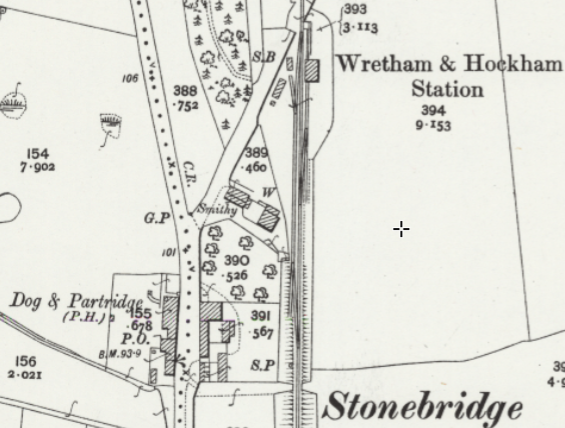
    This feels really quite sad, it’s the Dog & Partridge pub in Wretham, located right by the Peddar’s Way path (here’s some information about that courtesy of the LDWA). It first became a licensed premises in at least the 1780s, but it finally closed its doors in 2019 and is now a residential property.

    In 1904, the local press reported that Charles Crook, a local man aged 74, had died suddenly whilst walking along the road. His body was taken to the Dog & Partridge where it was laid to rest whilst waiting for an inquest. I can’t imagine that JD Wetherspoon would be entirely pleased if that was the policy today and someone died near one of their pubs.

    More recently, the pub has had a troubled history. It closed in 2002 for four years, before being brought back to life. The owner claimed that the smoking ban caused issues and despite updating the accommodation in 2010, it wasn’t enough to make the venue profitable.

    The owner told the local press at the time:

    “There have been several attempts to have traditional pub darts and pool teams but the villagers themselves asked that such activities be stopped so that they didn’t clash with similar activities already undertaken at the village hall.”

    I’d suggest that’s a sub-optimal arrangement as a pub with accommodation might have been more useful to the area than a village hall, but who am I to comment…… Anyway, it limped on for a few years and they couldn’t sell the venue, so it closed for good in 2019. Much as I’m sure the perfect operator could have made it work, it would have required a huge effort given its location and there aren’t many perfect operators about.

    I’ve cycled and walked Peddar’s Way, so I would have gone by here in the past, but, I can’t remember this village. The pub did have some accommodation, but I’m not sure how many users of the path would have used it. The road is the A1075, which is relatively busy, but it’s not the major route into Norwich.

    What might have saved this pub is if Wretham and Hockham railway station had survived, as that would have allowed walkers to access the beginning of Peddar’s Way by staying here. Unfortunately, the Crab & Winkle railway line which ran between Swaffham and Thetford closed in 1964, another poor transportation decision. It wouldn’t have taken long to walk from the railway station to the pub.
  • Great Hockham – Eagle Pub

    Great Hockham – Eagle Pub

    The expedition for the day on Saturday was with friends Roy and Jen to a number of country pubs. There is a logic for choosing these pubs that Roy has, but I’ll leave that to another post to explain. I was surprised and delighted at their proposed list as there were so many pubs that I hadn’t been to.

    This is a hugely challenging time for country pubs, so it’s really good to make an effort to come and see different venues. This one also had the advantage that it’s listed in the Good Beer Guide, indeed for the ninth year running, so that’s another one ticked off for me.

    This has been a licensed premises since at least the 1840s and it became a Steward & Patterson free house, before being taken over by Watney Mann and later it became part of Punch Taverns. Fortunately, it’s now free of Pubco interference and is free of tie.

    In 1909, the landlord Frederick George Thompson had the indignity of finding himself in the Norwich Argus with the headline of “an unsuccessful publican” which feels a little harsh. He had found himself in financial difficulty and invested in a horse to cart his beer about. Anyway, that went wrong and in court his representative mentioned “it was a pony that was a very poor beast and took two hours to go a mile and a half” to which the newspaper reported that there was laughter….. He left the pub the following year.

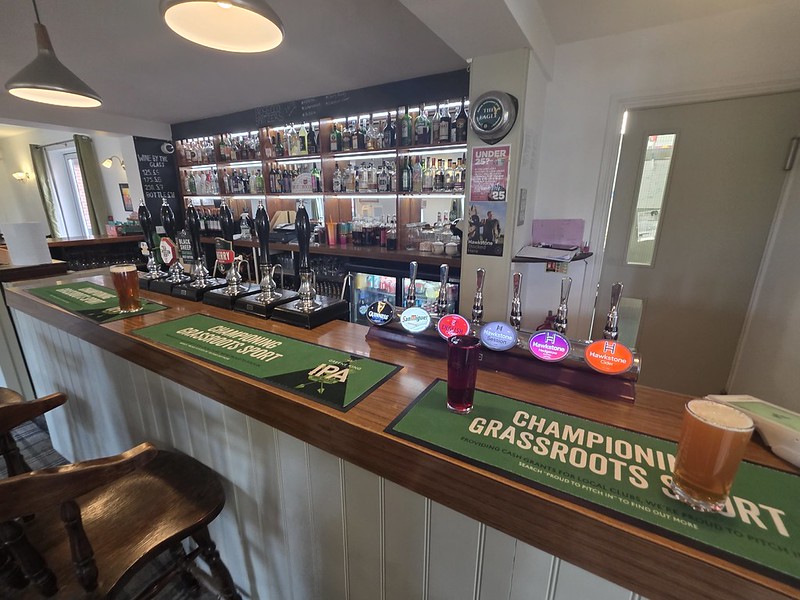
    There was a good choice of real ales, including Old Speckled Hen, Woodforde’s Wherry and Best Bitter from Black Sheep, although there are usually five different real ales. The keg options were a little Hawkstone heavy for me, but each to their own.

    I’ll note now that I was on half pints at every pub during the day, Roy went for pints, but he’s always been tough like that. This is the Best Bitter from Black Sheep, it was well-kept although served very cold, although that’s hardly surprising given the outside temperature of our visit. It was bitter and inoffensive, it’s not the most exciting beer in my mind, but it’s a decent sessionable offering.

    Their pie weekend sounds really quite decadent, they have a huge choice of pies during the weekend and it’s become something of a thing in the local community’s calendar.

    We arrived shortly after opening and were the first in, but there was another customer who came in soon after us and it had a welcoming community feel. Down the other end of the pub is a games area with a pool table. Incidentally, I’m a fan of carpets in pubs and like that they give it an element of warmth.

    They serve food and there’s an extensive dining room area. There is also a fire and I won’t mention in public about burningchildschristmascardgate…..

    And another one of the pub’s achievements. On this note, I’d suggest that this is a great shout for being in the Good Beer Guide, there was a friendly welcome, clean environment and a choice of well kept real ales. The prices were moderate and it had a proper community feel.

  • Norwich – Bar Billiards Singles Tournament

    Norwich – Bar Billiards Singles Tournament

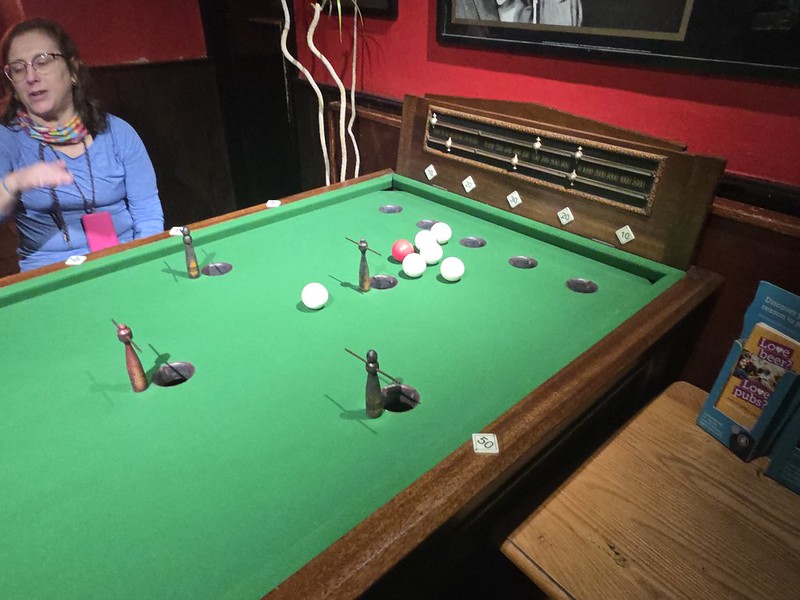
    Today was the excitement of the first round of the Norwich Bar Billiards singles tournament. For anyone interested, the results will be at https://www.norwichbarbilliards.co.uk/Singles. Oscar calmed my nerves with some sensible beer selections and managed to miss all my great shots, but I didn’t say anything.

    Thanks to Oli and Emma for their scoring assistance. This is an unusual cluster of balls all where I didn’t want them…. And I’m still surprised I went for a very difficult 200 shot, which went in, at a critical point in the game. As I said to Zak, I’m crediting him with teaching me how to be brave. I don’t think I’ll be being brave again for a while, I’ll go back to my 10s.

    OK, I didn’t expect a 3-0 win, but I’ll take it….. My aim is to score 1,000 in each game and I was surprised and delighted to achieve that. Thanks to Katie for a great game and I am sort of looking forwards to the second round in late February.

  • Norwich – 1848 Map

    Norwich – 1848 Map

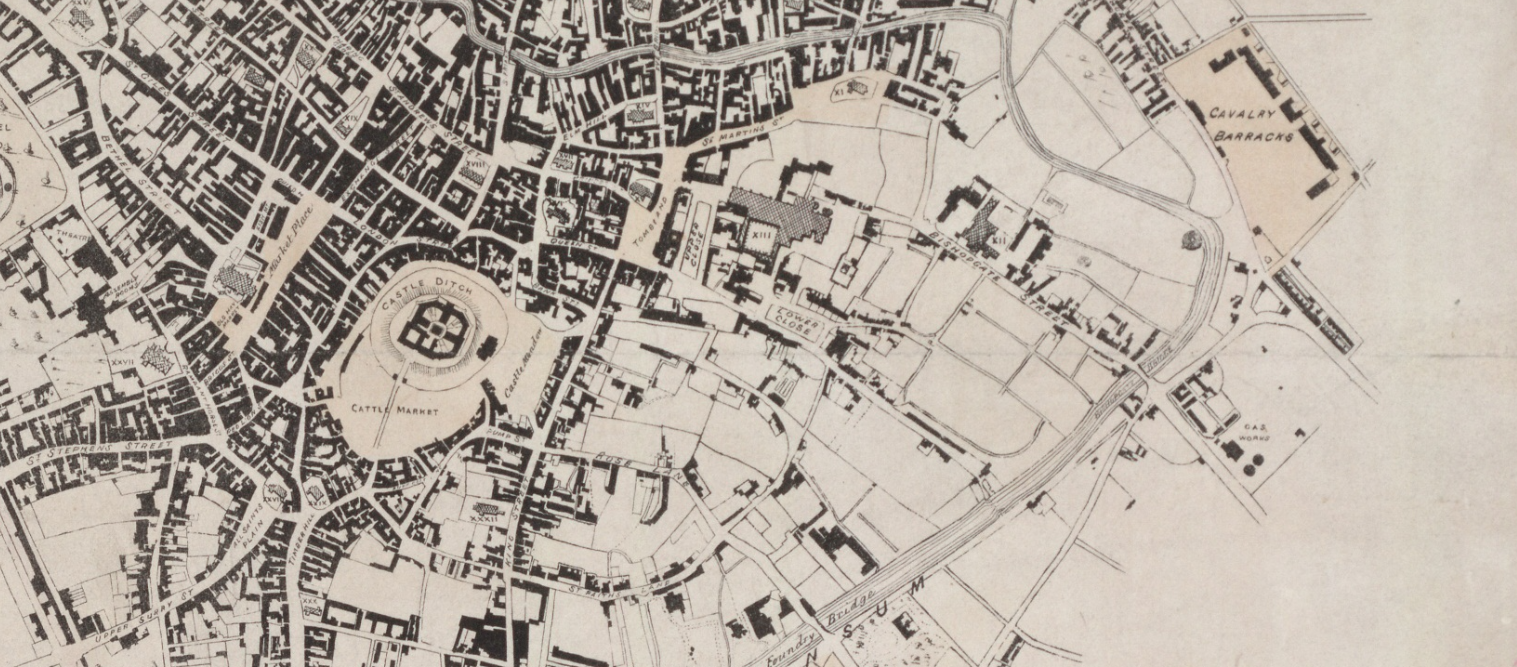
    This is the 1848 map of Norwich that was produced by Jarrold and here’s a link to a 1781 map of the city.

  • Norwich – Norwich Castle Museum (Cromer by James Stark)

    Norwich – Norwich Castle Museum (Cromer by James Stark)

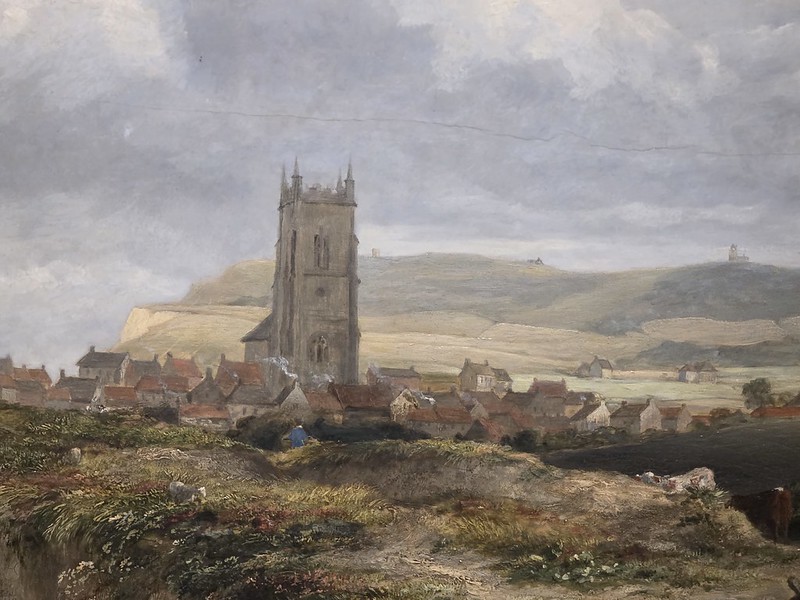
    This is an artwork by James Stark (1794-1859) which is in the collections of Norwich Castle Museum. It was purchased for the museum in 1975 with grants from the Art Fund, Watney Mann (I don’t specifically know why the brewery contributed to this) and the Victoria & Albert Museum.

    Stark was a Norwich School landscape painter, best known for his big and usually windswept skies along with his slightly melancholy countryside scenes. He trained in Norwich, showed at the Royal Academy, and later taught drawing, including a spell as a master at Queen’s College, Cambridge.

    In terms of this rather serene artwork, in the bottom-left of his painting there are some fishermen going about their business in what would have been a very different town. With no bus or train services at this point, this would have likely felt a rather remote destination.

    Stark painted this in the mid-1830s, at a time when Cromer was starting to evolve as something of a summer tourist destination for those in Norwich and environs. The railways didn’t arrive here until the 1870s, so the town would remain relatively unchanged for some decades.

    Of course, I feel the need for AI to join the party and this is what it believes the scene would look like today if painted in a similar style. I rather like this. The addition of Cromer pier, constructed in 1901, is an accurate one even if some other elements aren’t exactly perfect here.

  • Norwich – Norwich Castle Museum (Fuller’s House by Henry Ninham)

    Norwich – Norwich Castle Museum (Fuller’s House by Henry Ninham)

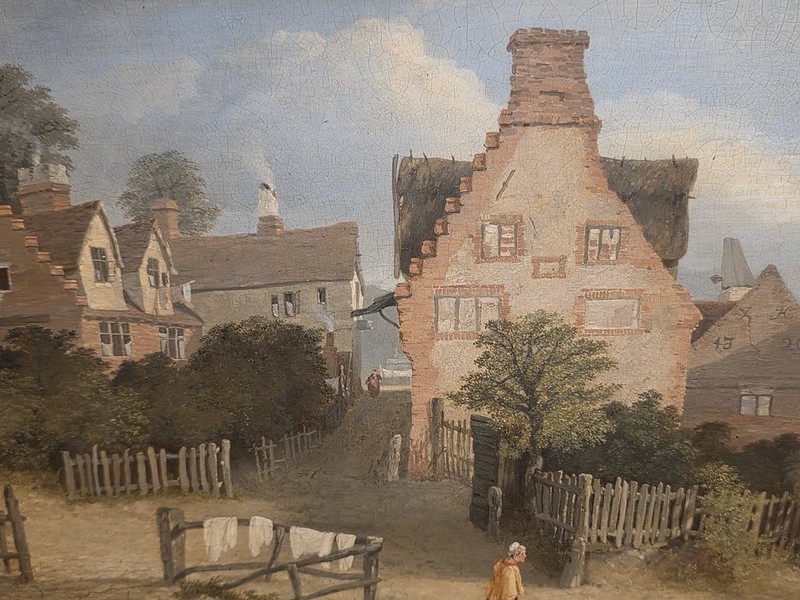
    This artwork is in the collections of Norwich Castle museum and was painted by Henry Ninham (1796-1874). The artwork was painted in the 1840s and was donated to the museum as part of the 1946 Russell James Colman bequest. Ninham nearly exclusively painted Norwich scenes and was enormously useful at recording the history of the city in the period just before photography.

    The building in the painting is Fuller’s House, also known as Fuller’s Hole, which was a residential property owned by Alderman Fuller, who it is frequently mentioned was the Mayor of Norwich, but I can’t find any evidence of that in the lists.

    Unfortunately, this building was pulled down amongst nearly everything else in the area as part of slum clearance in the 1930s. I’m not sure that the area is much better today in terms of architectural merit, it’s the St. Martin’s Close area of the city. If this would have somehow survived, as Elm Hill only just managed to do, it would have been full of character although the splitting of Oak Street in two by the flyover has rather broken this part of the city away.

    I’ve felt the need to get AI to bring it to life a little, I think it adds a slightly interesting perspective to matters.

  • Norwich – It’s Snowing so Gas Hill Closes

    Norwich – It’s Snowing so Gas Hill Closes

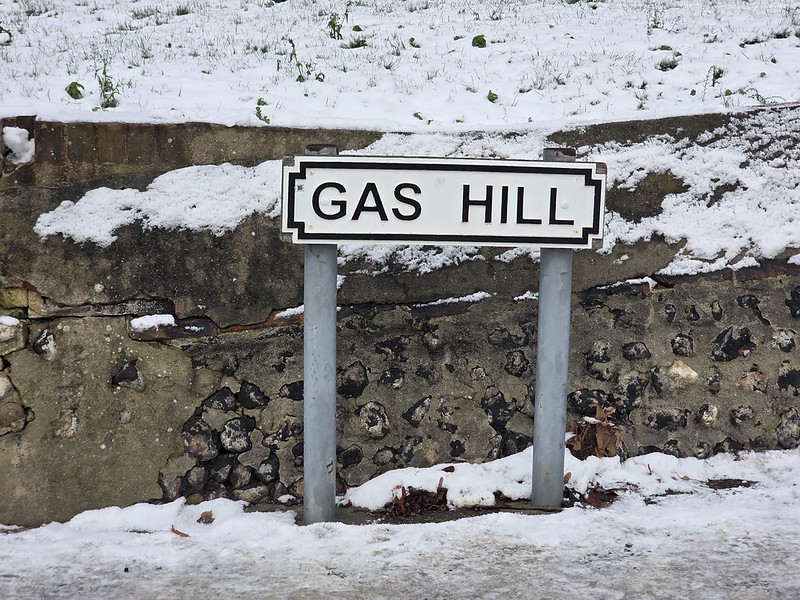
    There are some people who don’t realise how hilly Norwich is, Norfolk isn’t the flat county that some expect. And this is Gas Hill Mountain, clearly impassable on its upper slopes and the road has been closed following a car accident. I mean, who would have realised that this might have been dangerous to cars…..

    Incidentally, this is one of the very few streets in Norwich where the pavement has been gritted and not the road, rather than the other way around. Not that I’ve been moaning about this.

    Gas Hill was named after the gas holder that was located half-way up, but that was demolished a couple of years ago. But, this is just one of the things that we have to bear in this mountain community in which we live, although I’m in the foothills rather than near to the summit.

  • Norwich – Norwich Castle Museum (Lots of Old Keys)

    Norwich – Norwich Castle Museum (Lots of Old Keys)

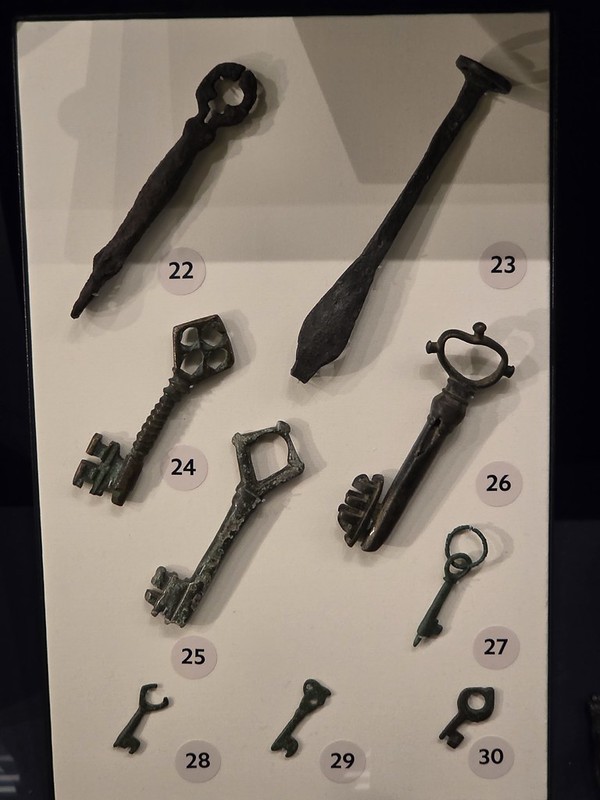
    Maybe a heap of old medieval keys in a museum isn’t at first sight very interesting, but there are certainly some stories hidden away here, even if it’s not clear exactly what they are. As a summary of the keys:

    22 : From St. Martin at Palace in Norwich (dated between 1000 and 1200)

    23 : Found at Castle Acre Castle (dated between 1100 and 1500). This is an iron barrel padlock key that entered the museum collections in 1984.

    24 : Found at Snettisham (dated between 1200 and 1300). This is a copper alloy key that entered the museum collections in 1907.

    25 : Found at Hardingham (dated between 1200 and 1500). This is a copper alloy key that entered the museum collections in 1999.

    26 : Found in Old Buckenham (dated between 1200 and 1500). This is a copper alloy key that entered the museum collections in 1966.

    27 : Found on Botolph Street (dated between 1200 and 1400). It is perhaps a little sub-optimal that this street has gone, I moan periodically that the street line of this could be restored with a little thought with the new Anglia Square replacement development.

    28 – 30 : Found in Caistor St Edmund (dated between 1200 and 1500)

    The museum appears to have put nearly all of their medieval keys on display, so perhaps it’s a little random, but at some point in history these keys would have guarded treasures and resources. There’s a fair amount of engineering that has gone on with some of these and some of them have a fair amount of styling to them.

    I’m not sure that much more is known about any of them, but I rather like the snapshot of history they provide even if their stories have been lost to time. And every treasure once had a keeper….

  • Norwich – Norwich Cathedral (Thomas Tawell Memorial)

    Norwich – Norwich Cathedral (Thomas Tawell Memorial)

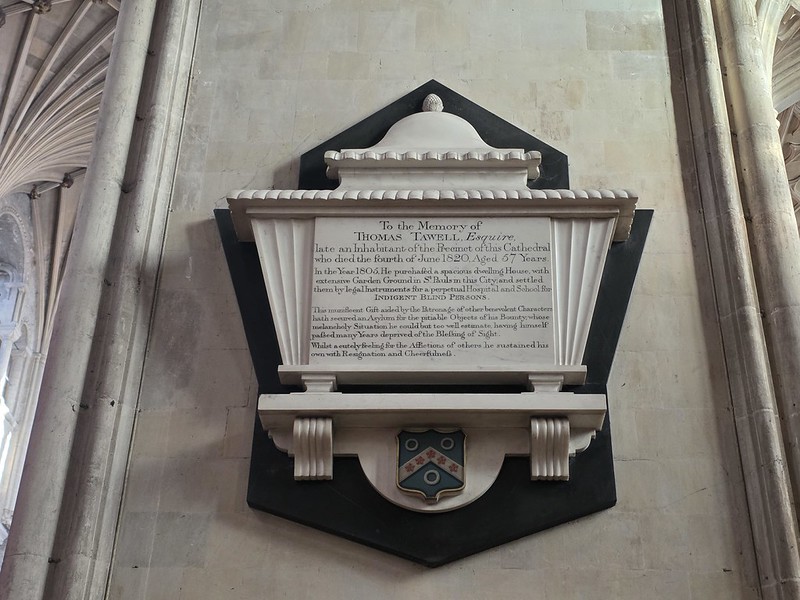
    This is certainly a rather lovely place to have a memorial tablet and it commemorates the life of Thomas Tawell (1763-1820). Tawell was born in Wymondham in 1763 and he was born into a wealthy family, although his father died when he was just ten. He went to work for his uncle, a Norwich ironmonger, and Thomas managed to build up quite a wealth for himself.

    Perhaps now best known for his generosity, his turn toward charity was rooted in his own experience with sight loss. While he was a successful merchant buying and selling his iron, he became blind, a condition that lasted for several years before he partially recovered his sight. This ordeal inspired him to help those who did not have the means to support themselves in a similar situation.

    In January 1805, Tawell spoke at a public meeting at the Norwich Guildhall to propose an institution for the blind. To ensure the project moved forward, he took direct action by purchasing a large house and three and a half acres of land in Magdalen Street for the cause. He also donated 1,000 guineas, which is estimated to be worth approximately £86,000 in modern terms. He was particularly adamant that the institution should not just educate the young but also care for the elderly, a requirement he made a central part of the charity’s rules.

    The building on Magdalen Street was known as the Asylum and School for the Indigent Blind (I didn’t know what ‘indigent’ meant, but it’s someone who is poor and/or needy). That building has since been demolished, but the organisation lives on, later called the Norfolk and Norwich Association for the Blind and, since 2020, now the more snappy ‘Vision Norfolk’.

    The text reads:

    “To the Memory of THOMAS TAWELL, Esquire, late an INHABITANT of the Precinct of this Cathedral who died the fourth of June 1820, Aged 57 Years.

    In the Year 1805, He purchased a spacious dwelling House, with extensive Garden Ground in St. Paul’s in this City; and settled them by legal Instruments for a perpetual Hospital and School for INDIGENT BLIND PERSONS.

    This munificent Gift aided by the Patronage of other benevolent Characters hath secured an Asylum for the pitiable Objects of his Bounty; whose melancholy Situation he could but too well estimate, having himself passed many Years deprived of the Blessing of Sight.

    Whilst acutely feeling for the Afflictions of others he sustained his own with Resignation and Cheerfulness.”

    He sounds a really quite positive man by all accounts. Incidentally, I’m very impressed at this art collection which was sold off a couple of months following his death, the auction catalogue notes:

    “ALL the valuable PICTURES, Prints, Coins, and curious Articles, of THOMAS TAWELL, Esq. deceased, at his late Dwelling-house, in the Upper Close, Norwich; comprising some fine specimens of the old Masters, Ostade, M. A. Carraveggio, Wyke, Zuccorelli, Frank Hall, Old Frank, Teniers, Rysdael, &c. &c. proofs and fine impressions from Bartolozzi, Vasseau, Wille, Earlom, Sharpe, Edelinck, Woollet, &c. Cupid in Psyche, Bacchus and Ariadne, Venus in statuary marble—Italian workmanship, very fine; a large collection of gold, silver, and copper coins, Roman urns, and a variety of curious antique articles.

    In the Books will be found Jeremy Taylor’s Works, Shakspeare’s in folio, Mant’s Bible, Josephus, Clarendon’s Rebellion, Statutes at Large, Robertson’s Charles, America and Scotland, Hume’s England, Burke’s Works, Annual Register, 62 vols. Blackstone’s Commentary, Hook’s Roman History, &c. &c.”

    Owning a Caravaggio is really quite exciting. Although if I owned one, I’d be stressed worrying someone would pinch it and I dread to think what the insurance cost would be. I’d worry about it every time I looked at it, so I think on that basis I won’t buy a very valuable old painting for several million pounds. Although there’s another limiting factor within that last sentence, but I digress.

    At least this memorial is of a man who made a great contribution to the people of Norwich, and not a tomb to a bishop that oversaw the execution of people who had a slightly different belief to him.

  • Norwich – Norwich Cathedral (William Inglott Memorial)

    Norwich – Norwich Cathedral (William Inglott Memorial)

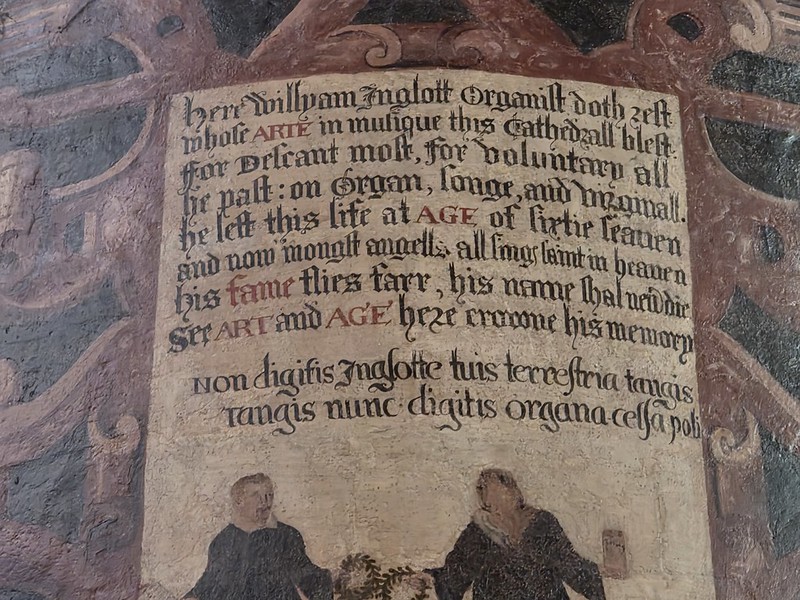
    This is a rather nice memorial, commemorating the life of William Inglott (1554–1621), a celebrated organist and composer at Norwich Cathedral during the Elizabethan and Jacobean eras. This image shows the memorial to William Inglott (1554–1621), a celebrated organist and composer at Norwich Cathedral during the Elizabethan and Jacobean eras. The monument is a painted mural located on a pillar near the presbytery screen with the obligatory skull located on the memorial to note the inevitability of death.

    William Inglott was the son of Edmund Inglott, who was also an organist at the cathedral. William began his musical journey as a chorister under his father before eventually becoming the cathedral organist himself from 1587 to 1591. After a period working at Hereford Cathedral, he returned to Norwich in 1611 to replace the famous composer Thomas Morley.

    He died on the last day of December 1621 and they had painted this within six months. This feels like a nice memorial and it’s still in excellent condition today, although the face of one of the two choristers seems to be blurred out. Maybe he wanted to be redacted.

    I’ve had AI transcribe this, so it might not be entirely accurate….

    “Here William Inglott Organist doth rest
    whose ARTE in musique this Cathrall blest
    for Descant most, for Voluntary all
    he past: on Organ, longe, and virginall.
    he left this life at AGE of fiftie yeares
    and now ’mongst angells, all sing laud in heaven
    his fame flies farr, his name shal not die
    See ART and AGE here crowne his memory

    NON digitis Inglotte tuis terrestria tangis
    tangis nunc digitis organa celsa poli”