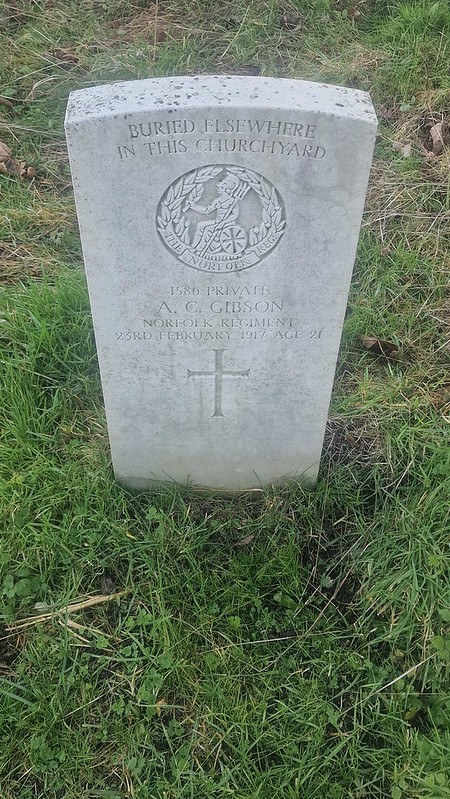
This is the war grave of Arthur Charles Gibson who is buried at St. Mary’s church in Burgh Parva, located near to Melton Constable. I’ve never seen a war grave with the words “buried elsewhere in this churchyard” on it, but in this case it’s because Arthur wasn’t listed on the Commonwealth War Graves Commission list, but in 2015 he was added to the United Kingdom Book of Remembrance.
Arthur’s record at the 1911 census when he lived on Gordon Road in Melton Constable. He lived with Walter Stangroom’s family, with Walter being his brother-in-law, and he worked as a telegraph operator. They also lived with Arthur’s mother, Ellen Gibson, who had been widowed. His military records note that he signed up voluntarily on 3 January 1912, but he was discharged on 19 July 1916 due to ill health. I’m not sure if he was injured abroad, or whether he was injured whilst working at the Melton Constable railway works, which was an important industry for the war effort. It seems unlikely to me that he was serving abroad, as otherwise he would have been more likely to have been listed on the Commonwealth War Graves Commission list. His military number was 1586 and he was a Private in the Norfolk Regiment, dying in London on 23 February 1917 at the age of 21, with his death certificate noting he died of empyema. He doesn’t seem to have a headstone of his own from the time, with his stone being added here in 2015.
Located at St. Mary’s church is the gravestone of Henry William Thomas Stimpson, the son of Henry Thomas Stimpson and Deborah Stimpson.
Henry was born in 1891, but wasn’t baptised until 18 October 1894 when he lived in Briston. He signed up to the military in 1911 when he was 18 on a 4 year territorial force contract, when he was still living in Briston but he was working as a coach painter at the railway works. Above is the 1911 census record for the family.
As he reached the end of his territorial contract, he was discharged from the military on 14 January 1916 when the documents note him to be 24 years old and 5’6″ tall. He lived at 5 Gordon Road in Melton Constable and he worked as a coach painter at the railway works. His character was noted to be “steady and sober”, but he wasn’t sent overseas to fight as it was noted he was serving at home from 5 August 1914 until 14 January 1916, I assume on what was defined as war work. He committed some minor offence on parade in Dereham on 30 November 1914 and was fined one day’s pay. He joined the National Union of Railwaymen in 1916 at the age of 24.
He served as a Private in the Norfolk Regiment, with service number 1385. I’m unsure how he died, but I’m going to take a guess that it was at the railway works as his body is located here and he doesn’t seem to have travelled overseas at any stage during his military career. I might well be wrong, I often am…..
According to his grave, he died on 13 November 1918 at the age of 28, although I’m really not sure that age is correct as it doesn’t fit in with the other dates and the death register notes him at 27 which seems correct.
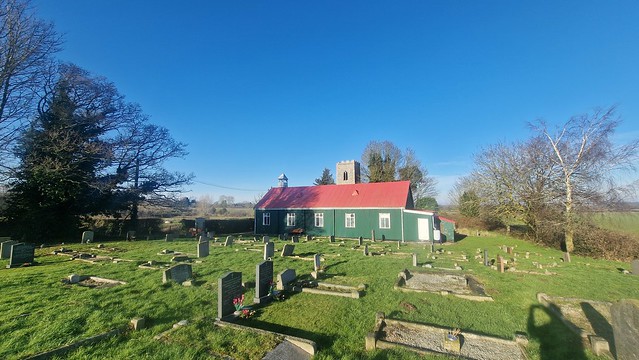
The old church at Burgh Parva has mostly fallen down and if the village of Melton Constable hadn’t been transformed by the railways, then the remains of that building are likely all that would remain today. However, the village population increased tenfold in just a few decades and it was evident that a new church was needed.
This building wasn’t meant to be permanent, but they’ve never quite built a new one. On 4 April 1903, the Norfolk Chronicle reported that:
“During the process of excavating and levelling the land round the old church for the purpose of the new churchyard, the foundations of the walls of the old churchyard have been found.”
This churchyard in the front of the image above is the newly opened section. It was reported in the local press later in 1903 that:
“Mr Ritson Batson Woods, at the age of 97, has constructed an oak lectern and presented it to the new Burgh Parva (temporary) Church of St. Mary, to be transferred to the permanent building as soon as it has been restored.”
There seems to have been a difference of opinion between whether to restore the old church or whether to construct an entirely new modern church instead, which is perhaps why a decision was never quite taken on what to do. There were fund raising exercises that went on for some time, but there is something quite homely about this tin construction.
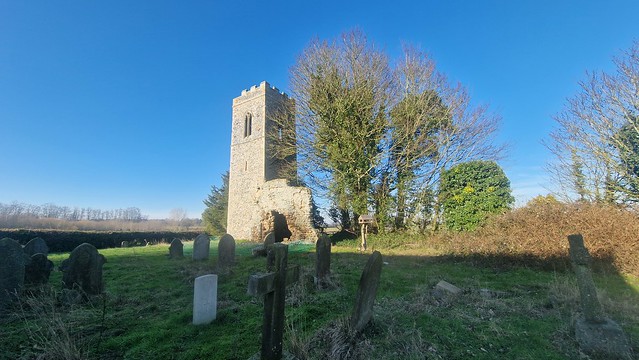
This is what remains of St. Mary’s church which is located near to Melton Constable, in what was once the parish of Burgh Parva. This medieval village has long since gone and the church was always a relatively small one. It’s thought that the church was constructed during the later part of the fifteenth century and the early part of the sixteenth century. David Kennett in his Norfolk Villages book notes:
“In 1845, White’s Directory described Melton Constable with Burgh Parva as a fertile parish of 1,700 acres. They had 114 inhabitants in 1831, but only 75 in 1841, several families having emigrated to America”.
There’s otherwise very little historical text that I can find about this church, just guesswork about the exact building dates.
The Norfolk Heritage web-site mentions that the church was likely ruinated in the reign of King Charles II, but the chancel had likely gone following the Reformation as some of the stone has been repurposed into the nearby hall. The tower is looking remarkably robust given how long it’s been standing, although it’s evident that there have been some repairs over recent decades. As can be seen, an advanced system to keep people out has been erected around the church.
The door had been filled in with stone before the church mostly fell down. I accept that I wonder about strange things, but it would be interesting to know when the last person to walk through that door was (the actual door, not the new hole that has appeared).
The church evidently wasn’t that large judging from the size and there’s no evidence of there being any aisles.
There’s one other section of wall remaining which seems to be near the end of the former nave.
Inside the church tower.
The former roof line is still visible. There have been some Saxon and early Norman finds here and it’s possible that there was a church here at that time, although equally, the stone might have been moved across to this as a new site.
Richard and I were off back on our church spotting and I had one of my marvellous ideas (which often actually aren’t) to combine that with a visit to Melton Constable. I’ve known this as the centre of railways in North Norfolk, but I’ve never managed to go there. We walked across from the church along the former railway line which led on to Holt and Sheringham. Melton Constable is mostly a planned village built to house railway workers, with the population going from just over 100 in 1881 to over 1,100 by 1911.
The former track which closed to passengers in early 1964. I didn’t expect just how sharp the drop off was at some stages along this line, there were considerable earth movements made to construct this line.
Melton Constable became a railway hub as two lines crossed there and this is the site of where they met. One was the line which went from Bourne in Lincolnshire across to Cromer and Great Yarmouth, whilst the other was the line which ran from Sheringham to Norwich, via Holt. The former of these lines closed in 1959 and the writing was very much on the wall at that point, as only the service from Melton Constable to Sheringham remained and the village became a terminus. In April 1964, that service was brought to an end and the railway station was closed.
The cursor marks where we were standing.
The village beacon.
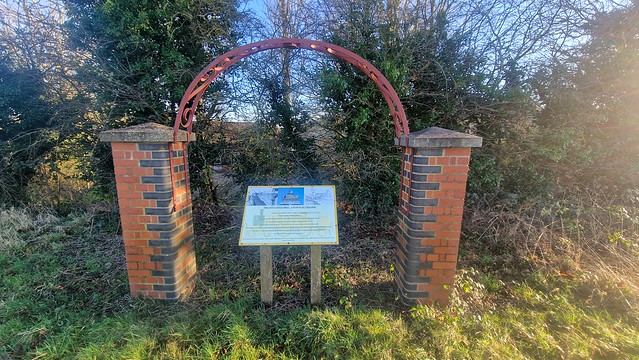
I was hoping for an information board about the railway’s past and I wasn’t disappointed. The metal structure here is original, it’s the one that’s in the below photo. The brickwork is recreated from the original, more on which in a moment. The road layout has changed a little here, but this is effectively where the railway station itself was located.
A postcard of the station as it once looked. The station was constructed on land which was owned by Lord Hastings and his involvement was rewarded as he was given a private platform and waiting room, which seems quite a grand arrangement for any individual. Perhaps Elon Musk might try and get himself a private platform at London Waterloo or something….
The steps down to the railway works. These works were a major employer for the area and they were constructed here soon after the railway opened in 1883. The works employed over 1,000 people at their peak and the village became known as “the Crewe of North Norfolk”. The workers here primarily repaired locomotives, constructed carriages and they also provided maintenance for a whole range of railway infrastructure. There was also a concrete works at the site and the still exciting concrete railway sign at West Runton was made here.
This maps shows how the railway station, the railway works and the sidings used to dominate the village. The planned housing can be seen quite clearly here and they have something of a northern industrial town feel to them.
And here’s the original location of the steps, with the original brick pillar still in situ.
They’re not clearly visible in this photo through the foliage, but the original steps down to the railway works are still there.
And this is where the railways buildings were located, with the large engineering shed on the right still there.
And another old railway building.
It’s disappointing that they’ve demolished so much of the railway heritage here, although the area is quite remote and after they demolished the railways tracks it made it rather hard to get to. In the summer of 1964, a regular bus service was put on for the 30 residents who needed to get to Holt and there remains a service operating to this day. It’s rather quiet now and it’s hard to imagine just how many trains used to come through this station and how many people once worked here.
Another in my little series of posts from the Norwich Mercury 200 years ago this month.
“Sirs,
A great sensation has been occasioned in this neighbourhood, by a body recently being taken from the church-yard of Hethersett. This, though so distressing to the feelings of surviving relations, is an evil which will never be prevented, unless a sufficient number of human bodies can by other means be obtained, for the purpose to which this, no doubt, has been applied, and which, for the advancement of a science, the most important to the welfare of the human race, is indispensably requisite. I have long been of opinion, that the bodies of ALL malefactors who are executed should be delivered to the surgeons: this would operate as a two-fold good—for I am persuaded it would tend greatly to the prevention of crime.
Hardiment, who was executed here about two years ago for murder, felt, as I have been credibly informed, a much greater horror at that part of his sentence which subjected his body to dissection, than at death itself. Two men were condemned at the same Assizes, for having set on fire some premises in or near Diss. A short time before their execution they expressed a strong desire to see their prosecutor; told him they felt persuaded, that if buried at Norwich, their bodies would be taken up, and requested him to make them a promise that they should be taken to a church-yard they named, at the distance of about twenty miles, which being granted, they became comparatively easy. This account I received from a professional gentleman who had been employed on their trials.
I would not, however, stop here: I would also give up to the surgeons the bodies of all who execute themselves, excepting those only, who it should be clearly proved, had been under restraint from imputed insanity or lunacy. This would, I have no doubt, greatly tend to prevent self-murder, and I have, almost under my own eye, a much stronger proof in print, than that in the case above stated.
In the Spring, 1821, R. residing in a neighbouring village, cut his throat, though not so as to occasion death. In the Spring, 1822, L. residing in another neighbouring village, hanged himself: an inquest was held, and, as usual in such cases, it was adjudged that he was at the time insane. Immediately after this, R. said to some of his neighbours, “though L. hanged himself they buried him in the church-yard.” The next morning the body of R. was found hanging and dead.
Feb 8th, 1825. Your’s, &c. &c. A.B.”
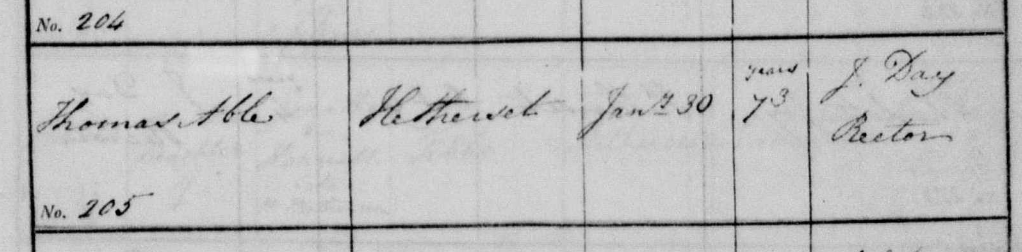
The church where the body snatchers struck was St Remigius in Hethersett. I was able to find out that the burial was of a “poor old man” on Sunday 30 January 1825 and his body taken on the Wednesday.
He wasn’t named at the time in the media, but there was only one burial that day at the church which was Thomas Able, a 73 year old man from the village and this fits the description of an “old man”. His wife died on 23 December 1846 and was later buried at the same church, so she must have suffered terribly. At the time, it was thought that a body going to be dissected wouldn’t go to heaven, which is why it was an extra punishment for those condemned to death by the courts and why the letter writer suggested people who committed suicide should have their bodies taken, something which happened in Germany at the time. The theft of a body wasn’t a criminal offence in 1825, as long as any clothing or other items weren’t taken away at the same time, which is why they were left at the site. The matter was mostly resolved by the passing of the Anatomy Act in 1825, legislation which was long overdue as fear of a loved one’s body being removed became a slight national obsession.
In my little series of posts from 200 years ago, there’s a one line article on the court reports for 1825 that reads:
“By the decision of magistrates, Charles Smith, for non-performance of an order of bastardy – three months tread wheel”.
The tread wheel was a relatively new invention at this time, having been designed by Sir William Cubitt and introduced in the prisons of Bury St Edmunds and Brixton. The punishment varied, but Charles was likely on the tread wheel for around six hours a day, which must have been healthy but also tiring and probably rather annoying to say the least.
The concept of bastardy orders has roots in English common law, where children born to unmarried parents were deemed filius nullius, meaning “child of no one”, which does feel a slightly harsh way for a youngster to start their life. These children lacked legal standing in society and were prohibited from inheriting property from their father unless legitimised, which could be done rather more easily for the landed gentry. These children could not claim support from their parents, and the responsibility for their care initially fell upon monasteries and local councils. The Poor Law of 1733 in England stipulated that the putative father was responsible for maintaining his illegitimate child. Local authorities would issue public funds to maintain the mother and child until the father could assume responsibility.
The 1834 New Poor Law in England introduced a Bastardy Clause, representing something of a significant shift in social and legal approaches to illegitimacy. This clause shifted the responsibility for illegitimate children from the parish to the mother and this change aimed to deter illegitimacy and reduce the cost of poor relief by placing the burden on unmarried mothers . The Bastardy Clause was rooted in the principle of “less eligibility”, which sought to make workhouse conditions less desirable than even the lowest paying jobs, thereby discouraging reliance on poor relief. A Royal Commission into the changes that became the 1834 Poor Law stated that the existing system gave generous payments for illegitimate children and indemnified the mother against failure to marry, noting:
“The effect has been to promote bastardy; to make want of chastity on the woman’s part the shortest road to obtaining either a husband or a competent maintenance; and to encourage extortion and perjury.”
Charles Smith is too common a name for me to be able to work out much about him, but the parish officials would have made an Order which required him to pay for his child and it’s evident that he didn’t make those payments.
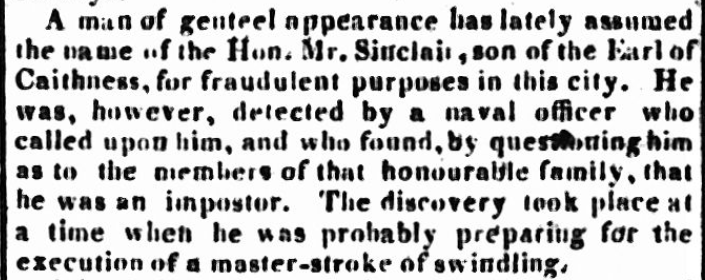
Back to my little series of posts about the Norwich Mercury from 200 years ago. It’s hardly a surprise that there were conmen operating in Norwich 200 years ago, but it must have been a lot harder back then to actually spot such deceit when it happened. The Earl of Caithness at the time was Alexander Campbell Sinclair, 13th Earl of Caithness, with the fraudulent man pretending to be his son. He was perhaps unfortunate to have discovered a naval officer who was able to ask penetrating questions about the Earl of Caithness, otherwise he might have gotten away with his little scam. It’s a nice little phrase from the newspaper though, “preparing for the execution of a master-stroke of swindling”, as there are some politicians that could be said about today.
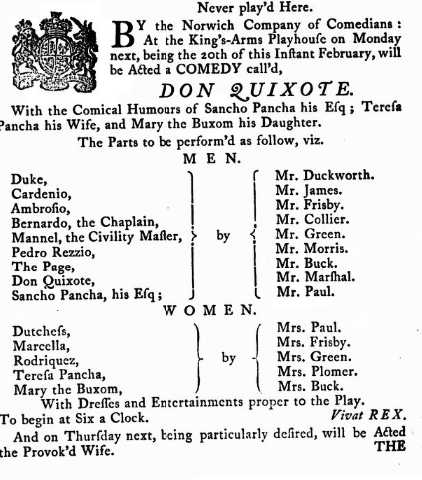
As I’m up at 02:00 waiting for security to open at Rome Fiumicino airport, I thought I’d look at some newspapers from 1727 as that’s great entertainment for an early morning. It’s one of the earlier editions of the Norwich Mercury, which was printed from the early 1720s until May 1949.
“Never play’d Here.
By the Norwich Company of Comedians:
At the King’s-Arms Playhouse on Monday next, being the 20th of this Instant February, will be Acted a COMEDY call’d,
DON QUIXOTE.
With the Comical Humours of Sancho Pancha his Esq; Teresa Pancha his Wife, and Mary the Buxom his Daughter.
The Parts to be perform’d as follow, viz.
MEN.
Duke, Mr. Duckworth. Cardenio, Mr. James. Ambrofio, Mr. Frisby. Bernardo, the Chaplain, by Mr. Collier. Mannel, the Civility Maſter, Mr. Green. Pedro Rezzio, Mr. Morris. The Page, Mr. Buck. Don Quixote, Mr. Marshal. Sancho Pancha, his Esq; Mr. Paul.
WOMEN.
Dutchefs, Mrs. Paul. Marcella, Mrs. Frisby. Rodriquez, by Mrs. Green. Teresa Pancha, Mrs. Plomer. Mary the Buxom, Mrs. Buck. With Dresses and Entertainments proper to the Play.
To begin at Six a Clock. Vivat REX.
And on Thursday next, being particularly desired, will be Acted the Provok’d Wife.”
Firstly, the King’s Arms Playhouse is something of a mystery and doesn’t come up on any searches. There have been ten pubs in Norwich with this name, but there’s only one which seems to have been open at this time and it’s a pub still in existence, now called Berstrete Gates. Don Quixote had been written just over 100 years before, so was an old favourite even back nearly three hundred years ago.
It’s rather sub-optimal that no first names were given, it’s too hard to work out who any of these early actors and actresses were. They were a touring company, as their names appear in locations across the region. Fortunately, a little more is known about the Norwich Company of Comedians, who between 1731 and 1757 made the White Swan Inn, near Peter Mancroft, their home. This pub started trading in the early 1600s, but the building was pulled down in the 1960s to make way for car parking. A sub-optimal decision…. Anyway, despite more being known about the company, there’s still no link between the names of the performers in this production and the history of the comedians, so that didn’t help much.
Despite my failures of research, it’s still a rather lovely little piece of Norwich history, a theatre company performing 300 years ago to surprise and delight the locals….
And just one more post from the Norwich Mercury of 200 years ago this week…..
“NORFOLK, SUFFOLK, AND ESSEX Rail Road Company.
At the request of several Gentlemen of influence and respectability of Norwich, the Committee of Management have consented to receive SUBSCRIPTIONS for SHARES until the 1st February, before which time all Tenders must be made, to Messrs. Gurney, Messrs. Tompson, Barclay, & Ives, Messrs. Onley, Hudson, and Harvey, and Messrs. Day, Bankers; Messrs. Unthank and Foster, Solicitors, at Norwich; Messrs. Brown and Co. Messrs. Oakes & Co. and E. Squire, Esq. Bankers, at Bury St. Edmund’s; Messrs. Borton, Solicitors, Bury St. Edmund’s; or to Messrs. Sir W. Kay, Price, Marryatt, and Coleman, Bankers, Mansion House-street, London; Messrs. Morland & Co. Pall Mall; Messrs. Wolfe and Edmunds, Brokers, ‘Change Alley, Cornhill; and Messrs. Wilks and Verbeke, Solicitors, 36, New Broad-street.
But all parties so making Tenders must remit the amount of deposit of £1 per Share, on the Shares for which they may tender, to one of the above-named Bankers, otherwise the Tender cannot be received.
London, 13th Jan. 1825. WM. SIM, Sec. Pro-Tem.”
I’ll ignore that Oxford Comma in the first line…. I can’t find any substantial reference to this company, although I like the early use of the words rail road, so I’m not entirely sure what happened to it. However, this must have been one of the earliest attempts to create a rail company in East Anglia, but it took over a decade for any line to appear in the region. However, I suspect I’ll start to see a lot more journalism and adverts about the rail network from 200 years ago, as in 1826 there was an Act of Parliament that authorised the Liverpool and Manchester Railway.