Category: Norwich

  • Norwich – The End of Debenhams

    Norwich – The End of Debenhams

    That’s the end of Debenhams in Norwich, they’ve been boarding up (or metalling up, whatever the phrase is) the entrances of this large building all week. It’s not somewhere that I’ve been for years, it has felt old fashioned and under-resourced for a long time.

    This boarding up has meant that the recessed areas where the homeless have been sleeping have been made inaccessible, with the tents just moved to the outside now. I’m not sure that this is entirely ideal.

    It’s a far cry from 1955 when this building was being built, then known as Curls (or Curl Brothers) and replacing a war damaged building. There’s a photo on Photo Norfolk of what the site looked like following the end of the Second World War, with Debenhams now being located where that pool of water is.

    Debenhams purchased Curls in the 1960s, but it continued to trade under its old name until the 1970s. What will happen to the building is anyone’s guess, but I suspect part will be turned into residential flats and there will likely be some coffee shop or the like added to it. The future for large department stores doesn’t look entirely bright, although I suppose this will be useful for nearby Jarrolds who might benefit from the trade.

  • Norwich – Old Library Wood Accident

    Norwich – Old Library Wood Accident

    This is the approach to Old Library Wood in Norwich (where I’ve written about the rather excellent sculptures before) just after I returned from my rather brave camping adventure this weekend. Visible at the rear of the photo is an Openreach van, located there as a Royal Mail van managed to plough into the wood’s wall yesterday and destroy a chunk of it.

    The wall from inside Old Library Wood, a situation I’d suggest isn’t entirely ideal. I hadn’t realised before, but there was a mural at this spot, now nearly entirely demolished. But, no-one was hurt and that’s the main thing.

  • Greater Anglia : Norwich to London Liverpool Street

    Greater Anglia : Norwich to London Liverpool Street

    This is my first rail journey of 2021 and it’s certainly a step-up from the bus travel that I’ve been limited to for the last few months. It wasn’t busy at Norwich railway station with just a few people walking around the concourse, a couple peering into the M&S that has remained closed since March 2020. I still think that should have been a Greggs, but I don’t go on about it…..

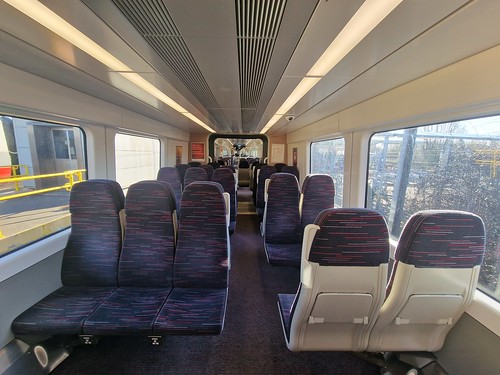
    This is one of the Greater Anglia fleet that has no tables, as passenger surveys have apparently told them that customers don’t like them. I make no comment….. Anyway, the train was clean, shiny and nearly completely empty. Everything on the train was working though, including the power and even all the toilets were functional. How lovely.

    One of the slight problems with the rail journey into London is that it stopped at Witham, one of the few towns in Essex that I haven’t visited. I looked at TripAdvisor to see the top four rated attractions in the town and they are (i) a walk by the river, (ii) the library, (iii) the statue of Dorothy L Sayers and (iv) the town hall information centre. Given that, and with respect to the denizens of the town, I might wait just a little longer before making a proper visit.

    Anyway, there were plenty of Greater Anglia staff to guide customers onto the buses which would take us to Newbury Park. I’m not sure where Greater Anglia had found these staff, but they were particularly friendly and engaging, all a really organised effort.

    I try not to complain about things, but on my bus travels in recent years I’ve discovered that just about every vehicle has no more than four seats across. This is because there is only space for four seats and an aisle between them. But, no, this bus company has decided that more is better and have crammed in five seats across. I accept that if all the passengers were five years old, then this would be a perfectly sensible transportation move. But, the rail passengers were all above 18, which presented me with an interesting time watching them try to fit into the space provided, which was made more exciting as the bus company have given customers no real amount of leg room either. One man looked positively annoyed. I’d add that wasn’t me.

    I moved to the back of the bus to get some space, and I’m pleased to say that unlike the Inbetweeners, I wasn’t moved off those seats by anyone. The fortunate thing is that social distancing means that customers are kept apart, so there were only about 12 of us on the vehicle. About 105 seats, but only 12 people sitting on them.

    The rail replacement bus arrived into Newbury Park, where we were politely told to get on the Central Line into London. I asked the gateline staff if I was allowed to continue travelling down the Central Line to Oxford Circus, or whether I needed to get off at London Liverpool Street. To cut a long story short, he told me that I should really get off at London Liverpool Street, but that wasn’t what he recommended I should do. He suggested winging it with the gateline staff at Oxford Circus as that would be much quicker. He mentioned though that this was all at my own risk. Indeed, he mentioned that three times.

    I worry if I don’t have the right ticket, so I decided not to spend an hour worrying and I got off at London Liverpool Street. That also meant I didn’t have to try and enter into protracted negotiations with the gateline staff at Oxford Circus, which didn’t sound an exciting game to play. I had to faff about finding a member of gateline staff to let me out of London Liverpool underground station, and he looked slightly annoyed to watch me then go back through from where I had come from around thirty seconds later. But, my journey was now fully compliant with railway rules and I didn’t have to fear any TFL ticket inspectors. And more excitingly, I was back in London after way too many months.

  • Norwich – The Garden House

    Norwich – The Garden House

    Before going in, we had decided that we would pre-judge the Garden House, which had been a marvellous pub and then Craft Union took it over. I haven’t been since that takeover, but Craft Union have in my experience been reliably terrible with clunky makeovers and a poor range of drinks. I’ve never been quite sure what the word Craft is doing in their name, trying to cash in on craft beer when that’s not something they have any focus on. So, my expectations really weren’t very high and I’m used to Craft Union not even offering real ale, so we were wondering whether we’d have to fall back on something like Guinness.

    The welcome offered at the entrance was excellent and verging on exceptional and I understand it was the landlord standing there taking charge of that. That was a positive first sign, as being made to feel welcome really is a skill that some pubs struggle to get right and it shouldn’t be that much of a challenge. The second positive sign was that list of real ales, as Theakston’s Old Peculier is what I consider to be a very good option to have, as is Timothy Taylor Landlord. It’s also really useful when pubs write down the beers that they have, as staff trying to remember what they have is not an ideal situation as it’s often poorly communicated. But here, there was clarity, friendliness and a self-assured service style all as part of the initial greeting, which is rather lovely.

    There’s a large beer garden and that is apparently the reason the pub was named the Garden House because of that rather useful feature, although for reasons unknown, the pub name was changed for a short period in the 1980s to ‘Fridays’. Today, the garden area is all organised and there’s an area with an external television and seating area. That the pub can show live sports is not much interest to me, but I can see that it’s a very useful thing to have to help them serve the community. The pub is using a clunky app provided by Craft Union, which reminds me of the Greene King app which really isn’t very focused on proper beer, as neither can cope very well with real ales. This wasn’t a problem here, a staff member was able to take our order as she confirmed real ale can’t be ordered using the app. As another little bonus, the prices charged for the ales, and indeed most drinks that I saw, was towards the lower end of the scale.

    This is my problem with the Craft Union name, it implies to new customers that they focus on craft beer. Their advertising is actually more focused on drinks such as this, which is entirely fine (and, a bit secretly, I wouldn’t turn any of those down…..) but not keep in fitting with their name. Craft Union is now part of Stonegate, who are probably going to do a better job than the complete disaster that Enterprise Inns made of most things when they operated it.

    Anyway, my issues with the national brand aside, this pub was very well run and the customer service was faultless. The beer was well kept, the choice was better than my expectations and the environment was comfortable. It’ll take me a while yet to be convinced about Craft Union, but this was a rather positive experience. It does show though that when they find an excellent operator that the concept they use (where the operator is self-employed but gets 18% of the take for themselves and to pay their staff) is one that can work.

    It’s a reminder also to us that we shouldn’t really pre-judge pubs as often they can surprise and delight.

  • Norwich – The York Pub

    Norwich – The York Pub

    This whole drinking outside only thing does rather reduce the quality of the photographs (it is a bit easier to take photos inside where there’s actually some light), but this is The York pub on Leicester Street in Norwich. I’m not sure why the owners have lost the Tavern bit from the name, but this was until recently known as the York Tavern. Customers enter via the front door (that sounds obvious, but often at the moment customers can get into pubs through some random side gates) and the process was all well managed for us. We had to provide details for the NHS app and then separately to the pub, which was slightly convoluted, but best for the pub to be careful.

    This is the pub’s sizeable beer garden, which used to be a bowling green. I wouldn’t have noticed that if I hadn’t been told, although the defined shape is a slight giveaway. An article in the Norfolk Chronicle in 1902 mentioned that the bowling club had been open for 27 years and that it was one of the oldest in the city. Today, there’s a large marquee on part of the lawn and then some picnic benches dotted about. And all credit to the pub owners over the years for not trying to sell this land off for housing, as it’d be possible to cram a new house in there.

    The clues to it being a former bowling green are though more evident with the structures at the side (I mean the club house thing, not Nathan). Norfolk Pubs notes that the pub opened in 1878 (which suggests that the bowling club was already there if the dates in the Norfolk Chronicle are to believed) and also that the landlord Albert Plane had been found dead at the bottom of the stairs in 1922 having gone to get his family all a cup of tea, which isn’t an ideal situation. This was the same landlord who refused to admit the police into his pub in 1916, a rather brave thing to do. The reasons for the police visit aren’t known to me, but Plane was involved in black market activities, so perhaps it was in relation to that.

    There wasn’t a particularly exciting range of real ales or craft beers, but there was Gamma Ray from Beavertown which was satisfactory. I wouldn’t go further than satisfactory, but it’s a reliable pale ale. I’m still vaguely on the lookout for Spresso, which is Beavertown’s imperial stout, although they might not even make it any more. The ordering is done on-line, and Nathan managed this without too many issues on his Nokia 3310 (or whatever it is that he has).

    Anyway, the pub’s garden is spacious and so the tables were suitably far apart from each other, and there was a one-way system in place inside to get to the toilets. That went via the pub’s internal stairs, which wasn’t entirely ideal now that I knew a previous landlord had died there. Although we arrived too late for it, the pub is doing food and the reviews for that seem positive and their chicken wings sound quite delicious.

  • Norwich – Brewery Tap

    Norwich – Brewery Tap

    This is another pub that I’ve visited many times, but never made the effort to write about, but since it’s in the Good Beer Guide and I’m trying to visit every pub in it (I accept that’s a forlorn task), now seems an appropriate time. It’s part of the Fat Cat estate in Norwich, but it’s got a more modern and contemporary feel to the whole arrangement.

    There was a small queue when we arrived, but it was efficiently managed and the staff were fully in control of the situation. We had to wait whilst Nathan waved at all his friends in the pub beer garden. Perhaps this is how the late Duke of Edinburgh felt when the Queen was waving to her admirers whilst he stood behind waiting to get in for the food and drink. Anyway, after that faffing about, we were seated and it transpired we were seated underneath a heater. I liked this a lot.

    I mentioned yesterday that the Artichoke has pretty much the best selection of beer in Norwich, but the Brewery Tap really isn’t far behind. The highlights of the beer options for me were the Extra Brownie Pints from Brew York and the Raspberry Gose from Yonder Brewing. But, the selection of beers was well balanced and there were some exciting little numbers in the “coming up” section of the on-line menu. Ordering was via staff coming to the table, and that all worked pretty efficiently, with the beer knowledge being excellent. The pub deserves to be full with such beer, staff friendliness and staff knowledge, which it was throughout most of the night.

    Nathan spent much of the evening pressing the little button to turn the heater on, partly due to pressure from me and partly due to pressure from another table. That heater did though make things much easier throughout the evening, as inevitably it got quite chilly when it got dark and heading towards closing time.

    The food menus. I’ve never eaten food here before (other than crisps, although I think I’ve eaten crisps at just about every pub in Norwich), but food seemed to be going to a lot of tables, so it felt almost impolite not to join in (or that was my excuse on this occasion).

    Dr. Pepper is one of the best soft drinks going as far as I’m concerned, so the pulled pork soaked in that nectar from the Gods seemed a decent choice. And, it worked beautifully, the portion size was filling and the pulled pork was tender and had a rich taste. The chips themselves weren’t overly exciting, they were just, well, chips, but the topping more than made up for that. Some of the food prices, such as the burgers, are a little punchy, but it was served hot and tasted fine. The food was served until 21:00 and the staff helpfully went around telling customers when the last orders were, an opportunity we took advantage of.

    Another rather lovely visit and I like the thought that has gone into the food, the service and the beer selection. Incidentally, I note that CAMRA say “you’ll find a working set of traffic lights, which indicate whether the bar is open or not”, which I’ve never noticed before, but I’ll look out for when customers are allowed to visit the bar and actually sit inside.

  • Norwich – Artichoke Pub

    Norwich – Artichoke Pub

    The Artichoke is the pub that I visit most in Norwich, although I’ve never made the effort to write a post about it on here. Since pubs have re-opened now, or at the least the outside of them have, I thought I’d go to my favourite Norwich licensed premises, and it’s where I stayed nearly the entire day. Thanks to Brian, Gordon, Nathan, Megan and James for keeping me company during the day…….

    Anyway, the background to this pub is that it was quite generic in its offerings in previous years and perhaps in danger of being closed down permanently and for it to become another casualty of the pub trade. It was taken over by an independent operator, Kevin Tweedy of the Golden Triangle Brewery, and the pub has been transformed over the last few years into a venue that is busy, well managed and has an excellent beer range.

    Ordering at the moment is via either the Artichoke app or by asking a staff member directly, with payment being by card only with no cash accepted. The app perhaps needs some work as there were some technical issues with it, but if nothing else it was a useful way of seeing the beer list. The pub wasn’t as busy as I thought it’d be during the day, although it was often nearly at capacity, but never quite reached it for very long. The weather was tolerable throughout the day, but got rather colder later on and my feet started to feel just a little chilly. What did remain for the day though was the welcoming atmosphere, this is a very non-threatening location.

    The beer selection in the Artichoke is what I’d consider to be the best in Norwich, not reliant on a few generic and dull options, but instead offering an ever changing selection of beers. The outstanding ones from my visit yesterday were:

    Big Idjit from Dugges Bryggeri

    Trium Faba from Three Hills Brewing

    Must Kuld Chilli & Chocolate from Pohjala

    Yuzu Juniper G&T Raw from Three Hills Brewing

    As an assortment of beers to have available, I think that’s pretty impressive. The staff here are very knowledgeable about the beers, some of the best drinks knowledge that I’ve seen in a pub. That’s some enthusiasm and good training there, with the staff being able to make suitable recommendations when someone just asks for a lager. As for downsides, I’m not sure that there really are any, not least anything which is sufficiently annoying to comment on. Perhaps the only minor problem at the moment is that the beer garden seems to allow smoking throughout the entire area, which isn’t ideal at all for non-smokers. But, it’s not long until the inside of pubs can open again.

    These photos are from pre-lockdown, a reminder of what it was like to sit inside pubs.

    These are a random selection of the cask and keg lists that the pub has had over recent years, but there’s also a long list of cans and bottles in addition to this. Food isn’t always offered in the pub, beyond Pipers Crisps (although these are very moreish) and nuts, but on some weeknights and on Sunday afternoons there is the XO Kitchen which offers a range of small plate options.

    Anyway, as a pub, I very much recommend the Artichoke and I think it’s lifted the entire area. And, it’s also listed in the Good Beer Guide.

  • Norwich History by Parish : St. Michael at Thorn 1/2

    Norwich History by Parish : St. Michael at Thorn 1/2

    And a new little project that Jonathan and I are undertaking because this lockdown went on for longer than we had anticipated, so we had time to do this. It’s a bit niche (our project I mean, not the lockdown), I’ll accept that, but there we go. Effectively, it’s walking around Norwich, ancient parish by ancient parish and seeing what is there now compared to a map from the 1880s (and the 1920s). There’s a PDF of these boundaries to provide some extra background to this whole project.

    This week’s meander was around the parish of St. Michael at Thorn and this is one that has been badly hit by a combination of war damage and what I would consider to be quite incompetent city planning. The church was damaged during the Second World War, but it could have been replaced or the tower saved. Instead, the site was tarmaced over and turned into a car park. Housing and pubs on the other side of Thorn Lane were torn down in the 1960s and replaced with a small number of commercial units, but mostly more car parks. There are relatively few old buildings surviving on either side of Ber Street and the entire area between Surrey Road (sometimes now all referred to as Surrey Street) and Ber Street has been flattened to build car parks. All of the yards were removed and no parish boundary markers remain today that we could find.

    Such is the devastation caused by the demolition, not one single listed building seems to remain in this parish. However, there is some good news, there is another part of St. Michael at Thorn parish which is near to the castle, separated by St. John Baptist Timberhill parish, so that’s where we will visit next week.

    The centre of this parish is (or was) St. Michael at Thorn parish church, located on Thorn Lane. Or, as some local wit has amended it to here, Thorne Lane. The church was originally known as St. Michael on the Hill, but also as St. Michael Spinas, which is the Latin word for thorns. So, they’ve named a church as it had a load of thorn bushes in the churchyard, which were also still there in nineteenth century accounts.

    This is the corner of Rouen Road and Thorn Lane, the edge of the parish. Only this frontage is located within the parish, but this was all Paradise Place which was an area of much denser housing. It retains the same name today, but there’s more greenery and this is some of the limited amount of new property that has been constructed in this parish over recent decades.

    Thorn Lane used to carry on to the left and go down to King Street through the old brewery, but post-war redevelopments have seen that link removed. There’s a photo from around 1910 of Kahler and Sons bakers, which was pretty much in the centre of my photo above.

    This map from 100 years ago is hard for anyone today to be able to place into the current landscape, but the top section (on the left) of Thorn Lane is still there, and King Street is still there on the right of the map. Rouen Road ploughs through the middle of the map today, roughly where the ‘A’ in Thorn Lane is located on the map.

    This is today the entrance to the EDP’s car park, but it was once where Bacon’s Square was located, named after Nicholas Bacon’s house which was located nearby. Just to the right of this, George Plunkett took a photo in 1937 (whilst standing on Thorn Street) of what was then Middle Square.

    A rather faded sign which notes the church that was once here.

    This is a planning mistake, and quite a sizeable one in my view. George Plunkett shows what was here in the 1930s, which was St. Michael at Thorn church from which this parish takes its name.

    There was likely a church here from the late Saxon period, but it was rebuilt in the medieval period and a steeple added in 1430 following another major rebuilding effort.

    There was another substantial renovation which took place in the Victorian period, with this plan dating from 1870. It could be argued that this didn’t go entirely to plan, as the tower fell down on 3 November 1886 which wasn’t at all ideal, especially as it took some of the nave with it. The cost of this restoration, which restored the tower to its previous appearance with the exception of the pinnacles and a parapet, cost £500 and the church struggled to raise this. I have some sadness here to think of how much people struggled to raise this money for their church, which they viewed as important and wanted to be successful. They did well though, the damage was repaired within one year of the tower collapse and the service at its reopening was very well attended.

    The nave and chancel of the church was destroyed during air raids during the Second World War, but the tower survived. There was talk of rebuilding the church in 1948 and costings were drawn up, but this was at a time when there were enough churches in Norwich and there wasn’t enough support for its reconstruction. Just down the road, St. Julian’s Church had also been damaged and it was decided that only one church needed saving. Indeed, the door from St. Michael’s was used as part of that reconstruction, so at least something remains. The Church of England had the power though to do more here, they were quick to demand locals pay money that they didn’t have to repair the church in times of need not that many decades before, but they abandoned it with perhaps undue haste. Anyway, George Swain took a photo of the doorway in 1952, just before it was moved.
    As for the reuse of this site, I think it was idiocy to turn this entire area into a car park. It could have been turned into a play park as happened at St. Paul’s church in the city, something that was a useful amenity to the local population. It was decided to save the towers at St. Bartholomew’s Church in Heigham and St Benedict’s Church on the street of the same name, so that could have been done here.

    Located over the road from the church, likely where the residential home is now located on the corner, was a grand house. Blomefield notes:

    “The house over against the church with a large garden, of 3 or 4 acres thereto belonging was anciently John Corbet’s; then Edward Southwell’s, after that Alderman Tho. Grene’s; after that Sir Nicholas Bacon’s city house; and during the time Bishop Reynold’s was repairing the palace, he dwelt there; it was a grand house, but is now converted into small tenements.”

    Located next to the church, and bordering onto the parish of St. John the Baptist, was the Windmill pub and then two doors down from that was the Exhibition Tavern. The Windmill pub had traded as a licensed premises from at least 1760, but the building was damaged during the Second World War and the City Corporation compulsorily purchased it in 1958. They then demolished it in 1970, but George Plunkett has a photo of Windmill Alley which he took from the churchyard in 1937 and that shows the rear of the pub. The Exhibition Tavern traded from the 1860s, but was closed in the early twentieth century when it was decided nationally to reduce the number of licensed premises.

    For anyone who doubts the number of pubs in Victorian Norwich, this is what existed around St. Michael’s church in the 1870s, the PHs being public houses and the Tavs being Taverns. All I can say is what a time to be alive…..

    I don’t know why there’s a Christmas tree stuck on the side of this building in April, but this is located opposite the end of Thorn Lane.

    A sculpture which was installed here in 1999, which I’ve never entirely understood. Given that, I’ll just quote what Norwich City Council say about it:

    “The railings combine forms which reflect the tree-trunks and leaves with mechanically inspired springs and zigzag forms. They were created both for and with the residents of Brooke Place responsible for modelling the roundels in clay which were then cast in bronze and fixed to the railings.”

    Brooke Place stands today in the vicinity of where Brooke Yard was once located, although none of the streetlines match up.

    This is Brooke Place today, with the access road to it (on the John Lewis side) once being the route of Berry’s Court.

    Some street art of St. Julian of Norwich.

    This is Surrey Grove, a route that has been here for a few hundred years, although it was once a tree lined route on either side. It’s all a bit less salubrious today.

    The parish reaches Surrey Street, but on the left hand-side of Surrey Grove the only building that is part of the parish is now called the Surrey Kitchen & Bar, or what I still consider to be the Surrey Tavern. This has been a pub since at least the 1850s, and despite some regular brief periods of closure over the last couple of decades, it is continuing to trade.

    This ugly building (I think it’s ugly anyway….) is Norfolk Tower and is one of the tallest in Norwich, being the home of BBC Radio Norfolk between 1980 and 2003, when the corporation decided it needed some of the most prestigious office space in Norwich in the new Forum. The parish incorporated some of this building, but then cut back in, so it didn’t go far down Surrey Road (or Surrey Street for those who prefer that).

    Behind Norfolk Tower is another car park, but this was once where a large baptist church built in 1854 with seats for 1,400 people was located. George Plunkett took a photo of the building in 1979, but it was demolished in 1986. Some of the church might just have projected into the building on the left-hand side, although that’s another car park, this time for John Lewis.

    A closed footpath behind John Lewis, although I’m not sure where it normally leads to, unless it’s into the shop. I didn’t investigate given the signage.

    The wall here by the car park was pretty much the oldest thing remaining in this area since the council have allowed everything else to be demolished.

    This was once Glasswells Furniture Store, which opened in 1984. The building was later used as a temporary lending library following the disastrous fire which destroyed Norwich central library in August 1994.

    The path which runs behind the properties facing onto Ber Street, connecting Horns Lane with Thorn Lane. Incidentally, there used to be a Twitters Court located just by here, that would have been a popular location today if it had survived. Although I suppose people would have kept pinching the street sign, so perhaps it’s best not to be there any more.

    Just to the right, there was a Victorian urinal, handy given how many pubs were in this vicinity. And just by where that sign is today, that would have been the entrance to the Rose Tavern, which was open from the 1850s to around 1910.

    Around ten metres further down the road, this is where the Bartholomew Tavern would have stood, a pub that was open from the 1850s until the 1960s. Here’s a photo of it from the 1930s, with the entrance to Bartholomew Street being about where that tree is in the above photo. There’s an interesting dip in the road in that 1930s photo, I hadn’t noticed that before in any images.

    I like it when councils keep street lines when redeveloping an area, it anchors the area to the past even if the buildings are nearly all changed. And, I’ve never paid much attention to Garden Street, but after some checking on a dual map, it’s in exactly the same place as it once was when there was housing in the area. Indeed, the area in front of this sign was once a corner pub, the Carpenters’ Arms. This means that there were three pubs within literally throwing distance.

    There’s more information about the Carpenters’ Arms, including a photo, at Norfolk Pubs. The pub closed in 1963, so that the council could build a lovely new car park. One thing you can’t criticise Norwich City Council for is their determination to ensure there is always somewhere for people to park their car in Norwich.

    This is Garden Street today and I can see that an effort has been made to bring some light commercial zoning into the area. But, this was perfectly good housing and I think it should have remained for that usage. Instead, it’s mostly now all car park.

    That’s another parish done, and there’s surprisingly little history still remaining here, much less than I had expected for an area so close to the city centre. Next week, the other part of the parish which I hope is more history and less car park.

  • Norwich History by Parish : St. Peter Southgate

    Norwich History by Parish : St. Peter Southgate

    And a new little project that Jonathan and I are undertaking because this lockdown is clearly here for at least a few more weeks. It’s a bit niche (our project I mean, not the lockdown), I’ll accept that, but there we go. Effectively, it’s walking around Norwich, ancient parish by ancient parish and seeing what is there now compared to a map from the 1880s (and the 1920s). There’s a PDF of these boundaries to provide some extra background to this whole project.

    Today’s meander was around the parish of St. Peter Southgate, which sits at the southern end of King Street, connecting to the parish of St. Julian’s. This parish has retained much of its medieval character, not least the city walls which run straight through the middle of St. Peter Southgate. The church itself has mostly gone, but some of the structure remains and the churchyard is now partly used as a playground. Some of the riverside buildings have also gone, but equally, many have been turned into residential properties. The old road structure and layout remains in place here, with the exception of Carrow Bridge which has moved location slightly. Overall, I do like this part of Norwich, and it has some extensive views over the city centre.

    The parish cuts across the Read Mills development, with the Malt House, Ferry Yard, Albion Mill and Spooner’s Wharf all being in this parish, and Cannon Wharf is in St. Julian’s parish. I quite like this development, there’s a mixture of old and new, with some redeveloped buildings and some new build. George Plunkett has a photo here from 1968. The sad loss here is the pub that stood at the edge of this development where it joins onto Carrow Bridge, as this used to be the Kingsway Pub (photo from 1938) which traded from 1935 until 2001 and was demolished in 2005.

    The Reads Mill development is on the site of where St. Olave’s Church once stood. St. Olave was a Scandinavian saint and this church was here in Saxon times, but there’s documentary evidence that it stood here between 1186 and 1210. It’s not known when the building was demolished, but it was before 1345. I mentioned to Jonathan that I was confused why the wall opposite, Southgate Lane, had chunks of what looked like Caen stone from the Cathedral, but it seems that it might well have been taken from this church.

    I rather like these steps, well worn over the decades, and they’re at the entrance to Southgate Lane.

    The old sign still hanging onto the flint wall.

    This is the path which leads onto Bracondale and Ber Street. There was an entrance to St. Peter’s churchyard somewhere on the wall to the left, but it appears this was rebuilt in the late nineteenth century and so any evidence of that has gone.

    This is the church from which the parish takes its name, St. Peter Southgate, and it was the most southerly church within the city walls. This is all that remains of it today, but it was still standing (sort of, bits were falling off which isn’t ideal) in the 1880s. There was some talk at the time of saving it, but there were enough other churches in the area, so it was mostly demolished in 1887. What is quite exciting is that there was some archaeological work here in 1997 and they found that some of the structure had been left buried underground and they also found the former medieval pathway to the church.

    What remains today is the lower part of the tower, but this is what it looked like in the middle of the nineteenth century. The main structure of the building was fourteenth century, although there was likely another church on the site before that, with some redevelopment taking place in the earlier sixteenth century.

    This is where Argyle Street joins Southgate Lane. There were residential properties here until not long ago, but they were demolished as there appears to be some subsidence issues.

    Back on Southgate Lane, these properties were built on at the same time as Alan Road and Stuart Road (more on which later in this post), all part of the Colman development. These three properties are located on the former site of the rectory of St. Peter Southgate Church.

    For those who think Norfolk isn’t hilly, they should walk about a parish built onto the side of what I consider to be a mountain. This is still Southgate Lane and its near vertical incline (or what I consider vertical).

    Southgate House, but the edge of our parish is about here, so I’ll cover the rest of this area in another post. The reason that the parish line is along here is that this is the ridge which runs along this part of the city, and it formed quite an obvious boundary between the lower and upper parts of Norwich in this area.

    Now on Carrow Hill, this is the remains of the city wall which was constructed in the thirteenth and fourteenth centuries to keep dangerous people out of Norwich.

    A fair chunk of the wall stands in this part of the city, I think it’s one of the best preserved parts. Most other parts of the wall have only survived because buildings have been built up against them, but this has generally damaged the wall and development takes it toll on structures like this. Here’s a George Plunkett photo from 1934 of this section of wall.

    Until recently this was Carrow Hill Hostel, but was previously a private residence known as the Wilderness. It was constructed in the middle of the nineteenth century, with a later extension added at the end of the same century. Unfortunately, it is now boarded up, but would make a quite wonderful home given its views over the city. Or, actually, it would make a nice Greggs.

    I have to be honest and mention that this isn’t necessarily the nicest part of Norwich, there’s a fair amount of vandalism and anti-social behaviour here. I’m fairly sure that this isn’t where the railings should be either.

    The Black Tower, which was once the home of the city constable. By the eighteenth century the original defensive purpose of the tower had been lost and it was turned into a snuff mill, although the structure was modified in the nineteenth century to remove most remnants of that usage.

    The base of Black Tower which was used in the sixteenth century to hold the bodies of plague victims.

    Inside the Black Tower, but it’s gated off to prevent anyone getting in.

    Walking down the path by the city walls.

    The views over Norwich are extensive here, although a little hidden by the trees at the moment. Little has really changed in this part of Norwich, also named the Wilderness, over the last few hundred years.

    More fence smashed off from somewhere.

    I don’t know who is in charge of the maintenance here, but the wooden support rails have been damaged or have just fallen off through age.

    More of those Norwich views.

    The remnants of a bike. There’s quite an assortment of junk down here, including some wheelie bins that some resident is likely quite annoyed to have lost.

    This is Wilderness Tower, which sits further down the hill to Black Tower, and takes its name from this area which as mentioned earlier is also known as the Wilderness. This doorway is visible in George Plunkett’s photo from 1965, where the path down doesn’t look quite as easy to navigate as it is today.

    And more litter…..

    Looking back up the path, this route is I think often overlooked by visitors to the city who might not think to come to this part of Norwich.

    At the base of Wilderness Tower.

    The path narrows here and returns back down to King Street.

    Alan Road, built by the Colman family, and this was named after Alan Cozens-Hardy Colman.

    This road backs onto the hill, with both the Black Tower and the Wilderness Tower in the distance.

    The base of the hill at the end of Alan Road.

    The back alley between Alan Road, on the left, and Stuart Road, on the right. Morrison’s might want to pop down to this little vicinity to collect several of their trolleys which have been abandoned.

    This is the wall that separates Stuart Road from the former churchyard of St. Peter Southgate.

    And now into the Colman family built Stuart Road, which is named after James Stuart, who married Laura Colman. He’s also linked with Stuart Court and Stuart Gardens in the city centre.

    And this road runs parallel to Alan Road.

    One area that has changed over the last 100 years is the moving of Carrow Bridge and more on its former location later. This new bridge required a section of road to be built from King Street to the River Wensum, although there was already a road on the other side that led to the river. As the plaque notes, the bridge was opened by HRH Edward Prince of Wales on 27 June 1923.

    Standing on the current bridge, it’s possible to see where the predecessor was, as it’s by that red life buoy (click on the above image to even get a chance of seeing that…).

    The pilot’s office (I have no idea if that’s appropriate terminology, but it’s the shed thing that the person who moves the bridge up and down sits in) which I’m not sure is used very regularly any more.

    This is Carrow Bridge House, used by the master or pilot of the bridge, which was sold off in 2017, reaching the sum of £250,000. It’s currently boarded up and will probably end up as some Airbnb arrangement.

    This is back on King Street and was until relatively recently the site of the Jolly Maltsters public house. I read that this was pulled down for road improvement works that never took place, but that might just be a false rumour. It’s a shame the pub was lost, especially since the Kingsway pub opposite was also taken down. George Plunkett, as ever of course, has photographed it, and here’s the Jolly Maltsters in 1983.

    The former city walls leading down to the river. This work on the walls seems to have been going on for some considerable time, but perhaps the current pandemic has caused a delay.

    There is a boom tower on either side of the river here, in place of the walls. The boom is a chain which would be slung across between the two towers, making it impossible for enemy boats to sail into the city.

    One of the converted riverside buildings and I know a little about this development. It’s been a little bit fraught throughout and although these older buildings look fine aesthetically, the construction of the site wasn’t perhaps always ideal. It’s a decent location though by the river, but I wonder about the long-term sustainability of some of the new build flats that have been put up.

    I mentioned earlier that the bridge has moved and there’s a plaque which is a reminder of what the old one looked like.

    George Plunkett has a photo from 1964 of what the stone footing of the bridge looked like on this side of the river.

    These are the buildings that remained part of the industrial site until recently, but will likely end up soon as a residential development. I don’t want to write much about Colmans at this stage, because most of these buildings are in Bracondale parish and I don’t want to confuse myself in advance of writing about that area. However, Colmans built their first factory in Norwich in 1854 and they only left in 2020, meaning this entire site is likely to be part of a major new development. There’s a plan being put forward which would see 4,000 homes being constructed here and some talk of a marina. I hope it has a Greggs.

    The Granary View development, with the new section on the left hand side, and the buildings on the right which back onto the river are mostly renovated from older structures. The road to the left at the front of the photo leads to King Street and to the right (and out of shot, but by that yellow grit bin) is the site of the former bridge.

    Our parish boundary comes to an end around here, where it becomes the parish of Bracondale. However, that is outside of the city centre parishes, so this was the edge of Norwich as far as those boundaries went, just outside of the line of the old city walls.

    Looking up Carrow Hill.

    I’m slightly puzzled that this building doesn’t appear to be listed, but it’s the Carrow Hill school which was opened by Colmans to help educate the children of their workforce. Colmans had an excellent reputation for this, as well as for their efforts to construct decent housing for their employees. The school opened in the 1860s, but it stopped being used for that purpose in 1919. Colmans kept hold of the buildings and used them for research laboratories and for Sunday school gatherings, finally selling off the buildings to be used as offices in 1962. There were some extensive allotments here, but they are now under a new residential development.

    The stone isn’t the easiest to read, but I think it says infants. I doubt many infants would work that out….

    A reminder of the air raid that killed five employees of Colmans, namely Maud Balaam (aged 40), Maud Burrell (aged 37), Bertha Playford (aged 19), Gladys Sampson (aged 18) and Bessie Upton (aged 36).

    Norwich is definitely not flat, this is the city centre taken from Carrow Hill.

    And to end the walk, a meander back down to King Street using a different set of steps. This is all, I think, a quite lovely area (bar the vandalism and fly tipping).

  • Norwich History by Parish : St. Julian (Section 2/2)

    Norwich History by Parish : St. Julian (Section 2/2)

    And a new little project that Jonathan and I are undertaking because this lockdown is clearly here for at least a few more weeks. It’s a bit niche (our project I mean, not the lockdown), I’ll accept that, but there we go. Effectively, it’s walking around Norwich, ancient parish by ancient parish and seeing what is there now compared to a map from the 1880s (the map above is from 1789, but the one from the 1880s is more detailed, which is why we used that). There’s a PDF of these boundaries to provide some extra background to this whole project.

    St. Julian (the exclave) is the ninth parish we’ve visited and as can be seen from the above PDF, it’s split into two separate areas, with St. Etheldreda in the middle and I’ve already covered the main part which includes St. Julian’s Church. This post is the southern part, and there is nearly nothing left from even 100 years ago. In the main, I’d say that someone who lived here 100 years ago wouldn’t be able to recognise what stands today, as the majority of roads in this section of the parish have been removed and changed.

    To start off, I’ll try and explain what is happening in this area and the above is a dual map, with 1920s mapping on the left and the current mapping on the right (click on the image to make it larger). There are a few constants here, which are Ber Street on the left of the map, Argyle Street in the middle and King Street on the right. The southern part of St. Julian’s parish doesn’t have a church in it, it’s at the base of the hill (so the buildings on Argyle Street) to the River Wensum.

    This collection of sheds is along the former route of Compass Street, which connected Argyle Street to Mariners Lane. This is what the council planners have delivered for the people of Norwich, here’s what was here before. Others can decide which they prefer.

    The base of the hill, this section was Arthur Street.

    This is standing on what was Compass Street looking towards Argyle Street, which is still there, although with no older buildings on it.

    Normandie Tower stands 16 storeys high and was completed in 1966. I’ve never been convinced that this entirely fits into the landscape of Norwich, but the city council likely thought it was a marvellous idea. It’s the same height as Winchester Tower, in another part of Norwich, which are the tallest buildings in the city with the exception of Norwich City Hall. Geoffrey Goreham took a photo of Normandie Tower being constructed.

    Argyle Street, and this is perhaps one of the better known streets in the country as it was the scene of a large squat between 1979 and 1985. The short story is that a decision was made to save this one section of the city from destruction, as great swathes of nearby residential developments were pulled down, in many case ignoring substantial local opposition. However, to cut a long story short, various council decisions saw the community shunted out and they were left with a squat. There were some initial plans to formalise this arrangement, but the Government wouldn’t let the council do this. After much faffing about, the bailiffs took control of the buildings and demolished them, replacing these Victorians buildings that had survived the slum clearances to be lost in the mid-1980s.

    Some of the council’s replacement buildings from the 1980s have recently been pulled down as there are subsidence problems in the area. There are now plans for a replacement development and I note that the city council is requiring:

    “The design of development must respect the adjacent wooded ridge and the setting of neighbouring listed and locally listed buildings.”

    I think it’s fair to say that the council finally and belatedly recognises the importance of this area, but sadly much heritage from the village on the hill has all now gone for good. There’s a much longer account of how the council managed to get into this fiasco at https://issuu.com/alstokes/docs/argyle_street_ which is written by Al Stokes.

    And here’s what the street looked like in 1962, which I think all looks quite attractive.

    The base of the ridge, which is the rear of the parish boundary.

    I’m not an expert in old walls, but this is probably a supporting wall from the 1960s, but it might have an older structure behind it as this slope is natural and not caused by building work.

    Moving away now from the Argyle Street area, this is Cannon Wharf which lies between the River Wensum and King Street. It retains the name of the previous building and it’s the final building in St. Julian’s parish before it becomes St. Peter Southgate parish. Norfolk Heritage Explorer notes:

    “An excavation in 1997 discovered buried soils dating from the early Norman period, demonstrating that intrusive modern development has not destroyed the earliest archaeological deposits in this area. These deposits were overlain by a medieval stone building which may have been partly destroyed during Kett’s rebellion in 1549. Finds from the site include Late Saxon and medieval pottery and 12th century leather working debris. Excavation in 2007-2008 has also recovered evidence of revetment and deposits laid in order to raise the level of the foreshore of the River Wensum in the 11th-13th centuries, as well as the possible remains of a landing stage. Later medieval and post medieval features included a flint boundary wall and further possible landing stages, and the remains of industrial buildings and services dating to the late 19th and 20th century were also uncovered.”

    This is one of only two older buildings in this southern section of St. Julian’s Parish, known as Cannon Cottage.

    The cottage is now used for holiday lets, which is a shame as it would have made for a nice residential property.

    The frontage onto King Street, although the interior has been heavily changed. The building was heavily restored to ensure that it survived and I like that it has been kept, at least something of a constant in an area that has nearly all been bulldozed.

    The original building date of 1847 is visible.

    The fenced off area is likely because there’s a hot tub in there and they didn’t want people watching from the bridge.

    Norwich is twinned with Novi Sad in Serbia and this bridge was named after that connection.

    The bridge is for pedestrians and cyclists only and not for road traffic (I approve), having opened in 2001. Constructed by May Gurney at a total cost of £800,000 it’s apparently an asymmetric cable stayed swing footbridge, which probably means more to my friend Liam (who is currently building a bridge, or more likely drinking tea thinking about building a bridge).

    There’s foot access to the Wensum by the side of the bridge, looking left towards Norwich Riverside.

    And looking right towards Carrow Road, which is Norwich City’s football ground.

    This has been the scene of much controversy and delay over recent years, the former car park of the Ferry Boat Inn in Norwich. The former Greene King pub shut a few years ago, meaning that every pub along the main part of King Street has now been shut down, with a new project called King’s Bank now underway here. This project means the structure of the pub will remain, but it won’t be used as a licensed premises, instead the site will have 41 homes on it.

    This is the former line of King Street, there’s now a junction here with Rouen Road on the left and King Street on the right. This is roughly where 195 to 197 King Street stood, a not particularly exciting building which George Plunkett photographed in 1936.

    The side of the Ferry Boat Inn, George Plunkett took a photo here in 1936 and he also has one from behind the pub dating from 1987. There’s a photo from AA King of this area from the 1940s, although taken from the other direction to my photo.

    And the pub itself, which is the only other building that survives in this part of the parish. It open as a licensed premises in the middle of the nineteenth century and closed, initially temporarily, in 2006. For a while in 1988 the pub’s landlord was Steve Wright, the Ipswich mass murderer. It’s a shame that this won’t continue to be a pub, as it once occupied something of an enviable river position.