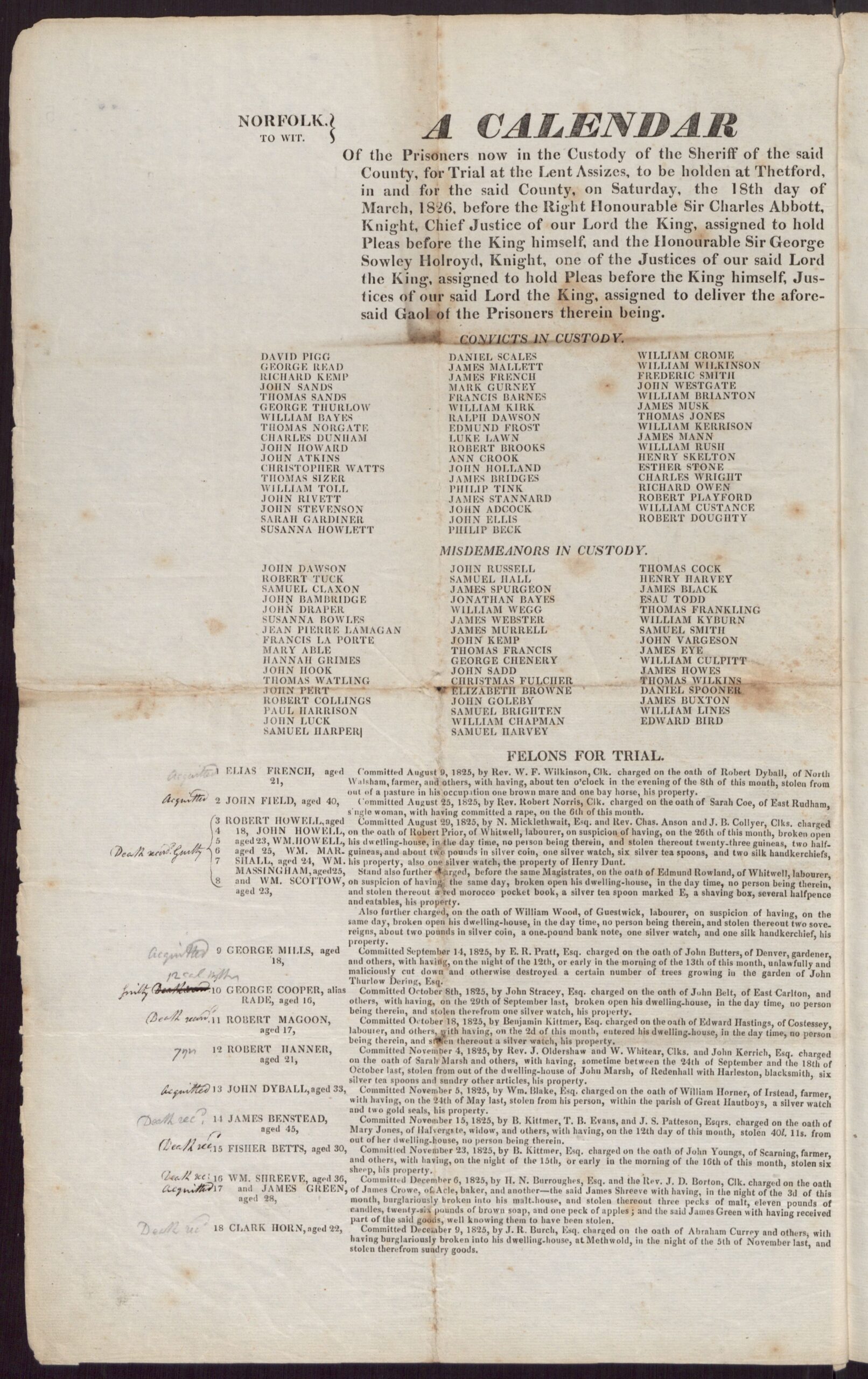
Back to my series of articles from the Norwich Mercury 200 years ago, with this being the report of the sentence of death recorded against Clark Horn. Clark had been born in 1802, the son of John Horn and Mary Horn of Methwold.
There’s something of a brutality about all of this. However, views were changing in 1826 and the death sentence was clearly not working as a deterrent. It was reported in the Norfolk Chronicle of 6 May 1826 that Clark Horn had been removed from Norwich Castle and sent to the Leviathan prison ship.
Then on 7 October 1826, Clark was put on a ship, the Midas, to New South Wales and he arrived there on 15 February 1827. There were 148 prisoners on that ship and 61 of them had life sentences, although Clark’s punishment had by then been reduced to 16 years imprisonment.
He didn’t turn up again in the records until 1843 when it appears that he died in the area of Bathurst, New South Wales. His father, John Horn, missed all of this as he had died in 1808, but his mother, Mary Horn, would have known of the transportation as she died in 1830. It must have been a strange world for Clark Horn and I wonder if he lived an isolated life in one of the work camps. I can’t see that he had any descendants and that makes me wonder about just how many people might have thought about the life of Clark Horn since his crime….
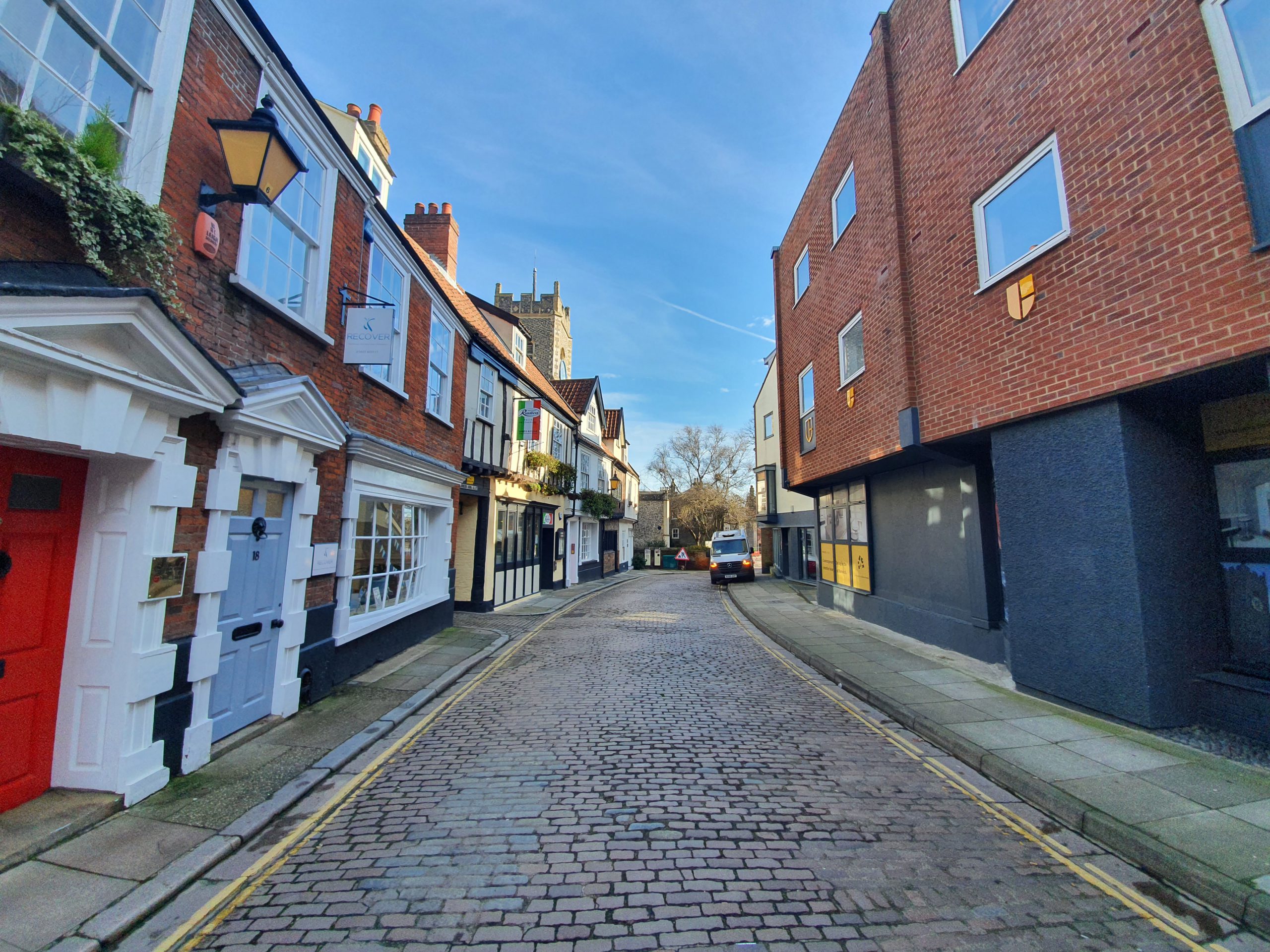
There’s good news about the missing parish boundary marker which was located on Princes House and it seems that the building, and indeed the marker, is now in very good hands. Further information about this parish is at https://www.julianwhite.uk/norwich-history-by-parish-st-george-tombland/.
Andy from Princes House messaged me to say:
“The original design for Princes House from the early seventies was not the moribund architecture which you see now. The hard economic times saw the design diluted and we have played our part to add some interest and curiosity to our side of Princes Street.
You will be pleased to know that we are creating some art which will feature the Hungate St. Peter parish boundary marker which we have had professionally cleaned to remove the paint and cement splatter from it, while retaining its patina. We will describe the relevance of 1834 and the Poor Law Amendment Act and the historical boundaries referenced by the parish boundary marker. Along with this we plan on celebrating pictorially the local churches, those that are still with us and those that are not. It is our intention to have this up and displayed this spring.”
I think I might lead another walk when the work is completed.
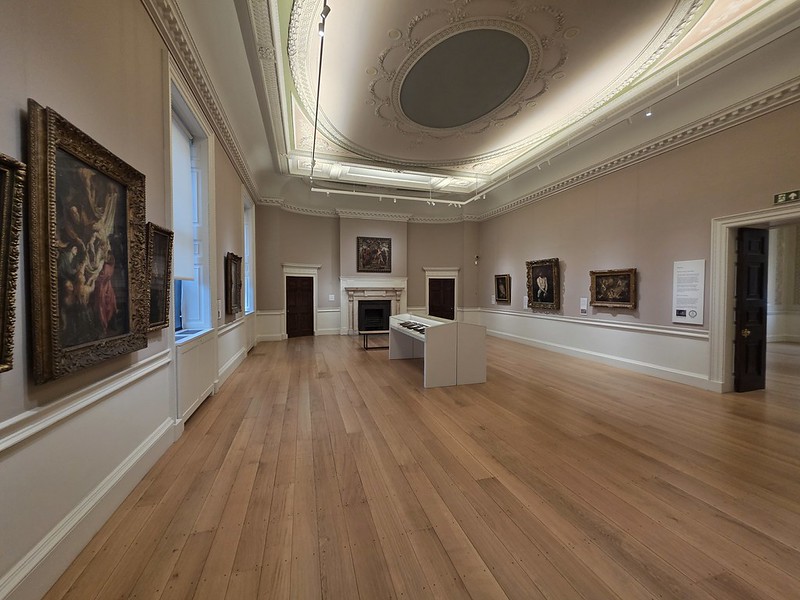
One thing that I really rather liked about the Courtauld is that they’ve got information in each room about how the space was once used. Today, this is Room 6 which is used to display the gallery’s collection of works by Peter Paul Rubens. The plasterwork on the ceiling is by Thomas Collins, who also completed work in other rooms at Somerset House.
However, it was once the Council Room of the Society of Antiquaries, which was created in 1707 to study ancient monuments. Their first meeting was at the Bear Tavern nearby on the Strand and they moved into Somerset House in 1780 and remained there until 1874. They moved at that point to Burlington House on Piccadilly and they’re still there today.
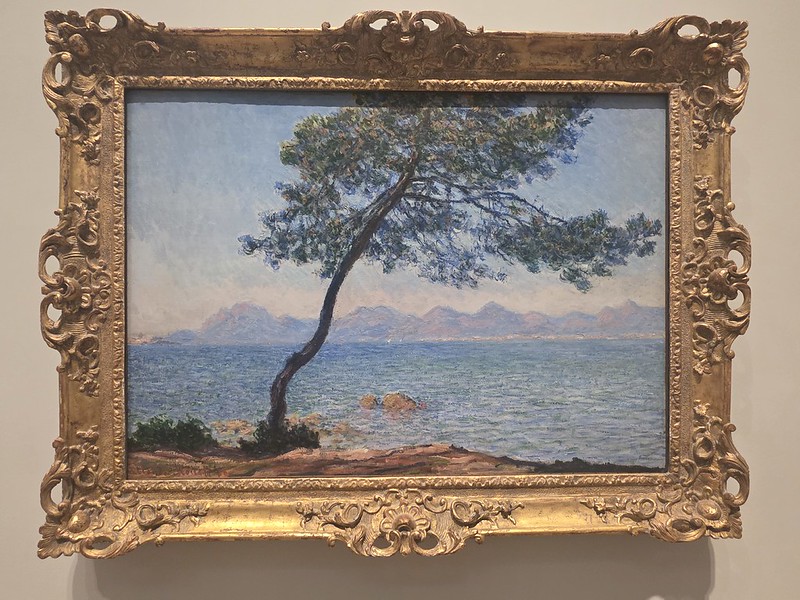
When Claude Monet (1840-1926) arrived in Antibes, on the Mediterranean coast of France, in January 1888, he was not just looking for fresh subject matter he was in pursuit of something far more elusive, namely, light. I don’t know very much about artwork, but every guide to this painting talks about the importance of light. Lovely as it is, it was the history of the painting’s ownership that particularly interested me, but more of that in a moment.
Monet himself said “one must repaint a single subject three times, four times, even twenty times”, which I would say is the amount of effort that I put into this blog, although that might not be entirely true. Anyway, there’s one maritime pine in the painting and we’re supposed to look at that and then dwell on the beauty of the light from the water, the sky and from the mountains.
One thing I like from gallery websites, which I think is all too rare, is seeing the provenance of an artwork. This one is listed by the Courtauld, namely:
“Bought from the artist by Boussod & Valadon, June 1888; (?) with Georges Petit, 1888; Mme Vve Barbedienne, Paris, 1894; sold Hôtel Druout, Paris, 24 February 1894 (lot 39); bought Paul Durand-Ruel; Decap, Paris, 1894; Bernheim-Jeune, Paris, 1907; Baron Caccamisi, Paris, 1907; Mrs Blanche Marchesci, London, c.1910; Paul Rosenberg, Paris; M. Knoedler & Co., London; purchased by Samuel Courtauld, August 1923; Courtauld Bequest, 1948”.
I wondered why a hotel, namely the Hôtel Drouot, had purchased a painting like this, but then I checked and have realised that it’s actually a large auction house in Paris which is still trading. This auction house was implicated in the sale of looted Jewish artworks and Paul Rosenberg, who was a Jewish art collector who owned this artwork for a while, later had some of his collection stolen. It was then purchased by Samuel Courtauld, who ultimately gave it to the gallery which bears his name. Although, if Rosenberg hadn’t of sold it, then it might well have later been part of the collections that were stolen by the Nazis. And on that theme, the son of Blanche Marchesi, namely Leopold Popper-Podhragy, was sentenced to death by the Nazis although he managed to avoid that and lived until 1986, but his artwork collection was also taken.
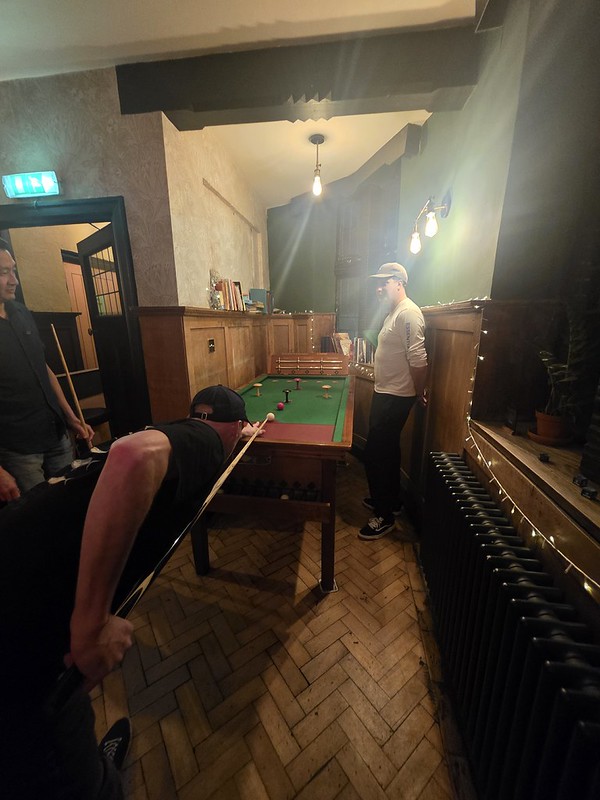
In a move that serves as a definitive warning against leaving the room during a committee meeting, I have somehow managed to get myself appointed as the captain of the Artichoke Hearts bar billiards team. I am still not entirely sure how the transition from “vaguely reliable middle-order player” to “fearless leader” occurred, but yet here we are.
It is quite a step for someone who honestly thought they had successfully navigated their way into a quiet retirement from the competitive green baize of bar billiards, indeed, I’ve written about that before. But it seems that the league has a way of pulling you back in just when you think you have escaped the pressure of a tricky final shot.
The fixtures have just landed with some promptness and the grace of a lead balloon, and they have not exactly eased me into the role. Our opening gambit is against one of the absolute titans of the division, the Black Stars, and, to add a layer of personal drama to the proceedings, our subsequent match is against the quite wonderful Serengeti led by Roy, who is perhaps the most gentlemanly person I’ve ever met. Having spent a couple of seasons playing for them, I now find myself in the awkward position of trying to outmanoeuvre my old teammates while pretending I don’t know all their tactical weaknesses. Although they know my many weaknesses, so all of this might not be useful.
Despite my own questionable leadership credentials, the Artichoke Hearts are actually really quite good by all accounts. I won’t go overboard here as we’re likely to come last in the league, so no point being overly optimistic. There is a genuine sense of fun that (generally) permeates this league, which is probably why I couldn’t stay away. The social side is of course inevitably compelling, especially with the news that the Red Lion in Coltishall has joined the league this year and we’re playing there in May. I am genuinely excited about the prospect of heading out there, but I don’t get out much.
Home games at the Artichoke are fairly straightforward affairs involving decent beer and a steady supply of Tayto crisps, which remain the undisputed king of the bar snack hierarchy I’ve recently decided, although I can be fickle with these things. It is going to be a long, unpredictable season, but at least the crisps and beer are likely to be good. What could possibly go wrong?
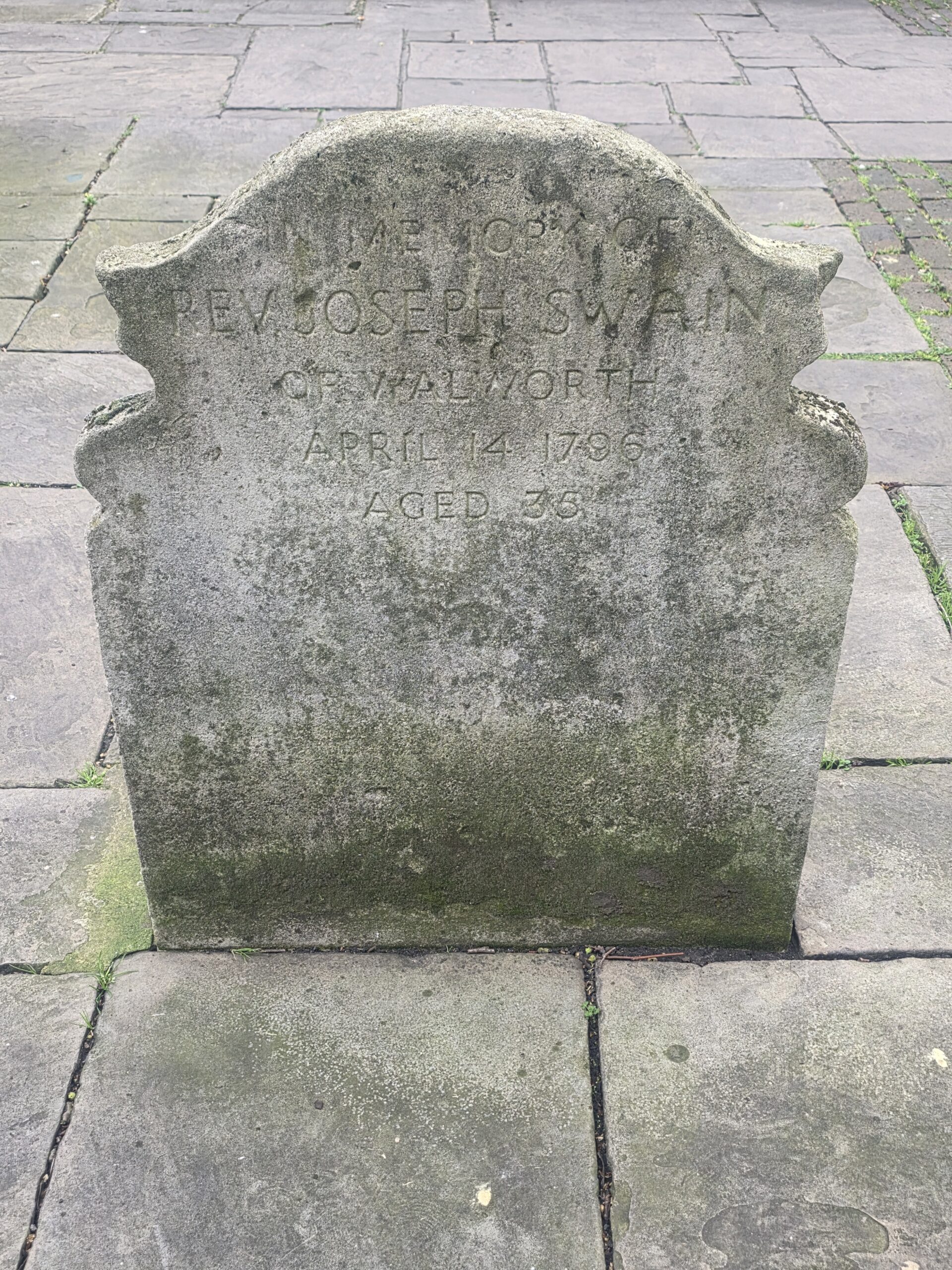
This is the main section of Bunhill Fields graveyard, but there was another section that was bombed during the Second World War that they cleared. Many graves were destroyed and locations lost, but the gravestone of Joseph Swain (1761-1796) was salvaged and kept.
Swain was chiefly remembered for his work as a Baptist minister and hymn-writer, becoming one of the notable nonconformist religious voices of the late eighteenth century. After his conversion he was baptised in 1783 and soon devoted himself to preaching, eventually serving as pastor of the Baptist chapel in East Street, Walworth, where his ministry attracted such large congregations that the chapel had to be enlarged on several occasions. Alongside his preaching, Swain wrote a substantial body of devotional hymns and religious verse.
Looking at an old newspaper report, Swain was a difficult act to follow and that task fell to Dr Joseph Jenkins who the reporter noted:
“Jenkins was far superior to his predecessor in literary acquirement and elaborate preparation for the pulpit, but he was by no means his equal in energy and admiration.”
The church at Walworth had some troubled years, 36 of the members went their own way and created a new church, which all proved something of a challenge for all concerned. The result of this part of the graveyard being landscaped is that Swain’s gravestone now stands out in the paving, located near to the graves of William Blake and Daniel Defoe.
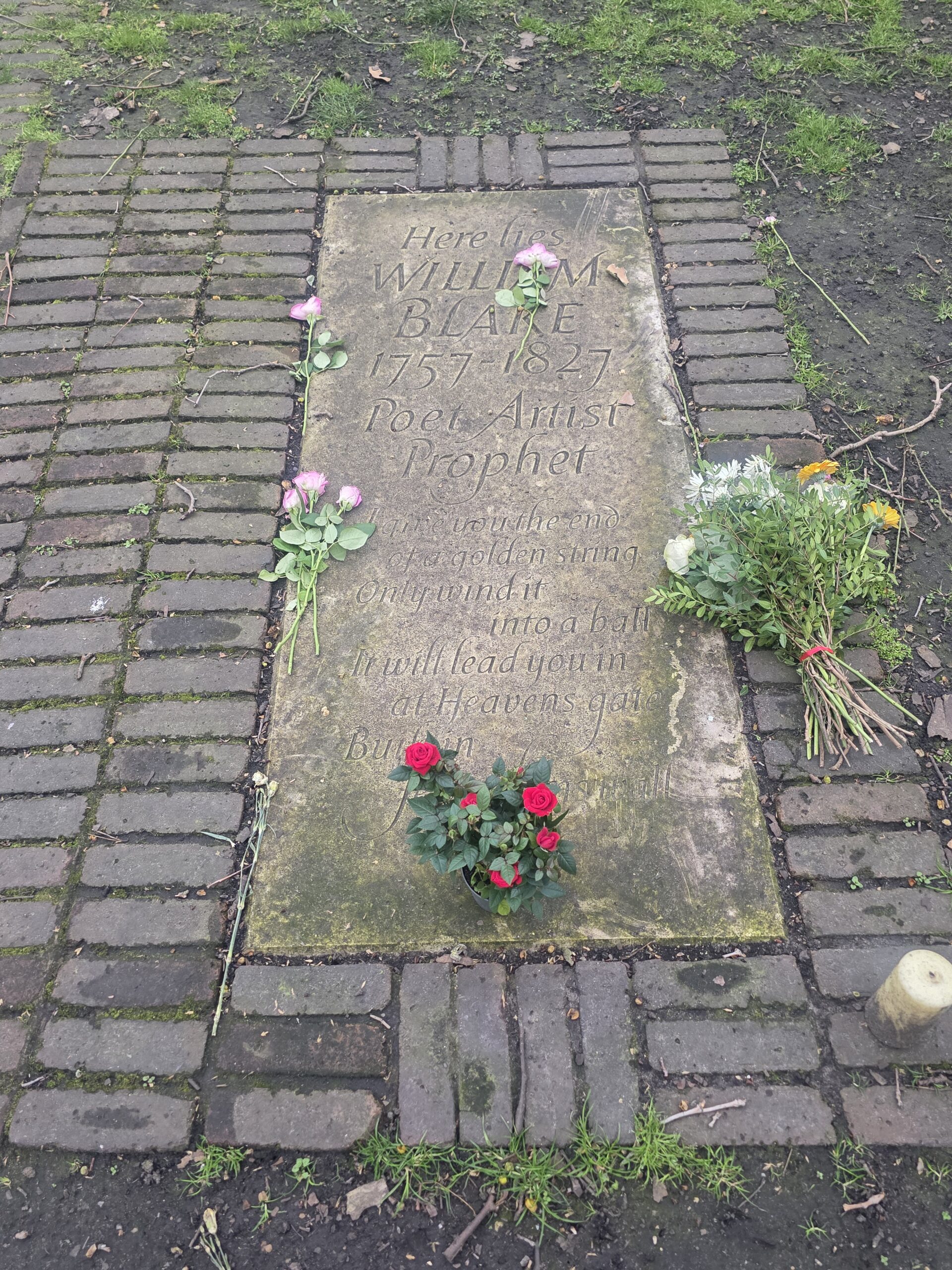
I’ve walked through the graveyard at Bunhill Fields on numerous occasions, but I don’t think that I’ve ever really explored it. One of the most important burials that they have is William Blake (1757-1827), a poet and painter who was rather unrecognised during his lifetime.
In the photo above is the older memorial stone which states that Blake and his wife Catherine lie “near by” which was deliberately vague, because by the twentieth century the exact location had been lost and later landscaping moved the memorial away from the burial place.
But all was not lost as research by Blake enthusiasts and the Blake Society helped identify the original plot, and in 2018 a new stone was unveiled on the exact site of Blake’s grave in Bunhill Fields.
This grave stone now stands alone as the area had been landscaped as a garden following damage during the Second World War.
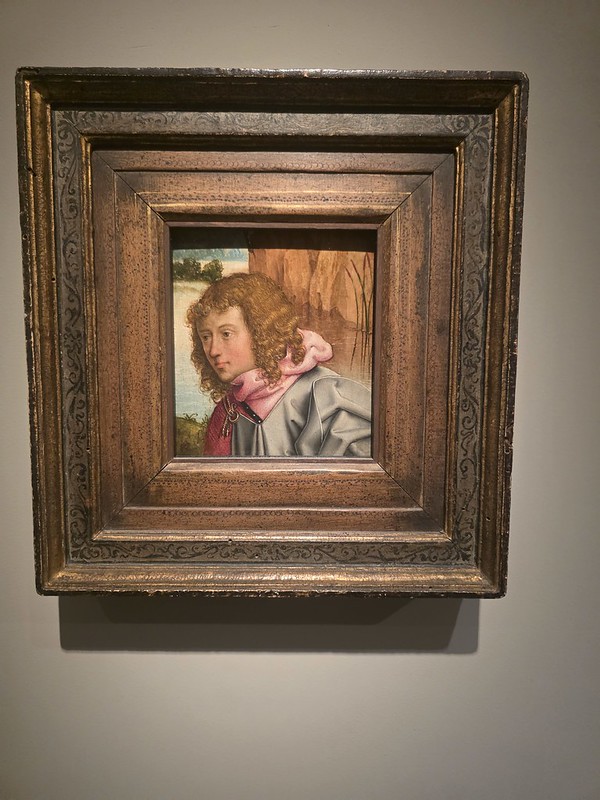
The gallery gives this artwork the title of “Head of a Man against a Landscape” which is all that they have since this has been cut so tightly that it has lost much of its original meaning. It was once likely part of an altarpiece, but now they don’t know who the image is of, nor who painted it.
The painting entered the gallery’s collections in 1952 as part of the Sir Robert Witt bequest. There’s something perhaps sub-optimal about such a small piece of the original artwork and in such a large frame, but at least some has remained.
Given this lack of clarity, and my slight obsession with AI, I asked ChatGPT and Google Gemini to have a go at this. Along with the gallery’s best guess, this is the result of the artist, date of painting and who is in the image.
GALLERY : No artist known, but likely Dutch influence. Painted between 1495 and 1500. No knowledge of who is in the image.
CHATGPT : Maybe school of Hans Memling, but likely Dutch influence. painted between 1480 and 1500. Possibly Saint John the Evangeliest.
GEMINI : No artist known, but likely Dutch influence. Painted between 1510 and 1540. No knowledge of who is in the image.
I also asked Microsoft Copilot but the answer was complete nonsense, it announced that this was a nineteenth century copy of an earlier piece and was painted by an Italian artist.
I’m interested if I retry this experiment in a couple of years whether the results will be better, although ChatGPT seems to be nearly there.
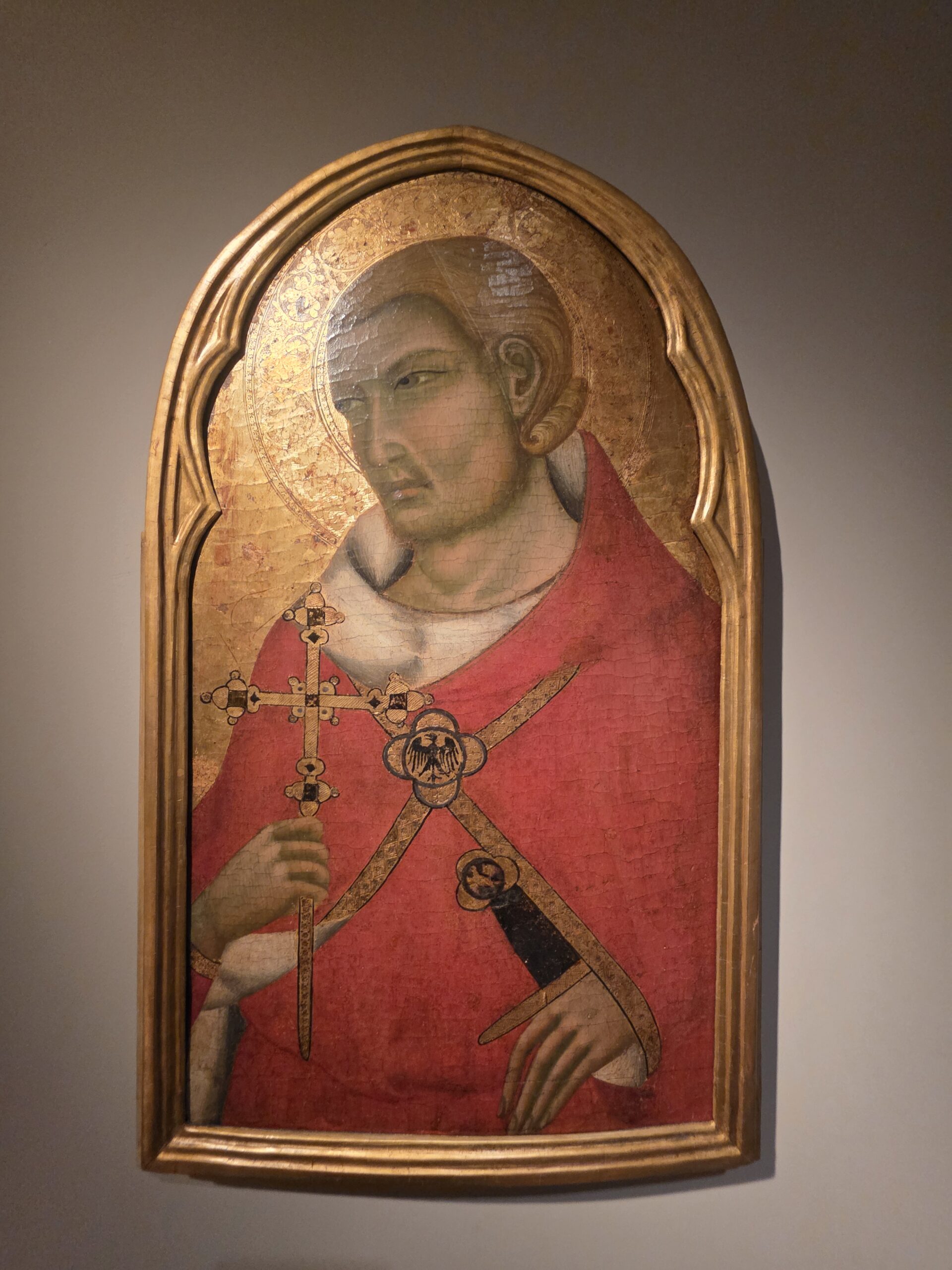
I’ve been meaning to go to the Courtauld Gallery in London for some time and with my Art Pass I was able to get free entry. And this artwork in the first room was very appropriate, as it’s Saint Julian. The gallery notes:
“The rich garments and fine sword refer to the traditional belief that Julian was a nobleman before devoting himself to the sick and needy.”
That sounds very much like me. Well, other than the rich garments, fine sword and nobleman bit. The artwork is part of an altarpiece from the Church of San Torpé in the Italian city of Pisa. Originally, Julian was looking towards the central panel of the altarpiece which contained the Virgin Mary and Jesus Christ. The church is still there, but the rest of the altarpiece is likely long gone.
The artwork, originally painted in around 1320 was donated to the gallery as part of the Gambier-Parry Bequest in 1966. The provenance isn’t known, but it’s thought that it was originally purchased by Thomas Gambier-Parry (1816-1888) after 1863. There’s an interesting book on this whole Gambier-Parry collection with the introduction of that written by Sir Anthony Blunt who later became better known for other things…
Anyway, this was a very positive first impression of the gallery for me.
After dropping the car off at the hire place, which isn’t something that I usually need to worry about on my trips, it was time to get a British Airways flight back to the UK. Richard went through premium security, but I was content muddling through in the poor lane.
That’s helpful of me, I thought I had taken a photo of the flight screen so that I could mention the time, but I appear to have failed to realise that it had gone to the second page with the flights for the day after. Anyway, it was the BA793 flight at 20:00. Once again I had problems with the BA app, so, to be safe, I printed a boarding pass out at the airport.
Richard had priority boarding and he was anxiously waiting to be called forward with the VIPs, as he had spent a small fortune upgrading to business class. I hadn’t upgraded and I was happy to sit and wait until boarding was nearly complete. I was on an aisle seat near the back of the aircraft, so this wasn’t a problem. Boarding announcements were relatively poor, Richard was standing for 26 minutes and they had said they were about to commence boarding quite early on during that process.
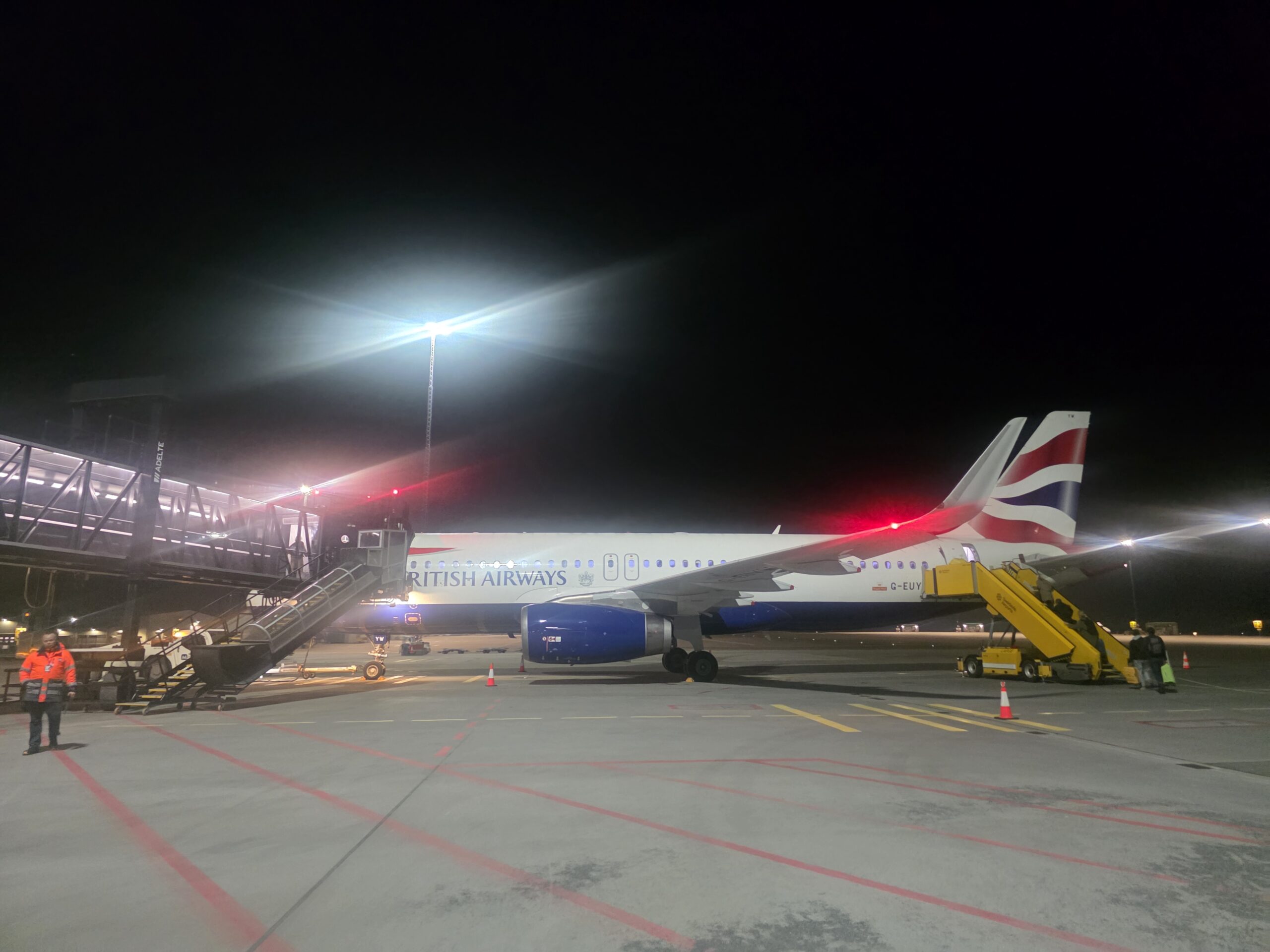
I was pleased to be able to board by the stairs as I like that to see the aircraft registration number, although it was partly hidden here. It was though G-EUYW, an Airbus A320 that BA has had since new in 2014. The boarding was more efficient than the chaotic outbound flight, but there were fewer passengers here for the crew to deal with and there were some issues with a lack of staff for bag storage.
In terms of what I paid, which was £20 each way after Avios discount, I was entirely content. But, the tray table was dirty and so they had clearly made only basic efforts to clean the aircraft between flights. I mention this as Wizz Air, in the last 80 or so flights I’ve taken with them, have never offered me a tray table that wasn’t clean.
On another note, the cabin crew were standing so far forwards during the safety demonstration that it was pointless for us at the back (they were at rows 1, 4 and 14, whilst I was on row 28 and there were rows behind me. Most passengers seem to disregard the safety announcement anyway, but I didn’t have much choice here if I had been interested in following intently. They were doing a safety announcement from row 4 as that’s where the economy section of the cabin started, but it felt slightly sub-optimal. I would add at this stage that I have complete confidence in BA’s broader safety processes and always have had.
Disembarking was more time consuming than ideal as it was from the front only, although that more inconvenienced Richard as he was on row 1 and had to wait for me. This is really a side issue as to just how complex baggage storage is on the flight, there are passengers trying to walk backwards to the only space they could place their bags, it’s just a mess. I accept BA’s service style and the layout of the airport isn’t to have stairs at the rear at Heathrow, but it would have been quicker.
On the positive side, the crew were helpful and engaging, with the benefit of free wifi being particularly useful so I could read messages on WhatsApp. I’m going to do a separate post about the comparison between Wizz Air and British Airways, I’m not at this stage sure who will win on my riveting comparison post, but it’s going to be very close. The provision of wifi might just be enough for BA…..
When I did work for British Airways they said that their problem was that the only thing they were consistent at was inconsistency. I suspect little has changed and I certainly see no reason to fly with them again in the near future.