Category: Serbia

  • Belgrade – National Museum of Serbia – Child at Breakfast by Pierre Bonnard

    Belgrade – National Museum of Serbia – Child at Breakfast by Pierre Bonnard

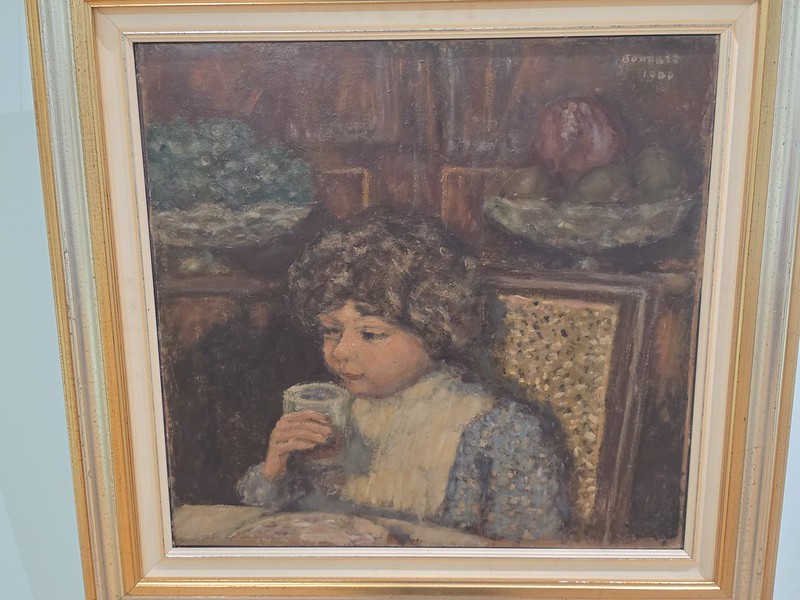
    As someone who has photographed a substantial number of breakfasts, I was rather pleased to find this painting at the National Museum of Serbia in Belgrade. This is Child at Breakfast, painted by Pierre Bonnard in 1900. I’m conscious that there’s a little difference between producing a painting worthy of a national collection and taking a photograph of an avocado muffin in Wetherspoons, but I’m pleased that we agree meals are worth recording. Well, the drink bit anyway in this case.

    Bonnard (1867–1947) was a major French painter and one of the founding members of Les Nabis, a group which formed in Paris in the late 1880s. Influenced by Paul Gauguin and Japanese prints, they experimented with colour and pattern. Bonnard’s interest in domestic life became an important part of his work, with meals, familiar rooms and the people around him providing subjects throughout his career. Breakfast was evidently quite sufficient to be getting on with.

    The child holding the glass looks quite content and seems to be paying little attention to anything beyond the table and I can appreciate that level of commitment to breakfast. However, television and mobile phones had yet to be invented, so there’s probably a limit to what the child could be looking at. There’s something to be said for recording these small domestic occasions. Not everything has to be grand and exciting. We have a chair, clothes, glass and the moment of a child’s morning from 1900 and that’s rather lovely in its own right.
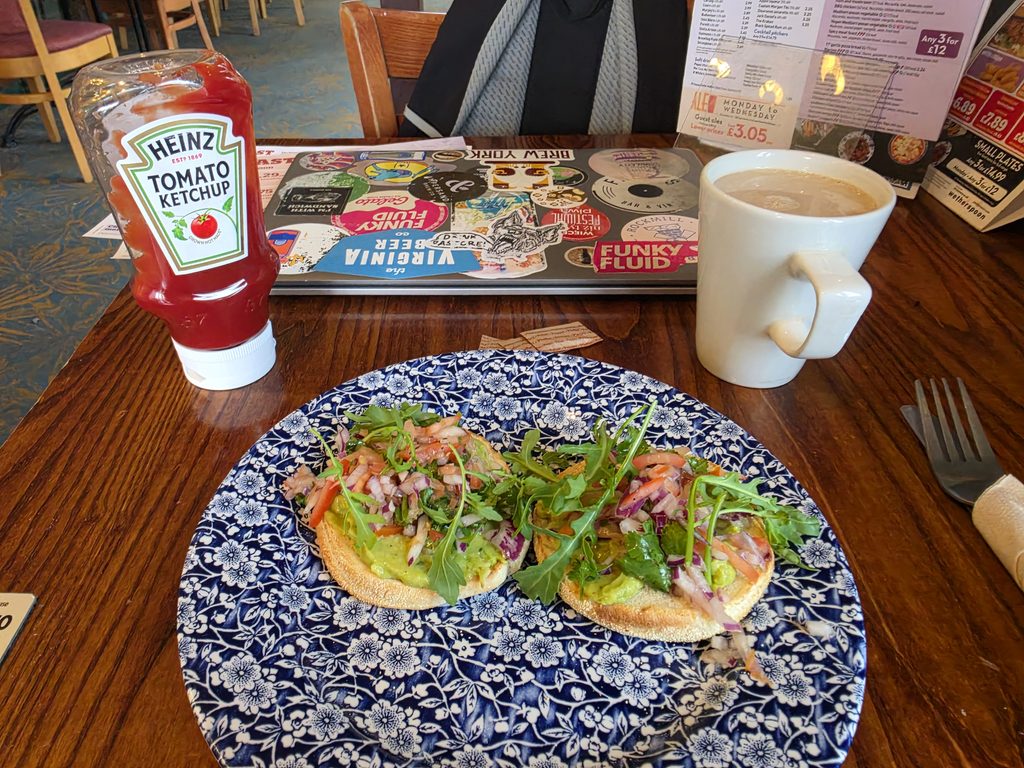
    Not wanting to be outdone, here’s today’s photo of an avocado muffin and coffee from JD Wetherspoon. I don’t suppose that Norwich Castle Museum will want to put this on their walls, but perhaps they should. And indeed on that note, I will make a post from Norwich Castle the next one for my two loyal blog readers to be excited about. Or something like that.
  • Belgrade – National Museum of Serbia – Testing the Terrain in New Belgrade by Boža Ilić

    Belgrade – National Museum of Serbia – Testing the Terrain in New Belgrade by Boža Ilić

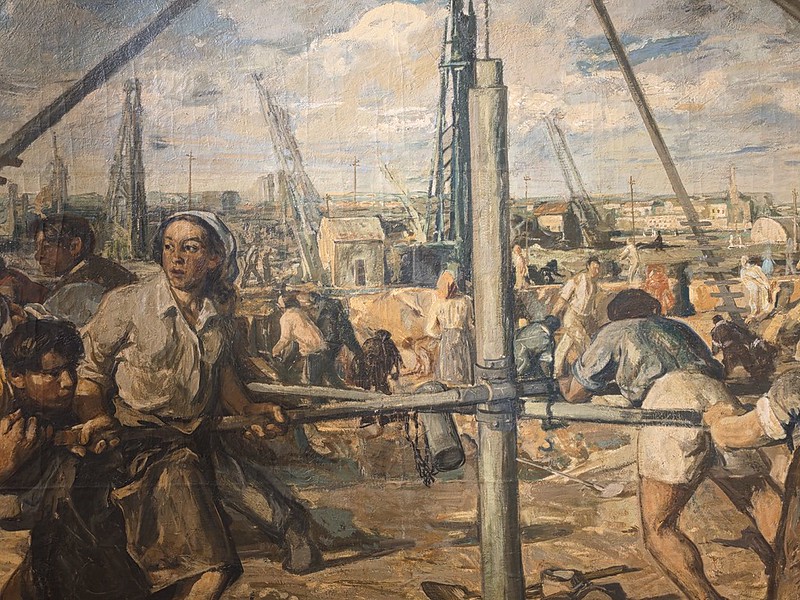
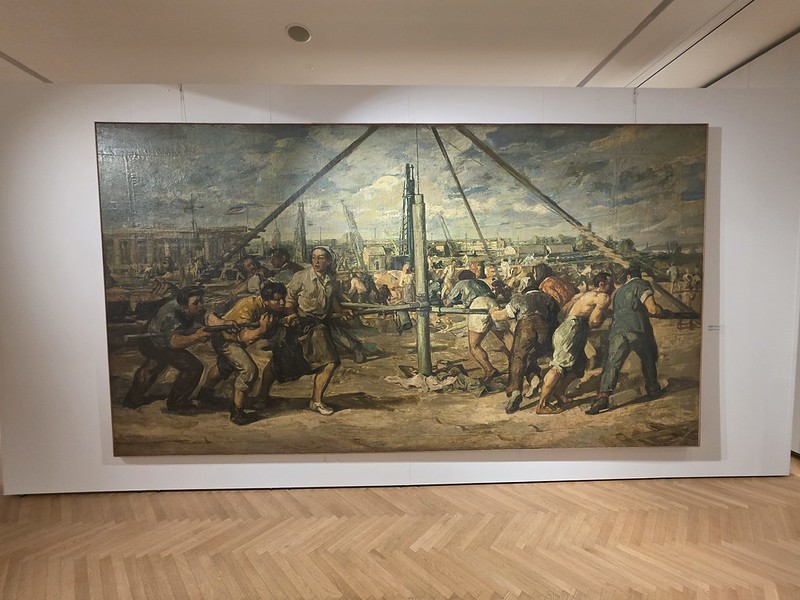
    Now I’m sort of caught up with this blog, I felt the need to go back and fill in a few gaps before the next little adventure. This sizeable painting is Testing the Terrain in New Belgrade, painted by Boža Ilić (1919-1993) in 1948. Even the initial business of finding out what was beneath the ground appears exhausting and I’m fairly sure that I would have needed a nap after something like this. This all meant that I was entirely content to assess the arrangement from the relatively undemanding position of standing in a gallery.

    This feels like propaganda because the workers are being shown as a united, purposeful group with their physical effort turned into an uplifting image of a nation building its socialist future. Workers lean into the bars of a drilling apparatus, backs bent and hands gripping tightly, while the construction site stretches away behind them.

    New Belgrade, or Novi Beograd, is the large planned urban area of the Serbian capital across the River Sava from its historic centre, extending towards Zemun. There had been plans to develop this area of marshy and sandy ground before the Second World War, with a contract for reclamation work signed in 1938, but the postwar Yugoslav Government made the project an integral part of its much wider programme of redevelopment and improvements.

    11 April 1948 is the date commemorated as the official beginning of construction, although preparatory work and initial building activity were already firmly under way in 1947. Civil engineers went in to plan the whole new city arrangement, and likely drink plenty of tea, and large amounts of sand had to be brought from the Sava and Danube rivers to raise the level of the marshy ground. Young people were invited from across Yugoslavia to work in organised labour groups, joining a project which relied heavily on manual effort.

    It’s the relevance of this history which is why I rather liked this artwork as it shows the start of something new. It’s easy to describe the foundation and growth of a city through its architects and plans, but Ilić brings this to life. Some of the faces of the workers are visible, others are turned away or lowered towards the task in hand. The woman just left of centre has her head turned to the side, but she’s perhaps given prominence to show how this was a project that everyone was involved with.

    The bus from the airport goes through this area with its long straight roads and there’s something rather decadent about contemplating all that manual labour from a bus seat, but that’s probably how I’ll be doing it.

  • Belgrade – National Museum of Serbia – On the Train by Ivan Tabaković

    Belgrade – National Museum of Serbia – On the Train by Ivan Tabaković

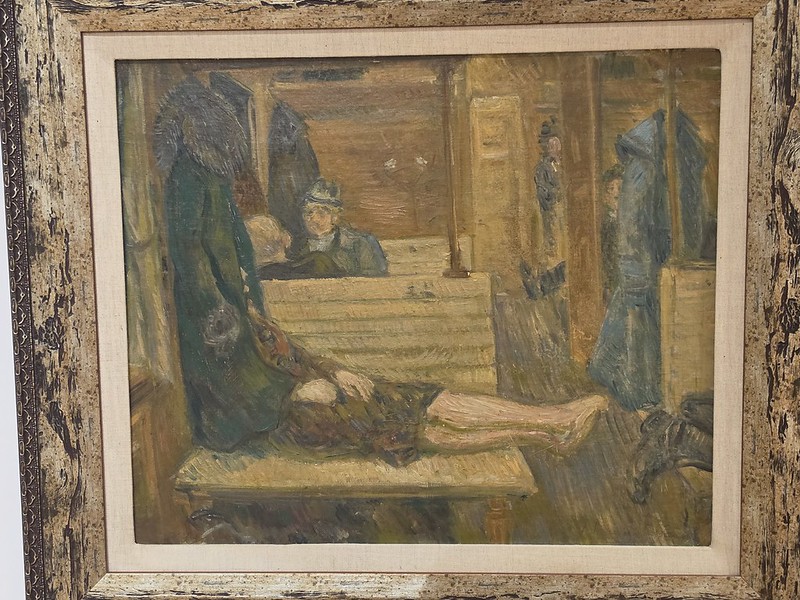
    Back to the National Museum of Serbia for one more painting, this is ‘On the Train’, painted by Serbian artist Ivan Tabaković (1898–1977) in 1934. What intrigued me, as I obviously need more things to think about, was wondering who these passengers were and where they were going. There’s a figure stretched out across the wooden bench in the foreground and another sitting upright behind. They might be travelling together, or they might be strangers sharing a compartment, with one quietly regretting not claiming the bench first. or perhaps they’ve had an argument, who knows…..

    Tabaković had helped found Zemlja, an artists’ group concerned with social hardship, in 1929, although he left in 1932. That doesn’t explain these passengers, but it adds something to my curiosity about them. Are they travelling for pleasure, heading to work or making a journey they’d rather not have to take? The reclining passenger might be exhausted, although perhaps they simply spotted an empty bench and acted decisively, much like Wizz Air passengers sneaking into the exit row seats.

    I’m conscious that I’ve read a comfortable journey into a scene that might be anything but comfortable. Wooden seating, heavy coats and someone lying down could equally suggest a tiring trip with little opportunity to rest properly. Having too much time on my hands when travelling, I sometimes construct little histories for fellow passengers, usually on evidence that wouldn’t survive even the most sympathetic examination. Being British, I’m obviously not going to ask them about their life, so I have to imagine these things.

    Tabaković’s career also took him well beyond railway compartments. He won a Grand Prix for painting and ceramics at the 1937 Paris international exhibition, and MoMA holds his later work ‘Escape to Universe’. From a wooden bench to the universe is a substantial expansion of travel ambitions. Here, though, he leaves us with two people whose destination remains unknown, and I rather like having to accept that I’ll never find out. I’ve perhaps now spent longer wondering about these passengers than I have about some of my actual travelling companions.

  • Belgrade National Museum of Serbia – Giovanni di Paolo’s God the Father and Three Angels

    Belgrade National Museum of Serbia – Giovanni di Paolo’s God the Father and Three Angels

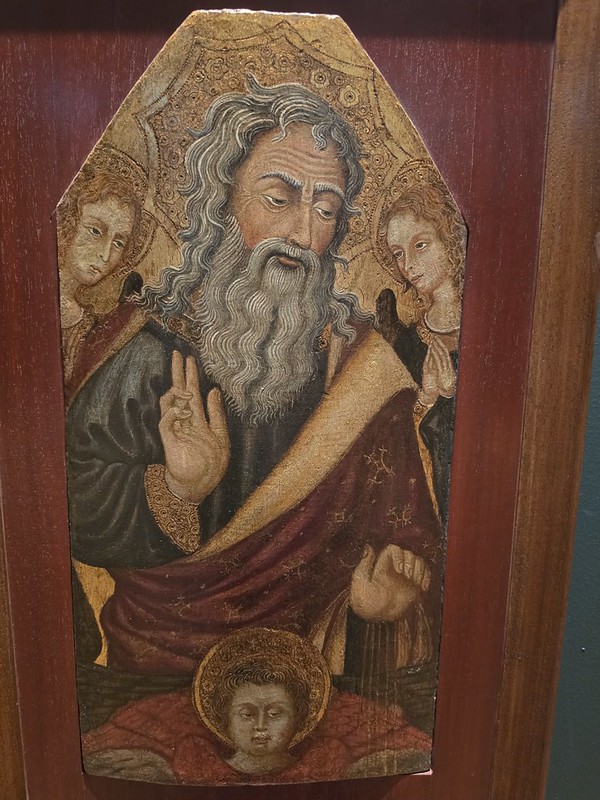
    Having already sneaked two paintings from Belgrade into today’s stream of piffle, I might as well make it three. This is God the Father and Three Angels, a fifteenth-century tempera painting on a wooden panel attributed to the Sienese artist Giovanni di Paolo. God occupies nearly the entire composition, raising one hand in blessing while three angels attempt to fit into the remaining space. Two have secured reasonably prominent positions beside him, while the third has been allocated only enough room for a head at the bottom. I initially assumed that this rather solemn and not entirely realistic child was intended to be Jesus, but the title confirms that it is the third angel. Fifteenth-century artists were only gradually moving towards more naturalistic representations of children, and sacred figures were often idealised, with their importance conveyed through gold, halos and position rather than convincing childhood anatomy. The religious message mattered rather more than whether the artist had recently observed an actual toddler.

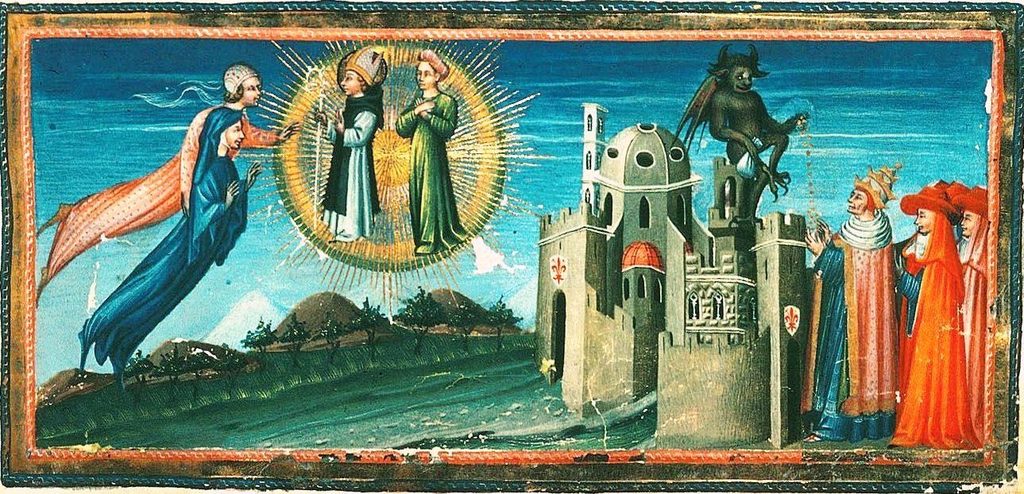
    Giovanni di Paolo was active in Siena by 1417 and became rector of the city’s painters’ guild in 1441. He specialised in religious subjects, often using brilliant colours, patterned gold and slightly dreamlike figures rather than attempting strict realism. He was also commissioned to illustrate Dante’s Paradiso, producing dozens of images for a manuscript of the Divine Comedy. I hadn’t realised until now that Giovanni was responsible for the image above (from British Library Yates Thompson MS 36), which I have encountered numerous times. It accompanies Canto IX, where Folquet de Marseille condemns corruption among the clergy, and shows churchmen accepting riches directly from a devil. The symbolism of the abuses in the church was evidently not intended to be especially difficult to interpret.

    The panel measures only around 54 by 27 centimetres, and its tapering shape suggests that it may once have occupied part of a larger religious arrangement. Whatever originally surrounded it has been lost, leaving this tightly packed gathering to survive independently in Belgrade. I rather liked the combination of splendour and mild overcrowding, particularly the lowest angel, who appears to have arrived late and is now peering over the edge to see what is happening.

  • Belgrade National Museum of Serbia – Vittore Carpaccio’s Saint Roch

    Belgrade National Museum of Serbia – Vittore Carpaccio’s Saint Roch

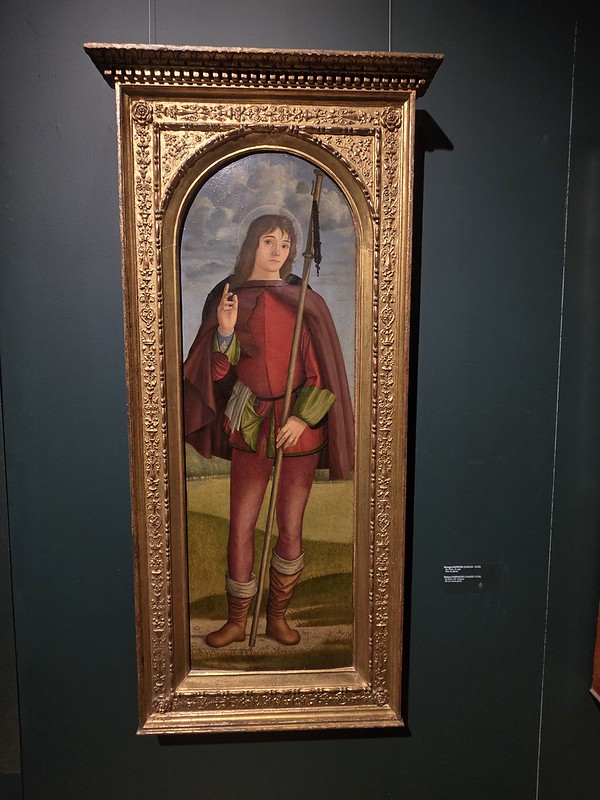
    This is the second painting from Belgrade that I have sneaked into my current stream of piffle today, but that is the delight of this blog. It is not always full of excitement. This is Saint Roch, a sixteenth-century oil painting on a wooden panel by the Venetian artist Vittore Carpaccio. Roch is shown as a remarkably youthful pilgrim, holding his long staff and raising his other hand in what appears to be a blessing. According to tradition, he travelled through Italy caring for victims of the plague, contracted the disease himself and subsequently became a saint invoked for protection against it. It seems like quite a complex arrangement to me.

    Saint Roch is usually depicted displaying the plague wound on his thigh and accompanied by the dog that brought him food, although neither is evident here, so perhaps the dog had been given the day off. I was quite reliant on the museum label to tell me who this was, as my knowledge of saints is not entirely impeccable.

    Far more interesting to me, however, is that the artist’s name acquired an unexpected second life in 1950 when Giuseppe Cipriani of Harry’s Bar in Venice named his new dish of thinly sliced raw beef after him, as its red colouring reminded him of Carpaccio’s paintings. The vivid red clothing in this work makes that decision slightly easier to understand, although the saint himself looks unlikely to approve of becoming indirectly associated with an uncooked starter. Plague protection, a surviving panel from a Renaissance polyptych and culinary immortality seemed sufficient to justify sneaking another painting into the blog proceedings.

  • Belgrade National Museum of Serbia – Joos van Cleve’s Man with a Rosary

    Belgrade National Museum of Serbia – Joos van Cleve’s Man with a Rosary

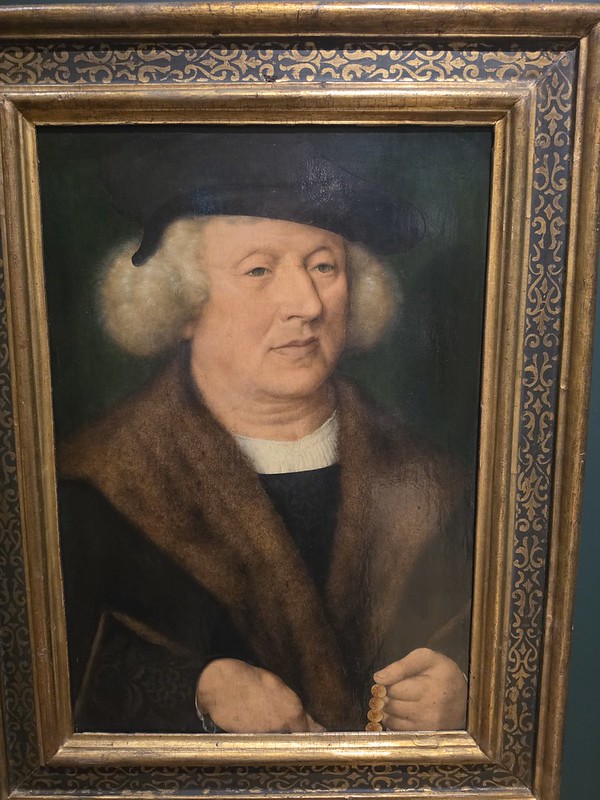
    Sneaking back with another post from Belgrade, as I was intrigued by so many of the artworks in the National Museum of Serbia. This is Man with a Rosary, a sixteenth-century oil painting on a wooden panel by the Flemish artist Joos van Cleve. The sitter’s identity has been lost, but his expensive fur collar suggests that he was prosperous, while the rosary prominently displayed between his fingers presents him as a man of faith.

    Van Cleve became a master in Antwerp in 1511, later held senior positions in the city’s painters’ guild and operated a substantial workshop. He was sufficiently well regarded as a portrait painter to work for the French court, where he painted Francis I. However, I found this unidentified man rather more intriguing than another formal portrait of a king, as there are already rather a lot of those.

    I wonder whether the sitter would be pleased that his portrait has survived, although I imagine he would consider it sub-optimal that no-one now knows who he was. He evidently budgeted for the fur collar and a leading portrait painter, but not for a sufficiently durable name badge. Nearly five centuries later, we therefore know how he dressed, what he looked like and how he wanted to be remembered, but not the relatively fundamental detail of what he was called. It is an unexpectedly successful piece of personal branding apart from that minor omission. His name disappeared, but his face has survived in Belgrade and, after all this time, he still looks quietly pleased about the arrangement.

  • Belgrade – National Museum of Serbia – Colporteuse by Omer Mujadžić

    Belgrade – National Museum of Serbia – Colporteuse by Omer Mujadžić

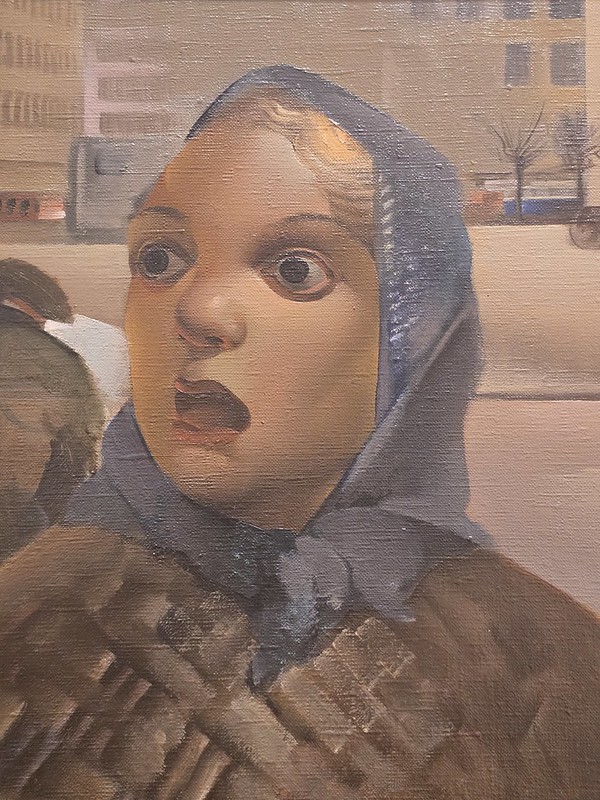
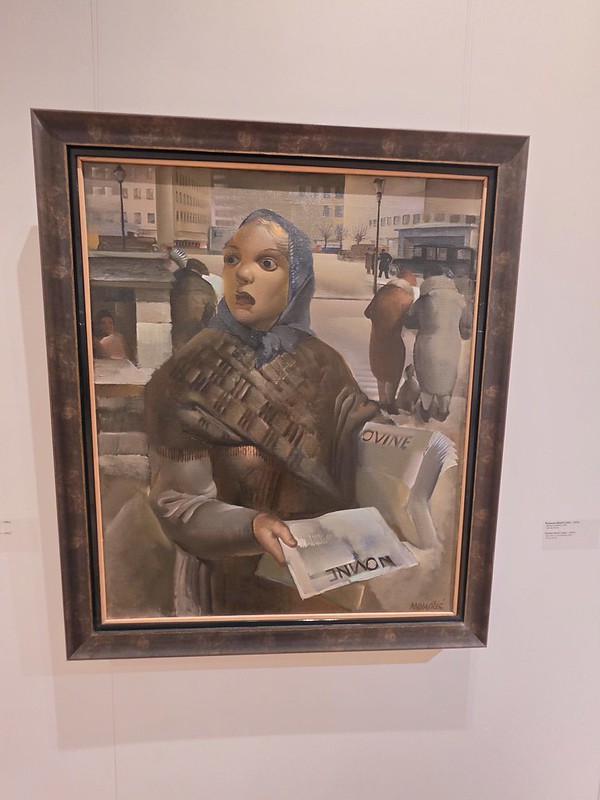
    This rather vibrant painting in the National Museum of Serbia is Colporteuse, painted by Omer Mujadžić (1903–1991) in 1929 or 1930 using oil on canvas. The French title refers to a female street vendor and the word NOVINE, meaning “newspapers”, on the papers confirms that she is selling them. Her enormous eyes and open mouth make her look as though she has just discovered the story of the decade, although she may simply be calling out the latest headlines to passing customers. The whole arrangement looked so contemporary that I had assumed it was a much more recent painting rather than a work which is now approaching its centenary, although my art knowledge is hardly that of Sister Wendy Beckett.

    Mujadžić was born in Bosanska Gradiška in 1903 and entered the Academy of Fine Arts in Zagreb at the age of only fifteen. After graduating, he continued his studies in Paris, where he encountered the work of Picasso, André Lhote and the old masters in the Louvre. He later became associated with the Earth Group, whose artists believed that art should reflect contemporary society rather than concern itself solely with attractive subjects. That perhaps explains why he chose to paint the woman selling the news rather than one of the politicians, editors or newspaper proprietors more commonly associated with it.

    I rather liked this painting because it looked to me ahead of its time, although its almost cartoon-like features also made it slightly unsettling. What makes it particularly effective is that I couldn’t decide whether the woman was frightened, surprised or simply shouting loudly enough to sell her newspapers. Indeed, she certainly appears more animated than most people employed to sell newspapers at that hour of the morning. This painting stayed in my mind for much longer than many technically accomplished portraits of important people that were displayed elsewhere in the gallery. I’m still not sure that I’d hang it on my wall, with the usual caveat that I lack the DIY skills to hang anything there.

  • Belgrade National Museum of Serbia – Pavle Simić’s Founding of the Village of Neuzine

    Belgrade National Museum of Serbia – Pavle Simić’s Founding of the Village of Neuzine

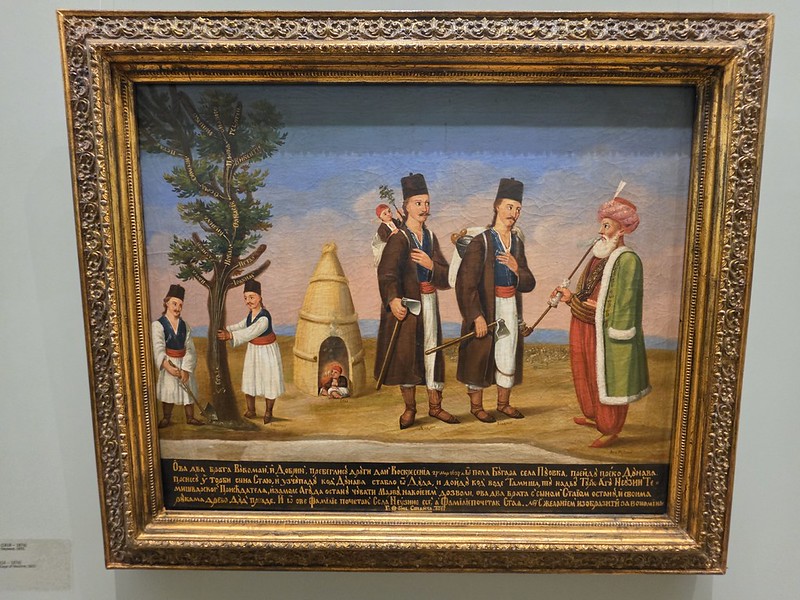
    This detailed historical scene is Founding of the Village of Neuzine, painted by Pavle Simić in 1835 using oil on canvas. Simić was born in 1818, meaning that he was only around seventeen when he completed it, a remarkable achievement for an artist of that age.

    Neuzine is now a small village in the Banat region of northern Serbia, although its foundation was apparently a rather formal occasion. According to local tradition, Neuzine took its name from a Turkish agha called Neus, who employed two Serbian shepherds named Staja and Nikola. The two young men in the centre may represent these traditional founders, while the older figure appears to be their Ottoman landowner. The two younger men look remarkably enthusiastic about building their new village, although the extent of the work required may not yet have been fully explained to them.

    Simić was born in Novi Sad and received his early artistic training in the workshop of the Italian painter and decorator Alojzije Kastanji. He painted this work while staying in the Banat region and before moving to Vienna in 1837 to study at the Academy of Fine Arts. He later became known principally for his religious paintings, church iconostases and portraits. His career eventually spanned around four decades and included commissions across what is now Serbia and neighbouring countries. Founding of the Village of Neuzine offers an early indication of his interest in presenting historical subjects through carefully arranged figures and recognisable narrative details.

    I rather liked this painting, partly because it records a very specific local story rather than a grand military victory or an important royal occasion. Most villages emerge gradually without anybody commissioning an oil painting of the process, so Neuzine did well to secure the services of an unusually productive teenager. There cannot be many artists represented in national museums by work they completed at the age of seventeen.

  • Belgrade – SASA Gallery of Visual Arts & Music – V-1 Propaganda Poster

    Belgrade – SASA Gallery of Visual Arts & Music – V-1 Propaganda Poster

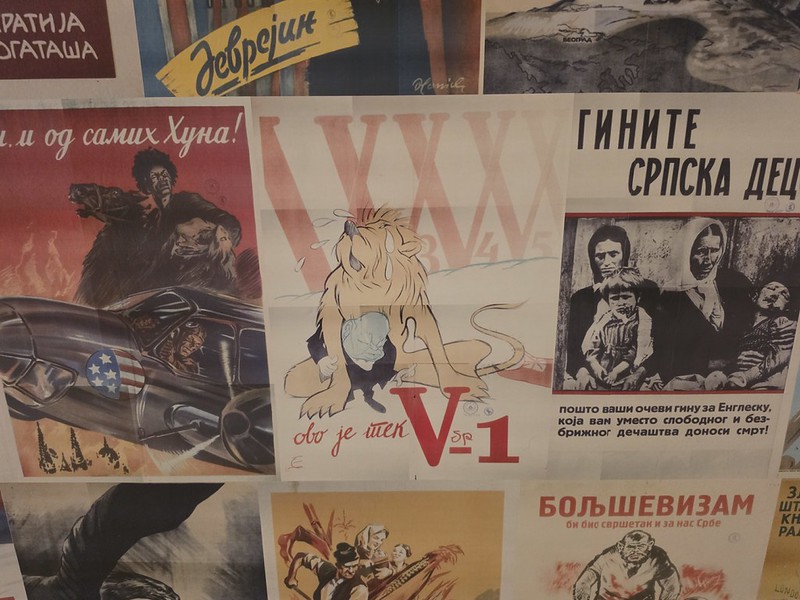
    Among the exhibits at the SASA Gallery of Visual Arts and Music in Belgrade was this collection of Serbian-language propaganda posters from the Second World War. The exhibition, Even in Captivity – Freedom!, explored the art produced during the occupation of Serbia and demonstrated that creative work could serve as a means of survival, resistance or propaganda.

    As some background to proceedings, Serbia was then part of Yugoslavia, whose Government joined the Tripartite Pact in March 1941 before an anti-Axis coup took place just two days later. Germany invaded and occupied the country, installing a collaborationist administration in Serbia while resistance movements fought both the occupiers and one another. The Serbian-language poster was therefore propaganda aimed at people living under occupation, intended to maintain confidence in an eventual German victory.

    The wording on the central poster reads Ovo je ipak V br. 1, which translates literally as “This is, after all, V No. 1”, although “And this is only V No. 1” better conveys the intended threat. The distressed and perspiring lion represents Britain, while the globe incorporated into its body appears to refer to the British Empire. Approaching from the right is a V-1 flying bomb, surrounded by large Vs in case anyone had somehow failed to understand the principal theme of the messaging.

    The V-1 was the first of Nazi Germany’s so-called vengeance weapons and attacks on London began in June 1944, but although the weapon was damaging it had rather limited accuracy. By this time things were of course going very wrong for Germany and events were turning decisively against it. This messaging was all intended to frighten Britain while reassuring audiences in occupied Serbia that Germany still possessed weapons capable of transforming the war. Ultimately, the V-1 caused substantial death and destruction, but it could not reverse Germany’s military position and Belgrade was liberated on 20 October 1944.

    I photographed several of the other posters in this exhibition because I had never encountered them before and I’ll likely return to some of the others in the future.

  • Belgrade – National Museum of Serbia – Vladimir Veličković’s Portrait of an Unknown Man

    Belgrade – National Museum of Serbia – Vladimir Veličković’s Portrait of an Unknown Man

    I’ve finished the chronological run of my Balkans posts, but there is still plenty that I feel the need to witter on about. This news will no doubt excite all three regular readers.

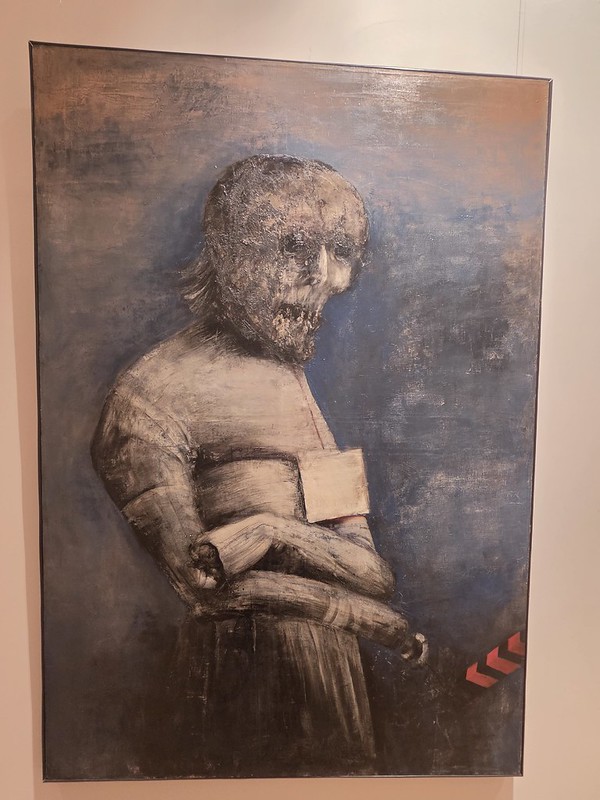
    This work at the National Museum of Serbia, which I found moderately unsettling, is Portrait of an Unknown Man, painted by Vladimir Veličković (1935–2019) in 1963 using oil and tempera on canvas. The unidentified figure stands in profile with his arms folded around what appears to be a book or rectangular board of some sort. His body remains recognisably human, but his face has been rubbed, scraped and darkened until much of his identity appears to be disintegrating. This isn’t the sort of thing that I’d hang on my wall, even if I had the ability to put artwork up, which it’s not entirely clear that I do.

    Veličković was born in Belgrade in 1935 and originally trained as an architect before establishing himself as an artist. This painting dates from the beginning of his professional career and the year of his first solo exhibition. He became known for paintings involving violence, fear and the vulnerability of the human body, which doesn’t feel like an entirely optimistic artistic direction.

    The painting comes from the endowment collection of Dr Jakov Smodlaka and is an example of the unexpectedly challenging modern art displayed among the museum’s more traditional portraits. I wasn’t especially keen on it, nor could I find a meaning that spoke to me. That perhaps says more about my expectation that every artwork should communicate something recognisable than it does about Veličković’s intentions. Museums and galleries would become exhausting if I felt obliged to understand and enthusiastically admire everything, although that has never previously stopped me writing about it.