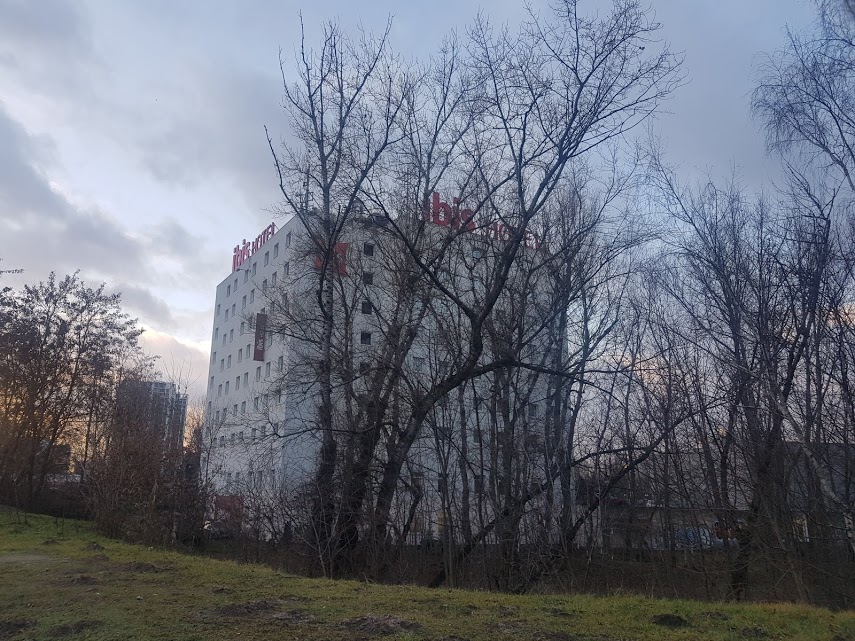
I stayed at this hotel twice over the last month, once for one night and once for four nights. I also had to delay writing this review until I spoke to Accor customer services, as the hotel’s manager entirely confused me. Although the hotel has given the blog a new tag-line.
My first visit was mildly confused as the room they gave me wasn’t ready, although fortunately a cleaner stopped me en route and helpfully referred me back to reception. She was very polite, but I was in no hurry so I walked back to reception and thought that I’d enjoy the welcome drink. Little did I know incidentally about the later welcome drink debacle.

The only beer available was Zywiec and this was under-poured. But, since it’s Zywiec, I wasn’t too bothered. The staff member was very apologetic about the room mix-up and I was offered the food menu, which I decided against, but I thought that the staff had been so polite that I’d dine here on my return visit.

The bottled water and a chocolate. I wasn’t sure whether this was in every room or it was a welcome gift, but either way, it was all very nice.

The room, which I’m entirely content with. On the Ibis room matter I posted excessively about, I’ve been moderately relieved to hear from Accor that their plans are being tempered, so we’ll have to see what happens with the future of Ibis rooms and their modernisation programme.

The breakfast room, which is also where meals are served in the afternoon and evening.

The breakfast selection, cold meats, cheeses and there are some hot items available as well.
Right, but now onto the second visit, which started fine and all was well.
About once a year, I get bad service at a pub, restaurant or hotel. It’s incredibly rare for me to experience, something like 1 every 150 visits or so. And, I try and be sympathetic as I don’t know why I’ve received poor service, it could be that the staff member has received some bad news, they’re tired from working hard or something which is entirely relatable. I’ve never previously poor service in Poland, on all my tens of trips, this was the first.
I’ve also spent the last 31 days non-stop in Accor hotels, so I thought it’d be interesting to try the food at an Ibis hotel, and as mentioned above, I had intended to eat here as the staff member had been friendly on the previous occasion. I was also conscious that the Accor member of staff I had spoken to at their Head Office had said they’d monitor my experiences, which is almost certainly something said to shut me up, but I like to please. Ibis run with the same menu across Poland, but I haven’t had anything from it for a couple of years and it’s nice to see how things develop.

On a different note, I was pleased to receive this drinks voucher which is new marketing as part of Accor’s switch to the ALL loyalty programme. This differed from the previous voucher I had received at this hotel and, experienced as I might be with Accor vouchers, I hadn’t seen this one.


Just as an aside on this, there are plenty of drinks vouchers out there and hotels vary in what they offer. They don’t have to be really generous and offer nearly any drink, but some do and they’d use the voucher on the right. Some are more limited, they put on the voucher to check the drinks at the bar, it’s a more limited list. They’re equally common and both are used in Poland. I don’t much care which is used, it’s a little gesture, I don’t assume that I’m going to get the most delicious craft beer.
Anyway, back to being pleased with Accor’s drinks voucher for this hotel. I thought I’d opt for a Zywiec Porter and a burger from the main menu, perhaps buying another drink later on. This plan was all going swimmingly, until I got to the bar.
The barman ignores me and my hello in Polish, but I put that down to the translation issue that I can’t speak the local language very well and clearly they can. Sometimes I get that a staff member can’t speak English and it’s no doubt frustrating for them. Anyway, he clearly doesn’t want to serve any customers, offering someone else before me a less than polite service, and by this stage he seemed entirely irate at me and ignored me for a little while before serving me. Unfortunately, the barman decided that I must be stupid and he made that very clear. His behaviour didn’t credit his hotel, but we’ll put that down to factors that I have no knowledge of. But, staff sneering at customers isn’t a good look.
A relatively large number of my friends don’t like going to restaurants or bars on their own, they find it difficult. I’ve long stopped since caring about these matters for me, but I do always ponder how it would affected friends that would have built up confidence to order at a bar. Conscious that customer service staff are on the receiving end of all manner of abuse, I’ll assume that this barman was having a bad day, but it was some of the worst customer service that I’ve seen and exceptionally rare for Poland.
But, I’m not going to deal with anyone who sneers at customers so I opted for a Pepsi to take to my room, and abandoned my plan to order food. However, I did e-mail the hotel from upstairs (how very British of me, although I did this as I didn’t want any service recovery, I thought that I was being helpful) and query their bloody voucher as without that, I’d have probably never encountered the poor service and I’d have instead happily ordered food. To cut a very long story short, they are defining “any drink other than champagne or spirits” as “any small beer, wine or soft drink”. So, it’s not any drink other than champagne or spirits, indeed, it’s a tiny choice from what they offer paying customers. And, really, the hotel management is blaming Orbis (the company who run Accor hotels in Poland) for giving them the voucher to give out. The management seemed to think it was fine to just hand the voucher out, not mention any limitations, let customers sit down in the restaurant and then mention at this stage the voucher isn’t being honoured. Why on earth try and turn the positivity of a free welcome drink into a negative, I’m unsure.
This situation confused me, and I decided that I must be an idiot and that the hotel manager was perhaps entirely correct. However, I spoke to Accor customer service, and they replied that the hotel should stop using that voucher and I should tell the hotel manager. At this point, I realised I had done enough to reassure myself that the hotel was at fault, so I just left it. I didn’t tell them that it was the hotel manager that decided the voucher was correct.
But, moving on to my thoughts about the hotel generally. The staff at breakfast and the cleaning staff were all friendly and polite, the hotel was spotlessly clean and there were no noise problems either internally or externally. There’s not much point in trying to re-evaluate my entire experience because the member of bar staff sneered at me, but nonetheless, I can’t help thinking that the manager’s decision to give customers a voucher which told them they could get any drink, and then decide that this meant “any drink from a list” was really to blame here. But, such things are up to them, and I was otherwise happy with the hotel. It’s located a little way from the centre of Warsaw, but there are frequent trams which stop just a few minutes away, so it’s not an inconvenient location given that. The prices can also be a little cheaper than the city centre Ibis hotels because of its location.