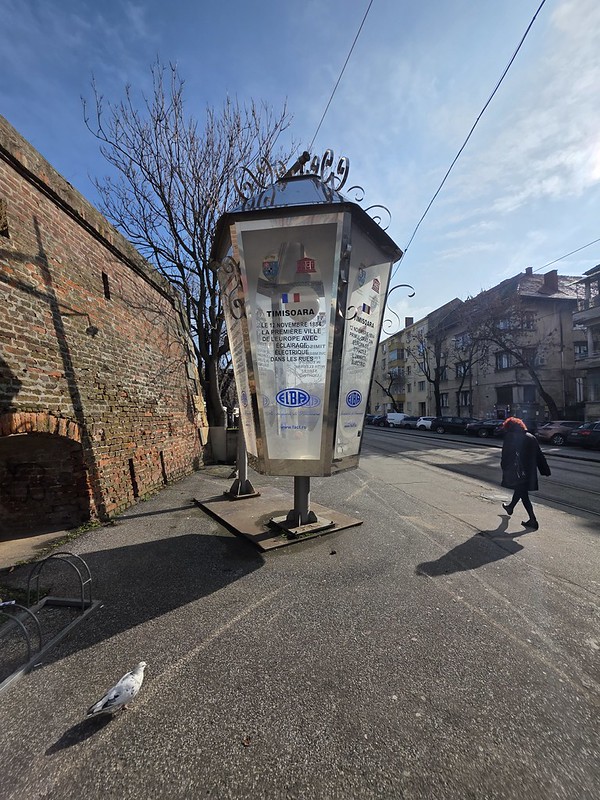
Timișoara are quite proud that they were the first city in Europe with electric street lighting when it was introduced on 12 November 1884. There were over 700 street lamps, so it was all something of an effort.
It’s perhaps in some need of cleaning, but it’s a nice little commemoration of their forward thinking. The reality is slightly more complex though, as it often is, as the city’s gas lighting contract was coming to an end and the company wanted a lot more money. The city wasn’t prepared to sign, but the infrastructure was owned by the gas company and so Timișoara could have been plunged into action if they hadn’t acted…..
Although with the limitation of history is told by the winners, I like seeing that statues and sculptures there are in a city. It’s always intriguing to see whose memory they want to be remembered. I wonder if Nicolae Ceaușescu ever thought that his statues would stand proud across Romania, or whether he was aware of the inevitably that they would be pulled down.
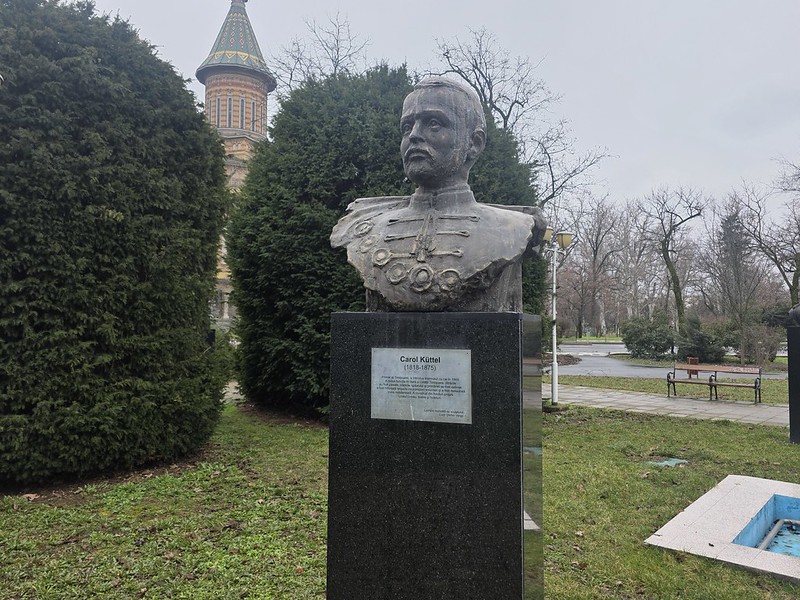
Anyway, I digress. This is Carol Küttel (1818–1875), often referred to as Karl or Károly, who was a pivotal figure in the urban development of Timișoara, serving as the city’s mayor during two distinct terms from 1859 to 1861 and again from 1867 to 1872. A jurist by training, Küttel is widely celebrated for his role in modernising the city’s infrastructure, most notably for initiating the establishment of the horse-drawn tram system in 1869, making Timișoara one of the first cities in the world to adopt this form of public transport. His administration was also instrumental in the decision to construct the city’s theatre, a move that furthered Timișoara’s reputation as a “Little Vienna” and a cultural hub within the Austro-Hungarian Empire.
This statue of him was unveiled in 1999, but I’m quite focused on his horse-drawn tram escapades. Although this was the first city in what is now Romania to get them, they were only just ahead of the Romanian city of Arad, which isn’t far away at all. It was one of the earliest in the world to have trams and I like the innovators who must have been very much ahead of the game here. And, the city still has trams, unlike those places which got in early and then got rid of them far too early.
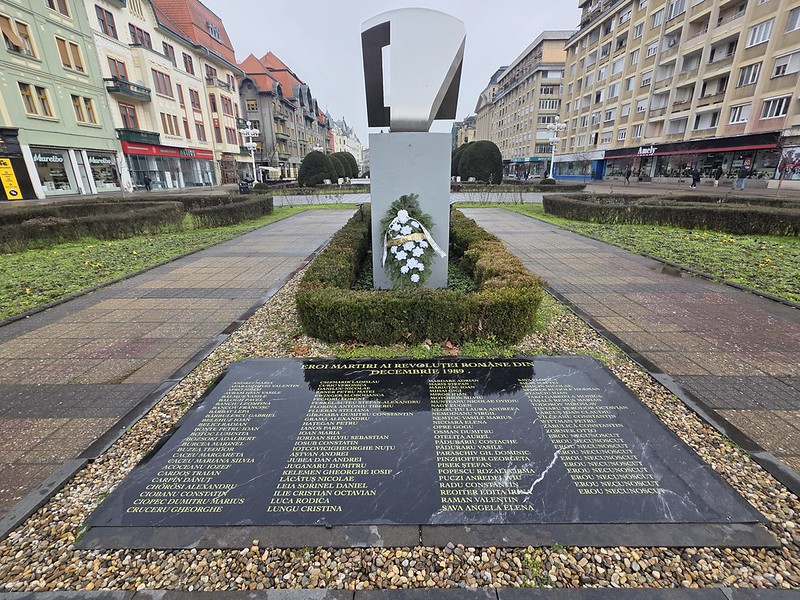
With the city’s cathedral in the background, this is the Crucifixion monument, designed by Paul Neagu.
In front of the monument are names of those who died in the 1989 Romanian Revolution. The revolution began in Timișoara and the city is still very much defined by that today, it is not something that is kept a secret and they seem very proud at being at the forefront of change. And, to stand up to Nicolae Ceaușescu much have taken some considerable bravery and courage.
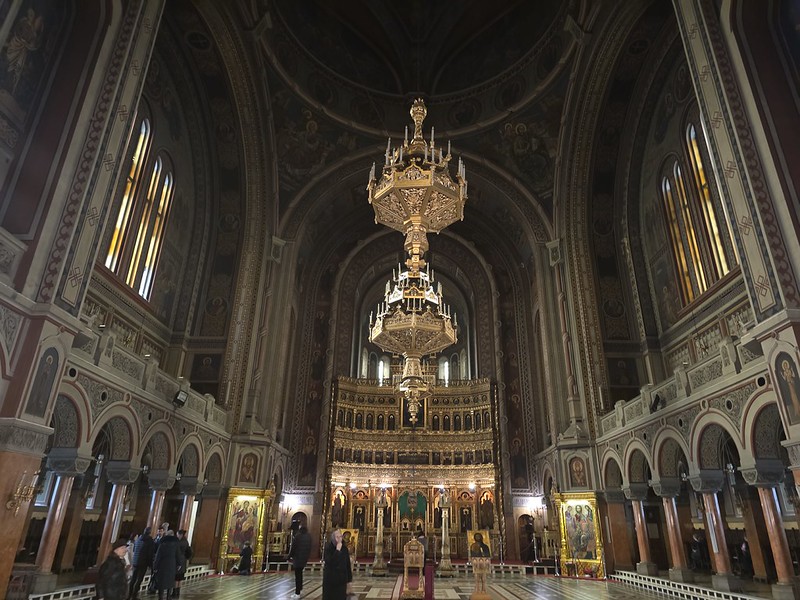
The Timișoara Orthodox Metropolitan Cathedral, something of a soaring landmark at the edge of Victory Square, stands as one of the most iconic symbols of the city and the wider Banat region. Built between 1936 and 1941, the cathedral was designed by architect Ioan Traianescu in a distinctive Neo-Moldavian style that harmoniously blends Byzantine, Ottoman and late Renaissance elements. Its silhouette is defined by eleven towers, the central spire reaching an impressive height of 90.5 metres, making it one of the tallest religious structures in Romania. The exterior is notable for its vibrant polychrome facades, featuring intricate brickwork in shades of red and orange, complemented by glazed ceramic roof tiles that form traditional Romanian mosaic patterns. Because the cathedral was constructed on marshy ground, it rests upon a massive concrete slab supported by over 1,000 reinforced concrete pillars driven 20 metres deep into the soil.
I decided to only take one photograph as this was a place of worship and I was evidently the only tourist, not that anyone looked at me or said anything. This is a deeply impressive cathedral, not because of its decoration or design, but because there was something else going on. There were acts of devotion all around me, but there were also people sitting in the seats to the side reading and thinking, this was a place for true reflection.
The interior of the cathedral is clearly grand, designed to accommodate up to 5,000 worshippers within its expansive, cross-shaped plan, although I’d suggest that this would be somewhat packed. The walls are adorned with elaborate frescoes by the renowned painter Anastase Demian, though the completion of these works was significantly delayed by the onset of the Second World War. The iconostasis is magnificent and was carved and gilded in 22-carat gold by the sculptor Ștefan Gajo. There’s a link between the building and the 1989 Romanian revolution, but more of that in another post.
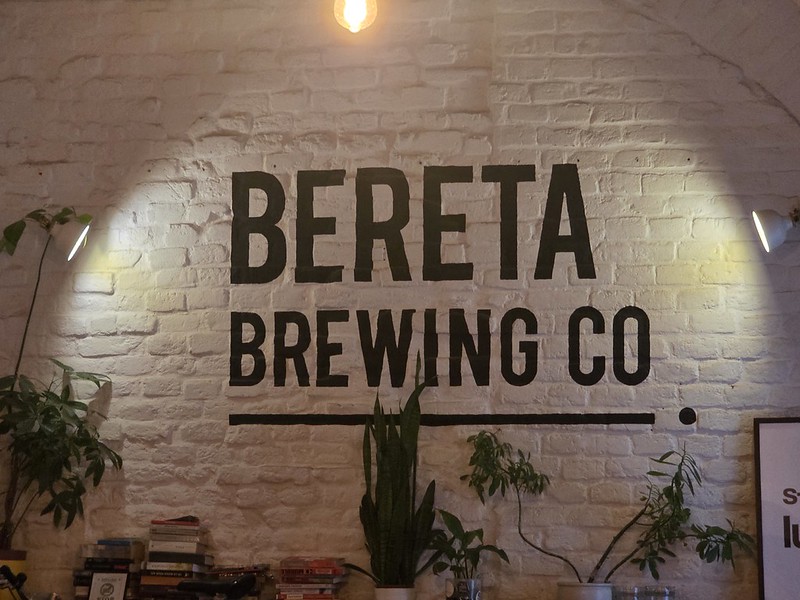
I accept that the frontage of Bereta’s taproom isn’t the most decadent and awe-inspiring, it’s not the Grand Canyon of entrances, but I’ve been looking forward to visiting here.
The beer selection and there are some decadent little numbers on here.
If I understand correctly, customers can order food into the taproom, but they don’t offer their own food options other than for these crisps.
It was quiet, but it was clean, comfortable and interesting. The team member serving was friendly and helpful, it had an inviting and relaxing vibe to it.
Bereta Brewing emerged from the burgeoning homebrewing scene of Timișoara in 2014, when founders Adrian Biebel and Silviu Dumitru turned a shared hobby into one of Romania’s most influential craft beer projects. Initially operating as cuckoo brewers, utilising the spare capacity of established facilities, the duo quickly gained a reputation for their uncompromising focus on modern, hop-forward styles such as New England IPAs and experimental stouts. Their trajectory changed significantly in 2018 with the opening of their own dedicated brewery in Giarmata, just outside the city, which allowed them to increase production and refine their technical processes. And, this taproom in Timișoara opened last year to expand their reach a little further.
Can decoration.
This is the ‘Ai Pi lei from Bereta, a piney and punchy beer, hop forward with a bit of citrus.
I was just going to go for Bereta beers, but they had a Funky Fluid beer and so that gets prioritisation. The best brewery in Europe can’t be overlooked. This is the Yule Cherry and although I know it’s February, I went for it anyway. Lots of cherries, only very slightly tart, all very reliable from this great Polish brewery.
And finally, I went for Billie’s Special 2025 from Bereta, which was boozy, rich, packed with cherries, it was sweet with chocolate notes and very definitely decadent.
They’ve also got some fridges in a separate room with numerous delights, including a couple of Funky Fluid. I bought a couple of Bereta beers to take away, I’ll report back….. Anyway, this was a rather lovely visit and it’s good to see the taproom of this fine brewery and I’m sure that I’ll be back.
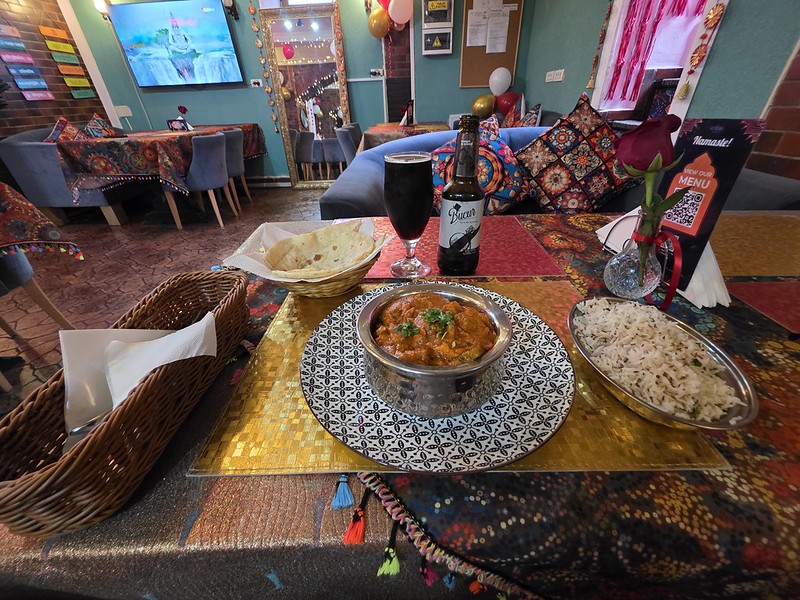
It’s slightly hidden away, but this is the very well reviewed Indian Bistro which is located in the cellar of this grand building. The restaurant is known for making an effort to import ingredients from India and apparently reservations are usually needed at weekends.
It’s certainly atmospheric with its bright colours and internal decor choices. I’m not a huge fan of sofas for dining purposes, but the tables have a choice of more traditional seating on one side which I opted for rather than going for some ‘choose your own adventure’ arrangement where I would be sitting too low or high for the table. The venue doesn’t have printed menus (or I didn’t see any), but instead uses a QR code for diners to have a look at the food and drink options.
The server spoke English which was rather helpful for ordering purposes and she was friendly and personable. I had read in advance that there was a scale of spice for each dish that was between one, no spice, and five, lots of spice. I opted to go for five, as I’ve been in this situation many times in Europe and the high spice option doesn’t quite meet my hopes. She did look slightly surprised which was initially something of minor concern to me.
That’s the chicken kadai, one of my go to options at the moment, served alongside cumin rice (jeera) and a chapati. All beautifully presented, it looked appetising and appealing, with the portion size being entirely reasonable.
Back to the spice level, this really was ramped up, which surprised and delighted me. Holding no prisoners in terms of the spice, the sauce was flavourful and interesting, with the chicken being tender. The rice was well cooked and the chapati was slightly nutty and complemented the curry arrangement well.
The beer here is the Bucur Bruna, a dark beer with tastes of caramel, coffee and malt. They had quite a choice of beers, not just the riveting excitement of Cobra and Kingfisher which is the limit of many Indian restaurants in the UK.
All really rather lovely, the prices were low by UK standards (around £12 for everything) and the quality was high. This was really rather good and I have positive memories now of a restaurant that isn’t frightened of using spice in food.
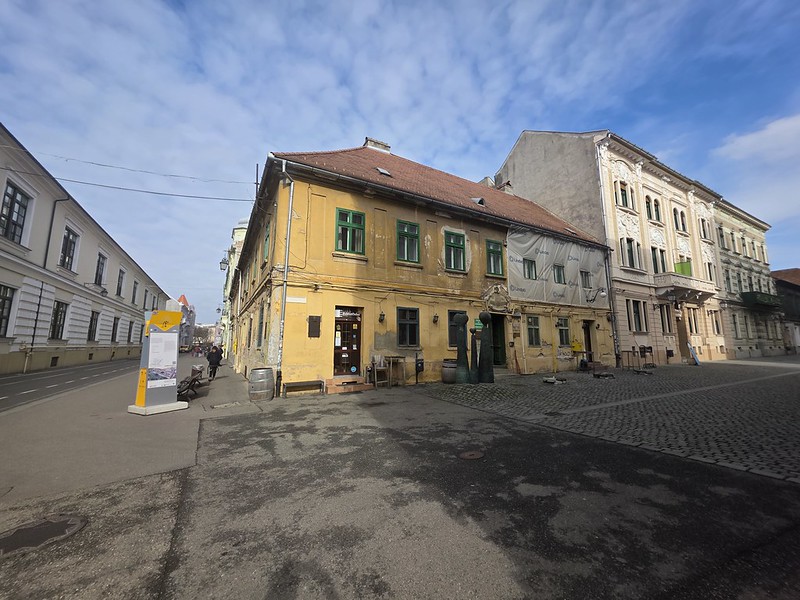
This is Prince Eugene House, which even has its own Wikipedia page, which was constructed in 1817 on the former site of the Forforosa Gate. This location is significant as it marks the exact point where Prince Eugene of Savoy entered the city in 1716 after successfully seizing the fortress from Ottoman control, marking the start of Habsburg rule.
Although the house bears his name, the military commander never actually lived there, as construction began more than eighty years after his death. The building serves as a memorial to this transition of power, featuring a prominent medallion above the doorway of the above photo that depicts a basic representation of the original gate.
Over the centuries, the property has transitioned through various uses, serving as a Jewish house of prayer, a series of private commercial shops, a restaurant and pub (my favourite usage) before becoming a theatre agency during the mid-20th century. Following the period of nationalisation under the communist regime, the building was eventually returned to the descendants of the Savici family in the 1990s.
It’s perhaps in need of some repair today, although that’s true of a lot of the grand buildings in the city, although matters are clearly improving. The graffiti isn’t doing a great deal for the look of the building to be honest….
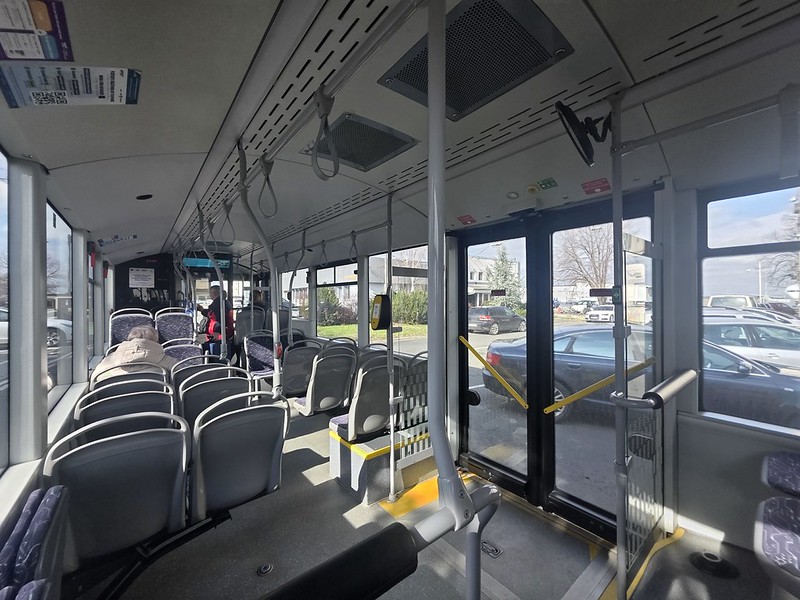
This is the bus stop at Timișoara Airport, around a twenty second walk from the airport terminal.
It’s a long bendy bus and I was pleased to find out that it’s easy to just use contactless cards on board. The journey to the city centre takes around thirty minutes and costs 65p. The ticket lasts for sixty minutes and allows transfers onto other public transport.
There’s my friend Liam departing after kindly dropping me off at Luton Airport and it’s always a delight being back here. Well, it isn’t, but travel is about being positive.
I decided to just stay at the airport overnight, it’s not worth the faffing about leaving the hotel early to get here. And, it’s a more thrifty option. Here’s the airside area shortly after it opened.
My usual visit to Big Smoke with my Priority Pass card and it’s not often that I’m here early enough for the breakfast menu. The £18 allowance doesn’t allow a huge amount of decadence here with prices ever rising.
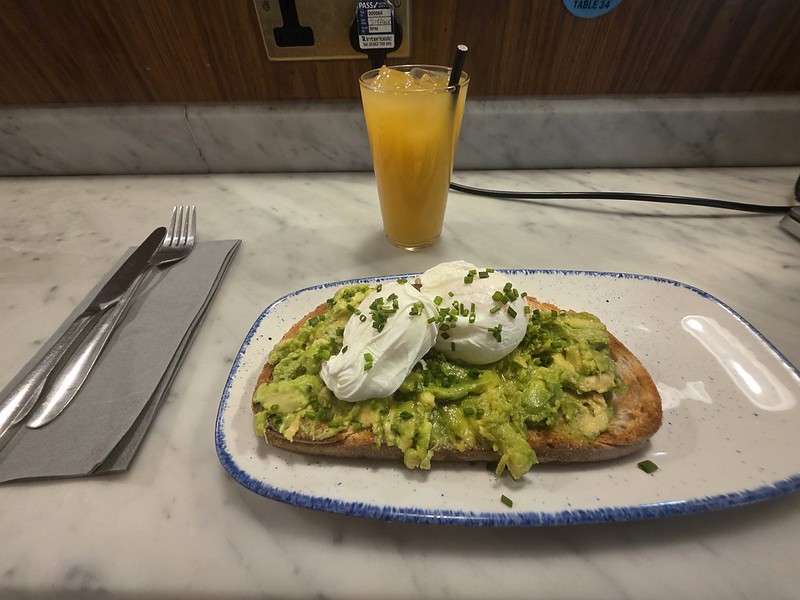
The poached eggs on avocado with sourdough bread served alongside a pineapple juice was a suitable breakfast for 04:00. It’s half-term this week and the airport was very busy, with Big Smoke being at capacity for much of the time that I was there.
Orange juice, latte and granola at Nolito, where I merrily waited until I got an alert on my phone with the gate number.
Coffee acquired. I’m not sure why the Wizz Air app mentioned the gate number before it was announced, as it led to several customers arriving to see no gate information and then asking staff members for help. It’s handy to get extra time to arrive at the gate though.
With the gate now announced I managed to be the first to queue up, with boarding commencing nearly immediately. This was one of the flights where Wizz Air had mentioned that there might be €100 in Wizz Air credits for volunteering not to fly. I have little interest in this, it would deny me getting any UK261 compensation if they were planning to refuse me.
There’s the aircraft positively glimmering in the morning sun.
The turnaround on these flights is something to behold, we were boarding within fifteen minutes of these passengers disembarking.
Boarding the aircraft, which was registration HA-LWQ, an Airbus A320 which Wizz Air have had in their fleet since 2012 and that I don’t think I’ve been on before.
This is one of the older aircraft in the fleet and these are the old fashioned seats that I haven’t seen in some time. I was pleased that the seating Gods had allocated me an aisle seat as the flight was just about full.
The aircraft was clean, but it felt a little rickety in places, as is perhaps evident with those yellow pieces of tape indicating the damaged overhead lockers. As for the flight, it all seemed well managed, although I was asleep for most of it so all manner of havoc could have been happening and I wouldn’t have known. I hope that I didn’t miss out on any drama though….
And safely at Timișoara Airport, a little earlier than expected. It took only around twenty minutes to get through border control, there were few British people on board and they delayed matters slightly because of the EES.
I had plenty of time at Yerevan Airport, giving me time to visit the lounge that they had here before I boarded my flight to Prague.
There were a variety of sandwiches, with the whole food selection being quite broad.
Snacks and salad. Those red wafer things were very moreish.
A selection of empanadas.
The usual generic lager. There was a self-service bar which had a range of spirits, a brandy and a choice of two different beers. It’s a large lounge and I liked that they had some higher tables rather than just low tables. There were also power points liberally dotted around, as well as as wi-fi.
Some healthy Greek salad, although that’s not entirely evident from the photo, which was my favourite thing from the food options. It’s unusual for lounges to have bottles of coke and the like available, as they must lose a lot to customers taking them away with them.
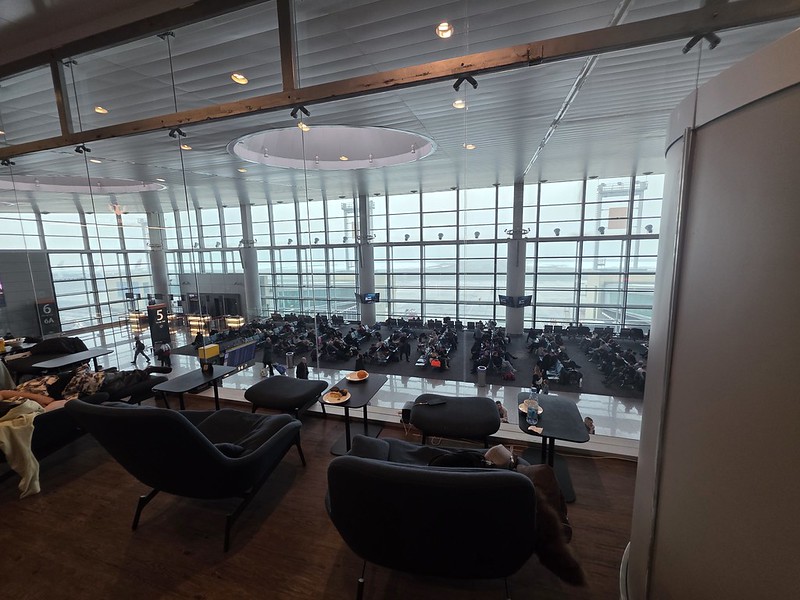
The lounge has a view over the boarding gates, which is particularly handy to see when flights are actually boarding. My flight started to board earlier than previously announced, so I decided after a couple of hours to meander down.
The online reviews for this lounge aren’t great, but I thought that it was all fine. There was plenty of space, a wide selection of food and drinks, with team members keeping the whole lounge clean and organised.