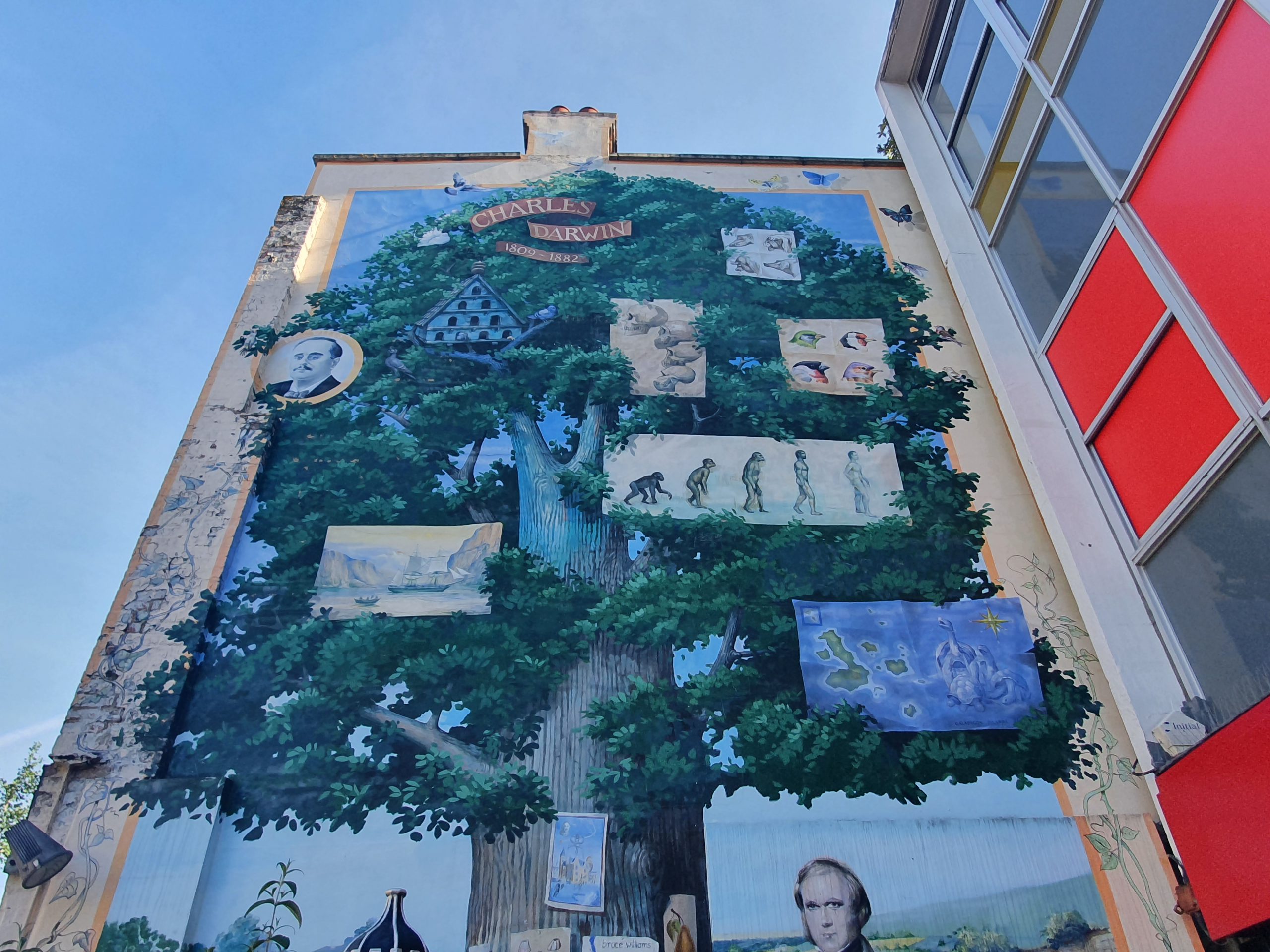
It’s a long time since I’ve been to Bromley and I’ve never seen this mural dedicated to Charles Darwin and his work, but it’s an impressive sight. It’s been placed here as Darwin lived for forty years a few miles away, in the Down House in Downe. Darwin might not have strong links to Bromley itself beyond that, but it’s known that he visited the town many times.
Until 2008, there was a mural dedicated to the life of HG Wells here, with the Darwin one being painted here in 2008 by Bruce Williams. He isn’t entirely forgotten though, and he appears in this mural as well (Wells I mean, not Bruce Williams), on the left hand side. In many ways, it’s a shame that the Wells mural was lost (this wasn’t vandalism, just that the wall needed replastering anyway), as he was born just a few metres away from this location.
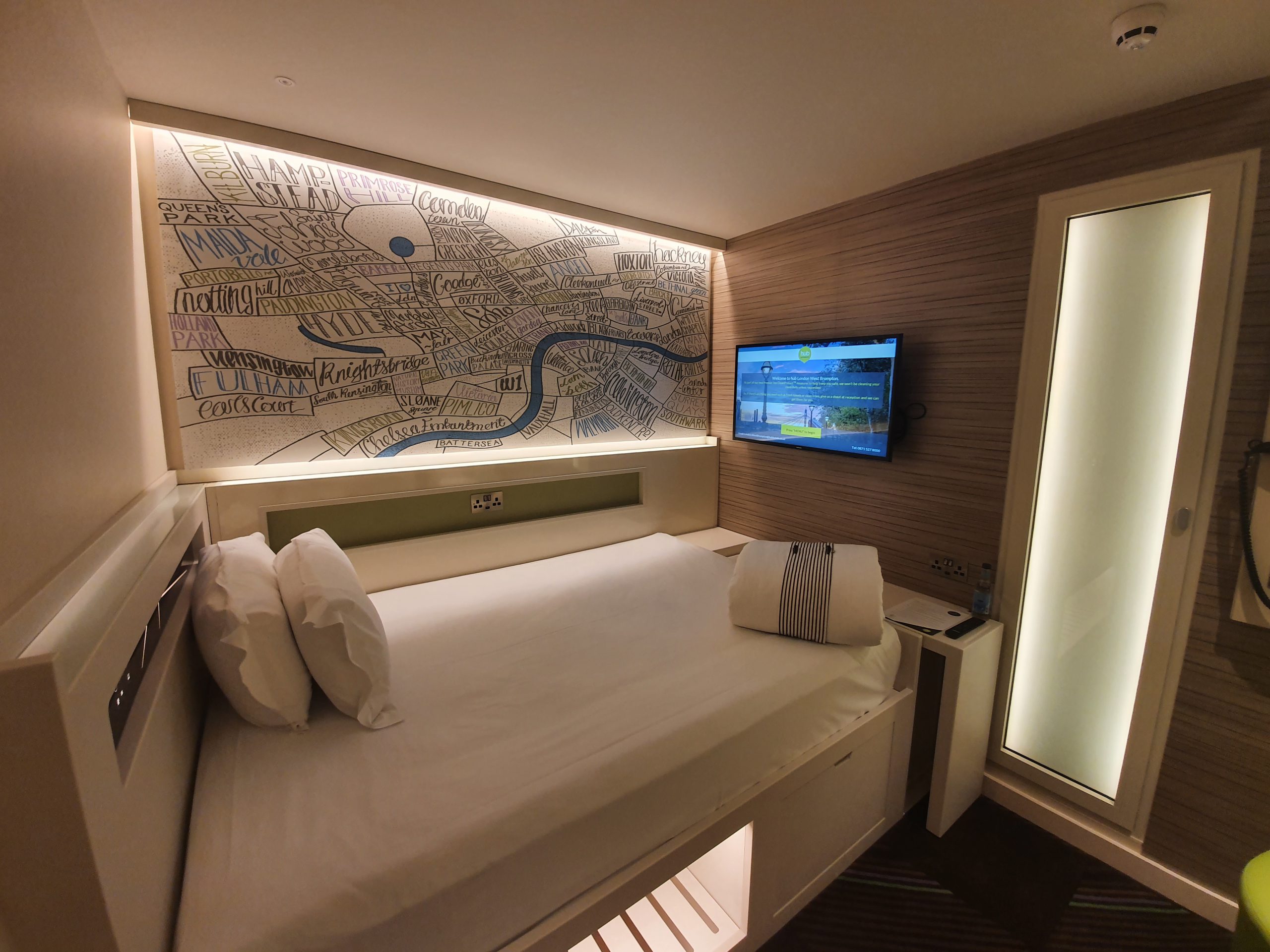
I like new hotel concepts and The Hub is Premier Inn’s attempt to create an on-trend accommodation option which has more flexibly sized rooms (by flexible, I mean smaller) which allows them to charge a little less. It’s not quite the capsule style as the rooms are larger than that, but they are of course much smaller than traditional hotel rooms.
The room with the television at the end of the bed and plenty of space for bags underneath the bed.
The lighting controls are at the end of the bed.
This table pulls out to provide an element of desk space. The bottle of water is free and although there are no coffee or tea facilities in the room, they are available free of charge downstairs.
The view from the end of the bed.
There is a large television and it allows mirroring from smartphones, so this is what happens when you do that and point the phone towards the television. I accept, I need to get out more….
The bathroom, which is pretty much the same size as in most hotel rooms.
When I stayed in India, it was common for a digital display outside the room to indicate whether the guest wanted to have their room cleaned or whether they wanted privacy. I’ve wondered when this would come across to Europe in more hotels at a budget level, as it’s much better than hanging bits of card from the room door.
The pricing was competitive, coming in at under £30 for the night and the hotel is just a very short walk from West Brompton underground station. I very much liked this concept, as the execution is brilliant. A lot of thought has gone into the design of the room to maximise space, and it is entirely functional. There’s storage space, a chair, desk, comfortable bed and a perfectly sized bathroom. The bin is in a cupboard (that’s more appropriate than it sounds) and the bottle of water is a nice little touch. The room was incredibly quiet, with no noise impact from either inside or outside of the hotel.
I accept that the room isn’t ideal for romantic breaks or for families who need more space for their children and to argue, but as a place to stay I really rather like it. There are some larger rooms in the hotel, but there wasn’t a floor plan on the back of the door as there usually is to guide customers out in the event of a fire. That was a slight shame as I couldn’t establish just how the hotel was laid out in terms of how large the rooms are.
There weren’t really any problems, I thought that the room in total darkness might be hard to find the control panel of lights, but it was still very slightly visible. I quickly checked the wi-fi and that was fast and functional. As for the staff member who checked me in, she was full of engagement and personality, so a credit to the hotel. There was a friendly checkout process as well (I say process, I put the key in a box and the staff called out asking if I had enjoyed my stay, so that works for me). London is competitively priced at the moment, but this could be an option I’ll consider in the future and Premier Inn have opened up a few of these already in the city.
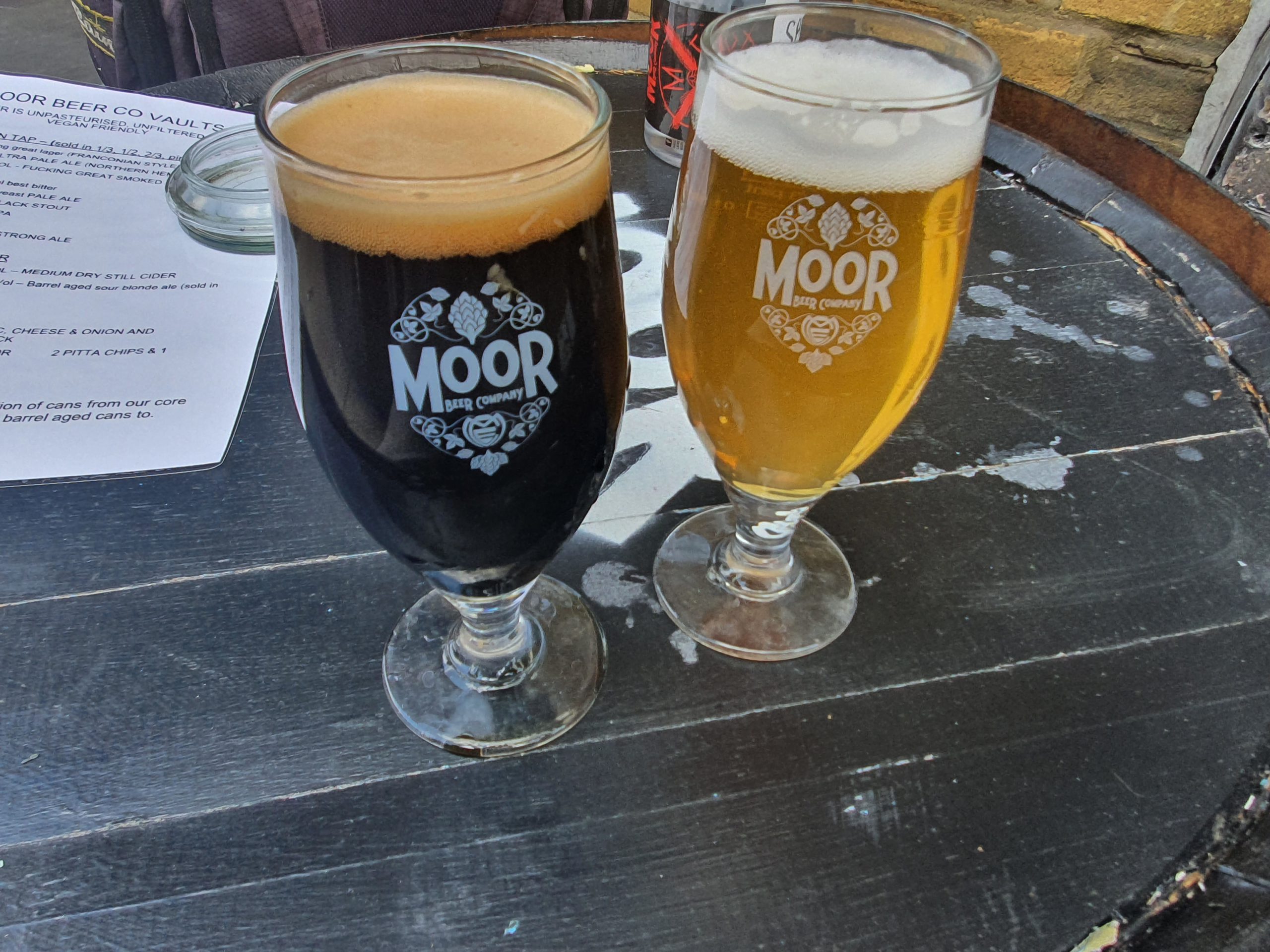
Part of my slow and steady walk along the Bermondsey Beer Mile, this is Moor Brewing. They’re a Bristol brewery who brew a range of different beer styles and they have this informal little arrangement in London. Friendly staff and I was offered a choice of tables, so made myself comfortable in the corner out of the way of the sun.
This is the beer menu, which isn’t really suitable for children.
The beer on the left is Moor Beer’s stout, and very acceptable it was too. But, it’s the one on the right, which is Moor’s Smoked Lager, that I’ll focus on here, as I wasn’t sure that I’d even like it. Fortunately, I did, and I’ve been thinking about it ever since (not constantly, just every now and then…..) and I should have rated it higher on Untappd.
Anyway, without using the language that Moor use on their menu, it’s a smoked lager and I knew nothing about this concept. I was pleased to find out on Facebook from the wonderful Oliva (who I think is one of the foremost experts on beer in Norwich) and the no less wonderful Tony from the Hop & Vine in Hull that this is a beer style that is popular in Bamberg, in Germany. This is delightful information for me and I’m planning a trip there now (I mean Germany, not the Hop & Vine, to which a visit has already been planned) and I am unanimous in that……
The smoked lager’s main strength for me was its beautiful aftertaste, that lingering smoky flavour and I can imagine some German sausages would go well alongside that (or a McRib come to think of it). Effectively, it’s a beer that tastes slightly of bacon, but without the greasiness (and without the need for me to cut the fat off) and it also had something of a sweet edge and limited bitterness. I very much liked the concept and feel the need to experience the area of Germany which inspired this beer.
Bringing this back on track, I liked Moor’s, it was relaxed and calm, which is an atmosphere that I like. The prices weren’t listed on the menu, but they’re moderate and as I like, they really prefer card payments here. Like most of the places along the Bermondsey Beer Mile, it’s not particularly large inside, but it is definitely worth a visit. Very lovely.
A short walk from the Central Line underground station of Newbury Park is this relatively new and shiny Holiday Inn Express hotel. On approaching, I thought that the reception was a bit hidden away (I like things to be very clear, I don’t like being expected to use my initiative as I can get muddled up) and there’s no way of accessing it at the moment without using a lift, which doesn’t seem ideal. After waiting for a while for the required lift to take me to reception, whilst quietly tutting at this set-up, the staff member was welcoming and so my initial pre-annoyance at the hotel dissipated soon enough.
I very much like the clarity here with the welcome drink, and I know my place in the lower levels of the IHG rewards programme. I can look forwards to a free packet of crisps when I move up a level.
The restaurant and bar area, which wasn’t exactly overly busy, but it’s a comfortable environment. There are numerous other dining options in the local area, which must make it challenging for the hotel to sell much food, but it was all reassuringly clean. Although perhaps a little sterile, but I suppose there’s a limit to what you can do on the first floor of a hotel in Newbury Park during a pandemic.
The bar didn’t have any products available on draft, but the staff member said that guests could have any bottle of beer as their welcome drink. London Pride is an appropriate beer given, well, the hotel is in London and I was satisfied that an effort had been made to offer a range of beers that went beyond just having Carlsberg. The glass isn’t dirty, it had been chilled in the fridge.
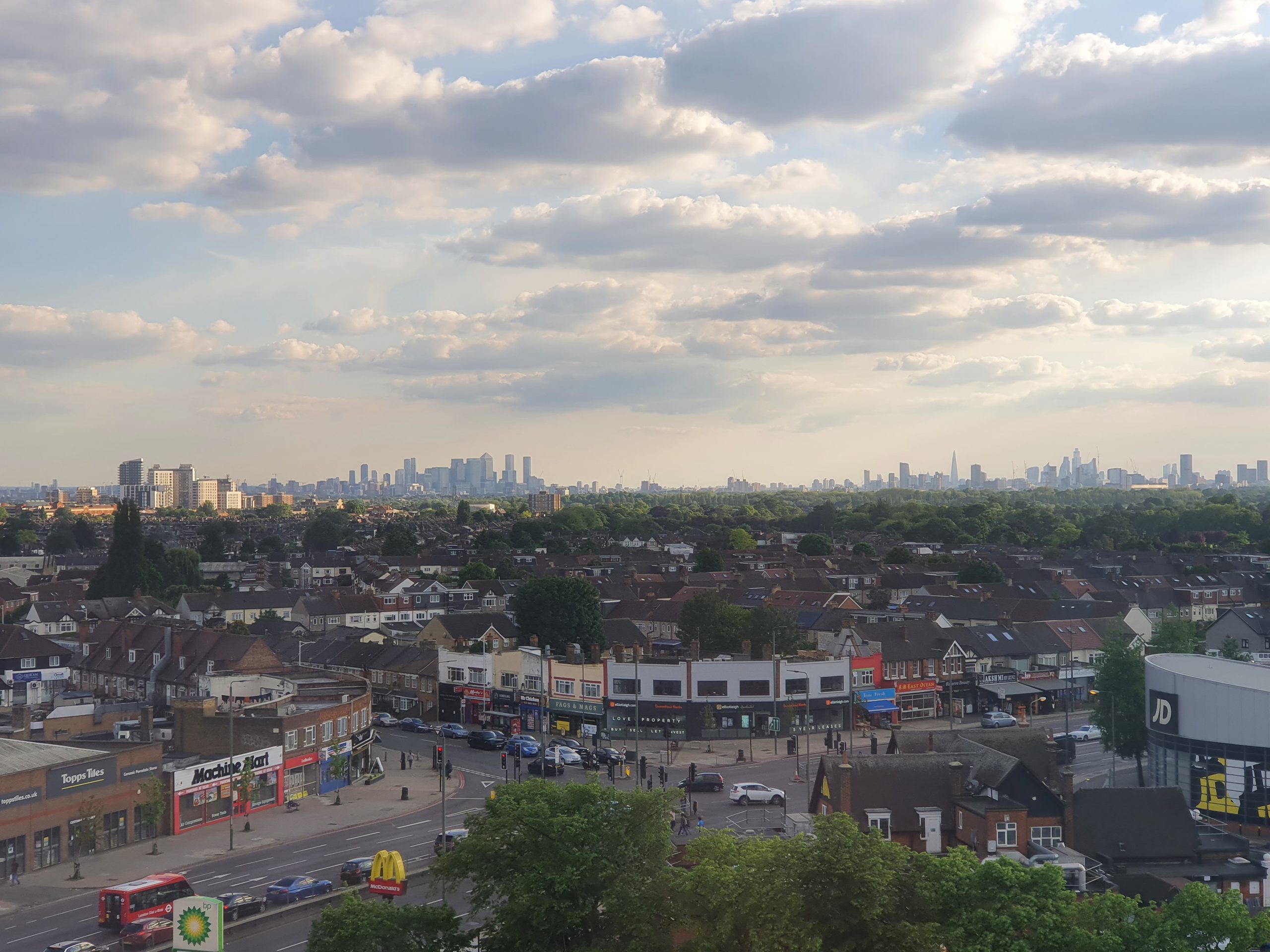
The view from the front of the hotel when I got to my room on the seventh, and top, floor. I was at this stage quite hopeful that my room would also have a view of something interesting and not just some shed or the like.
All very standard as a Holiday Inn Express hotel room, but it was clean and comfortable, so all was well in the world (or in my world anyway). There are the usual tea and coffee making facilities, with all the room information material taken out.
Until seeing the view from the area near the lifts, I hadn’t given much thought to the views from the windows of a hotel in Newbury Park, but it surprised and delighted me with the vista of central London in the background. Nice.
The breakfast arrangement was a bit fiddly as although everything was laid out as it would be usually, a staff member served it from a little counter. Other Holiday Inn Express hotels don’t seem to be faffing about like this, although the staff member was keen to help. The food was all fine and I liked that the bacon was nicely crispy and that there wasn’t too much fat for me to laboriously cut off. Which was fortunate as guests were given wooden disposable cutlery.
Of no real relevance at all, but I puzzled for a good few seconds why they decided to put the assembly point map the other way up to the floor plan. I decided not to let it bother me though as I had other concerns, such as what pub would I be popping to next……
The reviews for the hotel are generally very favourable and I can see why, there was nothing problematic about my stay. I note they did get a negative review on TripAdvisor from someone complaining the hotel wanted £127 for one night for a late booking, compared to them only wanting £55 if he had booked much earlier. A guest who didn’t stay and complained that prices get higher towards the night of the stay, and then TripAdvisor wonder why their site seems to be dipping in credibility…. There’s a justified negative review though from a guest who complained that the hotel refused to deal with a room that was playing music very loudly. Pretty appalling, and I can see why the hotel apologised and offered compensation in their reply…..
Anyway, I’ve digressed again. All told, I very much liked this hotel. I’m not sure what it cost per night as it was free as a rewards night by using 12,000 points. Given its convenience for the underground, its cleanliness and the general efficiency, I think I could manage coming here again in the future.
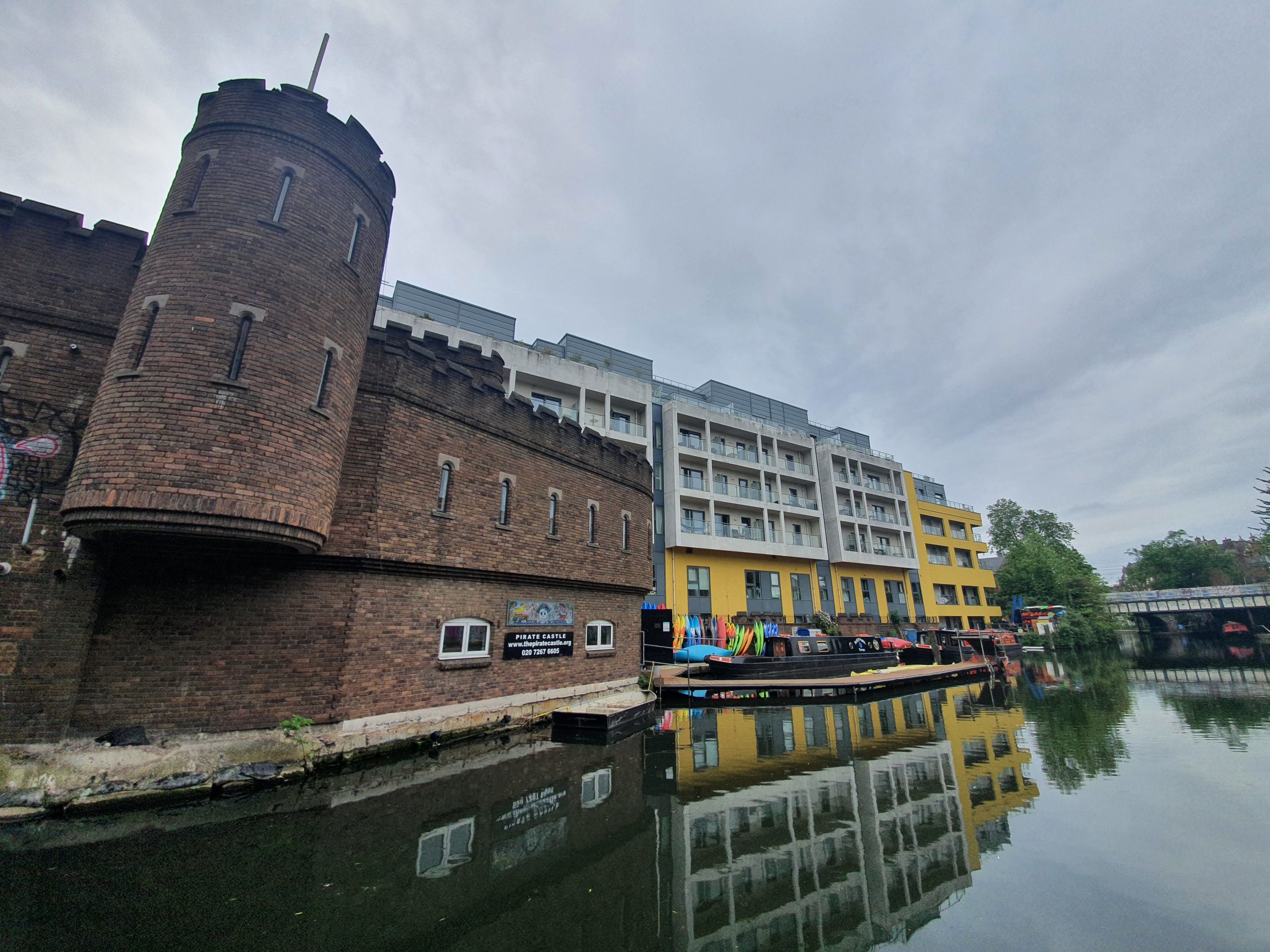
Just photos on this post from my little meander along the Regent’s Canal. This is quite a beautiful nine-mile walk, connecting into locations such as London Zoo, Camden, Little Venice, Regent’s Park and King’s Cross, amongst many other locations. Work on the canal started in 1812, with the first section being completed in 1816. Projects like this, given the tools of the time, are hard not to be impressed by, they were large scale and complex construction efforts.
The railway rather changed the commercial viability of the canal and there were several plans to build a railway line alongside it, although these didn’t get permission in Parliament. Today, the area is easy to walk along and although some stretches are inevitably busy, there are quieter parts where I didn’t see anyone for quite a way. I didn’t complete the entire route on this visit, but I might go back at some point and write something more substantial about this walk, one of my favourite in London. There’s something nice about being in central London, but feeling that the location is a little more remote and away from it all.
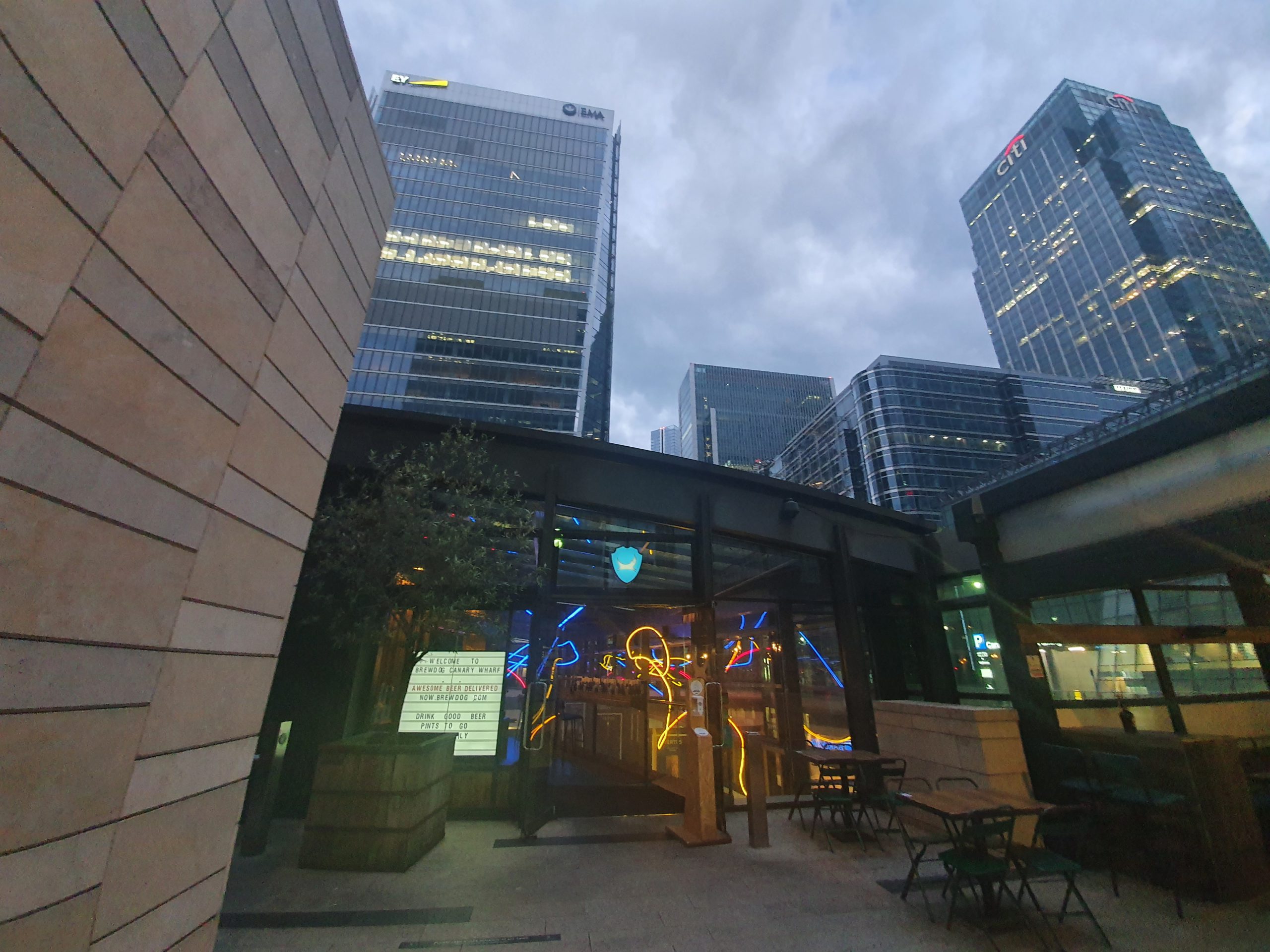
I tried to visit Brewdog at Canary Wharf at the end of last year and I was partly successful….. This was at a time when customers could go indoors, but there was a problem with the door to get in, so the only seating option was outside. This sufficed for a quick visit, but I wanted to return to see the main event.
Richard accompanied me as he’s becoming ever more enthused about this whole beer drinking thing, although he’s now got some sort of weird obsession with brightly coloured gins. I try not to encourage that, but fortunately, he was entirely agreeable that this would be a beer night. Well, sort of, we left Brewdog and he then gets the most ridiculous coloured gin in the next pub, but I didn’t say anything.
I’m not sure that Canary Wharf is ever really that busy on a Sunday night in summer, but it was certainly quiet during our visit. It’s a spacious bar, although not quite as large as I had expected, but we didn’t have any shortage of tables to choose from. I can imagine that when Canary Wharf is in full flow that this must be a very busy location and I can imagine the money that they make is substantial. As for this quiet Sunday evening, I can’t imagine there was much profit being made.
There were the bright lights, looking only slightly like a brothel, that Brewdog often have in their pubs (I mean that Brewdog often have bright lights like this, not that they have brothels in their pubs).
And the artworks on the wall, all very Brewdog.
But, I’m not here to critique the bar’s interior design, it’s not that important to me. The main element here is the beer and there were numerous stouts for me to choose from. I went through a few beers here that included more than just stouts, doing my normal just purchasing them in one thirds, but the star of the show was the Russia Stout from Mikkeller. I ordered this one without much expectation and a staff member came over and said it was a beautiful example of its type, simple, but elegant. And he was right, this was just a well produced stout which didn’t have any gimmicks to it. It had a level of decadence that I didn’t expect it to have, meaning just small sips delivered the coffee and chocolate notes each time. Smooth, elegant and really rather lovely, rare to have such a richness when not an imperial stout (the ABV is just 5.1%).
The staffing was excellent, knowledgeable, engaging and polite staff members who were keen to converse about the beers. The location was clean, the temperature wasn’t too hot, the beers were excellent, the staff knew what they were talking about and this is the first contender for my fiercely contested pub of the year award (when I say fiercely contested, I mean more, I think it should be fiercely contested). This is a bloody lovely bar. I suspect I’ll be back (although that sounds like a threat).
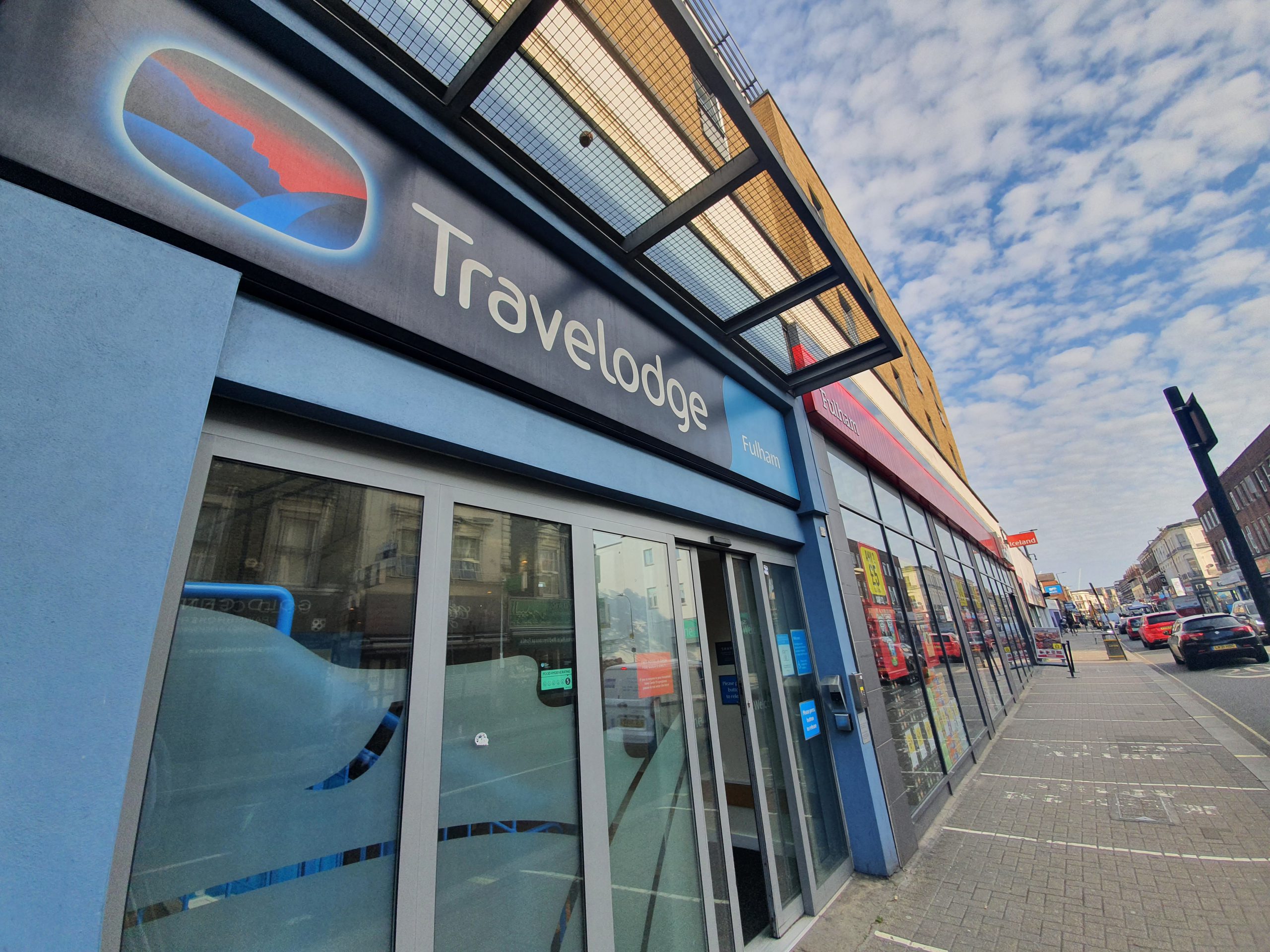
At the moment, I switch hotels to whichever seems to be the cheapest in London for the evening, with that exciting accolade going to Travelodge Fulham yesterday with their room for under £25 for the night. Easily accessible from the nearby Fulham Broadway underground station, it’s a convenient option for those coming from central London.
It’s not exactly the most decadent choice, but it’s a serviceable hotel option and the staff members at the front desk were helpful and engaging. The public areas seemed clean, if not entirely well maintained, and one of the lifts had a missing button to get to one of the floors and that wasn’t entirely ideal.
My room and this is the first time I’ve experienced a hotel in the UK that doesn’t have a duvet on the bed, just sheets. There was a reason for this, which was that the room was very hot and the building hasn’t been blessed with air conditioning. The duvet was though there in the room, in that blue bag in the corner, for anyone who wanted it.
Richard was staying in the same hotel, and he looks for decadence and expense in everything, so he upgraded himself to a Super Room. In the interests of showing the difference, this is his room. I didn’t allow him in it until I had taken photographs of it, although fortunately he didn’t complain at that situation. It does have a nicer feel to it.
The Super Room costs £5 per night more than the standard rate and for that the guest gets a coffee machine, a Kit Kat, nicer curtains, a nicer framed picture on the wall, a more comfortable (but less practical) chair and, well, that’s it. In some hotels, the guest would enjoy free air conditioning as well, but that wasn’t offered here. Richard did though get a fan that I didn’t get (although they’ve available at reception for us less decadent guests), so I think he felt his £5 was well spent. Incidentally, and I won’t go on about it, but Richard broke the coffee machine, but fortunately, I was there to ensure that the machine worked again. Sometimes you just need someone practical…..
Although the hotel was quite hot, it is the case that London is quite hot at the moment, so that could perhaps be forgiven. Given the prices currently being charged, I thought that the value was really rather good, especially as there were no noise disturbances either externally or internally. The kettle in my room needed replacing, but I didn’t let that bother me, as I was busy collecting my free decadent coffee machine drinks from Richard’s room.
The hotel is reasonably well reviewed, although on that review front, I did have a little browse through what guests had put on TripAdvisor. One reviewer had the title “teriminlly ill guest thrown out of hotel for having one ciggerate in room by manager” [sic] which is as it sounds, the guest decided to smoke in his room and was furious that the hotel was annoyed at this situation. The hotel unsurprisingly remained furious and stood by their decision.
A few guests also noted that there was lovely air conditioning in reception and by the lifts, so they suggested moving bedding and sleeping there. To be fair, the reception area was kept beautifully cool, so that wouldn’t be the worst idea in the world, although I’d be interested to see what the staff thought about it if anyone tried. Another guest, also annoyed at the lack of air conditioning, posted a review titled “the oven of hell”, which summed up his experiences. He suggested, and this is a good strategy:
“We had a fan on in the room, the curtains closed, window open, but the only way to sleep was to soak the towels in cold water and drape them over us whilst we slept!”
He’s probably right though that it might have been better to put some form of air conditioning in rather than spend years fielding complaints from guests. The review about someone who left their phone charger is well worth a read, I can see why the staff soon got fed up with hearing about this phone charger.
Anyway, I thought it was all clean and organised, so I’d happily stay here again, although only at a lower point. I note some guests paid over £100 for their rooms, and I can imagine why they were annoyed at the temperature issues.
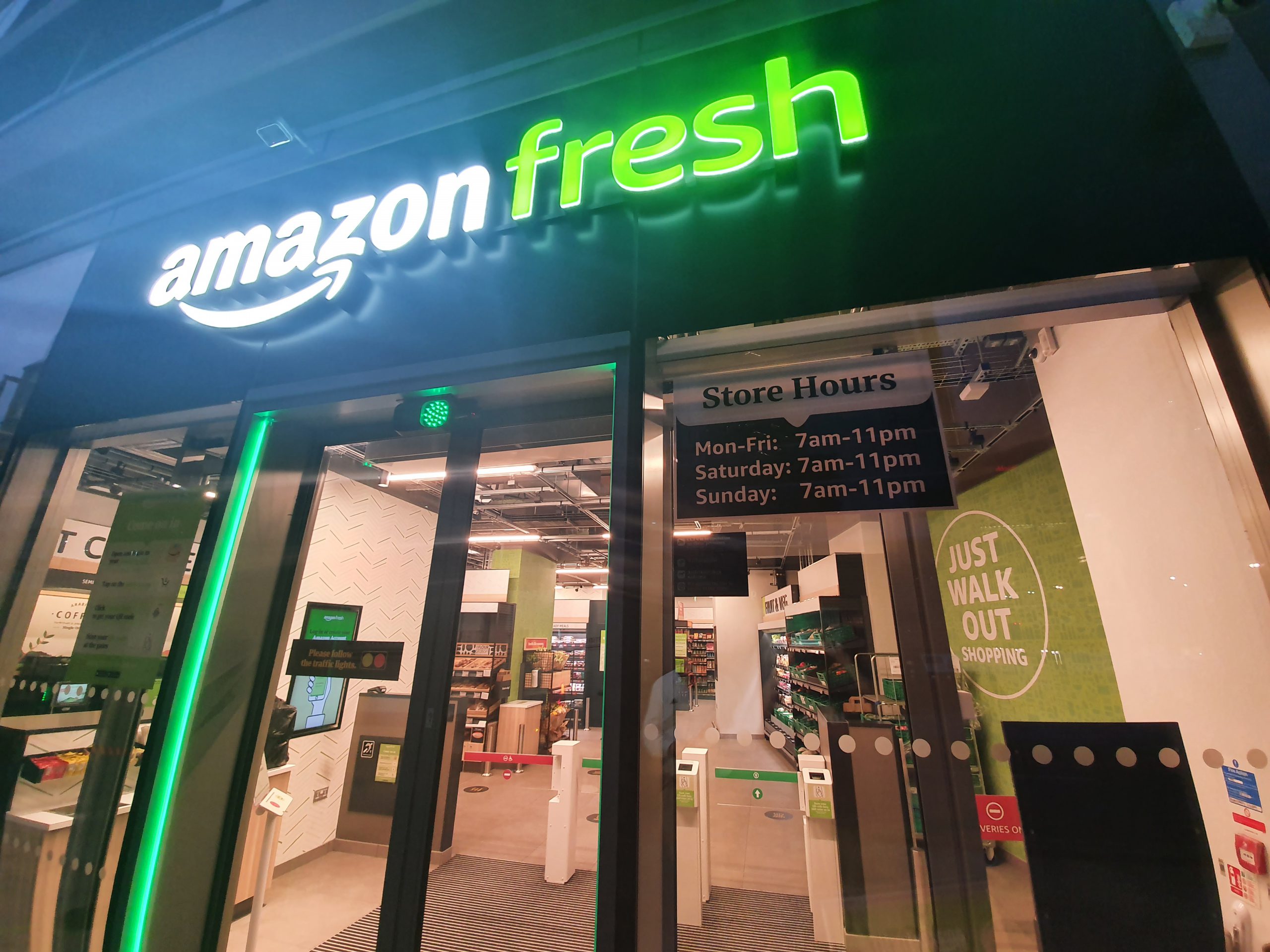
I don’t usually shop on-line using Amazon, but I heard a few weeks ago that they had opened their first Amazon Fresh convenience store outlet in Ealing. They’ve opened a couple more now in London, with this one being in Canary Wharf. There are still only a handful of cities in the world that Amazon have opened in and it’s fair to say that the technology in action here is, well, breathtaking.
The instructions to get in the store were prominently displayed outside. I was with Richard, who is pretty competent at technology, and we used his Amazon account since he actually has one he knows the password to. Customers need to have the Amazon App on their phone to scan their way into the store, but there’s no other registration process needed.
A helpful staff member came out to check if we needed assistance, and he confirmed that the main cardholder can guest others in. There’s a lot of novelty about this whole process, so I suspect that the staff member is doing a lot of explaining. There is a slight catch though, if I picked anything up, it would be free of charge for me and would be charged to Richard’s Amazon account. I didn’t take advantage of this situation on this occasion, although I might in future. It’ll make family shopping interesting though, as if the child picks something up and hides it about their person, then the shopper who took them in will be charged.
This whole shop works by cameras, sensors and technology that I don’t really understand. It knows when you pick things up from the shelf and when you put them back. You walk around the shop, put your purchases in a bag, your pocket or anywhere else, and just leave. The technology knows what you’ve had and unless you’ve got alcohol which needs a ID check, there is no human intervention in the process.
This is undeniably all very clever, and regardless of whether this is good or bad for humanity, I was impressed at the smoothness of the entire operation. Amazon are working in partnership with Morrison’s, so this technology would allow every checkout staff member to be replaced, just having security guards to monitor the entrance to a store. How the technology would work in a larger and busier store, I don’t know, but I assume Amazon will find a way to solve any problems which are encountered.
The store was laid out like any other convenience store would be, all neat and tidy. The prices were either the same as in Morrison’s, and there’s lots of their stock in the store, but they were mostly more expensive. This isn’t the cheapest shop to purchase items in, but it’s also not hugely more expensive so it’s still a viable choice for customers. For convenience, it’s perhaps unbeatable though.
Richard purchased two items and on the first product he waved it about in the air a bit, to ensure the cameras and sensors had picked it up. For the second product, he just shoved it straight in a bag. And it was as simple as that, we then walked out into the darkness of the Canary Wharf maze of buildings.
For the next hour, Richard was convinced that he’d shop-lifted as there was no receipt sent. However, an hour or so later he looked in his Amazon account and the two purchases were there, he’d been charged correctly. He seemed relieved that he wasn’t a shop-lifter, but we were mostly just both in awe at this technology. It has implications for staff numbers, but as a purely technological achievement, this is one of the most impressive things that I’ve seen. I’d be amazed if this doesn’t become the norm for convenience shops (and indeed entire supermarkets) in the future, it’s the end of shop-lifting and the end of queues.
As I’ve mentioned on previous updates, I’m so pleased to read the accounts of entrants to the LDWA 100 last week. It’s a reminder of just how many people took part in the event in so many delightful parts of the UK and how different people took to walking their 100 miles.
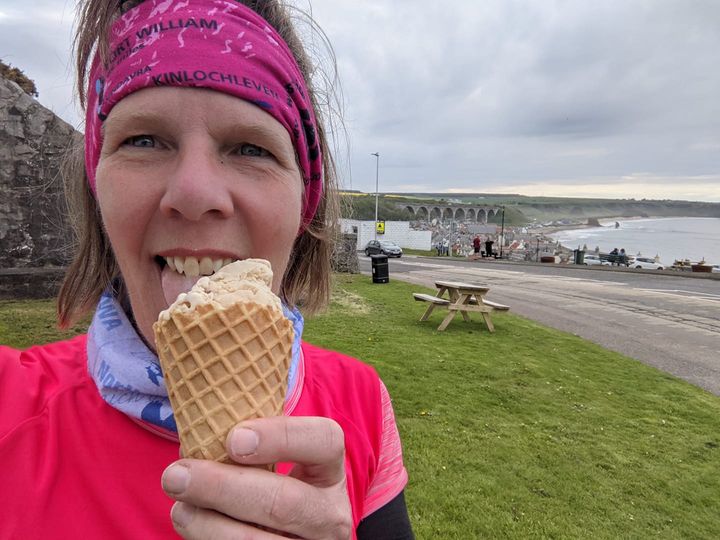
This is the walk of Jenni Coelho, who is from the very exciting North of Scotland group (formerly the North West Grampian group) which is also the home group of LDWA chair Julie Cribb. I love the distractions of food and drink in this account, and I suspect I would have stopped for an ice cream if the opportunity had arisen later on during the walk. Although Jenni didn’t quite finish this one, I’m sure she’ll be back for more and I’m impressed she went out running the next day. How very brave 🙂
Anyway, before I get distracted with food again (Julie does that to me), here’s Jenni’s account of the Moray Meander in her own words.
I was a relatively late sign up to the Virtual 100. My original plans for the Bank Holiday Weekend were taking part in the Cairngorm to Coast Challenge (a hike and bike event). Unfortunately, due to covid restrictions this had been postponed.
Since the end of January I had been putting in plenty of miles doing another virtual event, the GB Ultras Race Across the Alps, which was finishing on the Bank Holiday Weekend. So I needed to find something else for a grand finish. My mind had already started ticking away on possibly doing the LDWA 100 and whilst out for a run mid April I came across Bea from my local group (North of Scotland) who encouraged me to enter, as she, Julie, Rikky and a couple of others were planning on doing the Loch Ness 360. Duly persuaded, I entered that evening!
Covid of course, had to throw a spanner in the works. In the week before the whole of Scotland was supposed to be moving down a level, there was a spike in cases in Moray and we remained in Level 3. This meant that I potentially wouldn’t be able to travel to do the Loch Ness 360 (and neither importantly would my Other Half be able to support us).
So, back to the drawing board for Plan B, a route within Moray.
First choice, the obvious one, was two laps of our own 50 mile Challenge walk, the Laich o’Moray 50. The route almost passes my front door, so chance for a middle of the walk shower and snooze. The danger with this one was I might not easily awake from the snooze. Bea decided on an out and back along the Dava Way, a rest at her house and then a loop of the Laich o’Moray.
I eventually decided on a route taking me from my home in Elgin, out to Lossie Woods, leading to the coastal path taking me all the way along to Cullen (for an ice-cream!) then back to Buckie. From here I would come inland, over the hill to Keith following the Fisherwives Trail, then from Keith picking up the Isla Way to Dufftown. Then I would join the Speyside Way, passing through Craigellachie, up over Ben Aigen for a lovely sunrise, up to Spey Bay, where I would rejoin the Coastal Path heading west to Hopeman, then finishing inland at the historic Duffus Castle. A fabulous route (if I do say so myself!).
I decided to make virtual checkpoints around every five miles, ensuring that I would eat and drink at regular intervals and have five minutes with the weight off my feet. I would be mostly self supported, with my OH meeting me at three points: 47 miles for a change of clothes and coffee; 72 miles, again for a change of clothes and a flask of coffee and of course 100 miles at the finish. And so, the Moray Meander 100 was born.
The following weeks were spent recceing parts of the route which I hadn’t done before and with a warm and dry forecast for the Bank Holiday weekend everything was looking positive. I was loving all the pre-event chat on the Facebook page with all the people all over the country preparing for the weekend. It was suggested to post updates on the day to the Facebook page, so I decided to do this.
The Start
The actual day arrived. I was up nice and early, my plan was to leave about 5am and I left at 5.30 am (very good for the Queen of Faff). The weather was perfect for walking, the haar was hanging about and didn’t lift properly until it was nearly lunchtime. This meant a lot of the coastal walking which could have been quite brutal in the heat was undertaken in cool conditions.
The coastal path into Cullen involves a wee section over rocks, which when I arrived was a little challenging due to an incoming and high tide. I decided to take the alternative route back to Portknockie along the old railway line. However, the route onto the iconic viaduct was not obvious to someone who had been on the go for ten hours. So I lost an additional 15 minutes or so getting myself onto the viaduct (without going through someone’s garden!!).
Checkpoint 6 – Cullen
Progress was pretty good, with my overall timings only slipping about 15 minutes – but with the 30 minutes added on for late departure, I possibly shouldn’t have sat down for quite so long in Cullen eating a very large and very delicious rum and raisin ice-cream.
Checkpoint 7 – Strathlene
Coming down into Findochty, clouds were beginning to darken and it began to rain. Humph. Fortunately, there was a public convenience, so I took advantage of it and when I came back out, the rain was easing off. Looking at my timings I realised I wasn’t going to make it to my first support visit without my headtorch, so I phoned my long suffering OH to meet me in Buckie. I definitely lost some pace on this section and I was aware of some pain on my right heel. On arrival in Strathlene, which was my teatime stop, I arranged for my OH to come to me there instead. After I’d had something to eat, I braved having a look under my sock and found a fairly large double bubbly blister lurking there. So, it had to be dealt with and then some plasters stuck on top. Paracetamols popped and off I went again with my next meeting with the OH to be in Keith for a change of clothes before the proper night-time section.
As I arrived into Buckie I sensed that I needed to go to a proper toilet, so kept my fingers crossed that the harbour toilets might still be open as it was after 8pm. Hooray, Brucie Bonus, the door was open. Hallelujah.
Job done, and I strode up through Buckie, a new woman.
On my way out of Buckie, I was aware of a large group of boozy teenagers gathered in a park I had to walk past – fortunately, they were all having far too good a time to be bothered about the crazy walking lady. However, it did strike a note of unease into my mind.
The end is nigh – Drybridge Hill
I headed up the hill after Drybridge looking back to the absolutely stunning sunset over the Moray Firth. There were deer in the field beside me. These are moments that make these challenges all worth it.
The weird noises in the hills and woods I was heading into mind you were making my mind ever more uneasy and after about another ten minutes of hearing sounds like people were being murdered, I stopped and considered my situation. The next section was remote and I had hoped to be over it before dusk, which was not now going to happen. The following section after my support stop was not an area I wanted to be walking through in the dark either.
So, I made the decision to call it a day and retraced my footsteps back to where I could be rescued.
A smidgeon over 40 miles in the end in 16¾ hours.
Had I had a companion for the dark hours I definitely would have kept going, but I just didn’t feel safe, so I don’t regret the decision. I don’t know if I would have completed the 100, but I reckon I could’ve gotten 60-70 miles before my feet would’ve stopped in protest. If I’d realised how distracting the Facebook posts would have been, I wouldn’t have done them either, it seemed like a good idea at the time, but I definitely lost five minutes here and there which all added up.
Next time..… well, I don’t know if there will be a next time. Our local group are holding the Speyside 100 in a couple of years’ time so maybe I’ll do the marshals walk. Or I might try doing my Moray Meander later in the summer, perhaps with company …
What I did have to do was finish off my Race Across the Alps challenge – by only walking 40 miles, this still left me with another 15 miles required by close of play on the Sunday. Aaaargh.
The next day
On the Sunday, off I went (with my running shoes on this time) and covered what would have been the end of my Moray Meander, finishing at the Duffus Castle with a smile and a well-deserved Moretti.
I’m really pleased to have been receiving so many stories of how LDWA members took part in the 100 mile walk last weekend, and I’m still very impressed at the bravery shown by so many entrants!
Below is the adventure that Caroline Tennant got herself into and I think that terminology is appropriate, as I often wonder how people get themselves into these situations. In my case it seemed a good idea in the pub last year, but as Caroline mentions, I think many entrants did take to moments of introspection during the walk to discover why they were taking part. My initial plan was just to walk as far as I can, as Caroline aims to do in future walks, and reaching 60 miles is still a huge achievement. And I really like how members from East Lancs LDWA group came together to walk the 100, our wonderful LDWA community in action 🙂
This is Caroline’s story (I like #sausagerollgate, I’ve had overstocking incidents too…..).
Well, what happened was…my feet got me at 59 miles. All the planning in the world and it was my feet that defeated me. No blisters or injuries that I could do anything about, just plain old pain. I thought I would be gutted not to finish and at the time I really wasn’t. I was more than happy (putting aside the foot pain, swollen knees, aching, minor chaffing and general tiredness) I had walked further than I had ever walked before and qualified for 2022.
As the pain eased, I got a little introspective and pondered whether 100s are even for me…could I have gone further? Could I have walked through the pain? Then I looked at my blotchy feet, in sandals because I can’t get my feet in shoes, and realise it was the right decision. It’s annoying, yes, but I am safe and have done no permanent damage. I will take great pleasure in entering future 50s, which I love doing and yes, I will have a bash at another 100, but aiming to walk further than I have and seeing how I get on rather than aiming straight at the 100. It will be far easier on a ‘real’ 100. Having the checkpoints, support and company will remove a huge chunk of the preparations, lists and charts involved in a virtual event. Whilst I loved doing all of that (possibly more than the event itself!) concentrating on the walking will be a bonus.
As for the walk itself, the first 56 miles were brilliant and I loved every minute, until the cobbles on the renamed ‘Rocky Road’ got me…
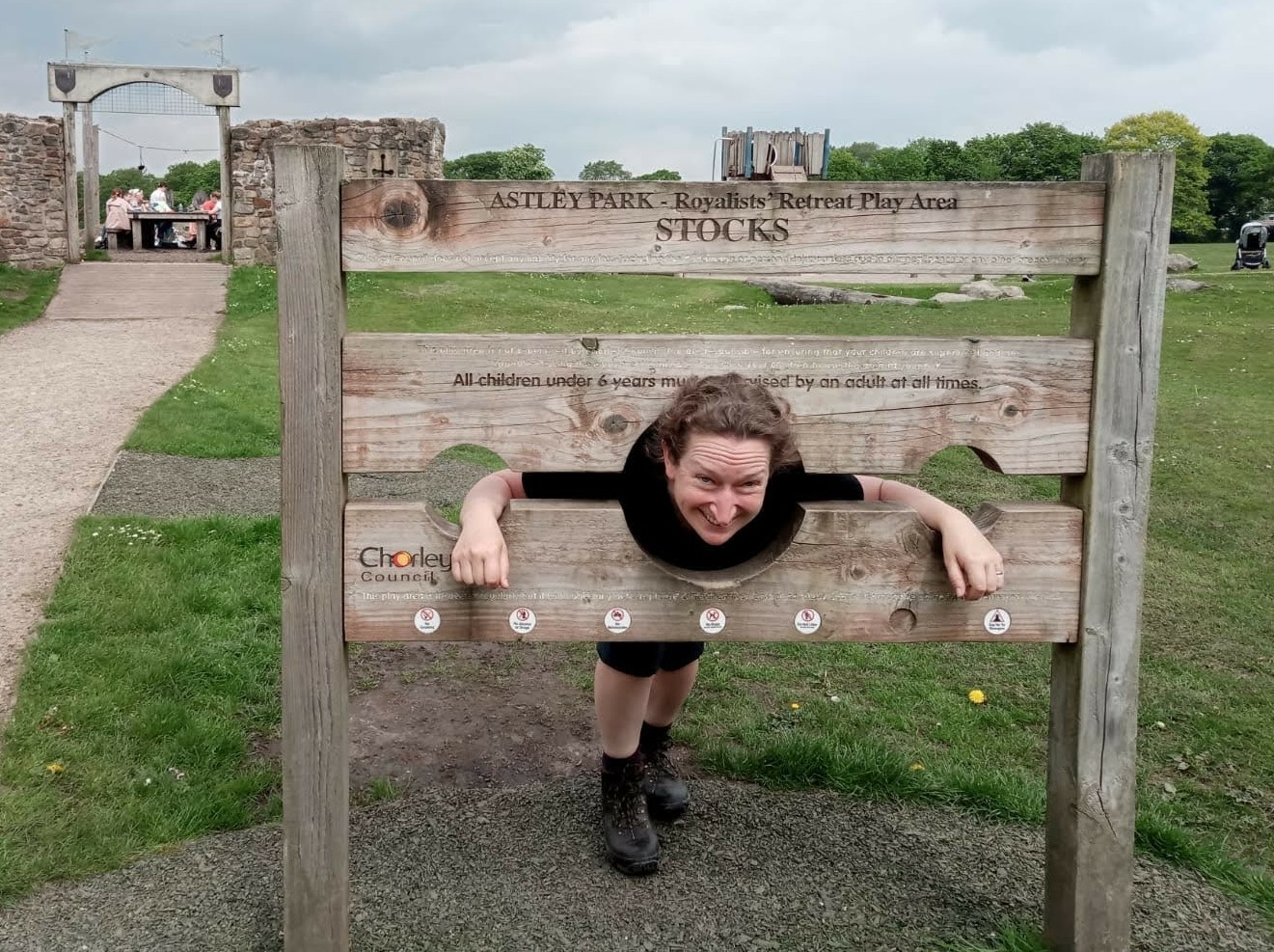
The 8 of us East Lancs members met up for a 07.30 start from Pauline’s in Standish. Chomping at the bit, we set off at 07.22, all hoping to complete our first 100. Up the canal to Chorley, via Yarrow Valley (bacon butties!) and Astley Park, where I ended up in the stocks. Back to the canal and River Darwen to Cherry tree where we met the lovely Jane, who accompanied us through the night to Horden Stoops. Through Hoghton to the main evening meal stop, 19.30 and 32.4 miles in, at my house.
Mr Tennant did a marvellous job feeding and watering us in the back garden. Pasta and brews all round. Nearly all round, he forgot about my brew! Anyhow, refuelled, repacked, bottles topped up, homemade Lancashire parkin in hand, we set off leaving a chaos of washing up and dirty socks behind us. And sausage rolls. When I had asked for some sausage rolls, I had not specified they were only for me. 28 were purchased. There are still a load in the freezer.
Cuerden Park saw us cheered on by Karen & Ian Wardle from West Lancs. Proper dark was upon us by the first break at Withnell. We were in near silence as the seating was by houses. Disappointed by the lack of village stocks here, but they were off being repainted. Across to Tockholes to use the benches and toilets for another break before the main climbs of our 100.
A pitstop for pictures by the East Lancs PNFS sponsored sign and then a boggy ascent of Great Hill. Down to Horden Stoops at 04.00 and 49.7 miles in. Jane left us here for home. Walking with someone fresher than the rest of us, I think, was a huge help, especially with it being overnight. Many thanks to Jane for the good company and the orange loaf.
Then began my downfall on ‘Rocky Road’ with its evil cobbles. Issues were made worse as my water spout decided it was going to leak, wherever I positioned it. So, either a wet tshirt, or wet trousers, as it slowly dripped on me. Normally no big deal, but hugely frustrating when you have miles to go. Also, when we reached Pike Cottage, it being not even 5am, it was closed, so we could not consume pies. Pies are necessary for all significant walks. I should have planned them in earlier, not into the second day. We ascended Winter Hill with the sunrise and I began to slow on the descent, but made it to Hilary’s house for the breakfast stop. At 08.00 and 59 miles in, Nick and myself decided to call it a day, tired but happy.
Pauline, Suzanne & Paul opted to not snooze and so set off once reorganised and full of lovely breakfast, sausage butties in hand. Dave, Alma and Hilary setting off slightly later, after a brief rest. Huge thanks to Hilary’s son, Craig, for feeding and cleaning up after us and Mr Scott for the good cheer, despite recovering from knee surgery, and not calling us crazy to our faces.
Off into the beautiful, and unfortunately, scorching day for the remaining 6. Back to Pike Cottage for refreshments, Rivington and then White Coppice. At 14.30 and 71 miles the heat took its toll and Hilary, Dave & Alma decided to stop having also walked further than they ever had before.
Pauline, Suzanne and Paul altered the planned route. Partly on purpose, partly tired accident. They missed White Coppice, but returned to the canal where they, eventually, found themselves at Frederick’s for very well deserved ice cream. The second evening meal stop at Pauline’s saw Suzanne retire at 81 miles. Pauline and Paul battled on, taking local circuits, steadily clocking up the miles. Determination saw them through as the miles slowly increased and finally reached 100. They did our group proud and we are all over the moon for them both!
Between the 8 of us, we clocked in 612 miles. I don’t know if this would have been the case had we walked individually. I, for one, think having the group and the support that bought, was a huge factor. From encouragement and distraction on the event itself, to having people to bounce ideas off in the run up to it, I couldn’t have done it alone. And now after 5 months planning, what do I do with myself now? Thank you to Suzanne Corlett, Nick Halford, Paul Kielty, Pauline Melia, Hilary Scott and Dave & Alma Walsh, for putting up with my over organising and sharing this adventure…When do entries open for the TP100?!
Well done to all those that took part, supported, organised and made the event possible and the wonderful thing that the 100 is. See you all next year where we will all either be walking or back helping out at the East Lancs breakfast stop.