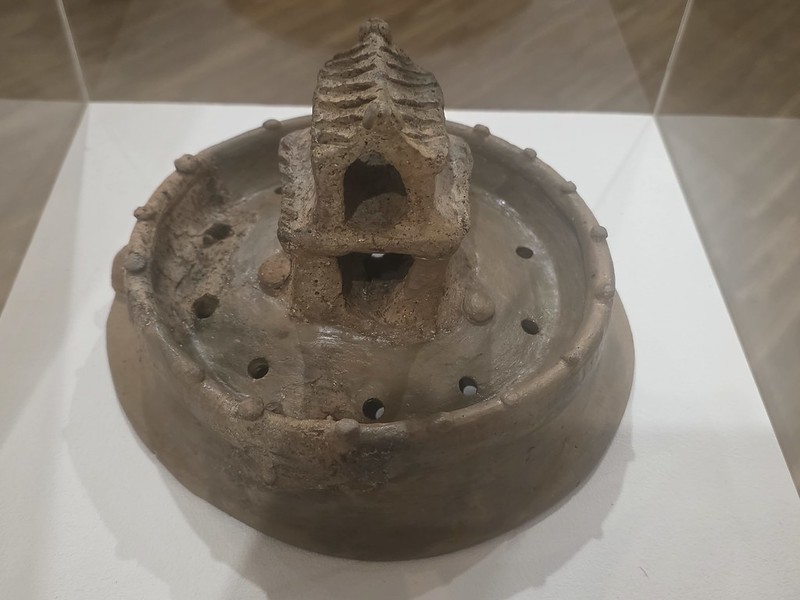
I’m aware that some of these posts are a little niche, but back to Yerevan and Armenia, with this little model of a bronze temple which dates to around the fifth or sixth century BC. This reminds me of a much more professional clay model that I made at school of a castle that I’m convinced will be worth at least £25 in twenty years (although it probably cost more than £25 in clay to make). It was also slightly more substantial than this little temple, but there’s something quite alluring about this exhibit which is about 3,000 years old and that’s also rather a long time for it to remain unbroken.
The museum notes that it was found at Astghi Blur, which was an ancient fortress located on a strategic hilltop near the village of Yenokavan in Armenia, featuring impressive double and triple stone walls that date back to the sixth and fifth centuries BC.
Back to Timișoara briefly, this is the Palace of Culture which was redesigned by Duiliu Marcu to give it this rather distinctive frontage. The building now houses the Romanian National Opera, the Mihai Eminescu National Theatre, the Csiky Gergely Hungarian State Theatre and the German State Theatre which is all rather cosmopolitan of it.
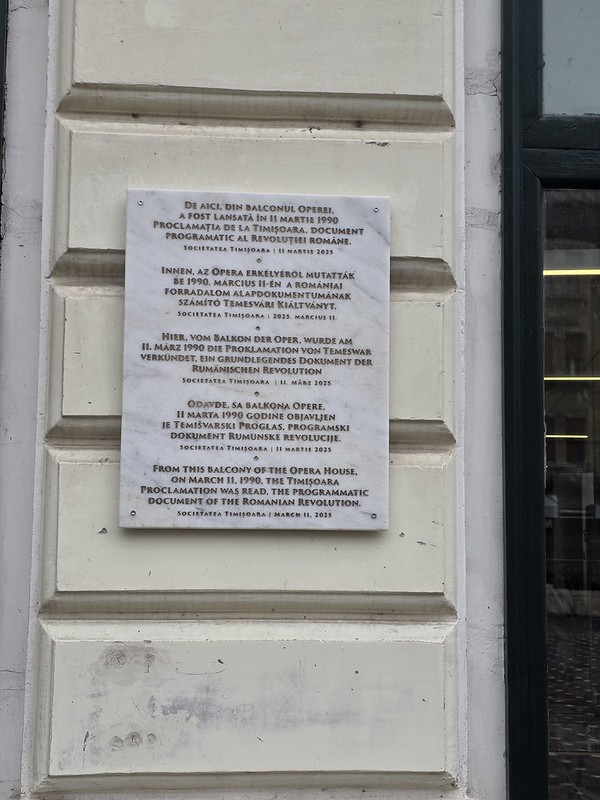
Perhaps the most interesting aspect of this building (to me anyway) is its balcony, a site of immense revolutionary significance where the Proclamation of Timișoara was read on 11 March 1990. This document served as a powerful condemnation of communism, following the execution of Nicolae Ceaușescu at the end of 1989. As the nation sought a new path forward, the proclamation articulated a vision for democratic reform and political transparency. Although these liberal values faced immediate and harsh opposition from those loyal to the previous regime, the balcony remains a symbol of the moment Timișoara was declared the first city in Romania free of communism and this plaque was installed here last year.
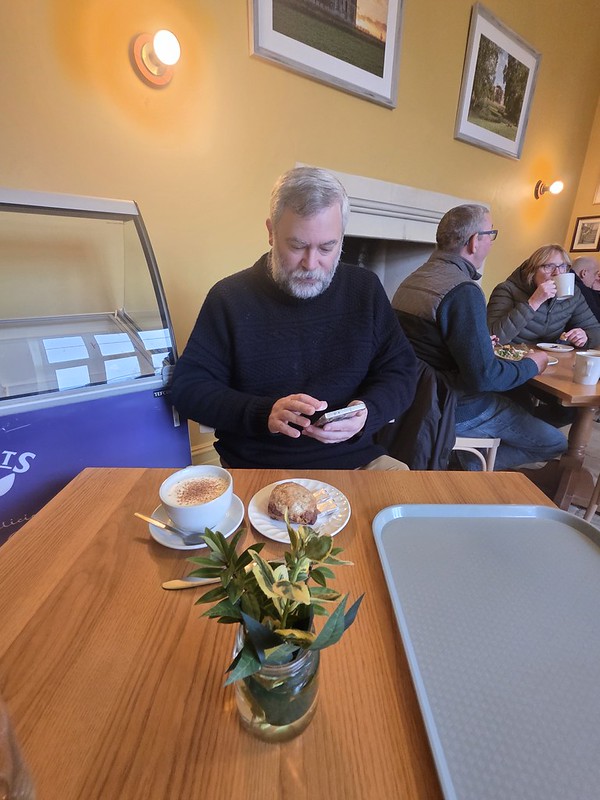
And the centrepiece of the National Trust’s focus at this historic site, their cafe which was full of decadently priced things to appeal to decadent people. Namely Richard in our case. There was a fine selection of scones and a ridiculously priced sausage roll at £6.75.
To calm my nerves at the high pricing, Richard treated me to a plum & ginger cider.
Richard quickly transferring some money to his current account to fund his purchases. He was delighted by his scone I’m pleased to say, he went for the monthly special of the cheese and marmite one.
Anyway, as cafes go it was certainly quite extensive as well as being the busiest part of the site. It did seem to be the case that some members had driven out to the venue just so that they could visit the cafe, which I suppose is why there’s such a focus on it…..
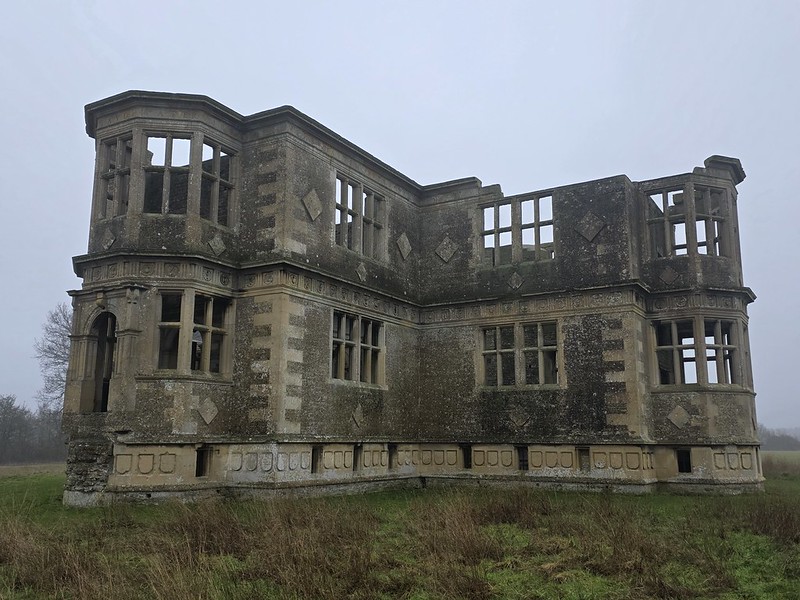
This is the manor house at Lyveden, a site which is perhaps best known for the incomplete Lyveden New Bield. The National Trust have owned the latter for over a century, but in 2013, they also acquired this manor house. Not much is known about the manor house that Sir Thomas Tresham lived in, this one dates to after 1615 and after his death.
In my radical view, that no-one will care about as I complain about many things, I think that the National Trust has rather botched this. They’ve acquired, at significant expense, this entire property and they’ve done pretty much nothing of note to it that explains the history of the site.
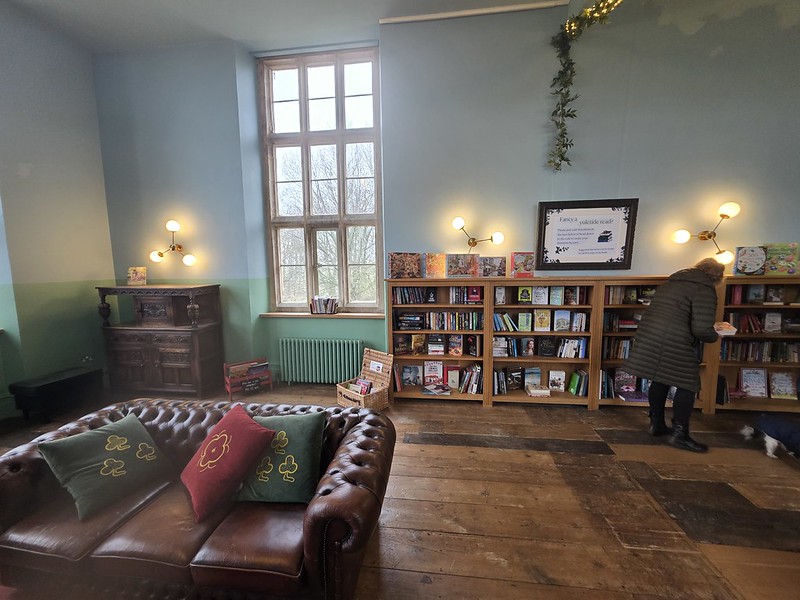
They’ve got one room painted in bright colours which is a very potted history of the estate, but it seems that they’ve primarily taken the opportunity to build themselves a substantial cafe, numerous offices for their own usage and some empty rooms. There is so much potential for more imagery, deeper histories, maps and just information about the site.
I got free access as I’m a National Trust member, but this site costs around £13 per person to get in and that gives access to the exterior only of the unfinished building, along with entry into this former manor house. If a family came here because a child was interested to see the former manor house, I’d suspect they might feel conned by the cost of entry. It’s £33 for a family and although I know the National Trust price entry highly to get people to join, this feels like they’ve taking advantage at this point.
“Very little to see for the money, only 3 rooms open in the manor house, one used to sell books, one for the cafe and the other painted a garish magenta colour had a few info boards on”
I don’t disagree with this review….
What appears to have actually happened is that the National Trust has acquired this property to operate as a cafe. Lovely as that is, it would be nice if they gave some sort of priority to the telling of history and explaining what is happening at the site.
Absolutely interesting, but does this have to be shoved at the bottom of the stairs?
Anyway, in fairness, I’m not entirely grumpy and I liked this exhibit. Although I wasn’t overwhelmed with things to look at in the house, other than the fine selection of scones.
They had some books for sale in a room that I felt was really being used as an overflow area for the cafe.
No expense has been spared with the television that they’ve put in the fireplace.
Anyway, the next post is about the cafe, as I think that’s what the National Trust would like visitors to focus on.
My friend Richard loves scones and I love historic properties, so that meant we decided to go to a National Trust property for the day in mid-January. We opted for Lyveden New Bield, which is located near to Oundle, so roughly it’s somewhere inbetween Corby and Peterborough.
Lyveden New Bield was conceived in the late sixteenth century by Sir Thomas Tresham, a wealthy Northamptonshire landowner and devout Catholic. Tresham designed the building during a period of intense religious persecution under Queen Elizabeth I, intending for it to serve as a secret oratory and a powerful symbolic expression of his faith. Tresham’s vision was partly for a nice summer house when not as his main manor house just down the road, but it was also for a physical manifestation of his religious devotion at a time when taking part in Catholic services was a criminal act punishable by imprisonment or even death.
Full credit to the builders of this structure, it’s still in really quite decent condition centuries on, despite never having had a roof. Unfortunately, there’s no public access to the interior now, the National Trust have decided that it’s too risky.
The planned main entrance to the house. Construction on the New Bield began around 1595, but the project was never brought to completion as the work came to an abrupt halt following Sir Thomas Tresham’s death in September 1605.
Just months after Thomas’s death, his son and heir, Francis Tresham, became embroiled in the Gunpowder Plot, the failed Catholic conspiracy to blow up King James I and the Houses of Parliament. Francis died in the Tower of London on 23 December 1605, just before he could be executed, and the family’s estates were subsequently heavily fined or confiscated. Deprived of the funds and the leadership necessary to finish the intricate stonework and roofing, the house was left as an empty shell, preserved exactly as the builders had left it over four hundred years ago.
The site remained a ruin for centuries, eventually passing into the care of the National Trust in 1922. The survival is something of some note as it would have been easy for the building to be demolished at any time, or for it to be repurposed into a cattle shed or something.
I had to take this photo through the hole in the locked gate, but I did want to go and explore inside…… It’s not clear if the National Trust will ever allow entry again, they say that the closure is temporary but they don’t seem to be rushing to resolve the problems of what they claim is falling masonry.
Back to mid-January, when Richard and I decided that we needed a little adventure and we opted for Burton upon Trent and the Ibis Styles there.
The corridor arrangement is clever, as if someone stains it then it’s not really evident. I’m fairly confident that this was the actual reason for this design as I can’t see anyone picking this by choice.
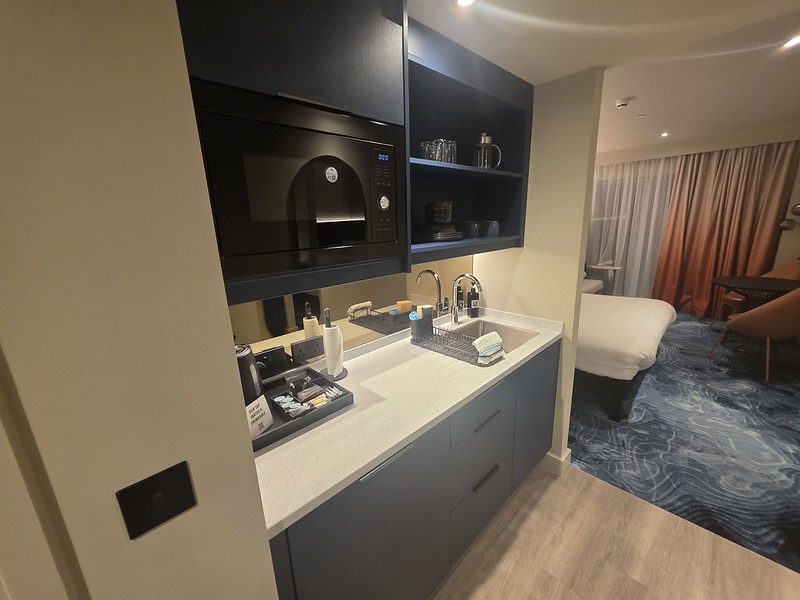
Richard was very excited that the room he had booked came with a kitchenette. I was pleased that mine did too, but solely as I didn’t want him having a better room than me (I’m not petty). As an aside, I personally don’t like these kitchens in rooms, they’re a nightmare to clean properly for the staff and require substantial maintenance for something that many guests aren’t going to want. Keeping a microwave and every piece of cutlery and crockery clean isn’t an easy thing to do, I can’t really see why they want to burden themselves with this.
Someone rather unkindly used AI to put a bottle of wine in the fridge and pretended that it was a welcome gift. Actually, on that point, there was no welcome gift, but I won’t labour that matter. Anyway, Richard was stomping about the place as he didn’t get a gift of wine but luckily I was able to reassure him before the manager was called. It would be helpful for Richard’s stress levels if people didn’t do this, but at least I calmed the matter down before there was a diplomatic incident. It was a good job that I was there to be honest.
There was a modern looking bar area, all rather comfortable.
It’s quite a clever mix of retro and modern, although it hadn’t exactly inspired hundreds of people to come in.
I would have preferred a wider range of beers, but in fairness, they have Pedigree which is an important beer locally so at least they’ve made an effort to have a local option.
As for the hotel in general, it was all clean, welcoming and well maintained. Richard didn’t end up having an argument with the manager and there were no noise issues either internally or externally. It’s a relatively new hotel and it faces competition from an IHG hotel literally next door, but it all seemed well managed.
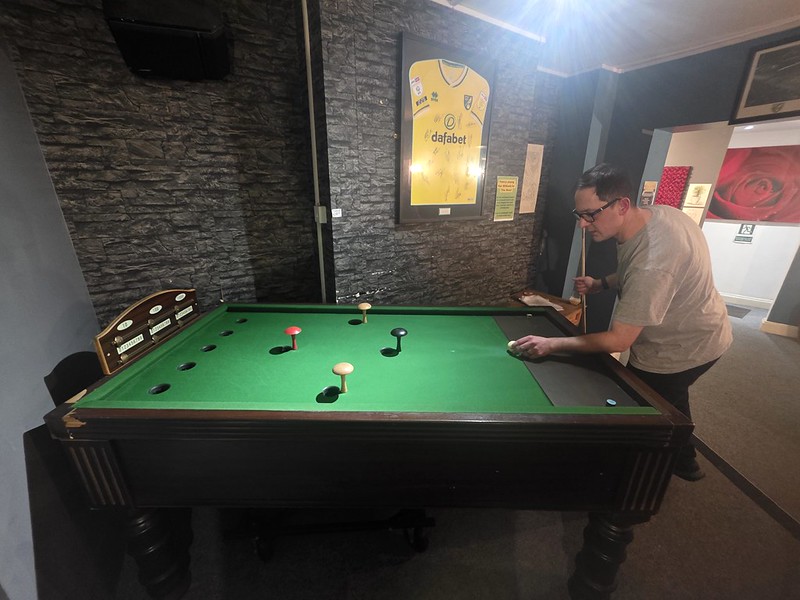
This is the final bar billiards table in the Norwich league that I haven’t played on, with the exception of the table out in South Walsham. It’s the table at the Rose and since Zak was planning to practice and Nick had a game from the singles competition at the pub, this felt the ideal time to try it.
Before Nick’s match, we had time for one game, and it transpired that neither of us had ever played at the table. He won, but not by many.
I did have a couple of victories in the evening and here’s Nick after beating his opponent 3-0. He now gets to play Oscar, who annoyingly beat me a few days ago…. Sub-optimal, I could have beaten Nick and I might have mentioned that to him 🙂
This was the second singles tournament game I’ve refereed in a week, I’m hoping that some of the talent will come to me via some form of osmosis.
Anyway, back to the table, it’s a robust arrangement and it’s quite fast off the back cushion. The pockets aren’t very forgiving, it requires some accuracy to get them in. It feels like a relatively low scoring table, I think it’s hard to build big breaks, but it’s nicely looked after. It’s the only table that’s £1 a play in the league, although I suspect the others will catch up at some point.
And, the Rose is a really lovely pub, a suitable range of cask and keg beers, friendly staff and it was also good to see my friend Emma over there, now back brewing Boudicca again.
This is a court case from 21 July 1886, when John Gayford, a 19-year old labourer, was tried in the Guildhall in Norwich with the judge being Baron Pollock.
The crime was sexually assaulting a six year old girl for which he was found guilty and sentenced to six months hard labour for his offences. This seems unduly lenient to me from today’s standards, but one substantial change is that they were merrily naming the poor girl who had been assaulted. To give some context, and although it was a repeat offender, the court the same week gave a criminal twelve months hard labour for stealing 14lbs of plums.
The victim was Nellie Baldwin and in an earlier hearing it was decided that although the only witness to the crime was a five year old boy, the courts accepted that they would take his evidence into account. Nellie, aged six, her five year old friend and a baby in a pram all went out together for the day. When the group returned home, Nellie explained what had happened and a police doctor was called. Some of the case relied upon it must have happened as she was physically hurt and how else would a little girl be able to describe what had happened.
John Gayford went on to become a self-employed gardener, he married Rosanna and they had two children, Rosa and Florence. Someone guilty of his crime today would have likely left the area after they were released, but at the 1921 census he was living at 20 Northumberland Street in Norwich, just a short walk from where the crime took place. He lived there until his death in 1942 and I imagine that just about everyone not directly impacted by the crime had forgotten about it, in those days when searching for information was somewhat harder.
Richard and I were walking down the road whilst he was busy gossiping on the phone and I saw this Indian and Nepali restaurant, quickly taking the positive action that we should go in it. I might have also got myself seated inside before he even got off the phone, but he was very pleased with my decision.
Incidentally, I wasn’t sure whether it was Nepalese or Nepali, but it seems that the latter is now preferred but the restaurant uses the former.
The restaurant has only opened relatively recently and it’s got some very positive reviews. And here’s the menu, which looked interesting with numerous tempting options.
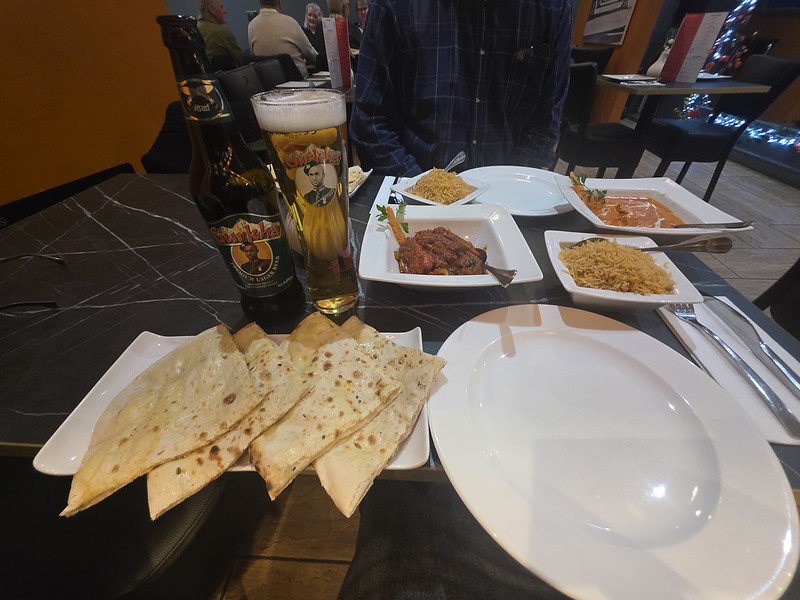
I opted for the Gurkha beer, which was actually about as good as a lager like this was going to be.
The poppadoms were brought over two short, but that was soon rectified, with the dips and chutneys being suitably tasty but they were quite hard to get out of the very flat plate they’d used.
And here’s my little arrangement of Bhuteko Kukhra, pilau rice and a peshwari naan. The curry was Nepalese fried chicken in a sauce with aromatic ginger, garlic and a robust masala sauce, with a chunk of carrot to act as a decoration. The curry had a depth of flavour, a certain amount of spice and the chicken was tender. The naan and rice both added positively to the main dish, all being filling and Richard was happy with the butter paneer that he had ordered.
The service was always polite and attentive, with a welcoming atmosphere and personable staff members. I liked that they placed us at a table for four rather than fitting us on a table for two, which ensured that we had plenty of space. It’s clearly a popular venue as well, they were getting quite full by the time we left and they had a steady stream of delivery and collection orders.