Blog

  • Leominster – Chequers

    Leominster – Chequers

    20231013_220656

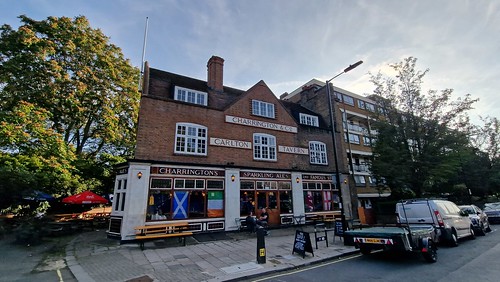
    Excuse the sub-optimal photo quality, but this is the Good Beer Guide listed Chequers pub. It’s operated by the Wye Valley Brewery, so there’s a strong emphasis here on the beers that they brew. The building was constructed in the late sixteenth or early seventeenth century, with seventeenth and nineteenth century extensions. It was likely first used as a residential property, with the earliest evidence of it being a licensed premises being from 1843.

    20231013_213009

    This is a photo of the real ales that I had to take of the back bar rather than the front bar. My first impressions of the venue were negative as they had customer seating along the small front bar which entirely blocked the view of the real ales, meaning I had to try and use my camera to zoom into the options. One customer provided me with help with choosing a beer which is all rather lovely, although it’s more usual that the member of the bar staff does that. Anyway, that issue aside, there was a laid-back and inviting feel to the pub.

    20231013_212729

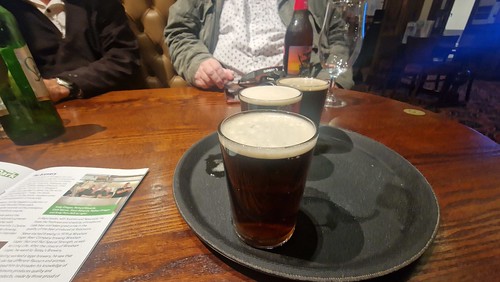
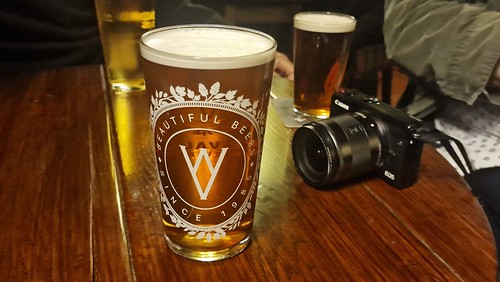
    Julian’s camera isn’t for effect here, it was just a relatively small table. The choice of table was mine as I noticed that I could charge my phone if we sat there, another little problem resolved. The beer is the Talisman from Wye Valley Brewery, a well kept pale ale which was unexceptional but still pleasant tasting.

    There was lots of heritage here, although I had thought when visiting that it was an old coaching inn and it doesn’t appear to have been despite its size. However, a modern extension and new toilets has been sensitively placed onto the side of the building, with the interior feeling historic and comfortable. Just a couple of weeks ago it was named by Hereford CAMRA as their “pub of the season” which isn’t an award that I’ve heard of before.

    Engagement from the team members was minimal, but by putting seats in front of such a small bar they’ve created a barrier to first time customers. The result of that is team members are unable to help customers, a situation that I thought was just a little sub-optimal. All else seemed fine though, with the pub being clean and well presented. For those lacking in confidence, it’s probably best to visit a venue such as the town’s JD Wetherspoon which doesn’t barricade its bar as part of some defensive mechanism against newcomers, but for those who are confident and want to try Wye Valley beers, it’s recommended.

  • Leominster – The Duke’s Head

    Leominster – The Duke’s Head

    20231013_211815

    The first pub of the evening that Jonathan, Julian and I visited in Leominster was the JD Wetherspoon operated Duke’s Head. I’ll use their history of the pub, but in short, it’s the former Post Office which is named after a pub which once stood nearby.

    “Before the post office was built in Corn Square, there was a small building on the front part of the L-shaped site. In the mid 1850s, it was the premises of dressmaker, Ann Lloyd, later occupied by Susanah Knill. She was the widow of the innkeeper of the Duke’s Head Inn which was located just a few feet away, on the corner of Draper’s Lane. The long-standing timber-framed inn closed in the 1870s and was demolished soon after.”

    I’m already going off on a tangent, such is my way, but I had a look at the response of some of the locals when in 2007 JD Wetherspoon put their planning permission request in…..

    “5.3.1 The loss of the post office is a loss of a public service.
    5.3.2 Already enough public houses in Leominster which are finding it hard to compete with each other let alone the low prices which Wetherspoons charge.
    5.3.3 No need has been proven for a further drinking establishment in area. Independent cost benefit analysis would be required to back up need for another drinking premises.
    5.3.4 The proposal will lead to rowdiness and attract undesirable elements to the area. Unruliness, anti-social behaviour, vandalism and noise will be generated in the area by proposal.
    5.3.5 Change character of town due to scale of proposal and anticipated number of drinkers.
    5.3.6 Already a public house in vicinity. Will make situation worse.
    5.3.7 Police already have problems in area.
    5.3.8 Noise will affect residential amenities of adjacent dwellings.
    5.3.9 Problems of litter.
    5.3.10 Proposal will destroy amiable atmosphere of Corn Square.
    5.3.11 Landscaped area at rear could be screened.
    5.3.12 Maybe managed inside but problems will occur outside.
    5.3.13 Enough public houses in Leominster and more will lead to more trouble.
    5.3.14 The vehicular access onto Church Street is very narrow and delivery lorries will have problems entering and leaving access.
    5.3.15 Church Street already busy with problems of parking which will be made worse by proposal.
    5.3.16 Large lorries have caused problems to local people over the years.
    5.3.17 More use of rear access track will make surface even worse.
    5.3.18 Public access along track will cause problems. Parking in local streets by customers will add to existing problems.
    5.3.19 Extra cars will be attracted to area.
    5.3.20 Not enough room for delivery lorries to turn within site.
    5.3.21 Delivery lorries could take light from dwellings in Church Street.
    5.3.22 Vehicular access from Corn Square would also be a problem due to narrowness of streets.
    5.3.23 The proposal could adversely affect tourism.
    5.3.24 Leominster needs to address its social problems.
    5.3.25 The proposal would destroy character of landmark building in town centre.
    5.3.26 More about demolition than conservation.
    5.3.27 Former post office building has strong period character. Loss of distinctive lantern roof and windows is undesirable as they complement fenestration of surrounding buildings.
    5.3.28 The replacement building is featureless and undistinguished and gives little consideration to its exterior and surroundings.
    5.3.29 Wetherspoons can do a better job of redesign than this.
    5.3.30 There are a number of inconsistencies in the drawings, ie drawing no 173, “area to be demolished”, fails to show the removal or covering of four first floor and one ground floor window, and does not agree with elevation no 173/12 and plan no 173/10E. The smaller size of this drawing makes it an easier point of reference making its potential to mislead the more likely. There are other more minor discrepancies between drawings 173/10E and 173/12.
    5.3.31 Church Street is an historic street and could be damaged by additional traffic generated by proposal.”

    Three people wrote to support the new pub. The local planners were more supportive, and in my view correct, noting:

    “There is no convincing evidence to the effect that an additional public house will adversely affect Leominster Town Centre.”

    20231013_204049

    It was all quite pleasant inside and I’m not sure that the world fell in because the town got a JD Wetherspoon pub opening there.

    20231013_204057

    As the JD Wetherspoon beer festival is on, I went for three one third of a pint beers. Oddly they had a beer priced at 99p which I queried as it seemed wrongly priced and the team member and manager had a little think and decided it was wrong but they left the signage up anyway. Perhaps sub-optimal, but it didn’t impact me. One of these thirds was under-measured, but they filled it when I asked. Jonathan was on his Staropramen whilst Julian was on low alcohol Ghost Ship as he was the designated driver.

    I went for the Yazoo Dos Perros, a brown ale brewed by a company based in Tennessee, with the beer having some hints of chocolate. The next was the Nut Brown from Adnams and I was aware I had come halfway across the country (or indeed more) to have a local beer to me, with this being quite fruity. The final beer I had here was a favourite of mine which was 1872 porter from Elland Brewery. This was odd, it tasted of bitter Kenco coffee and gravel, I can only think there was a cellar issue or they’re somehow serving the wrong beer. This was the one priced at 99p and they seemed confused what beer was on what line as it was. But the whole arrangement came to around £2.30, so I didn’t exactly feel short-changed.

    I liked the environment and ambience of the venue, it was all relatively peaceful and the service was timely and polite. The venue was clean, although I was disappointed at the lack of power points, but that was because I was keen to charge my phone up rather than me expecting them to have them. I had a look at the reviews on-line and they seem average for a JD Wetherspoon venue. One person left a one star review because of council policies and it wasn’t even the local council to the pub:

    “We traveled to bridgenorth while on holiday in Ludlow when we arrived traffic getting in to town was so bad because of road work we could only park fo 40 mins as car park was blocked off couldn’t wait to get out of there which took about 20 mins shame because we had been before and its a lovely place get something done about this mess Bridgenorth council”

    Helpful…

    “Had breakfast this morning. Mine was cold after being stood around for 10 minutes while my partners was being cooked. When they arrived the eggs were RAW and the pancakes were rock solid!”

    I’d like to see how these raw eggs were served. Perhaps still in their shell.

    “Not good,. Got our order wrong at the till when asked to put her mistake right, she just verbally abused us. Kitchen staff apologized and said it was McDonalds mistake who claimed to be the manageress.. shame could be a great place.”

    McDonald’s? Many of these reviews entirely confuse me.

    Anyway, it’s a large pub and I’m not sure who else would have taken these substantial premises over if JD Wetherspoon hadn’t of come along. The prices for drinks were towards the lower end of the scale, with a wide range of real ales available as well as numerous craft beers. A suitably refreshing first venue of the evening, but our next port of call would be a Good Beer Guide listed pub.

  • Wormsley – St Mary’s Church

    Wormsley – St Mary’s Church

    20231013_181732

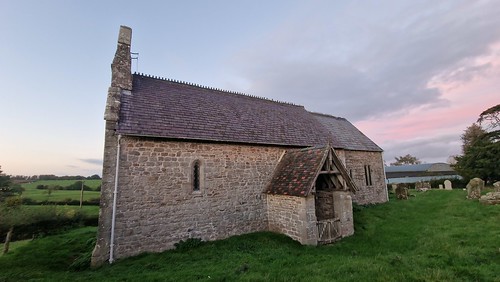
    I’ve returned from a weekend near Hereford and this was the shortest of the walks from our accommodation which was at Herefordshire Golf Course. Jonathan and I wandered down this track which only goes to some farm buildings and the former village church which is only a five minute walk away at most.

    20231013_181857

    We didn’t have a great deal of time before it was dusk, so it was fortunate that this was such a short walk.

    20231013_182105

    We didn’t need to worry about the church closing before we got there, since it’s open 24 hours a day. It’s looked after by the Churches Conservation Trust and they’ve got historical information about the building on their web-site.

    20231013_183227

    I would say that the churchyard was peaceful and quiet, but there was a cacophony of barking from the dogs on the adjoining farm.

    20231013_183026

    I slightly wonder how this church had a large enough congregation to support it into the twentieth century. There were only 70 residents in the village in the late nineteenth century and as religious attendance fell there were inevitable questions about its sustainability. In 1972, rather inevitably perhaps, the Church of England declared it redundant.

    20231013_182451

    It’s fair to say that it was rather dark when we entered. The rest of the photos are using flash and some by using my phone camera’s night mode to try and brighten things up somewhat.

    20231013_182500

    I thought that it was all really rather beautiful. The church dates from the twelfth century, but there was likely an earlier religious building on the site before that as there was a priest listed in the Domesday Book as living in the village.

    20231013_182926

    The twelfth century nave is built of sandstone and the chancel was added in the thirteenth century, but this has been knocked about by the Victorians who rebuilt it and incorporated some of the original stone.

    20231013_182727

    This font dates to the twelfth century, although the base is more recent. As someone fascinated by history and items that have been important to generations of people, being able to see a font that was used to baptise children born 900 years ago is something of an experience. I’m not an expert in font design, but there remains the possibility that this font is earlier and would be the only element remaining from the previous church. But this font remained safe during the Hundred Years’ War, the Reformation, the English Civil War and then the two world wars of the twentieth century. It’s done well.

    20231013_182703

    Both the doors in the north wall are blocked off, although it’s lost to history when that would have happened.

    20231013_183105

    And the north wall from the outside.

    20231013_183126

    The guidebook notes that there might be evidence here of external rood steps, but my building knowledge isn’t that advanced to even know what I’m looking at here. I imagine they would be external though, there doesn’t seem to be enough space internally for them.

    20231013_183245

    The church is located on an elevated position giving it some fine views over the countryside.

    20231013_183319

    There is one Commonwealth War Grave in the churchyard, commemorating the life of Able Seaman Ralph Davies who died on 21 November 1944, at the age of just 20. He was the son of Alice Davies, who lived in the neighbouring village of Brinsop.

    20231013_183640

    With that, we retraced our steps back to the cabins, making this the shortest and easiest walk of the weekend. The sheep looked vaguely interested in our expedition at least.

  • Food from Every Stall on Norwich Market – Week 26 and Lucy’s Fish and Chips

    Food from Every Stall on Norwich Market – Week 26 and Lucy’s Fish and Chips

    20231010_134115

    It’s week 26 of my eating at every food stall on Norwich Market and this is Lucy’s Fish and Chips. I have to declare here that I’ve been coming here with James for over a decade and he questioned the point of the entire project as we might as well announce Lucy’s as the winner without visiting any other stall. That slightly defeated the object of the exploration process, so I stood my ground. Anyway, I digress, but it’s important to note that this stall has already surprised and delighted me on many occasions in the past.

    20231010_131624

    The menu, which continues to inspire me. The payment process was efficient and well managed, with the impressive situation that they remembered our regular order despite visiting other market stalls for several months. They get a mark for that level of customer service and they accept cards and cash. Friendly as ever, the welcome was personable and engaging.

    20231010_134057

    There’s a seating area reserved for Lucy’s customers. It’s rare that we don’t get a seat here, although the stall can often busy.

    20231010_131701

    There’s a little diagram explaining where to order from. I’m not going to suggest that it’s completely obvious to see, but it’s more effort than some other stalls have made. There’s a vegan menu as well showing how they cater for everyone.

    20231010_132436

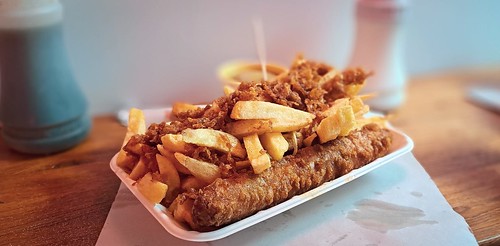
    Our regular order of large chips, large battered sausage, curry sauce and scraps, which is £5.10 each. Compared to some other stalls, this is a bargain. I think it might be starting to become evident that I’m going to like this visit. The chips are fluffy on the interior and firm on the exterior, with the scraps adding texture and decadence. The butcher’s sausage isn’t as good as they once had, but it’s still better than the generic offering often received at chip shops, with the curry sauce being rich and suitable for dipping chips into. All really rather lovely, as well as being hot and the portion sizes are generous. The whole thing sometimes sends me to sleep in the afternoon, but I had squash an hour later so that ensured that I didn’t have a little nap.

    IMG-20231010-WA0006

    James had the same as me, but his photo is considerably better than mine, so I’ll be using this as the thumbnail.

    IMG-20231010-WA0008

    It will come as absolutely no surprise to anyone that I’ll strongly recommend this stall and I’d be surprised if it doesn’t appear as one of my top three stalls in the final posts in a few weeks….. This is comfort food for the many, not the few.

  • 200 Years Ago in Norwich : Extraordinary Medical Circumstances

    200 Years Ago in Norwich : Extraordinary Medical Circumstances

    Another post in my series of articles from 200 years ago, this appeared in the Norwich Mercury in 1823. Firstly, any article from this period starting with “the following extraordinary circumstance” is likely to be quite an appealing thing to read and this certainly transpired to be an intriguing story. Not that it was evident from the first line that the newspaper editor wasn’t sure his readers would believe it.

    “The following extraordinary circumstance, although scarcely coming within the bounds of probability, is nevertheless undeniably true. A son of Mr. Thurman, of Cotton [I’m not sure of this, it definitely doesn’t say Catton, but I’m not sure where this place is], in this county, tailor, about 15 years of age, being about eight weeks ago employed in shooting small birds which were in the upper branches of a tree on his father’s premises, when the barrel of the piece bursting, he was stuck to the ground, and the report of the explosion being heard, he was found by some part of the family lying apparently lifeless.

    On removing him into the house it was perceived that he was not dead, and the best medical assistance being promptly resorted to, it was soon discovered that one of his eyes had been forced inward by some part of the gun, and though animation was restored he was incapable of speech, and any kind of nourishment, whether solids or liquids, weer with the greatest difficulty forced down, in quantities so small as scarcely to be sufficient to preserve him in existence. In this painful and perilious state he continued during the space of five weeks, at the end of which time the part of the gun which the explosion had forced into his eye made its way through into his mouth, which took place in the night, and by putting his fingers into his mouth he brought it away; in the morning it was examined, when, to the great astonishment of all who witnessed it, there was the breech of the barrel, the screw, and a part of the wood of the stock, the whole of which had ever since the accident being making its way through the internal cavities of the nostrils, and which, on being weighed, was found to be the weight of two ounces nearly, since which time (except in the loss he has sustained of one of his eyes) he seems to be in a fair way of recovery”.

    I’m mot a medical professional, but is this even possible?

  • 200 Years Ago in Norwich : Died by the Visitation of God

    200 Years Ago in Norwich : Died by the Visitation of God

    As part of my random series of posts from newspapers of 200 years ago, this article appeared in the Norwich Mercury in October 1823. I can’t say that the subject matter is particularly humorous, although I can’t imagine that I will upset any of his descendants given the passage of time, but I quite liked the style of how the proceedings were written up.

    “An inquiry was held at Lakenheath, on Sunday last, by Mr. Wayman, Coroner, upon Mr. William Roper, aged 78, a respectable farmer of that place, who, after eating a very hearty breakfast, and having been previously in good health, dropped down and expired immediately. Verdict – Died by the Visitation of God”.

    This “Visitation of God” is really just died of natural causes, but it was a relatively common description used during the early nineteenth century. It’s an intriguing turn of phrase nonetheless…..


  • Streets of Norwich – Goldsworths Buildings

    Streets of Norwich – Goldsworths Buildings

    Part of my Streets of Norwich project…. (updated in October 2023)

    20200515_110919

    I’m not entirely sure that there’s much of a street here, but there is a road name visible, so that’ll do for me.

    Screenshot-2020-05-15-at-12.08.12

    That road name visible in the previous photo is located on the Red Lion pub, but I wonder if it originally more described that row of buildings above the pub on this map from 1900. These buildings have since been demolished and the site is now used as the pub’s car park.

    20200515_110916

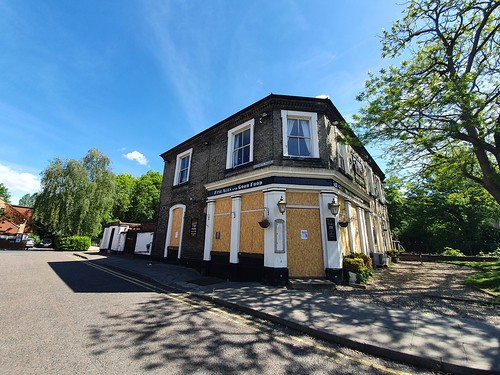
    Here’s the Red Lion, currently boarded up, although it was closed before the Covid-19 situation.

    20200515_110914

    This road seems to me to still be Bishopgate on maps, so it seems that the modern-day Goldsworths Buildings road is really now just the Red Lion pub and its car park. The landlord of the pub between 1842 and 1845 was James Goldsworth jr, so I have this idea that he built the properties by the pub and named them after himself. I have no evidence of this, but it makes for a nice story, so I’m going with it.

  • London – City of Westminster – The Rebirth of the Carlton Tavern

    London – City of Westminster – The Rebirth of the Carlton Tavern

    20231006_162828

    I’ve been meaning to visit this pub for a while, it’s a testament to the stubbornness of local heroes, rightly belligerent councils and loyal beer drinkers. The pub was illegally demolished in 2015 and nearly nothing was left standing. Pressure was brought to bear and the end result, after much legal wrangling, was that the pub had to be entirely rebuilt brick by brick. The difference in brickwork is visible, the section on the right is original and everything else is rebuilt. The local pressure group, the Rebuild the Carlton Tavern campaign, were praiseworthy of the restoration, although the developers CTLX decided not to attend the reopening.

    20231006_155649

    I would have never have known that this wasn’t a traditional pub, the internal recreation is sensitive and apparently nearly identical to what was here before. Some parts of the previous building, such as fireplaces and some of the bricks, were reused, and fortunately efforts had already been made to detail the interior and its decorative elements which made the restoration easier. The venue is also listed in the Good Beer Guide, so that’s another little tick on my attempt to visit every Good Beer Guide listed pub in the country.

    20231006_155518

    The toilets are down those steps to the right and nearly none of this survived other than the back wall. The pub had first been constructed between 1920 and 1921 by the Charrington Brewery, whose name is still outside the pub.

    20231006_155408

    But back to the present, there were three real ales available, and I haven’t tried any of them before, so that was something of a novelty.

    20231006_155521

    I went for the ‘Flying the Mags’ from London Brewing Co, a rich and creamy mild that was well kept and at the appropriate slightly chilled temperature. The service was polite and personable, with the environment feeling warm and comfortable. I liked this pub, it felt very much at ease with itself and it’s hard to imagine how close the community was to losing this. There are numerous community events, quite a substantial menu and the prices charged were very reasonable. I’m glad that I visited and this is a perfect model for what I think should happen at the Crooked House, a pub where there was a mysterious fire a few weeks ago.

  • Pubs Along the Hammersmith & City Underground Line

    Pubs Along the Hammersmith & City Underground Line

    Wooo, a new project for me! I’m aware I haven’t finished some of the other little endeavours that I’ve started, but I will get there eventually. My new riveting project for my two loyal readers involves me noting the best, or indeed just interesting (to me), pubs at every stop along the Hammersmith & City line. All 29 of them….. I will be doing this using a combination of Untappd, the Good Beer Guide and also my own endeavours.

    I’ll link them here when I’ve done them.

    • Hammersmith
    • Goldhawk Road
    • Shepherd’s Bush Market
    • Wood Lane
    • Latimer Road
    • Ladbroke Grove
    • Westbourne Park
    • Royal Oak
    • Paddington (H&C Line)
    • Edgware Road (Circle Line)
    • Baker Street
    • Great Portland Street
    • Euston Square
    • King’s Cross St. Pancras
    • Farringdon
    • Barbican
    • Moorgate
    • Liverpool Street
    • Aldgate East
    • Whitechapel East
    • Stepney Green
    • Mile End
    • Bow Road
    • Bromley-by-Bow
    • West Ham
    • Plaistow
    • Upton Park
    • East Ham
    • Barking
  • BOOK REVIEW : Travel Writing 2.0 (Third Edition) by Tim Leffel

    BOOK REVIEW : Travel Writing 2.0 (Third Edition) by Tim Leffel


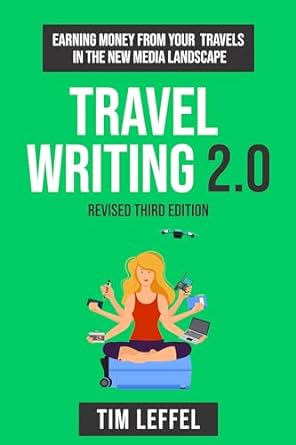
    This is another in my occasional series of book review posts and they might be appearing here more as I’ve just realised you can’t leave reviews on Amazon unless you spend £30 per year on other products. I admire their attempts to make reviews genuine, but it feels a little sub-optimal as I rarely buy anything from Amazon. Anyway, this book is by the travel writer Tim Leffel and I’ve followed him via his newsletters for some years. This is a slightly elongated version of the review that I would have posted on Amazon if I had met their new requirements.

    The present book aside, the best title that I’ve read on travel writing over recent years has been How to be a Travel Writer by Don George. That book perhaps needs a new version in a similar way to this update from Leffel given the ever shifting sands of the topic. The nature of travel writing has changed over recent years, but there are sections in this book on both traditional earnings as a travel writer and digital opportunities for a travel writer. Leffel notes that “the rise of one type of media does not mean the automatic fall of another” and I think that’s a solid way of thinking.

    Travel writing books many years ago would focus on writing articles for magazines and newspapers, as well as how to write guidebooks. Writing guidebooks is a challenging and time-consuming occupation and the comment that “you barely have time to write full sentences before moving on to the requisite restaurant listings and museum hours” is evident from any Lonely Planet or Rough Guide book. Leffel’s comment that many young travellers use their phone to source material and don’t go near guidebooks seems accurate as I can’t recall the last time I saw anyone in Europe or the United States under the age of around 40 looking at them. The market will continue to evolve, certainly the way in which travellers source their curated information on an area.

    The key element here, which I think is standard advice from all travel writers I’ve noted over the years, is to have a diverse portfolio of different income streams. Without that there will be inevitable highs and lows which make cash flow planning nigh on impossible without another way of earning money. The book is a useful exercise for those who are wondering what potential there is from entering the travel writing market, but the positive element is that there are low barriers to entry for anyone who wants to.

    In terms of writing style, the author stresses the importance of always being curious, noting:

    “If you are a closed-minded, dogmatic person who only gets news from one source, doesn’t have a passport, and never reads quality fiction, you are going to be a lousy travel writer.”

    I don’t claim to be a travel writer, although I have done some of it in numerous different ways over the years, but I’d agree that poor writing is often apparent. The author writes that some skills are innate and some are learned, but travel writing is certainly something that needs curiosity, practice and a lot of reading. Finding a tone of voice is inevitably important and Leffel preaches the need “to be authentic” in writing.

    All authors should perhaps consider getting their own blog, but this book suggests that it isn’t for everyone and it does potentially take up a lot of time. For some writers, the time and energy won’t be justified, but for others it is a useful marketing tool. I started this blog to primarily remember where I’d been, which I accept isn’t necessarily the inspirational back story some might like, but between my two loyal readers and myself I’ve been able to get numerous paid projects because of it. The pros and cons of having a blog are examined by Leffel, it’s certainly something to consider.

    There’s also practical advice relating to search engine optimisation, social media and networking. There’s also advice on things to definitely not do if new to the trade, alongside the importance of having a good work ethic. Most importantly, Leffel notes that it’s important to develop a thick skin for the inevitable rejections that will come. The advice on travelling in a frugal manner is also wise, I’ve managed to do that for years and I’ve always thought that this makes travel more authentic rather than taking away from the experience. When British Airways paid for me to travel in First and Club World I always had very different stories to tell than when in World Traveller, with most of my interactions during my five weeks in the United States last year being on public transport. There’s nearly always an angle, but the engagement with others plays a big part in telling any story.

    The author addresses very early on in the book the matter of income potential. Realism is important here, as most travel writers don’t earn that much from their profession, although there are some who do very well indeed. But, this is partly because some are hobbyists or just writing part-time, writing because they enjoy travelling and find that it makes their trips more affordable. For those who want to get into travel writing, this is certainly a good first book to read, particularly in conjunction with Don George’s book.

    You can buy the book by clicking on the Amazon image at the top of this post or directly at https://travelwriting2.com/get-the-book/.