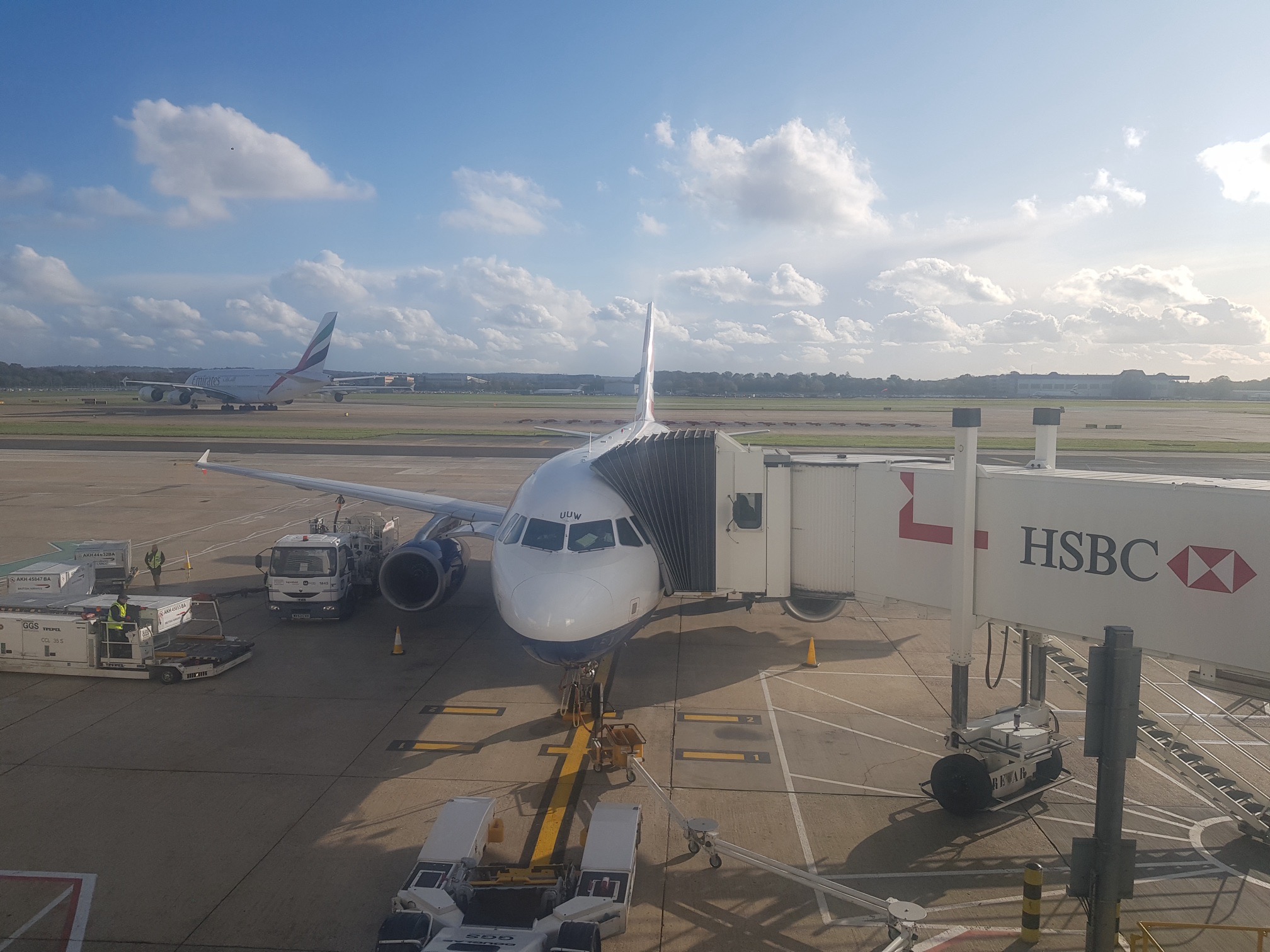
Above is aircraft G-EUUW, the Airbus A320 which was meant to take me from Gatwick South to Palma Mallorca. Unfortunately, a technical malfunction with the undercarriage meant that the aircraft needed to make an urgent return to Gatwick South after it dumped its fuel. The aircraft is one of BA’s Gatwick fleet and they’ve owned it since new, when it was delivered to them in 2008.

Going back a little, this is the boarding gate 28 at Gatwick South. The boarding process was all well managed, the groups were called in order and there was plenty of seating. There was the usual muttering from some passengers in group 5 who had clustered around the gate to board and then found themselves waiting until the end, but the signage and rules are clearly displayed. The staff members were pro-active in moving waiting passengers away from the queue, as there can be gate congestion if this isn’t well-managed.


I decided that I’d avoid an exit row on this occasion and went for one which was the row behind the exit row, because I like having my bag with me. After a major repair undertaken on my McCain’s bag, I wanted to monitor whether it would collapse or not. The flight was nearly full, it took off time and the pilots sounded friendly and helpful. With everything in order, I went to sleep.
I woke up to hear “we are now returning to Gatwick after we circle to dump fuel”. I asked the passenger next to me what had happened and was told that the pilot had made an announcement that something wasn’t responding, but there was no cause for alarm. I thought that this was most exciting and started to wonder whether there would be a three hour delay to claim EU261. I always think it’s just me who ponders on this, but it was clear from listening to other private conversations that it wasn’t just me. A couple of passengers were unnerved and wanted to abandon their flight when they arrived back into Gatwick, but all else remained calm. The crew came around with water and to offer reassurance, which they did very well.

Fuel dumped, landing back into Gatwick Airport.

I thought that BA dealt with the process well, but they didn’t really explain to customers where to go, they simply said to return to the main terminal and find customer services. That was fine, I knew where it was, but I was conscious that some people seemed to drift off unsure where to go. Nonetheless, there was a queue ahead of me at the customer service desk, where we were told that we’d be issued with new boarding passes and refreshment vouchers. Instead, we just got the vouchers and were told that the seat numbers would remain unchanged. I’m not sure in that case why they couldn’t have done that at the gate.

Every passenger got £10 to spend on refreshments.

I went to Boots with my vouchers. I had to pay 7p for the bag as the refreshments vouchers won’t cover that.

The boarding gate situation for the replacement flight wasn’t entirely clear, my app was telling me that the flight would depart from Gate 14. But, when I got there, no-one was there and the screen was blank. The boards didn’t give a gate number for some time, but eventually they did and I felt reassured that I wasn’t in the wrong place.

I was one of the first at the gate.

And here is my replacement boarding pass, a change from 13F. I had to check that this wasn’t an emergency exit row, for reasons already mentioned. I have, if I’m being honest, had better boarding passes, although it gave the information that was needed.
This was when things went just a little wrong for some customers. My seat was changed as the exit rows on the replacement A320 were in a different place, so they had to shuffle some customers around. I suspect that every customer was told about a change if it affected them, but some people claimed on board that they weren’t.
Anyway, I found one of the few plug sockets at the gate and charged my phone, conscious that the three hour delay was now quite marginal and if BA boarded quickly they’d get there just in time to avoid paying the EU261 compensation. Boarding started smoothly and I was on board again soon enough. The new aircraft was G-GATR, an aircraft brought into use by TAM and they kept it until it was sold to BA in 2015.
The boarding process was confused as some customers had a new seat number and some didn’t. I got on board, sat down at 11F and watched what became a slightly chaotic situation unfold. I’m not sure how much is BA’s fault, as I knew that two customers were deliberately staying in the seat they had already been allocated for the first flight, instead of their replacement seats. They were effectively being moved one row back to a different emergency exit row, but they weren’t having that. Which led to a domino situation of some customers in the right place, some in the wrong place, but some also standing in the aisle in a mood.
There’s a page on Flyertalk called DYKWIA (don’t you know who I am?) and there was a little of this kicking off. One customer told a crew member that they always had the same seat and he expected them to deliver that. The crew member didn’t seem impressed, but acted professionally, asking him just to take his new seat and they’d resolve the situation when everyone had boarded. Unfortunately, he didn’t like this and he told the crew that he was unhappy and stood up again, delaying customers. A few other people were murmuring, but BA had a crew member who was solid and firm, he wanted people to take their seats and he’d do what he could on what was a nearly full flight.
Our passenger, let’s call him Gordon although I don’t know his name, then continued arguing with a crew member in what was becoming a difficult situation. I heard another crew member say that they might need the pilot to intervene, but the crew member dealing with the situation said clearly “sir, you have two choices, you either sit at the seat you have been requested to sit at, or you leave the aircraft now”. The customer said something about there was another choice about he could have the seat he wanted, but the crew member was persistent and received a final warning of “sir, sit down or you will be asked to leave”. He sat down. I was marginally disappointed.
This whole situation had meant that BA no longer had any chance of arriving into Palma within three hours, although I’m not going to credit the grumpy customers with that. The flight was comfortable and the pilots were professional and calm, apologising several times for the delay. The pilot also mentioned that he had been led to believe that a new crew would have been taking us to Palma, instead of mostly the same crew, hence a delay as they had to complete a considerable amount of paperwork relating to the now broken aircraft. Incidentally, I was also pleased as I now had a seat free next to me on the flight, which I hadn’t earlier on.
We received refreshments of biscuits and a glass of water from BA, as there was no catering on the replacement flight. This isn’t a problem for economy as it’s a buy on board situation for customers, who could get stocked up at Gatwick, but the Club Europe customers couldn’t have been thrilled. The pilot made an oblique announcement when we landed that EU261 would apply, although he didn’t use those exact words and left just a little to the imagination. The doors opened, which is the measure of whether the compensation is paid, at 3 hours 19 minutes late, so this wasn’t the cheapest of days for the airline. But, looking at BA’s profits, I think they’ll manage.
But everyone was safe and sound, and all told, a professional operation from my favourite airline. How very lovely.