Author: admin

  • Poringland – The Fish Inn

    Poringland – The Fish Inn

    The Fish Inn in Poringland, one of our destinations for the day. As can be seen, there was no shortage of customers waiting to get in.

    The chip shop is attached to the Royal Oak pub (which for reasons unknown has recently decided to rebrand as the Poringland Oak, but will no doubt confuse many people). This is extension is relatively new (1980s perhaps) and there are some interesting old photos of the pub at http://www.poringlandarchive.co.uk/poringland/the-royal-oak.

    I was pleased that the chip shop was open when we went, as there was no information on-line and we thought we’d just take a chance. The opening times are quite limited, but this is a temporary arrangement given current events. The lack of card payment always slightly annoys me (although I was prepared for that here as they’ve picked up some negative reviews already for this decision), but is harder to justify given the current health situation. I haven’t seen anyone paying by cheque for some time, I was moderately surprised to see that.

    Lack of contactless payments aside, the operation seemed very safe inside with only one customer allowed in at a time and large protective screens. The service was efficient and friendly, it all seemed well managed.

    The battered sausage and chips was £2.50, which is pretty reasonable. The chips were excellent and had a sufficient depth of flavour without being greasy, with the battered sausage being generic but still entirely acceptable. Sauces are extra, but salt and vinegar is available and is added by the staff member.

    The reviews for this chip shop aren’t that positive at all, but that seems a little unfair. The limited opening hours probably make this easier to run at the moment as they don’t need to have food sitting around drying up, but I had no complaints about the service or food. I probably won’t go back (although since I’d have to walk over 5 miles to get there and then 5 miles back, I was never going to be their biggest customer) as cash only places are becoming ever more rare, but perhaps they’ll change that in due course. At the moment they just have to have numerous signs up saying they don’t accept cards, no doubt because it’s such a common request.

  • Dictionary of the Vulgar Tongue – Day 260, 261 and 262

    Dictionary of the Vulgar Tongue – Day 260, 261 and 262

    The Dictionary of the Vulgar Tongue was first published at the end of the eighteenth century, and given that the current health crisis is giving too much time to read books, I thought I’d pick a daily word from it until I got bored…. And to catch up after getting behind with these posts, and because I’m getting towards the end of the book, I’m doing three days at once now. How lovely….

    Post Master General

    Grose’s definition here is interesting as it gives some guidance about the evolution of the role of Prime Minister and that person’s control over the formation of the Cabinet, which was developing when the dictionary was written. Grose noted the phrase meant “the prime minister, who has the patronage of the all posts and places” and that would have been a relatively new thing.

    The role of Postmaster General had rather changed by the time that political figures such as Tony Benn were given the job. It was originally a powerful role as only the Postmaster General or his agents could authorise those who could handle the sending of mail, and the Postal Act of 1635 confirmed the monopoly situation. At least today there is little question of how much power the Prime Minister has, although it certainly not always been so.


    Prate Roast

    Following on from the previous definition, this is “a talkative boy”, but also meant anyone who was talkative or a chatterer. It’s a seventeenth century term, which lingered on into the nineteenth century before falling out of use. Someone who ‘prated’ was guilty of just talking for too long and too much, and although that word is still in usage I’m not sure that it’s particularly common.


    Priest-Linked

    This is a self-explanatory definition, just meaning “married” although it’s a shame that this isn’t much used today. I’d like someone to say “I’m Priest-Linked to her” rather than just say they’re married, it adds a touch of grandeur to the statement. Well, and perhaps slight contempt.

  • Norwich – Flint Wall of Bridewell

    Norwich – Flint Wall of Bridewell

    This pathway doesn’t appear to have a name on either old or new maps, but it separates Bridewell Museum from St. Andrew’s Church. And indeed, it appears that if we could go back 500 years to take a photo, this would look nearly exactly the same. Well, other than for the paving, that might not have been as good.

    OK, this is just a flint wall on the north side of Bridewell Museum, but it has gained a reputation for being one of the finest walls of its type in the country. And I think that deserves a blog post all of its own….

    What is today known as the Bridewell was actually built as a residential property in the late thirteenth or early fourteenth century. It was upgraded by William Appleyard in 1386, and at a guess, I think that this was when this wall was constructed. The building’s use changed after 1583, when it became used to house the city’s poor and unemployed, putting them to work, which is when it became the Bridewell.

    As an aside here, a Bridewell is a prison, and it took its name from one which was set up in London that was next St. Bride’s Holy Well. The name stuck there and was then used throughout the country, although these buildings were often also referred to as Houses of Correction. Anyway, the building was badly damaged by fire in 1751, the prisoners were moved out and it was then used as a factory, warehouse, storage unit and anything else the locals could think of. In the early twentieth century, it was given to the city to be used as a museum and it is now known as Bridewell Museum, the Museum of Norwich.

    The quality of this wall is pretty impressive and I’d hardly call myself a flint expert.

    This intrigued me and I could think of only one person I knew that could tell me what this was, and that’s my fellow NORAH trustee, David Stannard. I hope he won’t mind me quoting him:

    “The Bridewell wall is a classic example of knapped flint, and the picture of the circular feature is just that, flint. Flint is amorphous, i.e. it has no crystal structure to determine the way it breaks, and this block of flint, when broken in half by a hammer has produced this curious bulb…..it is termed conchoidal fracture.

    Curiously, if you look at the picture upside down you get an optical illusion of a hole rather than a cone….so there may be a corresponding ‘hole’ somewhere else on the wall….the courses above and below show similar bulb features.”

    And he’s quite right, look at the photo upside down!

  • Norwich – St. Stephen’s Church (Gates)

    Norwich – St. Stephen’s Church (Gates)

    I’ve learned something new today….. These are the gates of St. Stephen’s Church in Norwich where it meets Chapelfield (Chantry) shopping centre. I hadn’t given them much attention before, but they are finely made and add some character to the entrance to the churchyard. Anyway, what I didn’t know is that the stones set within the gate are there for a reason, they represent the stones that killed St. Stephen, who was stoned to death for his Christian beliefs.

    I admit that this probably isn’t the sort of fact that someone will want to rush to tell others, but I’ll look out for similar such projects when I visit churches dedicated to St. Stephen. As an aside, if the UK had remained Catholic, it’s unlikely we’d have anything called Boxing Day, we’d be like many other European countries and have a St. Stephen’s Day on 26 December.

  • Norfolk – Hundreds and Parishes of Norfolk

    Norfolk – Hundreds and Parishes of Norfolk

    Hundreds of Norfolk (in .pdf format)

    The hundreds are the old administrative divisions of Norfolk, in place from the Anglo-Saxon period to the nineteenth century civic reforms. I hadn’t seen this Hundreds of Norfolk map before, which has the parishes and the hundreds marked on it, which is rather useful. The PDF has been produced by the wonderful Norfolk Record Office and it’s a handy way of seeing how the old parishes and hundreds were made up. There were surprisingly few changes over the centuries, with 36 hundreds in Anglo-Saxon times and 33 by the middle of the nineteenth century.

  • Dictionary of the Vulgar Tongue – Day 257, 258 and 259

    Dictionary of the Vulgar Tongue – Day 257, 258 and 259

    The Dictionary of the Vulgar Tongue was first published at the end of the eighteenth century, and given that the current health crisis is giving too much time to read books, I thought I’d pick a daily word from it until I got bored…. And to catch up after getting behind with these posts, and because I’m getting towards the end of the book, I’m doing three days at once now. How lovely….

    Pin Money

    This is defined by Grose as “an allowance settled on a married woman for her pocket expenses” and it would have primarily been used to buy clothing and accessories (accessories here more defined as pins than anything more decadent). Sometimes it meant the sum of money given to the woman to run the household and there are some legal cases where pin money was given to women as settlements (not unlike today’s divorce arrangements). The phrase came into use in the mid-sixteenth century and is still used today, although usually in a wider meaning of just giving or paying someone a small amount of money.


    Plumb

    The definition here is “an hundred thousand pounds”, with Grose’s use of the word ‘an’ being common at the time as the ‘h’ of hundred was often not very clearly pronounced. This word could be spelled as ‘plum’ without the ‘b’ and the word ‘plum’ also meant wealthy, although I’m unsure why it came to mean £100,000 in particular. The word was mostly used by the criminal underworld and there were references to a ‘quarter of a plum’ and ‘half a plum’, so £25,000 and £50,000 respectively. It faded out of usage by around the middle of the nineteenth century.


    Porridge Island

    This is another one of Grose’s geographical definitions, “an alley leading from St. Martin’s church-yard to Roundcourt, chiefly inhabited by cooks, who cut off ready-dressed meat of all sorts, and also sell soup”.

    This is Horwood’s map of London from 1790, so from the same time as Grose’s book. St. Martin’s churchyard and the Roundcourt can be seen on the map (clicking on the map makes it larger). This is today a much visited part of London, as St. Martin’s Church still stands and is now on the edge of Trafalgar Square, which was laid out in the 1820s. Unfortunately, nothing else remains of the street plan where Roundcourt once stood, although the line of The Strand is unchanged. This part of London is now relatively modern and in places quite soulless, it must have been rather a sight to have seen this area inhabited by cooks selling their soup.

  • London – Kensington and Chelsea (Borough of) – Victoria and Albert Museum (13th Century Doors from Gannat)

    London – Kensington and Chelsea (Borough of) – Victoria and Albert Museum (13th Century Doors from Gannat)

    OK, I’ll admit that this doesn’t perhaps seem like fascinating blog content. It’s some old wooden doors from the thirteenth century with ironwork and they’re from Gannat, a commune in central France. The museum has some notes about just how rare these are and how they can be dated from their design and also as it was a transitional process of how chisels were used on the iron scrollwork.

    To be honest, that level of detail is a little over my head, I just like the element of history here. These doors would have been in use for hundreds of years and at one stage they were hung upside down, which is evident from the much later keyhole and lock. It’s not known which building these doors are originally from, but such decorative iron would have been expensive, so this would have been a substantial property.

    What does interest me here is just imagining how many people used these doors over the centuries. There are several church doors in Norfolk that date from the Norman period and there’s something quite magical about the thought of just how many people have passed through the doors for baptisms, marriages, funerals and the more routine sermons (of which I’m sure at least a few have been quite dull and mundane). The next stop on the church tour that Richard and I are doing is Runhall Church, where the tower door is thought to be contemporary with the building of the tower itself in the twelfth century. More on this in the next few weeks hopefully….

    The V&A likely have these doors on display as they want to show the design of the ironwork from the period, but I just liked that things such as this have survived and are visible to the general public. For anyone fascinated by old doors (I’m not sure how big that niche is….), there is just one left in the UK which is made from wood felled in Saxon times and it’s at Westminster Abbey.

  • London – Tower Hamlets (Borough of) – Ibis Shoreditch

    London – Tower Hamlets (Borough of) – Ibis Shoreditch

    Back a few weeks to when people could actually visit London, this is the Ibis Hotel in Shoreditch which is just a short walk from London Liverpool Street. Ideally also, it’s opposite Aldgate East Underground station, so it’s an easy hotel to get to.

    This visit was at a time when people could have a drink if they were also ordering a substantial meal. But, although the hotel was offering meals, there wasn’t much of a take-up.

    Part of the hotel’s decor, trying to give that East London theme to proceedings. The whole arrangement felt modern and welcoming, with something of an Ibis Styles type approach to the design rather than Ibis.

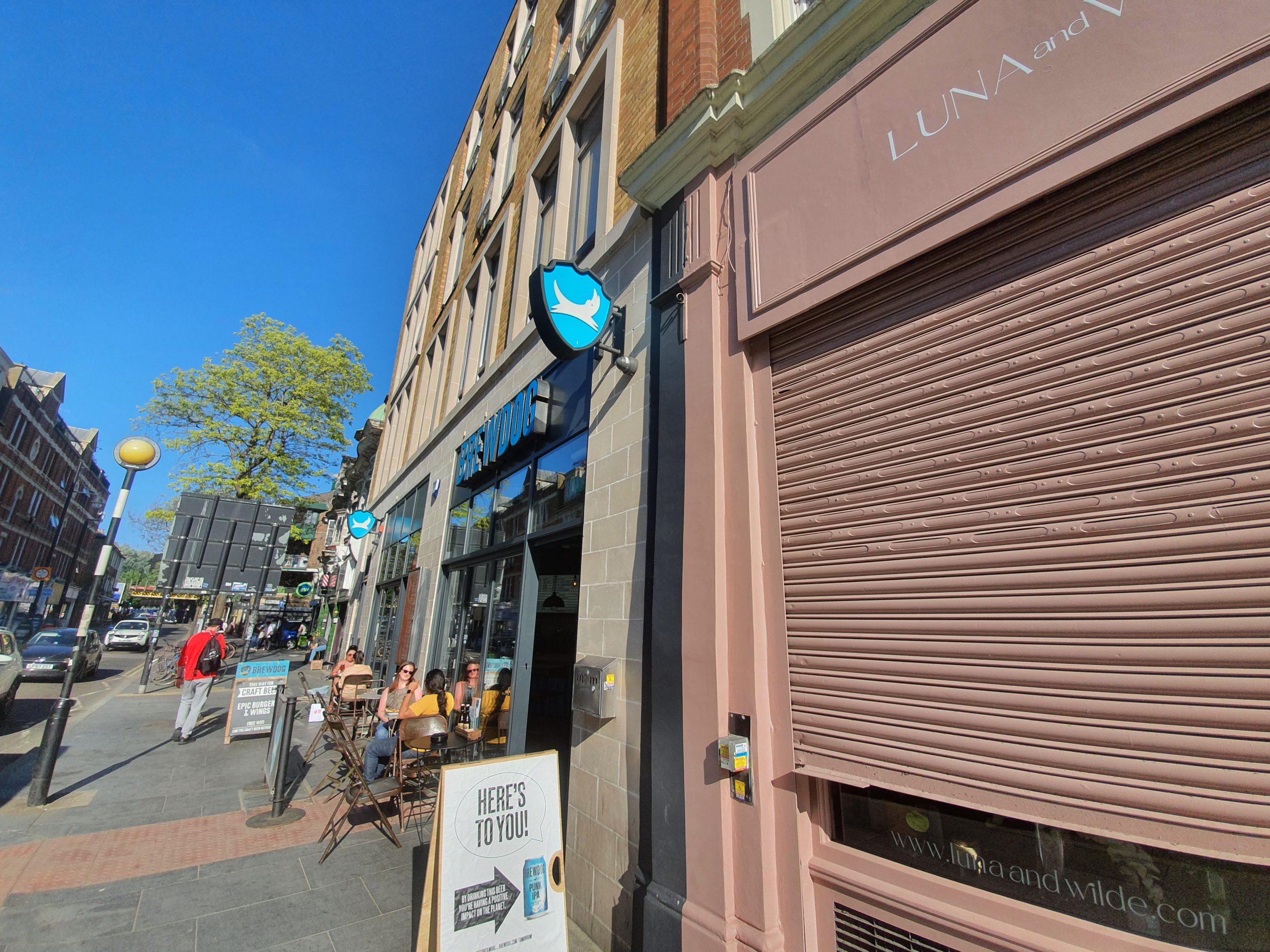
    This is the free welcome drink, one of the better ones which I’ve been offered. It’s not the finest in the Brewdog range, but I do very much like Punk IPA, nice and citrusy…. I look forwards to other Ibis hotels offering something slightly more exciting than Budweiser.

    The bedroom, all clean and comfortable. And it was located on the top floor and away from the elevator, just where I like. There were no noise issues either, although I’m not sure that the 348-room hotel was actually that busy. The hotel also had windows that could open, as I’m one of those slightly strange customers who likes the noise of city traffic and police sirens. It also meant that the temperature in the room was easy to control, something which I do most appreciate.

    I did very much appreciate the gesture and that’s a nice handwritten card, although secretly (well, not that secretly actually) I would have preferred chocolate…..

    Anyway, the stay as all sufficiently uneventful, which is ideally how hotel stays should be if it means that no disasters took place. Staff seemed friendly, although slightly underworked through the lack of guests, and I’ll come back here again.

  • Dictionary of the Vulgar Tongue – Day 254, 255 and 256

    Dictionary of the Vulgar Tongue – Day 254, 255 and 256

    The Dictionary of the Vulgar Tongue was first published at the end of the eighteenth century, and given that the current health crisis is giving too much time to read books, I thought I’d pick a daily word from it until I got bored…. And to catch up after getting behind with these posts, and because I’m getting towards the end of the book, I’m doing three days at once now. How lovely….

    Pigeon’s Milk

    And a prank from times gone by, defined by Grose as “boys and novices are frequently sent on the first of April to buy pigeon’s milk”.

    Google Ngram shows how the prank has slowly fallen out of favour.


    Pillaloo

    This word is defined by Francis Grose as “the Irish cry or howl at funerals”, although it originated as a hunting cry. The word dates to at least the early seventeenth century and is derived from the old Irish word puilliliú.

    And Google Ngram’s history of the word, which is now used relatively infrequently.


    Pin Basket

    One of the more simple definitions, this is “the youngest child”. This harks back to a long lost tradition of when a pincushion used to be given as a present to a new mother, with pins inserted of various lengths to indicate the children by age. The youngest would thus have the shortest pin, with this phrase dating from around the middle of the eighteenth to the middle of the nineteenth century.

  • Streets of Norwich – Barwells Court

    Streets of Norwich – Barwells Court

    Part of my Streets of Norwich project….

    This court connects St. Stephen’s Church to St. Stephen’s Street and isn’t the easiest of pathways to socially distance on, although fortunately I didn’t see anyone when walking down it.

    There is very little visually that is of much interest along this court, but its survival is quite remarkable as nearly every building along its route has changed over the last century. This was once where people lived and worked, but is now the rear of shops which stretch along St. Stephen’s Street. Norwich once had hundreds of courts and yards, although relatively few of them have survived in anything like their original form.

    This is the original width of the path and it has always been a thoroughfare and not just a court which has been opened up.

    This is looking towards St. Stephen’s Street and there is now a connection between the two properties which joins the buildings.

    Looking at the entrance to Barwells Court from St. Stephen’s Street, where there is now a Superdrug on one side and M&S on the other (formerly an H Samuels before M&S kept making their shop bigger).

    The court takes its name from Barwells Wine Merchants, which had been set up by John Barwell (1798-1876) and he was married to Louisa Barwell, the musician and educational writer. As ever, George Plunkett has a photograph here of interest, which shows damage from the Second World War and also what was underneath what is now Superdrug, but was then the premises of Barwells Wine Merchants.