

Pick your favourite ATM, there’s no shortage of choice….
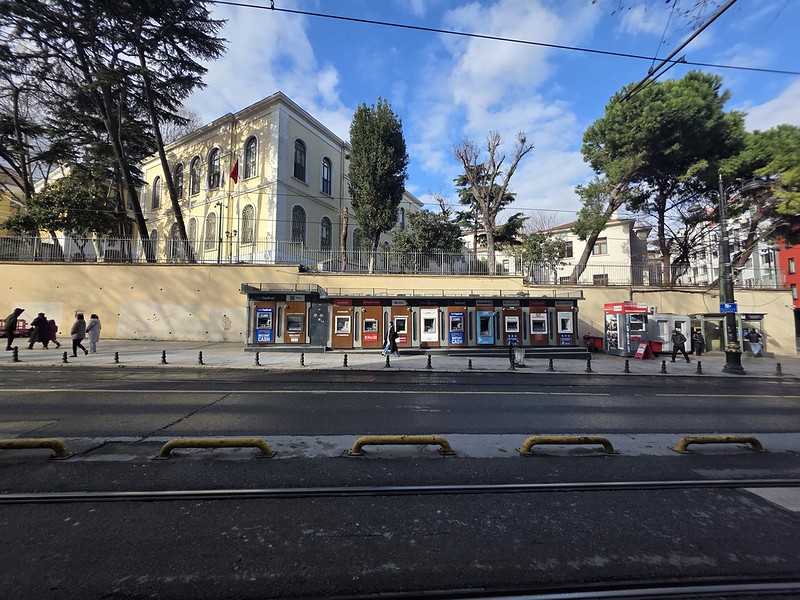
Pick your favourite ATM, there’s no shortage of choice….
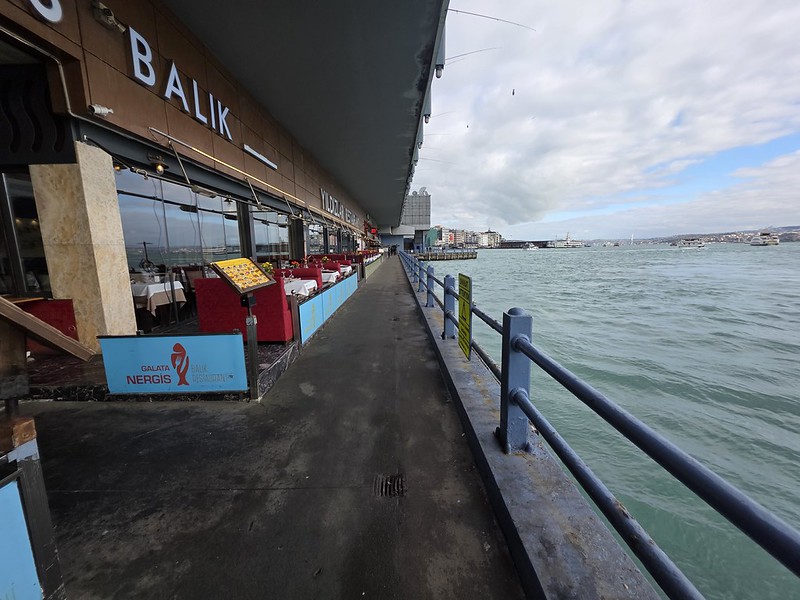

On the left is the Galata Bridge, which is the fifth structure built at this location, completed in December 1994 to replace a historic pontoon bridge that was damaged by fire. Spanning 490 metres across the Golden Horn, the bridge is a bascule design, featuring a central section that can be raised to allow large vessels access to the inner waters. The bridge is unique for its two-tier design, with the upper level dedicated to transit and the lower level housing a commercial corridor of licensed restaurants and cafes.

Standing on the lower deck of the bridge looking at the Golden Horn (an inlet of the Bosporus River), these aren’t flying fish, they’re the fishing lines from the fisherman standing on the top deck of the bridge.

We have a finely tuned policy on where to eat which requires advance research, so we weren’t tempted by the waiting staff trying to drag us into their restaurant on the lower deck.

Standing watching the river traffic going by.

The bridge links the Eminönü in the Fatih district and Karaköy in the Beyoğlu district. The photo shows the Fatih district, which is where we were staying and spend the day meandering around.

I’d note that there were a lot of people fishing and they were all catching a fair number of fish.

I’m very conscious that this ‘riveting’ blog is getting behind, I’m having some challenges with the Internet. Jonathan’s extremist view that I’m addicted to being online is ridiculous, so I’ve ignored that. Anyway, this is from Istanbul, so my first proper meal in Turkey. Posts might be a little shorter than usual in my attempt to catch up.

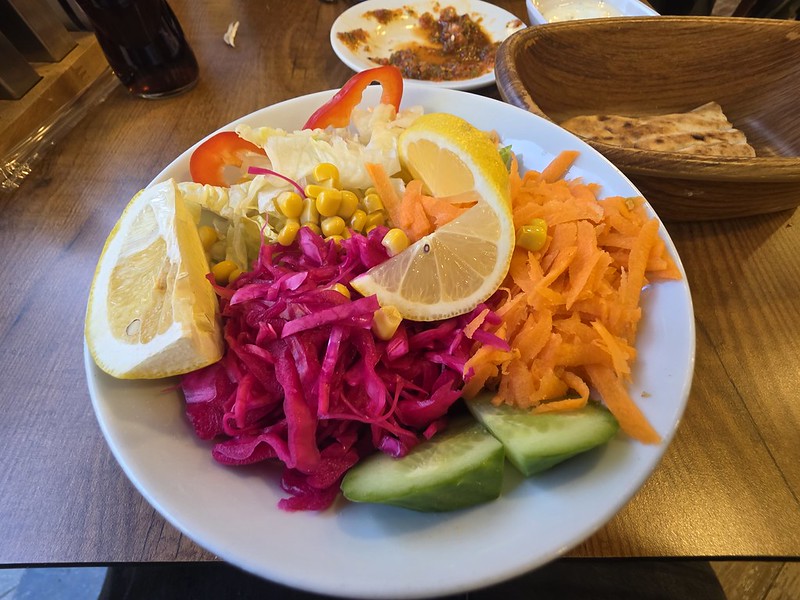
The bread, spicy ezme sauce and Tzatziki type dip was provided free of charge and they also replaced it when we ate all of it, which was really rather lovely.

I decided to go for a salad side as a healthy diet is obviously important to me. There was more salad than I expected and it was certainly a colourful and well presented arrangement.

The main course was chicken kebab which was really rather lovely, a depth of flavour to the chicken which was tender and moist. There was bread to mop up the juices and some texture from the onion.

There was a free dessert provided by the restaurant, this all felt a little bit like the Lowestoft Tandoori. It was similar to the Indian dessert of gulab jamun as it was sweet and syrupy, but the nuts added extra texture.
I paid around £6.50 for the Pepsi, salad and chicken kebab, with the rest of the elements all free of charge. It was also handy that they accepted card payments as I wasn’t sure what the set-up was in that regard. The service was attentive, polite and welcoming and the environment was clean and comfortable. This was certainly a really rather positive first impression of Turkish food in a casual and informal restaurant.
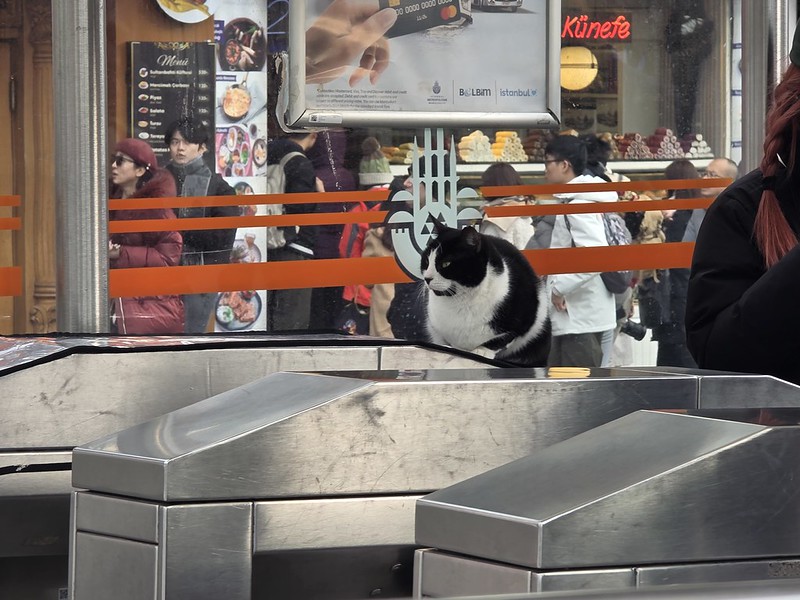
I realised that I was taking too many photos of stray cats in Istanbul, so I’ll pop some of the photos in this post and then I won’t need to mention it again. It’s not known how many stray cats there are in the city, but it’s thought to be around 125,000 to 175,000. That’s a lot of cats and the city has a policy to just let them be.

Sitting on a validator is likely quite warm and passengers can always work around it….

Very sweet.

A very focused cat.

A sleepy cat, I liked him…..

This one wanted attention but then saw a bird. Not that I went too near the cats, I’m unsure what little illnesses they might carry.

If you want to support local stray cats, they have cat feeding machines…

Perhaps this is why most of the cats looked relatively healthy. although it seems that many cats are adopted by locals who look out for them.
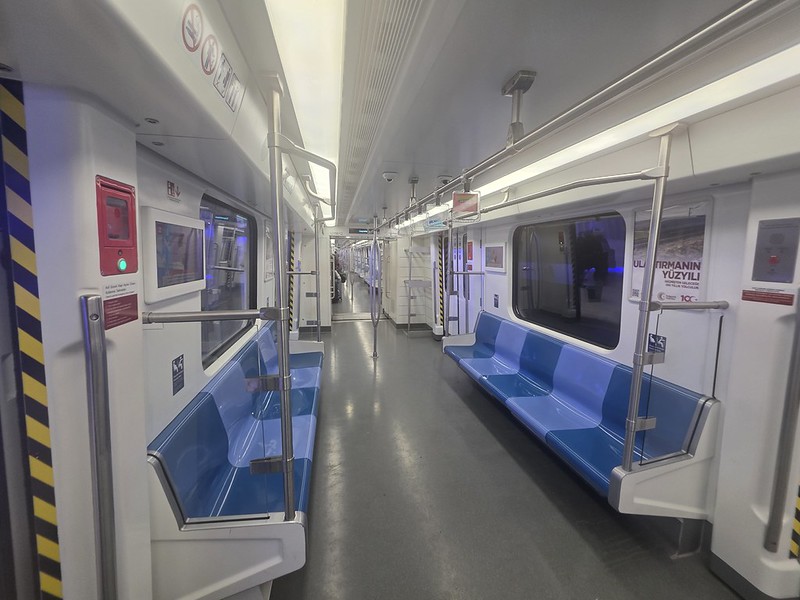

Istanbul Airport is a beautifully laid out building with clear signage and grand opening spaces. I’ve already mentioned that the wi-fi didn’t work, but I won’t continue to dwell on that.

The public transport signage, I was fortunate to have Jonathan to guide me through the options.

This is the covered outside area, it reminded me of Heathrow T5. It’s about a ten minute walk to get from the arrivals area of the airport to the metro lines.

I was hoping that the transportation system would be contactless, but it was more like London’s outgoing Oyster system. However, there were enough machines and the process was relatively painless and inexpensive.

We needed to take two metro trains to get to the city centre, this is the platform at the airport where we ready for our first journey.

We were heading to Gayrettepe Yonu station when we were transferring to a second line.

A photo of the metro train as we departed it, it had been much busier than that during the journey.

Changing trains at Gayrettepe Yonu, our first journey had taken around 45 minutes as the new airport is located a fair way out.

There was a bit of a walk, but we meandered up and down lots of stairs and corridors to another line which dates to the early 1990s. There’s a charge every time you change lines, but it’s all clear and works well.

There is wi-fi on some of the network for locals, but it doesn’t work on UK phones. I hardly complained about this to Jonathan.

The second train heading towards the Vezneciler-Istanbul University metro stop which is where we were getting off. This was a shorter journey of around twenty minutes.

And at around midnight, we arrived into the heart of Istanbul with just a twenty minute walk to the hotel. It was a little later than we would have liked, but we knew that the hotel had a 24-hour reception and it was good to be properly in Turkey for my first time (or Jonathan’s about 20th visit).

I had just enough time to pop into My Lounge at Gatwick Airport before the flight. It was busy when I entered but they were happily letting Priority Pass customers in without a queue, although it took me a little time to find a power point to ensure I was fully charged for the journey ahead.

There was some fruit for those who like that sort of thing.

And some reliably dreadful tasting Cruzcampo beer, but that’s fine as it’s meant to taste like that and wasn’t a serving error (although it is self-pour).

Our 13:05 flight was delayed by 80 minutes which was a little sub-optimal, but not critical to our travel arrangements.

I don’t entirely trust My Lounge food, but this looked safe enough as a little snack.

Boarding at the gate was, once again, efficient and well ordered. There were some passengers pushing their baggage limits somewhat, but they came unstuck as they were checking some bags. It’s an expensive extra cost for those who thought that they’d get away with it.

Boarding the aircraft which was registration G-WUKS, an aircraft that I don’t think that I’ve been on before. There was another ten minute delay whilst an engineer came on board to tape up a tray table was broken, but then we were good to go.

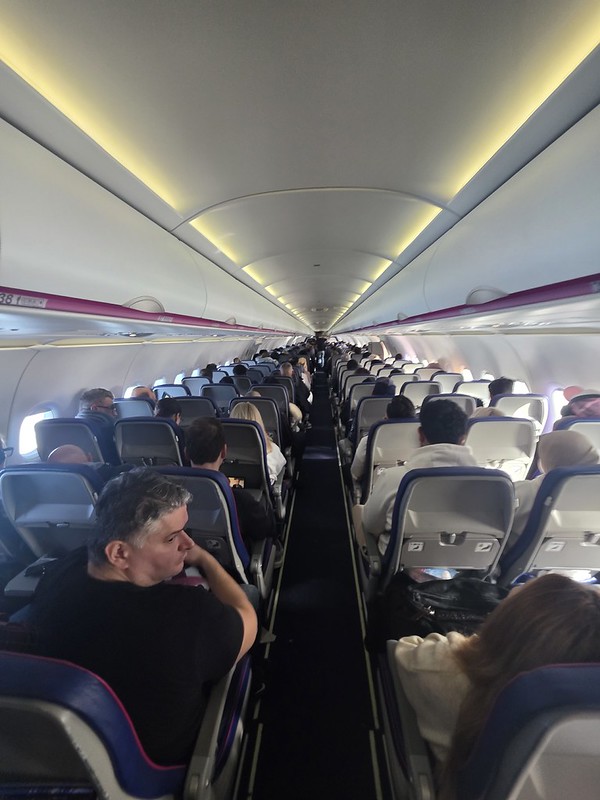
Jonathan and I had been randomly allocated middle seats which I had been slightly dreading as it was a four hour flight. Fortunately, when I boarded the row of three a couple of rows in front was evidently empty so I made a run (well, brisk walk) towards it. Another passenger mentioned to me that she was also moving there with her husband, but she suggested that I had the aisle seat, which is the one that I wanted anyway.
Jonathan had equally good news in being able to move to an aisle seat. The flight was actually three and a half hours, not four hours, but it’s a lot more comfortable when not wedged into a middle seat. The aircraft was clean throughout and as usual, the cabin crew were friendly, engaging and efficient.

And safely into Istanbul Airport which had no working wifi (I mentioned this a few times to Jonathan), but it’s a grand looking airport and the largest privately owned one in the world. It opened in 2019, replacing Ataturk Airport, and seems to be rather a long way from Istanbul. Anyway, on the positive side, the border control process only took fifteen minutes and we could then plan on getting to the hotel. Design wise, it looks an impressive airport and I’m sure that I’ll be back here again at some point in the future.
Although by this time we were around an hour behind schedule, the whole arrangement from Wizz Air surprised and delighted me, especially since I wasn’t trapped in the middle seat. Coping without wifi for another two hours wasn’t what I expected after landing though, but that’s not the fault of Wizz Air.

After safely switching platforms during the three minute connection time, I was safely at Hove railway station. To be fair, this isn’t going to be the most complex piece of transportation during this trip, but I was pleased that there were no delays here.
The original Hove railway station opened in 1840, but this was closed in 1880 and the railway station at this site opened in 1865 and was originally known as Cliftonville. It was renamed West Brighton in 1879, then renamed to Hove & West Brighton in 1894 before taking its current name of Hove in 1895.

Here the Southern Railways Thunderbolt rolling into the platform. It was a relatively busy train and an announcement was made that it was stopping additionally at Three Bridges to assist passengers having difficulty with the cancelled services between Brighton and London Gatwick.

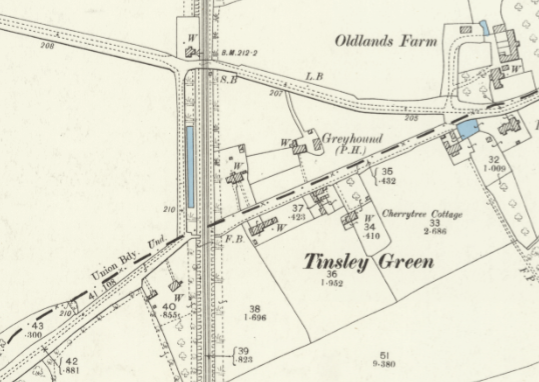
We arrived on time into Gatwick Airport railway station which was rebuilt in 1958 from the former Gatwick Racecourse station. As an aside there was also a railway station at Tinsley Green, renamed Gatwick Airport in 1936 (one of the first airport railway stations), but this was later demolished (to make way for the 1958 station) and this was a little further along the line towards Three Bridges.

As an update, Jonathan had already arrived at Gatwick about 45 minutes before, so this meant that we were now both safely at the airport ready for the flight. It was good to arrive on time given we didn’t have a lot of time to spare and it was then promptly announced that our flight was delayed.
And with that, the trip began…..

The morning of our first day started with my walking from the bargain priced Travelodge Brighton Seafront to Jonathan’s more decadent hotel.

A free breakfast courtesy of Jonathan’s accommodation arrangement. Jonathan was going to Gatwick via Flixbus on a bargain priced service which goes from the centre of Brighton. The journey was absolutely perfect in many ways other than they cancelled it, part of the reason that I didn’t book it in the first place.

Jonathan decided to get the train, although his options were somewhat reduced at that point. I had got a £4 rail ticket as part of the national rail sale, but that went from Brighton station to Hove station before connecting to another service. This station opened in 1840 and is mostly still there, but it’s hard to see the original building because of later extensions.

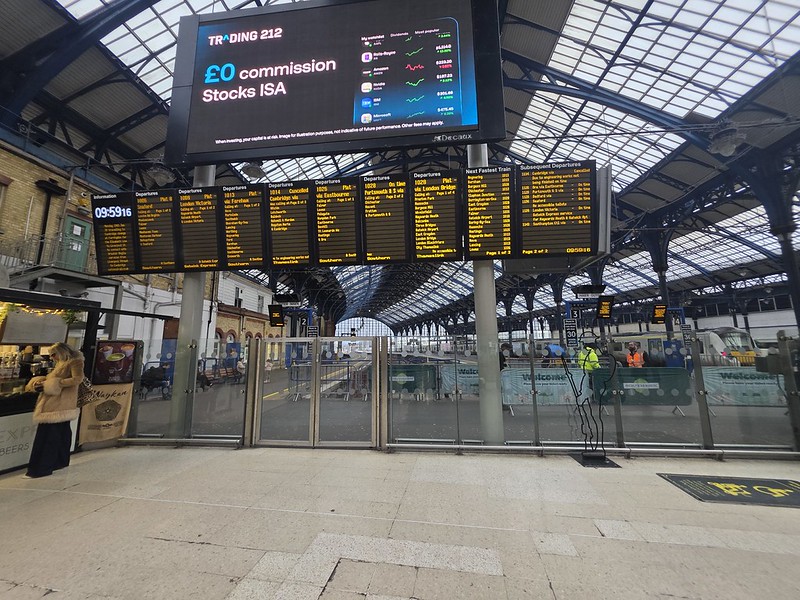
Mine was the 10:13 service and I was pleased that it was operating as usual as a number of services had been cancelled due to over-running engineering works. Jonathan had already departed on the first service he could, better to be safe than sorry when getting to an airport.

They announce the platforms around ten minutes before the train departs with this one departing from platform two. There are eight platforms at the station and some very careful gate line staff who were carefully checking all the tickets, something which took a few minutes as the barriers were rejecting a fair number of tickets, including mine.

My Southern Railways train sweeping in. I had cut this whole arrangement quite tight (well, tight for me), arriving just a couple of hours before my flight departed, due to wanting to get the £4 fare.

I got settled in for the four minute rail journey. There were power outlets and I must have charged my device by around 2% during the extensive journey. The train was relatively clean and organised, with plenty of free seats.

And safely into Hove railway station, where I had a connecting train to Gatwick Airport which departed just three minutes after my train from Brighton got in. A few others were doing the same connection and it feels too tight to me for those who aren’t easily able to navigate the subway between the platforms.
Anyway, that was the first part of the journey done….
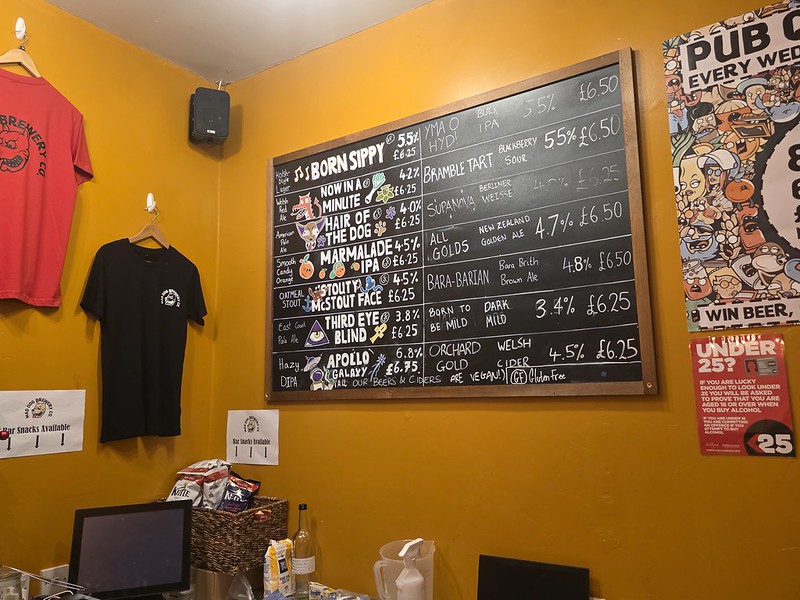

So many bars in Brighton that I haven’t been to, but unfortunately, so little time. Mad Dog is a brewery based in Cardiff, although they have taprooms in not only Cardiff and Brighton, but also Tunbridge Wells and Cheltenham. This venue has been open for around one year, so it’s a relatively new arrival to Brighton.

The beer list, although unfortunately the McStout Face wasn’t available. I opted for the three 1/3 pint beer flight that they offer, all beers from the brewery themselves. The welcome was friendly and so that gave a positive first impression.

The bar is located on the ground floor and that has nearly no seating, but there are seating areas on the first and second floors. It’s a slightly odd set-up, which makes accessibility nearly impossible, but it’s otherwise a clean and tidy arrangement.

They had Cards Against Humanity which brought me some amusement as I’m easily pleased. My first beer was the Marmalade IPA from Mad Dog, this had a gentle orange flavour and was crisp and clean.

Next was the Apollo Galaxy from Mad Dog, a punchy 5.5% (although the board gives a higher ABV) beer which had a taste of citrus from the hops and a bit of sweetness.

And finally the Now in a Minute from Mad Dog, this had a malty edge and a pleasant taste, but it was a bit thin.
The venue wasn’t overly busy when I was there, but the atmosphere was comfortable, informal and inviting. All really rather lovely and it was good to try three different beers from the brewery and I’ll likely visit their Cardiff taproom if I’m back in sunny Wales.
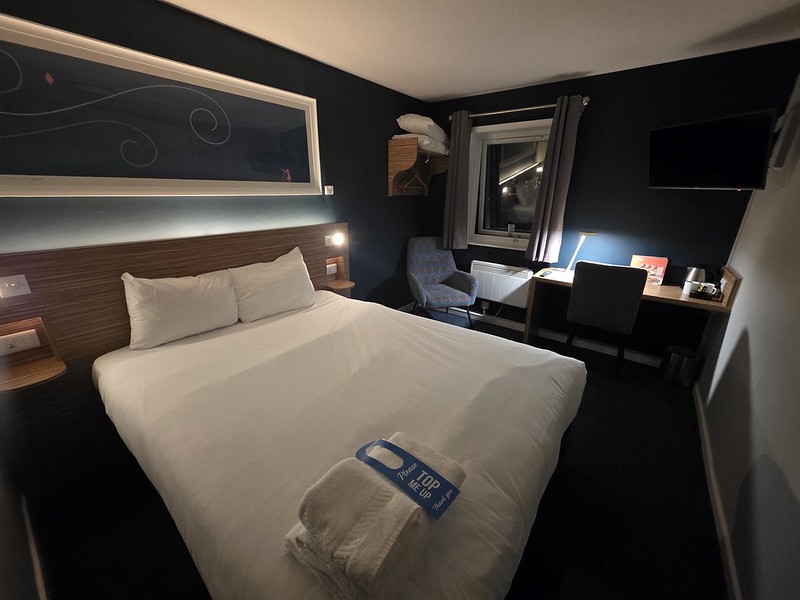

After a quick visit to the Rook Taproom, I popped to Brighton Travelodge Seafront to check-in and I was already pre-pleased with the arrangement as the room cost £22 per night which surprised and delighted me. There was a friendly welcome at reception and the receptionist mentioned that the bar was 24 hours, which is certainly handy.

For the money, I was very impressed with the value as the room was clean, tidy and well presented. The hotel looked a bit knocked about in places, but it’s obviously heavily used. There was a heater in the room and the window actually opened, so the whole range of options as far as I’m concerned.
I had a look at the online reviews and they’re not particularly good, but they’re not a disaster.
“DO NOT GO HERE -Needs redecorating and NOT value for money paid over the top for a scummy room and toilet .Not enough coffee and milk for two people complained to reception . I don’t normally give feed back but do not use Third party websites as you will be over charged and not willing to help.Travel Lodge think before you sell your booking slots…”
There’s a heap of tea and coffee at reception, as much as you could ever want. Definitely don’t buy a Travelodge room via a third party site though….
“I booked a night on the quieter floor but the music from the Pub across the street was unbearable, even with the window closed.”
I can imagine a lot of people don’t like the noise, but it’s probably best not to book a hotel in the centre of Brighton….
“Worst hotel ever! Stains all over the floor, bedding and walls. Kept awake all night by club across the road and the hotels response is well it’s not our hotel is it!”
It’s an honest answer to be fair…
“Yes this hotel is not too expensive and in a great location.
However room was infested with bed bugs causing over 40 bites on the body and then when moved room woke up with more. Was told they can’t offer refunds or compensation as the bites weren’t evidence enough so pest control have to confirm it. Rang 28 times and no one has answered to give a follow up and check If they have even rang pest control to avoid happening to other people.”
I like the reviewer’s precision of 40 bites and 28 calls.
“We paid over £200 for a 1-night stay. They don’t tell you that the hotel is right next to a nightclub that is open until 3am”
I think I would have considered paying £200 for a room as a bit sub-optimal, so they have my sympathy. Anyway, I digress.

And leaving the hotel the following morning. There was a lot of external noise during the night of crashing glasses and shouting people, but I like that kind of constant disruption and I slept through pretty much all of it. Overall, I was very pleased with the whole arrangement and if a room is under £25, then definitely go for it….