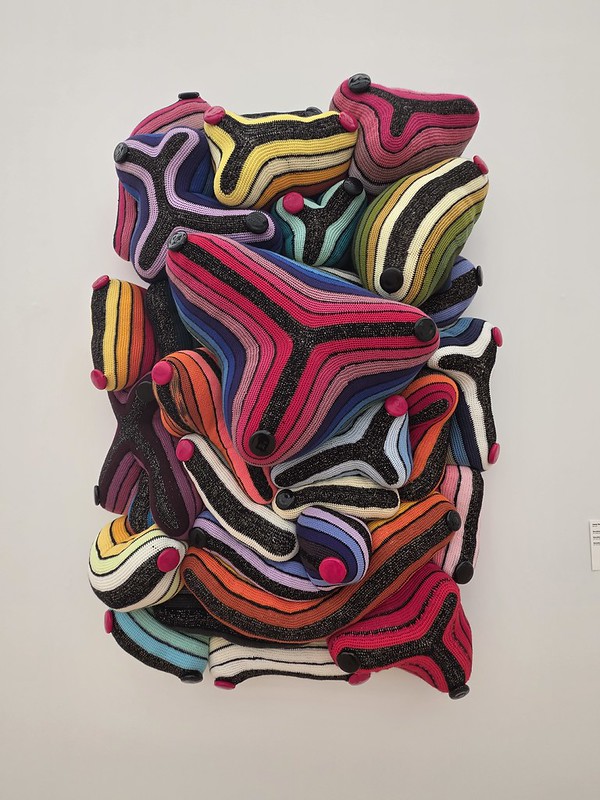
Returning to my riveting series on whether AI thinks an artwork is by a child or professional, it’s adamant that this one was created by an artist. Asked about the meaning it’s going with:
“I’d say the meaning is probably somewhere around abundance, softness, bodies, craft, colour and maybe the boundary between sculpture and textile work. It has that modern-art confidence of being friendly and inviting at first, then gradually making you wonder whether you are looking at something joyful, biological, decorative, unsettling or all of those at once. In technical terms, it is doing a lot.“
It was created by Joana Vasconcelos (1971-) in 2011 and has the title Shoreditch. It’s made from wool, murano glass, polyester and wood. It seems that the piece is named after the vibrant part of London which used to contain my favourite bar (namely Goose Island), until the bloody thing shut. This means that it remains culturally significant, although perhaps not in the way intended by the artist.
I don’t know, I can’t see any point in it, but AI likes it and has found meaning. It’s going down the route that artworks have traditionally been painted by men and have been of grand sculptures and paintings, whereas this shows everyday materials can be used to create art and that has feminist undertones. And, it appears that AI is right, reading some magazine articles, this is exactly what the artist has been doing. This is why galleries can be difficult. You can think you are looking at something decorative and then suddenly it is interrogating the patriarchy. But there’s a perspective I wouldn’t have realised, so all really rather lovely.
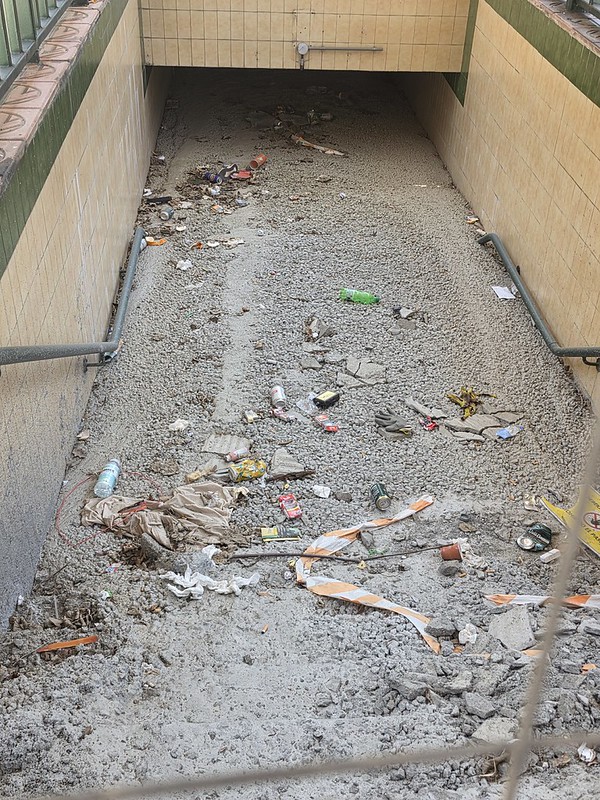
I was quite engaged with this as they’ve decided to redevelop the Bidebieta-Basauri railway station and that means filling in the underpass. There is something oddly compelling about railway infrastructure mid-transformation, especially when it involves a part of a station being quietly erased from public life.
It feels rather strange looking at this, knowing that just a few weeks ago passengers were able to use this underpass to cross over to the other side of the railway station. I liked that there was a sign saying that the underpass was closed, just in case anyone tried to crawl in through that hole at the top.
I understand that the railway station is being upgraded with new passenger buildings and platforms being constructed, as the existing underpass kept flooding. Underpasses always have a slightly gloomy feel to them at the best of times, and a frequently flooded one is unlikely to have been the highlight of anyone’s commute.
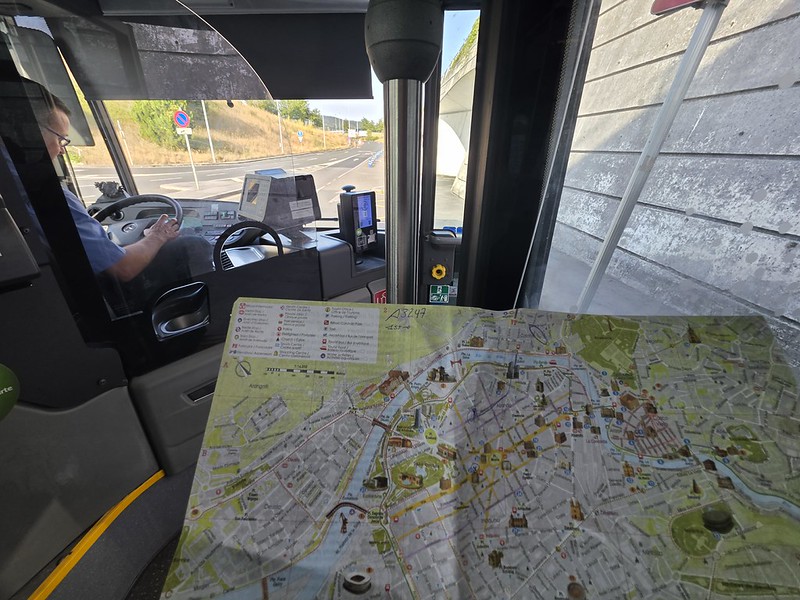
It might not take much, but this confused me when I went to find a bus to get to the city centre. This isn’t the bus number that I expected and nor did the signage make much sense which is always a promising start when I had just arrived somewhere hot, tired and in possession of slightly declining patience So, I went back inside and found a tourist information office. Now, the lady working there was very helpful and explained that Google wasn’t accurate for this, the bus number that I needed was the A3247, which is the bus I had been looking at.
I will add at this stage that the bus company hasn’t really bothered doing anything much here, there were problems with the return journey that other passengers were struggling with as well. But more of that in a few days as I don’t want to excite everyone too much by bringing forward all the Bilbao bus content at once.
And here we go again, but I’m ready this time. I was aware that getting a Barik card would have made this fare cheaper, but I had the lost the will to faff about any more, although I did get the card for the rest of my travels in Bilbao and it represented very decent value for money. For this journey, I just paid with my contactless card.
Right, all set with my map, the bus number and a star where I had to get off. My accommodation is marked in a circle at the top and the helpful lady told me that it was hot. I was actually very aware of this as I had nearly passed out in the extreme heat when I went outside looking for the bus the first time, but I didn’t say anything.
The bus journey takes around twenty minutes and it stops at a number of locations in the city centre, although these may or may not coincide with the advertised stops. This adds a little mystery to proceedings, which is exactly what everyone wants from public transport after landing in a new city. But, I mustn’t complain as I was delivered to the centre of Bilbao safely and the bus driver was making an effort to be helpful with everything.
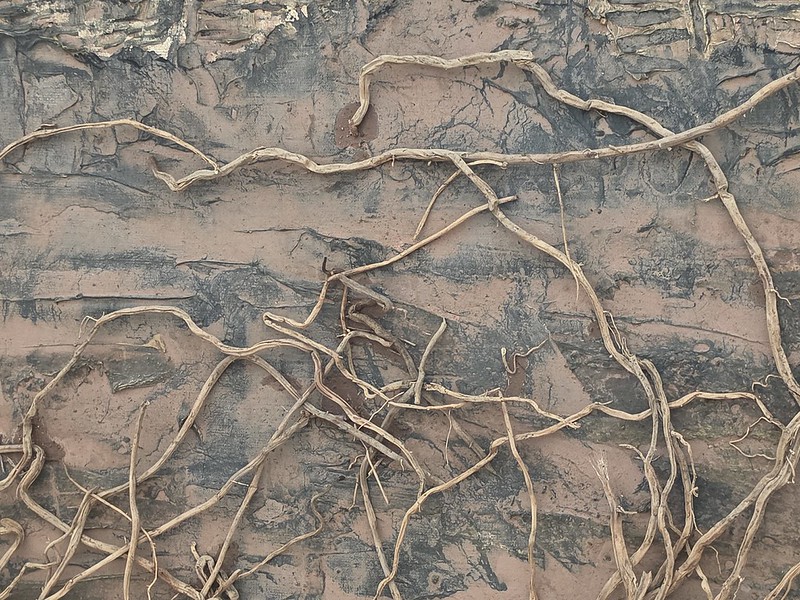
And onto my third artwork where I’m asking AI to try and give meaning to modern art, as well as just checking whether it thinks it was created by a professional artist or a child. This continues to be a slightly dangerous experiment, not least because AI appears to be gaining confidence while I remain largely in the ‘that looks like some roots’ stage of interpretation.
AI is adamant here that this is definitely a professional work, although added that “a child would not have been able to convince a gallery to put what appears to be half a hillside and some determined roots on the wall” which is another way of looking at it I suppose. Children may produce strange and powerful things with mud, glue and enthusiasm, but they rarely get the framing budget or the wall space to make it feel like a meditation on civilisation. The artist is Anselm Kiefer (1946-) and the artwork was created between 1985 and 1991.
AI mentioned that “it has a strong feeling of decay, buried memory, erosion and nature reclaiming something human-made” and when pushed it gave the meaning to the artwork that it was suggesting that nature gradually took back control. It then wanted to go further, it said that this artwork was likely about “time overwhelming human ambition” which I thought was quite philosophical and powerful. I must admit that this did make me look at the artwork again in a different way.
This website gives more background to the artwork:
“In this work, Anselm Kiefer revisits another iconic episode in German history. The painting references the castle commissioned in 1838 by the Russian tsars from Karl Friedrich Schinkel, the great German neoclassical architect and one of the key figures behind the city of Berlin’s architectural landscape. For Schinkel, Orianda was a dream project, one with which he sought to leave an indelible mark on history. However, the castle was never built, and according to some interpretations, this disappointment delivered the final blow to the already weakened health of the renowned architect.”
This pleased me, I had an artwork that had meaning, was interesting to look at and which also had some historical perspective. It is all rather powerful, although admittedly still not something I would hang in a breakfast room unless I wanted to start every day contemplating human failure before the crispy bacon was served up.
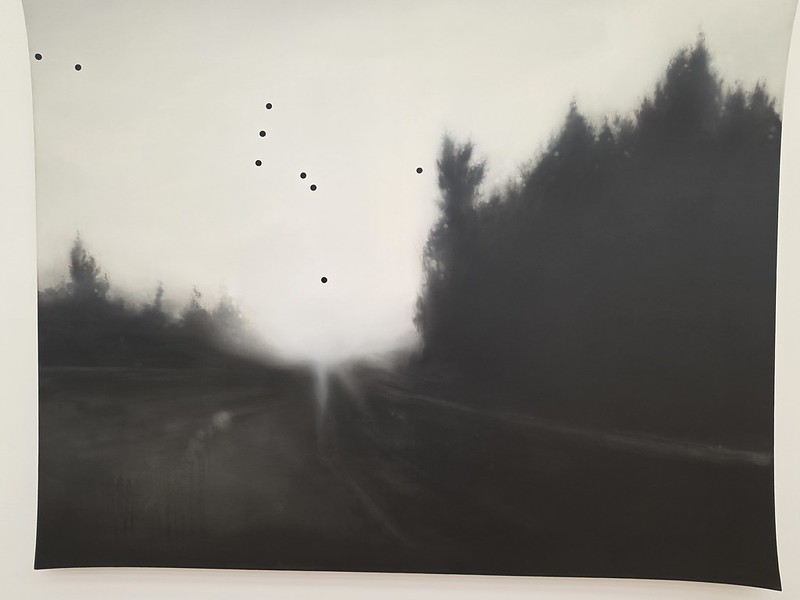
Continuing on my theme, which I’ll soon get bored with, of finding meaning to modern art by using AI, this is ‘Starway to Orion’ by Alain Urrutia (1981-) which was created in 2014. AI has decided again that it thinks that it was created by a professional artist rather than a child, but has added that it could have been created by a very thoughtful and gifted child. This is an interesting category, and I look forward to future galleries labelling works as “possibly by a serious adult, but do not rule out an unusually reflective seven-year-old”.
AI is going for this being a dreamlike landscape with the black dots giving the indication that this is a very controlled artwork which “moves this from a nice atmospheric landscape to gallery label incoming” which isn’t an unreasonable comment. What AI didn’t notice is that the dots are the constellation of Orion, although when I questioned it to look again it did reply “it looks like a constellation, but not one that I know” which is at least getting there.
This website gives a more detailed explanation about the artwork:
“Beyond mere representation, the artist seeks to create spaces where images become vehicles for exploring the ineffable and the mysterious—images that inevitably engage the viewer, evoking not only cinematic language but also the poetics of dreams. In this way, Starway to Orion alludes to an inner landscape that invites reflection, where painting acts as a bridge, reflecting his ability to condense complex emotions and thoughts into images that, at first glance, may seem simple but soon reveal their depth and become profoundly evocative.”
I didn’t get that, I thought it was an out of focus landscape with bullet holes. I don’t think I have the emotional depth for all of this. This is why I need AI, although given that it missed Orion, perhaps we are both attending remedial modern art class together.
I’ve jumped ahead a little here to write about the Museum of Fine Arts since I’ve just visited and I’m sure that the Internet is enthused to hear my feedback. I very much struggle with modern art, or at least, finding any meaning in it. So I’m going to lean into AI to help me, in the absence of the gallery doing much in this regard, and also asking whether it feels a piece is by a professional artist or a child. I appreciate this may not be the methodology most art historians use.
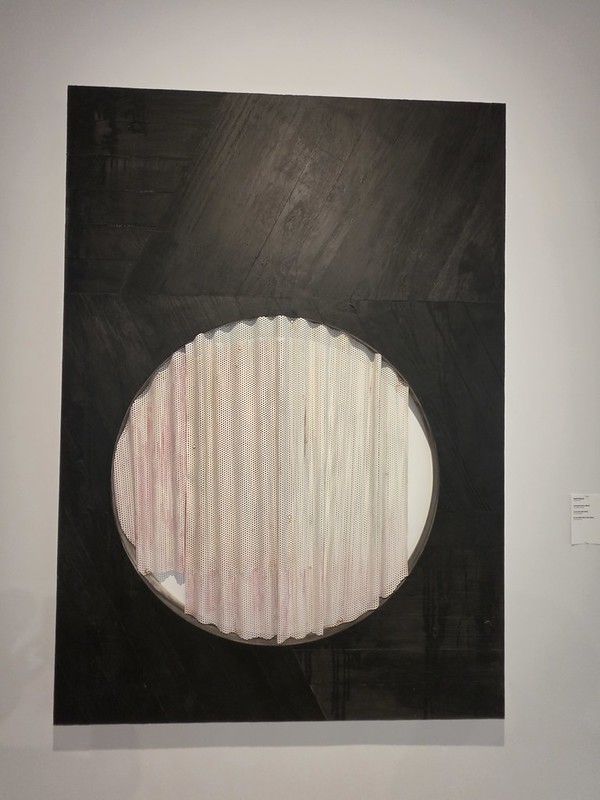
AI has immediately determined that this is an artwork by a professional, referencing that the contrast is the central element of the piece. It mentions that “pleasing tension” between the window, screen and barrier, with the viewer being invited to look through something whilst reminded that looking is being controlled. I’m not entirely sure that’s what I would have taken away from this artwork, but there we go. This is perhaps why AI is useful, it can find meaning where I find fixtures and fittings.
Anyway, it’s by Martin Boyce (1967-) and is entitled ‘On the Other Side of the Glass’, being created in 2014. What confuses me further is that other galleries appear to have displayed this work the other way up, which feels rather chaotic. I had assumed modern art was already challenging enough without requiring the viewer to establish which direction is correct. Perhaps that is part of the tension. Or perhaps someone just had a different wall and a quiet afternoon.
I’m not sure I need to write too much about Warsaw Chopin Airport given that this is not short on content about the building. There are only so many times I can photograph the same airport before it starts to feel less like travel writing and more like a long-term monitoring project. Still, here we are again (as a friend would say), because I am nothing if not thorough about documenting the movement of myself through transport infrastructure.
It was busy though and my usual security entrance was closed due to the number of passengers, but there’s another entrance further down into the terminal and that was quieter.
The lounge was busy, but I was able to get a high table next to a power point, which seems to be something of a theme this week. Anyway, the chicken and carrots were rather lovely, alongside beer, Fanta and coffee. I know how to live. Not extravagantly, perhaps, but with a balanced approach to liquids.
And some salad.
I gave myself twenty minutes to get from the lounge to the gate. I hadn’t realised that the gate was literally ten metres away, it’s there on the left and the lounge entrance is on the right.
There was a long queue to get into the lounge, which says quite a lot about how airport lounge access has changed. I’m afraid there are now too many people doing what I’m doing, although possibly with more sensible travel times and fewer self-imposed routing experiments. Lounge usage is more popular than the space allocated for it, and given that there are four airport lounges at Warsaw Chopin, with two reserved more for legacy airlines, it is an indication of their popularity. The modern airport lounge is no longer a tranquil refuge. It is now a competitive seating environment with pastries.
I don’t normally pay any attention to what the weather will be like in a destination as I neither care nor worry about it. However, it was hard not to note the temperature in Bilbao and so, as ever, I was pre-annoyed. This is one of my more efficient emotional states, allowing me to be irritated before the actual inconvenience has occurred.
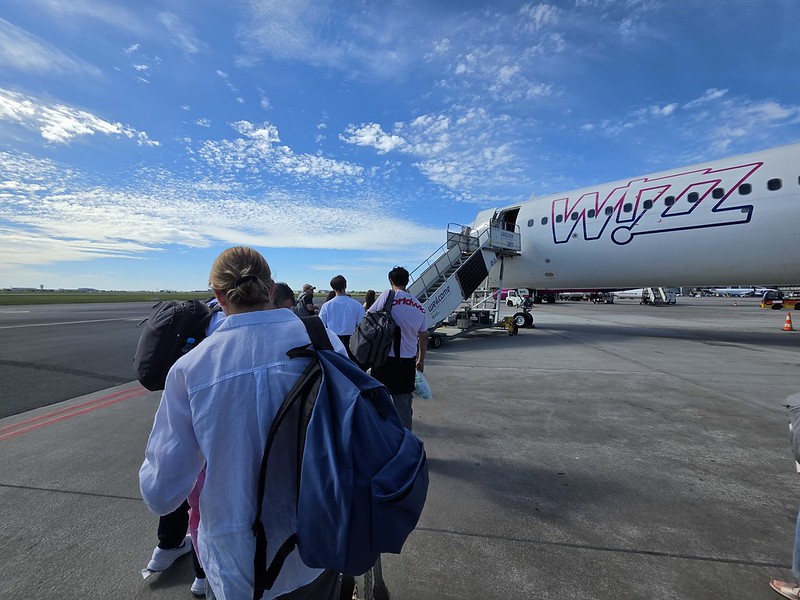
I wasn’t surprised that it was a bus to the aircraft.
The aircraft was 9H-WBE which was a new one for me and I’d add that I do realise this interests no-one else, but I like to keep a record for me. Some people collect records, some collect art and I apparently have a register of Wizz Air aircraft registrations, but I suppose we all find meaning where we can.
The seating Gods had allocated me an aisle seat which had pleased me greatly.
As for the flight, which I often find myself writing less about, it was once again operated professionally by Wizz Air and the crew were friendly, engaging and helpful. I noticed that the elderly guy sitting next to me had his wife on an aisle seat a few rows up and I decided to be pro-active and helpful offering to swap. That pleased them, so that was my good deed done for the day. I like to get these things completed efficiently so I can return to my normal programme of mild judgement and annoyance.
A decent number of passengers purchased food and drink from the crew and they completed a few pass-throughs of the cabin. One element of people watching is to see how passengers manage when they’re stuck behind the cart. Some are casual and accept their fate. Some try to calculate whether they can edge past without making physical contact with half the cabin. Others simply stand there looking deeply annoyed, as though the trolley has violated a principle of natural justice.
I suggest the best approach is to be inwardly annoyed but outwardly calm, looking at one’s phone as though entirely unfazed by the matter. This allows a person to maintain dignity while still experiencing a full internal complaint process. It is a very British arrangement, even when not in Britain.
As this was a Schengen flight there was no border control and so the whole process of getting through the airport was quick and efficient. I then had problems with finding the bus and ended up at the tourist information office to get help, but more of that in the next riveting instalment….. I appreciate that “Julian struggles to locate bus” may not sound like peak travel literature, but I have built entire posts on less. At least the flight had gone well, the aisle seat had been secured and my brief Warsaw visit had ended with chicken, a power point and a new aircraft registration for the personal archive. That feels like a perfectly respectable little arrangement for under £9.
I hadn’t actually realised until this week that Poland’s Central Transport Hub was still very much an active project, which shows the sort of detailed international infrastructure awareness my two loyal blog readers have come to expect. Known as CPK, and now sitting within the broader Port Polska programme, it is planned as a major new airport and transport hub between Warsaw and Łódź, combining flights, rail and road in one large national statement of intent. The airport is expected to be ready for passengers by the end of 2032, which gives me several more years to develop opinions about it without having to use it.
The plan is for CPK to take over much of the role currently played by Warsaw Chopin Airport, and I must admit I’ll be a little sad if that happens. Chopin is not perfect, but it is wonderfully convenient, close to the city and connected by rail in a way that makes arrival in Warsaw feel straightforward rather than like the first stage of a regional expedition. There is something very civilised about landing and being able to reach the city centre quickly, cheaply and without issues.
The new airport may have strong national rail links, including the planned fast line between Warsaw, the airport and Łódź, which could make it genuinely useful as a Polish transport hub. But from the narrow and selfish perspective of someone who mostly wants to get into Warsaw, it does sound like more of a faff.
I accept that this will be another mundane post, although I rarely set the bar that high. There is a certain freedom in operating at this level of expectation. Nobody arrives here demanding drama, revelation or moral transformation, not even my two loyal blog readers. This was essentially the reverse of the journey I had made the previous evening, but I like to document things. One day someone may need to know precisely how I got from a budget hotel in Warsaw to the airport, and I intend to be ready for that moment.
This photo was taken just outside of the hotel and I resisted popping into the McDonald’s, which isn’t something that I’ve always managed to achieve. Still, I resisted, which I think shows character. Not a lot of character, obviously, but enough to get me across the pavement.
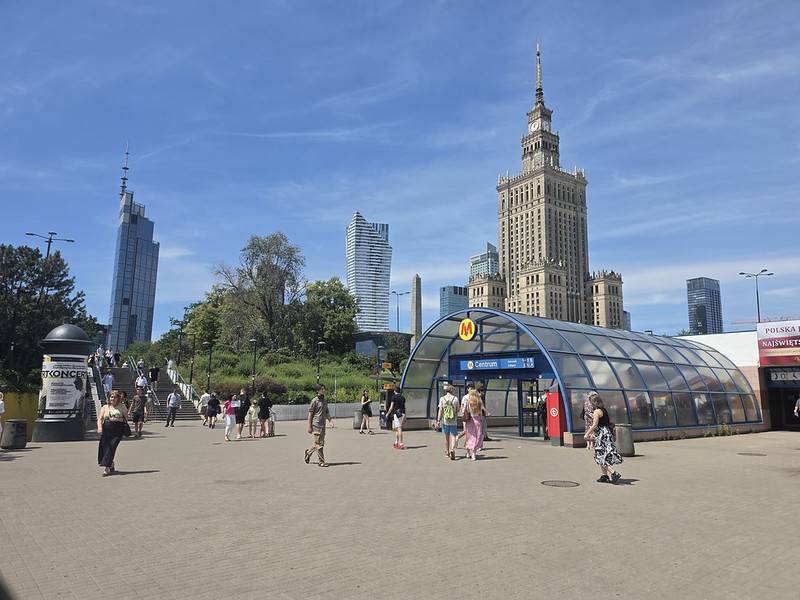
I had initially planned to visit some more metro stations before going back to the airport, to complete another half-finished project of mine. But the temperature was just too hot and so I decided that I’d walk to the tram stop and take one of the longer routes into the city centre and use it as a tourist experience.
The tram was air conditioned so I was all set and this immediately improved the mood of the entire arrangement.
Pootling along over the River Vistula.
And back into the city centre.
There’s Warszawa Centralna railway station in the background and I was already getting quite sad to be leaving Warsaw.
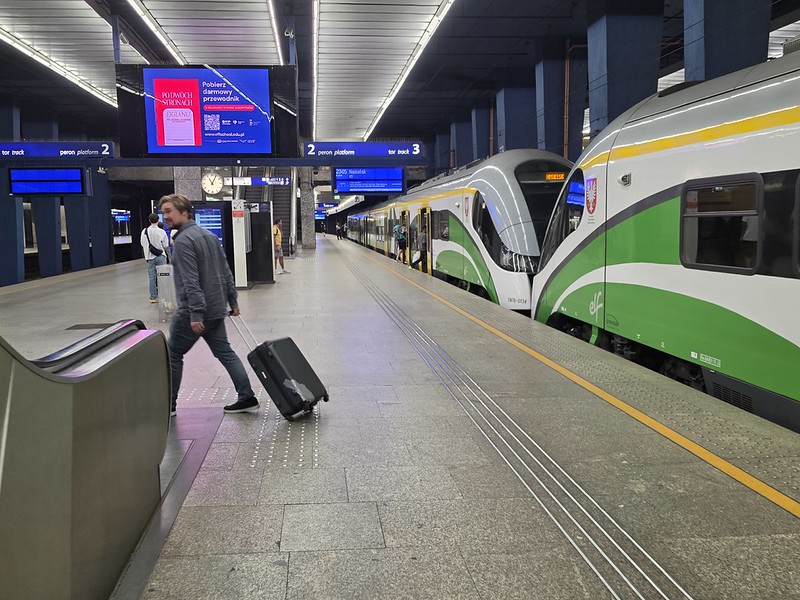
There we go, the 12:24 from Platform 3.
It’s the next Warsaw Beer Festival in October and I’ve decided I want to go to that, but the dates haven’t yet been released. I hope I’ll be back in Warsaw before that though.
The airport train looked like it would be on time.
And it was. There is something about standing on a platform with an airport train due that makes the trip feel suddenly over, even if technically there is still quite a lot of travel bureaucracy ahead.
And that was that, my short trip to Warsaw was over. It had been a slightly ridiculous routing, a brief overnight stay and probably not the most sensible use of geography, but it had worked. I had slept, eaten breakfast, ridden trams, resisted McDonald’s, crossed the Vistula and reached the airport without incident. That may not trouble the great travel writers of history, but it was all rather pleasing
And another short post as I’ve stayed at this hotel many times before and written about a fair number of them, so I won’t try the patience of my two loyal blog readers for long. There are limits even to my commitment to documenting budget hotel consistency, although admittedly I keep testing them.
It’s routinely the cheapest of the Accor hotels in Warsaw and it’s not hard to get to on the tram or bus, so it’s a very viable option. It’s probably not the best hotel to use as part of an airport layover, but travel should have challenges sometimes as where’s the fun in efficient?
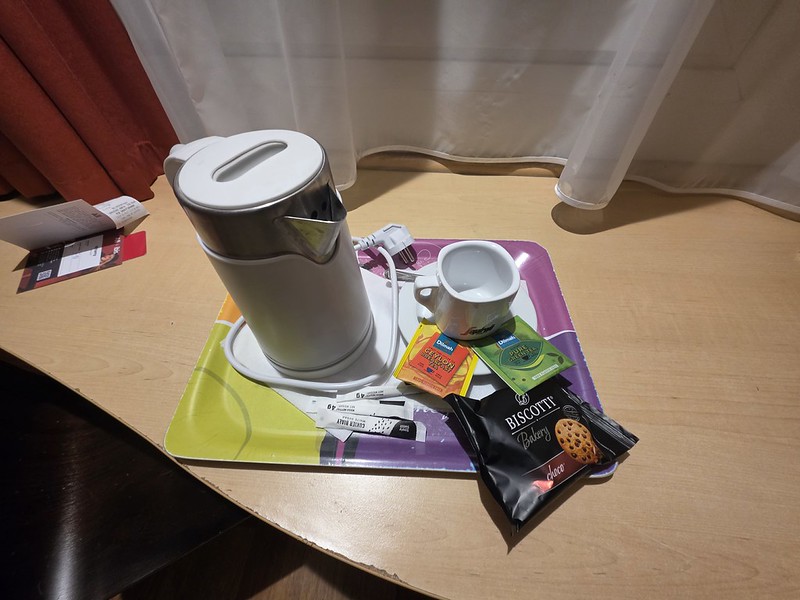
I had arrived too late for my free welcome drink, which is never ideal, but they had given me a welcome gift of some teas and a biscuit. These little gestures are always much appreciated.
Although the hotel is located by a busy road, the view from my window was rather more pleasant.
And a rather lovely breakfast. The meat looked quite frightening, so I went for some more healthy options. And a heap of bread and pastries at the back, alongside coffee, orange juice and tea. And a big dollop of strawberry yoghurt.
With that, I had to start planning my return to the airport, which was slightly annoying as I had only been at the hotel for a few hours. But, there were no noise issues internally or externally and I was able to catch up on sleep after a warm night in Faro the previous day. It was not a long stay, but it did exactly what was required which was a clean room, quiet night, decent breakfast and a biscuit-based welcome.